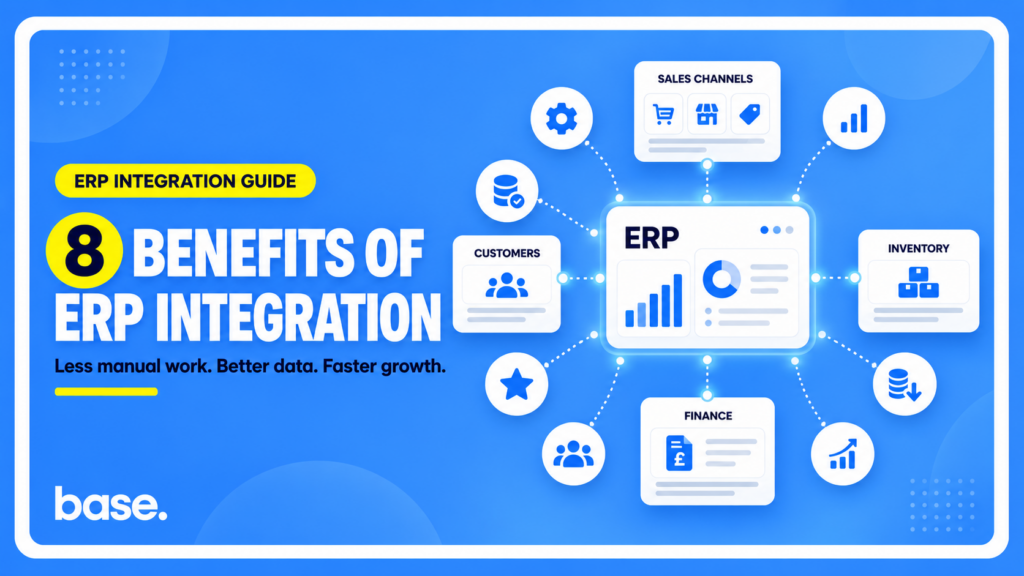
ERP integration connects the systems a business already relies on, so information moves between them automatically instead of being re-entered by hand. The real payoff shows up in daily operations: less manual work, fewer errors, and faster decisions based on data everyone trusts. For the basics of how it works and the types of integration available, see our guide to what ERP integration is.
What are the benefits of ERP integration?
The advantages tend to fall into a few buckets: less manual work, more reliable data, lower costs, room to grow, and better visibility across teams. Some of these show up immediately, like fewer typos in an order. Others compound over time, like the ability to handle twice the order volume without doubling headcount. The sections below walk through each in turn.
Less manual data entry and fewer errors
When systems are connected, information only has to be entered once. Orders, product details, customer records and documents move automatically from one system to the next, instead of being retyped by someone copying numbers from one screen to another.
That matters because manual entry is where most data errors start: a transposed digit, a missed row, a price copied from an outdated file. Before integration, a single order might be typed into three separate systems by three different people. After integration, it’s entered once and the rest happens on its own, which removes most of the opportunities for a mistake to creep in.
Real-time data and a single source of truth
Disconnected systems drift apart. Stock counts in the ERP stop matching what’s on the sales floor, prices update in one place but not another, and teams end up arguing about whose number is correct.
Integration keeps data synchronised as it changes, so everyone is looking at the same figures at the same time. A warehouse team, a finance team and a sales team can pull up the same order and see identical information, which cuts down on the back-and-forth needed just to confirm what’s actually true.
Better inventory and order control
Stock and order data can be kept in sync between an ERP and the other systems a business uses to sell and fulfill. That means stock levels update as orders come in, rather than being reconciled at the end of the day or week.
The practical effect is fewer surprises: fewer instances of promising something that’s no longer in stock, fewer manual stock counts, and more accurate numbers to plan around. E-commerce sellers feel this especially sharply, as covered below.
Smoother accounting and financial workflows
Sales generate documents: invoices, receipts, credit notes. Without integration, someone has to move that paperwork into the accounting system by hand, usually in batches, usually under time pressure at month-end.
With integration, those documents flow into the accounting system as transactions happen. That reduces the manual re-keying that causes reconciliation headaches later, and it shortens the time it takes to close the books, since most of the data entry is already done by the time anyone sits down to review it.
Lower costs and IT overhead
Every manual step has a cost, even if it doesn’t show up on an invoice: the hours spent on data entry, the time spent tracking down and fixing errors, the tools kept around just to bridge gaps between systems that don’t talk to each other.
Integration reduces the administrative load directly and consolidates the number of tools and workarounds a team has to maintain. Over time, that adds up to a meaningfully lower cost of running the same operation.
Scalability
Manual processes have a ceiling. A person can only enter so many orders, check so much stock, or reconcile so many invoices in a day. As volume grows, that ceiling turns into a bottleneck, and the usual fix is hiring more people to do the same repetitive work.
Integration removes that constraint. Once systems are connected, handling twice the order volume doesn’t require twice the manual effort, which means growth doesn’t have to come with a proportional increase in headcount or overtime.
Better visibility and cross-team collaboration
When every team is pulling numbers from a different system, collaboration slows down. Someone has to ask, wait, and cross-check before a decision can be made.
Shared, synchronised data gives sales, finance and operations a common view of what’s happening, which means decisions get made with the same information rather than three slightly different versions of it. That shared context also makes it easier to spot problems early, since discrepancies are visible immediately instead of surfacing weeks later during a reconciliation.
Better customer experience
Customers notice the downstream effects of disconnected systems even when they never see the systems themselves: an order confirmed for a product that’s actually out of stock, a shipping update that’s a day behind reality, a support agent who can’t see order details a customer already provided.
Accurate stock data, faster order processing and better order tracking all trace back to integration. The result is fewer mistakes reaching the customer and a smoother experience from checkout to delivery.
What ERP integration means for e-commerce
The benefits above apply to any business, but they’re especially pronounced in e-commerce. Selling across multiple marketplaces, an online store and a physical warehouse means higher order volumes, more systems that need to stay in sync, and less room for stock or pricing to drift between channels. A platform that connects sales channels directly to an ERP and accounting system, the way Base.com does, turns what would otherwise be several separate, manually bridged workflows into one connected flow, so orders, stock and accounting data stay consistent no matter how many channels a business sells on.
See how this works across every sales channel with ecommerce ERP integration
FAQ
What are the main benefits of ERP integration?
The main benefits are less manual data entry, more accurate real-time data, fewer errors, lower administrative costs, easier scaling as order volume grows, better visibility across teams, and a better overall customer experience.
Is ERP integration worth it?
For most businesses handling any real volume of orders, yes. The time saved on manual data entry and error correction, combined with more accurate stock and financial data, typically outweighs the setup effort, especially once order volume grows and manual processes start to become a bottleneck.
How does ERP integration reduce errors?
It reduces errors by removing the manual step where most mistakes happen: retyping data from one system into another. When information transfers automatically, there’s no opportunity for a typo, a missed update, or an outdated price to slip through.
Why is ERP integration important for e-commerce?
E-commerce businesses typically sell across several channels at once, each generating its own orders and stock movements. Without integration, keeping stock, pricing and order data consistent across all of them requires constant manual reconciliation. Integration keeps everything synchronised automatically, which matters more as order volume and channel count grow.