Key Summary
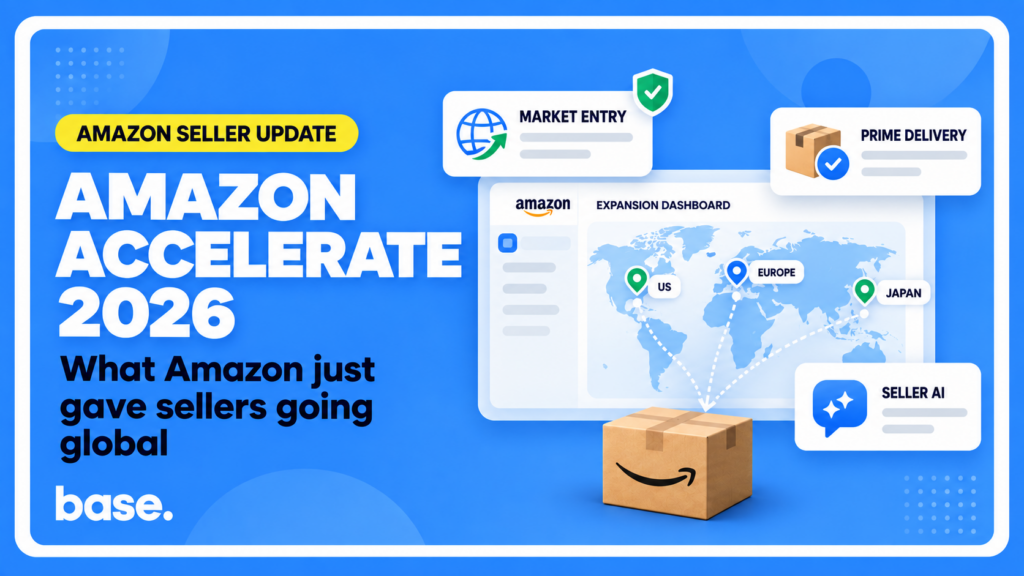
- Expansion dashboard: an expanded, unified view of demand signals and market entry steps across the US, Europe, and Japan, with more countries by year end.
- Compliance testing: one test submission covers multiple countries’ certification requirements at once, launching with toys.
- Prime delivery beyond Amazon.com: free Prime badging and delivery on merchant websites through MCF, at no cost beyond standard MCF fees.
- Seller Assistant plugin: Amazon’s seller AI now connects to Amazon Quick and Claude, with a free 12-month Quick Plus offer.
- Still on the seller: VAT and tax compliance, and running operations across markets these tools don’t reach yet.
Amazon used Accelerate 2026 in Seattle (September 22-24) to push out a real batch of updates for sellers, among plenty else announced that week. For anyone thinking about expansion, three are worth knowing: a set of tools for entering new countries, Prime delivery extended to merchant-owned websites, and a plugin that lets Seller Assistant work outside Seller Central. The first solves a problem sellers rarely get help with, and it’s worth noticing what all three have in common: they’re built to get a seller into a market, not to run things once they’re there.
The dashboard is the real news here
Only 30% of Amazon sellers currently list in more than one country, even though international sellers earn 70% more revenue on average, according to Amazon’s own figures. That’s less a technology problem than a knowledge one: where’s the demand, and what do you legally need to do to sell there. Amazon’s answer is what it calls an expanded, unified view of expansion opportunities, one screen showing demand signals, market data, and the remaining steps for market entry across the US, Europe, and Japan now, with more countries by year end.
Compliance testing changes too: a seller now completes one test submission that satisfies multiple countries’ certification requirements at once, instead of testing country by country. It launches with toys; electronics and baby products follow by year end. That turns certification testing from a per-market task into a single one, though each country’s own labeling, safety, and tax rules still apply on top of it.
Automated listing creation rounds out the group: build one listing and it auto-translates, adjusts currency and units, and flags compliance requirements for every destination at once, instead of rebuilding it by hand each time.
On logistics, Global Warehousing and Distribution, which launched in Shenzhen this past April, is expanding well beyond that first site. It connects to the US today and reaches eight countries total by year end: the US, UK, Japan, Germany, France, Italy, Spain, and Canada. The model ships a single manufacturing run to one facility, then redistributes stock by demand rather than fixed country allocations. Amazon says storage costs run up to 45% lower than US Amazon Warehousing and Distribution, with replenishment into FBA up to five days faster. AWD itself has separately expanded into the EU, UK, and Australia. Between the dashboard, the compliance framework, and the logistics network, this whole group is aimed at the moment before a seller goes live in a country, not what happens after.
Prime delivery moves off Amazon.com
Separately, Amazon opened up Prime badging and free Prime delivery to merchants’ own websites through Multi-Channel Fulfillment, at no additional cost beyond standard MCF fees, with setup about 70% faster than the standalone Buy with Prime integration. Amazon’s own numbers say 40% of Prime members are more likely to make a first-time purchase from a site showing the Prime logo, and 50% are more likely to buy again from sites offering Prime delivery. It’s a direct-to-consumer feature rather than a marketplace one, though it points in the same direction as the expansion tools: more of Amazon’s infrastructure available outside Amazon.com.
Seller Assistant now works outside Seller Central
Also genuinely new: a plugin connecting Seller Assistant to Amazon Quick and Anthropic’s Claude, bringing a seller’s Amazon data, listings, inventory, performance, sales, into whichever AI tool they already use, so Seller Assistant’s recommendations show up alongside financial, marketing, or manufacturing data instead of in a separate tab. Sellers can build their own pricing, listing, or restock agents inside Quick, which shows what it intends to do and waits for approval before acting, with a full audit trail kept. Setup takes about a minute with no coding, though the plugin itself is in beta for US sellers only. The free 12-month Quick Plus subscription is offered globally to every primary account holder through the end of 2026, plus two co-workers per account.
What’s still on the seller to handle
All three are genuinely useful, and all three are still about getting in: none of them close the loop on actually running a business across more than a handful of markets. The dashboard and compliance framework currently guide expansion into eight countries total, so sellers already active, or planning to be active, in Amazon’s other marketplaces don’t get that discovery or compliance help yet, and categories outside toys don’t get the compliance framework at all until later this year.
None of it touches tax, and that’s where independent research suggests the real friction sits. In the European Commission’s Eurobarometer survey on SME growth, 29% of exporting SMEs cite taxation issues as a barrier to cross-border growth, and a further 33% cite divergent business environments. A compliant, translated listing still says nothing about VAT registration or filing. Amazon’s own VAT Calculation Service, for example, doesn’t generate VAT returns or handle Intrastat filing, and downgrades an invoice to a plain receipt if a seller isn’t VIES-registered in the fulfillment country, something we covered in detail separately. Account setup and fee structures also stay per market, which our guide to selling on Amazon in 2026 walks through.
This is where a single operations panel earns its keep. Base’s Amazon integration covers all marketplaces, with multiple Seller accounts, stock, orders, invoices, returns and tracking managed in one workflow. VAT OSS and VIES handling is configurable, with document and pricing rules based on factors such as delivery country or VIES status. FBA inventory can also fulfill orders from other sales channels through MCF, manually, in bulk, or through automation, with tracking synced back automatically.
Amazon is making market entry easier. Base is designed to make the resulting multi-market operation manageable.