Let’s be straight with each other: The old rules of retail have been tossed out the window. For years, the name of the game in FMCG was scale, think massive production runs and slow-and-steady distribution. But today, the game is all about speed. The modern consumer doesn’t wait; they expect things instantly.
This shift is precisely why Quick Commerce (Q-commerce), which promises delivery in 30 minutes or less, is suddenly a non-negotiable strategic priority, not just a passing trend. When major players partner with platforms like Zepto or Swiggy Instamart, they are making a sharp, calculated move.
They aren’t just selling products; they are buying access to the instant gratification consumer, securing invaluable real-time data, and strategically dominating the highly profitable impulse purchase market. For your brand to stay ahead, you need to understand this alliance and how to leverage it.
Why are we seeing such a massive scramble to meet the “Instant Demand” Consumer?

Think about your own life. Who has time for a massive, planned grocery run anymore? Today’s urban consumers, especially the younger, digitally native generations, treat product delivery like they treat their streaming services: it should be immediate and effortless. They are willing to pay a premium for that convenience.
This consumer behavior has created a high-value niche that FMCG brands must fill. By having your products visible on Q-commerce apps, you are satisfying a moment of urgent need, turning a sudden craving into a guaranteed sale. More importantly, the Q-commerce environment is engineered for the fast, small basket, the absolute perfect scenario for impulse purchases, which is often where the best margins are found.
How does Q-commerce become the ultimate cash register for impulse buys?
Here’s the simple truth: when the distance between “I want it” and “I have it” shrinks to 15 minutes, rational thought takes a back seat. That’s how highly profitable, spontaneous consumption happens, especially for high-margin categories like premium beverages, gourmet snacks, and quick personal care items.
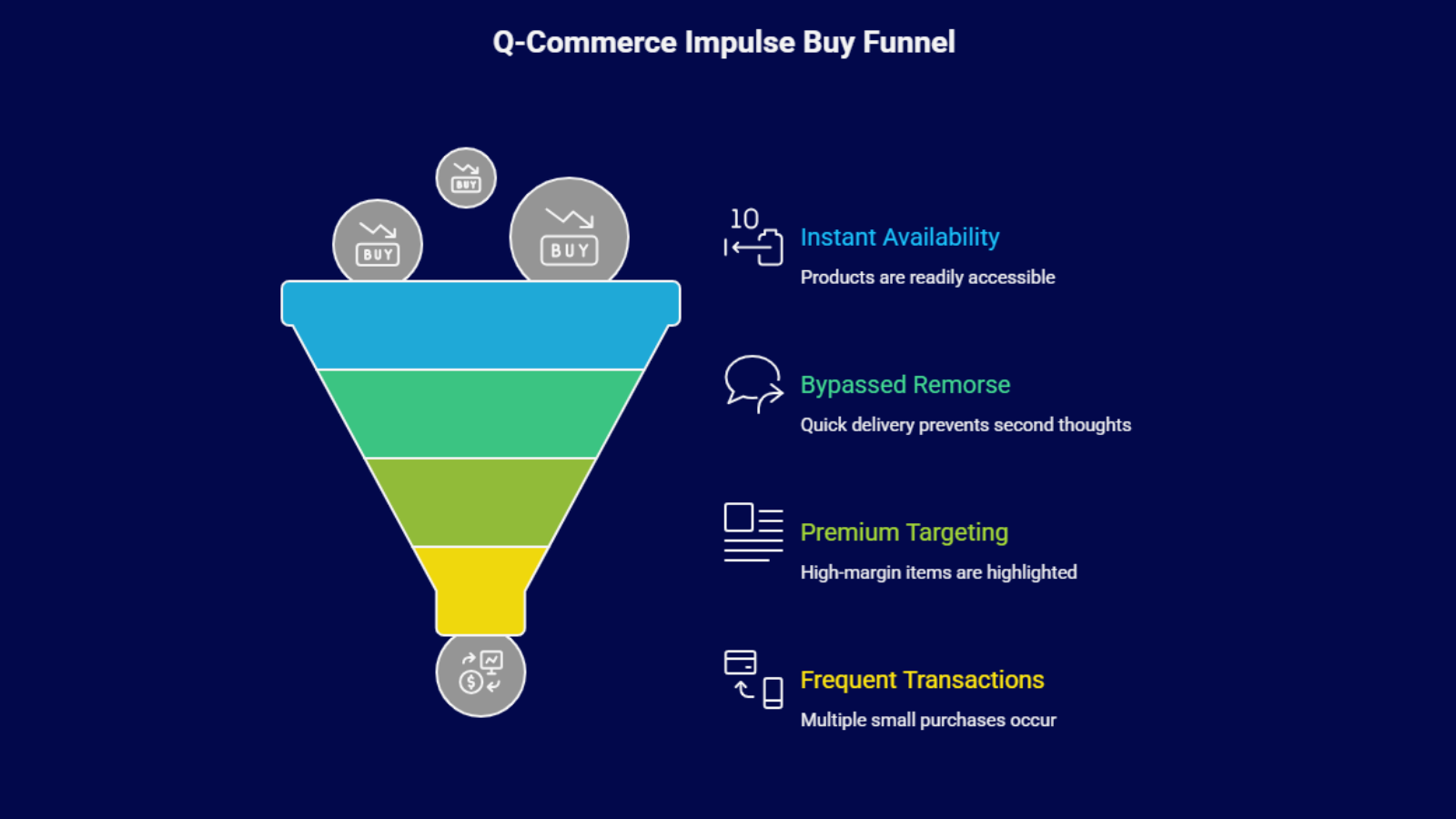
Q-commerce platforms master the art of the sudden urge. As a seller, your success here depends on being instantly visible and immediately available to capture that unplanned purchase.
- Bypassing Buyer’s Remorse: The quick delivery window minimizes the time for the consumer to talk themselves out of an unplanned purchase. It’s a frictionless path to conversion.
- Targeting Premium Sales: Q-commerce is a strong channel for launching and sustaining premium, high-margin SKUs, those specialized items consumers buy as a spontaneous treat.
- Driving Transaction Frequency: Unlike a once-a-week bulk order, Q-commerce facilitates multiple, small, high-frequency transactions, leading to a much more dynamic and reliable revenue stream.
- Controlling the Digital Shelf: You can use in-app promotions and prime digital placement to influence browsing and ensure your impulse products are literally the first thing a craving consumer sees.
How do these partnerships actually make your own supply chain smarter?
The real operational innovation here is the dark store network. These are not just small warehouses; they are hyper-local fulfillment centers strategically woven into the fabric of urban areas. They allow Q-commerce players to achieve delivery speeds that your traditional distributors simply can’t match.
For sellers, accessing this network offers unparalleled market penetration. But here’s the real kicker for your operations team: it forces you to become incredibly agile. You have to shift your thinking from making big, periodic deliveries to the dark store to handling small, precise daily replenishments. This is a forced operational upgrade that modernizes and tightens your entire supply chain.
What’s the benefit of ditching “bulk and batch” for a “real-time” logistics model?
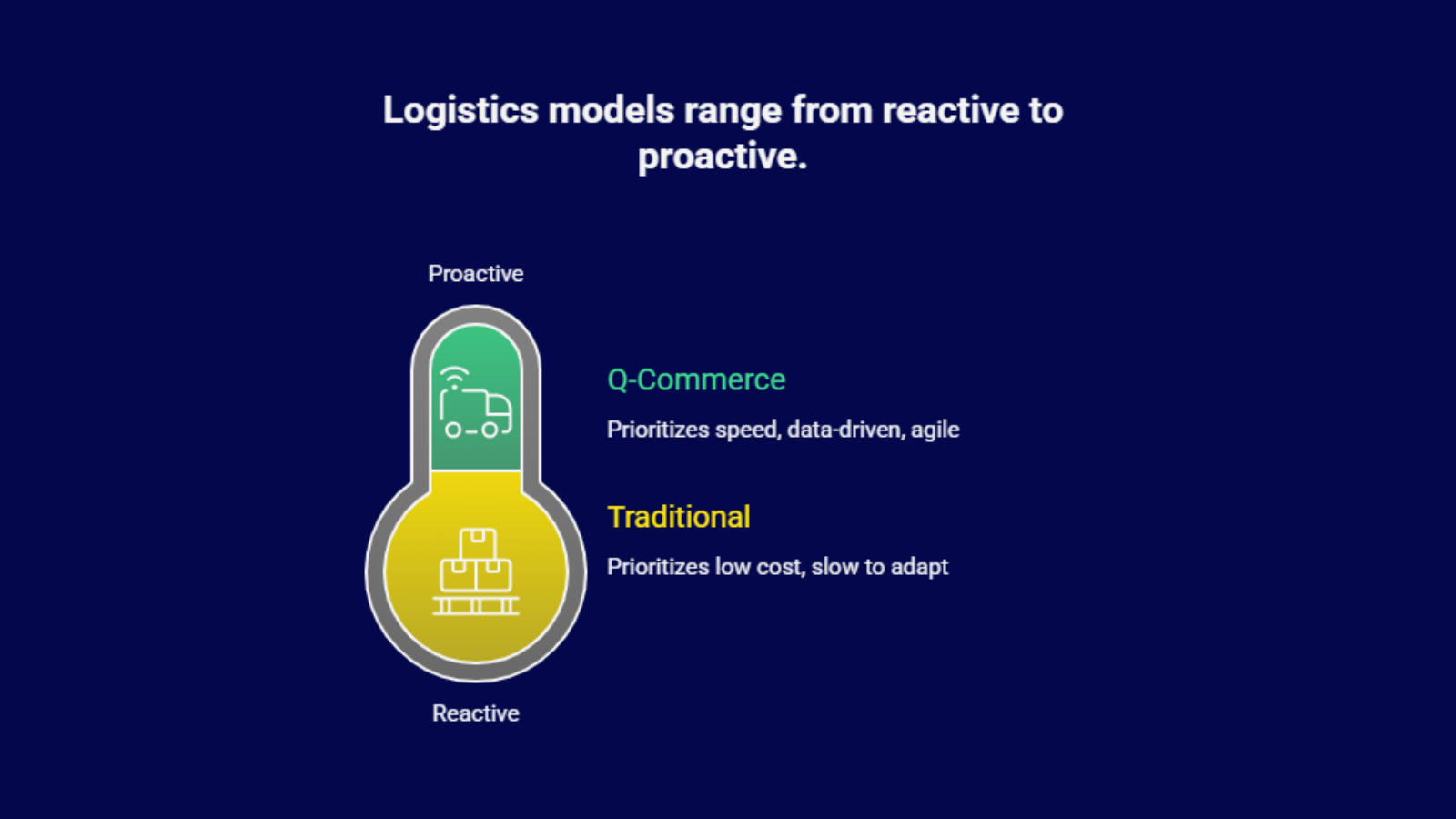
The classic “bulk and batch” system prioritizes low unit cost over responsiveness. It leads to wasted inventory and slow reactions to market shifts. Q-commerce demands that you operate differently.
It compels you to implement a lean, flexible, and entirely data-driven logistics process. This discipline drastically reduces your risk of stockouts and excess inventory, ensuring that your expensive products are sitting where they need to be, not collecting dust in a faraway warehouse.
| Supply Chain Strategy | Traditional (Bulk & Batch) | Q-Commerce (Real-Time & Reactive) |
| Stock Replenishment | Large, fixed-schedule orders (e.g., weekly) | Small, highly fluid, demand-driven orders (daily) |
| Inventory Risk | High; greater likelihood of obsolescence/wastage | Low; minimized stocking; focused only on high-velocity items |
| Forecasting Input | Historical, aggregated sales data (lagging) | Live, granular consumer behavior data by pin code (leading) |
| Operational Goal | Cost minimization through maximizing load size | Maximizing delivery speed and responsiveness |
| Agility | Low; slow to adapt to sudden demand spikes | High; ability to adjust inventory instantly based on app data |
Why is the data you get from Q-commerce partners worth the price of entry?
If speed is the advantage, then data is the treasure. Your traditional retail partners give you high-level sales reports. Q-commerce gives you a microscope: pin-code level insights on exactly who bought what, when the impulse hit them, and what time of day your product is most in demand.
This intelligence is priceless for planning. It allows your team to move beyond generalized predictions to ultra-precise, localized forecasting. Even better, use Q-commerce as your low-risk testing lab. Want to trial a new, premium product? Launch it in just a few dark stores, track the instantaneous consumer reaction, and make a confident, data-backed decision to scale up or pivot, a process that would take months in the traditional retail world.
Sellers Avoiding Channels Conflict
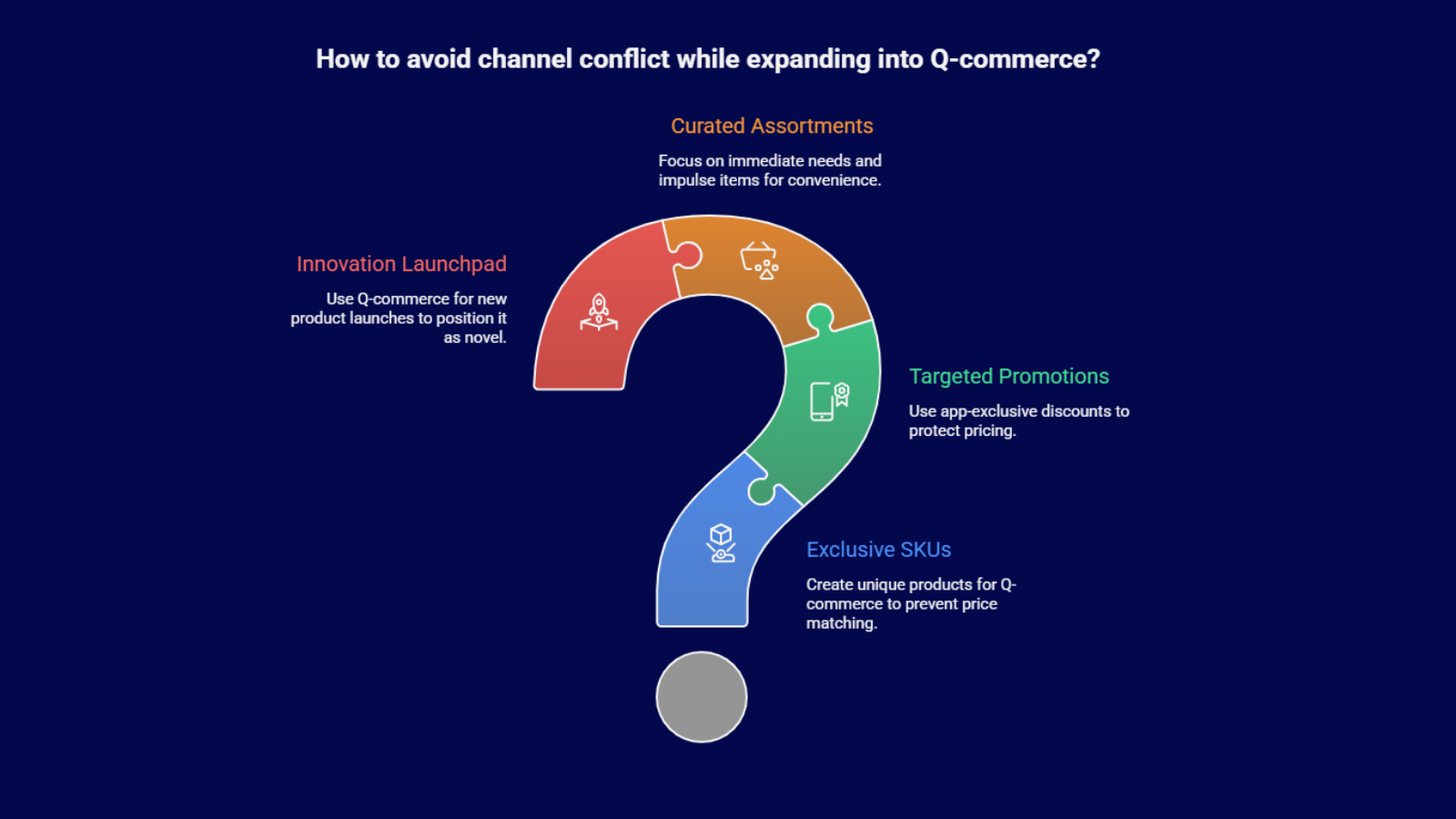
This is the big conversation every seller has. You can’t embrace a new, powerful channel without running the risk of upsetting your long-time retail partners (your supermarkets or neighborhood stores). The solution lies in smart differentiation.
The goal is to ensure your Q-commerce sales are incremental, that they capture a new consumption moment rather than just stealing a sale from the local kirana store. This requires disciplined, exclusive strategies for the rapid delivery ecosystem.
- Exclusive SKUs and Bundles: Create unique pack sizes or bundled products that are only available via Q-commerce. This prevents any direct price matching or channel hopping.
- Targeted In-App Promotions: Use flash sales and special discounts that are contained entirely within the Q-commerce app, protecting your pricing structure across traditional channels.
- Curated Product Assortments: Focus the Q-commerce offering strictly on immediate needs and premium impulse items. Avoid stocking the full bulk range found in supermarkets, maintaining the channel’s ‘convenience’ identity.
- Innovation Launchpad: Use Q-commerce as the preferred site to launch exclusive, premium, or limited-edition lines, positioning the channel as a unique source of novelty and quality.
In the mobile world, being present on a major Q-commerce app is like getting a front-facing display on every major street corner in a city. Your brand gains instant credibility and massive, frequent exposure to a high-value consumer base.
Sellers can use in-app marketing tools, targeted promotions, special loyalty offers, to engage directly with shoppers. This ability to link a promotion directly to a high-speed purchase strengthens your brand relationship, making the Q-commerce channel a dynamic, essential part of your overall marketing and loyalty strategy.
Conclusion
The partnership between major FMCG sellers and Quick Commerce platforms isn’t a friendly arrangement; it’s a calculated, strategic imperative. It’s the only way to meet today’s instant demand, gain cutting-edge market intelligence, and ensure your operational processes are fast enough to compete.
The future of profitable selling demands speed, precision, and data. If you’re not already thinking in minutes, you’re already behind.
Ready to integrate your product management and fulfillment processes with the speed required to win in modern commerce?
Stop relying on slow, historical sales data. Start building the system that allows you to fulfill demand instantaneously. Get Base.com and build the operational bedrock necessary to conquer the era of Quick Commerce.
Frequently Asked Questions from Sellers (FAQs)
1. Is Q-commerce going to make my traditional retail partners obsolete?
In short, no. Q-commerce fulfills a very specific, time-sensitive need (the emergency, the impulse, the top-up). The supermarket trip or the weekly haul at the local store is a different shopping occasion. Think of Q-commerce as additive, helping you capture sales moments that would otherwise be completely lost.
2. What are the biggest operational challenges I should be ready for?
The biggest hurdles are managing profit margins and inventory precision. Because of the high logistics costs, you must be surgical with your stock. Every product must be a high-velocity, high-margin item, and your packaging and fulfillment processes need to be ruthlessly efficient to protect that bottom line.
3. How can I use Q-commerce to test new products without risking a national flop?
Q-commerce is a perfect test kitchen. Instead of a costly national pilot, you can launch a new flavor or format in just a few dark stores across select pin codes. You get hard, quantifiable data, not focus group opinions, on consumer acceptance, pricing power, and demand patterns within days. It dramatically de-risks the entire product development cycle.