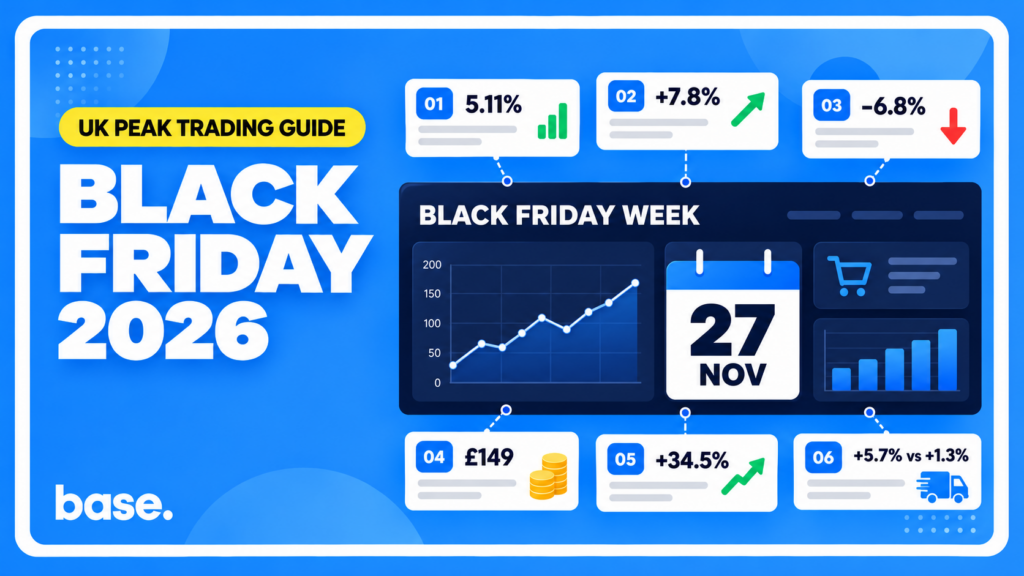
Black Friday 2026: 6 numbers UK sellers need to know before 27 November.
Black Friday 2026 lands on Friday 27 November, with Cyber Monday on 30 November. That leaves UK sellers about six weeks to lock in stock, pricing and fulfilment plans.
Plan for the whole eight days, not one Friday. In 2025, demand built steadily from Monday through to Cyber Monday.
Last year’s IMRG Black Friday week data shows the event no longer works the way many plans assume. Black Friday drove more orders than the year before, but barely more revenue. The busiest growth day wasn’t Friday at all. And some of the biggest category winners weren’t the usual suspects.
Here are six numbers from the 2025 IMRG data, what’s driving them, and what to do about each before 27 November.
5.11%Black Friday conversion, 45% higher than Monday’s
The data. Conversion climbs steadily through Black Friday week, then jumps on the day itself. IMRG’s 2025 figures put total market conversion at 3.52% on the Monday and 3.94% by Thursday. On Black Friday it hit 5.11%, and it stayed high through to Cyber Monday.
The context. Shoppers are still holding out for the headline offers. Payments provider Worldline told IMRG that transaction volumes on Black Friday 2025 ran about 32% above a normal Friday, even though promotions started earlier and ran longer than ever.
A conversion spike is when overselling hurts most. Every channel needs to see the same stock count, updated in minutes rather than hours. Set safety buffers on marketplace listings for your fastest sellers, and test how quickly a stock change on one channel reaches the others.
+7.8%Tuesday beat Black Friday for order growth
The data. The strongest year-on-year growth of Black Friday week 2025 came on Tuesday, not Friday. Orders rose 7.8% and revenue 4.4%, against +5.7% and +1.3% on Black Friday. Across the full eight days, IMRG reported total market revenue down 1.2%.
The context. Demand is spreading out because retailers are starting earlier. In IMRG’s panel, the number of retailers with a live Black Friday campaign on the first working day of November rose from 12 in 2021 to 41 in 2023 and 58 in 2025. Six in ten retailers launched earlier in 2025 than in 2024 (IMRG). Early movers also bought traffic more cheaply: agency Genie Goals found late-October offers drew cost-per-clicks about 30% lower than the Black Friday rush.
Plan for the peak to start on Monday 23 November, not Friday 27 November. Staff picking and packing for early-week volume, and have courier collections booked for that week. If you’re launching offers in early November, check now that pricing updates can reach every channel at once.
−6.8%The Thursday when shoppers looked but didn’t buy
The data. The day before Black Friday was the weakest of the week. Orders fell 6.8% year-on-year and revenue fell 7.7%, yet traffic was still up 1.7%. Average basket value also hit its lowest point of the week, at £132. Shoppers were browsing, building lists and waiting.
The context. UK shoppers have learned to wait, and many no longer trust the discount. In YouGov’s 2025 research, 35% of consumers said they were less interested in mega-sale events than two or three years earlier, most often because discounts felt misleading. Retailers responded by cutting deeper, and it didn’t work: IMRG found the share of items reduced by 15% or more rose from 45% to 50%, yet most categories still declined.
The government plans to consult this autumn on banning fake “was” prices, invented discounts and misleading RRPs outright under the Digital Markets, Competition and Consumers Act.
Don’t read a quiet Thursday as a reason to cut prices again. Use it as your last checkpoint: confirm stock levels, courier capacity and that Friday’s offers are queued correctly on every channel. Check that every “was” price you show is one you have genuinely sold at.
£149Cyber Monday baskets are the biggest of the week
The data. Cyber Monday 2025 had the highest average basket value of Black Friday week, at £149, against £145 on Black Friday. Conversion was the second highest of the week, at 4.84%. Even so, Cyber Monday revenue fell 3.2% year-on-year, so plenty of sellers left money on the table.
The context. Shoppers who wait tend to spend more when they buy. Worldline told IMRG that Cyber Monday transaction volumes ran about 39% above a normal Friday, ahead of Black Friday’s 32%. Delivery platform Scurri saw Cyber Monday orders in its network run around 70% higher than Black Friday.
2024 & 2025: payday on Black Friday
2026: payday on Cyber Monday
In 2024 and 2025, Black Friday was the last working day of November, which is payday for many monthly-paid workers. In 2026 that payday falls on Cyber Monday, 30 November.
Treat Cyber Monday as a second peak, not a clearance day. Hold back stock of your best sellers so they’re still available on Monday evening. Plan bundles and spend thresholds that suit bigger baskets, and make sure your warehouse can absorb a second wave of orders on Tuesday 1 December.
+34.5%Haircare grew fastest on Black Friday, while Electrical and Clothing went backwards
The data. Black Friday is no longer mainly a tech-and-fashion event. On the day itself in 2025, Health & Beauty categories posted the strongest revenue growth, while several traditional Black Friday categories declined.
Conversion followed the same pattern. Haircare converted at 10.1% on Black Friday and Beauty at 9.2%, against 4.2% for Clothing and 5.1% for the market as a whole.
The context. This isn’t a one-day blip. IMRG reports that Haircare and Skincare grew more than 20% year-on-year in most weeks, and its 2026 forecast has Health & Beauty at +5%, Electricals flat and Clothing at −4%. Scurri’s delivery data points the same way: Beauty shipments grew 10.3% in Q4 2025 while Fashion fell 9.1%.
Use your own sales velocity, not last year’s assumptions, to set Black Friday stock. If you sell in a growing category, make sure your best sellers are listed on every marketplace where shoppers look for them. If you’re in a declining one, protect margin rather than chasing volume with deeper cuts.
+5.7% orders, +1.3% revenueMore parcels for roughly the same money
The data. On Black Friday 2025, orders grew 5.7% year-on-year but revenue grew just 1.3%. That means revenue per order fell by roughly 4%. Sellers picked, packed and shipped noticeably more parcels than in 2024, for only slightly more money.
The context. Every extra parcel costs the same to handle whatever its value, so a gap like this comes straight out of margin. Delivery expectations are rising too. Scurri found standard delivery rose to 25% of peak orders, from 21%, as shoppers expect standard to arrive faster (IMRG). Parcel Perform reported that European carriers averaged 1.54 days to deliver during peak, while many retailers still promised five or more days at checkout and likely lost sales as a result.
21%
25%
vs 5+ days promised
Work out your true cost per order, including picking, packaging, labels and courier fees, before you set any Black Friday offer. Automate the repetitive steps that slow fulfilment down at volume, such as courier selection, label printing and order status updates. And show realistic delivery dates at checkout rather than cautious ones.
More parcels shouldn’t mean more people
This is where a unified operations platform earns its keep. Base brings orders from every marketplace and webshop into one Order Manager, keeps stock in sync across channels, and uses workflow automation to assign couriers and print labels in bulk. More parcels then doesn’t have to mean more people or more mistakes.
Six weeks is enough, if the work happens in the right order
Six weeks is enough time to act on all of this, as long as the work is done in the right order. The Autumn Budget lands on 28 October this year, a month earlier than in 2025, so any uncertainty it creates for shoppers should settle well before peak.
Black Friday rewards the operation, not the loudest discount
The 2025 data makes one thing clear: Black Friday rewards sellers who get the operations right, not the ones who shout the loudest discount. Demand spreads over eight days, arrives in waves and shifts between categories, and every wave tests stock accuracy and fulfilment speed.
Once Black Friday 2026 is over, we’ll be watching whether the Tuesday surge holds, whether the payday shift gives Cyber Monday a bigger share of the weekend, and whether Health & Beauty keeps its lead. Keep an eye on the Base blog for our take as the picture becomes clearer.
In the meantime, our UK whitepaper, Show Me the Money: Why UK eCommerce Has a Paying-Customer Problem, looks at where UK shoppers drop out between browsing and paying, from checkout and shipping friction to vouchers and devices. And if you want to see how Base handles peak volume across every channel, you can try it free for 14 days.
Try Base free for 14 days, or read our UK whitepaper on where shoppers drop out between browsing and paying.
Frequently asked questions
When is Black Friday 2026 in the UK?
Black Friday 2026 is on Friday 27 November, and Cyber Monday follows on 30 November. For planning, treat the whole of Black Friday week as the event, from Monday 23 November to Cyber Monday. In 2025, demand built steadily across all eight days.
Which day of Black Friday week brings the most sales?
It depends on what you measure. In IMRG’s 2025 data, conversion peaked on Black Friday itself at 5.11%, and the strongest order growth came on Tuesday at +7.8% year-on-year. Cyber Monday had the biggest baskets, averaging £149. A good plan covers all three peaks, not just Friday.
When should UK retailers start their Black Friday promotions?
Earlier than they used to. IMRG found that 58 retailers in its panel had a Black Friday campaign live on the first working day of November 2025, up from 12 in 2021. Starting early is now normal, but only if your stock, pricing and fulfilment can keep up for the full length of the campaign.
Do deeper discounts increase Black Friday sales?
The 2025 data suggests not. The share of items discounted by 15% or more rose from 45% to 50%, yet most categories still declined, according to IMRG. Offers that grow the basket, such as bundles and spend thresholds, tend to protect margin better than deeper cuts.
Which product categories do best on Black Friday?
In 2025, Health & Beauty led the market. On Black Friday itself, Haircare revenue grew 34.5% and Skincare 21.1% year-on-year. Electrical (−5.1%), Clothing (−5.2%) and Footwear (−12.1%) all declined. IMRG expects Health & Beauty to keep outperforming in 2026.
How can I avoid overselling during Black Friday?
Keep stock levels synced across every channel you sell on, updating in minutes rather than hours. Set safety buffers on marketplace listings for your fastest sellers. Test how quickly a stock change on one channel reaches the others well before 23 November.
Can Base set my Black Friday prices or forecast demand for me?
No, your pricing and offer strategy stay in your hands. What Base does is handle the operational side that comes under strain at peak. It keeps stock in sync across channels, routes orders from every marketplace into one Order Manager, and uses workflow automation and shipping management to assign couriers and print labels in bulk.