India’s D2C ecosystem has grown up fast. What started as founder-led Shopify stores shipping 20 orders a day has scaled into a market projected to cross $60 billion in the next few years, growing at 15–20% annually.
Today’s D2C brands operate across their own websites, marketplaces, multiple warehouses, and international destinations, while also managing COD-heavy order mixes that still account for over 50–60% of shipments and customers who expect delivery in 2–4 days, even in non-metro pin codes.
At the center of all this sits one critical decision: how you ship. Logistics now directly impacts margins, repeat purchase rates, and customer trust. A delayed delivery or failed COD attempt can erase the gains from even the best-performing ad campaign.
This is why shipping aggregators have become the backbone of modern D2C operations in India. Instead of negotiating separately with five or six courier partners, managing different rate cards, and logging into multiple dashboards, brands increasingly rely on a single platform to handle everything. For growing D2C teams shipping hundreds or thousands of orders per month, this consolidation can reduce manual ops effort by 30–40% while improving delivery consistency.
However, not all shipping aggregators are built the same. The “best” option depends on factors like order volume, COD percentage, average shipment weight, delivery spread across Tier 1–3 cities, and plans for international expansion. This guide breaks down the best shipping aggregators in India for D2C brands, with practical examples, niche workflows, and a closer look at how deep integrations fit into real, day-to-day operations.
Why Shipping Aggregators Matter for D2C
D2C shipping isn’t just about moving boxes. It affects margins, customer trust, repeat purchases, and even ad performance.
A good shipping aggregator helps you:
- Access multiple courier partners through one account
- Automatically choose the best courier for each order
- Handle COD, RTOs, and NDRs at scale
- Offer faster delivery promises without manual effort
- Expand to international markets without building new workflows
As order volumes grow, manual courier selection becomes a bottleneck. Aggregators turn shipping from a daily headache into a predictable system.
Top 5 Shipping Aggregators Used by Indian D2C Brands
Below is a practical breakdown of five shipping aggregators commonly used by Indian D2C brands today. Each one serves a slightly different operational need, so the right choice depends on scale, geography, and how complex your shipping logic is.
1. Shiprocket
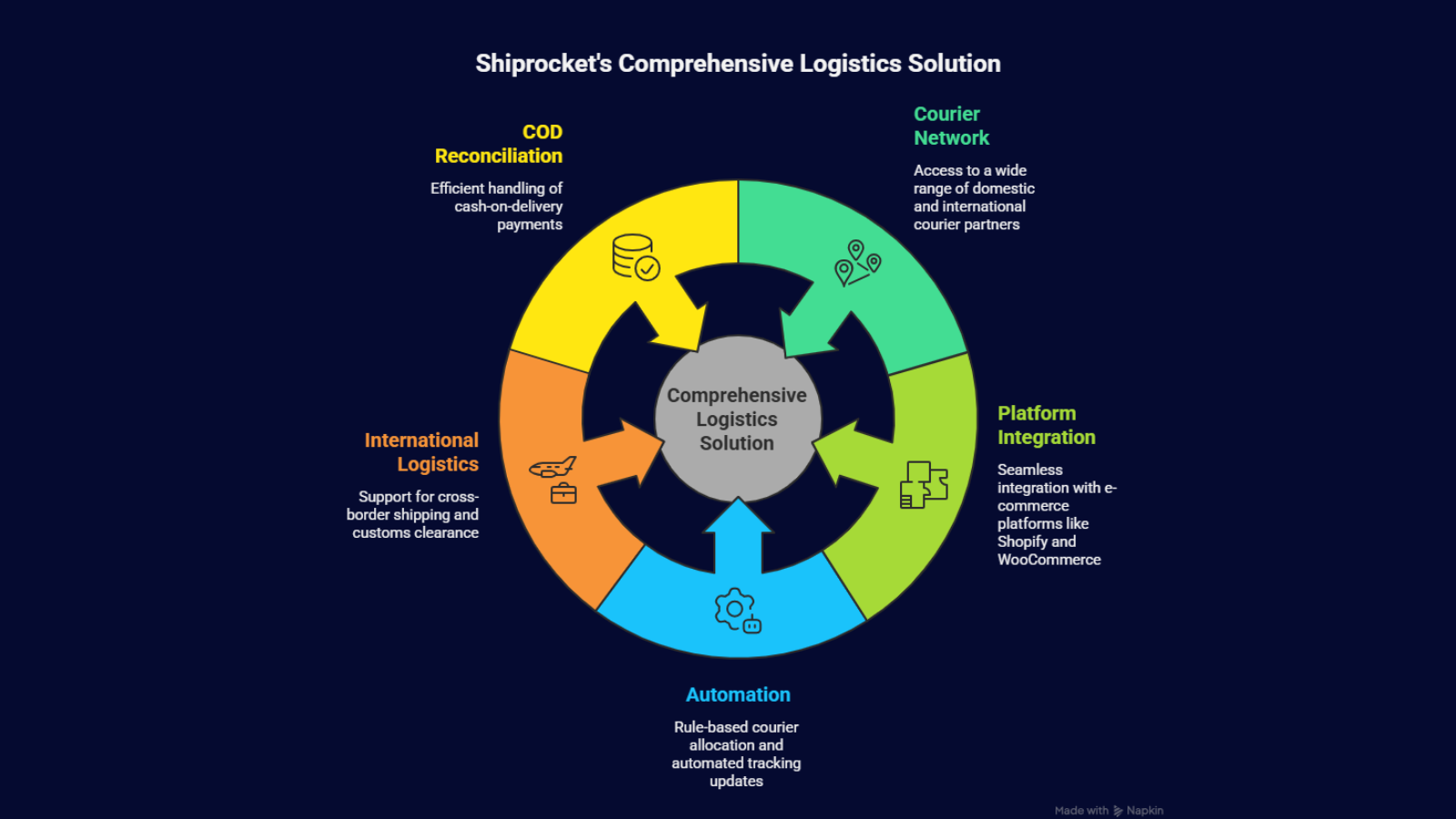
Shiprocket is one of the most widely adopted shipping aggregators in India’s D2C ecosystem. It offers access to a large network of domestic and international courier partners through a single dashboard and integrates deeply with platforms like Shopify, WooCommerce, and major marketplaces. Its core strength lies in automation, rule-based courier allocation, and scalability as order volumes grow.
Beyond basic shipping, Shiprocket also supports international logistics, COD reconciliation, label generation, pickup scheduling, and automated tracking updates, making it a full-stack logistics layer rather than just a courier marketplace.
Use Cases
- Brands running multiple sales channels (D2C site + marketplaces) that want all orders processed from one system
- D2C teams using to assign couriers based on weight, order value, payment mode, or destination
- Brands planning cross-border expansion without setting up separate freight forwarders
- Operations teams that want to minimize manual courier decisions during high-volume sales days
Advantages
- Large courier coverage across metros and non-metros
- Strong automation and courier allocation rules
- Supports both domestic and international shipping
- Easy onboarding for early-stage brands
- Scales well as order volumes increase
Disadvantages
- Growing order volumes require dedicated courier monitoring and cost optimization processes.
- Automation needs careful setup to deliver effective results.
- Higher-tier plans may be necessary for faster support and account management.
Best For
Early-stage to mid-sized D2C brands that want automation, scale, and flexibility without building custom logistics systems.
2. NimbusPost
NimbusPost positions itself as a cost-efficient shipping aggregator with a focus on transparent pricing and broad courier access. It is particularly popular among brands shipping to Tier 2 and Tier 3 locations, where serviceability and cost control matter more than premium SLAs.
The platform emphasizes simplicity, making it easier for smaller teams to get started without complex configurations.
Use Cases
- Brands shipping heavily to Tier 2 and Tier 3 pin codes
- D2C businesses focused on cost optimization over speed
- Founders managing logistics themselves without a large ops team
- Brands testing new geographies before scaling aggressively
Advantages
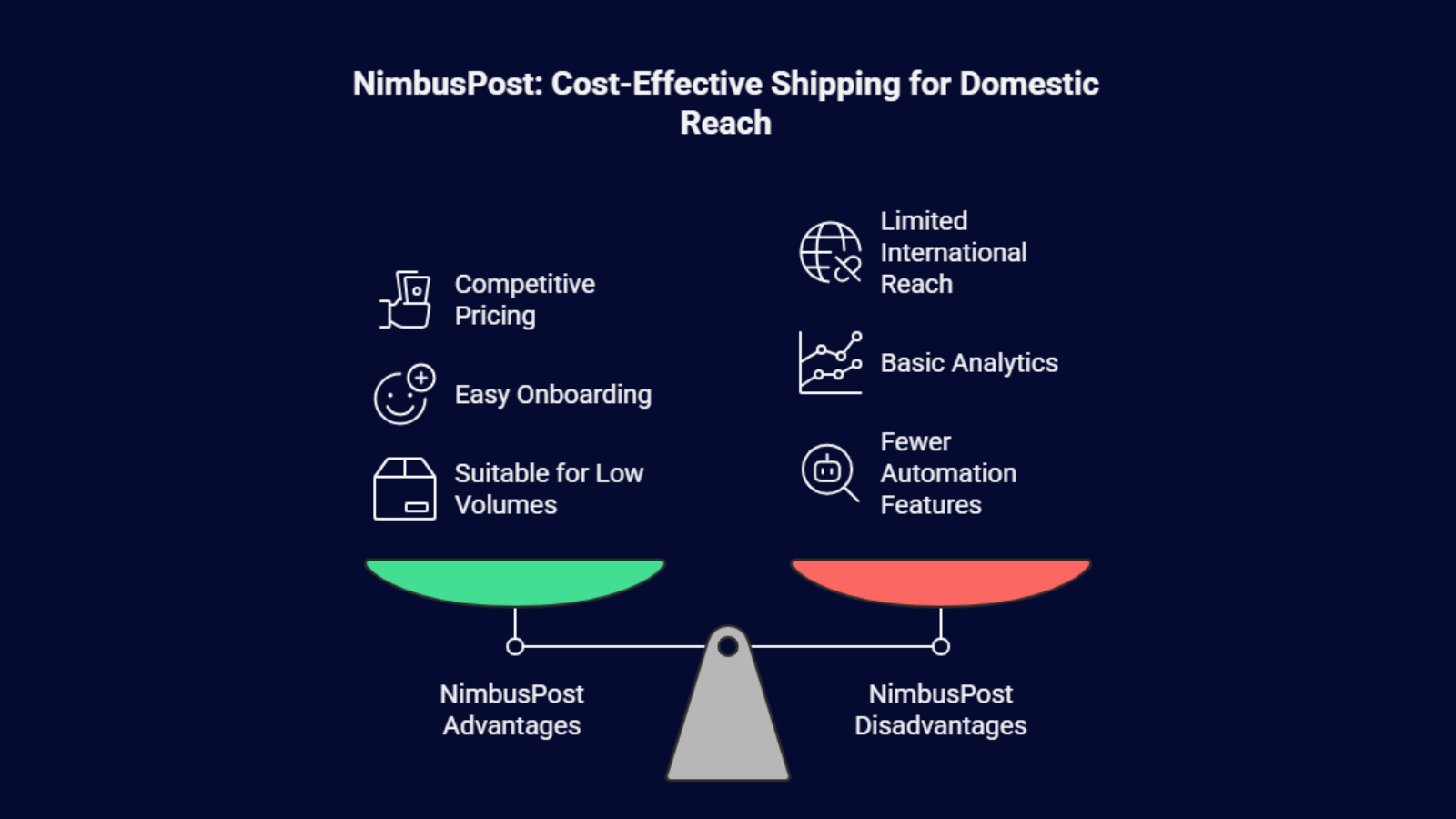
- Competitive pricing and simple rate structures
- Good reach in non-metro locations
- Easy onboarding and straightforward dashboard
- Suitable for low to mid order volumes
Disadvantages
- Limited advanced automation compared to larger platforms
- Fewer international shipping capabilities
- Analytics and reporting are relatively basic
Best For
Price-sensitive D2C brands and early-stage sellers focused on domestic reach rather than complex logistics workflows.
3. RapidShyp
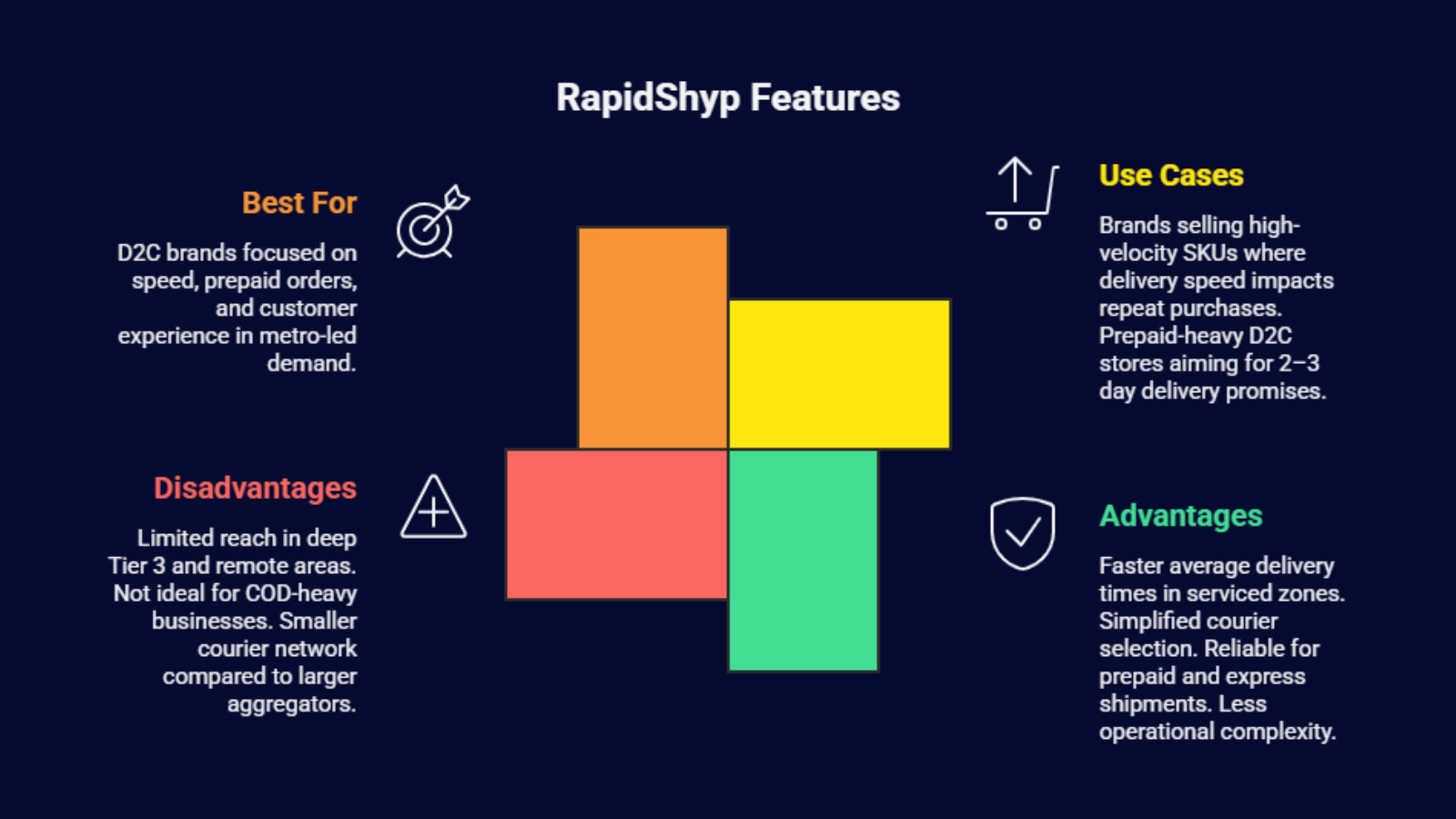
RapidShyp is designed for brands that prioritize speed and predictable delivery performance. It offers curated courier options and emphasizes quick pickups and faster transit times, particularly for prepaid shipments in metro and near-metro regions.
Rather than offering every possible courier, RapidShyp focuses on optimizing performance within a smaller, more controlled network.
Use Cases
- Brands selling high-velocity SKUs where delivery speed impacts repeat purchases
- Prepaid-heavy D2C stores aiming for 2–3 day delivery promises
- Brands running performance marketing where faster delivery improves conversion and retention
- Teams that want less courier choice but more consistency
Advantages
- Faster average delivery times in serviced zones
- Simplified courier selection
- Reliable for prepaid and express shipments
- Less operational complexity
Disadvantages
- Limited reach in deep Tier 3 and remote areas
- Not ideal for COD-heavy businesses
- Smaller courier network compared to larger aggregators
Best For
D2C brands focused on speed, prepaid orders, and customer experience in metro-led demand.
4. Shadowfax
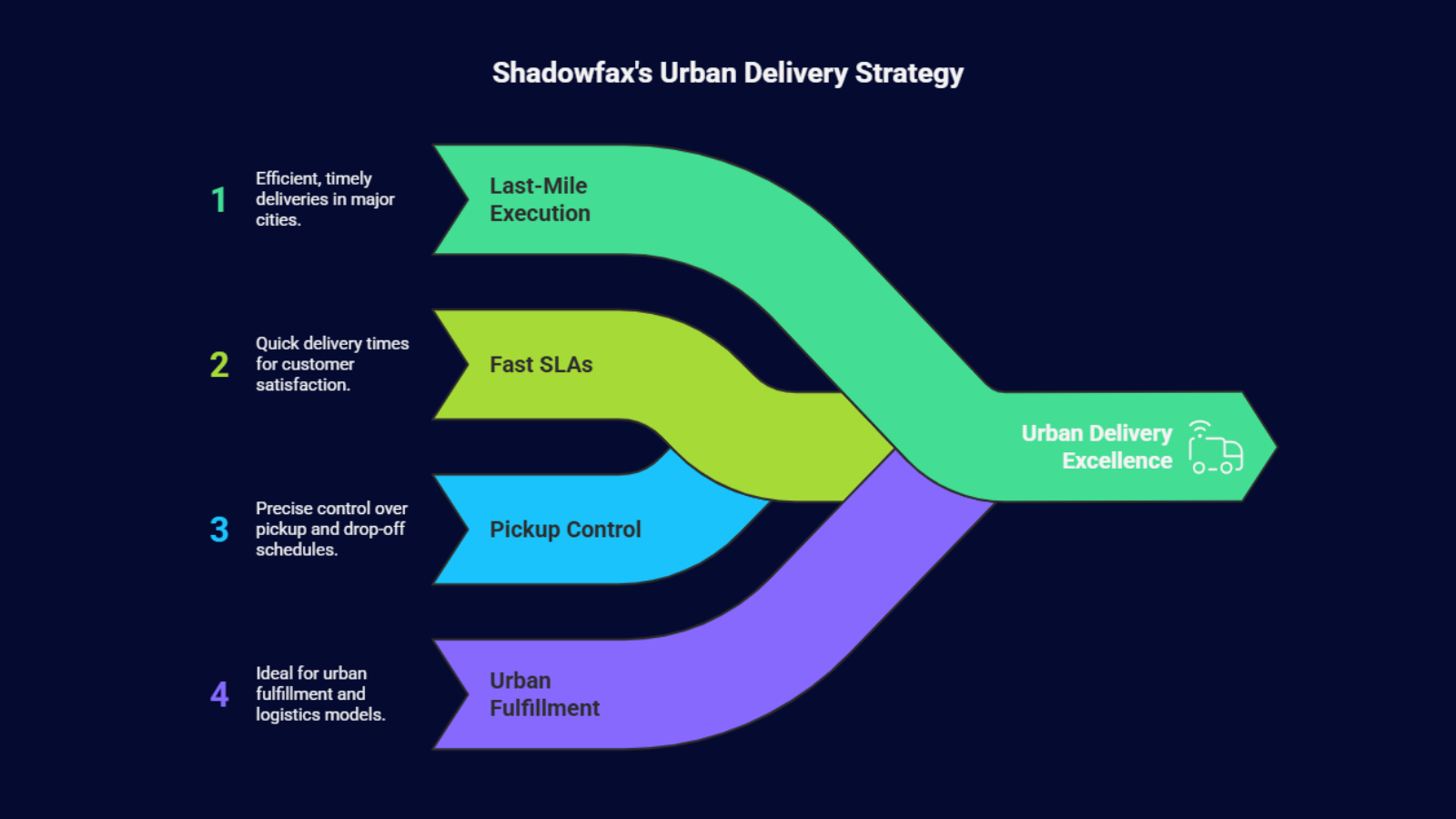
Shadowfax is primarily known for its last-mile and hyperlocal delivery capabilities. While not a traditional multi-courier aggregator, it plays a key role for brands that need same-day or next-day delivery in dense urban clusters.
It is widely used by quick commerce, fashion, and lifestyle brands experimenting with faster delivery promises.
Use Cases
- Brands offering same-day or next-day delivery in metros
- D2C companies running dark stores or city-level warehouses
- Fashion or essentials brands with high repeat frequency
- Brands testing hyperlocal delivery as a competitive differentiator
Advantages
- Strong last-mile execution in major cities
- Fast delivery SLAs
- Good control over pickup and drop timelines
- Ideal for urban fulfillment models
Disadvantages
- Limited national long-haul coverage
- Not suitable as a standalone shipping solution
- Pricing can be higher for non-hyperlocal use
Best For
Urban-focused D2C brands prioritizing speed and local delivery over pan-India reach.
5. Sellow Ship
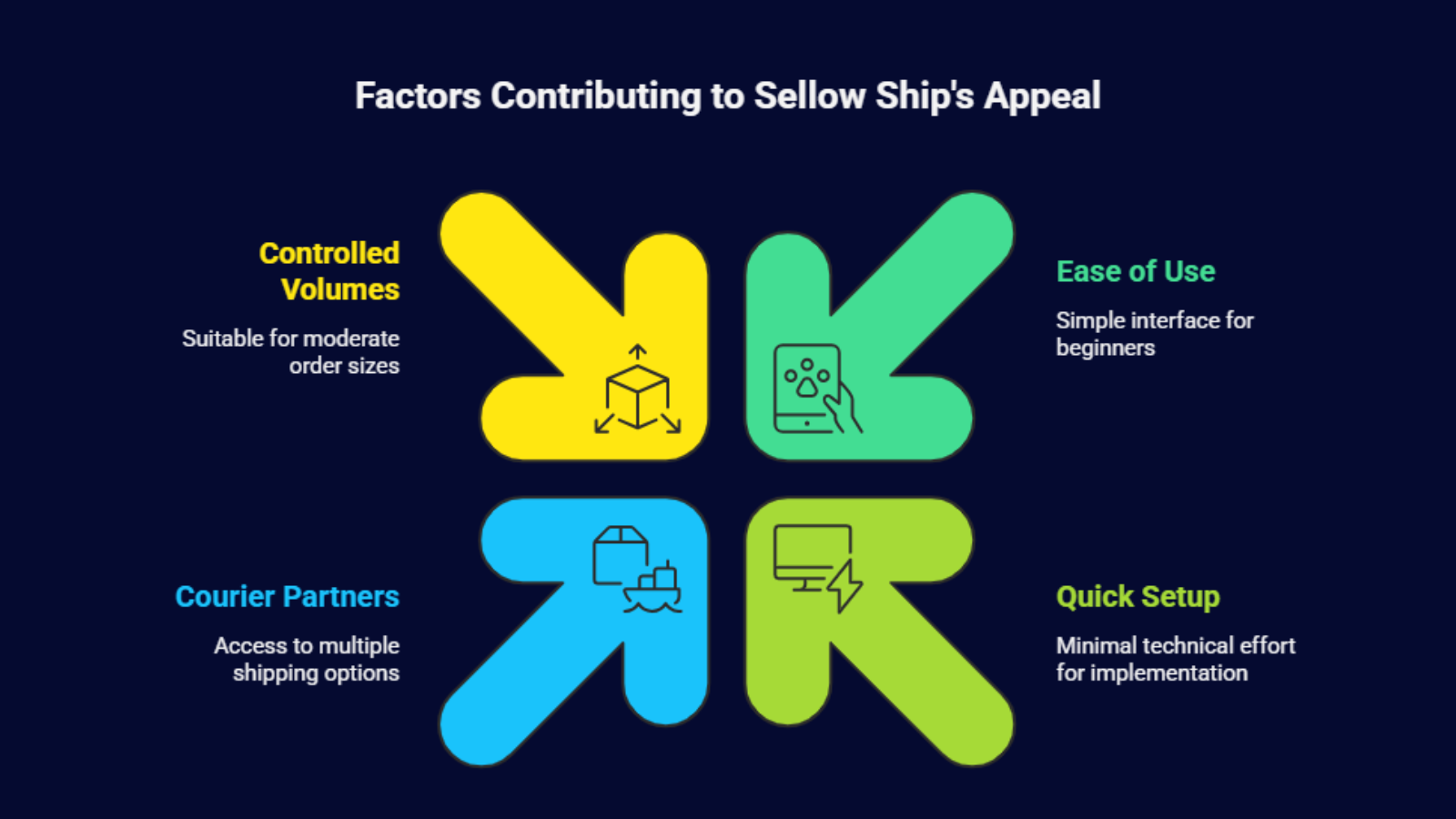
Sellow Ship is a growing shipping aggregator catering to small and mid-sized online sellers. It focuses on simplifying logistics operations with basic courier aggregation, label generation, and order processing tools without overwhelming users with complex configurations.
The platform is often chosen by sellers transitioning from manual courier management to an aggregated setup.
Unique Use Cases
- Small D2C brands moving away from direct courier contracts
- Sellers with low to moderate daily order volumes
- Founders looking for a simple, no-frills shipping solution
- Brands validating demand before investing in advanced logistics
Advantages
- Easy to use and beginner-friendly
- Quick setup with minimal technical effort
- Access to multiple courier partners
- Suitable for controlled order volumes
Disadvantages
- Limited automation and advanced rules
- Fewer analytics and performance insights
- Not ideal for large-scale or complex operations
Best For
Early-stage D2C brands and sellers who want a simple entry point into courier aggregation.
Why Shipping Aggregators Make a Big Difference for D2C Brands
As D2C brands scale, shipping stops being a back-office task and starts becoming a core operational system. What works at 20 orders a day breaks at 200. What feels manageable with one warehouse becomes chaotic with three. This is where shipping aggregators create real leverage. They don’t just bundle couriers. They introduce structure, logic, and automation into fulfillment.
Below are key scenarios where aggregators make a measurable difference, explained in detail.

1. Multi-Warehouse D2C Brands
When brands operate out of multiple warehouses, shipping decisions can’t be uniform. A shipment moving from Delhi to Gurgaon has very different requirements compared to one going from Mumbai to a remote town in the Northeast.
Shipping aggregators allow brands to set logic-based courier selection rules depending on warehouse location, destination zone, shipment weight, and delivery speed. This ensures that each order is routed through the most efficient courier rather than relying on manual judgment or default settings.
Without an aggregator, ops teams often rely on spreadsheets or gut instinct, which leads to higher costs and inconsistent delivery timelines. With an aggregator, warehouse-to-zone mapping happens automatically, reducing delays and improving SLA adherence across locations.
2. High COD Businesses
Cash-on-delivery still dominates Indian e-commerce, especially outside metro cities. For COD-heavy D2C brands, the real challenge isn’t shipping the order. It’s what happens when delivery fails.
Aggregators provide visibility into courier-level RTO and NDR performance, helping brands identify which partners underperform for COD orders. They also allow businesses to automatically block or deprioritize couriers with high RTO rates for specific regions or order values.
This level of control is nearly impossible when working directly with individual couriers. Aggregators turn COD from a risky necessity into a manageable channel by enabling data-backed courier decisions and faster NDR action.
3. Subscription or Repeat Orders
Brands with subscriptions or high repeat purchase rates benefit from predictability. When shipping patterns are consistent, there’s no reason for manual courier selection on every order.
Shipping aggregators enable automation rules based on historical performance. For example, if a courier consistently delivers subscription orders within two days in a specific zone, the system can automatically assign that courier every time.
This reduces per-order handling time, lowers shipping costs through optimized routes, and ensures customers receive their orders on schedule. For subscription-based businesses, this reliability directly impacts retention and lifetime value.
4. International D2C Expansion
Selling internationally adds layers of complexity that most domestic shipping setups can’t handle. Customs documentation, HS codes, declared values, and compliance requirements introduce friction and risk.
Aggregators simplify cross-border shipping by integrating international couriers, customs documentation, and export workflows into the same system used for domestic orders. Brands can generate commercial invoices, declare shipment purposes, and track international deliveries without onboarding separate freight partners or logistics vendors.
For D2C brands testing global demand or shipping limited international volumes, aggregators make international expansion viable without heavy upfront investment.
The Bigger Picture
Shipping aggregators matter because they scale decision-making, not just shipments. They replace manual judgment with rules, data, and automation. For growing D2C brands, that shift is often the difference between controlled growth and operational chaos.
Using Automation and Integrations to Scale D2C Shipping with Base
As D2C brands scale, logistics decisions cannot rely on manual checks or individual judgment. What works at low order volumes quickly becomes a bottleneck as sales channels, warehouses, and delivery geographies expand.
This is where automation inside an order and logistics orchestration platform like Base becomes critical. Instead of teams choosing couriers order by order, shipping decisions are driven by logic, data, and predefined rules.
1. Using Automatic Actions for Courier and Delivery Type
Base allows brands to configure automatic actions that trigger when specific conditions are met. These actions determine courier selection, service type, and delivery method without any manual intervention. Rules can be created using variables such as order source, shipment weight, payment method, order value, warehouse location, and destination pincode.
For example, an order originating from a Shopify store and weighing under a certain threshold can automatically be routed to an express courier, while heavier shipments are assigned to surface services. If a destination pincode is not serviceable by the default courier, Base can instantly switch to an alternate partner without pausing dispatch. High-value prepaid orders can be routed through premium or insured delivery services to reduce risk and improve delivery timelines.
By combining multiple conditions into layered rules, brands can fully automate courier selection across channels and warehouses. This removes human dependency, ensures consistency in shipping decisions, and significantly reduces dispatch delays during peak sales periods. Over time, shipping becomes infrastructure rather than a daily operational task.
2. Handling International Orders
International shipping introduces additional complexity, including customs documentation, compliance requirements, and pricing based on volumetric weight. Base supports structured international order workflows by ensuring that all required export-related fields are captured before shipment creation.
For global orders, teams can define shipment purpose, export reason, Incoterms, HS codes, and declared values directly within the system.
Accurate weight and dimension data are enforced to prevent billing discrepancies and customs holds. Base also supports workflows where commercial invoices and export documentation are generated automatically once order details are finalized.
This allows D2C brands to manage international shipments using the same operational framework as domestic orders, without relying on manual paperwork or separate freight processes for smaller export volumes.
3. Managing Shipping Across Multiple Sales Channels
When shipping workflows are tightly integrated within Base, logistics becomes an extension of inventory, sales, and customer operations rather than a disconnected function.
Orders from multiple sources, D2C websites, marketplaces, or social commerce channels, are centralized in a single dashboard, eliminating duplicate entries and reconciliation work. Shipment tracking updates flow back into the system automatically, giving both internal teams and customers real-time visibility without manual follow-ups.
Automated courier allocation ensures every shipment is optimized for cost, serviceability, and delivery speed. International logistics, including export compliance fields, is handled within the same interface. Faster label generation and pickup scheduling reduce dispatch timelines, while fewer errors and delays directly improve customer satisfaction and repeat purchase rates.
For growing D2C brands, this integration reduces operational headcount pressure while increasing daily order throughput.
4. Maintaining and Monitoring the Integration
Even with automation in place, ongoing monitoring is essential to ensure smooth operations. Teams should periodically review API connectivity, inventory accuracy, courier serviceability rules, and error logs within Base.
Outdated inventory data can lead to incorrect weights or dimensions, causing courier rejections or billing issues. Courier coverage and pincode serviceability should be reviewed regularly to keep automation rules effective. Error logs help identify failed shipments, missing fields, or data mismatches before they escalate into customer-facing issues.
By maintaining these checks, brands ensure that their shipping infrastructure remains reliable, scalable, and resilient during high-growth phases.
Choosing the Right Aggregator for Your Brand
There’s no universal “best” shipping aggregator. The right choice depends on a few core factors: daily order volume, the mix between COD and prepaid orders, whether you ship only domestically or also internationally, the number of warehouses you operate from, and the level of automation your operations require.
For many Indian D2C brands, using a shipping aggregator becomes the natural default because aggregators offer scale, automation, and access to a broader logistics ecosystem through a single interface. At the same time, more specialized providers can make sense at specific stages, such as hyperlocal delivery, premium express shipping, or cost-focused regional coverage.

The real objective isn’t just cheaper shipping. It’s building predictable, automated, and scalable logistics that doesn’t slow the business down as volumes grow. When shipping decisions are system-driven instead of manual, operations become more reliable and easier to scale.
When logistics works quietly in the background, teams can focus on what actually drives growth: products, customer experience, and expansion. That’s ultimately what a good shipping aggregator should deliver.
Click here to integrate Shiprocket with Base.com.
Frequently Asked Questions (FAQs)
1. What is a shipping aggregator, and how is it different from working with a single courier?
A shipping aggregator connects you to multiple courier partners through a single platform. Instead of managing individual courier contracts, rate cards, and dashboards, you get centralized access, unified tracking, and the ability to choose or automate courier selection based on rules. This is especially useful as order volumes grow and shipping decisions become more complex.
2. Are shipping aggregators suitable for early-stage D2C brands?
Yes. Many early-stage D2C brands start with aggregators because they reduce upfront effort and operational complexity. Aggregators eliminate the need for direct courier negotiations, provide ready integrations with e-commerce platforms, and allow brands to scale shipping without rebuilding processes every few months.
3. How do shipping aggregators help reduce RTOs in COD-heavy businesses?
Aggregators provide visibility into courier-level performance metrics such as RTO rates, delivery success, and NDR outcomes. Brands can use this data to block or deprioritize underperforming couriers for specific regions, order values, or payment types. Over time, this leads to better courier allocation and lower RTO percentages.
4. Can shipping aggregators support international D2C orders?
Most modern shipping aggregators support international shipping workflows, including cross-border couriers, customs documentation, and export compliance fields. They allow brands to manage international and domestic shipments from the same system, which is especially useful for D2C brands testing global demand without setting up separate logistics partners.
5. How do order management platforms like Base improve the value of shipping aggregators?
While aggregators handle courier access and execution, an order management platform like Base adds logic, automation, and control. It connects shipping to inventory, sales channels, and customer data, enabling rule-based courier selection, centralized order processing, and scalable operations. Together, they turn shipping into a system rather than a manual process.