Growth feels predictable in the early stage. You launch ads, CAC stays at ₹250 to ₹400, ROAS holds at 3.5x to 4x, and revenue scales from ₹1Cr to ₹5Cr, then ₹10Cr, and eventually ₹20Cr. At this point, most founders believe the growth engine is stable. But within 6 to 12 months after crossing ₹20Cr, performance metrics begin shifting in ways dashboards do not immediately reveal.
CAC typically increases by 20 to 35 percent as core audiences saturate. Repeat purchase rate drops from 35 percent to nearly 22 percent because new buyers are colder and more discount-driven. Return rates often rise from 12 percent to 20 percent, especially with COD-heavy geographies. Inventory days jump from 45 to 75 as SKU count expands, locking working capital. Even a 3 percent increase in RTO can wipe out ₹40 to ₹60 lakhs annually at this scale.
Revenue may still grow 15 to 20 percent year on year, but contribution margin quietly shrinks by 5 to 8 percent. This is exactly why growth marketing fails after ₹20Cr in D2C brands becomes a structural question. Ads are not the issue. The system underneath is not designed for scale. What appears as marketing inefficiency is usually operational leakage.
Top 7 Structural Shifts That Begin After ₹20Cr
Once a D2C brand crosses ₹20Cr, growth stops being about creative testing and media buying efficiency. It becomes about structural discipline. Before ₹20Cr, most inefficiencies are small enough to be absorbed by margin.
After ₹20Cr, even a 3 to 5 percent operational leak can translate into ₹40 to ₹80 lakhs annually. This is where many founders misunderstand the problem. They believe performance marketing is slowing down, but in reality, the system underneath is not designed to support scale.
At this stage, scaling ads D2C does not fail because platforms stop delivering. It fails because audience quality shifts, return rates increase, inventory complexity grows, and contribution margins get miscalculated. These shifts are subtle at first, but they compound every month. What looks like a minor inefficiency becomes structural D2C marketing failure over time.
Below are the exact structural shifts that begin after ₹20Cr, explained clearly with what is happening, what it impacts in numbers, and how to fix it before it damages growth permanently.
1. Paid Channel Saturation Begins Quietly
 After ₹20Cr, your best audience segments are already exhausted. Your top 20 percent of high intent users have purchased. Your remarketing pool stops growing proportionally to spend. Frequency crosses 3.5 or even 4.2. CPM rises 15 to 25 percent because the algorithm keeps hitting the same audience clusters.
When scaling D2C ads at this stage, Meta and Google start expanding into lower intent lookalikes. Revenue does not drop immediately, but buyer quality shifts. You begin acquiring users who convert once and disappear.
What It Impacts
- Repeat rate drops from 35 percent to nearly 22 percent.
- Customer lifetime value reduces by 18 to 30 percent.
- Blended CAC increases 20 to 35 percent.
This leads to silent D2C marketing failure because ROAS may still look stable while contribution shrinks.
How To Solve It
- Cap frequency at 3.2 and monitor audience overlap weekly
- Shift 15 to 20 percent of the budget into new creative testing instead of scaling winning ads blindly
- Build 60 day cohort analysis for new vs old buyers
- Expand into retention before expanding into acquisition
Scaling ads D2C without retention infrastructure is why growth marketing fails after ₹20Cr in D2C brands.
2. Your CAC Is Underestimated
Most brands calculate CAC as ad spend divided by orders placed. This works at a small scale. But after ₹20Cr, return rates rise. COD RTO increases. Reverse logistics costs compound.
Actual CAC must be calculated using net delivered and retained orders.
Example:
If you spend ₹30 lakhs and receive 10,000 orders, CAC looks like ₹300.
But if 20 percent are returned and 5 percent are RTO, you retain only 7,500 orders.
Real CAC becomes ₹400.
What It Impacts
- Contribution margin drops by 5 to 8 percent.
- Cash flow pressure increases.
- Marketing looks profitable, but operations absorb losses.
This miscalculation directly creates D2C marketing failure and explains why growth marketing fails after ₹20Cr in D2C brands.
How To Solve It
- Calculate post-delivery CAC weekly
- Separate COD, CAC, and prepaid CAC
- Remove high RTO pin codes from paid campaigns
- Track return adjusted contribution margin
Scaling ads D2C without recalibrating CAC leads to distorted decisions.
3. Discount Dependency Becomes Permanent
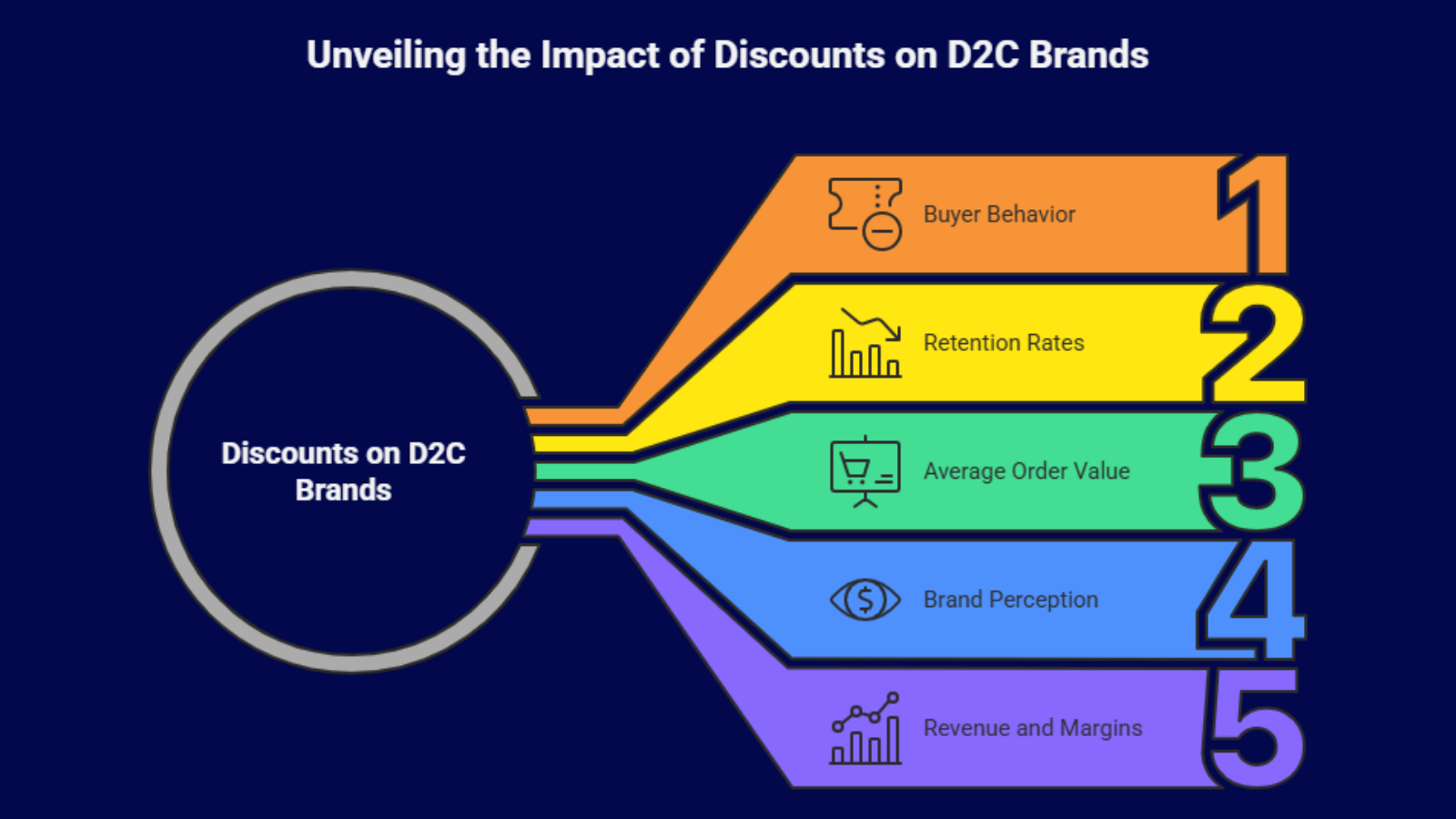 To maintain conversion rates while scaling ads D2C, brands introduce 10 to 15 percent discounts. Over time, 30 to 45 percent of new buyers become offer dependent.
These buyers show lower loyalty and higher refund probability.
What It Impacts
- 90 day repeat rate drops by 35 to 40 percent among discount cohorts.
- AOV declines 8 to 12 percent.
- Brand perception shifts from premium to transactional.
Revenue may grow, but margin structure weakens. This is a structural D2C marketing failure.
How To Solve It
- Track discount vs non discount cohort retention
- Cap discount exposure at 25 percent of new user acquisition
- Use bundle offers instead of flat price cuts
- Build loyalty incentives instead of coupon-driven conversion
Discount lock-in is one of the strongest reasons why growth marketing fails after ₹20Cr in D2C brands.
4. SKU Expansion Reduces Ad Efficiency
To push revenue, brands increase catalog size. But 30 to 40 percent of SKUs sell less than one unit per day. Inventory turns drop from 6x annually to below 4x.
Paid traffic now spreads thin across low-velocity SKUs with little social proof.
What It Impacts
- Conversion rate drops by 10 to 18 percent.
- Inventory days increase from 45 to 75.
- Working capital blocks 20 to 30 percent more cash.
Scaling ads D2C into a fragmented catalog reduces marketing clarity and drives D2C marketing failure.
How To Solve It
- Identify the top 20 percent SKUs driving 80 percent contribution
- Stop replenishing SKUs selling less than 1 unit per day after 60 days
- Use hero SKU strategy in paid campaigns
- Maintain SKU velocity benchmarks weekly
Catalog discipline directly prevents why growth marketing fails after ₹20Cr in D2C brands.
5. Contribution Margin Is Misunderstood
Brands track gross margin but ignore contribution after discounts, shipping, RTO, packaging, and gateway fees.
Example:
Gross margin: 60 percent
After deductions: 31 percent
If CAC is 28 percent, actual profit is 3 percent.
This looks like growth but operates like stagnation.
What It Impacts
- Annual profit leakage can reach ₹50 to ₹80 lakhs.
- Small CAC increases destroy profitability.
- Cash cycle becomes unpredictable.
This financial blindness fuels D2C marketing failure.
How To Solve It
- Build SKU wise contribution dashboard
- Track contribution after returns weekly
- Set the CAC cap based on real contribution, not gross margin
- Stop campaigns when the contribution falls below 15 percent
This clarity is essential to avoid why growth marketing fails after ₹20Cr in D2C brands.
6. Inventory Mismatch Kills Growth
8 to 15 percent of ad traffic lands on low stock or unavailable SKUs. Ads continue spending even when hero products are sold out.
Marketplace and website stock remain unsynced.
What It Impacts
- Lost conversions increase by 5 to 10 percent.
- Ad spend wastage increases.
- Customer trust declines due to cancellations.
What appears as an ad inefficiency is actually operational leakage.
How To Solve It
- Implement real-time inventory sync
- Pause campaigns automatically when stock drops below the threshold
- Maintain 30-day rolling inventory visibility
- Track stockout percentage during campaigns
Scaling ads D2C without inventory control creates structural D2C marketing failure.
7. Pin Code Risk Is Ignored
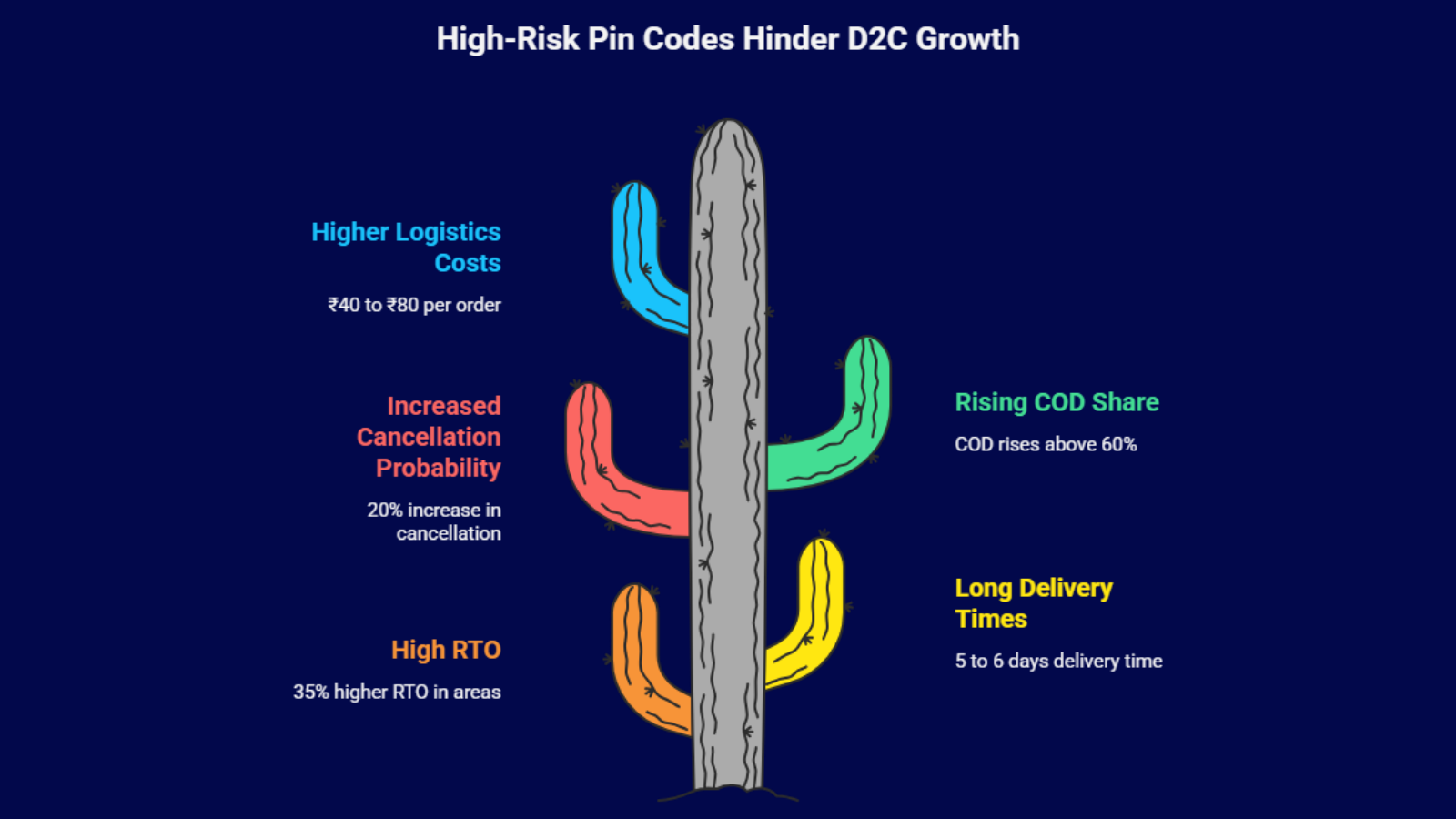 As brands expand geographically, they enter high-risk pin codes without data filtering. Some areas have 35 percent higher RTO and a delivery time of 5 to 6 days.
What It Impacts
- Cancellation probability increases by 20 percent.
- COD share rises above 60 percent in certain regions.
- Logistics cost per order increases by ₹40 to ₹80.
These losses compound quietly.
How To Solve It
- Track RTO by pin code weekly
- Block the top 10 percent high-risk regions from paid campaigns
- Switch high-risk regions to prepaid only
- Compare the courier performance data monthly
Geographic discipline prevents D2C marketing failure and addresses why growth marketing fails after ₹20Cr in D2C brands.
The Real Shift Required After ₹20Cr
Once a brand crosses ₹20Cr, growth stops being about pushing higher ad budgets and starts becoming about protecting contribution with discipline. Before this stage, a 3 to 4 percent leak in margins can go unnoticed. After ₹20Cr, that same leak can mean ₹50 to ₹80 lakhs annually. This is where most sellers misread the problem. They think performance marketing is slowing down. In reality, the system underneath is weak.
The first shift is cohort-level clarity. A campaign showing 3x ROAS may look strong, but if the 90-day repeat rate of that cohort drops from 32 percent to 18 percent, long-term profitability collapses. Most brands only track 30-day returns, not 90 or 180 day contributions. That short-term view is dangerous when scaling ads D2C.
The second shift is SKU-level economics. After ₹20Cr, usually 20 percent of SKUs generate nearly 75 percent of real contribution. Yet paid traffic often gets distributed across the full catalog. If 30 percent of SKUs are selling less than one unit per day, working capital locks up, and inventory days increase from 45 to 75. This weakens cash flow even if revenue grows.
The third shift is operational linkage. Return rates rising from 12 percent to 20 percent, COD RTO increasing in certain pin codes, and delivery delays beyond four days all reduce contribution by 6 to 9 percent. If these are not tracked alongside paid acquisition, scaling ads D2C simply amplifies inefficiency. That amplification is what eventually becomes D2C marketing failure.
Building Operational Control Before Growth Breaks
 The solution is not another creative refresh or a higher ad budget. After ₹20Cr, growth does not slow because ads stop working. It slows because visibility breaks. When inventory, returns, and contribution data sit in different systems, decisions get delayed, and inefficiencies compound quietly.
At this stage, you need centralised operational control. Base.com helps create a unified inventory pool across Shopify, Amazon, and Flipkart so stock is not fragmented across channels. Real-time stock sync ensures that ads are not pushing traffic to SKUs that are low in stock or already sold out. This alone can reduce wasted ad spend by 5 to 10 percent.
Base.com also tracks SKU-level velocity, helping you identify products selling less than one unit per day and preventing unnecessary replenishment. It provides courier-wise and pin code-wise RTO tracking, allowing you to block high-risk regions from paid campaigns instead of absorbing repeated losses.
Most importantly, it gives channel-wise profitability reporting. You can see whether your website, Amazon, or Flipkart is actually contributing after returns, logistics, and discounts.
When this operational layer becomes strong, scaling ads D2C becomes disciplined growth instead of risky expansion.
Frequently Asked Questions
1. Why does CAC increase after ₹20Cr revenue?
After ₹20Cr, core audiences are saturated. Ads expand into lower intent segments. Return rates also increase, which inflates the real acquisition cost. Without recalculating CAC post returns, profitability declines.
2. Is scaling ads D2C the main reason for growth failure?
Scaling ads D2C is not the root problem. The issue is scaling without operational readiness. When inventory, returns, and contributions are not tracked properly, ad scaling amplifies inefficiencies.
3. What is the biggest reason for D2C marketing failure after ₹20Cr?
The biggest reason is ignoring the true contribution margin and post-delivery losses. Many brands scale revenue while unknowingly shrinking actual profitability.
4. How does inventory impact growth marketing?
Inventory mismatch leads to stockouts, ad wastage, and poor customer experience. Without real-time sync, marketing performance drops even if ads are technically optimised.
5. How can brands grow beyond ₹20Cr sustainably?
Brands must focus on operational discipline, SKU velocity tracking, cohort-based LTV analysis, and return control. Systems like Base.com help create structured growth beyond paid ads.