
For a D2C brand, the journey from “Order Confirmed” to “Delivered” is the most expensive phase of the business. For a D2C brand, every order represents a promise, but in India, that promise is often broken by logistical hurdles. If you are not actively finding ways to reduce RTO in ecommerce, your profit margins are likely being swallowed by shipping labels and return logistics.

An Order Management System (OMS) is no longer a luxury for big players. It is a fundamental requirement for any seller who wants to scale without losing money on every third delivery. By automating the backend, an OMS tackles the three biggest profit killers: Returns to Origin (RTO), customer cancellations, and failed delivery attempts.
Common Questions About Order Management
When a package returns to your warehouse without being delivered, you lose more than just the sale. You lose the forward shipping cost, the reverse shipping fee, and the cost of the packaging material. Most importantly, your inventory is blocked. A product stuck in an RTO loop for 14 days is a product you cannot sell to a genuine customer.

In India, where Cash on Delivery (COD) accounts for a massive chunk of orders, the lack of “skin in the game” from the buyer leads to high refusal rates. To reduce RTO in ecommerce, you need a system that filters intent before the box even leaves your shelf.
| Expense Category | Impact of RTO |
|---|---|
| Shipping Fees | You pay for the journey to the customer and the journey back. |
| Inventory Health | Products are prone to damage during the long return transit. |
| Operational Labor | Your team spends double the time on a zero-revenue transaction. |
| Marketing Spend | The Ad spend used to acquire that customer is completely wasted. |
How an OMS Stops Returns Before They Happen

The best way to handle an RTO is to prevent it from happening in the first place. An OMS uses data and automation to act as a gatekeeper for your business. This proactive approach is the core of ecommerce RTO prevention.
Smart Address Verification
A common reason for delivery failure in India is an “undeliverable address.” Often, customers provide vague landmarks or incorrect PIN codes. An OMS automatically cross-references addresses against a database, flags missing house numbers, and prompts the customer to fix the error. This ensures the courier has a clear path to the doorstep, which helps reduce RTO in ecommerce.
Identifying High-Risk COD Orders
Not every order deserves to be shipped immediately. An OMS can analyze the buyer’s history. If a phone number has a history of multiple RTOs across different platforms, the system flags it as high risk. You can then choose to call the customer for confirmation or nudge them to pay online. This level of ecommerce RTO prevention keeps your shipping budget safe from habitual “returners.”
Five Ways an OMS Streamlines Your Fulfillment
An Order Management System (OMS) simplifies fulfillment by bringing inventory, warehouses, and shipping partners onto a single platform. It removes manual decision-making by automating stock allocation, order routing, and courier selection in real time. This helps brands ship faster, reduce errors, and maintain delivery promises even as order volumes scale.

1. Unified Inventory View
An OMS syncs your stock levels across Amazon, Flipkart, Shopify, and your warehouse in real-time. This prevents you from selling a product you don’t actually have, leading to an immediate order cancellation reduction in India.
2. Automated Order Routing
The system identifies which warehouse is closest to the customer. By shipping from the nearest location, you reduce transit time. Faster delivery means the customer has less time to change their mind, helping to reduce RTO in ecommerce.
3. Smart Courier Selection
The system chooses the best courier based on the specific PIN code’s performance. If one courier is known for failing in North India, the OMS picks a better-performing partner for that region to ensure ecommerce RTO prevention.
4. Real-Time NDR Management
When a delivery fails, the OMS gets a notification instantly. It triggers an automated message to the customer asking for a better delivery time or a location pin. This “second chance” is vital for order cancellation reduction in India.
5. Automated Customer Communication
From “Packed” to “Out for Delivery,” the OMS sends branded updates. When customers know exactly where their package is, they are more likely to be home to receive it, which helps reduce RTO in ecommerce.
Speed is the Key to Lowering Cancellations
In the Indian market, the “excitement” of a purchase has a shelf life. If a product takes seven days to arrive, the buyer might find it in a local store or simply lose the desire for it. This leads to order cancellation reduction in India becoming a major challenge for slow-moving brands.
An OMS speeds up the “Click-to-Ship” time. By automating label generation and manifest creation, you can get orders out the door in hours, not days. The faster the package reaches the customer, the lower the chance of them clicking the cancel button.
Managing Failed Deliveries with NDR Workflows
A Non-Delivery Report (NDR) is a signal that something went wrong. Perhaps the door was locked, or the customer didn’t have the cash ready. Without an OMS, you wouldn’t know this until the package is already on its way back to you.
With an OMS, the NDR process is automated:
- Courier signals failure: The rider marks the order as “Not Delivered.”
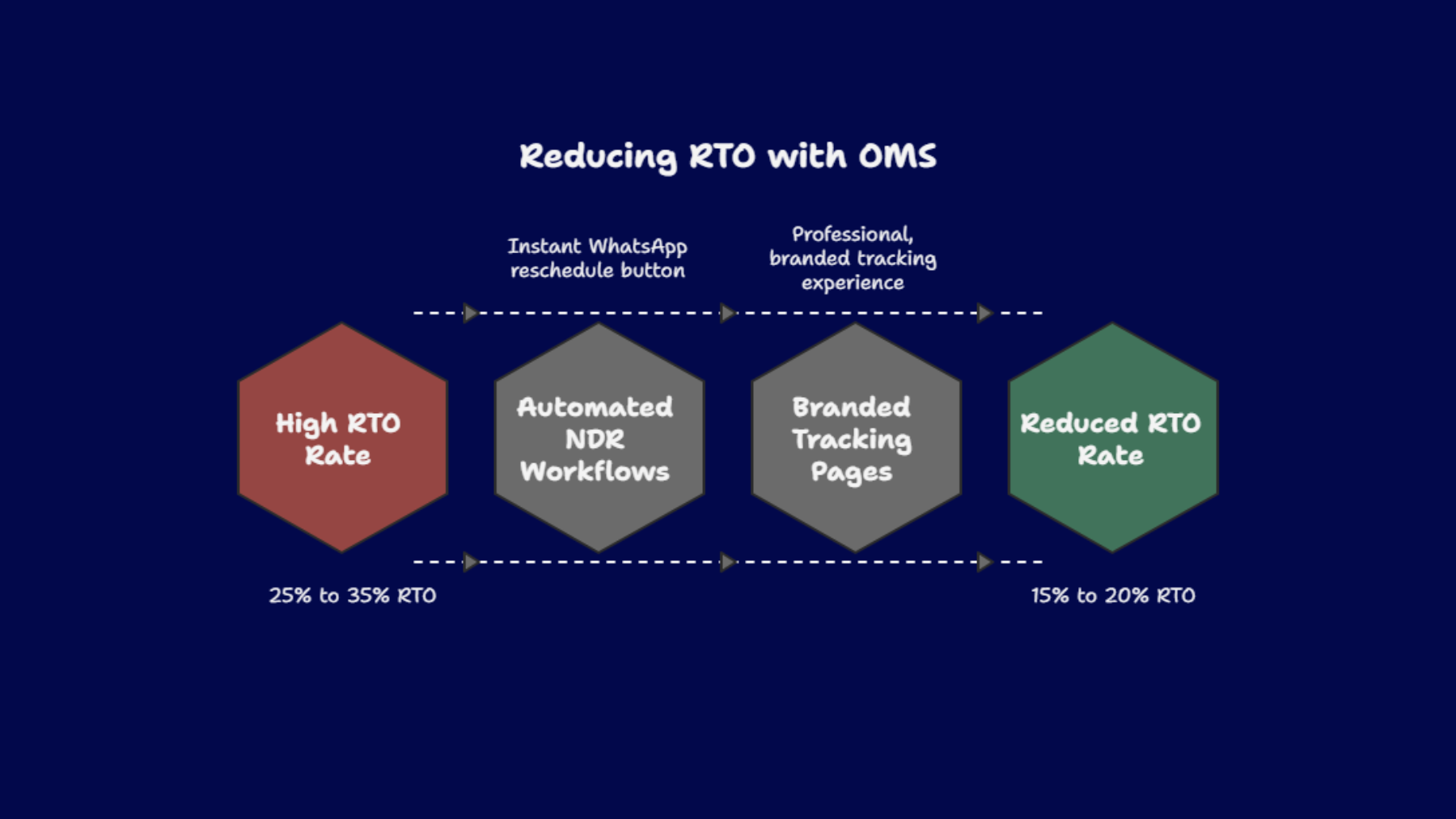
- Instant Trigger: The OMS sends a WhatsApp to the customer with a “Reschedule” button.
- Customer Action: The customer picks a time when they will be home.
- Re-attempt: The courier is notified of the new time, drastically improving the chance of a successful sale.
This loop is one of the most effective tools to reduce RTO in ecommerce because it rescues a sale that was almost lost.
Building Trust to Prevent Cancellations
Many cancellations happen because the buyer feels a lack of trust. If they don’t receive a confirmation or a tracking link quickly, they assume the site is a scam. To achieve order cancellation reduction in India, you must provide a “Big Brand” experience.
An OMS allows you to send professional, branded tracking pages. Instead of sending them to a boring courier website, you keep them on your own page. This keeps the customer engaged and confident in their purchase, which is a subtle but powerful form of ecommerce RTO prevention.
| Metric | Without Automation | With OMS |
|---|---|---|
| Dispatch Time | 24-48 Hours | < 6 Hours |
| Address Errors | High | Near Zero |
| Customer Updates | Manual / None | Automated WhatsApp/SMS |
| RTO Rate | 25% to 35% | 15% to 20% |
By focusing on these metrics, you can reduce RTO in ecommerce and turn your logistics from a cost center into a competitive advantage.
Shifting Customers from COD to Prepaid
The ultimate way to ensure ecommerce RTO prevention is to reduce the number of COD orders. An OMS can help you run “Prepaid Conversion” campaigns. For example, if a customer chooses COD, the system can automatically send a message: “Pay now via UPI and get an extra 5% off!”
When a customer pays upfront, the RTO rate drops by nearly 80%. Using an OMS to manage these nudges is a sustainable way to reduce RTO in ecommerce over the long term.
Click here to know how returns and logistics actually work.
Frequently Asked Questions
1. How does an OMS reduce RTO in ecommerce for new brands?
For new brands, an OMS provides the data needed to spot high-risk orders early. By verifying addresses and confirming COD orders automatically, it prevents the shipping of orders that are likely to fail, ensuring better ecommerce RTO prevention.
2. Why is NDR management important for order cancellation reduction in India?
NDR management gives you a second chance to deliver a package. Instead of letting a failed delivery return to the warehouse, you can re-engage the customer immediately. This is a key strategy for order cancellation reduction in India.
3. Can I reduce RTO in ecommerce without changing my courier?
Yes. An OMS helps you manage your existing courier better by providing them with cleaner address data and faster updates from the customer, which naturally leads to better ecommerce RTO prevention and fewer returns.
4. How does inventory syncing lead to order cancellation reduction in India?
When your inventory is synced across all sales channels, you never sell a product that is out of stock. This eliminates the need for “seller-side” cancellations, which is a major factor in order cancellation reduction in India.
5. What is the most common reason for delivery failures in India?
Inaccurate addresses and the customer not being available are the top reasons. An OMS solves this through automated address cleaning and real-time delivery scheduling, helping to reduce RTO in ecommerce and improve overall delivery success rates.