If you’re selling across four or more channels, you already know the problem. Listings fall out of sync. Inventory gets stale. Suppressions go unnoticed. And the more channels you add, the worse it gets.
Most sellers assume it’s a tool problem. It’s not — it’s a structural one. Each marketplace has its own title limits, category taxonomy, image specs, and suppression logic. What looks like a single task, keep listings current, is actually dozens of parallel workflows that must stay in sync, for every SKU, at all times.
Here’s what’s actually causing it, and what scaling sellers are doing to fix multichannel listing management for good.
The Scale of the Problem
Five years ago, multichannel meant 2 to 3 channels. According to Veeqo’s 2025 multichannel research, scaling sellers now commonly manage 8 or more active platforms — each one a separate listing environment with its own rules.
The math compounds fast. A seller with 500 SKUs across 6 channels is managing over 3,000 individual listing configurations — each of which can break, fall out of sync, or get suppressed independently. IHL Group estimates that inventory distortion across channels costs global retail $1.77 trillion annually.
| 8+Channels managed by a typical scaling sellerVeeqo, 2025 | 3,000+Listing configs for 500 SKUs across 6 channelsBase calculation | $1.77TAnnual global revenue lost to inventory distortionIHL Group |
Where It Breaks
These aren’t edge cases. They’re the operational realities every scaling seller hits — usually all at once.
1. Product data requirements vary by channel
Every marketplace has its own rules for what a listing needs to look like:
- Amazon: 200-character title, keyword placement matters
- Walmart: 75-character title cap, stricter brand field requirements
- TikTok Shop: weights content differently in its discovery algorithm
- eBay: its own item specifics framework
- SHEIN: different attribute structures than all of the above
One product can require four or five entirely different configurations just to meet basic compliance. At hundreds or thousands of SKUs, that’s not a listing task — it’s a content operation.
The compounding math:
- 500 SKUs x 6 channels = 3,000 listing configurations
- Each with its own title, description, attributes, and image specs
- Add A+ Content and promotional pricing: 20,000+ content elements to keep accurate
2. Inventory sync failures cause overselling
When inventory doesn’t update in near real-time across channels, you sell stock you don’t have. The consequences stack up fast:
- One oversell on Amazon triggers an order defect against your seller health score
- Multiple events in a short window can trigger account suspension
- Reinstatement takes days or weeks and costs far more than the original orders
Research shows only 26% of businesses update inventory frequently enough to maintain accuracy across channels — meaning nearly three in four are operating with stale data at any given moment.
3. Price changes have to land everywhere, simultaneously
Every pricing update needs to hit every channel at the same time. Without automation, the problems are predictable:
- Products on sale in one place, full price in another
- MAP violations that go unnoticed for days
- Manual updates across multiple seller portals, each one a chance for human error
4. Listing suppression is invisible unless you’re looking
Listings get suppressed for all kinds of reasons — missing attributes, image issues, pricing violations, GTIN mismatches. Every platform has its own suppression logic and its own dashboard. On six channels that means:
- Six dashboards to check regularly
- Suppressions that sit unnoticed for days or weeks
- Listings that are invisible to buyers while everything looks fine on your end
5. Adding channels takes longer than it should
Research from Shopify shows brands selling across multiple platforms grow revenue 38% faster than single-channel sellers, but only when their operations can keep pace. For most teams, adding a new marketplace means:
- Building or sourcing a new integration
- Reformatting the product catalog for that channel’s requirements
- Setting up and testing order management workflows
The overhead keeps sellers off channels that could meaningfully grow their business.
Why the Current Approach Hits a Wall
Veeqo’s 2025 research found that 27% of sellers are still running operations on spreadsheets, even at meaningful scale. The typical multichannel stack looks like this:
- A primary marketplace tool (usually Amazon-specific) for the main channel
- Native seller portals for secondary channels
- Spreadsheets for product data and tracking changes
- Manual processes for pricing updates and error monitoring
- A developer keeping the integrations running
It works until it doesn’t. The breaking point usually hits between $2M and $5M in revenue. At that stage, hiring more people to manage listings just scales the cost, it doesn’t fix the underlying problem.
See the Marketplace Manager
How Base Solves It
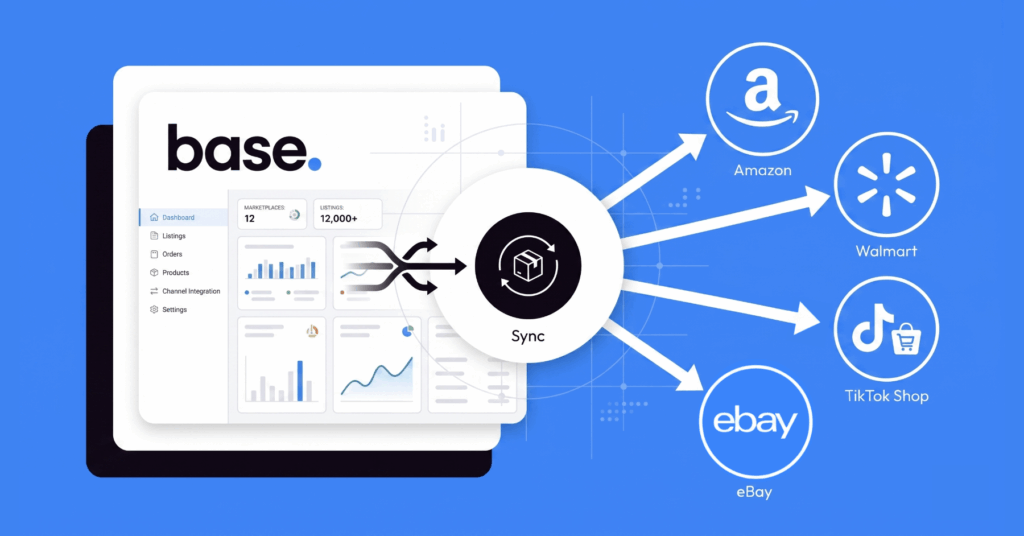
Base is built as a single operational hub for multichannel sellers — one platform where product data, inventory, orders, and listings are managed centrally and pushed out to every channel from one place.
One source of truth for every channel
Base’s Product Information Manager centralizes all product data with channel-specific field configuration:
- The same SKU carries the right title, attributes, and specs for each marketplace — managed from one product record
- When something changes, it propagates to every connected channel automatically
- No manual re-entry, no missed platforms, no version drift
Real-time inventory sync built for high-velocity selling
Base’s inventory engine syncs stock levels as fast as each marketplace API allows:
- SKU-level safety stock thresholds prevent overselling during high-velocity events
- Channel-specific allocation rules protect shared inventory across platforms
- During a 1,000%+ order spike over 24 hours, Base processed the full volume with zero overselling events
1,700+ integrations across every major marketplace
Base connects out of the box to:
- Marketplaces: Amazon, Walmart, TikTok Shop, Target+, eBay, SHEIN, Kroger, Macy’s, Nordstrom, and 100s more
- Storefronts: Shopify, BigCommerce, WooCommerce, Magento, plus more
- ERPs and back-end systems: SAP, Oracle, QuickBooks, ShipStation, and more
For channels not yet supported, Base can add new integrations for customers typically within a few weeks.
Automation that reduces the manual workload
Base’s no-code workflow automation handles the rule-based work that currently runs on manual effort:
- Order routing, listing updates, fulfillment triggers, and pricing rules run automatically
- Bulk operations push price changes, attribute updates, and new listings to all channels simultaneously
The Bottom Line
Multichannel listing management keeps breaking for the same structural reasons: too many channels, too many data requirements, too many manual handoffs. The sellers who get it under control stop trying to manage it channel-by-channel and move to a centralized platform that handles the complexity for them.
The result is faster channel expansion, more accurate inventory, fewer suppressions, and more revenue from the catalog you already have.
Frequently Asked Questions
What is multichannel listing management?
Multichannel listing management is the process of creating, syncing, and maintaining accurate product listings across multiple sales channels at the same time. This includes marketplaces like Amazon, Walmart, and TikTok Shop, as well as owned storefronts like Shopify or BigCommerce. It covers channel-specific product data requirements, inventory sync, pricing consistency, and suppression monitoring across all active channels. For sellers on four or more platforms, dedicated platform infrastructure is typically required to stay accurate and current at scale.
Why is managing listings across multiple marketplaces so difficult?
Each marketplace has its own product data requirements, category taxonomy, image specifications, pricing rules, and suppression logic. A single product may need four or five completely different listing configurations to meet basic compliance standards across platforms. For sellers with hundreds or thousands of SKUs, maintaining these configurations manually across six or more channels creates thousands of data points that can fall out of sync or be suppressed without the seller knowing. The problem compounds as SKU count and channel count grow.
How do I prevent overselling when selling across multiple channels?
Preventing overselling across multiple sales channels comes down to how frequently your inventory syncs and how your stock is allocated. The more often inventory updates across channels, the smaller the window for oversell risk. SKU-level safety stock thresholds and channel-specific allocation rules add another layer of protection — reserving buffer stock so no single channel can sell through your entire shared inventory. Research shows only 26% of businesses update inventory frequently enough to maintain accuracy across channels, meaning most sellers are carrying more oversell risk than they realize. A centralized inventory management platform that gives you control over sync frequency and stock allocation rules is the most reliable way to manage this at scale.
What should I look for in a multichannel listing management platform?
The most important capabilities are: a centralized PIM that handles channel-specific data from one product record; fast inventory sync; bulk listing operations for catalog-wide updates; cross-channel suppression monitoring; and integration depth covering every channel you sell on. Confirm coverage for Amazon, Walmart, TikTok Shop, Target+, SHEIN, Kroger, Macy’s, and Nordstrom. Also verify the platform connects to your existing ERP or WMS without requiring a full stack replacement.
When does a multichannel seller need a dedicated listing platform?
Most multichannel sellers hit the limit of manual listing management somewhere between $2M and $5M in annual revenue. Veeqo’s 2025 research found that 27% of sellers are still relying on spreadsheets even at significant scale. Sellers managing 200 or more SKUs across 3 or more channels should evaluate centralized listing management tools before they hit that wall, not after.
How does Base handle multichannel listing management?
Base is a multichannel ecommerce management platform used by 30,000+ brands in 100+ countries, processing over 300 million orders per year. Its Marketplace Manager includes a built-in PIM with channel-specific field configuration, real-time inventory sync with SKU-level safety stock thresholds, bulk listing operations, and cross-channel suppression monitoring. Base connects to 1,700+ integrations including every major marketplace and leading ERP systems. Customers report up to 50% reduction in operational process burden.