
The Indian e-commerce landscape is a vast, high-stakes battleground where visibility is gained on major platforms like Amazon India, Flipkart, and Myntra, but long-term profitability is often secured through the brand’s own Direct-to-Consumer (D2C) channel. For the modern Indian seller, the challenge is clear: how do you manage sales, inventory, and fulfillment across these highly specific, often conflicting ecosystems without driving operational teams insane or hemorrhaging profits?
The solution lies not in juggling more spreadsheets or hiring more hands, but in adopting an intelligent, central e-commerce automation platform, typically a sophisticated Order Management System (OMS). This strategic technological pivot transforms channel complexity from a paralyzing liability into a strategic advantage, enabling seamless, scalable, and highly profitable multi-channel growth.
This comprehensive guide details the critical challenges faced by Indian multi-channel sellers and details the essential technological features required to master cross-platform order management, transforming complexity into a competitive advantage.
Why Is Selling Across India’s Major Marketplaces Inherently Complicated?
Every successful multi-channel retailer in India eventually hits a wall. That wall is the sheer, overwhelming complexity created by operating in isolation on multiple unique platforms. The pain points are predictable and directly impact the bottom line.
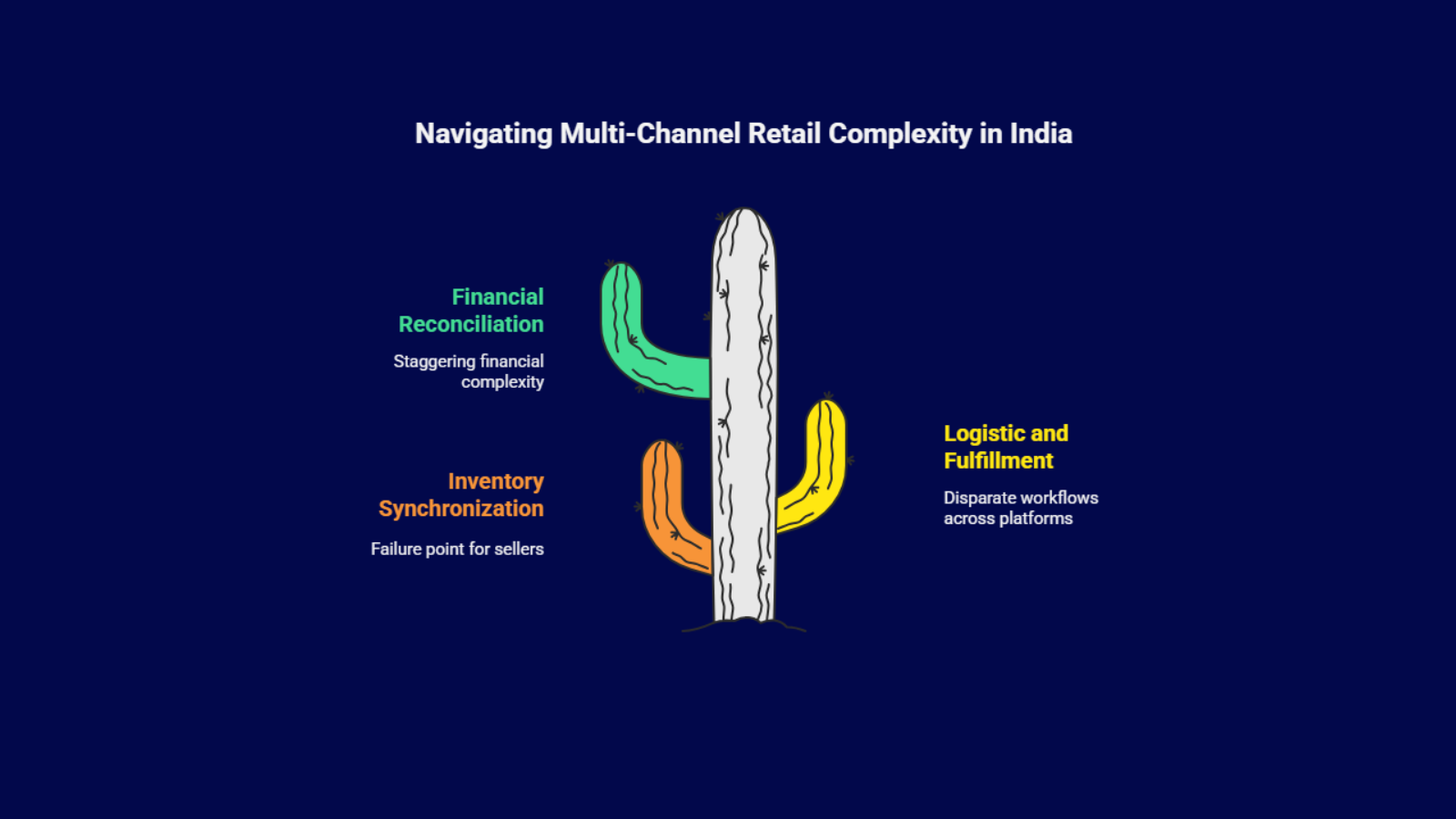
The Inventory Synchronization Crisis: The Root of All Evil
This is the single most significant operational failure point for multi-channel sellers. When you run out of stock on one platform, the other three must know instantly.
- The Overselling Trap: If a popular product sells out on your D2C website, and your inventory level isn’t instantly updated across Amazon, Flipkart, and Myntra, you’re guaranteed to oversell. The result? Order cancellations, financial penalties from the marketplaces, and severely damaged seller ratings a quick way to lose visibility on the platforms.
- The Crippling Stockout Penalty: Conversely, if you keep a buffer of stock reserved for each platform to prevent overselling, you create an artificial stockout on your best-performing channel. Capital gets tied up in slow-moving inventory across three separate silos, crippling cash flow and causing you to miss high-demand sales.
- Manual Updation Errors: Relying on staff to manually update inventory counts across four or more separate portals during peak season (like Diwali or Big Billion Days) is humanly impossible and ensures errors creep in, leading back to overselling or stockouts.
Logistic and Fulfillment Chaos: The Disparate Workflows
Each marketplace has its own specific set of rules, documentation, and logistic partners (e.g., FBA for Amazon, Ekart for Flipkart, and third-party logistics for your D2C site).
- Custom Documentation Requirements: Every order requires a different workflow: generating a specific label format, using a different manifest system, and adhering to varied packaging guidelines. Staff have to switch between multiple interfaces just to process a day’s orders.
- Return Management Complexity: Returns are managed through different portals, with different inspection standards and timelines. Reconciling these returns checking if the item is resellable, issuing the refund, and updating the stock count across all platforms becomes a manual nightmare.
Click here to learn how to handle the reverse logistics in India.
The Financial Reconciliation Burden
The financial complexity of selling on multiple platforms in India each with its own payment cycle, commission structure, discount subsidies, and tax requirements is staggering.
- GST and TDS Reconciliation: Reconciling GST and TDS (Tax Deducted at Source) statements across Amazon, Flipkart, and your D2C site against your actual bank deposits and order manifests is extremely time-consuming and prone to audit risk if done manually.
- Pricing and Promotions Mismatch: Managing pricing and promotions manually across channels is nearly impossible. A pricing error on one channel, especially if it breaks minimum advertised price (MAP) policies, can lead to compliance issues or immediate margin erosion.
What is the E-commerce Automation Platform and How Does It Unify Operations?
The solution to multi-channel chaos is the implementation of a single, powerful e-commerce automation platform, often an advanced, cloud-native Order Management System (OMS) designed for the Indian environment. This platform serves as the central hub, standardizing processes and connecting all endpoints.
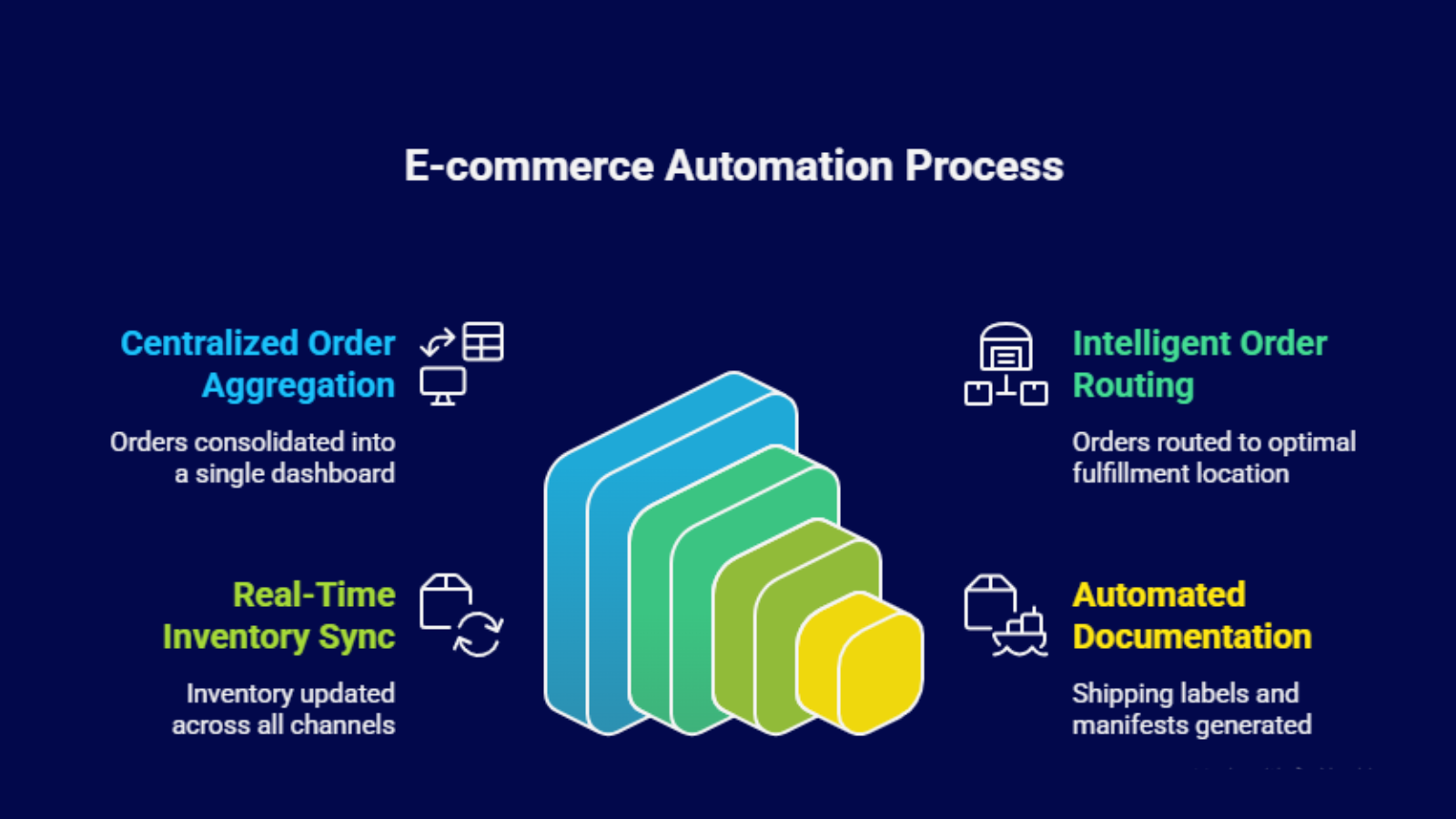
Centralized Order Aggregation and Routing
A modern OMS consolidates all orders from every connected channel (Amazon, Flipkart, Myntra, and the brand website) into a single, cohesive dashboard, standardizing processing from the first click.
- Single Dashboard View: Orders are instantly pulled from all channels into the OMS, eliminating the need for staff to log into multiple seller portals. This creates a standardized, single point of truth for order status.
- Intelligent Routing: The system applies logic to route the order to the most optimal fulfillment location: the nearest warehouse, the brand’s own retail store (for ship-from-store), or a dedicated marketplace warehouse (like FBA). This decision is based on stock levels, customer location, and shipping cost.
- Order Prioritization: The system can be configured to prioritize high-value or D2C orders over low-margin marketplace sales, ensuring that the most profitable orders are processed first during peak volume.
Creating the Single Source of Truth for Inventory
The platform’s greatest value is creating a Single Source of Truth (SSoT) for inventory. This is the cornerstone of profitable multi-channel selling and is achieved through real-time data flow.
- Real-Time Two-Way Sync: Every time an item is sold on any channel, the OMS instantly pushes the updated stock count back to all other connected channels. If an order is placed on Flipkart, the available inventory is immediately reduced on Amazon, Myntra, and the D2C site.
- Dynamic Safety Stock Configuration: Instead of manually setting inventory buffers, the platform allows the seller to configure safety stock rules. For instance, a retailer might keep a minimum of 5 units of a high-selling item and dynamically allocate the remaining available stock based on each channel’s sales velocity, maximizing revenue without risking overselling.
- Warehouse and FBA Stock Unification: The system seamlessly manages stock across the brand’s owned warehouse and marketplace fulfillment centres (FBA, Flipkart Smart), ensuring complete visibility and avoiding the costly scenario of stock sitting idle in one location while another channel is selling out.
Automated Documentation and Manifesting
The OMS automates the repetitive, channel-specific documentation tasks that consume huge amounts of labor time and are prone to human error.
- Channel-Compliant Label Generation: The system integrates with the specific APIs of each marketplace and their required logistics partners. The OMS automatically prints the correct, marketplace-compliant shipping label, invoice, and manifest documents, eliminating manual errors and reducing packaging time.
- Consolidated Manifesting: The platform aggregates data and handles the required digital transmission to all courier partners simultaneously, unifying the process that would otherwise require multiple logins and disparate paperwork.
What Advanced Features Drive Profitability in Multi-Channel Indian E-commerce?
For multi-channel sellers to not just survive but thrive, they need more than basic integration; they need advanced intelligence and control embedded in their automation platform.
Last-Mile Logistics Intelligence and RTO Mitigation
A modern platform empowers sellers to choose the best logistics partner for every single pin code across India, optimizing both cost and speed while actively protecting margins.
- Multi-Carrier Rate Shopping: The OMS instantly compares rates and historical performance data across a wide array of national and regional courier partners for the customer’s pincode, automatically selecting the most cost-effective and reliable carrier.
- Proactive COD Risk Management: The platform actively reduces RTO (Return-to-Origin) rates, a massive cost factor in Indian e-commerce by integrating automated pre-dispatch verification for Cash on Delivery (COD) orders via SMS or IVR, confirming the customer’s intent before shipping.
- Streamlined Reverse Logistics: The system provides a single interface for managing all returns, regardless of origin. It automates return label generation and tracks the package back to the warehouse, triggering the necessary inventory updates and refunds immediately upon physical Quality Check (QC).
Centralized Price and Promotion Management
Maintaining a consistent, compliant, and profitable pricing strategy across competitive marketplaces requires a sophisticated, centralized tool.
-
- MAP Policy Enforcement: For brands with strict pricing policies, configure the platform to monitor listed prices across all connected channels and flag violations. This enables you to take immediate corrective action against unauthorized resellers or pricing errors.
How Does a Centralized Platform Pave the Way for D2C Domination?
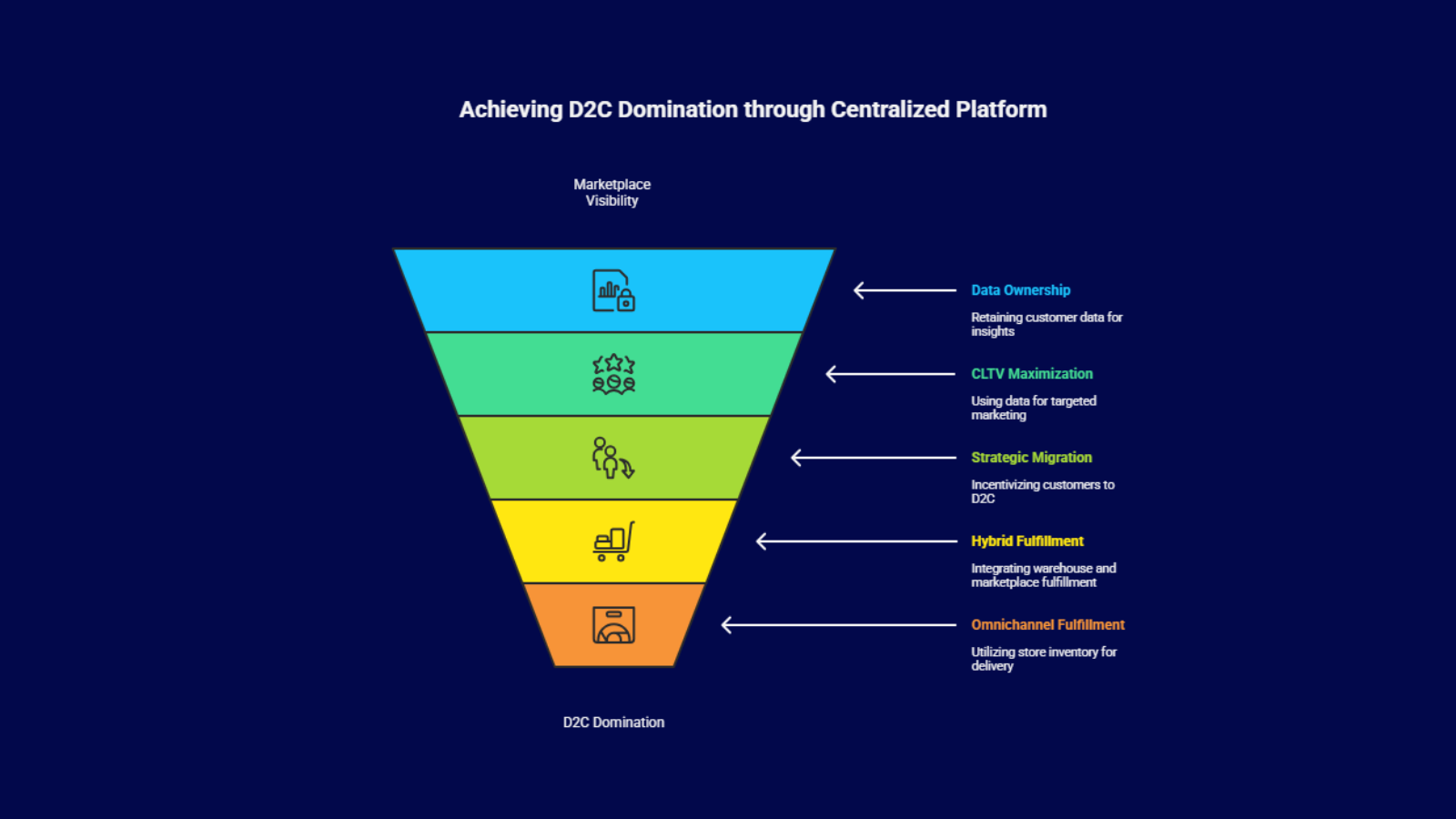
While marketplaces offer huge acquisition volume, a brand’s long-term profitability hinges on the D2C channel. The modern OMS is the essential bridge that allows brands to leverage the marketplaces for visibility while pushing high-margin transactions to their own website.
Data Ownership and CLTV Maximization
By routing all order data through the central OMS, the brand retains crucial ownership of the customer profile, even for marketplace orders (where permitted by the platform’s terms).
- Unified Customer Record: The OMS links all purchase data (channel, frequency, value) to a single customer record, enabling accurate CLTV (Customer Lifetime Value) calculation and precise marketing retargeting.
- Strategic Migration Incentives: Armed with this data, brands can strategically offer incentives (personalized discounts or exclusive bundles) to encourage marketplace buyers to migrate their next purchase to the higher-margin D2C website.
Enabling Hybrid and Omnichannel Fulfillment
The most profitable Indian sellers don’t choose between their own warehouse or marketplace fulfillment; they use a hybrid approach orchestrated by Omnichannel fulfillment.
- Marketplace Fulfillment Integration (FBA/Smart): The OMS connects with services like Amazon FBA and Flipkart Smart to send bulk inventory, while simultaneously reserving a portion of the inventory in the brand’s own warehouse for high-margin D2C and urgent orders. The system manages the complex two-way inventory flow between these fulfillment models seamlessly.
- Leveraging Store Inventory: The OMS allows for Ship-from-Store (SFS) functionality, turning the physical store network into a flexible fulfillment asset, shortening delivery times in urban areas, and maximizing the utilization of all available stock.
By consolidating operations, centralizing intelligence, and automating repetitive tasks, the modern e-commerce automation platform frees up retailers to focus on product development and marketing the strategic drivers of growth. This operational control is the non-negotiable prerequisite for scaling profitably in India’s competitive, multi-channel environment.
Ready to transcend channel chaos and achieve unified control over your multi-channel e-commerce empire?
Explore the future of e-commerce automation today at Base.com.
Frequently Asked Questions (FAQs)
Q1. What is the single most important metric that improves immediately after implementing a multi-channel OMS?
A. The most crucial metric that sees immediate improvement is Inventory Accuracy, which directly leads to the near-total elimination of Overselling. By enforcing a real-time, single source of truth for stock levels across all platforms (Amazon, Flipkart, etc.), the financial penalties and reputation damage associated with cancellations are drastically reduced.
Q2. Does an e-commerce automation platform help me handle bulk orders during major Indian festival sales?
A. Yes, this is one of its primary functions. The platform allows for bulk order processing (printing hundreds of labels and manifests simultaneously), and its Intelligent Order Routing dynamically scales by allocating orders across multiple fulfillment centers and carriers based on their current capacity, preventing bottlenecks that occur when relying on manual processes.
Q3. How does the system handle different commission and fee structures between Amazon and Flipkart for accounting?
A. The OMS integrates with the financial settlement reports of each marketplace. It automatically maps the commissions, shipping fees, discounts, and tax deductions from Amazon, Flipkart, and Myntra to the corresponding original order, providing a verified, item-level profitability report that simplifies financial reconciliation and internal auditing against your bank deposits.
Q4. Can I use the OMS to control my pricing and prevent price wars across channels?
A. Yes. The OMS allows for Centralized Pricing Rules. You set a base price, and the system can automatically adjust the final listed price on each marketplace by applying the respective platform’s commission structure and any pre-set channel-specific markup or discount. This prevents errors and helps enforce Minimum Advertised Price (MAP) policies across all your selling endpoints.