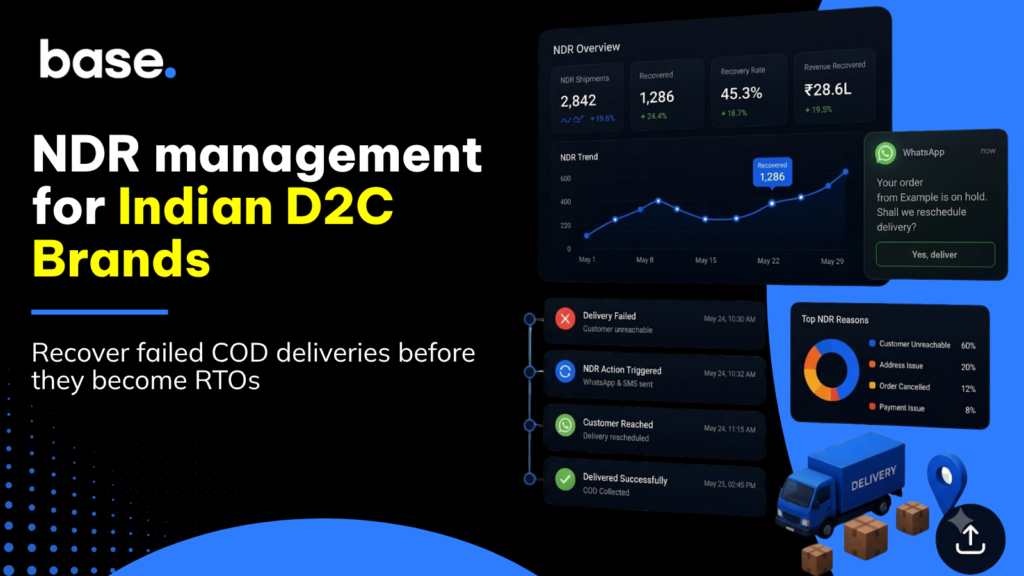
NDR management for COD delivery recovery in India is the operational gap that turns recoverable failed deliveries into permanent returns. A Non-Delivery Report is not a closed outcome. It is a window, typically 24 to 72 hours, where the right intervention can still convert a failed attempt into a completed delivery.
Most Indian D2C brands are losing that window every single day.
What NDR Actually Means for Indian D2C Operations
An NDR, Non-Delivery Report, is generated when a courier partner attempts delivery and fails. In Indian ecommerce, NDRs are not rare exceptions. They are a daily operational reality.
India’s COD return rate sits between 25-30% market-wide. A significant portion of that figure is not genuinely undeliverable orders; it is recoverable NDRs that were never properly actioned. The customer was unavailable at the time of the attempt. The address needed a small correction. The delivery was attempted at the wrong time of day.
NDR management for COD delivery recovery in India is the process of systematically intercepting these situations before the courier closes the case and initiates the return journey. Every NDR that converts to a successful delivery is an RTO that never happened, and a full order revenue that is retained rather than lost.
India’s ecommerce market is at $226 billion. The brands growing within that market are the ones treating NDR management for COD delivery recovery in India as a core operations function, not an afterthought.
Why NDR Management Fails at Most Indian D2C Brands
 The majority of Indian D2C brands have no structured NDR process. When a courier generates a failed delivery report, the order sits in a queue. Someone may follow up manually. Often, no one does, because at 500+ daily orders, manual follow-up on every NDR is not operationally feasible.
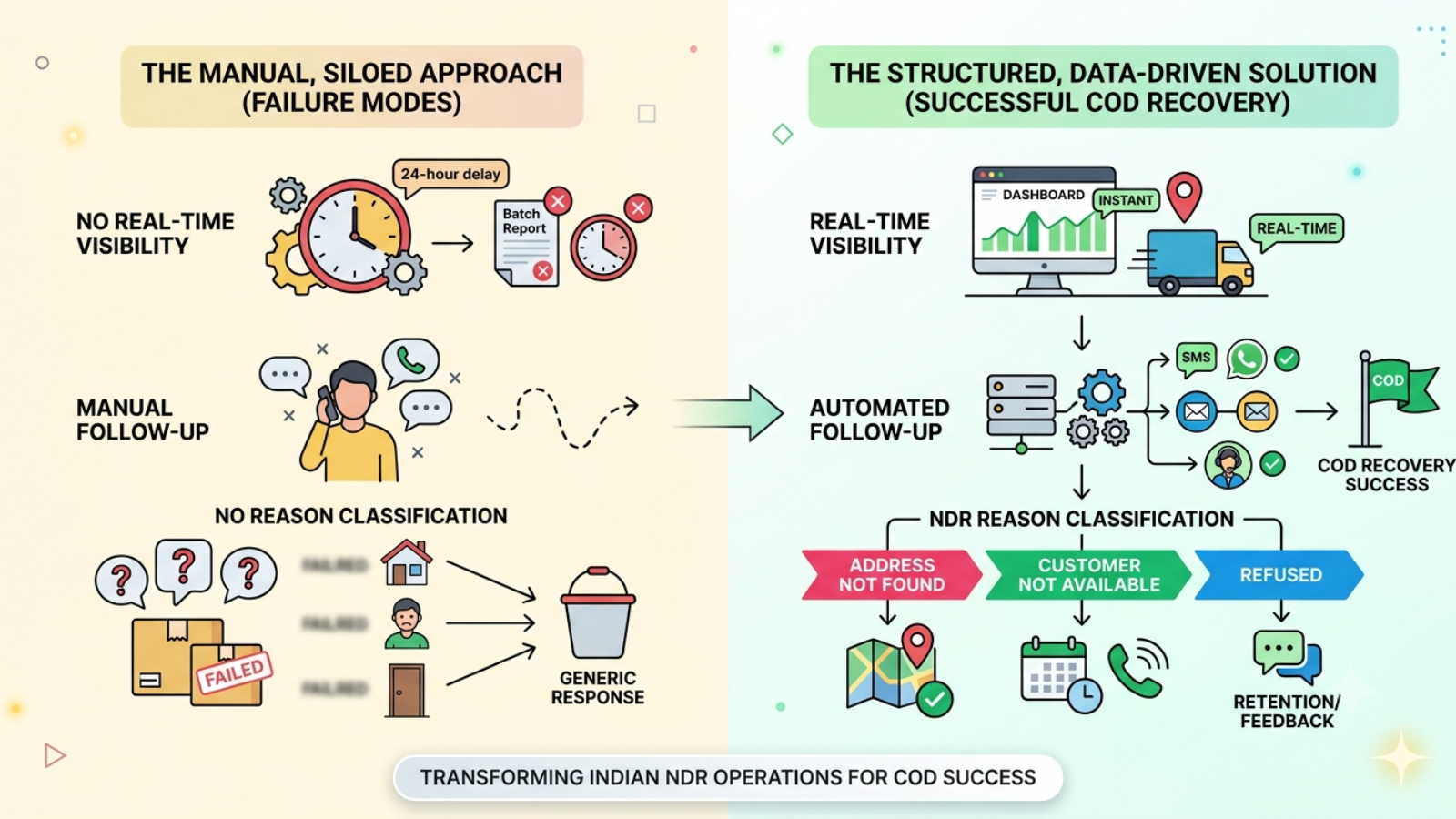
The Three Failure Modes in Indian NDR Operations
- No real-time NDR visibility. The operations team finds out about failed deliveries hours after they occurred, sometimes the next morning, during a batch report review. By that point, the intervention window has narrowed significantly.
- Manual, inconsistent follow-up. When follow-up does happen, it relies on individual team members calling customers one by one. This approach does not scale, is not consistent, and leaves the outcome dependent on who happened to be available that day.
- No NDR reason classification. Not all NDRs are the same. “Customer not available” requires a rescheduling call. “Address not found” requires address correction. “Customer refused delivery” requires a different workflow entirely, potentially a retention conversation rather than a redelivery attempt. Without classifying NDR reasons, brands apply the same response to fundamentally different situations and get poor results across the board.
- NDR management for COD delivery recovery in India solves all three failure modes, but only when it is built as a structured, automated, data-driven process rather than a manual exception-handling exercise.
The Financial Case for Structured NDR Management
Before examining how to build an NDR management process, it is worth being precise about what poor NDR management costs Indian D2C brands.
True Cost of a Single Converted RTO
| Cost Component | Typical Range in India |
|---|---|
| Outward shipping cost | ₹60-120 |
| Return shipping cost | ₹60-120 |
| COD handling charge | ₹25-50 |
| Repackaging and restocking | ₹30-80 |
| Team time, processing, and disputes | ₹40-100 |
| Lost margin on unrecovered order | Order value × margin % |
| Total cost per RTO | ₹215-470+ before margin loss |
At a 25% RTO rate on 10,000 monthly orders, 2,500 orders return every month. At ₹300 average true cost per return, that is ₹7.5 lakh monthly in direct return costs, before accounting for lost margin.
NDR management for COD delivery recovery in India does not need to convert every failed delivery to produce a significant financial impact. Converting even 30-40% of actionable NDRs back into successful deliveries produces measurable P&L improvement at every order volume level.
NDR Management for COD Delivery Recovery in India: The Complete Framework
NDR management for COD delivery recovery in India requires four sequential components working together: real-time NDR detection, reason-based classification, automated customer outreach, and redelivery scheduling with carrier coordination. Brands that implement all four consistently outperform those that address only one or two.
Component 1: Real-Time NDR Detection
 Real-time NDR detection captures failed delivery events instantly as they occur, instead of relying on delayed reports.
This enables immediate action, triggering automated customer outreach within minutes to maximise delivery recovery chances.
Why Timing Is Everything in NDR Management
The intervention window after a failed delivery attempt is narrow. In Indian ecommerce last-mile operations, couriers typically hold an order for 24-48 hours after the first failed attempt before initiating the return process. After the return is initiated, recovery becomes logistically complicated and commercially expensive.
NDR management for COD delivery recovery in India starts with knowing about the failed delivery the moment it is logged, not the next morning during a report review.
Base.com provides real-time NDR alerts to the operations team as soon as a courier partner logs a failed delivery event. This immediacy is not a minor process improvement. It is the difference between an 8-hour intervention window and a 30-hour one, and that difference determines how many NDRs are recoverable versus how many default to RTO.
What Real-Time NDR Visibility Enables
- Immediate customer outreach while the delivery attempt is still fresh in the customer’s awareness
- Carrier coordination before the return journey is initiated
- Same-day redelivery scheduling for customers is available later that day
- Escalation to the courier partner before the case is closed
Without real-time visibility, NDR management for COD delivery recovery in India is reactive by definition. The intervention happens after the optimal window has passed.
Component 2: NDR Reason Classification
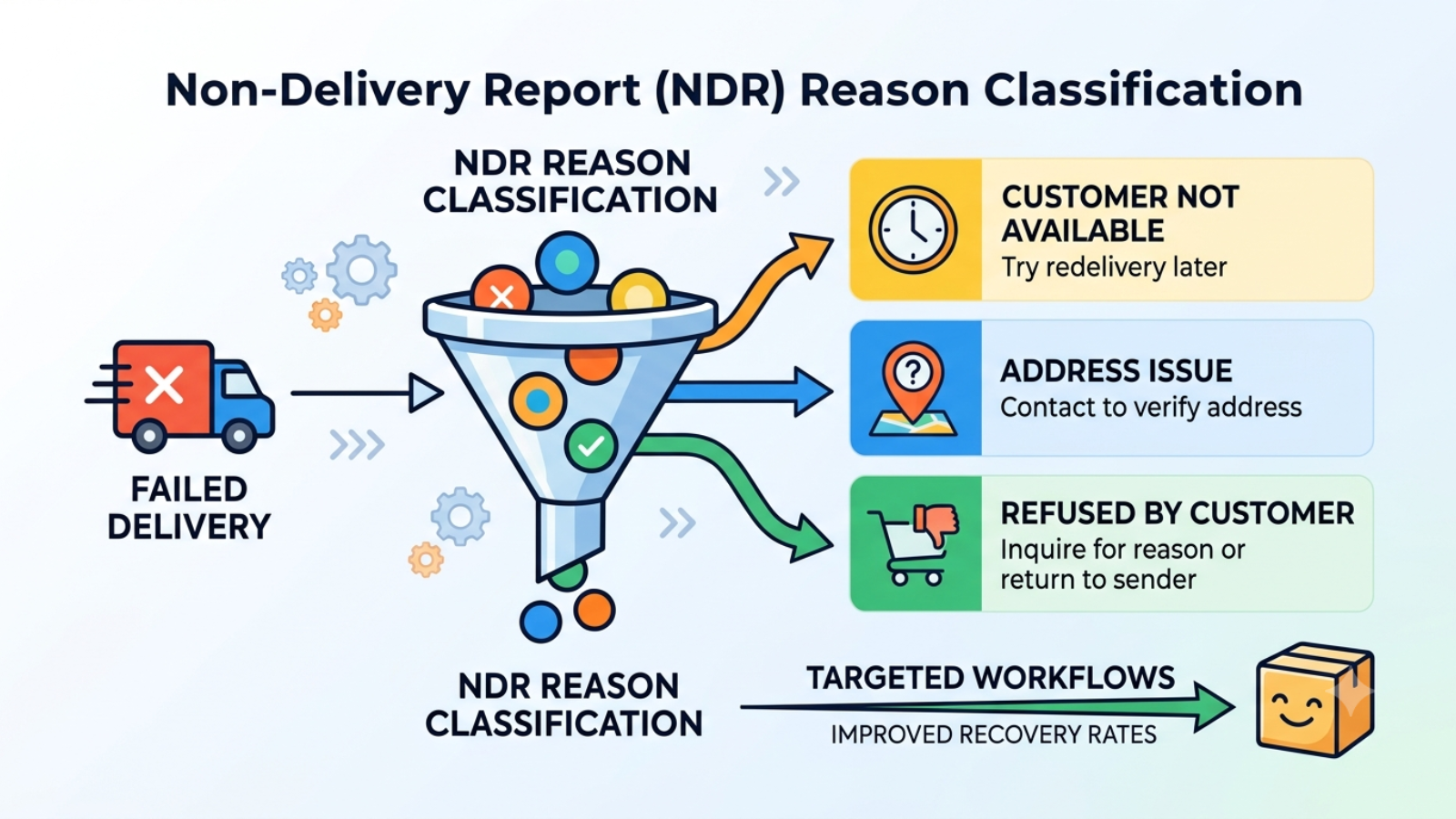 NDR reason classification categorises failed deliveries into specific reasons like “customer not available,” “address issue,” or “refused.”
This enables targeted, reason-specific workflows, improving recovery rates instead of using generic follow-ups.
Not All NDRs Are the Same Problem
This is the most operationally important insight in NDR management for COD delivery recovery in India. A single “failed delivery” label covers at least six distinct situations, each requiring a different response workflow.
| NDR Reason Code | What It Actually Means | Correct Intervention |
|---|---|---|
| Customer not available | The customer was away, a genuine timing issue | Automated reschedule call, offer new delivery slot |
| Address not found | Incomplete or incorrect address information | Address correction call, get specific landmark/details |
| The customer refused delivery | The customer chose not to accept the order | Retention call, understand reason, offer resolution |
| Phone not reachable | Customer unreachable at delivery time | Multiple contact attempts across different time windows |
| Fake delivery attempt | The courier did not genuinely attempt delivery | Dispute with the carrier using the confirmation records |
| Pincode not serviceable | Carrier does not serve this location | Carrier reassignment to an alternate logistics partner |
Applying a generic “call the customer” response to all six situations produces poor outcomes. NDR management for COD delivery recovery in India that classifies reasons and routes to the appropriate workflow recovers significantly more orders than undifferentiated follow-up.
Base.com maps courier NDR reason codes to internal workflow triggers, so a “customer not available” NDR automatically initiates a rescheduling workflow while a “customer refused” NDR triggers a retention sequence. The classification happens at the system level, not through manual team judgment on every case.
Component 3: Automated Customer Outreach
 Automated customer outreach triggers instant communication after an NDR, via calls, SMS, or WhatsApp.
It confirms intent, corrects details, and schedules redelivery quickly, improving recovery rates.
Why Manual Follow-Up Cannot Scale
At 100 daily orders, a team member making NDR follow-up calls is feasible. And 500 daily orders with a 20% NDR rate, that is 100 customer calls every day, before handling any other operational responsibility. At 2,000 daily orders, it is 400 calls. Manual NDR follow-up does not scale with order volume growth.
NDR management for COD delivery recovery in India at D2C scale requires automated outreach that runs on every qualifying NDR without team bandwidth dependency.
How Base.com Automates NDR Outreach
Base.com’s automated NDR workflow triggers customer-facing communication immediately when an NDR is received and classified. The communication flow varies by NDR reason:
- For “customer not available” NDRs: An automated call or WhatsApp message reaches the customer within 1-2 hours of the failed attempt. The message confirms the failed delivery, offers alternative delivery time slots, and requests the customer’s preferred window. The customer’s response updates the redelivery instruction in the system automatically, no manual data entry required.
- For “address not found” NDRs: The automated outreach requests specific address corrections, landmark, building name, floor number, and updates the delivery address in the shipment record for the next attempt.
- For “customer refused” NDRs: A structured retention sequence initiates, understanding the reason for refusal, addressing product concerns where relevant, and offering alternatives before the return is processed. This sequence recovers a meaningful share of impulsive refusals that would otherwise default to RTO.
This is the operational core of NDR management for COD delivery recovery in India, automating the follow-up that most brands attempt manually and inconsistently, at a speed and scale that manual processes cannot match.
India’s D2C segment is growing at 40% CAGR. Order volumes double within 18-24 months for high-growth brands. An NDR management process built on manual follow-up will break under that growth. One built on automation scales with it.
Component 4: Redelivery Scheduling and Carrier Coordination
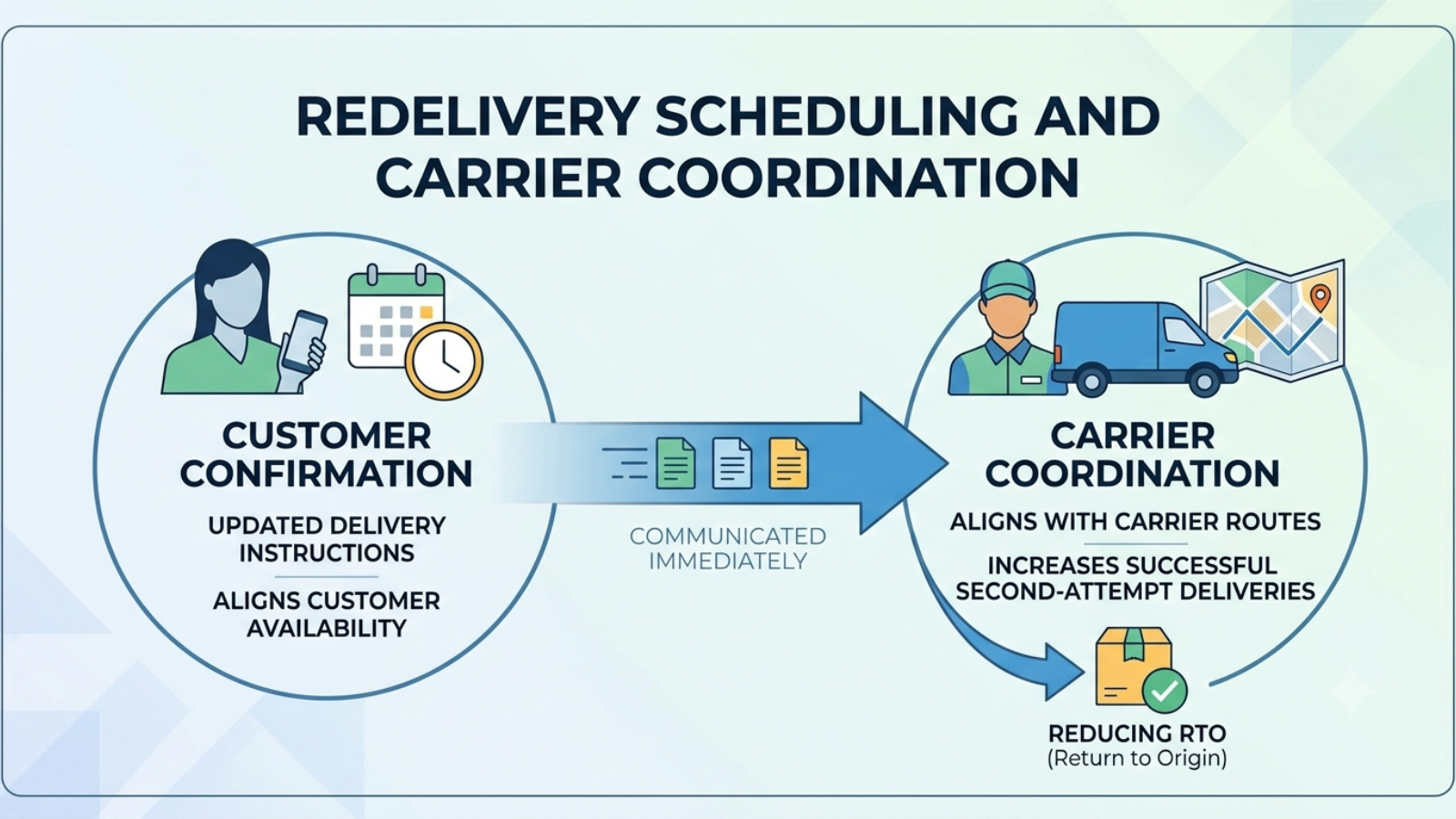 Redelivery scheduling and carrier coordination ensure updated delivery instructions are communicated to the courier immediately after customer confirmation.
It aligns customer availability with carrier routes, increasing successful second-attempt deliveries and reducing RTO.
Closing the Loop After Customer Contact
Customer outreach without operational follow-through is incomplete. NDR management for COD delivery recovery in India requires that a successful customer contact, the customer confirms a new slot, provides a corrected address, reconfirms delivery intent, and translates directly into an updated redelivery instruction to the carrier without manual intervention in the middle.
Base.com’s NDR workflow closes this loop automatically. When a customer confirms a new delivery slot through an automated call or WhatsApp interaction, the system updates the shipment record and pushes the new instruction to the carrier. The operations team does not need to manually communicate this to the courier.
This automatic instruction update is operationally critical. In a manual workflow, the chain looks like: automated call → customer responds → team member reads response → team member calls courier → courier updates delivery schedule. Every manual step is a delay risk and a dropout risk.
In Base.com’s integrated workflow: customer responds → system updates shipment record → carrier instruction auto-updated. The loop closes without human intervention at any step between customer confirmation and carrier notification.
Carrier Reassignment for Unserviceable NDRs
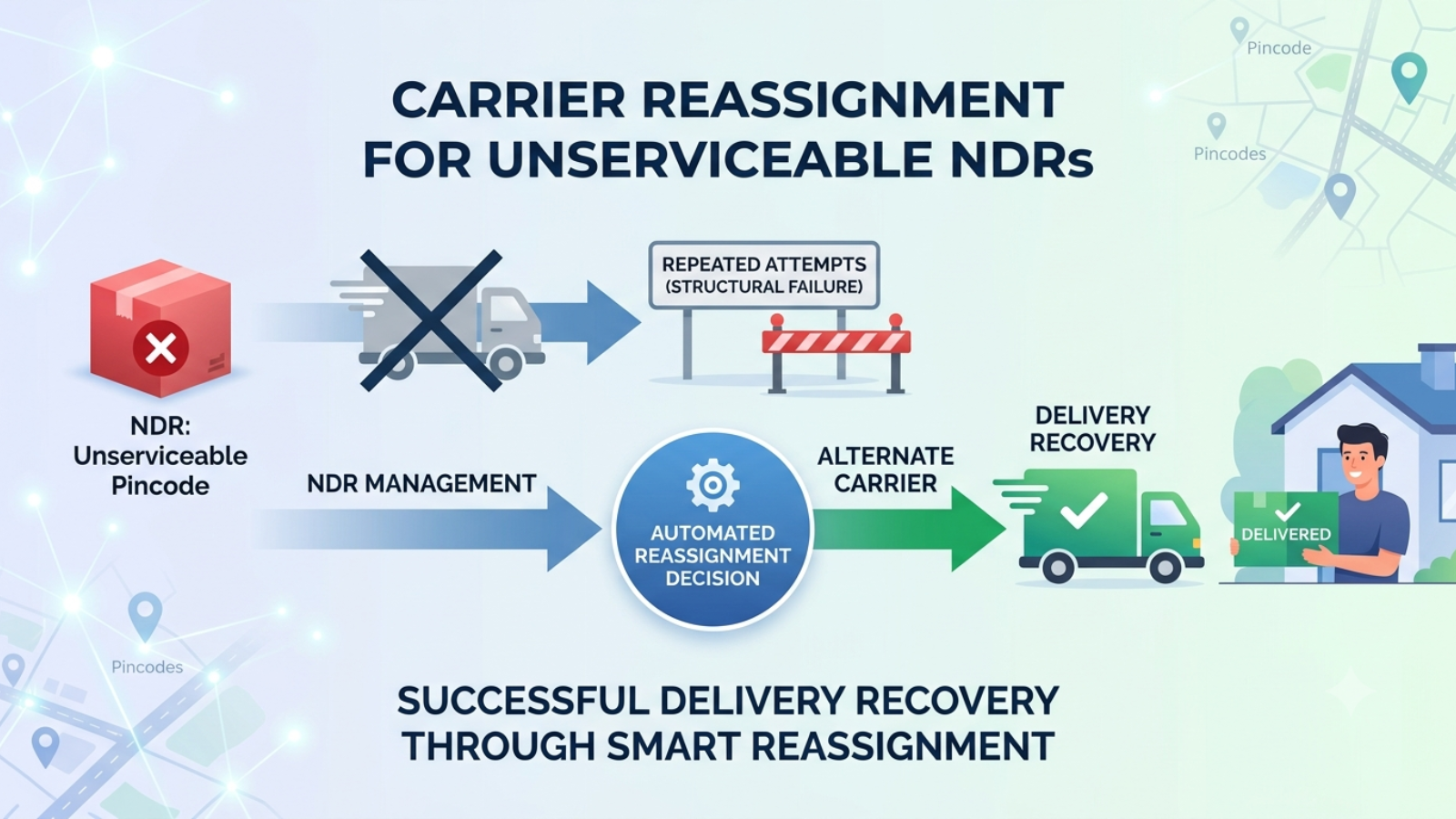 When an NDR is generated because the assigned carrier cannot service the specific pincode or address, NDR management for COD delivery recovery in India requires reassignment to an alternate carrier, not repeated delivery attempts by a carrier that structurally cannot complete the delivery.
Base.com’s carrier performance data and allocation logic support this reassignment, identifying alternate carriers with better serviceable coverage for the specific delivery location and reassigning the shipment before another failed attempt is logged.
How Base.com Builds NDR Management Into the Operations Layer
Base.com approaches NDR management for COD delivery recovery in India as an integrated operations function, not a standalone tool that sits outside the main workflow. This integration is what makes the outcomes measurable and consistent.
The Complete Base.com NDR Workflow
| Stage | Action | How Base.com Handles It |
|---|---|---|
| NDR received | Real-time alert to operations dashboard | Automatic NDR ingestion from carrier API |
| Reason classification | Map to internal workflow trigger | Automated reason code routing |
| Customer outreach | Confirmation or rescheduling contact | Automated call or WhatsApp sequence |
| Customer response | Update redelivery instruction | System auto-updates from customer input |
| Carrier coordination | Push updated instructions to the courier | Automated carrier API update |
| Performance tracking | Monitor NDR-to-delivery conversion rate | Integrated reporting within the operations view |
| Carrier reassignment | Switch to a better-performing courier | TAT-based allocation logic |
Every step in this workflow runs within Base.com’s single integrated system. There is no tool-switching, no manual data transfer between systems, and no step where a team member needs to intervene in a standard case.
Building an NDR Management Process: What Indian D2C Brands Must Do First
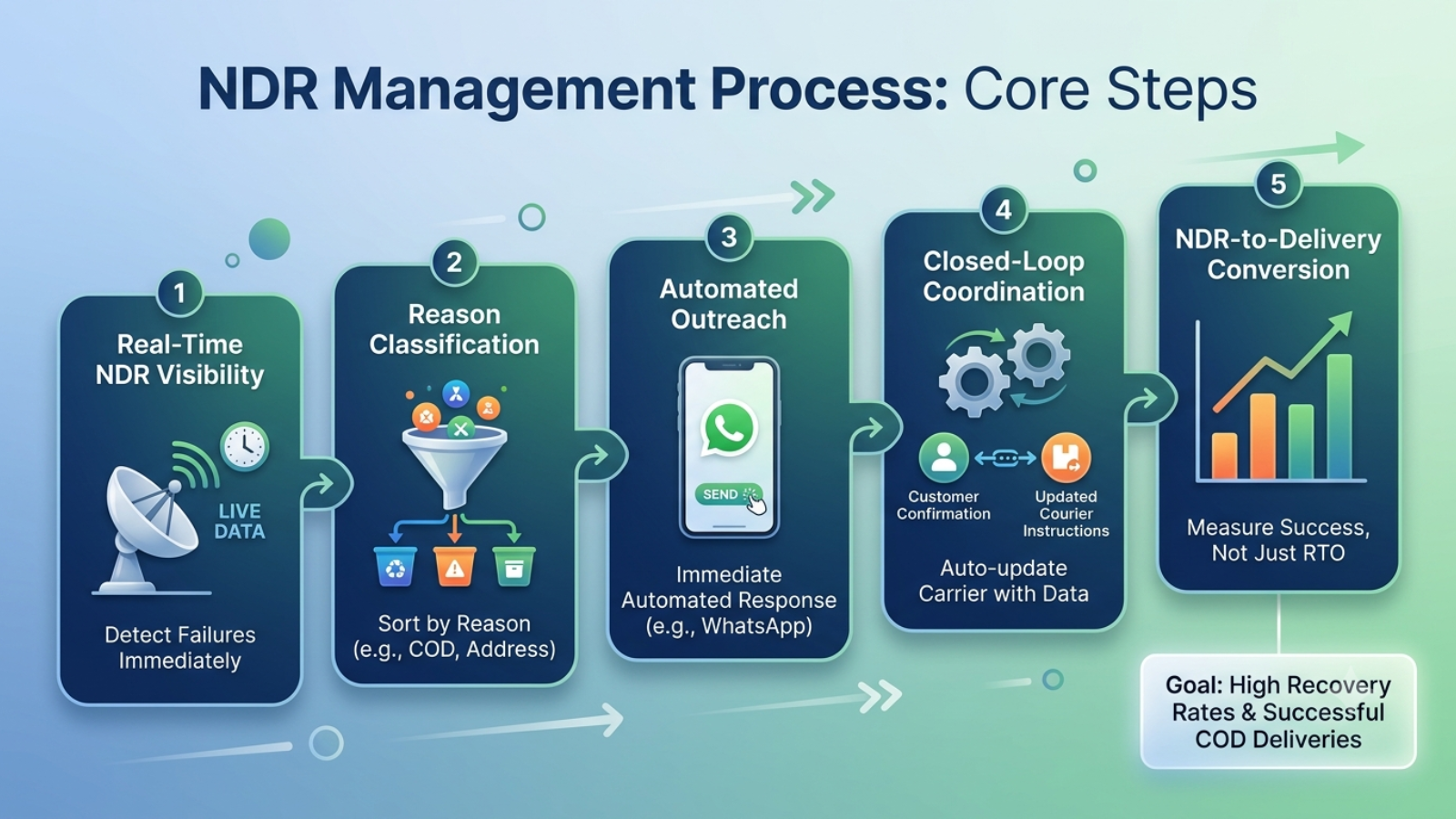 Start by mapping your current NDR flow, where failures occur, how quickly they are detected, and how teams respond.
Then prioritise real-time detection, reason-based workflows, and automated outreach to convert recoverable NDRs into successful deliveries consistently.
Step 1: Get Real-Time NDR Visibility Before Anything Else
If the operations team is reviewing NDRs in a morning batch report, the recovery window is already compromised for a large share of the previous day’s failures. Real-time visibility is the prerequisite for effective NDR management for COD delivery recovery in India. Without it, every other component of the process operates on delayed information.
Step 2: Classify Before You Contact
Undifferentiated outreach, the same message to every NDR regardless of reason, produces mediocre recovery rates. Classifying NDR reasons and routing to reason-specific workflows before any customer contact is initiated is what separates high-performing NDR management from basic follow-up.
Step 3: Automate the Outreach, Not Just the Alert
Knowing about an NDR in real time is only useful if the follow-up happens in real time too. Manual outreach at scale is not viable. NDR management for COD delivery recovery in India at D2C order volumes requires automated outreach, calls, WhatsApp, or SMS, triggered immediately by the NDR event, not queued for a team member to action when bandwidth allows.
Step 4: Close the Loop to the Carrier Automatically
Customer confirmation that does not automatically update the carrier instruction is a broken loop. Every manual step between customer response and carrier notification is a failure point. The workflow must close end-to-end, from customer confirmation to updated delivery instructions, without manual intervention in standard cases.
Step 5: Measure NDR-to-Delivery Conversion, Not Just RTO Rate
RTO rate is the outcome metric. NDR management for COD delivery recovery in India performance is measured by the NDR-to-delivery conversion rate, what percentage of actionable NDRs recovered as successful deliveries. Tracking this metric separately allows the operations team to identify which NDR reasons have the highest recovery rates and prioritise workflow investment accordingly.
Bottom Line
NDR management is not about reacting to failed deliveries; it is about preventing them from turning into permanent losses. When Indian D2C brands shift from delayed, manual handling to real-time detection, reason-based workflows, and automated execution, recovery becomes consistent and scalable.
The difference is structural. Instead of accepting NDRs as inevitable, brands start converting them into successful deliveries, protecting revenue and improving customer experience at the same time.
A well-built NDR system does not just reduce RTO; it strengthens the entire fulfilment operation.
Want to build a structured NDR management process that recovers failed deliveries before they become RTOs? [Talk to the Base.com team →]
Frequently Asked Questions
Q1. What is NDR management for COD delivery recovery in India, and why does it matter?
NDR management is the process of intercepting failed delivery reports before they convert into returns. Many NDRs are recoverable due to temporary issues like availability or minor address errors. Structured workflows with quick customer outreach help convert these into successful deliveries, preserving revenue and reducing unnecessary return-to-origin losses.
Q2. How quickly should brands act after an NDR is generated?
Brands should act within 24-48 hours, with the first 4-8 hours being most critical. Immediate outreach increases the chances of same-day or next-day redelivery. Effective NDR management requires real-time detection and automated communication within 1-2 hours, rather than delayed manual follow-ups that reduce recovery probability.
Q3. How does Base.com handle NDR management for Indian D2C brands?
Base.com processes NDR data in real time, classifies failure reasons, and triggers automated workflows like confirmation calls or rescheduling messages. Customer responses update carrier instructions instantly. This integrated approach reduces manual effort and improves recovery rates, helping brands significantly lower RTO by converting failed deliveries into successful completions.
Q4. Which NDR reasons have the highest recovery rates for Indian D2C brands?
“Customer not available” NDRs have the highest recovery rates, often 50-70% with quick follow-up. “Address not found” can recover 40-60% with prompt correction. “Customer refused” has a lower recovery rate at 15-30% but still benefits from targeted retention efforts. Reason-specific workflows perform far better than generic follow-up approaches.
Q5. What metrics should brands track to evaluate NDR management performance?
The key metric is the NDR-to-delivery conversion rate, showing how many failed deliveries are recovered. This should be tracked by reason type. Additional metrics include time-to-first-contact, carrier dispute resolution rate, and overall RTO trends. Tracking only RTO without NDR breakdown limits visibility into where recovery processes need improvement.