
Hitting ₹10Cr ARR can feel like stability, but in India, it often hides structural cracks that show up only when volume rises. Many brands move from a single warehouse to multi-city shipping and suddenly see delivery performance swing because zone-based courier allocation changes.
On marketplaces like Amazon and Flipkart, even a small spike in late dispatch or cancellations can pull down account health and reduce visibility during high intent periods. At this stage, returns and RTO start behaving like a cost line, not an exception.
For many Indian categories with high COD mix, RTO can easily run 12 to 25% depending on pin code quality, and every failed COD attempt adds forward shipping plus return shipping, eating margin quietly.
A common India-specific problem is blocked working capital from mixed channels. Marketplaces typically pay on a settlement cycle, while you pay vendors and packaging upfront.
If your cash cycle stretches to 45 to 75 days, you start under-buying winners and over-buying slow movers. Another blind spot is GST credit leakage.
When returns are not reconciled correctly across 3PL, marketplace returns, and your invoicing, brands lose input tax credit without realizing it. At ₹10Cr ARR, ops discipline decides whether you scale cleanly or bleed margin.
Why Ops Becomes the Real Growth Blocker After ₹10Cr ARR
At ₹10Cr ARR, the challenge is no longer demand generation. It is execution. Margins start shrinking without clarity. Returns increase. Warehousing becomes complex. Teams expand, but ownership reduces.
Most founders still think in terms of marketing efficiency, but growth now depends on operational discipline.
Here is what typically changes after ₹10Cr ARR:
- Monthly order volume crosses 8,000 to 15,000 orders
- SKU count increases from 15 to 50 plus
- Warehousing shifts from a single location to multi node
- Cash cycle becomes 60 to 90 days
- Return rate crosses 18 percent in many categories
If operations are not structured, D2C ops mistakes become the main reason growth stalls. These are not obvious errors. They are slow leaks.
Once a brand crosses ₹10Cr ARR, operations stop being a backend function and become the core profit driver. At this scale, most Indian D2C brands process 8,000 to 20,000 orders per month, operate across their own website plus 2 to 4 marketplaces, and manage 25 to 60 SKUs.
That is exactly where D2C ops mistakes and scaling mistakes D2C brands make start compounding. Below is a detailed breakdown of the most expensive blind spots, how they impact Indian sellers specifically, and how to fix them.
Once a brand crosses ₹10Cr ARR, operations stop being a backend function and become the core profit driver. At this scale, most Indian D2C brands process 8,000 to 20,000 orders per month, operate across their own website plus 2 to 4 marketplaces, and manage 25 to 60 SKUs. That is exactly where D2C ops mistakes and scaling mistakes D2C brands make start compounding. Below is a detailed breakdown of the most expensive blind spots, how they impact Indian sellers specifically, and how to fix them.
1. Inventory Forecasting Based on Sales Instead of Contribution
 At ₹10Cr ARR, many founders still plan inventory based on what sells the most, not what makes the most money.
The Real Problem
A SKU doing ₹20 lakh monthly revenue at 35 percent gross margin may look like a winner. But if another SKU does ₹8 lakh revenue at 60 percent margin with a lower return rate, the second SKU may generate a higher contribution per unit.
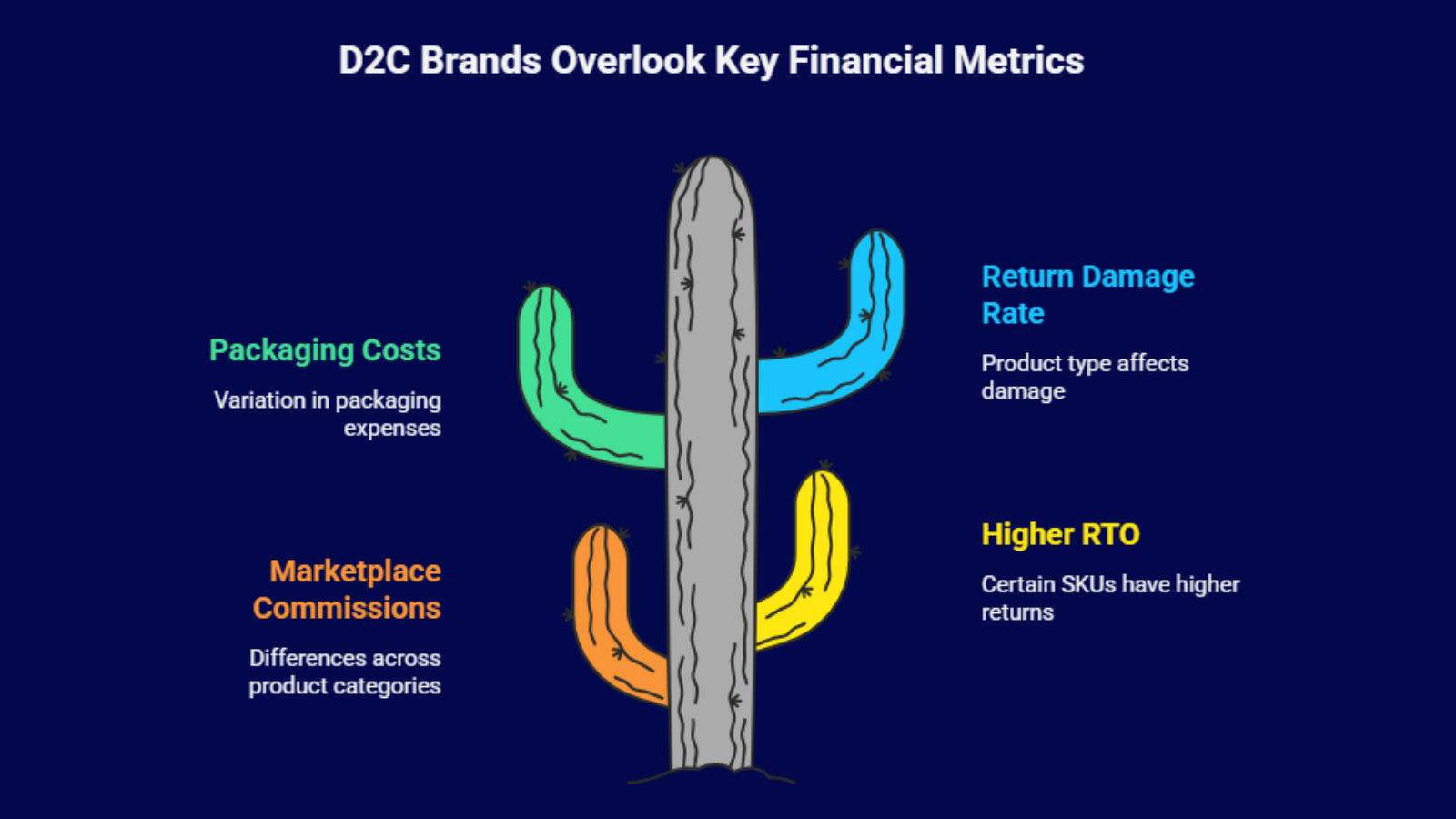
Indian brands often ignore:
- Marketplace commission differences across categories
- Higher RTO in certain SKUs
- Packaging cost variation
- Return damage rate by product type
If inventory is allocated based purely on revenue velocity, working capital gets locked into low contribution SKUs.
Financial Impact
- 3 to 5 percent of revenue is lost in excess holding costs
- 60 to 90 days blocked capital in slow movers
- Stockouts on high contribution SKUs during peak sale days
- Higher discounting pressure to clear dead stock
On marketplaces like Amazon, stockouts reduce listing rank. Even 5 to 7 days of stockout during high traffic periods can drop organic ranking significantly.
How to Solve It
- Track SKU level contribution margin after shipping, commission, payment gateway, and returns.
- Use a 30 day rolling sell-through rate.
- Set reorder point = average daily sales × lead time + safety stock.
- Liquidate inventory that does not move in 90 days.
- Allocate buying budget based on contribution share, not revenue share.
Ignoring this is one of the most common D2C ops mistakes post ₹10Cr ARR.
2. Not Building a Unified Ops Dashboard
At this stage, data fragmentation becomes dangerous. Marketing tracks ROAS. Finance tracks revenue. Ops tracks dispatch. But no one tracks net profitability daily.
Why This Hurts Indian Sellers
Marketplace settlement reports, Shopify data, 3PL dashboards, and payment gateway data all sit in separate systems. Refunds are processed separately. RTO adjustments show up weeks later.
Without integration:
- Contribution margin is miscalculated.
- Refund liabilities are ignored.
- Inventory ageing is not visible.
Many scaling mistakes D2C brands make happen because decisions are based on incomplete data.
Metrics That Must Be Tracked Daily
- Contribution margin after returns
- Net fulfillment cost per order
- RTO rate by state and courier
- Refund TAT
- Inventory ageing bucketed as 0 to 30, 30 to 60, 60 to 90 days
- Marketplace cancellation rate
On Flipkart and Amazon, a cancellation rate above the threshold can reduce listing visibility or invite penalties.
How to Solve It
- Create a central dashboard pulling data from the website, marketplaces, and 3PL.
- Track weekly profitability, not just revenue.
- Monitor courier performance by pin code cluster.
Assuming finance reports are enough is one of the biggest D2C ops mistakes.
3. Underestimating Returns and Reverse Logistics
 Returns are not just a logistics issue. They are a margin destroyer.
In many Indian categories:
- COD contributes 40 to 70 percent of orders.
- COD RTO can be 15 to 25 percent, depending on the region.
- Apparel return rate can cross 25 percent.
What Founders Miss
Every COD RTO means:
- Forward shipping cost
- Return shipping cost
- Possible packaging damage
- Payment gateway reversal cost
If the reverse cost per order increases from ₹70 to ₹120, and the return rate increases from 15 to 22 percent, the net margin can drop by 8 to 12 percent.
Refund TAT also matters. Delays beyond 7 days increase support tickets significantly. Support cost per ticket in India can range from ₹20 to ₹60, depending on outsourcing.
Marketplace Nuance
Marketplaces sometimes auto-approve returns. Quality check failures may not always recover seller losses. Many brands do not reconcile this properly.
How to Solve It
- Track RTO by courier and by pin code.
- Reduce COD exposure in high-risk regions.
- Improve product detail pages to reduce expectation mismatch.
- Restock returned items within 48 hours.
- Reconcile return claims weekly with marketplaces.
Ignoring reverse logistics is one of the most dangerous scaling mistakes D2C brands make.
4. Expanding SKUs Without Operational Readiness
After ₹10Cr ARR, founders feel pressure to launch new products monthly.
More SKUs increase complexity dramatically.
What Actually Happens
- Forecasting error increases.
- Picking errors increase.
- More packaging variations increase confusion.
- MOQ from vendors forces over-buying.
If the SKU count increases from 25 to 60 without a system upgrade, the warehouse error rate often rises above 2 percent. Even a 2 percent wrong dispatch on 15,000 monthly orders means 300 unhappy customers.
Marketplace Impact
Wrong dispatch leads to negative reviews. Negative reviews affect conversion rate. A 0.5 percent drop in conversion on Amazon can significantly impact revenue at scale.
How to Solve It
- Implement bin-level tracking.
- Use barcode scanning for every SKU.
- Test new SKUs with a limited batch before bulk buying.
- Align MOQ with a realistic 60-day demand forecast.
Launching without ops readiness is one of the classic D2C ops mistakes.
5. Ignoring Warehouse Discipline
 When daily orders cross 500, manual systems break.
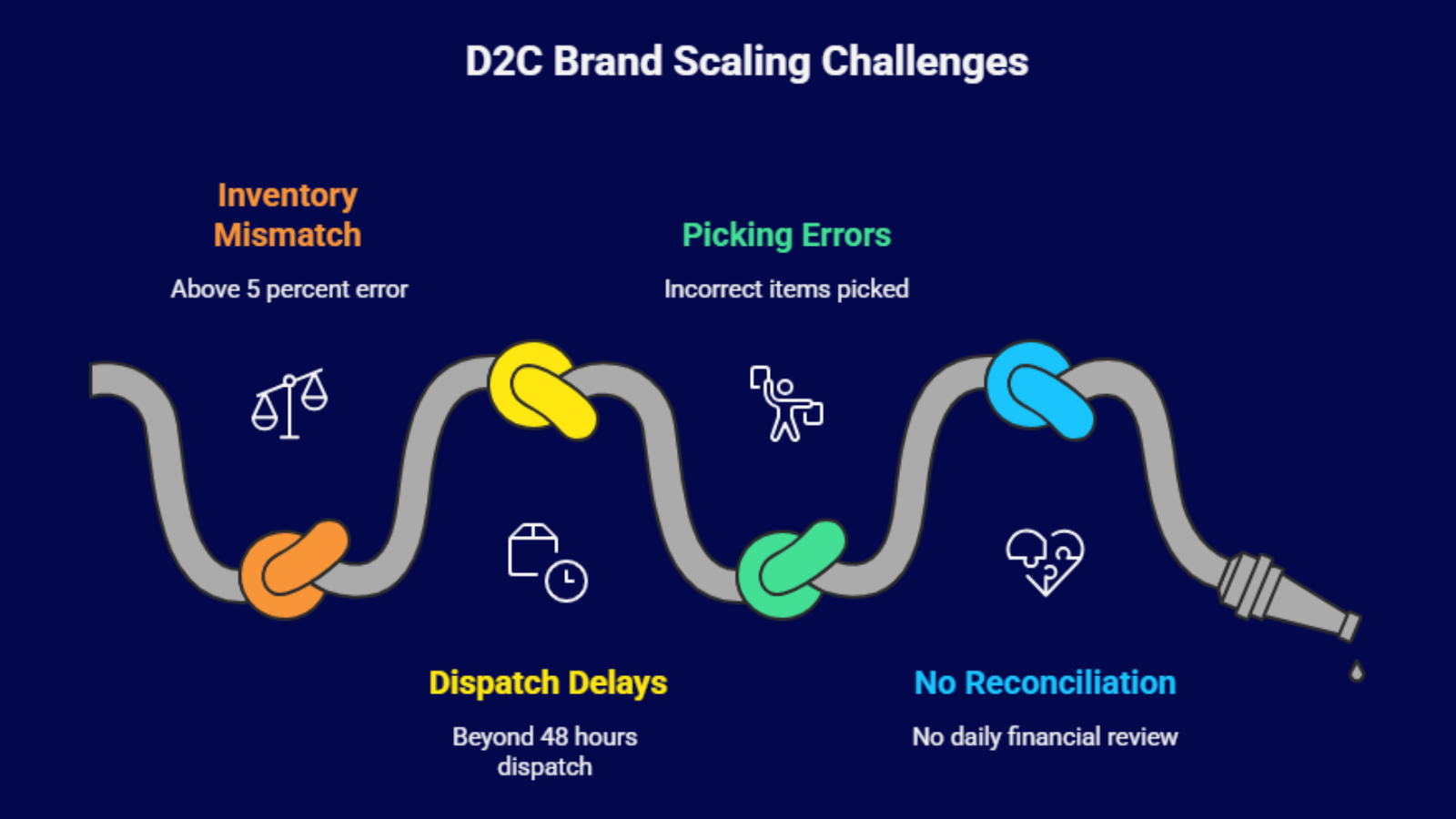
Common Problems
- Inventory mismatch above 5 percent
- Dispatch beyond 48 hours
- Picking errors
- No daily reconciliation
Delayed dispatch reduces the marketplace performance score. On Amazon, late dispatch rate impacts seller rating directly.
Impact
- Increased cancellations
- Higher returns
- Increased negative feedback
- Increased support workload
How to Solve It
- Daily cycle counting of high-value SKUs
- Mandatory barcode scanning
- Defined dispatch SLA under 24 hours
- Warehouse performance KPIs are reviewed weekly
Warehouse inefficiency is one of the most underestimated scaling mistakes D2C brands face.
6. Cash Flow Blind Spots
Revenue at ₹10Cr ARR does not equal liquidity.
Indian sellers face:
- 7 to 15-day settlement delays on marketplaces
- Payment gateway rolling reserves
- Vendor advance payments
- GST liabilities
Inventory blocking 90 days of capital can stress cash flow heavily.
Hidden Risks
- Refund liability is not adjusted weekly
- Credit note misalignment with GST filings
- Seasonal over-buying before sale events
Cash stress forces emergency discounting, which further reduces margin.
How to Solve It
- 13-week rolling cash flow forecast
- Maintain inventory to sales ratio under control
- Allocate buying budget based on actual cash position
- Track GST credit reconciliation monthly
Many scaling mistakes D2C brands make are cash-related, not revenue-related.
7. No Clear Ops Ownership
 At this stage, founder dependency becomes a bottleneck.
If there is no Head of Ops:
- Vendor issues escalate slowly
- No one tracks warehouse KPIs daily
- No accountability for returns
Clear ownership must exist for:
- Inventory planning
- Courier management
- Returns reconciliation
- Marketplace compliance
Without this, small D2C ops mistakes become systemic problems.
8. Not Auditing Vendor Performance
Courier costs and performance vary widely across India.
Some couriers perform better in metro zones, others in tier 3 regions.
What Most Brands Ignore
- On-time delivery percentage by zone
- Damage rate trends
- RTO difference across couriers
- Cost per kg increases over time
Even a ₹10 increase per shipment across 15,000 monthly orders means a ₹1.5 lakh monthly cost increase.
How to Solve It
- Monthly courier performance review
- Pin code-wise courier mapping
- Negotiate rates quarterly
- Maintain backup courier partners
Vendor blind spots are silent D2C ops mistakes that slowly erode profitability.
Final Thoughts
Reaching ₹10Cr ARR proves demand exists. But crossing ₹15Cr to ₹25Cr depends on how tight your backend runs. At this stage, even small D2C ops mistakes start showing up in the margin.
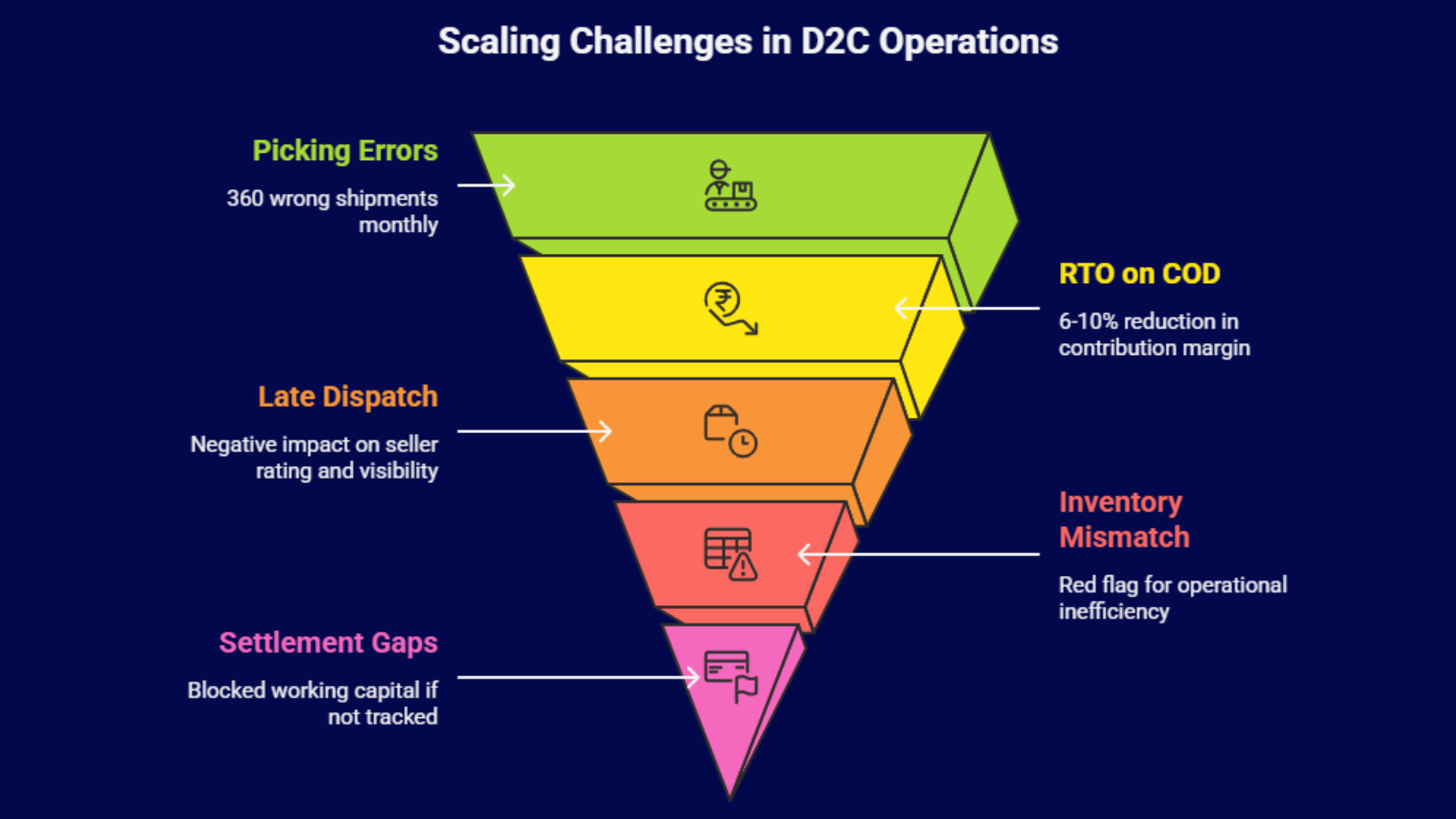 A 2 percent picking error on 18,000 monthly orders means 360 wrong shipments. A 20 percent RTO on COD in tier 2 and tier 3 regions can quietly reduce contribution margin by 6 to 10 percent. On marketplaces, late dispatch above allowed thresholds directly impacts seller rating and listing visibility.
Many Indian brands do not realize that an inventory mismatch above 3 to 5 percent is already a red flag. Or that settlement reconciliation gaps with Amazon and Flipkart can block lakhs in working capital if not tracked weekly. These are typical scaling mistakes D2C brands discover only when cash flow tightens.
This is where Base.com automation changes execution quality. With Base label printing, brands can auto-generate courier labels directly from order panels without manual errors. Picking and packing workflows reduce wrong dispatch through barcode validation. Built-in WMS tracks bin level inventory, ageing, and real-time stock movement across warehouses. Automated reconciliation helps match orders, returns, and settlements.
At scale, structured automation reduces D2C ops mistakes, improves dispatch SLA, and protects marketplace performance. Because beyond ₹10Cr ARR, clean operations are what unlock profitable growth.
Frequently Asked Questions
1. Why do operational issues increase after ₹10Cr ARR?
Because order volume, SKU complexity, and cash cycles increase. Systems that worked earlier break under scale, leading to D2C ops mistakes that impact margin and customer experience.
2. What is the biggest scaling mistake D2C brands make post ₹10Cr?
Ignoring contribution margin after returns. Many brands track revenue but not net profitability, which creates serious scaling mistakes that D2C brands only notice when cash flow tightens.
3. How often should inventory forecasting be reviewed?
At least weekly, using rolling 30-day velocity. Forecasting based only on monthly revenue leads to D2C ops mistakes that cause stockouts and dead inventory.
4. Should founders still manage ops after ₹10Cr ARR?
No. Founders should oversee strategy. Operational ownership must shift to a dedicated head. Without this, scaling mistakes D2C brands make will continue to repeat.
5. How can brands reduce reverse logistics losses?
Reduce COD exposure, improve product descriptions, analyze RTO by pin code, and shorten refund TAT. Ignoring this leads to recurring D2C ops mistakes.