
When you scale a brand in India, the logistical complexity grows faster than the revenue. Most sellers start by keeping all their stock in one room or a single warehouse in a major city. But as soon as you start selling on your own website, Amazon, and Myntra simultaneously, you realize that knowing exactly what you have and where it is located becomes your biggest hurdle.
In the Indian market, customers are no longer patient. The rise of quick-commerce has conditioned shoppers to expect their packages almost immediately. If your stock is in Delhi and your customer is in Kochi, you are already at a disadvantage. An Order Management System (OMS) acts as the brain of your operations, ensuring that multi-warehouse fulfillment in India is handled without manual intervention.
Why Inventory Visibility is a Struggle for Indian Sellers?
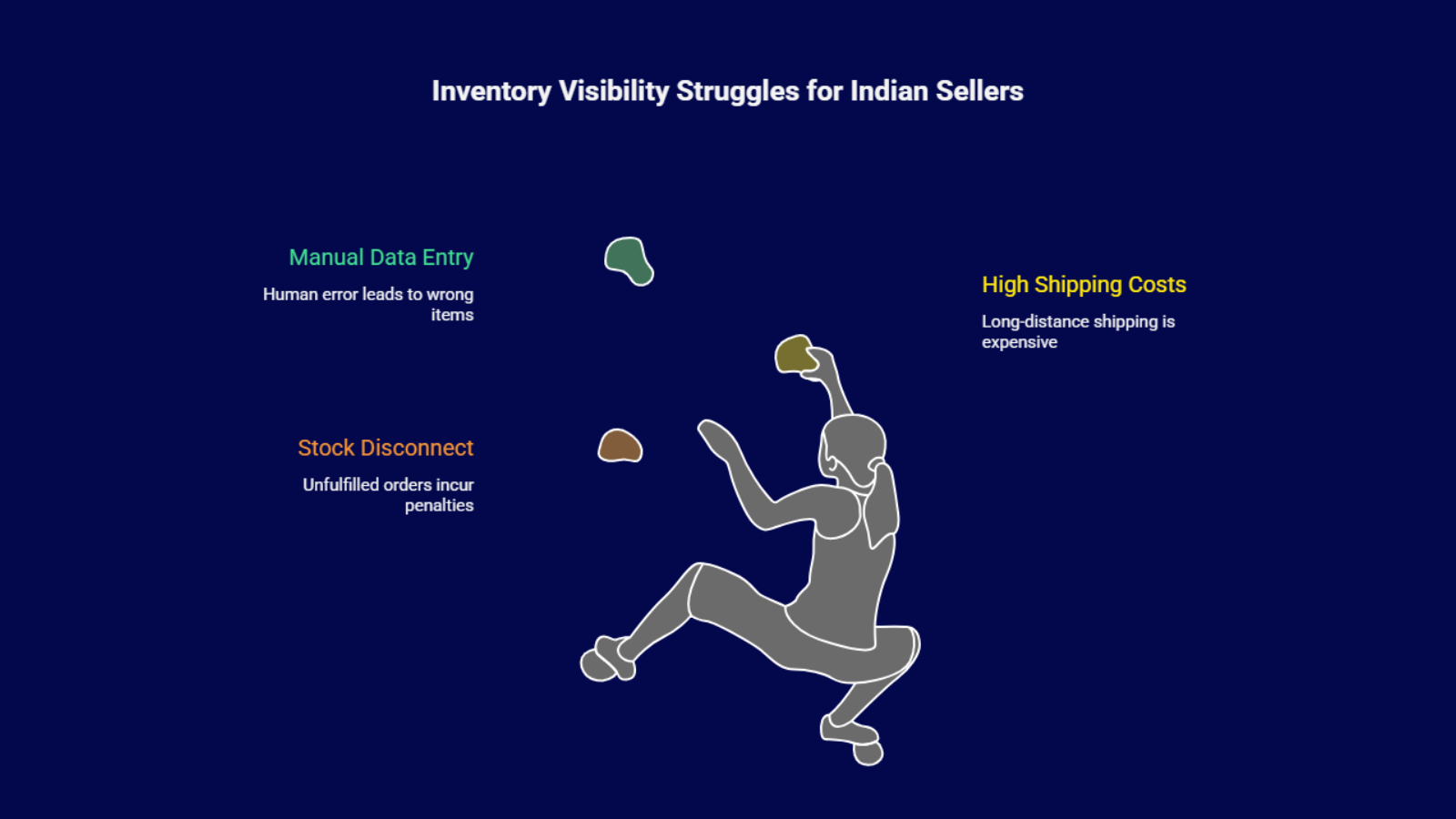
Most Indian brands deal with fragmented data. You might have stock at a 3PL in Mumbai, some in your own office in Bangalore, and some at a marketplace fulfillment center. Without inventory allocation in OMS, you are essentially guessing your stock levels. This leads to two major problems: overselling or under-stocking.
Overselling happens when your website says a product is in stock, but it actually sold out on a marketplace ten minutes ago. Under-stocking is just as bad; it’s when you have stock sitting in a warehouse, but because your systems aren’t synced, your website shows “Out of Stock.” This loss of revenue is entirely preventable with automated inventory allocation in OMS.
| The Problem | How it hurts your margins | The OMS Fix |
|---|---|---|
| Stock Disconnect | You pay penalties to marketplaces for unfulfilled orders. | Real-time sync across every sales channel. |
| High Shipping Costs | Shipping a Rs. 500 item from North to South India. | Automated multi-warehouse fulfillment in India. |
| Manual Data Entry | Human error leads to the wrong size or color being sent. | Barcode-based picking and automated labeling. |
How Allocation Logic Prevents Fulfillment Errors
The strategy for successful retail in India has shifted. You cannot rely on one central hub if you want to keep shipping costs low. By distributing your inventory across different regions, you engage in multi-warehouse fulfillment in India. This allows you to convert national shipments into local or regional ones.
When an order comes in from West Bengal, a smart OMS looks at your warehouse network and identifies the Kolkata hub as the fulfillment point. This doesn’t just save you money on courier fees; it reduces the time the package spends in transit. For an Indian brand, less time in transit directly correlates to a lower Return to Origin (RTO) percentage.
Inventory allocation in OMS is about more than just counting boxes. It is about “reserving” the right unit for the right customer the moment they click buy. If you are running a flash sale, thousands of people might be looking at the same SKU. The system must be fast enough to allocate that stock and hide the “Buy” button the millisecond the last unit is claimed.
For brands that handle perishable goods or beauty products, inventory allocation in OMS can also manage expiry dates. You can set the system to ship products that are closest to their expiry date first. This reduces wastage and ensures you aren’t stuck with “dead stock” that you can no longer sell at full price.
10 ways an OMS Improves your Daily Operations
Implementing a robust system transforms your daily warehouse activities from a chaotic manual process into a structured and predictable workflow. By centralizing your data, you can oversee every moving part of your supply chain without having to micromanage individual staff members or logistics partners. This level of automation ensures that multi-warehouse fulfillment in India remains efficient even as your order volume doubles or triples during peak shopping seasons.
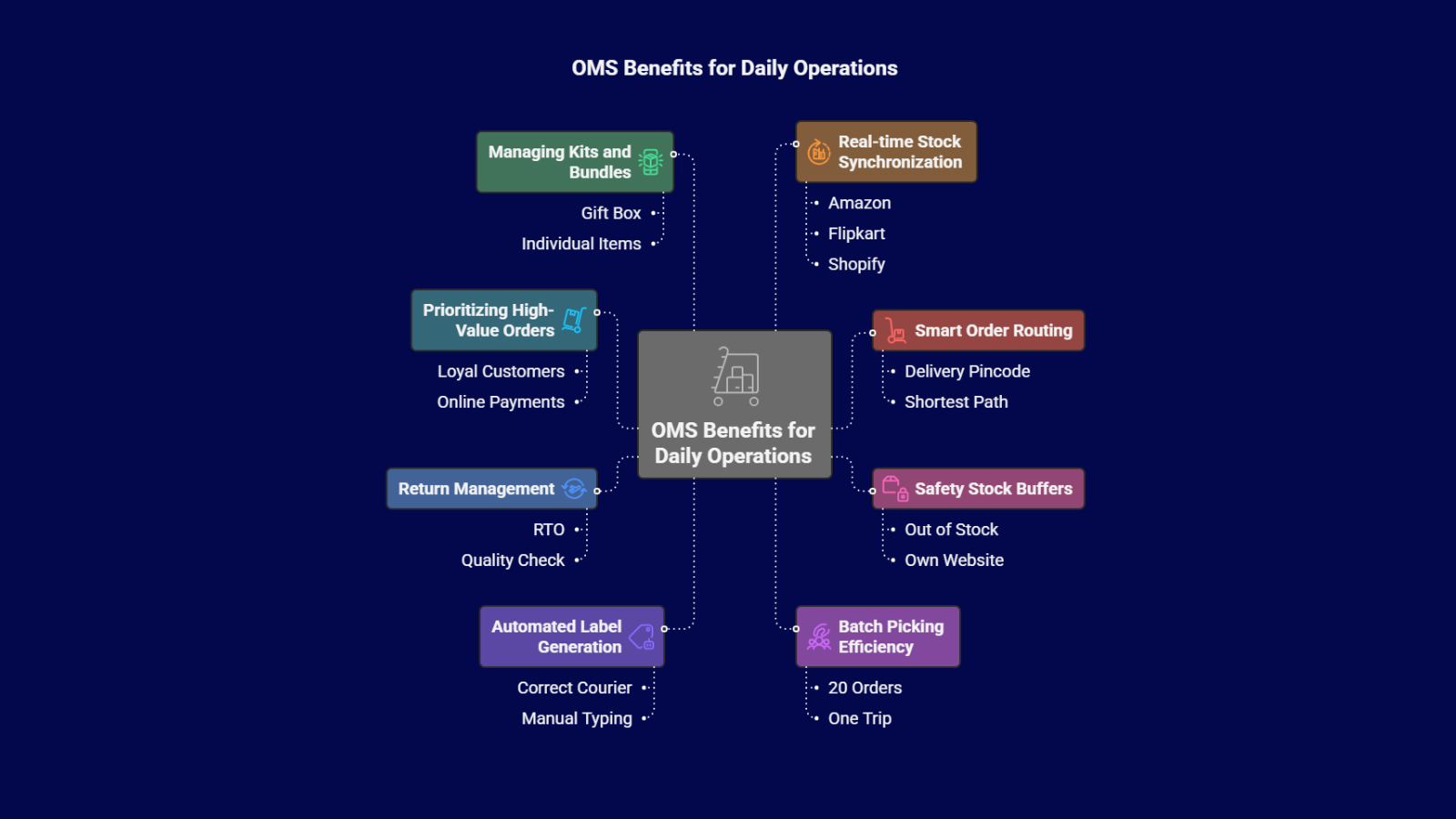
1. Real time stock synchronization
The system ensures that your inventory levels on Amazon, Flipkart, and your Shopify store are always identical. This prevents the nightmare of having to call a customer and tell them their order cannot be fulfilled.
2. Smart order routing
The OMS automatically decides which warehouse should handle an order based on the delivery pincode. This is the core of multi-warehouse fulfillment in India, ensuring the shortest path to the customer.
3. Safety stock buffers
You can set a rule that once a product reaches a count of 5, it shows as “Out of Stock” on marketplaces but remains available on your own website. This protects your brand’s primary sales channel.
4. Batch picking efficiency
Instead of walking across the warehouse for one order, the system groups orders together. Warehouse staff can pick items for 20 orders in one trip, significantly speeding up the dispatch process.
5. Automated label generation
As soon as an order is assigned, the shipping label is generated with the correct courier partner. This removes the need for manual typing, which is where most address errors happen.
6. Return management and quality checks
When a product comes back as an RTO, the OMS helps the warehouse team scan it back into the system. If it passes a quality check, it is immediately added back to the “Available” inventory.
7. Prioritizing high value orders
You can configure inventory allocation in OMS to prioritize orders from loyal customers or those who have already paid online over Cash on Delivery (COD) orders during high-demand periods.
8. Managing kits and bundles
If you sell a “Gift Box” that contains three different products, the OMS tracks the individual inventory of all three items. If one item runs out, the bundle automatically shows as unavailable.
9. Courier performance tracking
The system can choose a shipping partner based on who has the best delivery record for a specific Indian state. This data-driven approach ensures your multi-warehouse fulfillment in India actually works.
10. Multi-location stock transfers
If one warehouse is running low but another has a surplus, the OMS can flag this. It helps you manage the movement of stock between hubs to keep your inventory allocation in OMS balanced.
Solving the RTO Problem with Speed
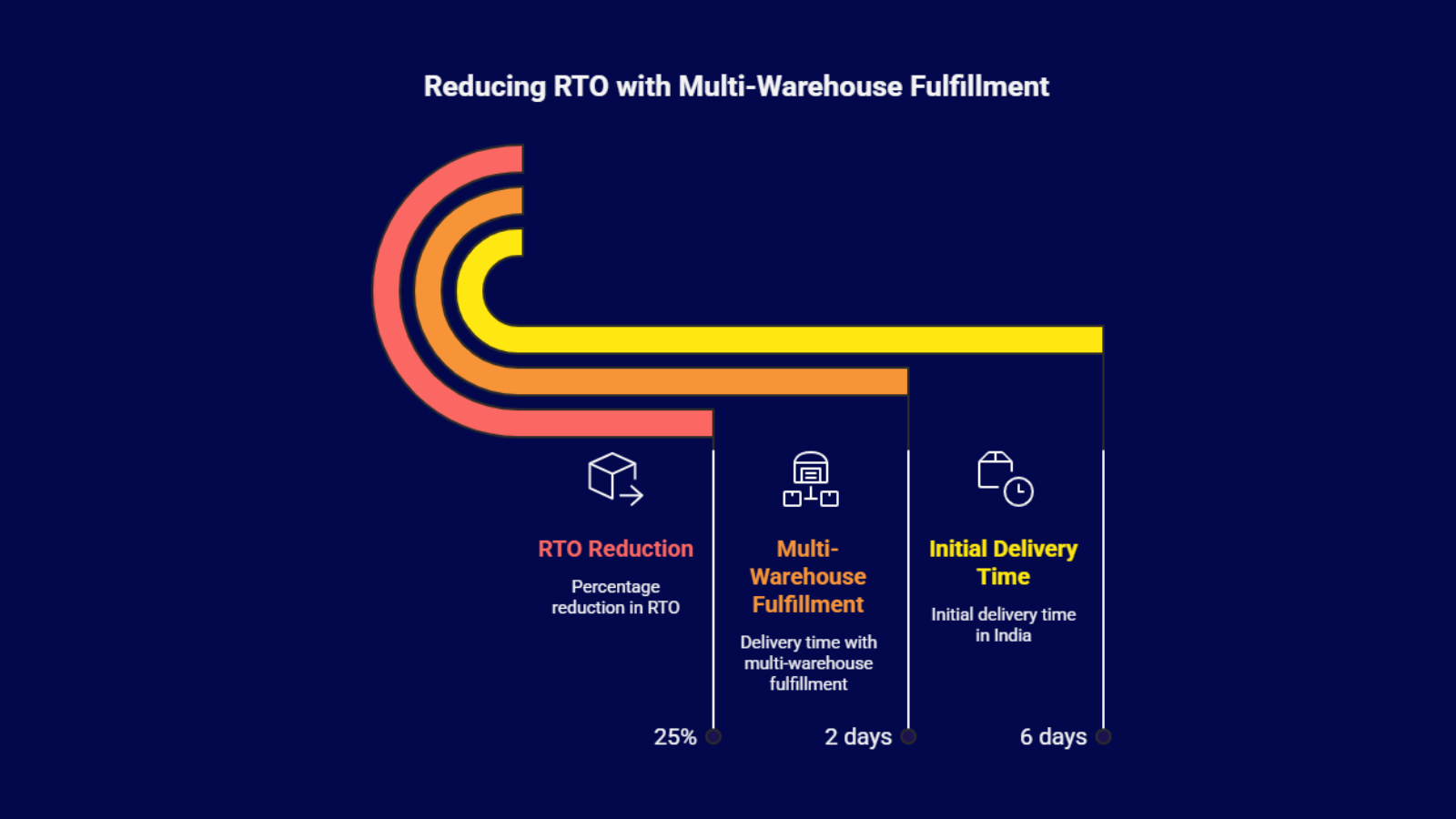
In India, COD is still a huge part of the market. The longer a package takes to arrive, the more likely the customer is to change their mind. Using multi-warehouse fulfillment in India to cut delivery time from 6 days to 2 days can reduce RTO by as much as 25 percent.
Accuracy is the other half of the puzzle. Sending a “Size M” when the customer ordered “Size L” is a guaranteed return. By using inventory allocation in OMS combined with handheld scanners in the warehouse, the margin for error is almost zero. The system won’t let the packer print a label unless the correct barcode has been scanned.
Using an OMS gives you a clear picture of where your demand is coming from. If 40 percent of your orders are from North India, but you only have a warehouse in Bangalore, the data will show you exactly how much you are overpaying in shipping. This evidence makes it easy to decide when to expand your multi-warehouse fulfillment in India to a new location.
Efficient inventory allocation in OMS also helps you understand your “Turnover Ratio.” You can identify which products are moving fast and which ones are just taking up shelf space. In the low-margin world of B2C, freeing up capital from slow-moving stock is essential for staying cash-flow positive.
Click here to know more about the future of e-commerce operations and how OMS & WMS shape it.
Frequently Asked Questions
1. Why is multi-warehouse fulfillment in India necessary for small brands?
Even small brands face high customer expectations. If you ship everything from one city, your shipping costs for distant states will be high. Using a distributed network allows you to offer faster delivery times and stay competitive with larger players.
2. How does inventory allocation in OMS handle marketplace sales?
The OMS acts as a central hub. When a product sells on any marketplace, the system instantly reduces the count across all other platforms. This prevents overselling and protects your seller rating on competitive platforms like Amazon or Flipkart.
3. What happens if a warehouse runs out of a specific product?
A smart system will automatically check the next closest warehouse that has the item. While the shipping cost might be slightly higher, the inventory allocation in OMS ensures you don’t lose the sale entirely due to a local stockout.
4. Does an OMS help in reducing manual labor in the warehouse?
Yes, it automates the creation of pick lists and shipping labels. By streamlining how orders are processed, your existing team can handle a much higher volume of orders without needing to hire more staff or working overtime.
5. How long does it take to sync inventory across India?
Modern systems sync in near real-time, usually under 60 seconds. This is vital for multi-warehouse fulfillment in India because it ensures that your stock levels are accurate across the country, regardless of how many warehouses you operate.