The story of every high-growth Indian Direct-to-Consumer (D2C) brand follows a similar trajectory: a brilliant product, explosive sales on platforms like Amazon India and Flipkart, and finally, the launch of a high-margin, brand-building D2C website. This rapid ascent creates immense opportunity, but it also creates the operational monster known as Multi-Channel Chaos.
For a brand moving from managing hundreds of orders a day to thousands, the operational bottlenecks overselling, delayed shipments, complex returns, and cripplingly high logistics costs are not mere inconveniences; they are a direct threat to profitability and customer loyalty. Trying to scale a business without a robust, scalable Order Management System (OMS) is like trying to build a skyscraper with a hand shovel.
A scalable OMS is not just software; it is the central operational brain that unifies your entire sales ecosystem. It acts as the single source of truth for inventory, orchestrates fulfillment across multiple warehouses and carriers, and automates the manual tasks that choke human productivity. For Indian brands aiming for a 10x growth trajectory, investing in this technology is the non-negotiable step to ensuring growth is not only fast but also sustainable and profitable.

Why Is the Current System Breaking Down for Fast-Growing Brands?
As a brand scales, the sheer volume and complexity of data outpace the ability of spreadsheets, manual logins, and siloed internal systems to cope. The initial ‘hustle’ that worked at 100 orders a day becomes a crippling liability at 5,000 orders a day, especially during massive sales events like the Diwali Great Indian Festival or Big Billion Days.
The Inventory Singularity Problem
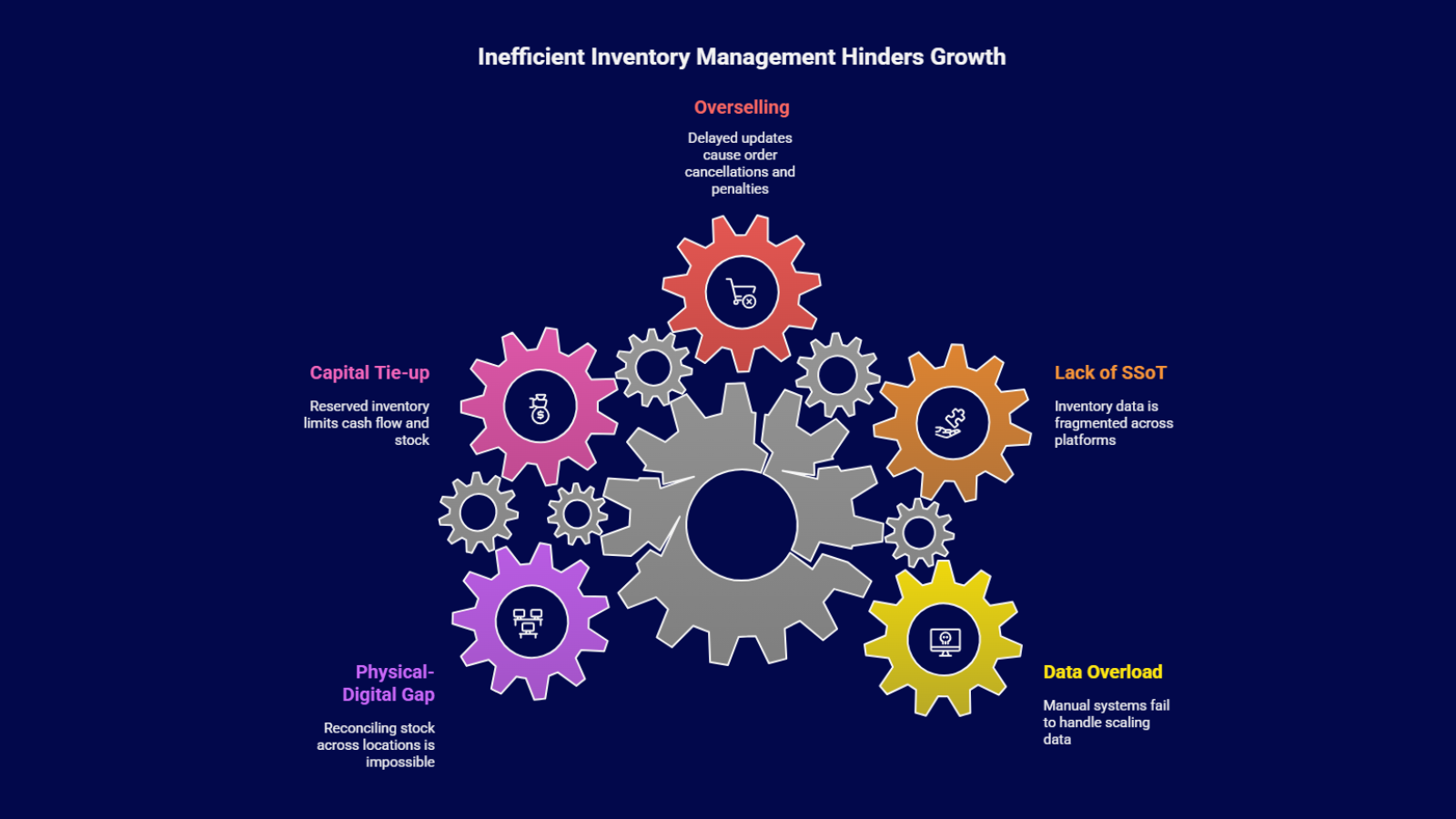
At the core of all operational issues is the lack of a Single Source of Truth (SSoT) for inventory.
- The Overselling Penalty: When a bestseller sells out on your Shopify/WooCommerce store, the stock count on Amazon, Flipkart, and Myntra does not update immediately. This lag leads to overselling, resulting in mandatory order cancellations, which carry stiff financial penalties from marketplaces, damage seller ratings, and erode customer trust.
- Wasted Working Capital: To prevent overselling, many growing brands manually set aside separate inventory buffers for each channel. This ties up capital in slow-moving stock reserved for specific marketplaces, creating artificial stockouts on high-demand channels and crippling cash flow that could be used for marketing or product development.
- The Physical vs. Digital Mismatch: Managing stock across your main warehouse, third-party logistics (3PL) centers, and dedicated marketplace fulfillment centers (like FBA) creates a fragmentation of data that no human team can accurately reconcile in real-time.
The Fulfillment Bottleneck During Peak Season
Festive seasons are the biggest revenue drivers for Indian e-commerce, but they also expose the limitations of non-scalable systems.
- The Manual Documentation Delay: Every order requires channel-specific documentation (invoices, labels, manifests, E-way bills). Relying on staff to log into multiple portals (Shopify, Amazon Seller Central, Flipkart Seller Hub, etc.) to generate these documents causes massive processing delays, pushing orders past Service Level Agreements (SLAs).
- Sub-optimal Carrier Selection: Without a centralized system, teams often default to a single, familiar courier partner. This prevents them from utilizing the fastest or cheapest carrier for a specific pin code, leading to unnecessarily high shipping costs and extended delivery timelines in remote parts of India.
The Financial Reconciliation Nightmare
Growth means more transactions, but also more complexity in a market with diverse tax and commission structures.
- Audit Risk: Reconciling the actual bank deposits from marketplaces which deduct commissions, shipping fees, returns charges, and TDS against the brand’s internal sales records is an exhaustive, error-prone task that exposes the business to major audit risks and masks true profitability per SKU/Channel.
- Margin Erosion: Hidden costs like Return-to-Origin (RTO) charges, failed delivery attempts, and marketplace penalties become impossible to track at scale, silently eroding the Gross Margin Return on Investment (GMROI) and leading to unprofitable growth.
What are the Core Capabilities of a Scalable OMS for the Indian Market?
A truly scalable OMS is purpose-built to eliminate the operational friction of multi-channel selling in a geographically vast and logistically diverse market like India. It replaces manual effort with intelligent automation.
Does a Centralized Order Hub Really Unify All Channels?
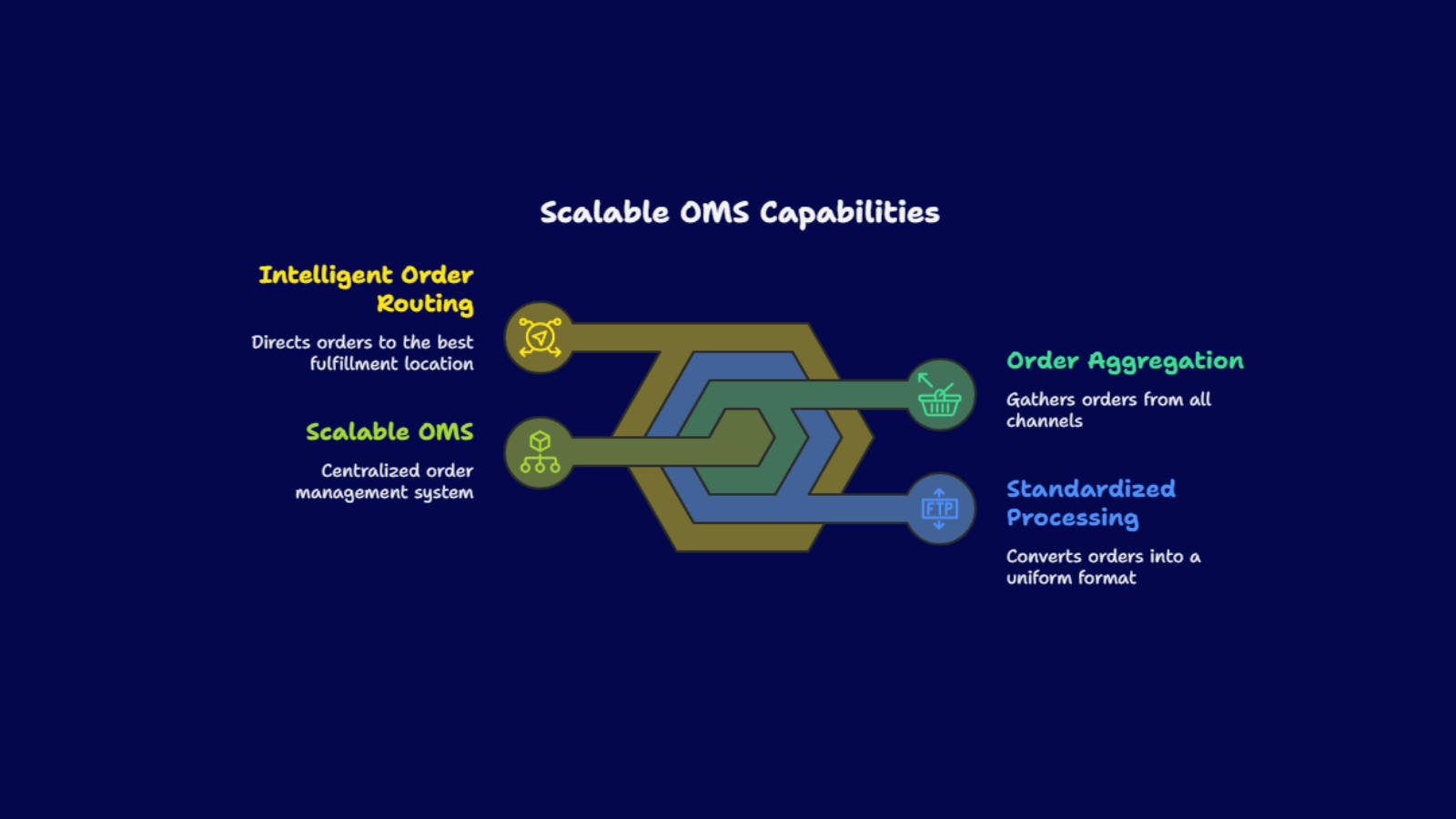
A scalable OMS serves as the Operational Command Centre for the entire business, aggregating orders and streamlining processing into a single, standardized flow.
- Real-Time Order Aggregation: It instantly pulls every new order from your D2C platform (Shopify, WooCommerce), major marketplaces (Amazon, Flipkart, Myntra), and social commerce channels into a single, live dashboard.
- Standardized Processing Workflow: Regardless of the source, every order is converted into a standard format, eliminating the need for staff to remember different marketplace rules for processing, picking, and packing.
- Intelligent Order Routing (IOR): The system automatically routes the order to the best fulfillment location (warehouse, 3PL, or even an activated retail store for ship-from-store) based on pre-defined, complex logic like:
- Proximity to the customer (for faster delivery).
- Inventory availability at the lowest-cost location.
- Carrier performance/SLA for the customer’s pin code.
How Does a Scalable OMS Ensure Real-Time Inventory Syncing?
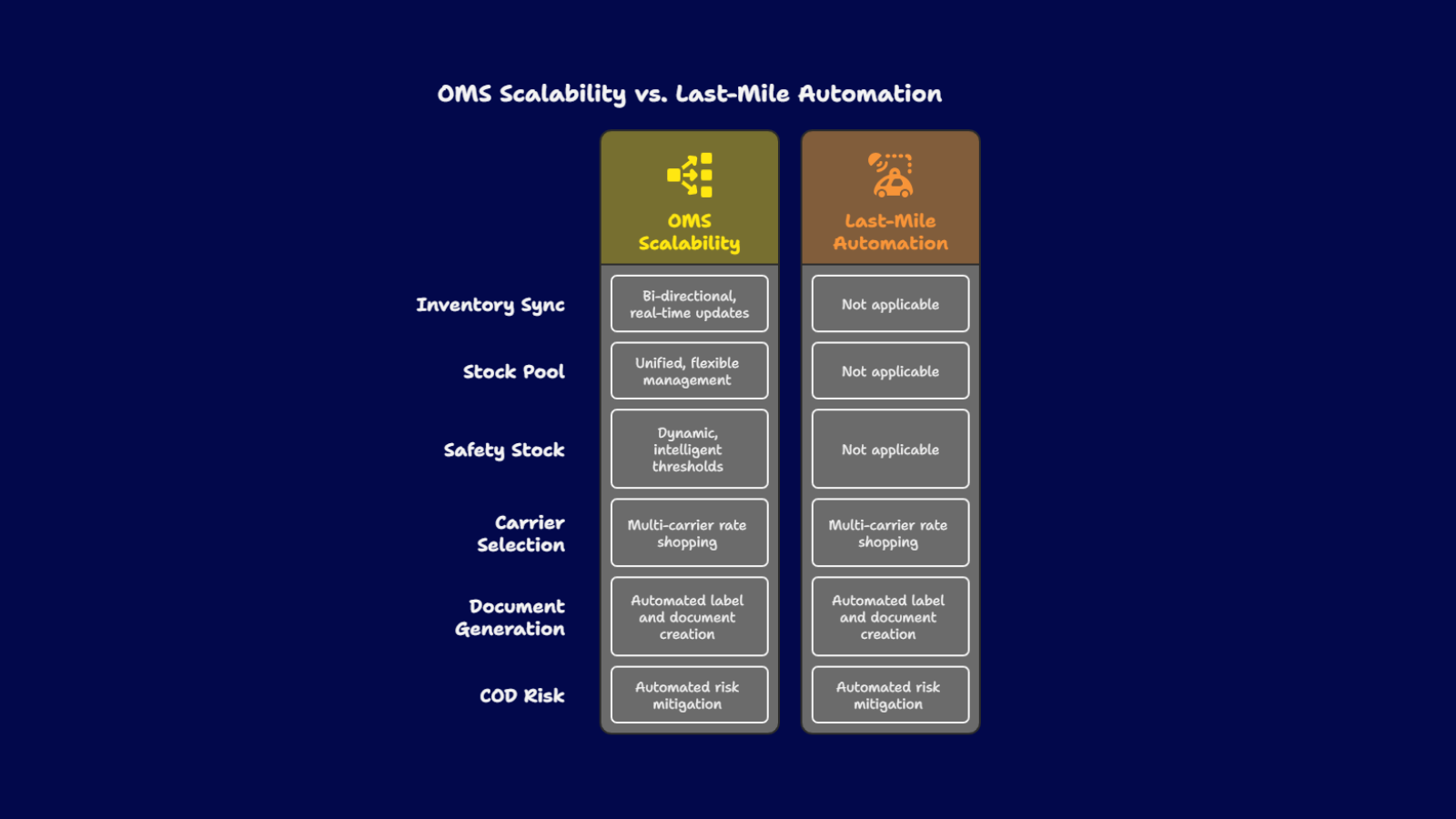
This is the non-negotiable feature for managing hyper-growth without financial penalty. The OMS acts as the ultimate Inventory Conductor.
- Bi-directional Real-Time Sync: When a sale occurs on any channel (e.g., a customer buys a shirt on Myntra), the available inventory count is instantly reduced across all connected channels (Amazon, Flipkart, D2C). When a return is processed and restocked, the count is instantly increased everywhere.
- Unified Stock Pool Management: It manages inventory as a single, flexible pool, breaking down the silos between different warehouses (including 3PLs and FBA/Smart). This maximizes the “Available-to-Sell” inventory, ensuring no stock is ever idle or stranded.
- Dynamic Safety Stock Rules: Instead of fixed buffers, the OMS allows you to set intelligent, dynamic safety stock thresholds that adjust based on:
- Sales velocity of the SKU.
- Forecasted demand for the channel.
- Lead time for replenishment.
This protects against stockouts while maximizing sellable quantity.
Can Automation Really Handle All Last-Mile Logistics Complexity?
The last mile is where profitability is often lost, especially in India with its varied infrastructure and high RTO rates. Automation is key to cost control.
- Multi-Carrier Rate Shopping and Allocation: The OMS integrates with a vast network of national and regional logistics partners. For every order, it automatically performs “rate shopping,” selecting the optimal carrier based on the lowest cost, fastest SLA, or best historical performance for that specific pin code.
- Automated Label and Document Generation: It integrates with the APIs of all marketplaces and carriers to instantly generate the correct, compliant shipping labels, GST invoices, and manifests in bulk, eliminating manual data entry and drastically reducing dispatch time.
- COD Risk Mitigation: The platform can automatically flag high-risk Cash on Delivery (COD) orders based on historical data or customer profile, triggering an automated pre-dispatch confirmation call/SMS to reduce the devastating cost of RTOs.
What Advanced Features Drive 10x Profitable Growth?
For brands moving into the next phase of growth, the OMS must move beyond mere order processing to become a strategic tool for profitability.
Is Omnichannel Fulfillment Essential for D2C Dominance?
Absolutely. An advanced OMS enables true omnichannel experiences, turning physical assets into fulfillment centers.
- Click-and-Collect/BOPIS (Buy Online Pick Up In Store): Allows customers to order online and pick up at the nearest physical store, using the OMS to confirm store stock and notify the customer, enhancing convenience and driving in-store traffic.
- Ship-from-Store (SFS): Uses retail store inventory to fulfill online orders, especially in high-density areas. This maximizes the utilization of store stock, shortens delivery times to hyper-local customers, and avoids marking down products in a store that might be selling well online.
- Micro-Fulfillment Orchestration: Manages inventory and fulfillment across multiple micro-warehouses or dark stores, enabling hyper-local same-day or next-day delivery, a crucial differentiator in competitive urban markets.
How Does an OMS Protect Margins Through Financial Control?
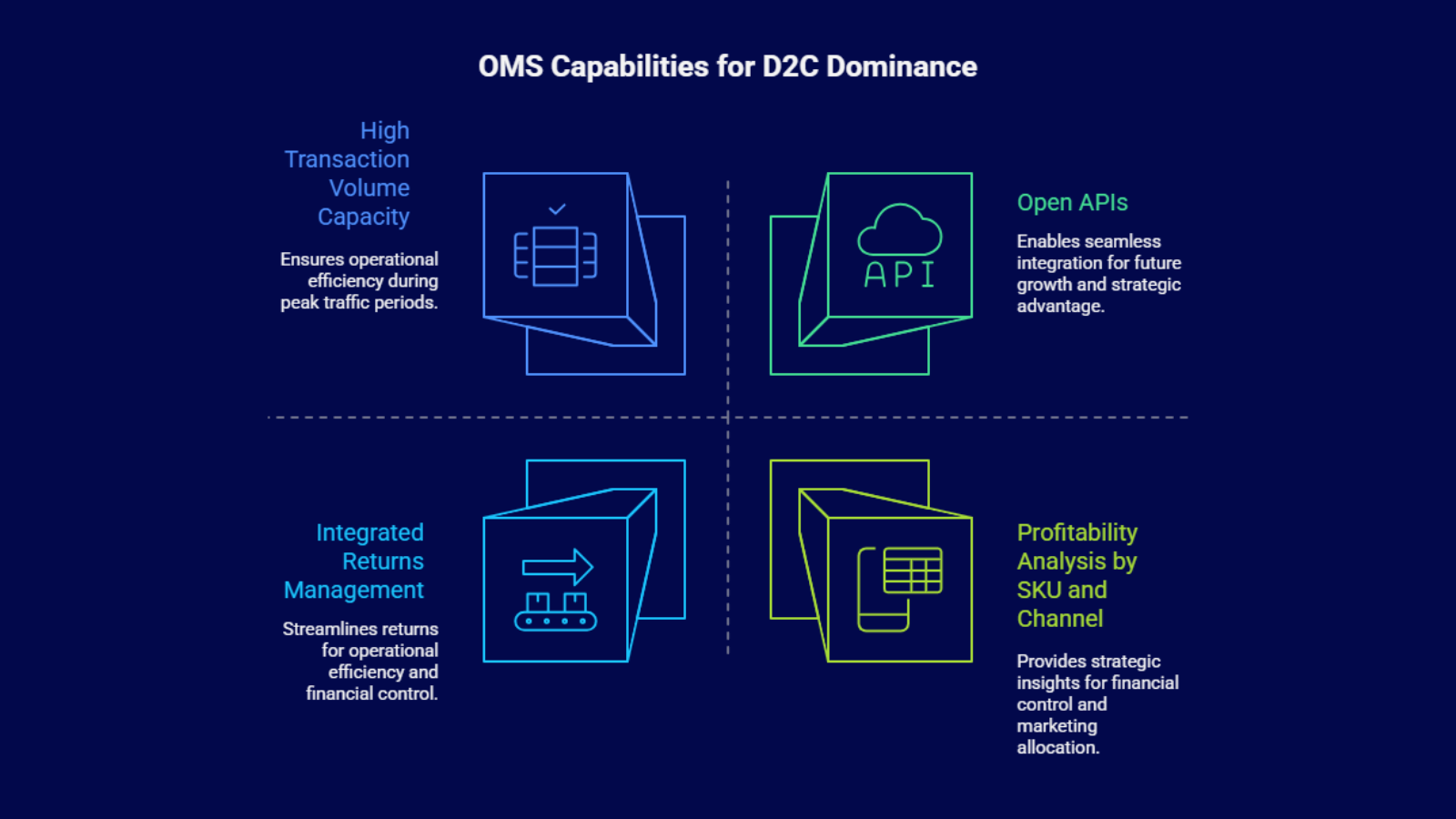
Controlling costs and understanding true profit is essential for funding continued growth.
- Integrated Returns Management (Reverse Logistics): A dedicated module manages the end-to-end returns process from customer initiation to automated return label generation, in-transit tracking, Quality Check (QC) at the warehouse, and instant stock update. This reduces the time an item is out of the sellable inventory and accelerates customer refunds, boosting loyalty.
- Profitability Analysis by SKU and Channel: By ingesting all costs (shipping, commission, returns, and payment gateway fees), the OMS generates reports that show the Net Profit per SKU on Amazon versus Flipkart versus D2C. This data is critical for deciding where to allocate marketing spend and which channels to prioritize.
Can a Scalable OMS Future-Proof the Brand’s Tech Stack?
Growth is non-linear and requires the ability to plug and play new technologies.
- Open and Robust APIs: The platform must have open APIs that allow for quick, seamless integration with other essential enterprise systems as the business grows from ERP (like Tally or SAP) to CRM, accounting software, and new international marketplaces. This prevents vendor lock-in and ensures agility.
- High Transaction Volume Capacity: A truly scalable, cloud-native OMS is built on architecture designed to handle massive, non-linear spikes in traffic (like during a Big Billion Day sale), ensuring the system never crashes or slows down, thereby eliminating a major financial and reputational risk.
Click here to learn more about the future of shipments in India.
The Strategic Leap: Transforming Operations into a Growth Driver
The transition to a scalable OMS is the operational equivalent of moving from a startup to a mature, high-performance enterprise. It shifts the focus of the operational team from manual firefighting and data entry to strategic planning and optimization.
| Parameter | Manual/Legacy System | Scalable OMS (Example: Base.com) |
| Inventory Accuracy | 65% – 85%; prone to overselling. | 99.9% accuracy with real-time sync. |
| Order Processing Time | $2-$3 hours per batch (due to manual documentation). | $5-$10 minutes per batch (fully automated). |
| Logistics Cost | High and opaque; reliance on default carrier. | Optimized by Multi-Carrier Rate Shopping. |
| RTO Rate | High; manual/reactive management. | Actively mitigated by COD Risk Assessment. |
| Peak Season Capacity | Prone to system crashes and fulfillment bottlenecks. | Cloud-based architecture handles 10X volume easily. |
| Profit Visibility | Margin is an estimate; true profitability is unknown. | Net Profit visible per SKU and Channel. |
For a high-growth Indian brand, a scalable OMS is the infrastructure that allows the sales team to focus purely on acquisition and marketing, safe in the knowledge that the backend can handle the complexity. It is the core technology that enables a brand to execute a flawless D2C strategy while still leveraging the massive reach of marketplaces.
Ready to build the scalable foundation for your 10x e-commerce growth?
Take control of your orders, inventory, and profit. Explore a demo of Base.com today.
Frequently Asked Questions (FAQs)
Q1. How long does it take for a fast-growing brand to see ROI after implementing a scalable OMS?
A. High-growth brands typically see an ROI within 3 to 6 months. The primary drivers of this rapid return are the elimination of overselling penalties, the reduction in shipping costs due to automated multi-carrier optimization, and the labor cost savings from eliminating manual order and inventory management.
Q2. Is a scalable OMS necessary if I only sell on Amazon FBA and my D2C website?
A. Yes, it is critical. While FBA handles fulfillment, the OMS ensures your FBA stock levels are accurately synced with your D2C inventory in real-time. Crucially, the OMS manages the complex inventory transfer process to FBA and allows you to strategically use the D2C channel for high-margin orders while FBA handles the high-volume marketplace orders, all from one dashboard.
Q3. What is the biggest risk of not implementing a scalable OMS before a major festival sale?
A. The biggest risk is operational collapse and severe reputational damage. The system will be overwhelmed by the 5X to 10X spike in order volume, leading to mass overselling, massive fulfillment delays, an increase in order cancellation rates, and a subsequent drop in crucial seller ratings on marketplaces. This single event can negate an entire year’s growth.
Q4. Can a scalable OMS help with my GST and TDS reconciliation for marketplace sales?
A. Yes. Advanced OMS platforms integrate with the financial settlement reports provided by major Indian marketplaces. They automatically link the sales data to the corresponding deductions (commission, fees, TDS) and provide a simplified, pre-reconciled view of transactions, significantly reducing the workload and error rate for your accounting team.
Q5. How does a single OMS handle both B2C and B2B/Wholesale orders?
A. A scalable OMS is designed to be channel-agnostic. It can simultaneously process high-volume, single-item B2C orders and complex, high-value, multi-unit B2B/Wholesale orders. It can apply different pricing rules, tax structures, and fulfillment logic (e.g., bulk pallet shipping for B2B) based on the order type, centralizing all revenue streams.