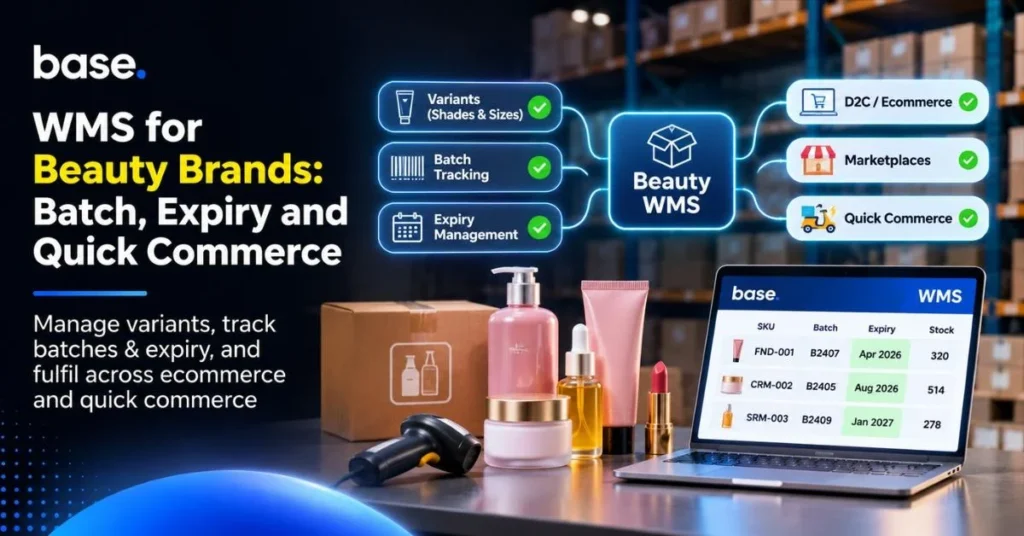
A WMS for beauty brands helps organise product storage, inventory movement, picking, packing and dispatch. Beauty stock often needs more than a total quantity by SKU: a brand may need to distinguish shades and pack sizes, identify which production batch is in a location, and check relevant expiry information before stock is picked. Those details matter more as a catalogue grows or the same inventory serves a D2C website, marketplaces and quick commerce partners. A warehouse management system can support the records and workflows behind that work.
Why beauty brands have specific warehouse requirements
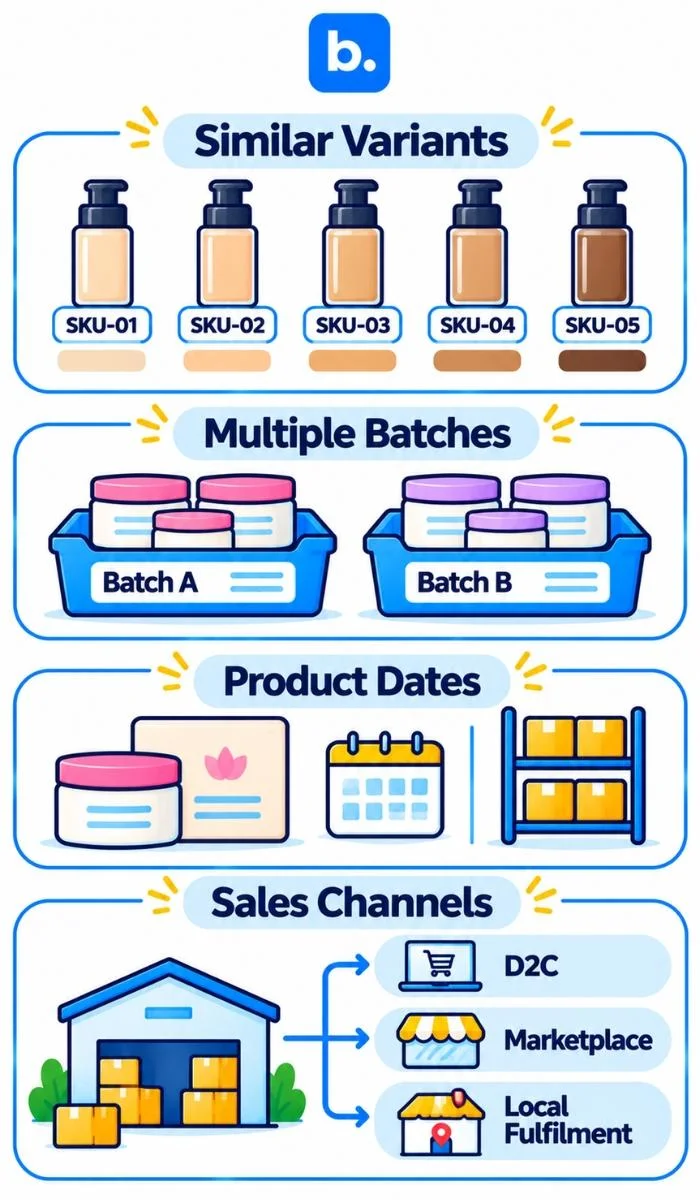
Beauty warehouses hold many variants and batches. A SKU total shows quantity, but not always which shade, production batch or date is in each location.
A wide range of similar-looking variants
A foundation range might include several shades; skincare may come in full-size, travel and gift packs. Similar labels can make variants easy to confuse on a busy shelf, so product records and locations should make the correct item clear at receiving and picking.
Batch identity and product dates
A SKU may be held in several production batches, with different references or dates. A total quantity will not show where each batch is. GS1’s Global Traceability Standard explains how batch or lot identification distinguishes production groups and supports tracing them through supply-chain events. The level needed depends on the product and the brand’s quality process.
Shelf life and handling are product-specific
Shelf-life and storage depend on the formulation, packaging and manufacturer guidance. Follow product-specific instructions; do not assume every cosmetic needs refrigeration or the same handling process.
Orders arrive through different channels
A beauty brand in India may sell through its own website, marketplaces such as Nykaa and Myntra, and quick commerce platforms serving customers through local fulfilment points. The same product may be listed across several channels, while stock is held in a central warehouse, regional warehouse or dark store. Teams need clear stock visibility by location, along with rules for reservations and replenishment. An Order Management System (OMS) can coordinate channel orders, while the WMS manages physical warehouse operations.
How batch tracking helps beauty brands
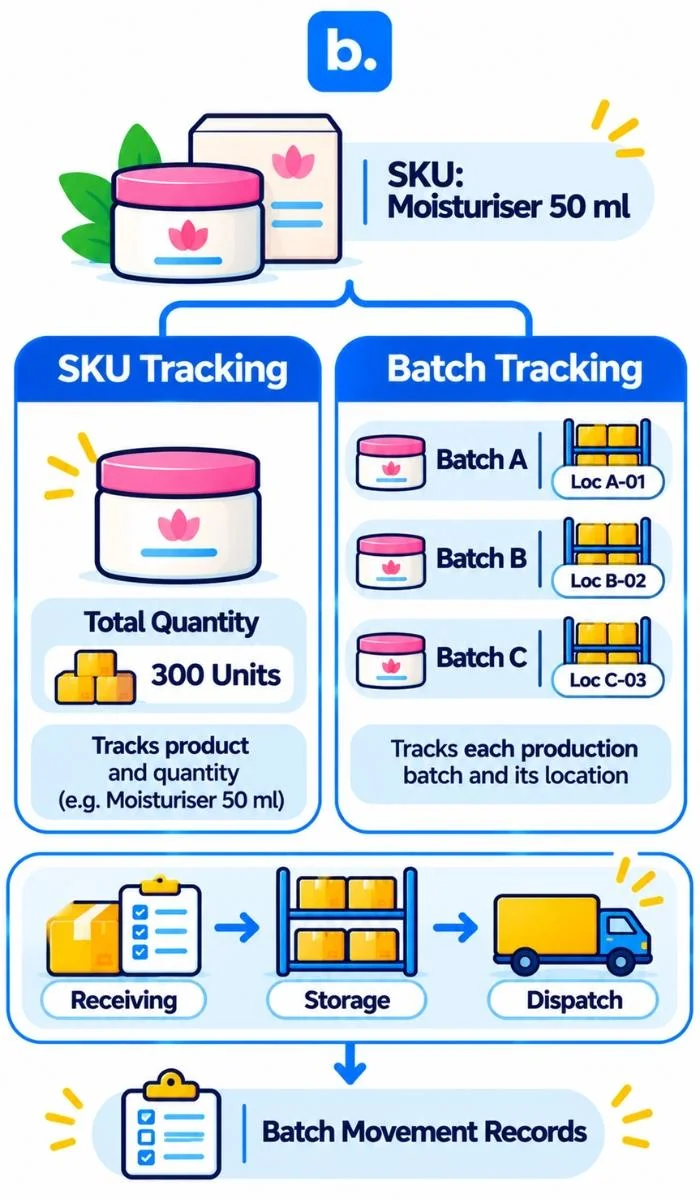
Batch tracking records which production group stock belongs to, alongside the product identity and quantity. It adds a level of detail beyond SKU tracking, which identifies the product or variant but not a particular production run.
| Area | SKU tracking | Batch tracking |
|---|---|---|
| Identifies | A product or variant | A production group of that product |
| Example | 50 ml moisturiser, shade or pack size | A specific production batch of that moisturiser |
| Main use | Product identification and quantity control | Batch-level traceability and stock handling |
| Useful records | SKU, description, variant and quantity | Batch reference, linked SKU and relevant batch details |
| Warehouse question answered | Which product and how many units? | Which batch is held, and where did it move? |
One SKU can have several batches in stock at once. A useful batch workflow connects batch details with receiving, storage location, movement and dispatch records, to the extent required by the brand’s quality process.
What to record when a batch arrives
A receiving process should make it clear which details staff need to capture and where those details will be used. A typical workflow is:
- Match the delivered item to the correct SKU and variant.
- Record the batch reference and relevant dates from the product or supplier information, where required.
- Confirm the received quantity and assign the stock to an appropriate location.
- Preserve the batch and location link when the stock is moved, picked or investigated.
The exact information and checks vary by product and process. A barcode scan only captures batch or date information if those details are encoded in the barcode or linked to a record that the system can read. Scanning an ordinary product barcode does not, by itself, prove which batch is being handled.
If a batch needs investigation
Batch records can help teams identify stock from a particular production run, check its locations and review relevant receiving or dispatch events. That can support a quality investigation or a decision to hold stock while the business checks further. The records do not determine whether a product is safe, and batch tracking alone does not guarantee that a recall process meets every requirement. Keep traceability procedures and product decisions under the appropriate quality and compliance owners.
Expiry dates, FIFO and FEFO
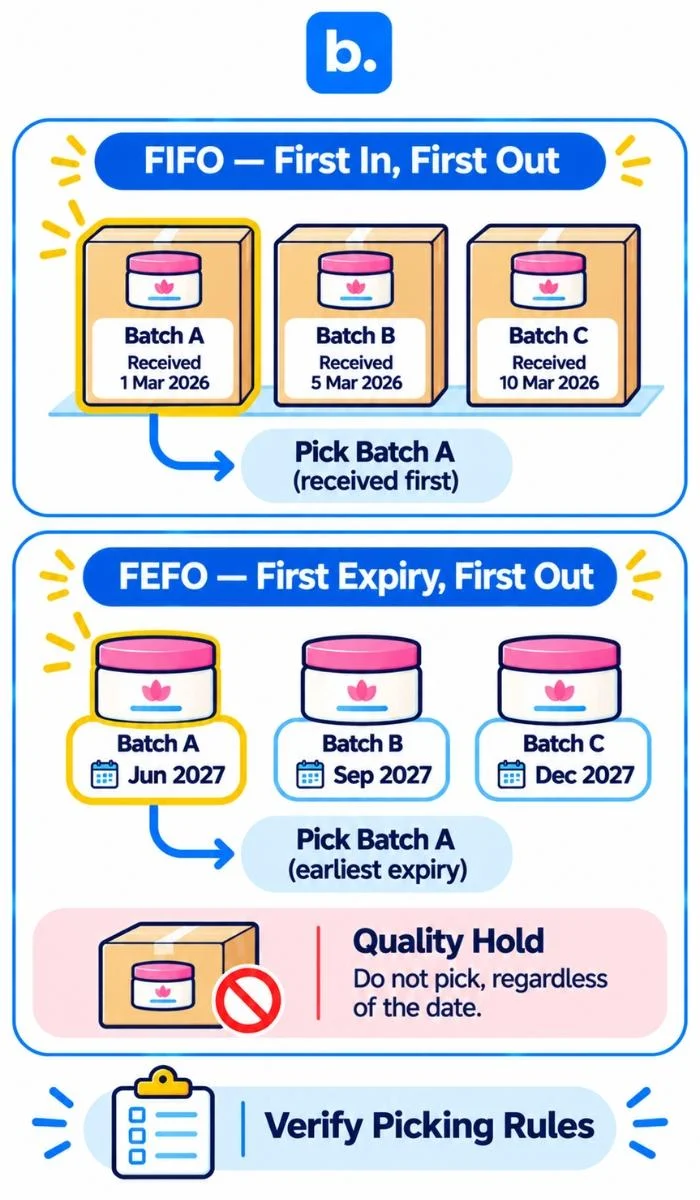
Expiry management means recording relevant product dates, monitoring stock that needs attention and rotating products according to their requirements. The correct method depends on the product information and the brand’s inventory policy.
FIFO versus FEFO
FIFO means First In, First Out: stock received first is issued or picked first. FEFO means First Expiry, First Out: eligible stock with the earliest expiry date is prioritised first. Oracle Warehouse Management documentation describes these as distinct allocation methods. A business should confirm that its software supports the rule it needs; a basic picking list does not necessarily apply FEFO.
FEFO can suit products whose expiry dates differ, while FIFO may be appropriate when receipt sequence is the relevant rotation rule. Neither should override a quality hold, damage status or other stock restriction.
For example, a brand has two batches of the same skincare product. Batch A arrived first but expires later than Batch B. If the product’s policy uses FEFO and both batches are eligible, Batch B should be considered first. If either batch is under review or otherwise restricted, staff should follow that status instead.
What PAO means, and what it does not
Period After Opening (PAO) refers to the recommended period of use after a product has been opened, often represented by an open-jar symbol with a time period. It is not the same as an unopened product’s warehouse expiry date: PAO concerns use after opening, while warehouse stock is normally unopened. The EU Cosmetics Regulation distinguishes date of minimum durability from the period after opening. That is an explanation of the EU framework, not a statement of Indian labelling rules. For India-specific requirements, refer to current CDSCO cosmetics rules and appropriate compliance advice.
Keeping stock with limited shelf life visible
Useful warehouse processes make it easier to identify stock approaching its relevant date, keep restricted or damaged units separate, and review stock held at different locations. Teams can then decide whether to rotate, transfer, promote or hold eligible inventory. Do not assume a WMS automatically blocks expired goods, sends alerts or enforces FEFO; verify these functions and how dates are entered before relying on them.
Beauty fulfilment across ecommerce and quick commerce
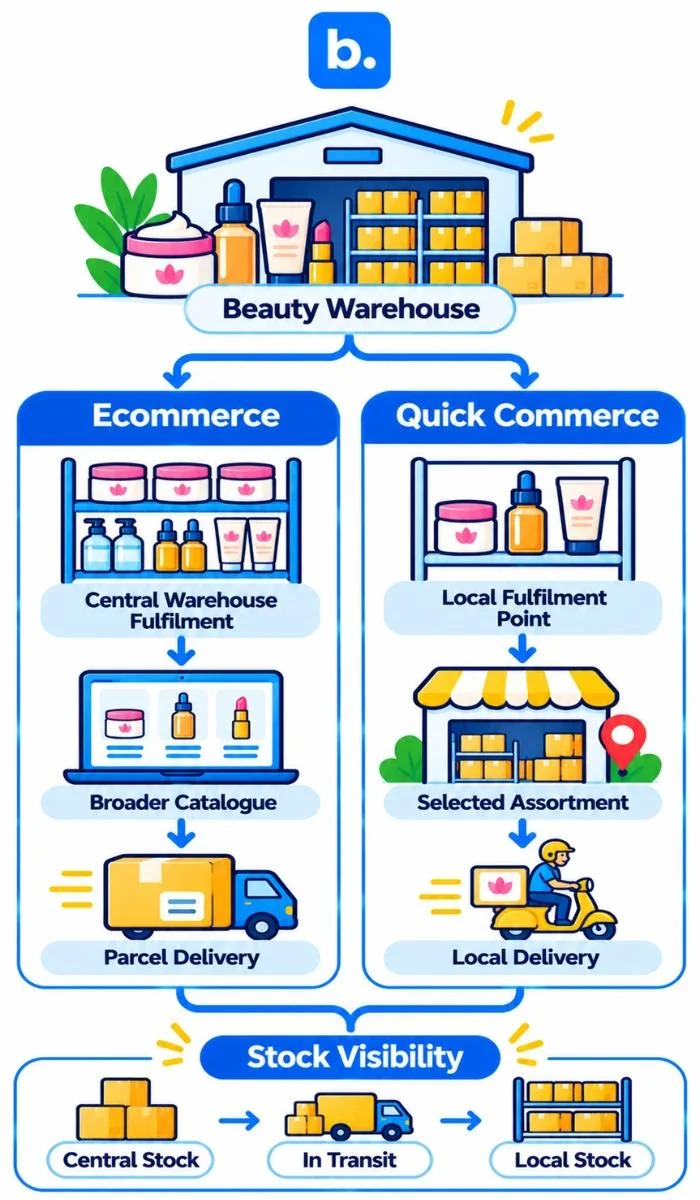
Indian beauty brands increasingly serve customers through different sales and fulfilment channels. A brand may sell through its website, Nykaa, Myntra and quick commerce platforms. Each channel can have different order volumes, delivery expectations and inventory requirements.
Traditional ecommerce orders may be picked from a central or regional warehouse. Quick commerce typically relies on local fulfilment points, where a selected range of products is positioned closer to customers.
| Area | Conventional ecommerce | Quick commerce |
|---|---|---|
| Fulfilment model | Central or regional warehouse may serve orders | Local fulfilment points serve nearby demand |
| Delivery promise | Based on the brand or marketplace service | Prioritises shorter fulfilment windows |
| Inventory placement | May be centralised or regional | Stock positioned closer to demand |
| Assortment | Can support a broad online catalogue | Often focuses on selected products |
| Stock visibility | Must reflect sellable stock across channels | Must reflect availability at each fulfilment point |
The same product may be available on Nykaa, Myntra and a quick commerce platform, but the stock serving each channel may be held at different locations. Brands need a clear view of available, reserved and allocated quantities to avoid promising stock that is not available.
Keep channel stock and warehouse stock aligned
A moisturiser listed on a brand’s website, Nykaa and a quick commerce platform may draw from different inventory locations. An OMS or inventory synchronisation tool can coordinate channel orders and stock availability, while the WMS manages warehouse tasks such as receiving, storage and picking.
Multiple fulfilment locations need batch-aware records
Beauty brands supplying several warehouses, dark stores or micro-fulfilment sites need location-level stock visibility. Batch information should remain associated with products as inventory moves between locations.
A central warehouse may hold reserve stock while local fulfilment points carry a smaller selection of fast-moving products. Teams need to identify which location holds the required product and batch before fulfilment.
Fast delivery should not mean ignoring product identity or date rules. If a local fulfilment point holds two batches of the same skincare SKU, the picking process should follow the brand’s chosen product rotation rule while selecting the correct variant.
WMS features beauty brands should evaluate
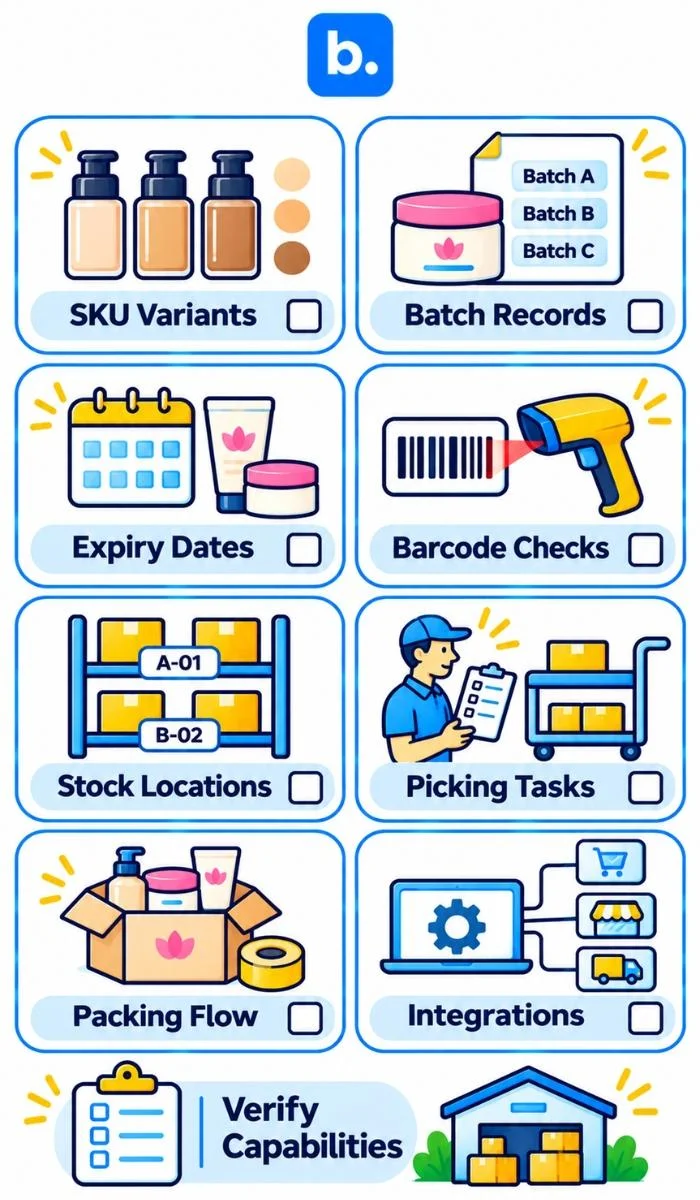
Warehouse management software can direct receiving, storage, picking and dispatch, but WMS systems vary. A warehouse stock management system may record only quantities and locations.
SKU and variant-level records
The system should distinguish the shades, sizes, formulations, pack sizes and bundles staff need to pick. Check that product names, identifiers and locations are clear enough to separate similar packaging.
Batch and lot fields
Ask whether staff can record a batch reference at receiving and associate it with stock and its location. The traceability depth differs across warehouse management software.
Barcode-assisted workflows
Scanning can help staff identify products and locations during receiving, picking and stocktakes. Correct product and barcode data still matter.
Location-level inventory and warehouse tasks
For a multi-site operation, check stock visibility by warehouse or fulfilment point, transfer handling and product-location records. Evaluate the picking list, verification, packing and dispatch steps as a complete workflow, including what staff see when the expected item is unavailable.
Connections to ecommerce and order systems
Check how the WMS exchanges information with the brand’s website, marketplaces, OMS, inventory platform, ERP and shipping tools.
How to choose a WMS for a beauty business
When comparing warehouse management system software, test it with the products and exceptions your warehouse actually handles. A feature list is not enough; ask the vendor to demonstrate receiving through dispatch.
| Evaluation area | What to check |
|---|---|
| SKU management | Can it distinguish variants, sizes and bundles? |
| Batch tracking | Can required batch information be captured and traced through relevant warehouse steps? |
| Expiry management | Can dates be recorded and reviewed as your process requires? |
| Picking rules | Does it support your FIFO, FEFO or other rotation policy? |
| Barcode workflows | Which product, location, batch or date details does scanning actually validate? |
| Multiple locations | Can teams see and transfer stock across the required network? |
| Integrations | Does it exchange the required data with your ecommerce and order systems? |
| Implementation | What data cleanup, configuration, training and integration work is needed? |
Test a product with several variants, the same SKU in multiple batches and different dates, plus one restricted or damaged unit. Check what happens when a worker receives, transfers, counts, picks or packs each case. This exposes gaps a standard sales demonstration may miss.
How our WMS supports beauty warehouse operations
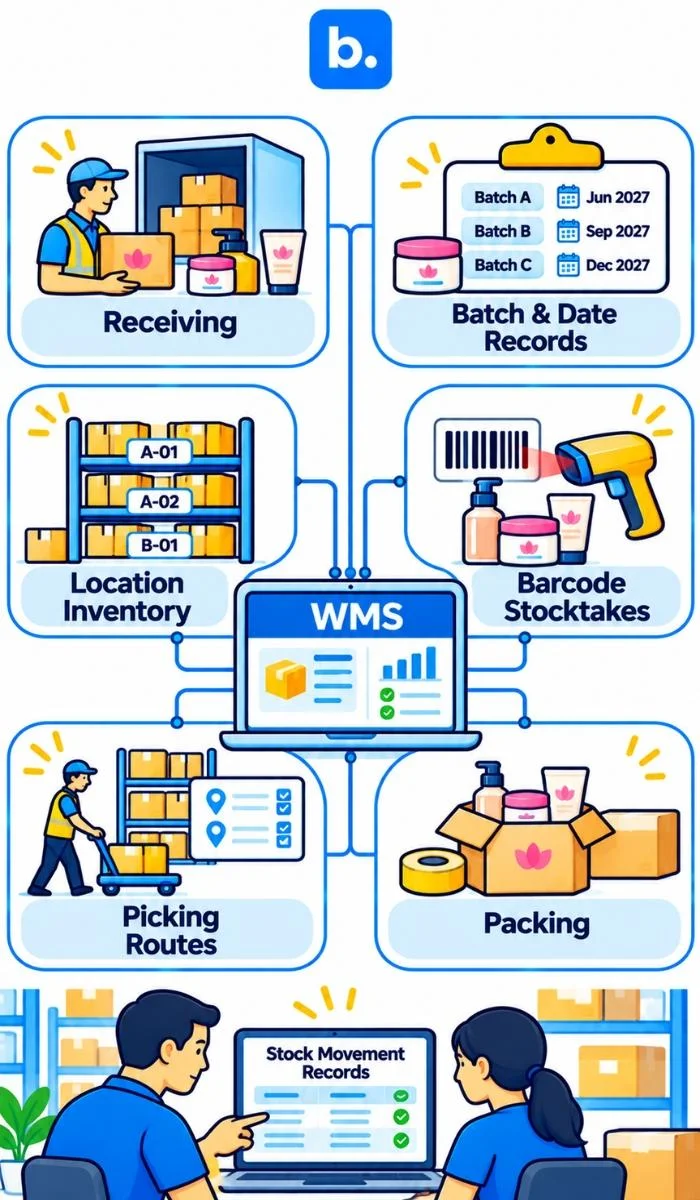
We at Base.com provide a WMS that supports the inventory and warehouse requirements of beauty and cosmetics businesses. Our Base WMS tracks batch numbers and expiry dates from goods receipt through storage, giving teams visibility of stock by product, batch, expiry date and warehouse location.
Our WMS also supports product rotation rules during picking, helping warehouse teams select the appropriate stock according to their configured inventory process. Alongside batch and expiry tracking, our warehouse workflows include goods receiving, inventory management, barcode-assisted stocktakes, pick lists, guided picking routes and packing.
For beauty brands managing multiple variants and production batches, this helps connect product identification with physical warehouse operations. Teams can maintain more detailed stock records and organise picking around the relevant product and expiry information.
Explore our WMS to learn how we support batch tracking, expiry-date visibility and warehouse picking.
Conclusion
Beauty warehouse management calls for more than a SKU quantity. Brands need processes that distinguish variants, retain relevant batch and date information, and support the right stock rotation across fulfilment locations. Choose a WMS by testing those workflows with real products. Confirm which capabilities are documented, and keep channel coordination and product compliance within their proper systems and teams.