In the Indian market, the gap between a successful brand and a struggling one is often the efficiency of their back-end. When a customer orders a leather bag from your website or a marketplace, they aren’t just buying a product; they are buying the promise of a seamless delivery.
Managing this promise manually becomes impossible once you scale. An order management system India serves as the central brain of your business, connecting your sales channels, warehouses, and courier partners into one unified flow.
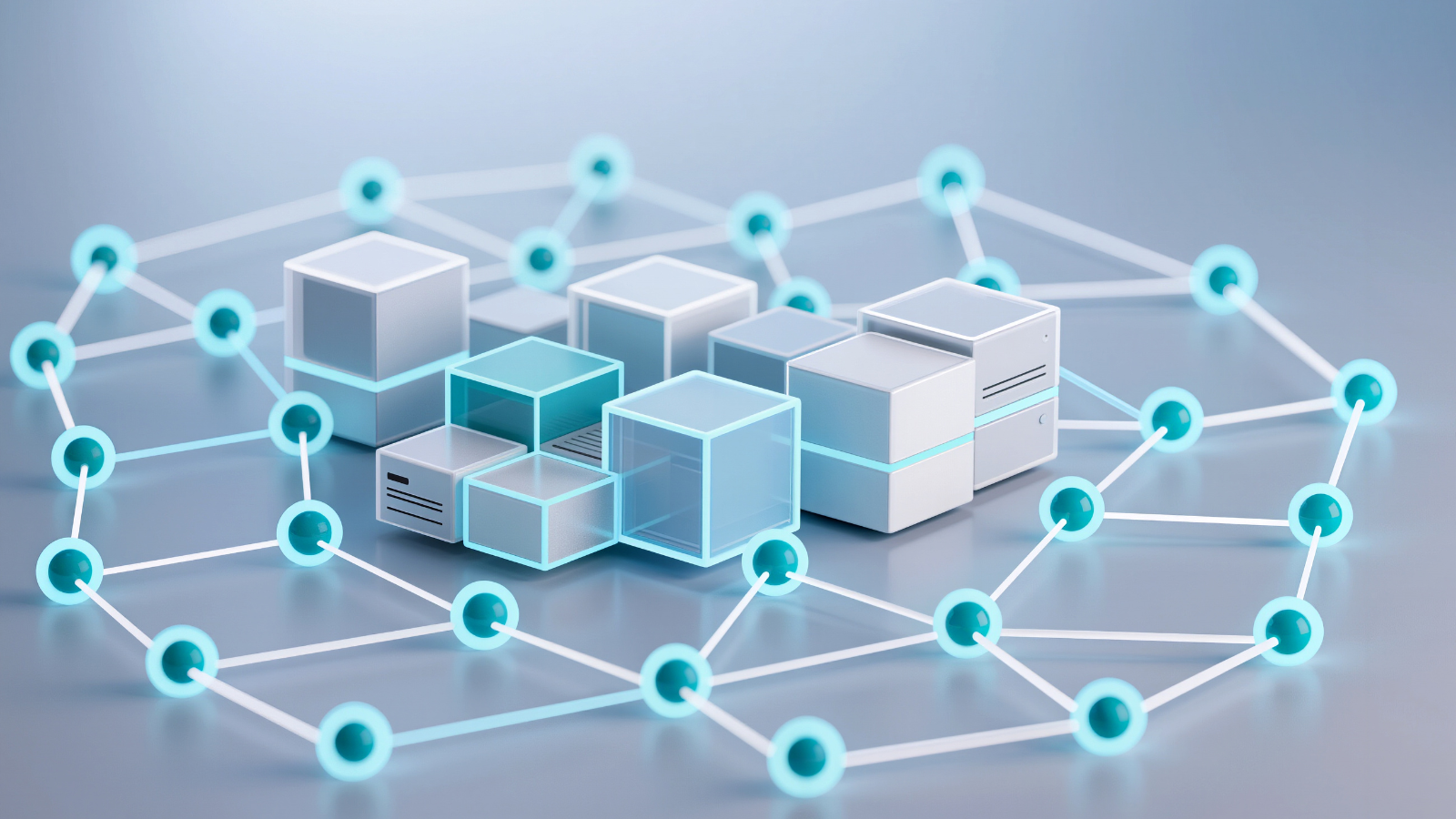
For a growing brand, an order management system India is the primary defense against operational chaos. It removes the guesswork from inventory management and ensures that your team isn’t wasting hours on data entry.
By automating the ecommerce order lifecycle, you reduce the risk of human error, lower your shipping costs, and significantly improve the customer experience.
Why an Order Management System India is Essential for Growth
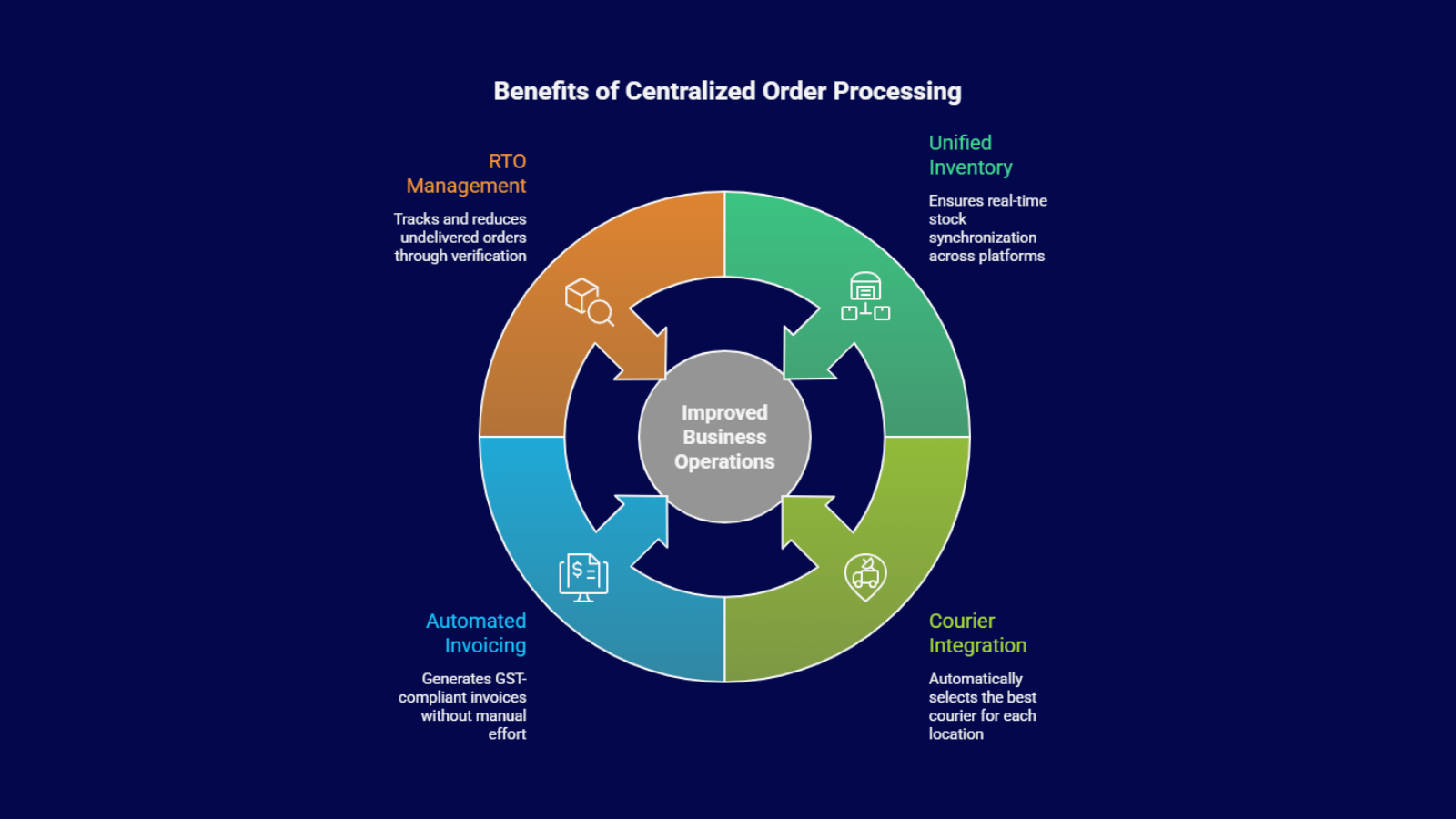
India presents unique challenges that traditional global software often fails to address. We have a heavy reliance on Cash on Delivery (COD), a complex tax structure with GST, and a massive geographical spread. An order management system India is built specifically to navigate these hurdles. It allows you to set rules for order routing, ensuring that a package for a customer in Chennai is shipped from your Bangalore warehouse rather than Delhi.
Using an order management system India also helps you tackle the high rate of Return to Origin (RTO). By integrating with communication tools, the system can send automated WhatsApp confirmations for COD orders, filtering out fake or high-risk purchases before they even leave the warehouse. This proactive approach saves thousands in wasted logistics costs.
Key Benefits of Centralized Order Processing
| Feature | Impact on Business |
|---|---|
| Unified Inventory | Prevents stockouts by syncing stock across all platforms in real-time. |
| Courier Integration | Automatically selects the cheapest and fastest courier for every pin code. |
| Automated Invoicing | Generates GST-compliant invoices without any manual intervention. |
| RTO Management | Tracks and reduces undelivered orders through smart verification. |
An order management system India ensures that as you add more sales channels, your workload doesn’t grow exponentially. It keeps your operations lean and your data accurate.
5 Critical Functions of an OMS for D2C Brands
To truly understand the value of this technology, we need to look at the specific problems it solves daily. An OMS for D2C brands is designed to handle high-velocity sales and complex fulfillment needs.
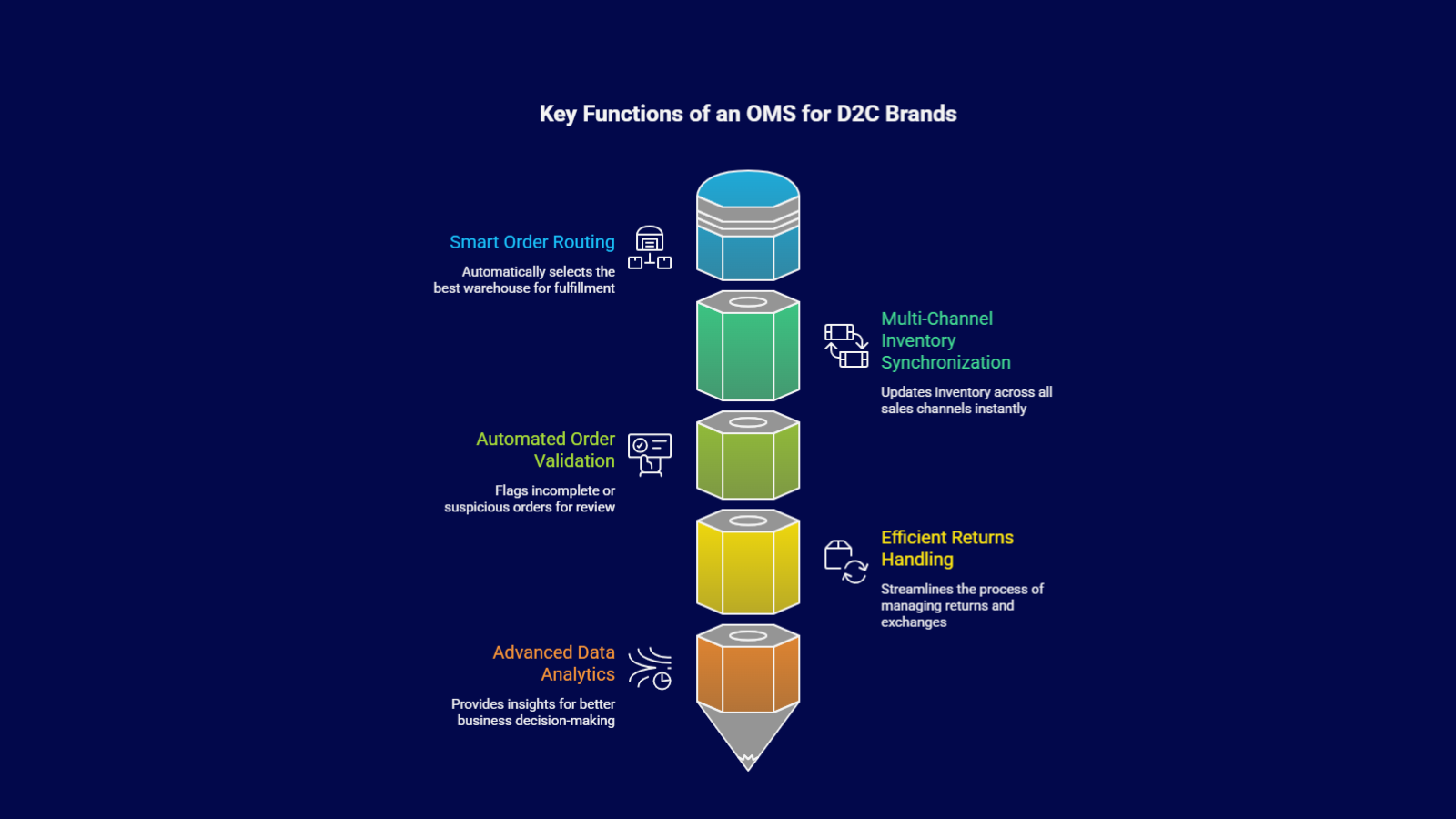
1. Smart Order Routing and Allocation
An OMS for D2C brands automatically decides which warehouse should fulfill an order based on proximity to the customer and stock availability. This reduces shipping times and transit costs.
2. Multi-Channel Inventory Synchronization
With an OMS for D2C brands, your inventory is updated everywhere the moment a sale happens. If you sell your last unit on Amazon, the listing on your Shopify store is instantly disabled to prevent overselling.
3. Automated Order Validation
In India, verifying addresses and phone numbers is crucial. An OMS for D2C brands flags incomplete addresses or suspicious orders, allowing your team to fix issues before shipping.
4. Efficient Returns and Exchange Handling
Returns are a reality of e-commerce. An OMS for D2C brands simplifies reverse logistics, ensuring that returned items are tracked, inspected, and put back into sellable inventory quickly.
5. Advanced Data Analytics and Reporting
An OMS for D2C brands provides insights into your best-selling products, fastest-moving warehouses, and most reliable courier partners, helping you make better business decisions.
Managing the Modern Ecommerce Order Lifecycle
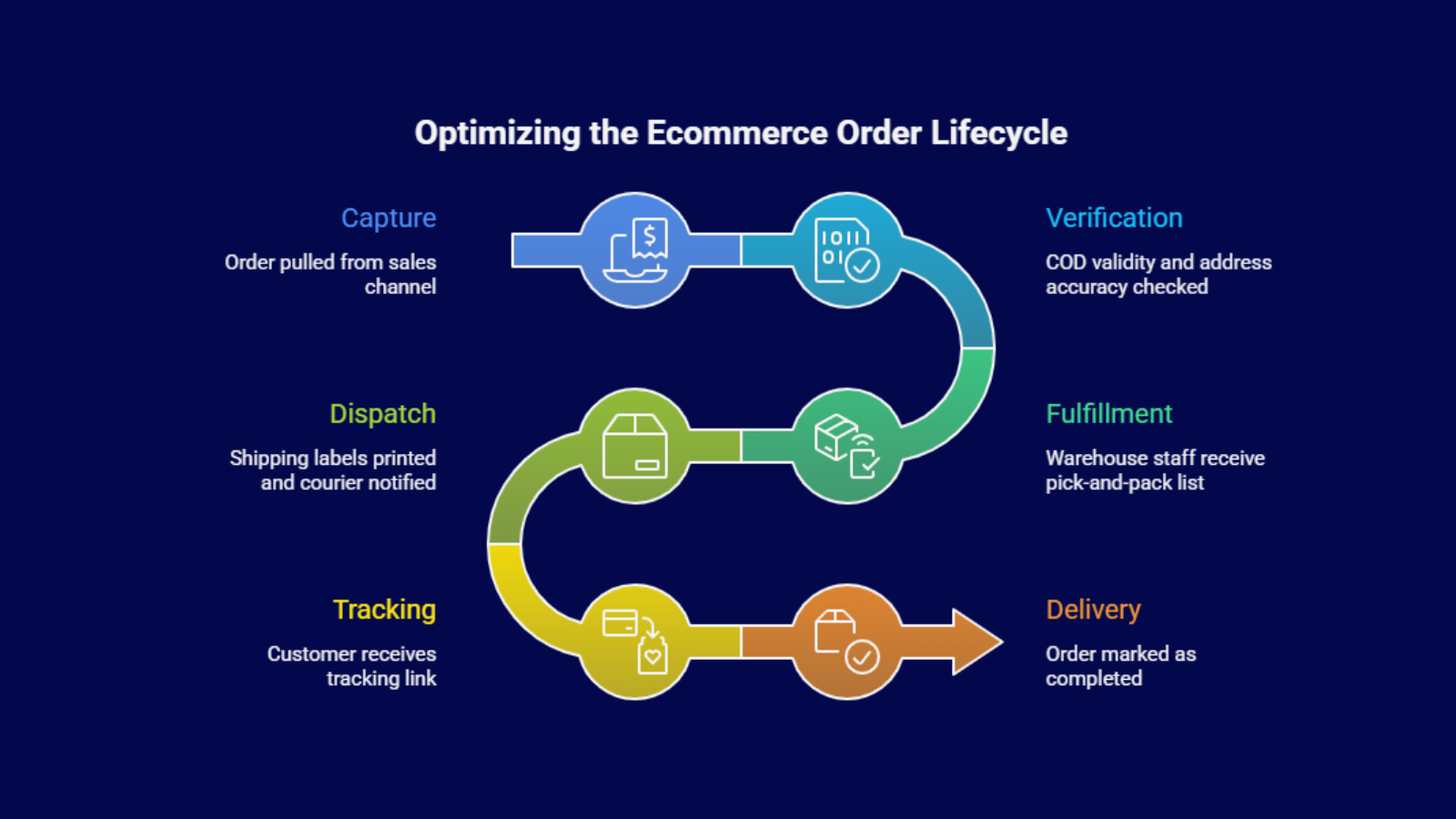
The ecommerce order lifecycle starts the moment a customer clicks the buy button and ends only when they are satisfied with their purchase. In a market where 10-minute grocery deliveries are becoming the norm, D2C brands must optimize every second of the ecommerce order lifecycle to remain competitive.
When you automate the ecommerce order lifecycle, you create a repeatable process that can handle 100 orders or 10,000 orders with the same level of accuracy. This consistency is what builds long-term brand trust. The ecommerce order lifecycle should be transparent, providing both you and your customer with real-time updates at every stage.
Stages of the Automated Order Journey
- Capture: The order is pulled from the sales channel into the central dashboard.
- Verification: The system checks for COD validity and address accuracy.
- Fulfillment: Warehouse staff receive a pick-and-pack list instantly.
- Dispatch: Shipping labels are printed and the courier is notified.
- Tracking: The customer receives a tracking link via SMS or email.
- Delivery: The order is marked as completed once the courier confirms a successful drop-off.
Optimizing the ecommerce order lifecycle directly impacts your bottom line. Faster processing leads to faster delivery, which in turn leads to higher customer satisfaction and fewer cancellations.
Reducing Costs with Order Processing Software India
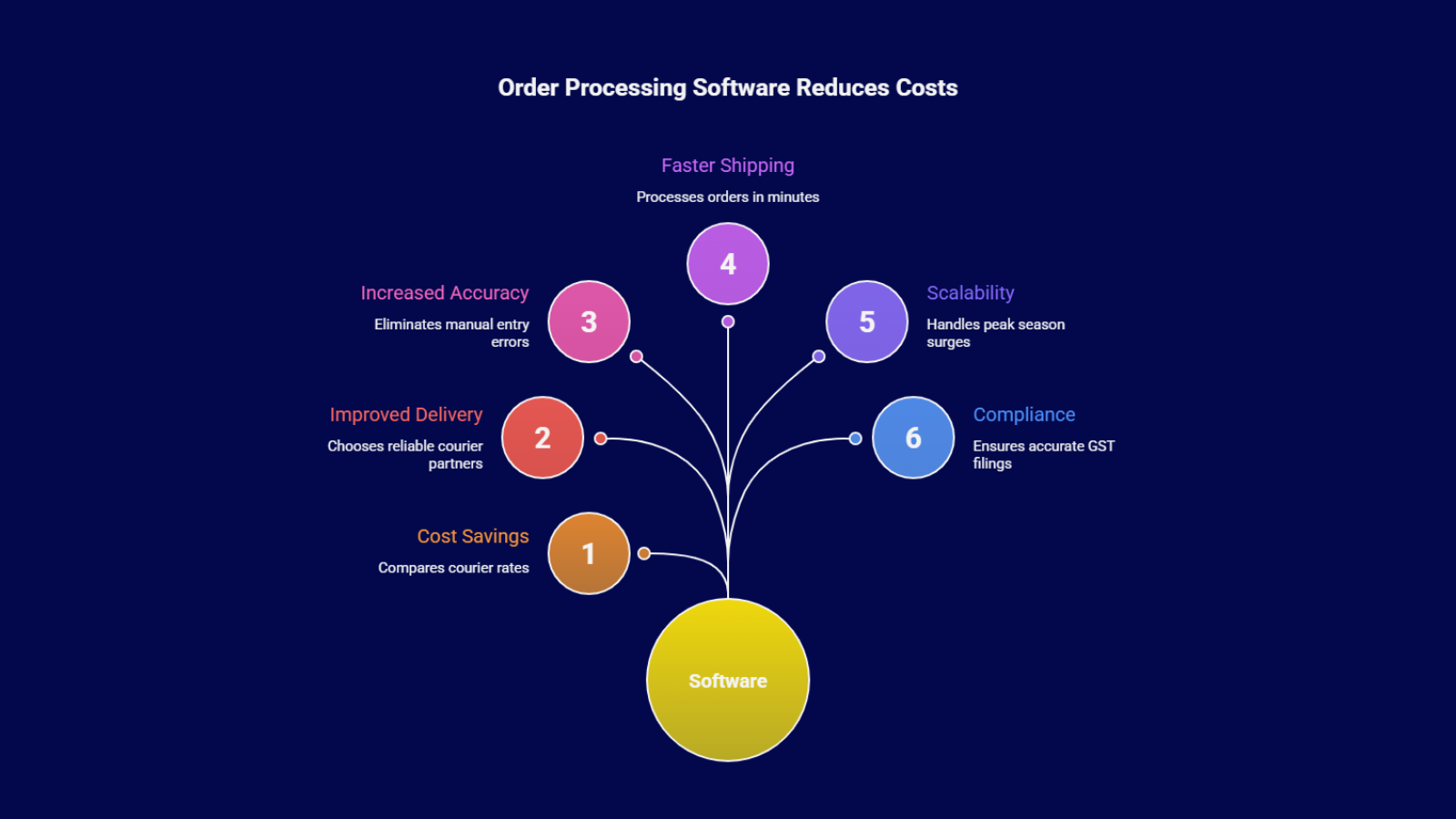
Running a lean business requires a deep focus on cost control. Order processing software India helps you identify hidden leaks in your operations. For instance, by using order processing software India, you can compare courier rates in real-time, ensuring you never overpay for shipping.
The “last mile” in India is notoriously expensive. Order processing software India uses historical data to choose courier partners that have the highest success rates in specific regions. If a certain courier consistently fails in North East India, your order processing software India will automatically route those orders through a different partner.
Why Automation Beats Manual Processing
- Accuracy: Manual entry leads to wrong addresses and incorrect items. Order processing software India eliminates these errors.
- Speed: Bulk processing allows you to ship hundreds of orders in minutes rather than hours.
- Scalability: You can handle peak festive season surges without hiring temporary staff to manage paperwork.
- Compliance: Order processing software India ensures all your E-way bills and GST filings are backed by accurate shipping data.
By centralizing everything within order processing software India, you gain a clear view of your profit margins per order. You can see exactly how much shipping, packaging, and returns are eating into your revenue.
Scaling Your Brand with the Right Tech Stack
The ultimate goal of using an order management system India is to free up your time so you can focus on product innovation and marketing. When your back-end is robust, you can experiment with new sales channels or international shipping without fear of breaking your operations.
Implementing an OMS for D2C brands is an investment in your brand’s future. It provides the infrastructure needed to compete with larger players while maintaining the personal touch that D2C customers love. As the ecommerce order lifecycle becomes more complex, having reliable order processing software India is the only way to ensure your business remains profitable and agile.
Click here to integrate Odoo with base.com to automate your end to end order lifecycle.
Common Questions About Order Management
1. What is the main difference between an ERP and an OMS?
An ERP focuses on broad business processes like HR and finance. An order management system India is specialized for the ecommerce order lifecycle, focusing specifically on inventory sync, marketplace integrations, and courier management to ensure fast, accurate fulfillment.
2. How does an OMS handle the Indian festive season rush?
During high-volume periods, an OMS for D2C brands automates bulk label printing and inventory updates across all platforms. This prevents overselling and allows your warehouse team to process thousands of orders daily without manual bottlenecks or errors.
3. Can I use an OMS if I only sell on my own website?
Yes, even if you only use one channel, an order management system India is valuable for managing multiple warehouses and integrating with various courier partners. It provides better shipping rates and automated tracking that standard website platforms often lack.
4. How does the system help with GST compliance?
Most order processing software India automatically calculates the correct GST (IGST, CGST, SGST) based on the warehouse location and the customer’s shipping address. It generates tax-compliant invoices and can often sync this data directly with your accounting software.
5. Will an OMS reduce my shipping costs?
An OMS for D2C brands reduces costs by automatically selecting the most cost-effective courier for each specific pin code. It also reduces RTO rates through order verification, which is the biggest hidden cost for most sellers in the Indian market.