When a direct-to-consumer business grows in India, what once worked on spreadsheets and manual checks suddenly breaks down. More orders mean more complexity, especially when you are selling on your own website, Amazon, Flipkart, Myntra, and even quick commerce platforms at the same time.
This is where OMS for D2C becomes critical. It is not just software. It becomes the control tower that keeps inventory, payments, and fulfilment aligned across every channel.
Indian D2C sellers often deal with high COD volumes, which still account for nearly 40 to 60 percent of ecommerce orders in many categories. Managing COD reconciliation manually leads to cash flow gaps and accounting errors.
An effective order management D2C system tracks payment modes, settlement cycles across marketplaces, and even partial refunds in real time.
Another nuance Indian sellers face is regional demand variation. A product that moves fast in Maharashtra may not sell at the same pace in Tier 2 cities. With GST compliance, multi-warehouse stocking, and frequent marketplace fee changes, manual systems fail quickly.
A structured OMS for D2C helps Indian brands reduce RTO rates, which can go as high as 25 percent in some segments, by validating addresses and automating courier allocation. That is the difference between controlled scaling and operational chaos.
What an OMS Actually Does
At its core, an order management system is a central platform that tracks and manages the lifecycle of every order across channels. For Indian D2C sellers, this is not just about convenience. It is about surviving marketplace complexity, COD risks, GST compliance, and high return rates. Instead of juggling spreadsheets, courier dashboards, Amazon Seller Central, and Shopify panels separately, an OMS brings everything into one operational view.
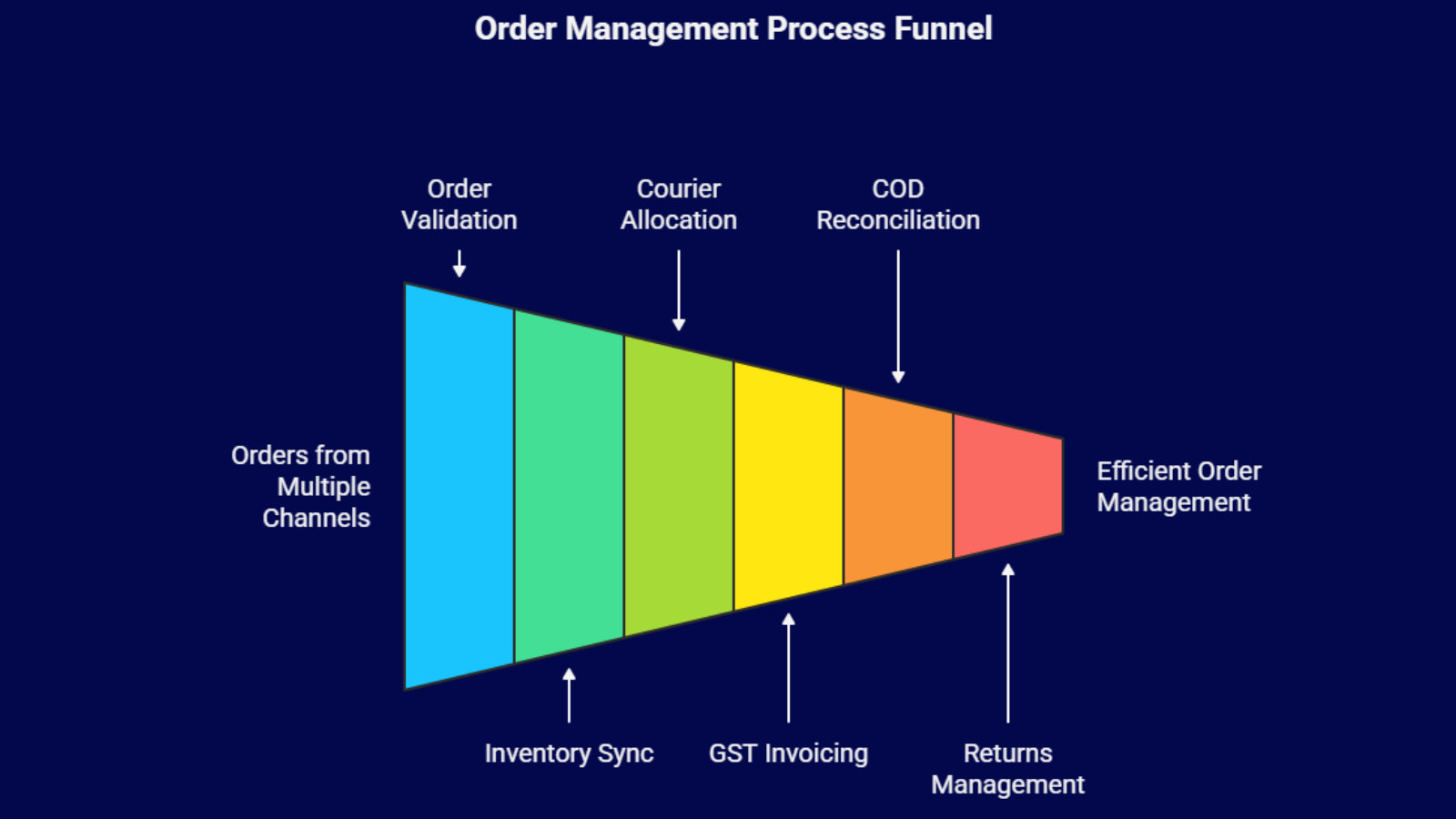 Once a customer places an order, the system performs specific actions that directly impact margins and speed:
Captures orders across all channels
Pulls orders from Shopify, WooCommerce, Amazon, Flipkart, Myntra, Ajio, and even WhatsApp commerce into one dashboard. This avoids double processing and reduces manual errors, which can account for up to 3 to 5 percent revenue leakage in growing brands.
Validates inventory in real time
Syncs stock across multiple warehouses and marketplaces. This prevents overselling during sale events like Big Billion Days or Great Indian Festival, where order spikes can be 5 to 8 times normal volumes.
Automates courier allocation
Assigns orders to courier partners based on pincode serviceability, COD acceptance, and delivery performance. In India, RTO rates can reach 20 to 30 percent in some categories. Smart allocation reduces this significantly.
Manages GST and invoicing accuracy
Automatically generates GST-compliant invoices based on shipping state, helping avoid compliance penalties and reconciliation issues.
Tracks COD settlements and reconciliation
Monitors payment collection and compares it with courier remittances, reducing cash flow mismatches.
Automates returns and exchanges
Updates stock instantly when returns are approved, preventing inventory distortion.
This level of automation turns an OMS into the operational brain of a scaling Indian D2C brand. It reduces errors, protects margins, and ensures that growth does not create backend chaos.
Why Manual Processes Fail at Scale
When an Indian D2C brand starts scaling beyond ₹5 crore and moves toward ₹35 crore in annual revenue, manual systems begin to crack under pressure. What worked when you were handling 100 to 200 orders a day simply does not work at 1,500 or 2,000 daily orders, especially when you are selling across Shopify, Amazon, Flipkart, and Myntra together.
Inventory mismatches become common because stock is updated manually across multiple dashboards. Even a 2 percent mismatch during a ₹10 crore festive sale month can translate into ₹20 lakh worth of cancelled orders, refunds, and marketplace penalties. Overselling during Big Billion Days or Diwali campaigns can also damage seller ratings, which directly impacts future visibility.
Dispatch delays are another silent margin killer. Marketplaces track strict SLAs. Late shipments can reduce account health scores and even trigger temporary suspensions. On top of that, customer support teams waste time switching between courier panels and seller portals just to answer one order query.
Manual processes also make forecasting unreliable. Brands often overstock slow SKUs and run out of fast movers, locking working capital unnecessarily. This is exactly where an automated order management D2C system centralizes real-time information and prevents these operational leakages from slowing down growth.
Core Benefits of OMS in Scaling Operations
 Growing a D2C business in India is not just about increasing sales from ₹5 crore to ₹35 crore. It is about fulfilling those orders accurately, protecting margins, and maintaining marketplace health scores while managing COD, GST, and multi-warehouse inventory. This is where a structured system like OMS for D2C becomes operationally critical.
Below are the core benefits that directly impact scaling Indian brands.
1. Centralized Inventory Visibility
When a brand reaches ₹20 crore to ₹35 crore in annual sales, it usually sells through its own website plus 3 to 5 marketplaces. Without centralized inventory, stock is manually adjusted in Amazon Seller Central, Flipkart Hub, and Shopify. This leads to mismatches.
A unified OMS solves this by syncing inventory in real time across channels and warehouses.
This ensures:
- No overselling during major events like Big Billion Days, where volumes can spike 5 times.
- Accurate warehouse-level stock tracking across Delhi, Mumbai, and Bangalore fulfillment centers.
- Reduced cancellations, which can otherwise hurt marketplace seller ratings.
- Better SKU-level forecasting based on regional demand patterns.
For example, if 2 percent of orders get cancelled due to stock errors in a ₹30 crore business, that is ₹60 lakh in direct revenue impact, excluding marketing waste.
2. Faster and More Accurate Fulfillment
In metro cities, customers increasingly expect 1 to 2 day delivery. Marketplaces also track dispatch SLA strictly. Late shipments reduce account health and visibility.
A smart OMS for D2C automates fulfillment decisions instead of relying on manual intervention.
The system:
- Routes orders to the nearest warehouse based on pincode.
- Allocates courier partners based on COD acceptance rate and RTO history.
- Generates GST-compliant invoices automatically.
- Creates picking lists to reduce warehouse errors.
In India, RTO rates can go up to 25 percent in some categories. Intelligent courier allocation and address validation can reduce this significantly, protecting lakhs in lost logistics costs every month for a ₹35 crore brand.
3. Better Returns and Reverse Logistics
Returns in Indian ecommerce are higher compared to many global markets, especially in fashion and beauty. Without structured processes, returned inventory sits unaccounted for, leading to stock distortion.
An advanced order management D2C system:
- Automates return approvals based on predefined rules.
- Updates stock instantly once QC is completed.
- Tracks refund timelines to avoid marketplace penalties.
- Separates resellable and damaged inventory.
For a ₹25 crore brand with even a 15 percent return rate, unmanaged reverse logistics can block significant working capital. Automated return handling reduces manual errors and speeds up refund processing, improving customer trust.
4. Unified Customer Experience
 Indian customers track orders actively and expect real-time updates. When support teams operate across separate systems, response times increase.
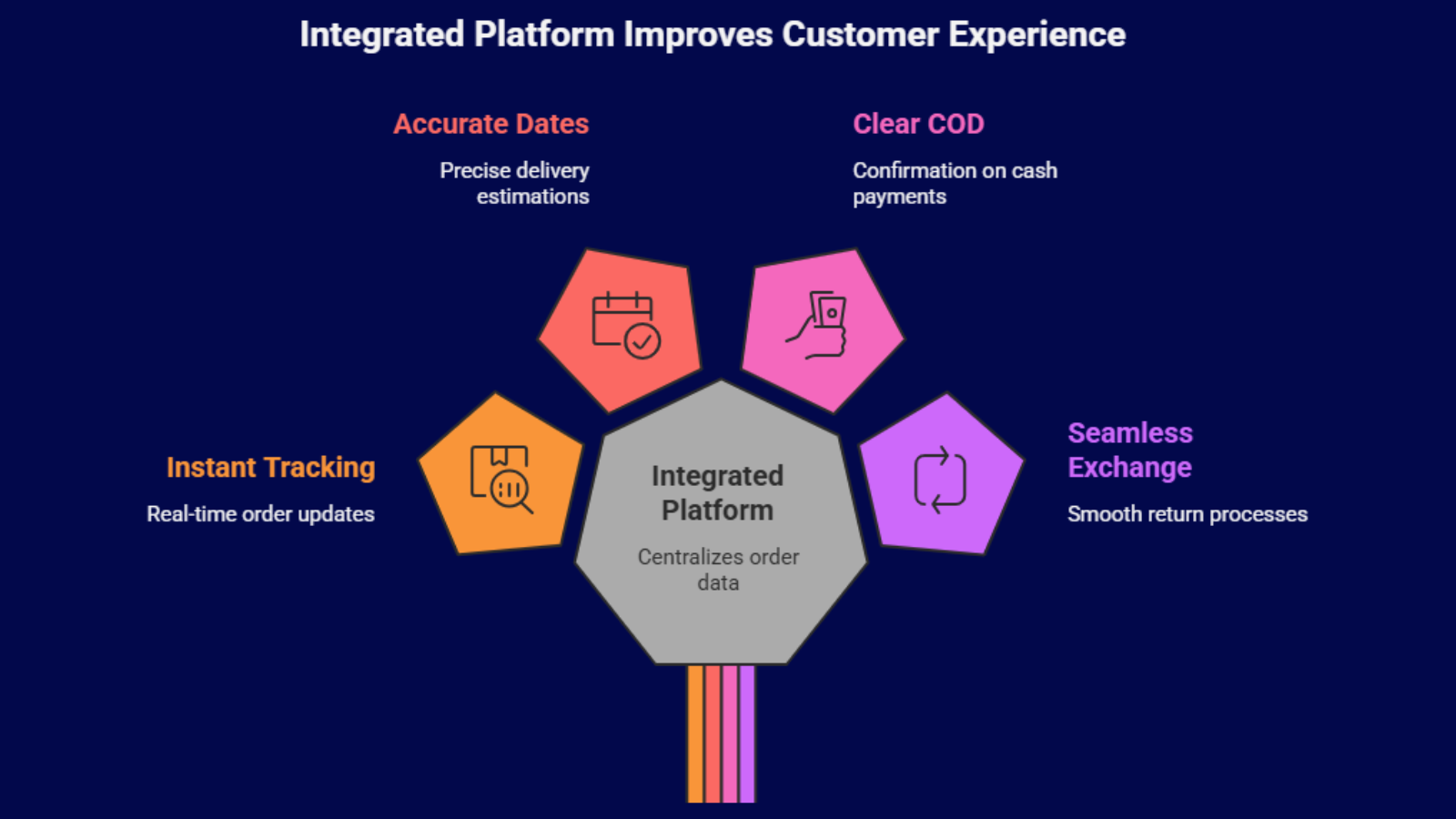
An integrated order management D2C platform centralizes order, shipment, and payment data.
This allows:
- Instant order tracking responses.
- Accurate expected delivery dates.
- Clear communication on COD confirmations.
- Seamless exchange workflows.
Faster responses improve NPS scores and repeat purchase rates, which are critical when customer acquisition costs continue to rise.
5. Real-Time Reporting and Forecasting
When revenue crosses ₹30 crore, founders cannot rely on monthly spreadsheets. They need SKU-level, region-level, and channel-level insights daily.
A robust OMS for D2C provides dashboards that show:
- Best-performing SKUs by state.
- Channel-wise cancellation rates.
- Courier performance and RTO percentages.
- COD versus prepaid ratios.
- Inventory aging and dead stock alerts.
This helps brands adjust marketing budgets, shift inventory between warehouses, and optimize working capital. For example, identifying that Tier 2 cities have 30 percent higher COD RTO can help brands introduce prepaid incentives in those regions.
In short, scaling from ₹10 crore to ₹35 crore is not just about demand generation. It is about operational discipline. A strong OMS for D2C and structured order management D2C framework ensures that growth translates into profitability, not backend chaos.
Comparing OMS Approaches
When an Indian D2C brand starts scaling beyond ₹15 crore to ₹35 crore in annual revenue, choosing the right OMS structure becomes a strategic decision. Most brands evaluate two models: ERP-integrated OMS and standalone OMS. The difference is not technical alone. It directly impacts finance visibility, GST compliance, reconciliation, and working capital planning.
Here is a simplified comparison tailored for Indian sellers:
| Feature | ERP-Integrated OMS | Standalone OMS |
|---|---|---|
| Real-time financial data sync | Yes, auto-sync with ERP | Limited or manual export |
| GST reconciliation | Automated with accounting | Requires separate sync |
| Marketplace settlement tracking | Integrated with finance | Often separate workflow |
| Speed of deployment | 2 to 4 months is typical | 3 to 6 weeks is typical |
| Scalability flexibility | Structured, process-driven | Faster experimentation |
| Cost structure | Higher upfront but unified | Lower upfront, separate fees |
When ERP-Integrated OMS Makes Sense
 If your brand is already using Zoho Books, Odoo, SAP Business One, or even Tally Prime, integrating your OMS directly with your ERP brings financial clarity that most growing D2C brands underestimate. As revenue moves toward ₹25 crore to ₹35 crore annually, complexity increases across GST filings, marketplace settlements, and COD reconciliation.
An ERP-integrated OMS automatically syncs sales invoices with correct GST classifications based on state and product category, which reduces compliance errors. It also reconciles Amazon and Flipkart settlement reports in real time, mapping commissions, returns, and penalties directly into your accounting system.
Courier COD remittance delays can be tracked against expected payouts, helping avoid cash flow gaps. Most importantly, SKU-level COGS and margin reporting become accurate because inventory movement and accounting entries are connected.
In a ₹30 crore business, even a 1 percent mismatch means ₹30 lakh in leakage. Integrated systems reduce these blind spots and make audits, due diligence, and funding conversations smoother because the books are clean and traceable.
When Standalone OMS Works Better
For early-stage brands between ₹5 crore and ₹15 crore in annual revenue, speed often matters more than deep financial integration. A standalone OMS is easier and faster to deploy, especially when the priority is integrating quickly with marketplaces like Amazon, Flipkart, Myntra, or adding new 3PL partners.
It works well if finance is still handled separately through basic accounting tools and monthly reconciliations. Standalone systems are also useful when experimenting with multiple warehouses or testing regional fulfillment strategies.
However, as order volumes increase and settlement cycles become more complex, manual reconciliation of GST input credits, refunds, and marketplace deductions becomes time-consuming.
Many Indian sellers realize this only after scaling, when financial discrepancies start affecting profitability and compliance.
How to Choose the Right OMS for your E-commerce Journey?
 When Indian D2C brands move from ₹10 crore to ₹35 crore in annual revenue, operational inefficiencies stop being small mistakes and start becoming expensive problems. Implementing the right OMS for D2C creates a measurable impact across revenue protection, compliance, and fulfillment speed.
Brands that automate order workflows typically see a 60 to 70 percent reduction in manual processing errors, especially during high-volume events like Big Billion Days. Dispatch timelines improve by 15 to 25 percent, which directly protects marketplace SLA scores on Amazon and Flipkart. RTO rates, which can go as high as 25 percent in certain categories, often drop by 10 to 20 percent when courier allocation is automated based on pincode performance and COD risk.
For a ₹35 crore brand operating at 18 percent gross margin, even a 2 percent operational leakage equals ₹70 lakh annually. A structured OMS for D2C prevents such losses by tightening inventory sync, COD reconciliation, and return processing.
| Operational Metric | Without Structured OMS | With Optimized OMS |
|---|---|---|
| Inventory mismatch | 2 to 3 percent | Below 0.5 percent |
| COD reconciliation | Manual, 7 to 10 days | Automated, near real-time |
| Order processing time | 8 minutes per order | 2 to 3 minutes automated |
When choosing a system, Indian sellers must prioritize scalability beyond 2,000 daily orders, strong integrations with Shopify, Amazon, Flipkart, Delhivery, and GST-ready invoicing. Local onboarding support also matters. The right OMS does not just manage orders. It safeguards profitability while enabling confident growth.
To scale successfully, your OMS needs to do more than manage orders — it needs to connect your entire fulfillment ecosystem. Base.com offers a platform that unifies your inventory, orders, logistics, and customer data into one efficient workflow. By choosing Base.com, brands unlock faster delivery, real-time insights, and operations that grow with you.
Frequently Asked Questions
1. What is an OMS in direct-to-consumer (D2C) operations?
An OMS is a centralized system that captures orders from websites and marketplaces, syncs inventory in real time, automates warehouse allocation, manages shipping workflows, and tracks returns. For Indian D2C brands, it also helps manage COD reconciliation, GST invoicing, and multi-warehouse coordination efficiently.
2. Why is order management important for D2C brands?
Order management directly impacts margins and customer satisfaction. As brands scale beyond ₹10 crore, manual tracking leads to cancellations, delayed shipments, and reconciliation errors. A structured system ensures accurate inventory, faster dispatch, smoother returns, and stronger marketplace performance scores.
3. How does an OMS improve inventory handling?
An OMS synchronizes inventory across Shopify, Amazon, Flipkart, and warehouses instantly. This prevents overselling during sales spikes and reduces stockouts. It also provides SKU-level insights, helping brands forecast demand region-wise and optimize working capital instead of locking funds in slow-moving inventory.
4. Can OMS help during peak seasons?
Yes. During festive sales, when volumes may increase five times, an OMS automates order allocation, courier assignment, picking lists, and invoicing. This reduces processing time, protects SLA compliance, and prevents costly cancellations that damage marketplace rankings.
5. What should I look for in a D2C OMS?
Focus on scalability beyond 2,000 daily orders, strong integrations with Indian marketplaces and courier partners, GST-ready invoicing, COD reconciliation tracking, real-time dashboards, and reliable onboarding support. These features ensure operational stability as revenue grows beyond ₹25 crore.