
Every D2C brand wants fast growth, but many Indian sellers hit a ceiling because their D2C poor tech stack cannot handle operational complexity. The problem usually doesn’t start with marketing or product demand. It starts when systems don’t sync properly across Shopify, Amazon, Flipkart, Myntra, and offline channels.
When inventory is not updated in real time, a product may show as available on your website but out of stock on Amazon. Even a 2-3 percent cancellation rate due to stock errors can impact marketplace rankings and reduce Buy Box visibility.
The issue becomes serious during sale events like Big Billion Days, Prime Day, or festive spikes. Without a strong OMS connected to live warehouse inventory, brands oversell.
This leads to order cancellations, and on Amazon, if your Order Defect Rate crosses 1 percent, your account health is affected. Many Indian founders don’t realize these penalties often come from backend system gaps, not operational negligence.
Finance is another blind spot. Marketplace payment cycles vary. Amazon settlements typically happen in 7-14 days, Flipkart weekly, and website payments via Razorpay settle T+2. Without automated reconciliation in your D2C operations tech, teams manually match COD remittances, returns, gateway fees, and GST. Industry data shows ecommerce brands in India lose 3-5 percent of revenue annually due to reconciliation errors and return fraud.
Logistics complexity adds more pressure. If shipments are not auto-assigned based on pincode serviceability or courier performance, RTO rates increase. In India, RTO can go as high as 25-35 percent in certain categories. Without automated address validation and prepaid nudges, margins shrink quietly.
This is why choosing the right systems is not optional. It directly protects revenue, seller ratings, and long-term scalability.
Why Your D2C Poor Tech Stack Determines Growth
A brand’s D2C poor tech stack directly affects margins, marketplace performance, and working capital cycles in India. Growth slows not only because of stock errors or cancellations, but because backend inefficiencies compound as order volumes increase.
- Marketplace commission leakage: Without automated fee auditing, many Indian sellers do not track incorrect weight slabs or penalty charges. Even a ₹10-₹20 excess charge per order can reduce annual margins by 2-3 percent at scale.
- GST compliance gaps: If your system does not auto-map HSN codes and state-wise tax rules, filing errors increase. Incorrect GST reconciliation can block input tax credit and impact cash flow.
- Return fraud exposure: Without image-based QC tracking in WMS, brands cannot dispute damaged or wrong return claims. In some categories, 8-12 percent of returns involve discrepancies.
- Demand forecasting issues: Without integrated analytics, brands overstock slow-moving SKUs, locking up working capital. Inventory holding costs in India can consume 18-22 percent of product value annually.
These operational gaps quietly reduce profitability, even when top-line sales look strong.
What Happens When a D2C Poor Tech Stack Is Weak
 At lower volumes, disconnected systems may feel manageable. Founders track inventory in sheets, reconcile payments manually, and pull reports from different dashboards. But once daily orders scale beyond 300-500, structural gaps in the tech foundation start affecting CAC, ROAS, and contribution margins directly.
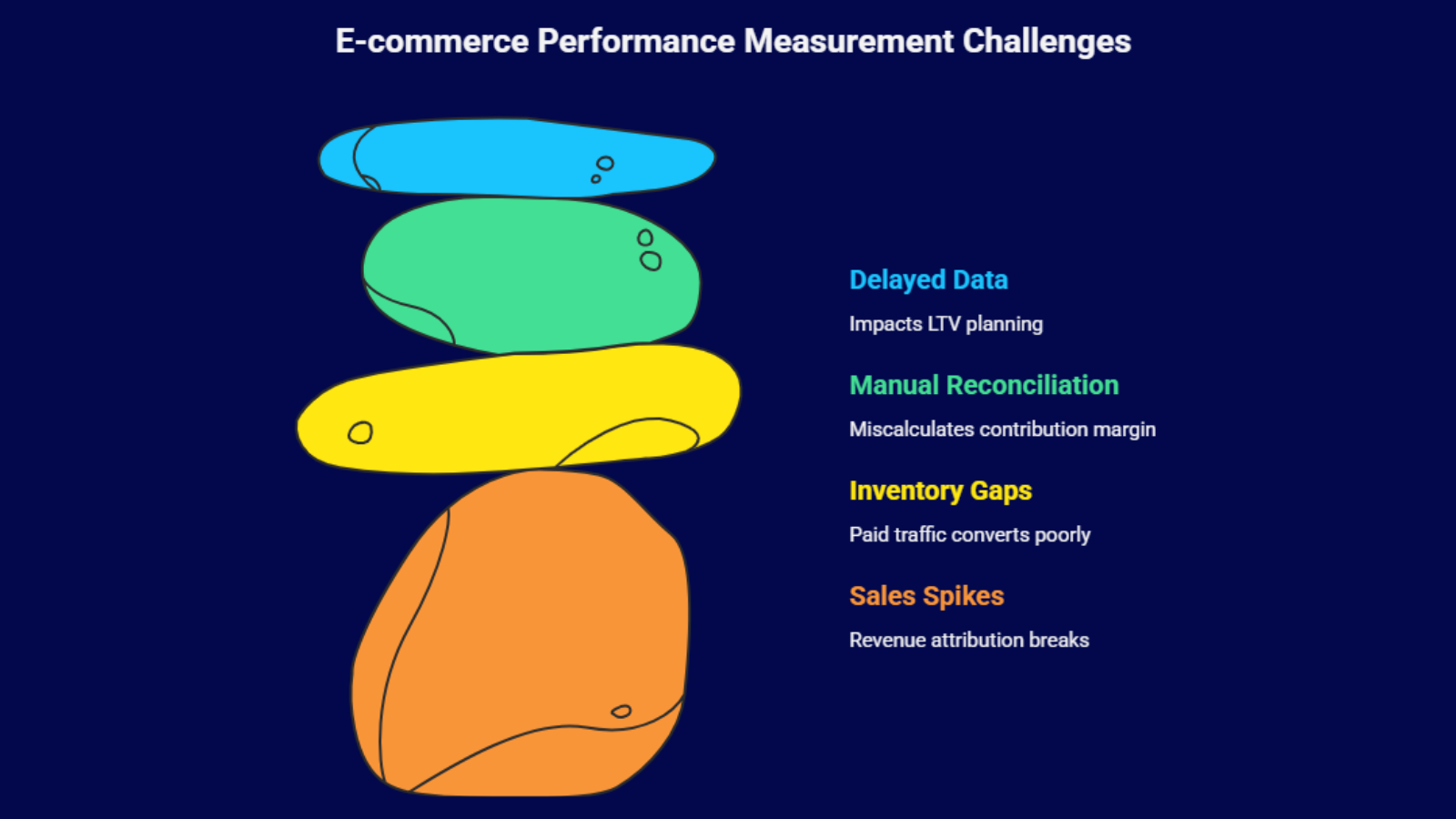
- Sales spikes distort performance metrics: If orders fail to sync during high-traffic events, revenue attribution breaks. Marketing may see strong ROAS in Meta Ads, but actual dispatched orders are lower. This inflates performance reporting and leads to wrong budget allocation.
- Inventory gaps increase CAC: When ads continue running on out-of-stock SKUs, paid traffic converts poorly. Conversion Rate drops, CAC increases by 10-20 percent, and blended ROAS weakens.
- Manual reconciliation hides true contribution margin: Without automated tracking of marketplace commissions, payment gateway fees, RTO losses, and refunds, brands miscalculate CM1 and CM2. Scaling ads without knowing real margins erodes profitability.
- Delayed data impacts LTV planning: If CRM and order systems are not synced, repeat purchase tracking becomes unreliable. This affects LTV calculations and retention budgeting.
When data from one system is inaccurate, it cascades into forecasting, procurement, ad scaling, and cash flow planning. The brand may grow in revenue, but efficiency drops, CAC rises, ROAS fluctuates, and working capital pressure increases. Growth becomes expensive instead of sustainable.
Symptoms of a Poor D2C Poor Tech Stack
| Symptom | Impact on Growth |
|---|---|
| Manual reconciliation | Incorrect CM1 and CM2 tracking; delayed profitability insights |
| Inventory out of sync | Lower Conversion Rate; rising CAC |
| Failed integrations | Revenue leakage and delayed order fulfillment |
| Slow storefront | Higher bounce rate; weaker ROAS |
| No unified analytics | Poor LTV tracking and inaccurate scaling decisions |
A weak tech backbone does not just slow operations. It distorts financial and marketing metrics that founders rely on to scale confidently.
10 D2C Poor Tech Stack Elements Every D2C Brand Needs
Scaling a D2C brand in India is not just about increasing ad spend or adding new SKUs. Growth becomes sustainable only when your D2C poor tech stack supports marketplace compliance, GST accuracy, courier performance, CAC control, and working capital visibility. Below are the 10 systems that Indian D2C sellers must implement, with clear ground-level relevance.
1. E-Commerce Platform
Your website is not just a sales channel. It is your highest margin channel. Unlike marketplaces that charge 15-25 percent commission, website contribution margins can be 8-12 percent higher.
What matters in India:
- Page load speed under 3 seconds. A 1-second delay can reduce conversions by 7 percent.
- Native UPI, BNPL, and COD support.
- Server stability during influencer drops and festive spikes.
- Easy integration with shipping aggregators like Shiprocket or Pickrr.
Without this, your CAC increases because paid traffic does not convert efficiently.
2. Order Management System (OMS)
 An OMS becomes critical when you sell across websites, Amazon, Flipkart, and quick commerce platforms.
Use cases Indian sellers face:
- Auto-priority routing between own warehouse and 3PL.
- Partial shipment handling when one SKU is out of stock.
- Auto-hold orders flagged as high RTO risk based on pincode history.
Brands crossing 500 orders per day without OMS often see 2-4 percent operational errors.
3. Inventory Management with Real-Time Sync
Marketplace algorithms penalize stockouts. If your fast-moving SKU goes out of stock for 48 hours, rankings drop and are hard to recover.
Must-have capabilities:
- Reserved stock logic for marketplaces.
- Bundled SKU mapping.
- Expiry tracking for FMCG or beauty brands.
- Live sync across offline POS and online channels.
Inventory holding costs in India range between 18-22 percent annually, so overstocking due to poor visibility directly impacts cash flow.
4. Warehouse Management System (WMS)
At 1,000+ daily orders, manual picking increases error rates significantly.
Ground-level benefits:
- Barcode-based picking reduces packing errors by up to 70 percent.
- Batch picking reduces fulfillment time by 25-30 percent.
- QC photo capture protects against false return claims.
In categories like fashion, where return rates can exceed 30 percent, WMS documentation protects margins.
5. CRM and Customer Data Platform (CDP)
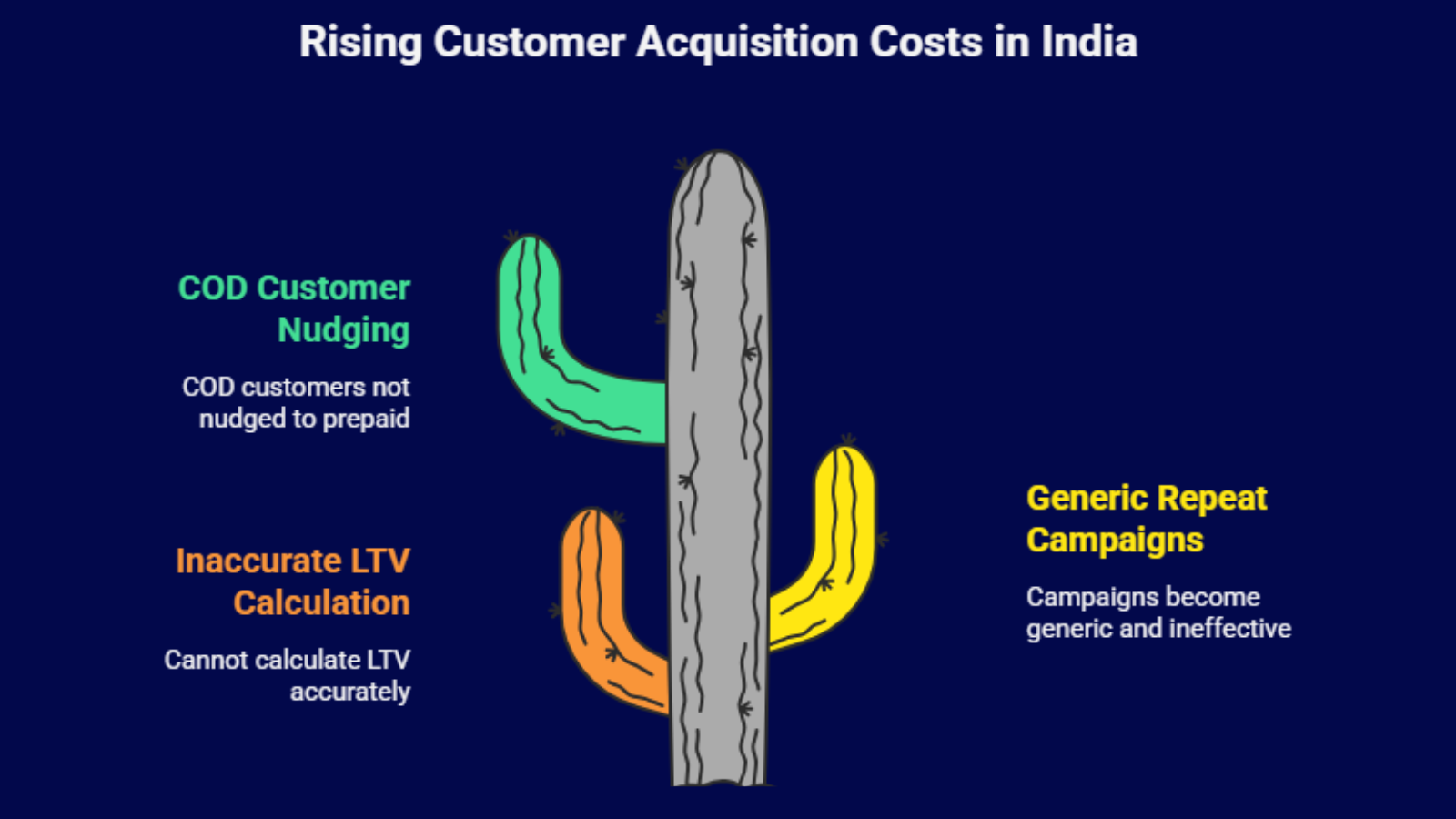 Customer acquisition in India is rising. CAC has increased 15-25 percent year-on-year in competitive categories like beauty and supplements.
Without unified customer data:
- LTV cannot be calculated accurately.
- Repeat purchase campaigns become generic.
- COD customers are not nudged toward prepaid.
A CDP helps:
- Segment first-time vs repeat buyers.
- Identify high-LTV cohorts.
- Trigger prepaid incentives in high-RTO pincodes.
Retention improves blended ROAS significantly.
6. Marketing Automation
Manual campaign management limits scaling.
Indian-specific scenarios:
- WhatsApp abandoned cart flows increase recovery by 8-12 percent.
- COD confirmation automation reduces fake orders.
- Festive campaign auto-segmentation for returning customers.
Without automation, CAC rises because retention revenue drops.
7. Analytics & Business Intelligence
Founders often rely on ad dashboard ROAS. But real profitability depends on CM1 and CM2.
What strong BI should show:
- SKU-level contribution margin after commission, shipping, and RTO.
- Marketplace vs website profitability comparison.
- State-wise RTO trends.
- Blended CAC and LTV ratio.
Many Indian brands scale ads at 3x ROAS but later discover negative CM2 due to hidden logistics and return costs.
8. Payment & Financial Reconciliation
Marketplace deductions are complex. Weight discrepancies, late shipment penalties, and promotional participation charges reduce payouts.
Must-have controls:
- Automated gateway fee validation.
- COD remittance tracking.
- Marketplace fee auditing.
- GST input credit reconciliation.
Brands lose 2-5 percent annual revenue due to unnoticed settlement errors.
9. Returns Management
 India has one of the highest RTO and return rates globally.
Critical features:
- Automated return approval rules.
- QC-based refund eligibility.
- Exchange-first workflows to protect revenue.
- Fraud flagging based on repeated abuse behavior.
Reducing RTO by even 5 percent can improve contribution margins by 3-4 percent.
10. Integrations & API Orchestration Layer
Most sellers use 8-12 tools. If integrations break, data silos form.
Why this layer matters:
- Real-time sync between ad platforms and inventory.
- Automatic SKU updates across marketplaces.
- Seamless refund and stock reversal flows.
- Centralized data warehouse feeding BI dashboards.
Disconnected systems increase manual intervention and distort CAC, ROAS, and inventory planning accuracy.
At early stages, spreadsheets and manual fixes work. But once monthly GMV crosses ₹50 lakh to ₹1 crore, operational inefficiencies compound. Marketplace penalties, GST mismatches, RTO losses, and inaccurate CM tracking quietly reduce margins even if top-line revenue grows.
The Real Cost of a Weak Stack and the Growth Impact of Getting It Right
 Ignoring D2C poor tech stack limitations silently eats into profitability. E-commerce brands globally lose 15-25 percent operational efficiency due to disconnected systems, and in India, where marketplace commissions range between 15-25 percent, and logistics adds another 8-12 percent, even a 3 percent leakage can erase net margins. Finance teams often spend 30-40 percent of their time on manual reconciliation of COD remittances, gateway fees, refunds, and GST, delaying clear CM1 and CM2 visibility. Poor inventory forecasting locks working capital in slow-moving SKUs for 60-90 days, restricting ad scaling despite healthy ROAS dashboards.
In contrast, a connected D2C poor tech stack improves inventory accuracy beyond 98 percent, reduces fulfillment TAT by 20-30 percent, and gives real-time visibility into blended CAC, LTV, and contribution margins. Automated reconciliation alone can protect 2-4 percent annual revenue. When systems work together, decisions become faster, margins cleaner, and growth far more predictable.
Final Thoughts
Growth in D2C does not slow down because of demand. It slows down because operations cannot support demand. When inventory is inaccurate, when settlements take weeks to reconcile, when marketplaces and website data don’t match, the business starts leaking margin.
Over time, CAC rises, ROAS becomes unreliable, working capital gets blocked in the wrong SKUs, and leadership spends more time solving operational chaos than building the brand. Disconnected systems create hidden friction. Connected systems create predictable scale.
This is where Base.com becomes critical for modern D2C brands. Base.com is designed to strengthen your D2C poor tech stack by unifying order management, inventory sync, warehouse operations, and reconciliation into one connected ecosystem.
Instead of juggling multiple dashboards, spreadsheets, and manual processes, you get centralized control across marketplaces and your website. Orders flow automatically. Inventory updates in real time. Settlements reconcile faster. Fulfillment becomes structured and trackable.
For Indian sellers managing multi-channel complexity, Base.com helps reduce operational errors, improve dispatch timelines, and protect contribution margins. It gives founders clean data, accurate reporting, and stronger backend discipline. When your foundation is strong, scaling becomes a decision, not a risk.
If you want growth without operational stress, it starts with fixing the backbone. Base.com helps you build it right.
Frequently Asked Questions
1. What does a D2C poor tech stack mean for a D2C brand?
A D2C poor tech stack is the collection of digital systems that power your online store, from order capture and inventory to marketing and analytics. These must work together to support seamless growth.
2. How does poor inventory management slow growth?
Without real-time sync, inventory mismatches lead to stockouts or overselling, frustrating customers and reducing revenue. Efficient inventory tech eliminates these bottlenecks.
3. Can manual reconciliation cost a D2C business growth?
Yes. Manual finance work consumes time, delays insights, and increases error rates. Automated reconciliation ensures faster reporting and better decision-making.
4. Why is integration important in a D2C poor tech stack?
Integration connects systems so data flows automatically. Without it, teams resort to manual work, increasing errors and slowing operations.
5. How does marketing automation influence scaling?
Automation ensures consistent engagement with customers without manual effort. It reduces workload, supports personalization, and improves retention.