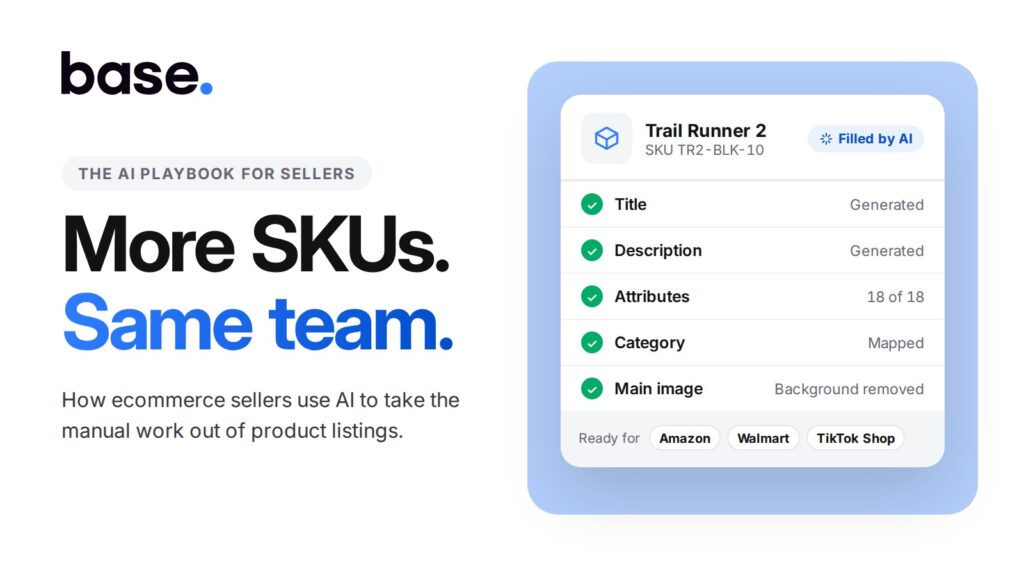
Every new SKU needs a title, a description, attributes, images, and a category on every channel you sell it on. Done by hand, that work caps how many products one person can manage, usually a few hundred. Add a new marketplace or a new country and the backlog grows again.
AI now handles most of that repetitive product work well, which makes it one of the most practical uses of AI for ecommerce. This playbook walks through it in nine short steps.
Ecommerce sellers get the most from AI by using it on repetitive product work: writing titles and descriptions in bulk, filling in attributes, fixing images, translating listings, and letting an AI listing agent publish new products to each marketplace. Start with clean product data, and have a person spot-check every batch.

Why manual work caps your catalog
Setup work grows with every SKU and every channel you add, which is why small teams often stop adding either. The work isn’t hard, there’s just too much of it. AI in ecommerce pays off fastest here, by taking over the repetitive parts so the same team can manage a much bigger catalog.
×3 channels
×3 channels
×3 channels
×3 channels
×3 channels
The AI for ecommerce playbook: 9 steps
Work through these in order. Each step removes a chunk of manual work, and the early steps make the later ones work better.
Time one SKU
Pick a typical product and time it from “new in the catalog” to “live on every channel.” Multiply by the products you want to add this year. That number is your business case, and it tells you which step to start with.
Clean your product data once
AI writes from the data you give it. Put every product in one catalog with the basics filled in: name, brand, key specs, dimensions, and at least one good image. The more complete your data, the better the output. (More on why one catalog matters in our multichannel ecommerce guide.)
Generate titles and descriptions in bulk
Select a group of products and generate titles or descriptions for all of them at once. Write your brand rules into the instructions (tone, length, words to avoid) so every batch sounds like you.
Let AI fill in attributes and categories
Attributes are where most manual hours go. Every marketplace wants different required fields, and every category has its own list (see our Walmart and TikTok Shop guides for examples). AI can read your product data, pick the right category, and fill in the fields for you.
Fix images at scale
Amazon and Walmart both want a white background on the main image. Use AI to remove backgrounds instead of editing each photo by hand, and use AI image tools for ecommerce lifestyle shots when you need secondary images.
Translate for new markets
Going cross-border used to mean an agency or a bilingual hire. Now you can translate names and descriptions for a whole catalog and have a native speaker review a sample.
Hand listing to an AI agent
AI agents for ecommerce keep working in the background, without waiting for someone to click. Set rules for which products should be on which marketplace, and the agent lists new products as they appear in your catalog, live or as drafts, without re-keying anything.
Keep a person in the loop
Review a sample from every batch before it goes live, and check the agent’s logs once a week. AI gets most listings right. A quick human check catches the rest, especially on regulated categories and your bestsellers.
Track one number
Measure SKUs live per person. If that number goes up while headcount stays flat, the playbook is working. Base Analytics can show it next to sales by channel.
Want the bigger picture? See how Base brings your products, orders, and stock together in one place, with AI built in to help you list faster.
Frequently asked questions
How can ecommerce sellers use AI?
The biggest wins are in repetitive product work: generating titles and descriptions, filling in attributes, picking categories, removing image backgrounds, translating listings, and publishing new products to marketplaces with an AI listing agent. These are the tasks that limit how many SKUs a small team can manage.
What are the best AI tools for ecommerce?
The best AI tools for ecommerce are the ones that remove your biggest manual bottleneck. For most sellers that’s product content and listings: bulk title and description generation, attribute filling, image background removal, translation, and listing agents. Tools built into the system that already holds your product data save the most time, because there’s nothing to copy between apps.
Can AI fill in product attributes for marketplaces?
Yes. AI can read your existing product data, choose the right category on each marketplace, and complete the required attributes. Results are only as good as your source data, so keep names, specs, and images complete, and review a sample before it goes live.
What are AI agents for ecommerce?
AI agents for ecommerce are tools that carry out a task on their own based on rules you set. A listing agent, for example, watches your catalog and lists new products on each marketplace automatically, live or as drafts, without someone creating each listing by hand.
How many more SKUs can one person manage with AI?
It depends on how complete your product data is and how much review your categories need. The change is that a person moves from creating each listing to reviewing batches, which lets the same team manage a much larger catalog. Track SKUs live per person to see the difference in your own business.
Does AI-generated product content need to be checked?
Yes. AI gets most listings right, but a person should review a sample from every batch, especially for bestsellers and regulated categories, and check that claims, sizes, and specs match the product.