Walk into any Indian metro today and you can feel a shift in how people shop. The midnight chocolate craving, the missing coriander for dinner, the last-minute birthday candle, the forgotten shampoo, everything now arrives in minutes. This is the world of Q-commerce, the new-age model that has turned waiting into an outdated idea.
For Indian sellers, this is not just another retail trend. It is a channel that pushes products right into the heart of daily consumption. And while the speed is exciting, the system behind it is complex, fast-paced, and full of opportunity for those who understand how it works.
Let’s break it down in the simplest, most real way possible.
What Exactly Is Quick Commerce and How Is It Different from Traditional E-commerce?

Quick commerce is the version of e-commerce that moves at lightning speed. Instead of promising delivery in a few days, it brings essentials straight to a customer’s doorstep in minutes. It is built for moments when people cannot wait , groceries they ran out of, snacks they suddenly want, or basics they forgot to buy.
Traditional e-commerce is built for variety. Q-commerce is built for urgency.
Traditional models rely on massive warehouses on the outskirts of cities. Q-commerce flips that idea. It uses small, tightly stocked dark stores placed right inside residential zones. These stores hold only what sells fastest, so every product is a quick pick away.
Here is the simplest way to understand the difference:
- Traditional e-commerce delivers everything. Q-commerce delivers what sells daily.
- Traditional warehouses sit far away. Q-commerce dark stores sit almost next door.
- Traditional delivery takes days. Q-commerce runs in minutes.
For sellers, this means inventory strategy is not just about availability. It is about being present in the right pocket of the city at the right time.
How Do Q-Commerce Companies Deliver So Fast in Cities That Can Barely Move?
Anyone who has sat in evening traffic in Mumbai or Delhi knows that fast movement is a luxury. Yet Q-commerce manages to move at an unbelievable pace.
The secret is not magic. It is the dark store network.
Dark stores are compact, high-speed warehouses. They are usually placed in busy neighborhoods, hidden inside small commercial buildings, basements, or repurposed shops. They are designed for one job: move products out fast.
Platforms layer this setup with technology that predicts what people will order before they even order it. The idea is simple. If customers often buy bread in a certain locality, the dark store in that area keeps that item fully stocked. If cold drinks spike during hot afternoons, the store prepares for it. This demand forecasting cuts delays at every step.
And then comes the delivery fleet. Riders stay close to these dark stores, waiting for orders. Their routes are optimized through real-time mapping so they can avoid traffic hotspots and take the fastest possible path.
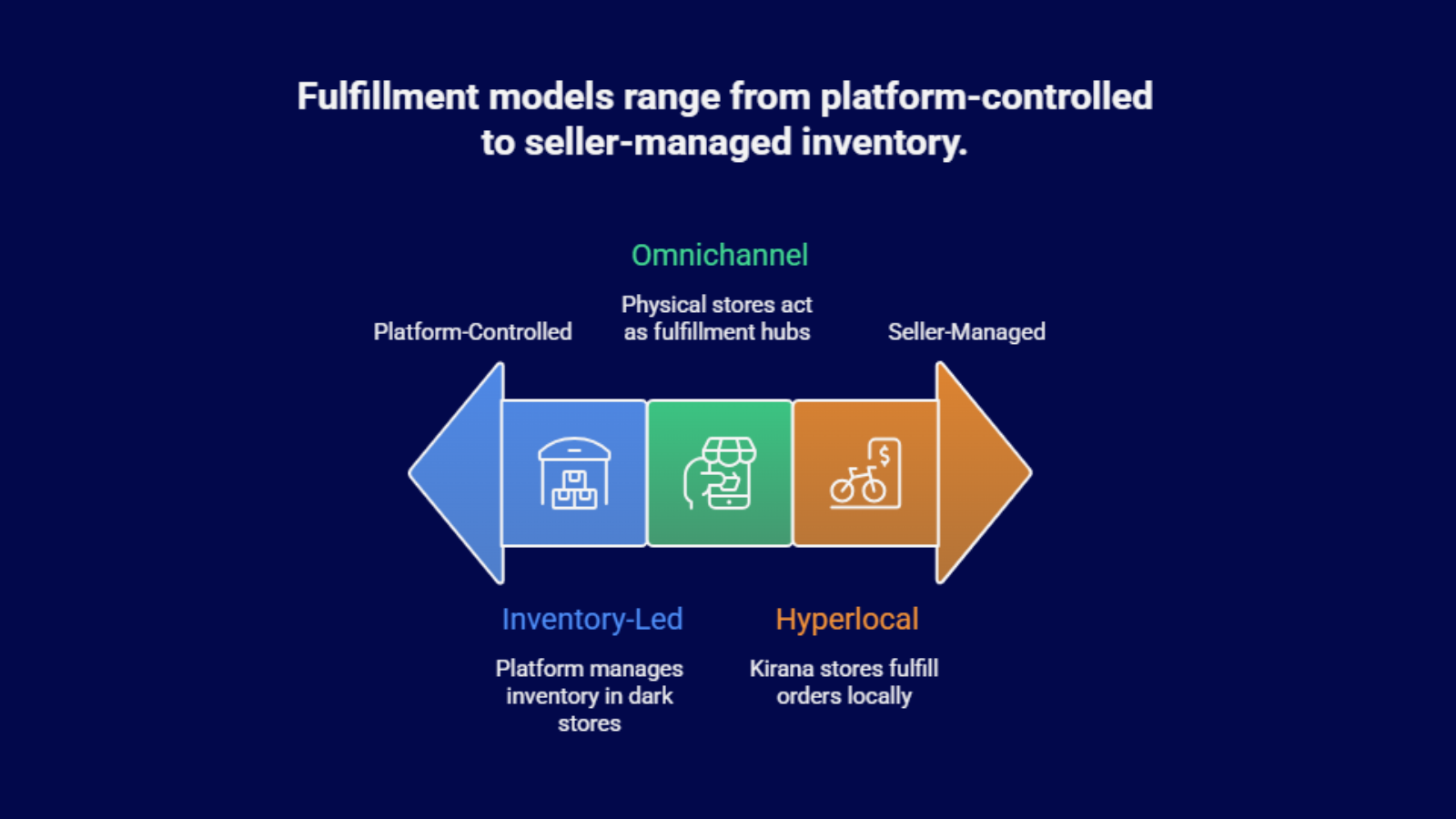
The Core Models That Power Q-Commerce
| Model | How It Works | What Sellers Need to Know |
| Inventory-Led | – Platform purchases and stores inventory in its own dark stores.
– Dark stores are placed within residential zones for faster delivery. – Platform controls replenishment, stock levels, and demand forecasting. – Orders are picked, packed, and shipped within minutes due to tight operations. |
– Best for fast-moving, high-rotation SKUs.
– Requires consistent supply, strong fill rates, and dependable availability. – Reduces stockout risk due to platform-managed inventory. – Strong visibility but demands competitive pricing and steady demand. |
| Hyperlocal | – Platform fulfills orders through nearby Kirana stores or local vendors.
– Orders routed to the closest partner with available stock. – Local stores prepare the order; platform riders deliver. – Works well for fresh, perishable, or regional products. |
– Ideal for perishables or hyperlocal specialties.
– Sellers maintain stock control, offering flexibility but requiring accuracy. – Helps small stores go digital with no major investment. – Accurate stock updates lead to better placement and more orders. |
| Omnichannel | – Existing physical stores act as fulfillment hubs.
– Online orders go to the nearest store with available stock. – Store staff handle picking and packing. – Delivery partners handle last-mile fulfillment. |
– Ideal for sellers with retail outlets expanding online.
– Helps clear in-store inventory faster and increases total sales. – Requires real-time inventory syncing to avoid cancellations. – Better coordination improves customer experience and repeat demand. |
Every part of the system is designed to save seconds. When speed is the product, every second counts.
Why Is Q-Commerce Booming So Fast in India?
India did not just adopt Q-commerce. It embraced it.
Urban life is busy, fast, and crowded. Convenience wins every time. That is why Q-commerce exploded in metros and is now making its way deeper into Tier 2 cities.
India’s quick commerce boom fits naturally into how urban life works. Dense neighborhoods make it easy for delivery riders to cover more orders in less time. Traffic makes even a short store run frustrating, so getting items delivered feels simpler than stepping outside. Cheap mobile data has made app-based shopping a habit across all age groups.
Younger consumers value convenience over planning, which aligns perfectly with instant delivery. And after the pandemic normalized ordering essentials online, households grew comfortable relying on digital platforms for everyday needs. All these factors together created the perfect environment for Q-commerce to thrive.
This combination has created a permanent shift in shopping behavior. People do not think twice before opening an app for a missing packet of curd or a sudden craving.
For sellers, this is gold. It means products get discovered faster, sold faster, and repeated faster.
What Challenges Do Sellers Face in the Q-Commerce Environment?
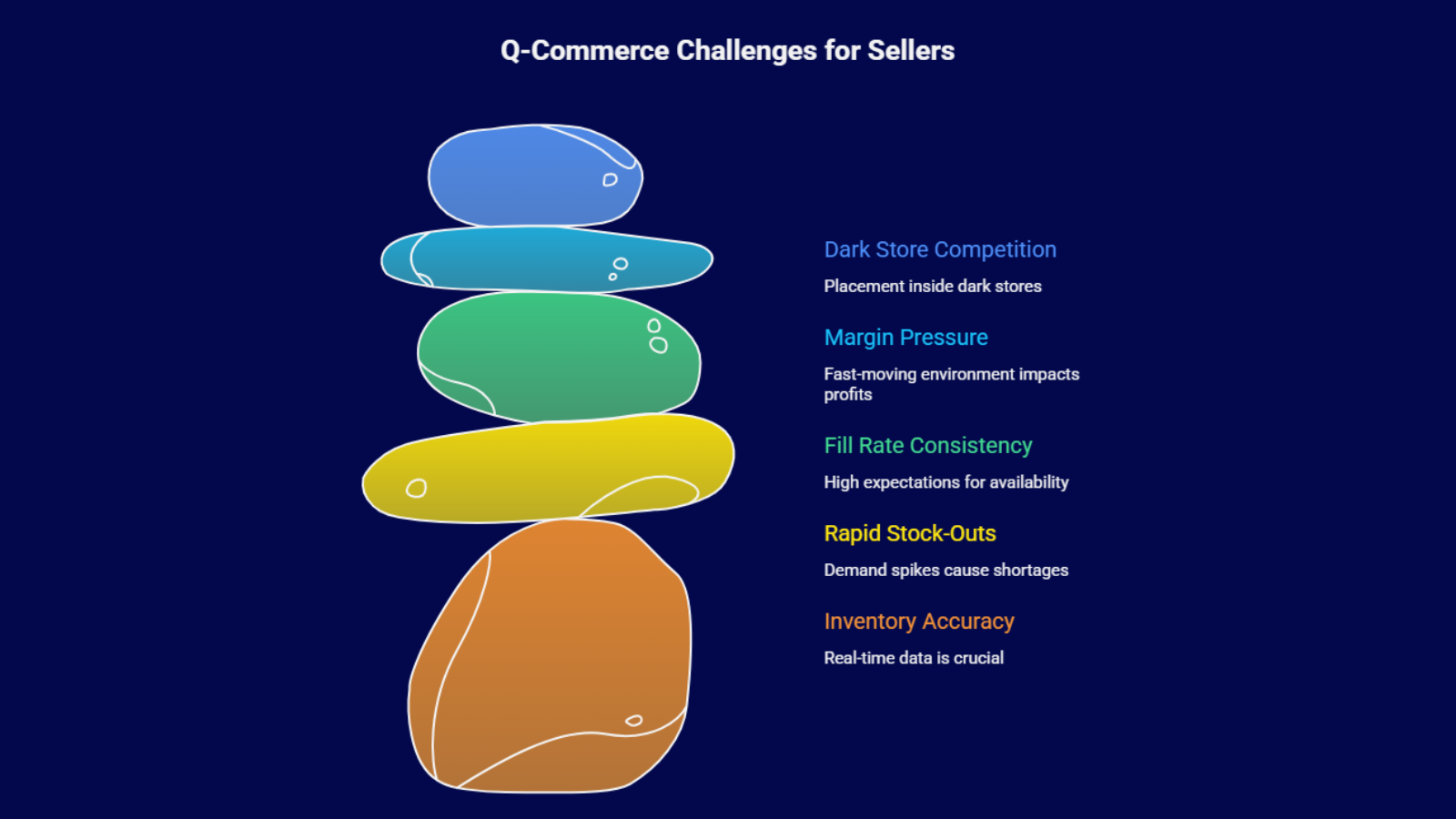
The opportunity is massive, but the expectations are high. Q-commerce moves fast, but the backend needs to move even faster.
The tight delivery promise leaves almost no room for error. If a product is not available at the dark store closest to the customer, the sale is instantly lost. And if inventory is not updated in real time, cancellations shoot up. If sellers cannot maintain steady supply, platforms push competing SKUs ahead.
And then there is the cost pressure. Dark stores require prime real estate and staff. Delivery fleets run round the clock. Platforms need volume and efficiency to stay profitable, so they demand reliability from sellers.
The Most Common Q-Commerce Challenges for Sellers
- Real-time inventory accuracy
- Rapid stock-outs due to sudden spikes in demand
- High expectations for fill rate consistency
- Margin pressure in a fast-moving environment
- Competition for placement inside dark stores
Smart Strategies Sellers Can Use to Win in Q-Commerce
| Strategy | How It Helps Sellers | Why It Matters |
| Focused Product Mix | Stock only fast-moving, margin-friendly SKUs. | Q-commerce is built for volume, not variety. |
| Real-Time Inventory Sync | Reduces cancellations and improves ranking. | Platforms reward accuracy and reliability. |
| Multi-Store Tie-Ups | Widens hyperlocal coverage instantly. | Increases visibility across neighborhoods. |
Winning in Q-commerce is about being fast, predictable, and consistently available.
How Will Q-Commerce Evolve in India Over the Next Few Years?
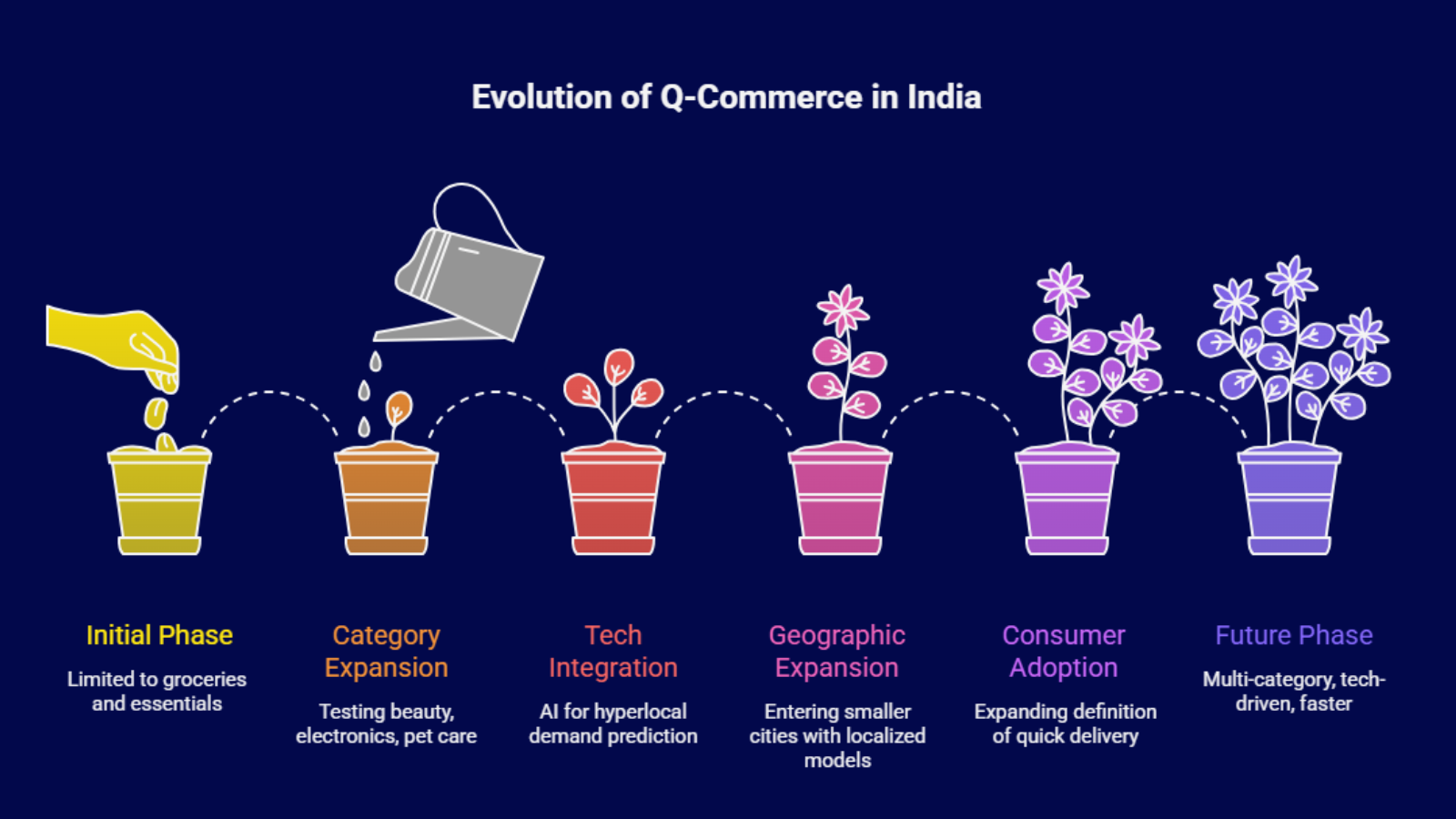
What you see today is just the trailer. The real movie is yet to play out.
Q-commerce will not remain limited to grocery and everyday essentials. Platforms are already testing categories like beauty, small electronics, pet care, kitchen tools, and over-the-counter health products.
The next evolution will include deeper use of technology. Advanced AI will predict demand at a hyperlocal level, helping platforms stock products before customers even think of buying them. As operations become more refined, Q-commerce will move into more cities, each with slightly different delivery promises based on density and demand patterns.
And as consumers grow more comfortable, the definition of what can be delivered in minutes will expand.
What’s Coming Next in Q-Commerce
- Expansion into smaller cities with localized speed models
- Smarter micro-warehousing powered by AI
- Broader categories beyond food and essentials
- Greater collaboration between platforms and sellers
The future is multi-category, tech-driven, and even faster than today.
Ready to Grow Your Brand in India’s Fastest Shopping Channel?
Q-commerce is not just the future of retail. It is the present. The buyers are here. The demand is here. The opportunity is here. If you want to get your products closer to customers and grow faster than the competition, this is the moment to act. List your products on Base.com and get instant access to India’s fastest-moving retail ecosystem.
Speed wins in Q-commerce. And the brands that move now win the next decade.
Frequently Asked Questions for Indian Sellers
1. How do Q-commerce platforms earn revenue?
Q-commerce platforms earn revenue through commissions on each order, delivery fees charged to customers, and paid visibility options like premium placements for sellers. Some also generate income from in-app advertising and partnerships with brands. Together, these revenue streams help offset operational costs and support faster fulfillment models.
2. Why are dark stores important?
Dark stores are the backbone of Q-commerce because they stock only high-demand items for specific neighborhoods. Their close proximity allows riders to pick, pack, and deliver orders within minutes. This focused, hyperlocal setup reduces travel time, cuts stockouts, and enables the ultra-fast delivery speeds customers expect.
3. Can small local stores benefit from Q-commerce?
Yes. Q-commerce platforms use hyperlocal models that partner with nearby Kirana stores to fulfill orders. This converts local shops into digital fulfillment hubs without requiring extra investment. Kiranas gain higher order volumes, improved visibility, and access to a broader customer base, all while continuing their regular operations.