
How to Spot Bottlenecks Before They Slow Your Growth
Growing an e-commerce business should create momentum.
But for many brands, growth creates something else entirely: more complexity, more manual work, and more operational friction.
Orders increase. Channels multiply. Inventory gets harder to manage. Teams spend more time fixing issues than improving performance.
And that raises an important question:
How efficient is your e-commerce operation, really?
That’s exactly what the Base E-Commerce Efficiency Scorecard is designed to help you answer.
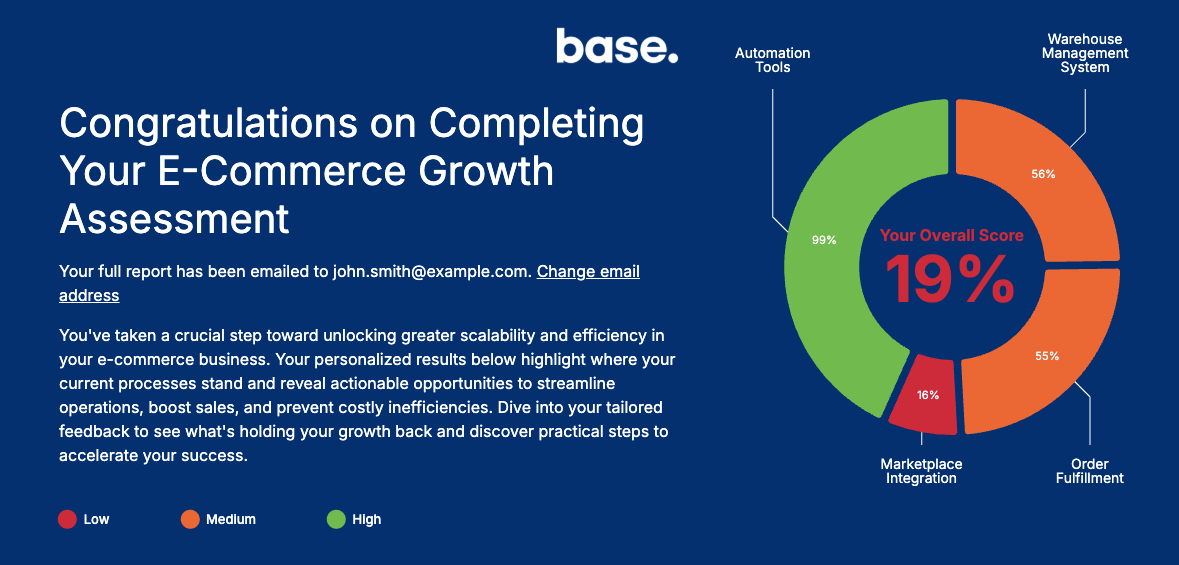
In just 15 questions, it helps brands assess how prepared their operations are to scale across four critical areas: warehouse management, order fulfilment, marketplace integration, and automation.
Why operational efficiency matters more than ever
Most operational problems do not start as major failures.
They begin as small inefficiencies:
- a stock discrepancy here
- a delayed dispatch there
- one more manual update across another sales channel
- one more repetitive task that still needs human input
At lower order volumes, these issues can seem manageable.
But as a business grows, those same inefficiencies begin to compound. What once felt like a minor inconvenience starts affecting fulfilment speed, stock accuracy, customer satisfaction, and team productivity.
That is when scaling becomes harder than it should be.
The four areas that define e-commerce efficiency
The scorecard focuses on four pillars that have an outsized impact on day-to-day performance and long-term scalability.
1. Warehouse Management System (WMS)
Your warehouse is the operational backbone of your business.
If stock visibility is limited, purchase orders are not automated, or warehouse workflows are disconnected from the rest of your systems, the result is often slower fulfilment, more errors, and less confidence in inventory data.
Brands that score lower in this area are typically dealing with manual processes, weak stock tracking, and delays that affect the wider business. Their report encourages them to explore more scalable WMS capabilities that automate stock control and streamline operations. Brands with stronger scores are encouraged to build on that foundation through further optimisation and automation.
2. Order Fulfilment
Fast, accurate fulfilment is no longer a competitive advantage. It is the baseline customers expect.
If orders are not routed automatically, teams rely on manual packing workflows, or shipping errors happen too often, fulfilment quickly becomes a growth constraint.
The scorecard highlights whether a business is still relying too heavily on manual fulfilment or whether it already has reliable workflows in place. Lower scores point to a need for better automation in routing, picking, and packing. Higher scores indicate a strong process, with opportunities to keep improving through smarter technology and better planning.
3. Marketplace Integration
Selling across multiple channels creates opportunity, but only if your systems stay connected.
When listings, stock levels, and order updates are not synchronised properly, businesses risk overselling, stockouts, duplicate work, and unnecessary admin.
This part of the scorecard looks at how well connected a business really is across its marketplaces and sales channels. Lower scores suggest disconnected systems and avoidable operational overhead. Stronger scores indicate a more centralised and scalable setup, with room to deepen integrations further as the business expands.
4. Automation Tools
Manual work is one of the clearest signals that operations are not built to scale.
Tasks like order processing, invoicing, notifications, listing updates, and pricing changes can all consume valuable time when handled manually. They also introduce more room for human error.
The automation section of the scorecard helps businesses identify how much they still rely on manual effort and where automation could deliver immediate gains. Lower-scoring businesses are encouraged to automate repetitive tasks to reduce mistakes and free up capacity. Higher-scoring businesses are guided toward more advanced optimisation opportunities as they continue to grow.
What the results actually show
One of the most useful parts of the scorecard is that it does not treat every business the same.
Instead of giving a generic summary, the report reflects different levels of operational maturity across each category.
For example:
- Low scores highlight areas where manual processes are likely causing delays, errors, and missed revenue opportunities.
- Medium scores indicate that some solid foundations are in place, but there are still bottlenecks and inefficiencies limiting scale.
- High scores show that a business already has strong systems in place, while also identifying opportunities for further refinement and future-proofing.That makes the scorecard useful whether a brand is just starting to professionalise operations or already managing a more advanced multi-channel setup.
A faster way to uncover bottlenecks
The Base E-Commerce Efficiency Scorecard was built to make that assessment simple.
In just 15 quick questions, brands can get a clearer view of how well their operations are set up to support growth and receive a personalised report tailored to their current level of maturity. The feedback is designed to highlight blind spots, surface inefficiencies, and point to practical improvements across the four key operational pillars.