
An Indian seller handling 5,000 orders a month is actually managing over 15,000 different data points. From warehouse bins to courier hubs and finally to the customer’s doorstep, information is moving everywhere. Yet, a staggering 65% of finance heads admit they do not trust the data provided by their operations teams.
This gap is what we call an ops finance data mismatch. While the operations team celebrates “dispatching” an order, the finance team is worried about when the cash will actually hit the bank.
For Indian D2C brands processing hundreds of COD orders daily, reconciliation delays between courier-reported deliveries and actual payment settlements can silently drain 8–12% of monthly revenue before anyone notices.
This disconnect leads to massive reconciliation delays and constant reporting conflicts. To grow a business in India’s competitive market, solving this trust deficit is no longer optional, it is a necessity for financial accuracy.
Why These Silos Create Data Gaps?
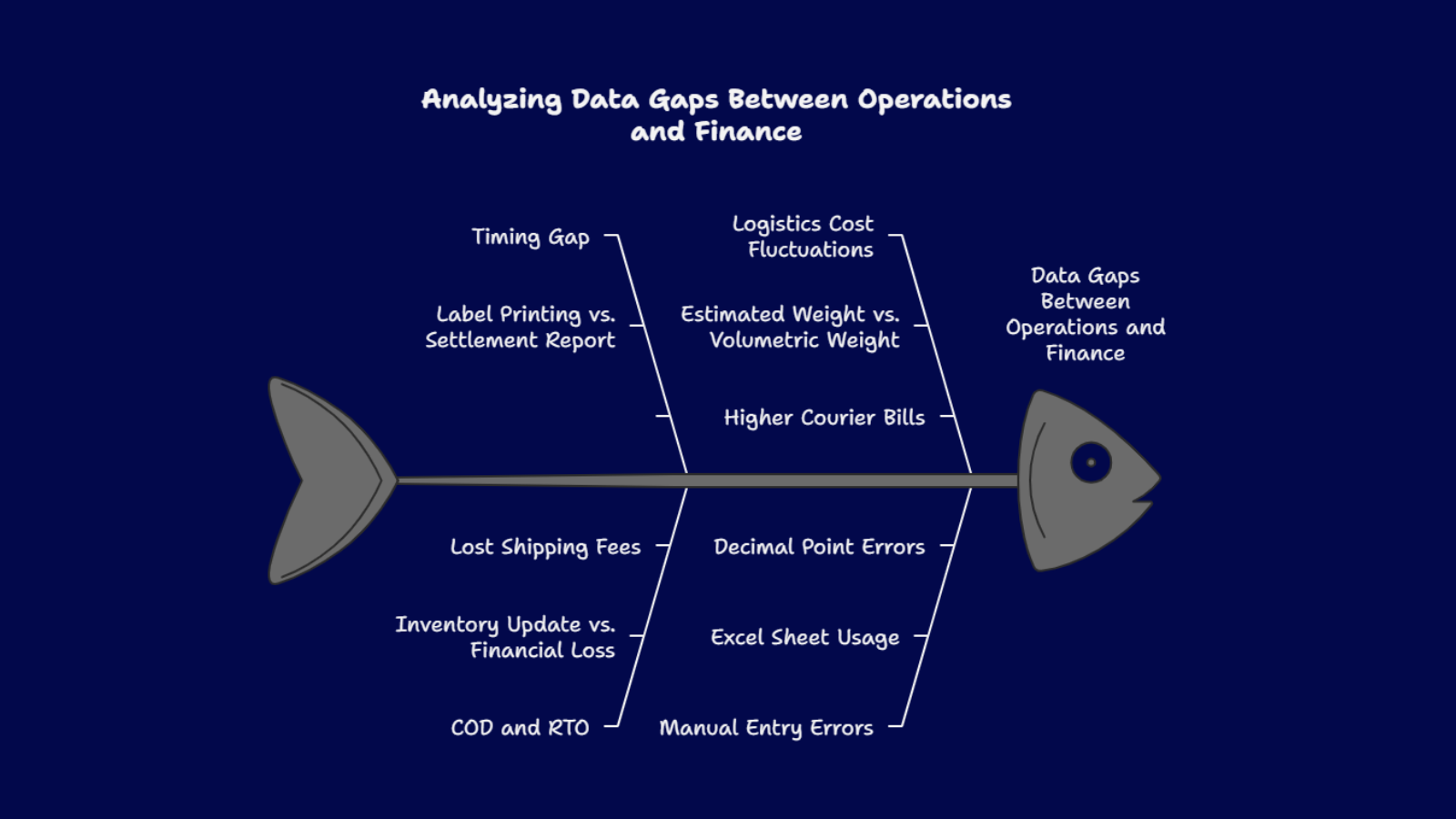
The biggest reason for the lack of trust is that operations and finance speak two different languages. Operations focuses on speed, getting the product picked, packed, and shipped. Finance focuses on the “finality” of money. In India, where Cash on Delivery (COD) accounts for a huge chunk of sales, an order “leaving the warehouse” is not the same as an order “being sold.”
This timing gap creates a massive ops finance data mismatch. When the warehouse management system says 500 units are gone, but the bank statement only shows payments for 400, the finance team has to go on a treasure hunt to find the missing money.
When marketplace payouts from Amazon or Flipkart don’t match your internal order records, reconciliation delays create a cascading effect, your team freezes purchase orders, halts restocking, and stalls growth while chasing missing numbers.
Main Reasons for Data Discrepancies:

- The Timing Gap: Operations records a sale the moment the label is printed. Finance waits for the marketplace settlement report, which might come 7 to 14 days later.
- The COD and RTO Factor: In India, “Return to Origin” (RTO) is a silent profit killer. Operations might track a return as a simple inventory update, but Finance has to track the lost shipping fee and the non-refundable marketplace charges.
- Logistics Cost Fluctuations: Operations looks at the “estimated” weight of a parcel. However, courier companies often charge based on “volumetric weight.” This leads to a scenario where Finance sees a higher bill than Operations predicted.
- Manual Entry Errors: Many Indian sellers still use manual Excel sheets to move data from their warehouse to their accounting software like Tally. One wrong decimal point can cause a huge reporting conflict.
High RTO rates make reconciliation delays worse because every returned order creates a disputed transaction that must be manually matched against courier debit notes, refund credits, and warehouse receipts — a process that can take weeks without automation.
Comparison Table: Two Different Worlds
| Feature | Operations Perspective | Finance Perspective |
|---|---|---|
| Order Status | “Shipped” means the job is done. | “Settled” means the money is in the bank. |
| Returns | A unit back on the shelf. | A loss of shipping cost and a tax credit. |
| Inventory | Physical boxes in the warehouse. | Tied-up capital and depreciating assets. |
| Discounts | A tool to increase sales volume. | A reduction in the Net Realized Revenue. |
The Impact of Reconciliation Delays on Business Growth
When a business suffers from reconciliation delays, it is effectively flying blind. For an Indian seller, every rupee counts. If you don’t know your actual profit for 30 days because you are waiting to “reconcile” your marketplace reports, you cannot make smart decisions about buying more stock or spending on ads.
Brands selling across multiple channels simultaneously face the sharpest reconciliation delays, as each platform follows its own payment cycle and fee structure, making it nearly impossible to get a clean daily P&L without a centralised order management system.
Finance teams often spend 80% of their time just cleaning data and only 20% actually analyzing it. This shift in focus ruins financial accuracy and makes the business reactive rather than proactive.
During India’s festive sale seasons, when daily order volumes spike 10x overnight, reconciliation delays compound rapidly as split shipments, partial deliveries, and bulk COD settlements all land at the same time with no automated system to untangle them.
Why Delays are Dangerous for Your Business:
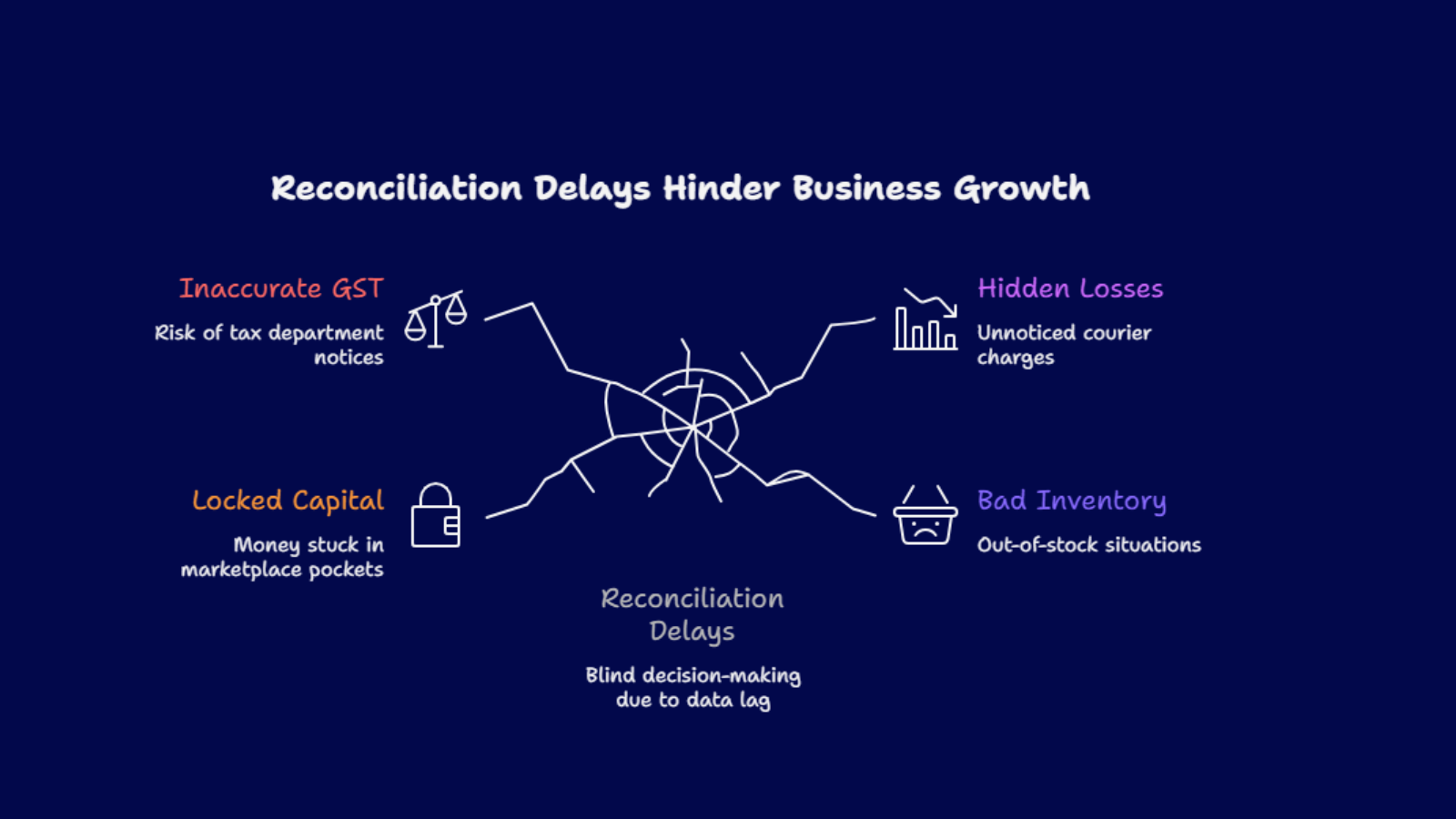
- Locked Working Capital: If you don’t realize that a marketplace has been overcharging you on commission for three months, that is money sitting in their pocket instead of yours.
- Inaccurate GST Filing: The Indian tax system is strict. If your sales data from operations doesn’t match your financial books, you risk getting notices from the GST department due to reporting conflicts.
- Hidden Losses in Shipping: Without a clear link between ops and finance, “Weight Discrepancy” charges from couriers go unnoticed. You might be losing 5-10% of your margin just on shipping errors.
- Bad Inventory Decisions: If Finance thinks there is more stock than there actually is (because of unrecorded damages in Ops), they might not release funds to buy new stock, leading to “Out of Stock” situations.
Strategies to Restore Financial Accuracy and Trust
Many growing Indian sellers don’t realise that reconciliation delays are often rooted in poor inventory allocation logic — when stock is dispatched from the wrong warehouse, the payment trail becomes fragmented across multiple fulfillment nodes and courier partners.
To fix the ops finance data mismatch, companies must stop treating these departments as separate islands. The goal is to create a “Single Source of Truth.” This means that when a warehouse worker scans a barcode, the accounting software should automatically know exactly what that means for the balance sheet.
Trust is built when the Finance team can look at a dashboard and see the “Life of an Order”, from the moment it was placed to the moment the final rupee was settled in the bank, including all the deductions in between.
- Automate Marketplace Syncing: Stop downloading CSV files manually. Use tools that pull data directly from Amazon, Flipkart, and Shopify. This ensures financial accuracy by removing human error.
- Real-time Weight Audits: Connect your shipping data with your finance records. If a courier charges for 2kg when the product is only 500g, the system should flag this immediately for the Finance team to dispute.
- Standardized Naming Conventions: Ensure that “SKU-A” in the warehouse is exactly “SKU-A” in the accounting books. Most reporting conflicts start because of different names for the same product.
- Daily Reconciliation Habits: Don’t wait for the month-end. Perform daily mini-reconciliations to catch errors while they are fresh. This prevents massive reconciliation delays at the end of the quarter.
Without a connected OMS, reconciliation delays between cancellation requests and courier pickups mean brands continue paying shipping fees on orders that customers have already abandoned, turning every cancellation into a double loss.
In the Indian e-commerce market, the difference between manual and automated systems is often the difference between a struggling business and a market leader. While many sellers start with spreadsheets, the moment they scale to multiple marketplaces like Amazon, Flipkart, and Zepto, the manual approach breaks down. This creates a massive ops finance data mismatch that becomes impossible to manage without technology.
Finance teams distrust manual systems because they rely on stale data. By the time someone updates an Excel sheet, the warehouse has already moved another thousand units. Automation ensures financial accuracy by linking every operational event directly to the accounting books, eliminating the need for constant “forensic” checks.
Comparison: Manual vs. Automated Systems
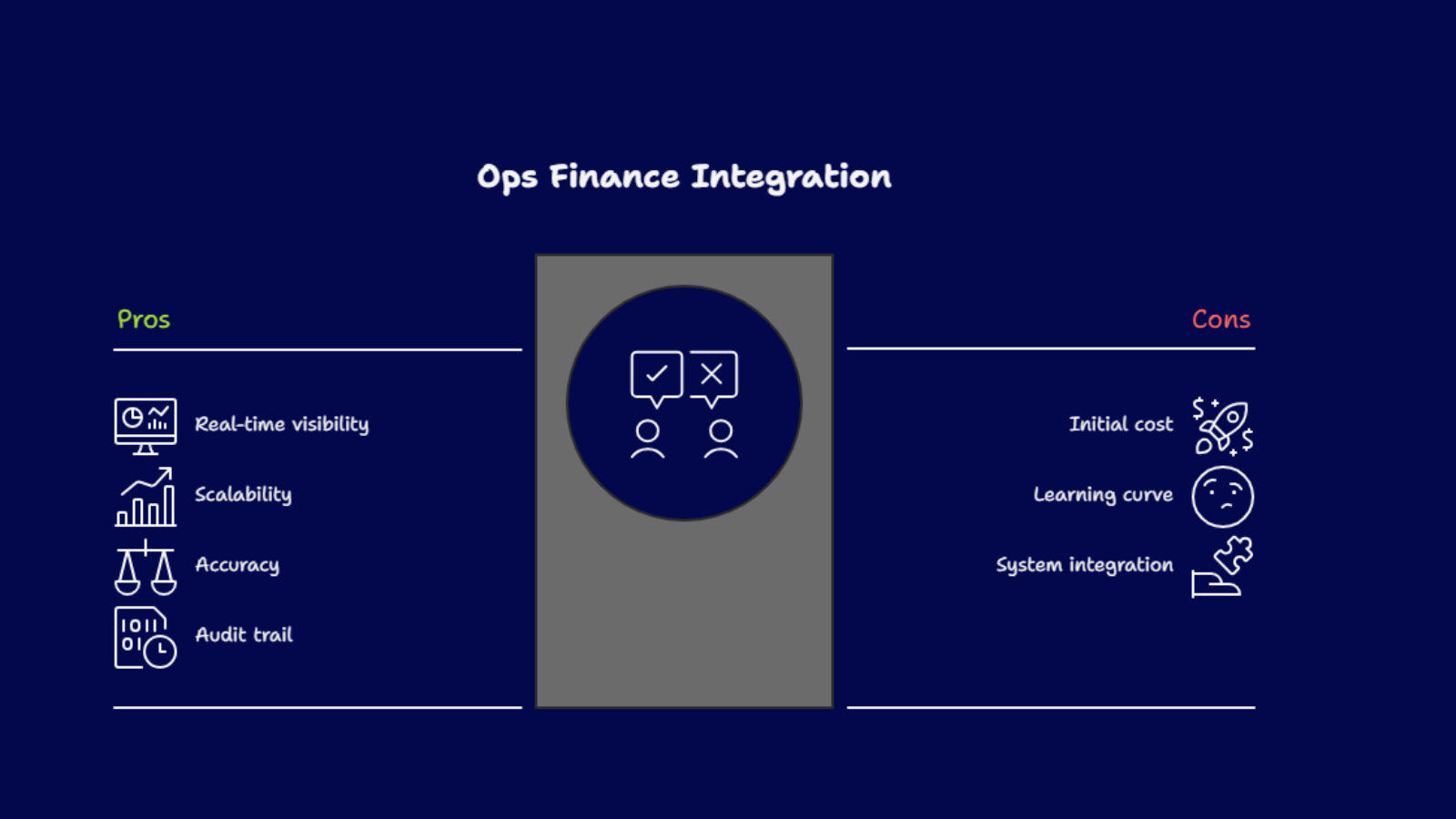
| Feature | Manual Spreadsheet Approach | Automated Integrated Approach |
|---|---|---|
| Data Entry | Relies on copy-pasting from various CSV files. This is 100% prone to human error and typos. | Data is synced via API directly from marketplaces and couriers. It is 100% accurate and hands-free. |
| Visibility | You only see the “truth” once a month during closing. This leads to major reconciliation delays. | You see your profit, loss, and cash flow in real-time. You always know exactly how much money is in transit. |
| Scalability | You cannot grow to 10,000 orders a month with Excel. You would need a massive team of accountants just to clean data. | The system grows with you. Whether you do 100 or 100,000 orders, the workload for your finance team remains the same. |
| Audit Trail | Fragmented across emails, local folders, and different versions of “final” spreadsheets. | A centralized digital trail for every transaction, making GST audits and marketplace disputes easy. |
| Conflict Resolution | Leads to constant reporting conflicts between teams because no two sheets ever match. | Provides a single source of truth that both Operations and Finance teams trust implicitly. |
Sync Your Success with Base.com
The gap between operations and finance is where profits go to die. Base.com is built to bridge this gap for Indian sellers. Our platform brings your inventory, shipping, and marketplace payments into one single, easy-to-read dashboard. No more ops finance data mismatch, no more “lost” orders, and no more month-end headaches.
The fastest way to eliminate reconciliation delays is to connect your warehouses, marketplaces, and courier partners into a single automated workflow, so that every delivery, return, and payment event is captured and matched in real time without any manual intervention.
With Base.com, your finance team gets the financial accuracy they need, and your operations team gets the speed they want.
Stop losing money to data errors. Join Base.com today and take control of your numbers.
Click here to learn top 10 hidden costs that quietly erode e-commerce margins.
Frequently Asked Questions
1. Why does my finance team keep asking for more reports?
Finance teams ask for more reports because the initial operations data often lacks the financial details needed for tax and bank matching. They are trying to fix the ops finance data mismatch by double-checking every single transaction manually.
2. How can I stop courier overcharging from ruining my margins?
The best way is to integrate your shipping data with your finance records. By automating the weight-check process, you can flag discrepancies immediately and raise disputes with couriers, ensuring your financial accuracy remains intact every single month.
3. What is the fastest way to reduce reconciliation delays?
The fastest way is to move away from manual spreadsheets. Using a central platform that automatically pulls settlement reports from marketplaces allows your team to see “matched” and “unmatched” transactions daily instead of waiting for the month-end.
4. Why is GST such a big part of the ops-finance conflict?
GST requires perfect matching between what you sold and the tax you collected. If Operations marks a return but Finance doesn’t record the Credit Note, you might end up paying more tax than required, leading to major reporting conflicts.
5. Is it expensive to automate these processes for a small seller?
Actually, it is more expensive not to automate. The money lost in shipping errors, marketplace commission mistakes, and the cost of hiring extra staff to manage Excel sheets far exceeds the cost of a unified platform like Base.com.