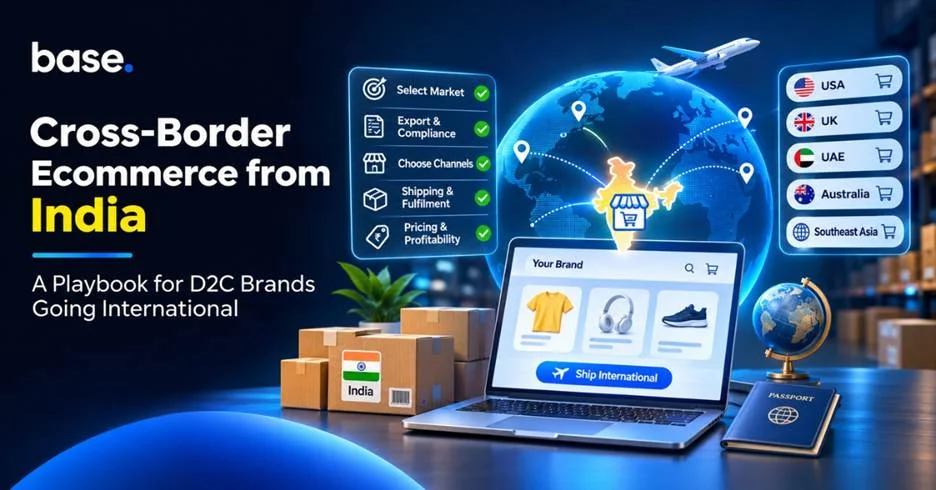
Cross-border ecommerce from India means selling products or services to customers in another country, either through an international marketplace or a brand’s own online store. It’s not just about translating a product page. A brand must choose a market and a sales channel, understand export and destination-country requirements, calculate the landed cost, and develop a shipping, returns and customer-support process. Some brands ship orders directly from India, while others hold stock with an overseas fulfilment partner. Each model has different costs, delivery times, stock exposure and compliance requirements. The right approach is to test one market with a limited product range, calculate the contribution after variable costs, and expand only when demand and operations can be repeated. This playbook covers the decisions to make before accepting the first international order, where ecommerce tools can help, and where specialist advice and authorities are still required.
What is cross-border ecommerce from India?
Cross-border ecommerce is the process of a business selling a product or service to a customer across the border. Indian D2C brands have two popular models to sell their products:
- Direct-to-consumer (D2C): sell via your own online platform, where the brand takes care of customer acquisition, checkout, export dispatch and post-purchase service; or
- Marketplace-led: list on an international marketplace that provides some marketplace services and may provide customer reach, but the seller remains responsible for the obligations it has under the marketplace agreement and the law.
By arrangement, the seller of record, exporter of record, importer of record, inventory owner and party responsible for duties may be different. Identify those roles in writing before launch. When selling through the marketplace, not all export, tax, product-safety or consumer-law obligations are transferred to the marketplace.
Which international market should an Indian D2C brand enter first?
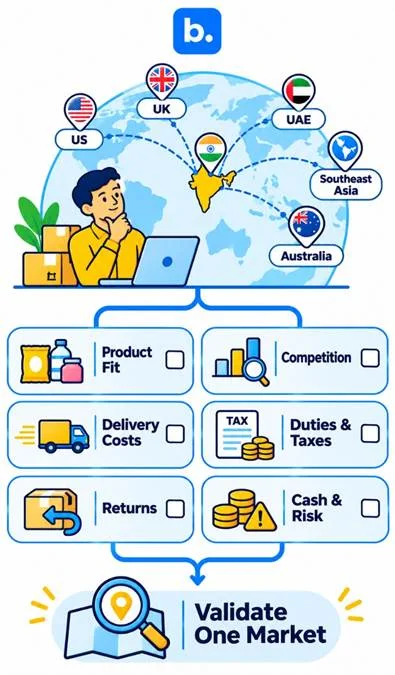
Select a market where there is evidence of product demand, customer fit and a manageable cost of serving customers. The United States, United Kingdom, UAE, Australia and Southeast Asian countries may be candidates, but none is the right first market for every brand. Validate a shortlist against customer, competitor, regulatory and fulfilment data.
| Decision factor | Before launch questions to answer: | Evidence to gather |
|---|---|---|
| Product-market fit | Does the product meet the requirements, is it safe and permitted in the destination? What adaptations/certifications might be required? | Category demand, customer feedback, local product rules |
| Competition and price | Who are the local alternatives? What is the price and delivery expectation of the buyers? | Listings on the marketplace, local stores, customer research |
| Delivery economics | Is the product shipable at an acceptable cost and time? Should it be shipped directly or should it be kept in stock? | Carrier quotes, parcel sizes, delivery lanes |
| Duties and taxes | Do you have any import fees, registrations or marketplace collection policies? | Advice from destination customs and tax authority; specialist advice |
| Returns and service | Does the business accept returns, provide support hours and local-language requirements? | Return terms, 3PL options, support workload |
| Cash and risk | Does the business have the cash to cover stock and operating expenses until the money comes in? | Supplier terms, settlement terms, FX and bank charges |
Start with one market and a few products that have proven demand and sufficient margin to cover shipping and returns. Growth is not just about gross sales. Repeat purchases, delivery performance, contribution after variable costs and manageable customer-service demand matter too.
Which export and compliance checks should Indian brands make?
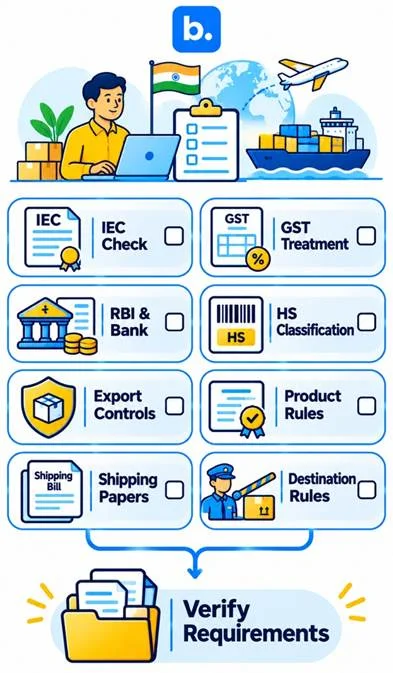
For exports of goods, check whether your business and transaction require an Importer Exporter Code (IEC). An IEC is generally required for the import or export of goods, subject to applicable exemptions. Requirements for services and technology can differ. Refer to the latest DGFT IEC guidance and confirm your position with an export adviser or the relevant authority.
GST treatment depends on the supply and the exporter’s circumstances. Qualifying exports may be treated as zero-rated supplies under the IGST regime. The applicable route, documentation and refund process depend on the transaction and prevailing rules. Check CBIC guidance and take tax advice on registration, invoicing, returns and refunds. For the fuller India export compliance checklist, see our export compliance guide.
The RBI’s Foreign Exchange Management (Export and Import of Goods and Services) Regulations, 2026, took effect on 1 October 2026. Export realisation and repatriation requirements and timelines depend on the transaction and whether invoicing or settlement is in INR. Do not apply one general timeframe to every export. Ask your authorised dealer (AD) bank which rules, documents, reporting requirements and deadlines apply to your transaction. Refer to the RBI Export and Import Regulations.
Check the product’s ITC (HS) classification and confirm whether export controls, licences, quality standards or other product-specific requirements apply before shipment. Destination-market rules may require separate safety testing, labelling, packaging, importer information or local registration. Common shipping documents include a commercial invoice, packing list, shipping bill or bill of export, transport document and any certificates required for the product, route, buyer or trade agreement. The exact documents depend on the goods and transaction.
Base.com does not register an IEC, give legal or tax advice, clear customs, file destination tax returns or transfer export proceeds.
Which sales channels and localisation decisions are relevant?
Having your own ecommerce store gives a brand more control over presentation and the customer relationship, but the business must attract traffic and manage payments, fulfilment and support. An international marketplace may provide access to existing customers and standardised listing or fulfilment processes, but sellers must still meet the marketplace’s country-specific eligibility and policy requirements. A brand can use both models, provided product information, stock and order procedures remain consistent.
Localise the product page and checkout for the target customer. Consider language, measurements, currency display, product claims, delivery promises, return terms and customer-service expectations. Set a pricing policy for each country instead of simply converting the Indian price at the spot exchange rate. Review marketplace fees, commissions, promotions and tax implications for each channel.
An ecommerce platform integration can connect orders from a store or marketplace with inventory and fulfilment processes. A multichannel integration platform can centralise supported data flows, but each connector must be tested. Having a Shopify store, marketplace account or Shopify integration does not provide legal market access or satisfy compliance and tax-registration requirements. Test SKU mapping, stock availability, order statuses, cancellations, refunds and which system is authoritative for each data field. A TikTok Shop integration, for example, is available only for supported markets and account workflows; connecting it does not make a seller eligible to operate in a market.
How should international shipping and fulfilment be set up?
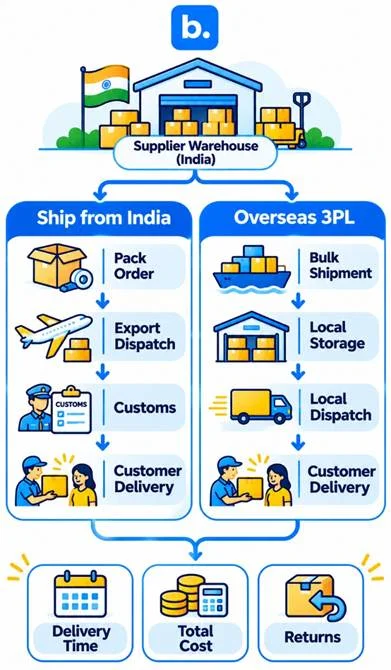
The two common fulfilment models are shipping orders directly from India and storing inventory with a 3PL or fulfilment centre in the destination country. Direct shipping may take longer and involve more customs work per order, but it reduces the need to position stock overseas in advance. Local fulfilment can shorten delivery times and make domestic returns easier, but it also requires investment in inventory, storage, receiving, local tax arrangements and partner management.
Consider the total delivered cost, delivery range, tracking quality, carrier coverage, customs handling, returns capability, insurance and peak capacity. Determine who will pay import duties and taxes, who will act as importer of record, and what happens if customs holds a parcel or delivery is refused. Explain delivery charges and duties at checkout, and do not quote a landed price until the charges have been confirmed.
When assessing a 3PL, consider service levels, inventory visibility, order cut-off times, receiving accuracy, returns processing, system connectivity, fees and exit terms. For more context, read What Is a 3PL and Should Indian D2C Brands Use One in 2026?
Prepare each parcel with accurate product descriptions, declared values, country of origin, tariff classification and the documents required for the route. When selecting a carrier, consider service quality and the total cost, not just the headline rate. How to Plan Shipments for Ecommerce Sales is a useful dispatch-planning reference, but international customs and delivery requirements must still be checked for each market.
How should a brand calculate cross-border profitability?
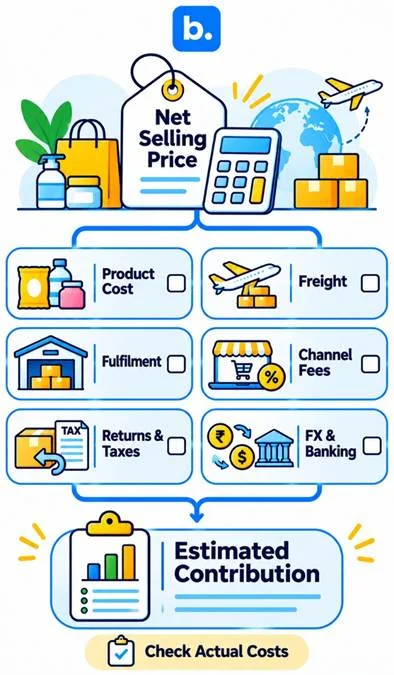
Calculate contribution per SKU, per destination and per channel. A simple model is:
- Net selling price after discounts
- Minus product and packaging costs
- Minus export handling, freight, insurance and fulfilment costs
- Minus marketplace, payment processing and advertising fees
- Minus duties and taxes payable by the seller, refunds, returns and customer-service costs
- Minus foreign exchange conversion and bank charges, where applicable
- Equals estimated contribution before fixed overheads
Fill out a worksheet that has one row for each destination and channel. State who pays each cost and don’t double count a tax or duty paid by the customer or marketplace. Maintain scenarios of exchange-rate fluctuations, shipping surcharges, damaged parcels and return rates. Re-check actual costs after initial shipments as quotes and settlement values may differ from initial estimates.
Cash-flow timing is important too. A brand may need to pay suppliers, carriers or a 3PL before marketplace or payment-provider proceeds arrive. Forecast cash requirements by order and settlement period, keep records of currency conversion and fees, and reconcile foreign-currency proceeds against bank credits with your finance team and AD bank.
How should international operations be coordinated?
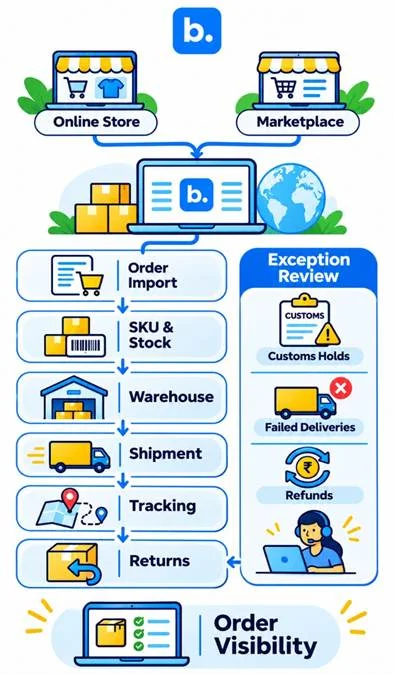
Establish a single operating record for each order, linking channel order ID, SKU, destination, promised service, warehouse or fulfilment partner, shipment reference, tracking, cancellation or return status and customer communication. Maintain uniform levels of stock across all active channels and consider reserved, in-transit, damaged and locally held stock.
Orders with failed imports, address or customs issues, missed dispatch targets, carrier events, refunds and return requests can be placed in exception queues. Assign an owner and response deadline to each queue. Maintain support materials and escalation paths for teams working across relevant time zones.
At base.com, we enable sellers to integrate supported ecommerce channels and handle order, stock and shipping processes. International selling on marketplaces is explained on our business page. Please check the integration, country and workflow before going live.
How can a brand test one market before expanding?
Do not launch in several countries at once. Use a staged approach:
- Select one target market and determine product, seller and legal eligibility.
- Select a limited initial mix and record all landed-cost assumptions.
- Run controlled orders to test listings, checkout, order imports, stock updates, shipping labels, tracking, customer notifications and returns.
- Review the first completed order cycle. Record actual shipping costs, delivery times, customs events, fees, refunds, foreign exchange differences and customer feedback.
- Compare contribution and service outcomes to the launch assumptions; make adjustments to the process before increasing traffic or inventory.
- Don’t scale up to a new market until supply, fulfilment, cash and customer support are solid at the current size.
Set up a cross-functional review involving ecommerce, operations, finance, tax and customer support. Expansion is more manageable when each team understands its responsibilities, records are consistent and the economics are based on actual results rather than projected demand.
Conclusion
When market selection, export readiness, channel choice, fulfilment and unit economics are planned together, cross-border ecommerce can become a measured growth path for D2C brands. Verify product and seller eligibility, understand the export and destination-country requirements, and test the full order-to-delivery and payment process before scaling. At base.com, our integrations support connected marketplace and store operations where the relevant connection is available. Regulatory filings, customs clearance, tax advice and international fund transfers remain with the relevant authorities and specialist providers.