The 3PL question comes up at every stage of a D2C brand’s growth. At Rs 5 lakh monthly GMV, you are asking whether it is time to stop shipping from home. And at Rs 5 crore, you are asking whether your 3PL can handle your volumes. At Rs 50 crore, you are asking whether your 3PL is costing you more than a self-operated warehouse would.
India’s D2C market is growing at 40% CAGR. The operational infrastructure decisions you make at each GMV stage compound; good decisions reduce per-order cost as you scale, bad ones create structural margin problems that are hard to unwind. Ecommerce automation in India is now mature enough that both 3PL and self-operated models can be run efficiently; the question is which one fits your current stage.
This article answers the 3PL question specifically for Indian D2C brands in 2026, covering what 3PLs offer, what they cost, when they make sense, when they do not, and how Base.com fits into the picture regardless of which fulfilment model you choose.
What Is a 3PL?
A third-party logistics provider (3PL) is a company that manages warehousing, inventory storage, order picking, packing, and shipping on behalf of your brand. You send your inventory to their fulfilment centre. They store it, pick it when an order comes in, pack it to your specifications, and dispatch it through their courier network.
You do not manage the warehouse. And do not hire warehouse staff. You do not negotiate individually with every courier. The 3PL handles all of that, and charges you a per-order or per-unit fee for the service.
In India, the 3PL market has matured significantly. Shiprocket Fulfillment, Delhivery Fulfillment, Xpressbees, Pickrr (now Shiprocket), WareIQ, Shadowfax Fulfillment, and regional operators now cover most Tier 1 and Tier 2 pin codes with next-day or same-day capability. Ecommerce automation in India has played a central role in enabling 3PLs to handle the volumes and complexity that Indian D2C brands require.
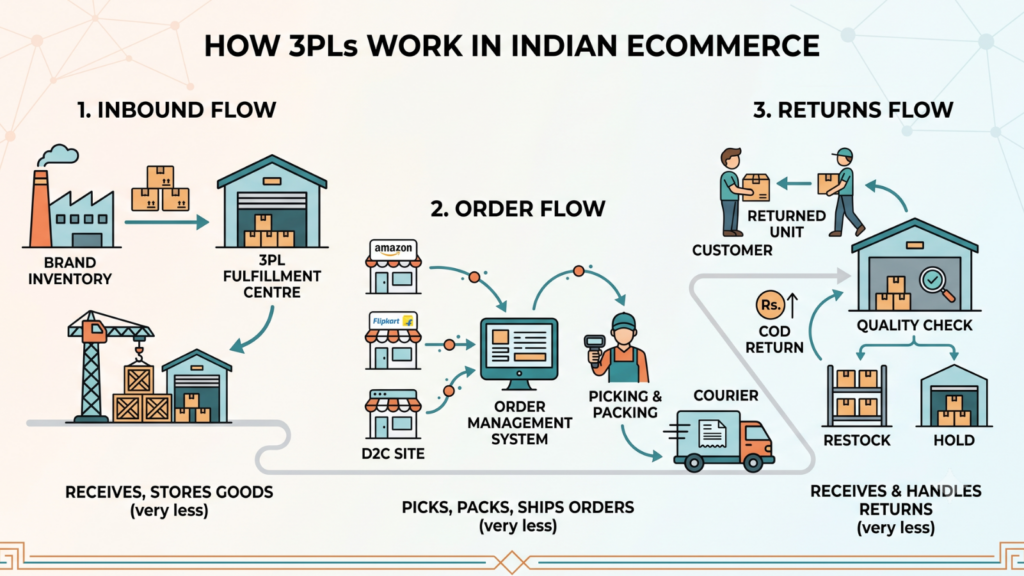
How 3PLs Work in the Indian Ecommerce Context
Indian D2C brands should use a 3PL when they lack the capital or volume to justify owning warehouse infrastructure. They should move away from a 3PL when operational control, unit economics, or data accuracy become more important than convenience.
The decision is GMV-stage specific, not a permanent choice either way. Ecommerce automation in India has made both models significantly more manageable than they were three years ago, which is why the decision now turns on economics and control rather than operational capability.
The Inbound Flow
Your brand ships inventory to the 3PL’s fulfilment centre. The 3PL receives it, counts it, scans it into their system, and assigns it a storage location. You pay a storage fee per cubic metre or per pallet per month.
The Order Flow
When an order comes in on Amazon, Flipkart, or your D2C website, your order management software sends it to the 3PL’s system. The 3PL picks the item, packs it, generates a shipping label, and hands it to a courier. You pay a per-order fulfilment fee, typically Rs 35-80 per order, depending on volume, size, and weight. Ecommerce automation in India has made this order-to-dispatch flow significantly faster and more accurate than it was even two years ago, with most leading 3PLs now operating on automated WMS platforms.
The Returns Flow
When a customer returns an order, the 3PL receives the item, does a basic quality check, and either restocks it or holds it for your instructions. Returns handling fees are typically Rs 25-50 per returned unit. India’s COD return rates run at 25-30% across ecommerce categories. At high COD volumes, returns handling costs at a 3PL can add up to a significant monthly line item.
The Indian 3PL Landscape in 2026
|
3PL Provider |
Coverage |
Strength |
Weakness |
|---|---|---|---|
|
Shiprocket Fulfillment |
Pan-India, 45+ cities |
Broad network, integrated with Shiprocket OMS |
Limited custom SLA or packing specs |
|
WareIQ |
Tier 1 + Tier 2 |
Smart inventory distribution, good analytics |
Premium pricing for smaller brands |
|
Delhivery Fulfillment |
Pan-India |
Strong last-mile + fulfilment combo |
Less flexibility for custom workflows |
|
Xpressbees Fulfillment |
Tier 1 + Tier 2 |
Cost-effective, growing network |
Analytics depth is limited |
|
Pickrr / Shiprocket |
Pan-India |
Affordable, quick onboarding |
WMS control is limited |
|
Ecom Express Fulfillment |
Pan-India |
Established network |
Fulfilment product is newer than their courier product |
|
Regional 3PLs |
City or state-level |
Flexible, local knowledge |
No pan-India coverage, variable quality |
The quality variation between 3PL providers in India is significant. A 3PL that works well for a beauty brand at 200 daily orders may not be appropriate for an electronics brand at 2,000 daily orders with fragile handling requirements. Ecommerce automation in India varies significantly across these providers; the top-tier networks have invested heavily in automation, while regional operators still run largely manual operations.
5 Reasons Indian D2C Brands Choose 3PLs
As Indian D2C brands scale, logistics quickly becomes a defining factor in customer experience and profitability. Managing warehousing, fulfilment, and shipping in-house can limit speed and flexibility.
This is why many growing brands turn to 3PL partners to streamline operations, reduce costs, and focus on growth while ensuring reliable, scalable order fulfilment.
1. No Capital Expenditure on Warehouse Infrastructure
Setting up a 2,000 sq ft warehouse in a Mumbai suburb costs Rs 15-25 lakh in deposits, fit-out, racking, scanners, and initial staffing. A 3PL requires no upfront infrastructure investment. For a brand at Rs 10-20 crore GMV, avoiding that capital outlay preserves working capital for inventory and marketing.
2. Instant Pan-India Reach
A well-networked 3PL can give your brand fulfilment nodes in Mumbai, Delhi, Bangalore, and Hyderabad from day one. Self-operated multi-city warehousing at this scale requires 18-24 months of operational setup. Pan-India delivery speed improves immediately when inventory is positioned closer to customers. Ecommerce automation in India at the 3PL level means brands can access this reach without building the automation infrastructure themselves.
3. No Hiring or Managing Warehouse Staff
Warehouse staffing in India is operationally intensive, with high attrition, seasonal availability, and variable skill levels being persistent challenges. A 3PL absorbs this entirely. Your brand does not interview pickers, train packers, or manage shift schedules.
4. Variable Cost Structure
At a 3PL, your fulfilment cost scales with your order volume. Low months cost less. High months cost more. This is a good fit for brands with seasonal demand spikes, particularly brands in fashion, gifting, or home décor where monthly GMV can vary 3-5x across the year. Ecommerce automation in India has made this variable-cost model more transparent, with most leading 3PLs now providing real-time dashboards that show cost-per-order by month and channel.
5. Faster Market Testing
If you are launching a new product category or expanding into a new geography, a 3PL lets you test without committing to long-term warehouse infrastructure. You can position inventory for a new region, observe delivery performance and RTO rates, and exit without stranded fixed costs.
5 Reasons Indian D2C Brands Move Away From 3PLs
As Indian D2C brands grow, the limitations of 3PL models often become more visible. What works at early stages can start impacting margins, control, and customer experience at scale.
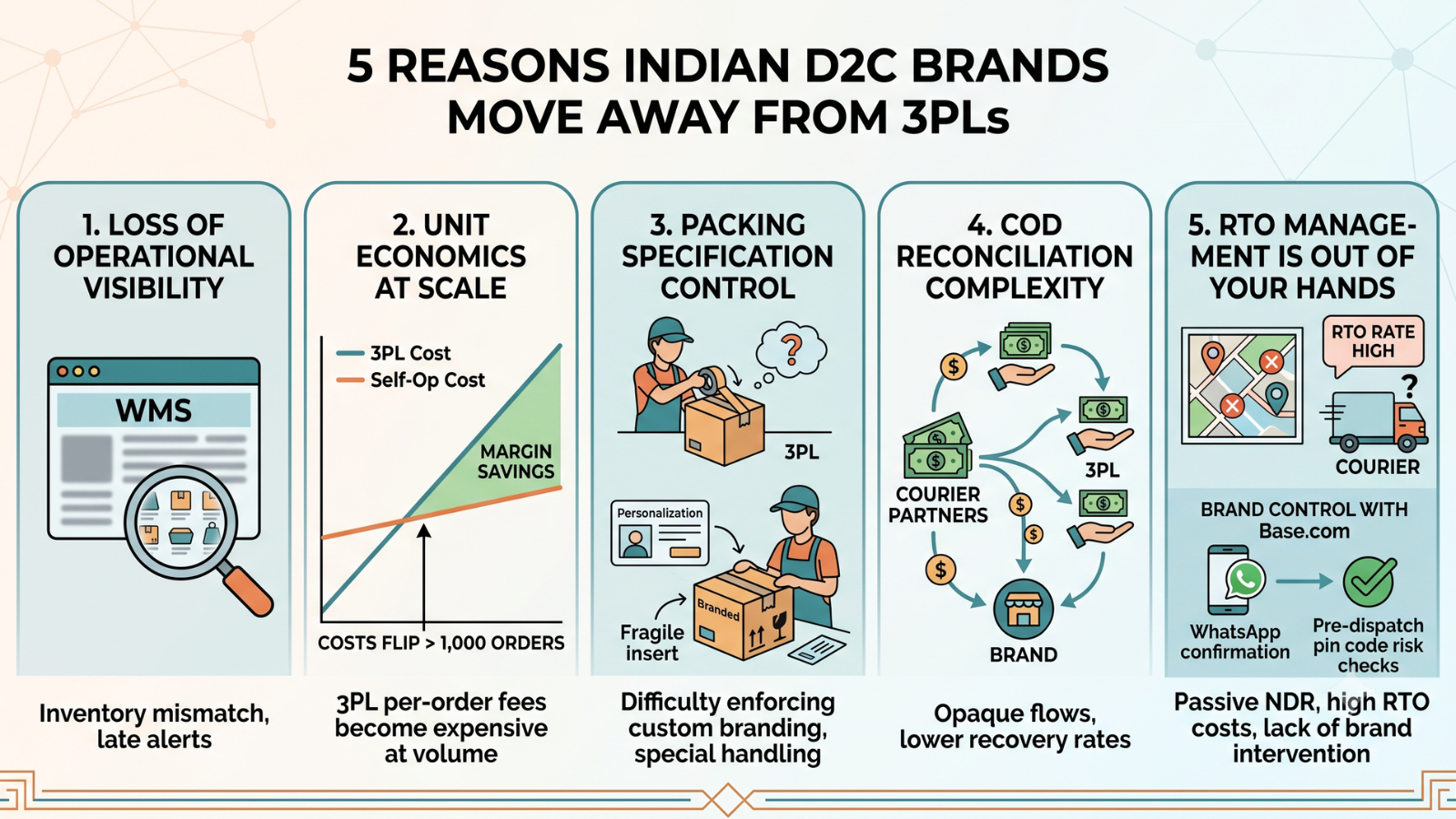 This is why many brands eventually move away from 3PLs to gain better operational visibility, improve fulfilment accuracy, and build tighter control over their end-to-end supply chain.
1. Loss of Operational Visibility
At a 3PL, you see what the 3PL’s system shows you. If their WMS is basic, your inventory visibility is basic. If their inbound processing is slow, you find out when you get your first stockout alert, not when the shipment arrived three days late and sat in receiving.
Brands that move from 3PLs to self-operated warehouses consistently report the same first surprise: their inventory was significantly less accurate than the 3PL’s system suggested. Ecommerce automation in India at the brand level, using a platform like Base.com to cross-check 3PL data independently, is the most reliable way to catch this problem before it causes a sale event stockout.
2. Unit Economics at Scale
Below 500 daily orders, a 3PL’s per-order fulfilment fee (Rs 50-80) is usually cheaper than the fully loaded cost of self-operated warehousing. Above 1,000 daily orders, the math typically flips. A self-operated warehouse at this volume costs Rs 15-25 per order in fully loaded cost, versus Rs 50-80 at the 3PL.
At Rs 1,000 daily orders and a Rs 30 per-order cost advantage, self-operation saves Rs 9 lakh per month. That is Rs 1.08 crore annually, a number that funds a warehouse setup in Year 1 and delivers pure margin improvement from Year 2. Ecommerce automation in India through platforms like Base.com is what makes self-operated warehousing at this scale genuinely viable. Without automation, the labour cost savings of leaving the 3PL are offset by the overhead of manual operations.
3. Packing Specification Control
Most Indian 3PLs do basic, standard packing. If your brand requires custom tissue paper, specific box dimensions, personalised inserts, or category-specific fragile handling, enforcing these specifications at a 3PL is difficult. Compliance rates on custom packing specs at 3PLs typically run 60-80%, meaning 20-40% of orders go out without the brand experience you paid for.
This matters more in beauty, premium fashion, and gifting, where the unboxing experience is a brand equity investment.
4. COD Reconciliation Complexity
When your 3PL is also managing courier relationships, COD remittances from multiple courier partners pass through the 3PL before reaching your brand. This adds a layer of reconciliation complexity and a layer of opacity. Some brands discover COD recovery rates at 3PLs are 5-8% lower than expected because the 3PL’s reconciliation is incomplete.
A dedicated order management software India platform like Base.com that handles COD reconciliation directly against courier remittance files, without going through a 3PL intermediary, gives cleaner, faster, and more accurate COD recovery. This is one of the most tangible benefits of ecommerce automation in India at the brand level, rather than relying on the 3PL’s systems.
5. RTO Management Is Out of Your Hands
At a 3PL, NDR (Non-Delivery Report) management is handled by the 3PL’s team or left to the courier. For brands with high COD mix in Tier 2 and Tier 3 India, where RTO rates can reach 35-50%, passive NDR management is an expensive gap.
Self-operated warehousing with Base.com’s RTO intelligence module lets your brand apply pin code risk scoring before dispatch, trigger WhatsApp COD confirmation within minutes of order placement, and automate NDR re-engagement within 2 hours of failed delivery. None of this is controllable at a 3PL without significant custom integration work.
Ecommerce automation in India for RTO prevention specifically is one of the highest-ROI investments a D2C brand can make, and it requires brand-level control that a 3PL cannot provide.
The Decision Framework: 3PL vs Self-Operated Warehouse
This is not a binary decision; it is a GMV-stage and operational-complexity decision. Ecommerce automation in India has shifted the breakeven point in favour of self-operation at lower GMV than was the case in 2022-2023, because WMS platforms are now significantly more affordable and faster to implement.
|
GMV Range |
Recommended Model |
Rationale |
|---|---|---|
|
Under Rs 5 crore/year |
3PL |
Capital preservation, volume too low for self-operation economics |
|
Rs 5-20 crore/year |
3PL with OMS |
Add order management software to improve visibility over 3PL operations |
|
Rs 20-50 crore/year |
Evaluate self-op for primary city |
Unit economics begin to favour self-operation for the primary fulfilment node |
|
Rs 50-150 crore/year |
Hybrid, self-op primary + 3PL for secondary cities |
Primary city self-operated for control, 3PL for pan-India reach |
|
Rs 150 crore+/year |
Self-op primary, 3PL as overflow |
Operational control and unit economics both favour self-operation at this scale |
The hybrid model, a self-operated primary warehouse with 3PL nodes for secondary coverage, is the most common configuration among Indian D2C brands at Rs 50-200 crore GMV. It captures the cost and control benefits of self-operation for the majority of volume while maintaining pan-India reach through 3PL nodes. Ecommerce automation in India through a platform like Base.com is what makes the hybrid model operationally manageable. Without a unified OMS routing across both nodes, the hybrid configuration creates more complexity than it solves.
How Base.com Works Across Both Models
This is where most D2C brands miss an important point: the right OMS for D2C brands works regardless of your fulfilment model. You should not have to switch your order management platform when you switch from a 3PL to a self-operated warehouse, or when you run both simultaneously. Ecommerce automation in India should be a consistent layer across your entire fulfilment network, not rebuilt every time the fulfilment model changes.
And Base.com is designed for exactly this flexibility.
Base.com with a 3PL
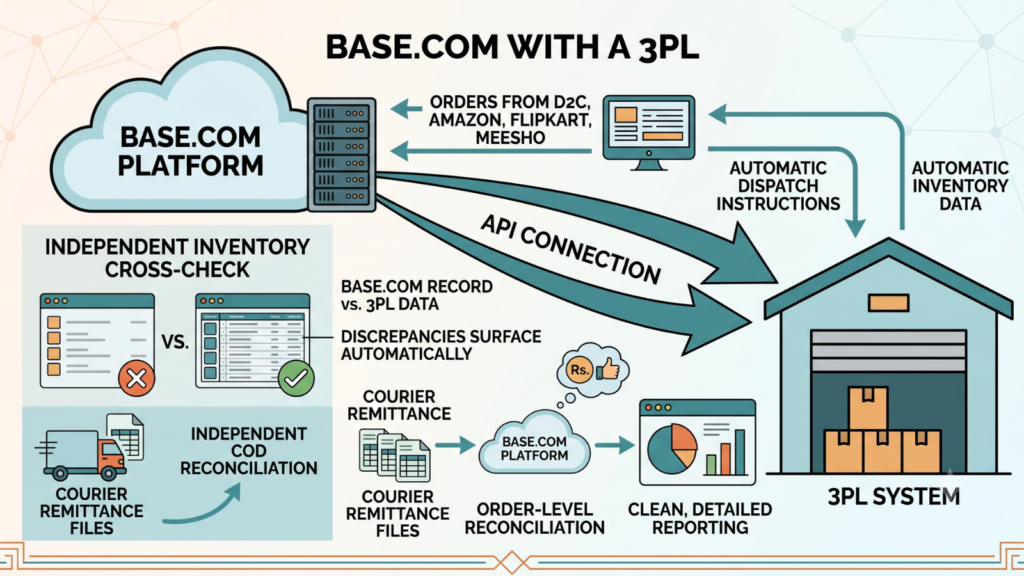
Base.com connects to 3PL systems via API, pulling inventory data and pushing order dispatch instructions automatically. Orders from Amazon, Flipkart, Meesho, and your D2C site flow into Base.com’s order queue and route to the 3PL’s system without manual forwarding.
The advantage over relying solely on the 3PL’s portal: Base.com maintains an independent inventory record that cross-checks against the 3PL’s data. Discrepancies surface automatically. You do not discover a 200-unit inventory gap during a sale event; you see it when it happens. This independent cross-check is one of the most valuable applications of ecommerce automation in India for brands operating on a 3PL.
Base.com also handles COD reconciliation independently of the 3PL, ingesting courier remittance files directly and reconciling at the order level. This is the most valuable capability for brands whose 3PL does not provide detailed COD reconciliation reporting.
Base.com with a Self-Operated Warehouse
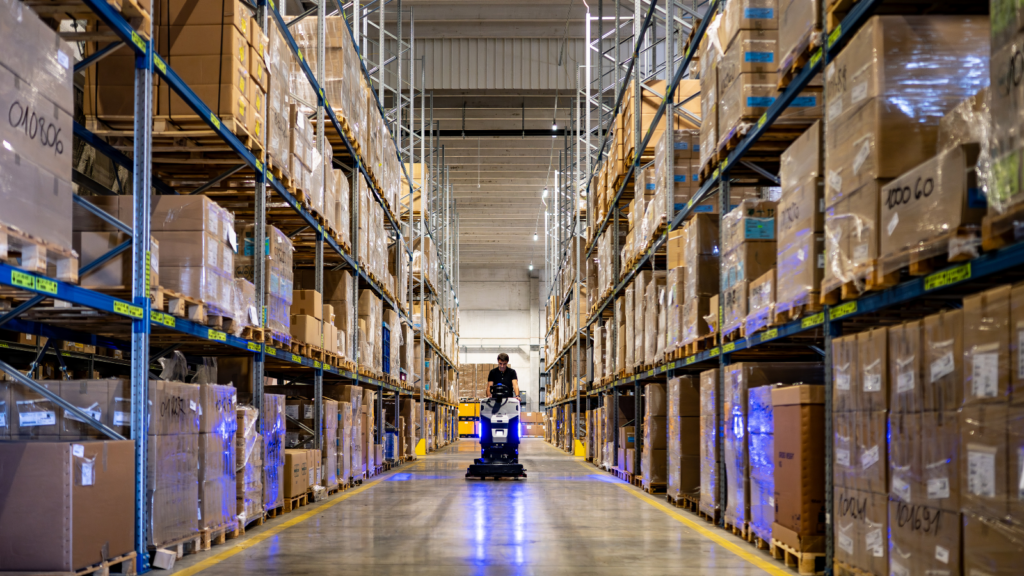
When you move to a self-operated warehouse, Base.com becomes the full operational backbone. Bin-level inventory management, scan-based pick-pack-ship workflows, packing verification, batch pick optimisation, and real-time dispatch analytics all activate within the platform.
The transition from 3PL to a self-operated warehouse does not require a platform change. You add your warehouse locations in Base.com, configure bin structures, activate scan-based workflows, and go live. The OMS and multi-channel integrations you already use continue without disruption.
This continuity is the practical definition of ecommerce automation in India done right. The automation layer persists across model changes so the brand never loses operational momentum during a transition.
Base.com in a Hybrid Configuration
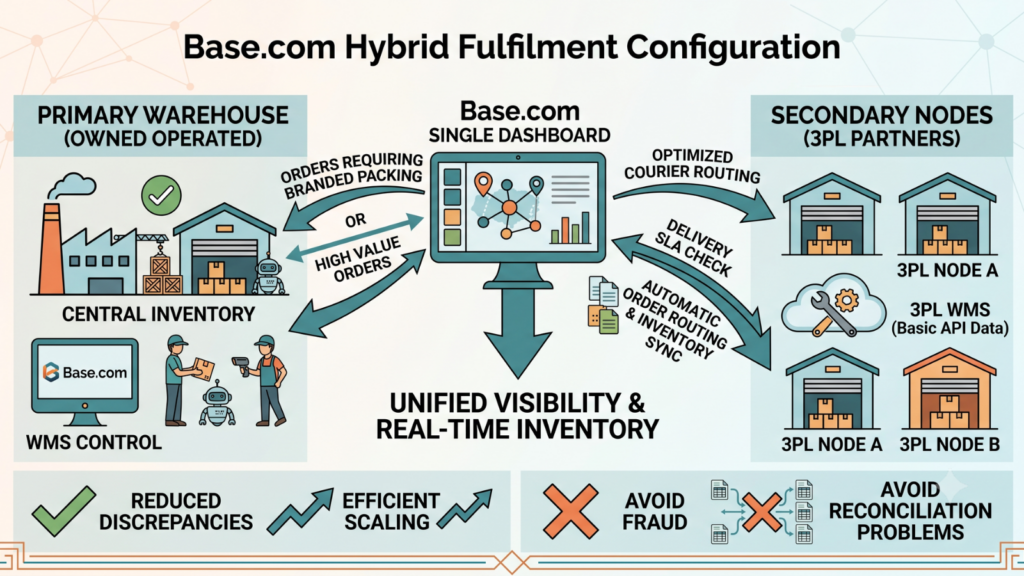
For brands running a self-operated primary warehouse and 3PL nodes for secondary cities, Base.com manages routing between them automatically. Each order is assigned to the fulfilment node with available inventory, the right SLA, and the best courier option for the delivery pin code.
Operations managers see all fulfilment nodes, owned and 3PL, in a single dashboard. Inventory across the full network is visible in real time. This is multi-channel order management in India in the most practical sense: one system managing the entire fulfilment network regardless of who operates each node. Ecommerce automation in India at this level, unified visibility across owned and 3PL nodes, is what separates brands that scale their operations cleanly from brands that accumulate reconciliation and inventory problems at every growth stage.
What Indian D2C Brands Get Wrong About the 3PL Decision
Indian D2C brands often choose 3PLs too early or too late, misjudging scale needs, cost impact, and control trade-offs, leading to inefficiencies, poor customer experience, and reduced operational visibility.
Mistake 1: Treating 3PL as a Permanent State
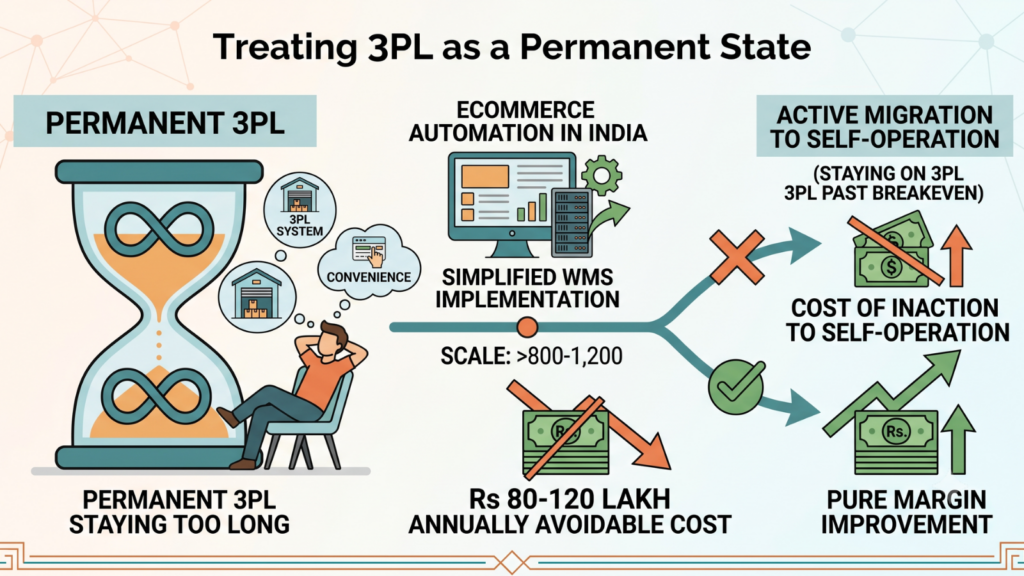
Many brands stay on 3PLs too long because the migration to self-operation feels complex. The complexity is real but manageable, particularly with ecommerce automation in India having simplified the WMS implementation process significantly.
The cost of staying on a 3PL past the breakeven point, typically 800-1,200 daily orders, is Rs 80-120 lakh annually in avoidable fulfilment cost.
Mistake 2: Not Having Independent Inventory Visibility

Trusting the 3PL’s inventory count without an independent cross-check is a risk. 3PL inventory accuracy in India typically runs 88-94%. That means 6-12% of your inventory records are wrong at any given time. At Rs 50 lakh in inventory value, that is Rs 3-6 lakh in incorrectly tracked stock.
Running Base.com alongside your 3PL gives you an independent inventory record and automatic discrepancy alerts. This is one of the highest-value uses of ecommerce automation in India for brands currently on a 3PL.
You get brand-level inventory accuracy without waiting until you move to a self-operated warehouse.
Mistake 3: Not Tracking Per-Order Fulfilment Cost Accurately
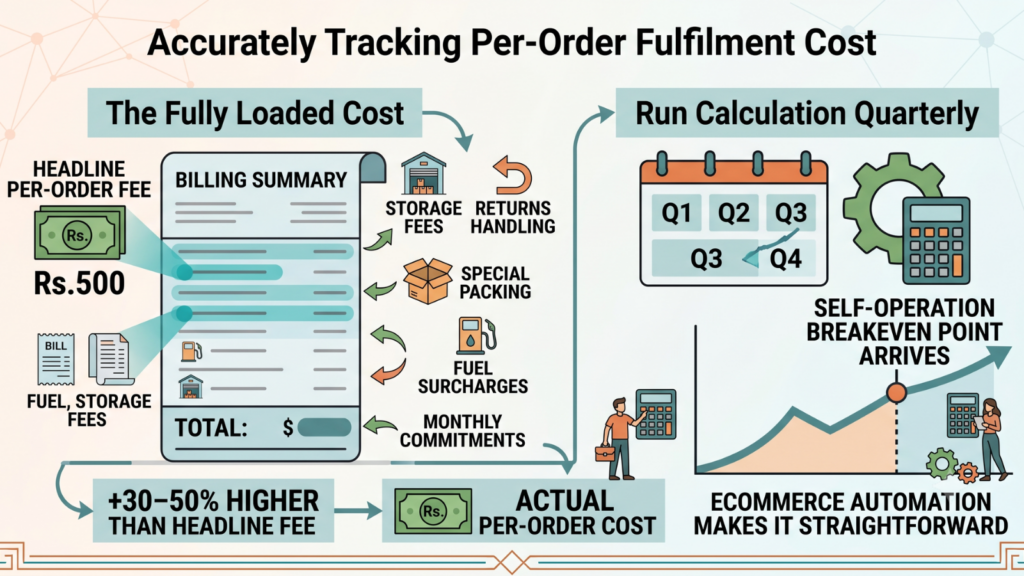
Most Indian D2C brands know their 3PL’s headline per-order fee. Few track the fully loaded cost: storage fees, returns handling fees, special packing surcharges, fuel surcharges, and minimum monthly commitments. When these are added to the base fee, the actual per-order cost is typically 30-50% higher than the headline rate.
Run this calculation quarterly. It tells you exactly when the self-operation breakeven point arrives. Ecommerce automation in India makes this calculation straightforward.
Base.com’s cost analytics can show you per-order fulfilment cost broken down by node, channel, and courier, so the 3PL-vs-self-op comparison is based on real numbers, not estimates.
Mistake 4: Ignoring the OMS Requirement
Some brands move from 3PL to self-operation and assume the warehouse operation will manage itself. It will not. Self-operated warehouse management without a dedicated WMS produces the same errors and inefficiencies that the 3PL was producing, but now they are your direct responsibility.
Ecommerce warehouse management India platforms like Base.com are the operational infrastructure that makes self-operated warehousing viable. Without a WMS, self-operation just means manual processes in your own building instead of someone else’s.
Ecommerce automation in India is the difference between a self-operated warehouse that delivers cost savings and one that delivers operational chaos, and Base.com is the most complete expression of that automation for Indian D2C brands.
The True Cost of 3PL vs Self-Operated: A Working Model
This model is based on a brand doing 1,000 daily orders (30,000/month) at Rs 500 average order value (Rs 1.5 crore monthly GMV). Ecommerce automation in India via Base.com is included in the self-operated model:
|
Cost Category |
3PL Model |
Self-Operated with Base.com |
|---|---|---|
|
Warehouse rent (1,500 sq ft) |
Included in 3PL fee |
Rs 60,000-80,000/month |
|
Warehouse staff (6 people) |
Included in 3PL fee |
Rs 1.2-1.8 lakh/month |
|
WMS / OMS platform |
Rs 15,000-25,000/month |
Rs 30,000-50,000/month |
|
Per-order fulfilment fee |
Rs 60 x 30,000 = Rs 18 lakh/month |
Rs 0 (absorbed in staff cost) |
|
Packing materials |
Included or charged separately |
Rs 3-5 lakh/month |
|
Total monthly cost |
Rs 19-21 lakh/month |
Rs 9-12 lakh/month |
|
Per-order cost |
Rs 63-70 |
Rs 30-40 |
At 30,000 monthly orders, self-operation with Base.com saves Rs 8-10 lakh per month, Rs 96-120 lakh annually. The infrastructure setup cost (warehouse deposit, racking, scanners, fit-out) typically runs Rs 15-25 lakh, recovered in 2-3 months of operational savings.
These are indicative numbers. Your actual figures depend on your city, SKU mix, order weight, and packing complexity. Run the model with your own numbers before deciding.
When a 3PL Is Still the Right Answer in 2026
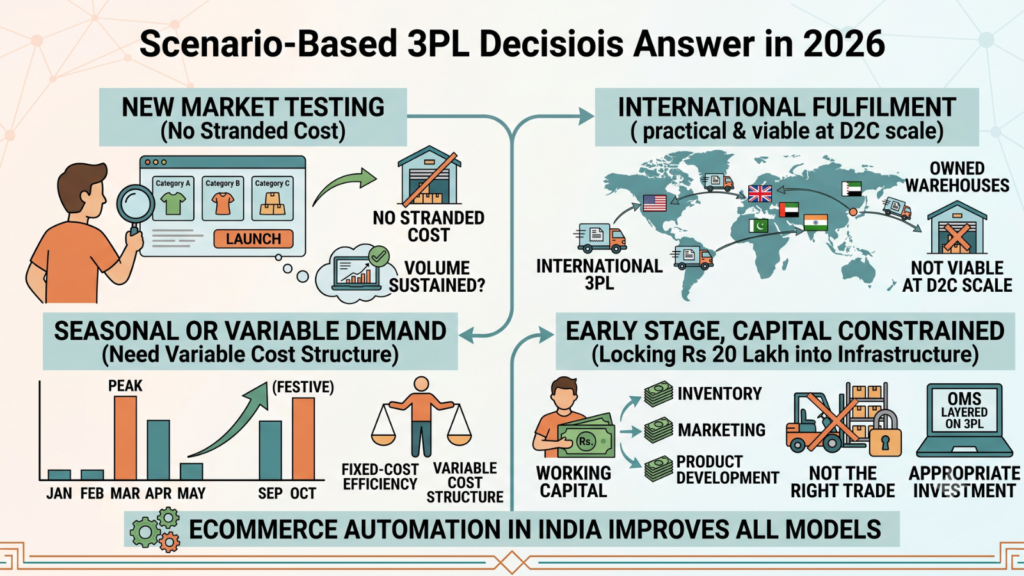
Despite the unit economics argument for self-operation at scale, 3PLs remain the right choice in specific situations. Ecommerce automation in India does not change the underlying logic of these scenarios; it only improves how well you can manage whichever model you choose:
New brand testing a market. If you are not sure whether a new product category will sustain volume, a 3PL lets you test with no stranded infrastructure cost.
Seasonal or highly variable demand. Brands where monthly GMV swings 5-10x need a variable cost structure more than fixed-cost efficiency.
International fulfilment. For Indian D2C brands shipping to the US, UK, or the Middle East, international 3PLs are the only practical option; building owned warehouses abroad is not viable at the D2C scale.
Early stage, capital constrained. If working capital is needed for inventory, marketing, and product development, locking Rs 20 lakh into warehouse infrastructure is not the right trade. In this case, ecommerce automation in India through a lean OMS layered on top of the 3PL is the more appropriate investment.
Base.com is an order management and warehouse management platform built for Indian D2C and B2B ecommerce. It works with 3PLs, self-operated warehouses, and hybrid configurations, so your operations platform never has to change as your fulfilment model evolves. Ecommerce automation in India should be a constant, even when everything else about your operations is changing. Talk to the Base.com team about your current setup.
Frequently Asked Questions
Q1 What is a 3PL, and how does it work for Indian D2C brands?
Q 2 At what order volume should a brand move from 3PL to self-operated fulfilment?
Q 3 Can Base.com work with a 3PL, or does it require a self-operated warehouse?
Q 4 What is the biggest operational risk of using a 3PL?
Q 5 How does Base.com help in transitioning from 3PL to self-operated fulfilment?