

How to reduce RTO in ecommerce India without removing COD is the most important operational question facing Indian D2C brands right now. The answer is not to eliminate COD. COD drives 60-65% of ecommerce orders in India. Removing it kills conversion. The fix is building smarter, more structured operations around it, and that is exactly what this blog covers.
Why Removing COD Is the Wrong Answer for Indian D2C Brands
Every brand that has tried removing COD to control returns has faced the same outcome: conversion drops of 20-40% within 60 days. The revenue loss from lower conversion consistently and significantly outweighs the savings from fewer returns.
India’s ecommerce market is at $226 billion. COD remains the dominant payment preference across tier-2 and tier-3 cities, the fastest-growing customer segments for D2C brands today. Removing COD does not solve the return problem. It solves the COD problem by destroying the revenue that came with it.
How to reduce RTO in ecommerce India without removing COD is therefore not a payment question. It is an operations question. The brands that crack it are not the ones that restrict payment options; they are the ones that build the right operational layer around COD orders from placement to delivery.
That operational layer has three stages: pre-dispatch verification, intelligent carrier allocation, and post-dispatch visibility with active intervention. Each stage addresses a distinct set of RTO causes. None of them requires removing COD from a single SKU.
What Actually Causes High RTO in Indian Ecommerce
Understanding how to reduce RTO in ecommerce India without removing COD starts with diagnosing what is driving returns in the first place. RTO in India is not one problem. There are five distinct problems that look identical from a reporting dashboard.
The Five Root Causes Every Indian D2C Brand Must Diagnose
- Unverified order intent. The customer placed a COD order impulsively, late at night, during a sale, or after seeing an ad. By the time the delivery arrives two days later, the intent has faded. This is especially prevalent among first-time buyers and high-value COD orders above ₹1,500.
- Incorrect or incomplete delivery addresses. Address errors cause failed first-attempt deliveries. A single failed first attempt raises the probability of eventual RTO sharply. Studies on Indian ecommerce last-mile suggest that orders failing the first delivery attempt convert to RTO at rates 3-4x higher than successful first attempts.
- Fake delivery attempts by courier partners. This is more widespread than most brands acknowledge publicly. Couriers mark orders as “customer not available” without making a genuine delivery attempt. Without pre-delivery confirmation records to contest this, brands absorb the return cost without recourse.
- The wrong courier was assigned to the geography. A carrier that performs reliably in Bengaluru may have deep underperformance in rural Odisha or parts of UP. Assigning orders based on rate cards rather than actual delivery performance data creates avoidable RTO at scale.
- No pre-dispatch intervention for high-risk order profiles. Orders with multiple elevated risk signals, new COD customer, high order value, remote pincode, incomplete address, previous return history, and enter the dispatch queue without any additional verification step.
| RTO Cause | Prevalence Among Indian D2C Brands | Intervention Required |
|---|---|---|
| Unverified order intent | Very high, especially for COD first-timers | Automated pre-dispatch confirmation calls |
| Incorrect delivery address | High | Address validation at order entry |
| Fake delivery attempts | Moderate to high | Confirmation records + carrier dispute data |
| Wrong courier for geography | High | TAT-based performance-driven allocation |
| No high-risk order intervention | Very high | Risk-scoring and conditional hold logic |
Brands that apply a single fix to all five causes see partial improvement at best. How to reduce RTO in ecommerce India without removing COD effectively requires matching the right intervention to the right cause, systematically, not reactively.
The Three-Stage Operational Framework to Reduce RTO Without Removing COD
How to reduce RTO in ecommerce India without removing COD requires structured intervention at three stages of the order lifecycle. Brands that only act at one stage consistently leave preventable returns on the table.
Stage 1: Pre-Dispatch Verification: Where the Highest-ROI Reduction Happens
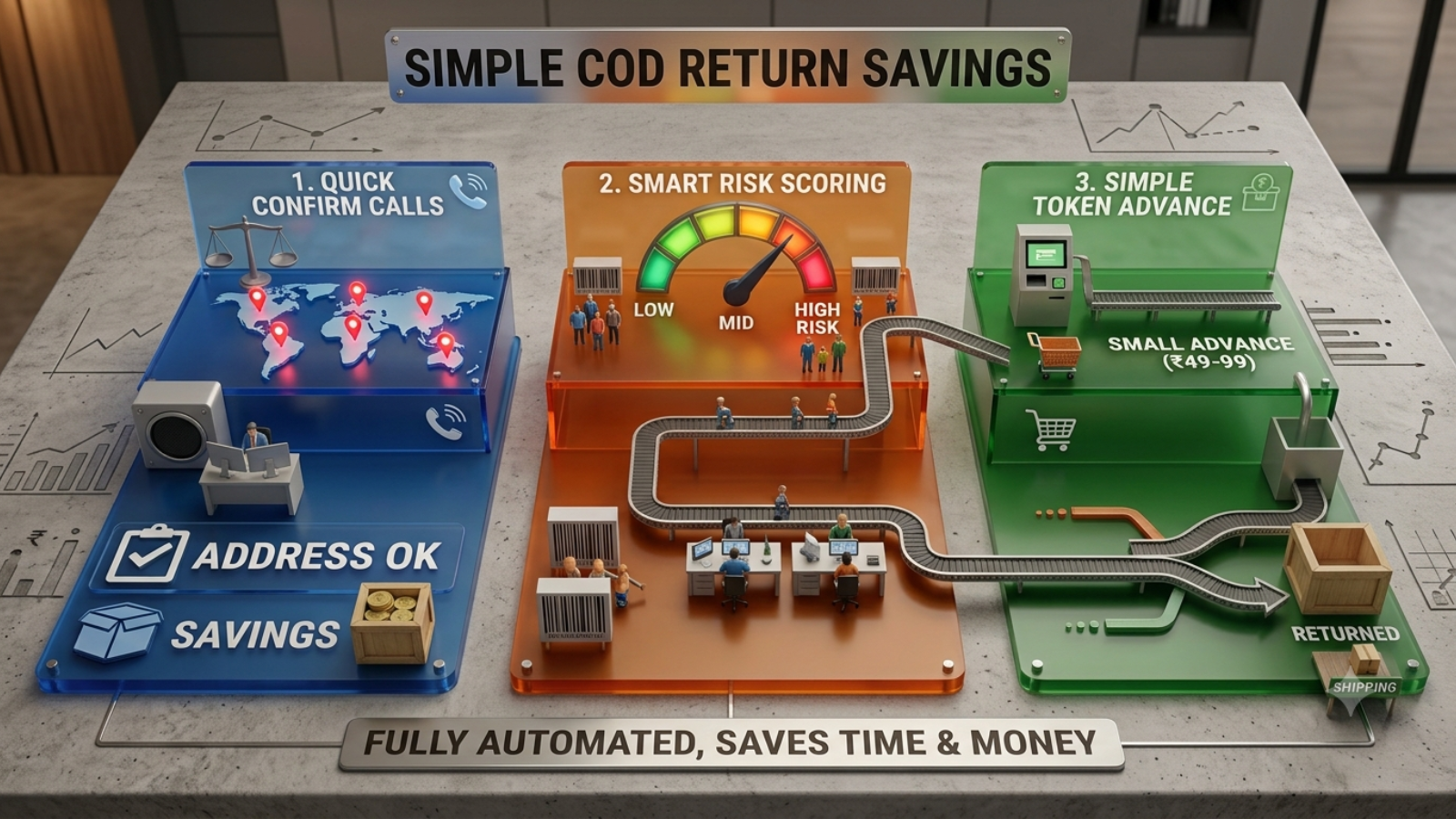 The most cost-effective place to reduce RTO is before the order ships. An order intercepted before dispatch saves 100% of the outward and return logistics cost associated with that return journey, typically ₹215-470 per order when all cost components are included.
Automated IVR and Confirmation Calls
When an order meets elevated RTO risk criteria, first-time COD buyer, order value above a configured threshold, specific pincode risk patterns, and late-night placement, Base.com triggers an automated outbound confirmation call. The call verifies delivery intent, confirms address details, and creates a timestamped record of customer responsiveness.
Orders where customers do not respond or confirm cancellation are removed from the dispatch queue before shipping. The logistics cost saved on a single intercepted high-value COD return justifies the cost of hundreds of confirmation calls.
This is one of the most direct and scalable answers to how to reduce RTO in ecommerce India without removing COD at the pre-dispatch stage. Manual calling at 500+ daily orders is not viable. Automated confirmation workflows running on every qualifying order are.
For Effilo, this automated confirmation layer was the primary mechanism behind reducing RTO from 60% to 20%, a result verified through Base.com’s implementation. The brand’s team described it as solving one of the biggest operational problems the business had faced.
Risk-Based Order Scoring and Hold Logic
Not every COD order carries the same return probability. A returning customer with three successful previous deliveries to the same verified address is low risk. A new customer placing a ₹2,800 COD order to an incomplete address in a low-serviceable pin code at 11:30 PM is high risk.
Base.com’s order management layer supports configurable risk-based routing, automatically flagging high-risk order profiles for confirmation holds before they enter the fulfilment pipeline. Low-risk orders move straight to dispatch. High-risk orders enter a verification queue. The operations team manages exceptions, not every individual order.
This segmentation is foundational to how to reduce RTO in ecommerce India without removing COD at scale. Applying the same confirmation overhead to every order is inefficient. Applying it surgically to the orders that need it is operationally precise and cost-effective.
Targeted COD Friction on High-Risk Segments
Brands do not need to remove COD entirely to reduce risk on specific high-value or high-return-history segments. Offering a small advance collection, ₹49-99, on COD orders above a value threshold creates enough friction to filter impulsive orders without eliminating COD for genuine buyers.
This approach applies targeted friction at the order stage without any change to the customer experience for the majority of orders. It is one of the most precise answers to how to reduce RTO in ecommerce India without removing COD for brands with concentrated return exposure in specific order value bands.
Stage 2: Intelligent Carrier Allocation: The Overlooked RTO Driver
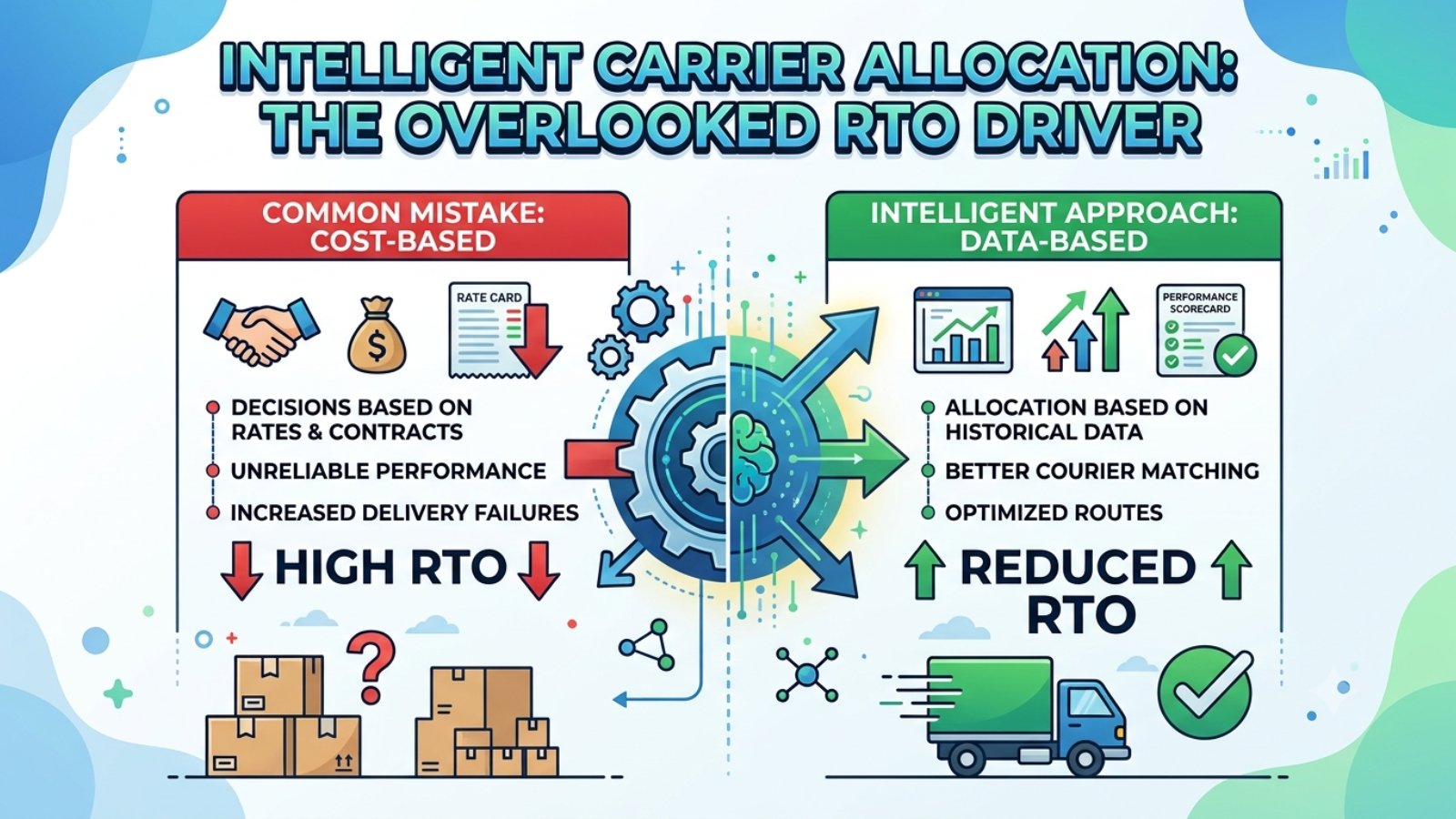 Wrong carrier assignment is one of the most consistently underaddressed contributors to high RTO among Indian D2C brands. Most brands still allocate shipping partners based on rate negotiations or existing commercial relationships, not actual delivery performance.
TAT-Based Allocation Using Real Delivery Data
The right question at carrier assignment is not “which courier is cheapest?” It is: “which courier has the best delivery success rate and turnaround time for this specific order, going to this specific pincode, at this COD value?”
Base.com uses historical carrier performance data to allocate orders to shipping partners based on actual TAT and delivery success rates, not static rate cards. For each order, the system evaluates which carrier is most likely to complete delivery successfully in that geography before assigning it.
This data-driven approach is a core mechanism for reducing RTO in ecommerce India without removing COD at the fulfilment stage. India’s logistics network has significant carrier performance variation by region. A carrier dominant in Maharashtra may underperform significantly in Bihar. Using performance data rather than habit to make this decision produces measurably better delivery outcomes.
| Carrier Allocation Method | RTO Impact | True Cost Impact |
|---|---|---|
| Cheapest rate always | High RTO, poor performers assigned | Low upfront, high total return cost |
| Fixed commercial relationships | Moderate RTO, no performance feedback | Moderate upfront, moderate return cost |
| TAT and delivery success rate-based | Lower RTO, best performer per geography | Higher per-order, significantly lower total cost |
The true cost calculation is critical here. A courier saving ₹8 per shipment but returning 15% more orders costs substantially more when return logistics, restocking, and team dispute-resolution time are included. How to reduce RTO in ecommerce India without removing COD at the carrier layer means calculating the true cost per delivered order, not the headline rate per dispatched shipment.
Routing Away From Fake-Delivery-Prone Combinations
Carrier performance data identifies which couriers have disproportionately high failed delivery scan rates in specific geographies, a reliable indicator of fake delivery patterns. Base.com’s allocation logic uses this data to route away from high-risk carrier-geography combinations before orders are placed.
This is a dimension of how to reduce RTO in ecommerce India without removing COD, which most standard OMS platforms in India do not address. They allocate by rate or speed. Base.com allocates by outcome probability, which is the only allocation logic that consistently reduces RTO.
Stage 3: Post-Dispatch Visibility and Active Intervention
Even well-verified orders with strong carrier assignments can fail at the last mile. Post-dispatch visibility determines whether a brand can intervene before a failed delivery attempt solidifies into a confirmed return.
Real-Time Tracking With Exception Alerts
Orders that have not received a delivery scan within the expected window should trigger an automatic exception alert. This creates an active intervention window, a customer reachability call, a redelivery attempt coordination, or a courier escalation, before the carrier marks the order undeliverable and initiates the return journey.
India’s COD return rate market average is 25-30%. Brands that build this post-dispatch visibility layer consistently operate 8-12 percentage points below market average. That gap is the operational dividend of active intervention versus passive tracking.
Carrier Dispute Management Backed by Confirmation Data
When a courier claims failed delivery on an order where the customer confirmed delivery intent through a pre-dispatch automated call, the brand has a contestable data point. Base.com’s confirmation records provide exactly this evidence layer, making fake delivery disputes documentable and prosecutable rather than unresolvable.
Without pre-delivery confirmation records, a courier’s failed delivery scan is essentially uncontestable. With them, the brand can present timestamped confirmation data against the courier’s claimed outcome. This combination is a key part of how to reduce RTO in ecommerce India without removing COD for brands dealing with persistent fake delivery patterns from specific carrier-geography combinations.
Base.com’s Specific Mechanisms for RTO Reduction
Base.com functions as an integrated execution layer for how to reduce RTO in ecommerce India without removing COD, not a reporting dashboard that tells you the problem exists. It operationalises the fix across all three stages.
What Base.com Delivers Specifically
- Automated confirmation calls: configurable risk criteria trigger outbound verification calls before high-risk orders dispatch, creating timestamped confirmation records at scale.
- TAT-based carrier allocation: every order is matched to the shipping partner with the best actual delivery performance for that geography, not the cheapest available rate.
- Risk-based order routing: high-risk COD order profiles are flagged automatically and routed to verification queues before entering fulfilment pipelines.
- Carrier performance analytics: ongoing delivery outcome data feeds back into allocation logic, identifying underperforming carrier-geography combinations continuously.
- Single integrated operations view: all order, dispatch, and delivery visibility in one system, eliminating the tool-switching that creates post-dispatch blind spots.
Verified Indian Client Results
| Brand | RTO Challenge | Outcome With Base.com |
|---|---|---|
| Effilo | ~60% RTO, fake deliveries, no confirmation layer, habit-based carrier allocation | RTO reduced to ~20%, targeting 10% |
| Blue Tea | Order processing delays and multi-warehouse coordination gaps are affecting dispatch accuracy | Processing time from 3 hours to 30 minutes |
| Blue Tea | Packing errors are creating return exposure at the fulfilment stage | Packing errors reduced from 3-4% to 0% |
These are verified outcomes from Indian D2C brands, not projections. How to reduce RTO in ecommerce India without removing COD is a question Effilo has already answered, with Base.com as the operational infrastructure that made it possible.
The True Financial Cost of RTO That Indian Brands Are Underestimating
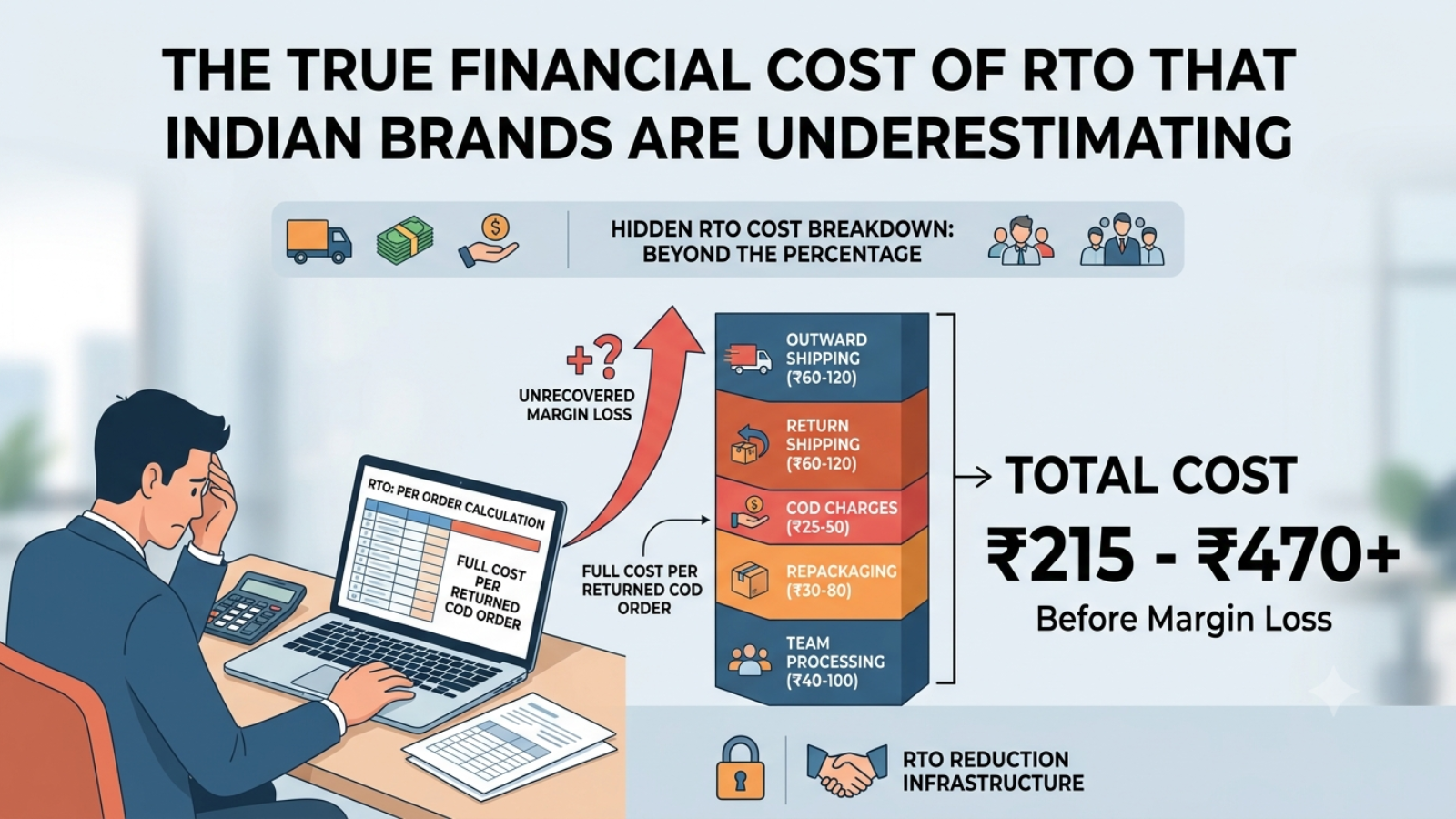 Most Indian D2C brands measure RTO as a percentage. Few calculate the full cost per returned order. That calculation is what makes the investment case for proper RTO reduction infrastructure genuinely compelling.
Full Cost Per Returned COD Order
| Cost Component | Typical Range in India |
|---|---|
| Outward shipping cost | ₹60-120 |
| Return shipping cost | ₹60-120 |
| COD handling charge | ₹25-50 |
| Repackaging and restocking | ₹30-80 |
| Team time, processing, and disputes | ₹40-100 (allocated) |
| Lost revenue on unrecovered margin | Order value × margin % |
| Total cost per returned order | ₹215-470+ before margin loss |
At a 30% RTO rate on 10,000 monthly orders, that is 3,000 returns per month. At ₹300 average true cost per return, the monthly operational loss is ₹9 lakh, before accounting for the margin on orders that were never completed.
How to reduce RTO in ecommerce India without removing COD at this scale is not an operations improvement exercise. It is a direct P&L intervention with a clear, calculable return on investment.
Four Mistakes Indian D2C Brands Make When Trying to Reduce RTO
Reducing RTO is not about one tactic; it is about fixing how decisions are made across the order lifecycle. Many Indian D2C brands attempt quick fixes like switching couriers or tightening policies, but miss the structural gaps causing returns. These mistakes keep RTO high, increase costs, and prevent brands from achieving predictable, scalable fulfilment performance.
Mistake 1: Removing COD Across the Catalogue
The most common mistake. Conversion drops immediately and significantly. For most Indian D2C brands, the revenue loss from conversion declines exceeds the savings from returns within 8 weeks. The answer to how to reduce RTO in ecommerce India without removing COD is never to remove COD broadly; it is to apply targeted friction where risk data indicates it is warranted.
Mistake 2: Switching Carriers Without Performance Data
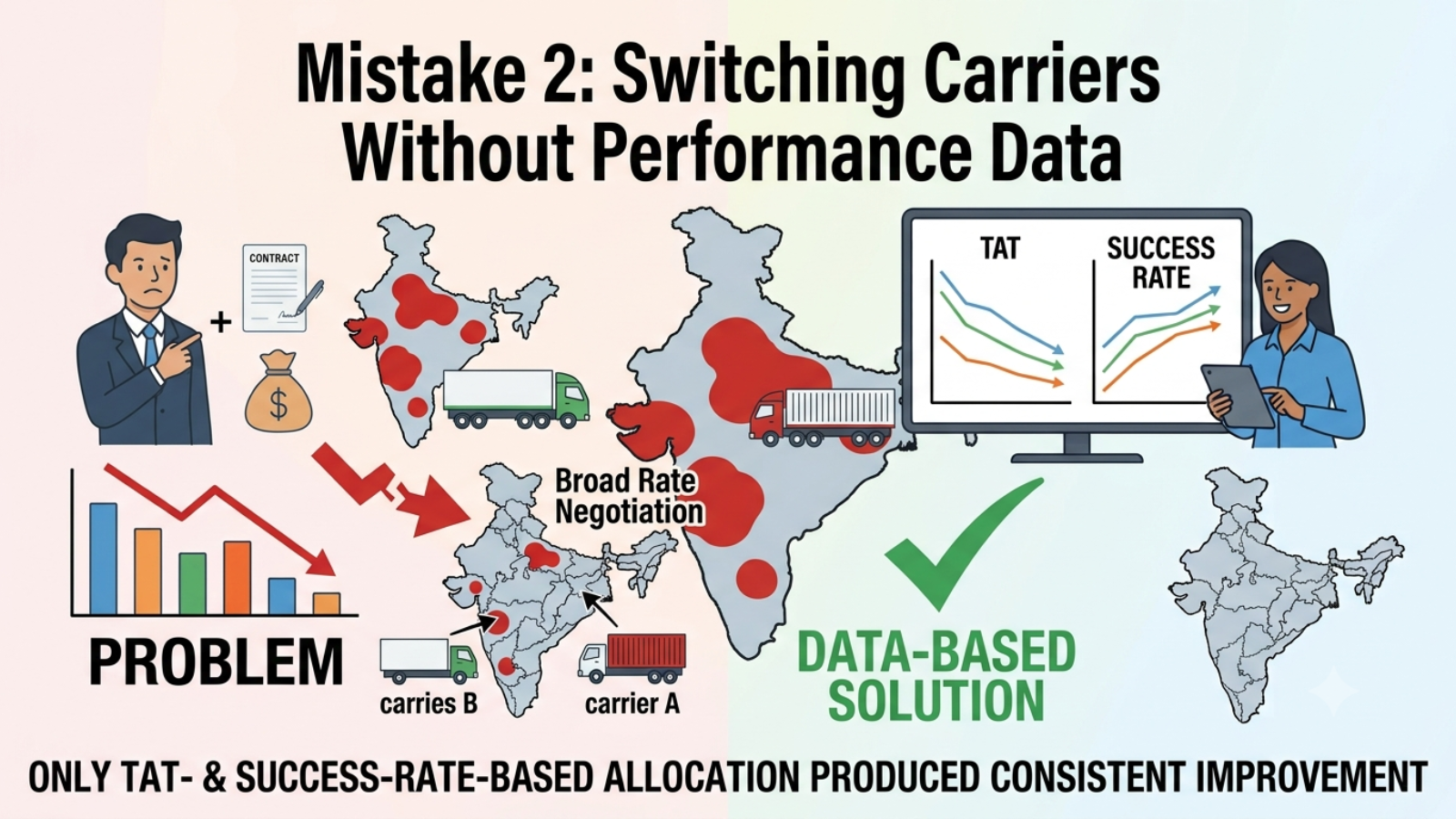 Changing couriers based on new rate negotiations rather than delivery performance data often moves the RTO problem to a different geography rather than solving it. The new carrier may underperform in the same locations. Only TAT- and success-rate-based allocation produces consistent improvement.
Mistake 3: Manual Confirmation Calls at Scale
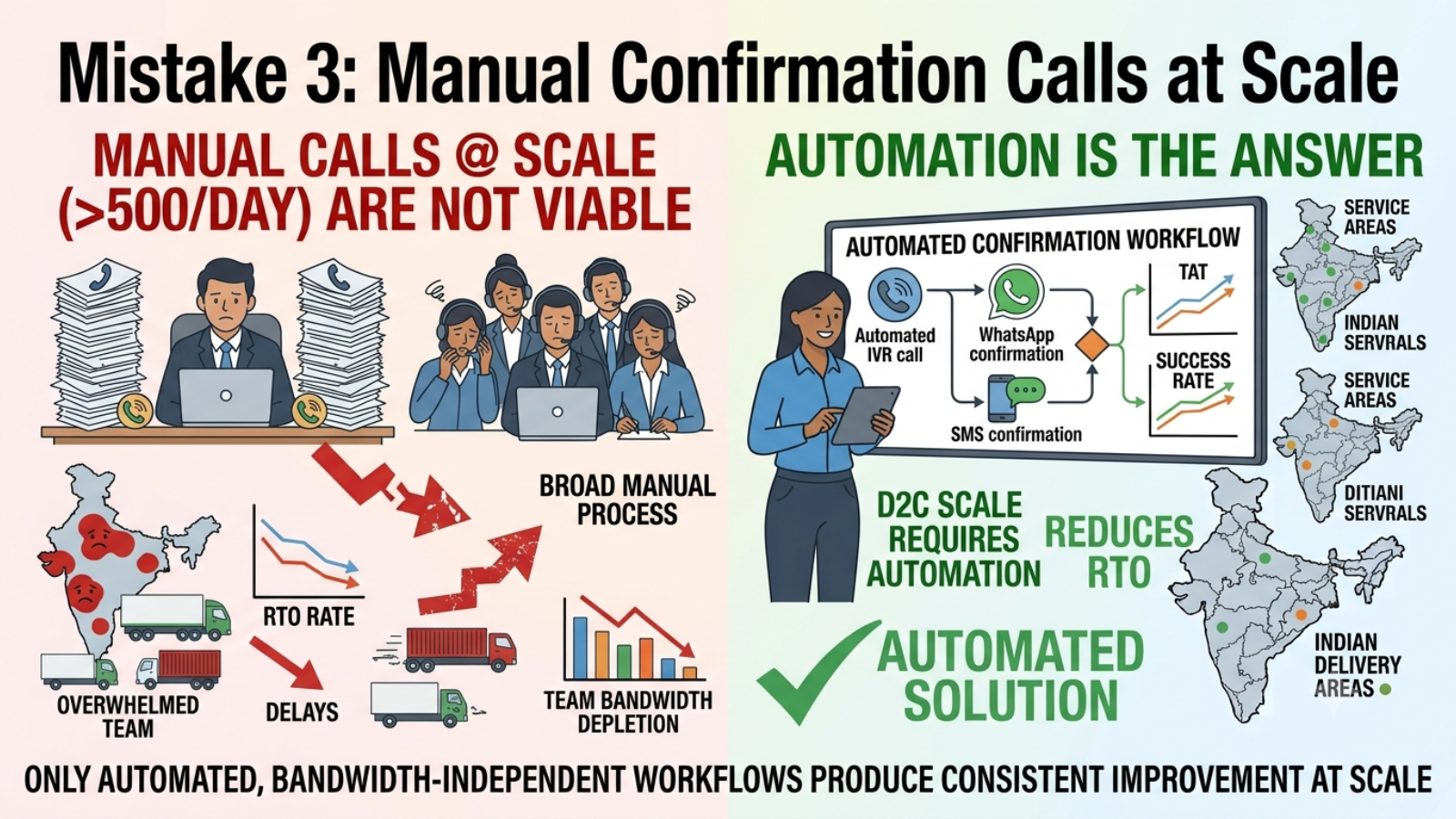 Manual calling is viable at 50 daily orders. It is not viable at 500. The answer to how to reduce RTO in ecommerce India without removing COD at the D2C scale requires automated confirmation workflows that cover qualifying orders without team bandwidth dependency.
Mistake 4: Treating All RTO as One Problem
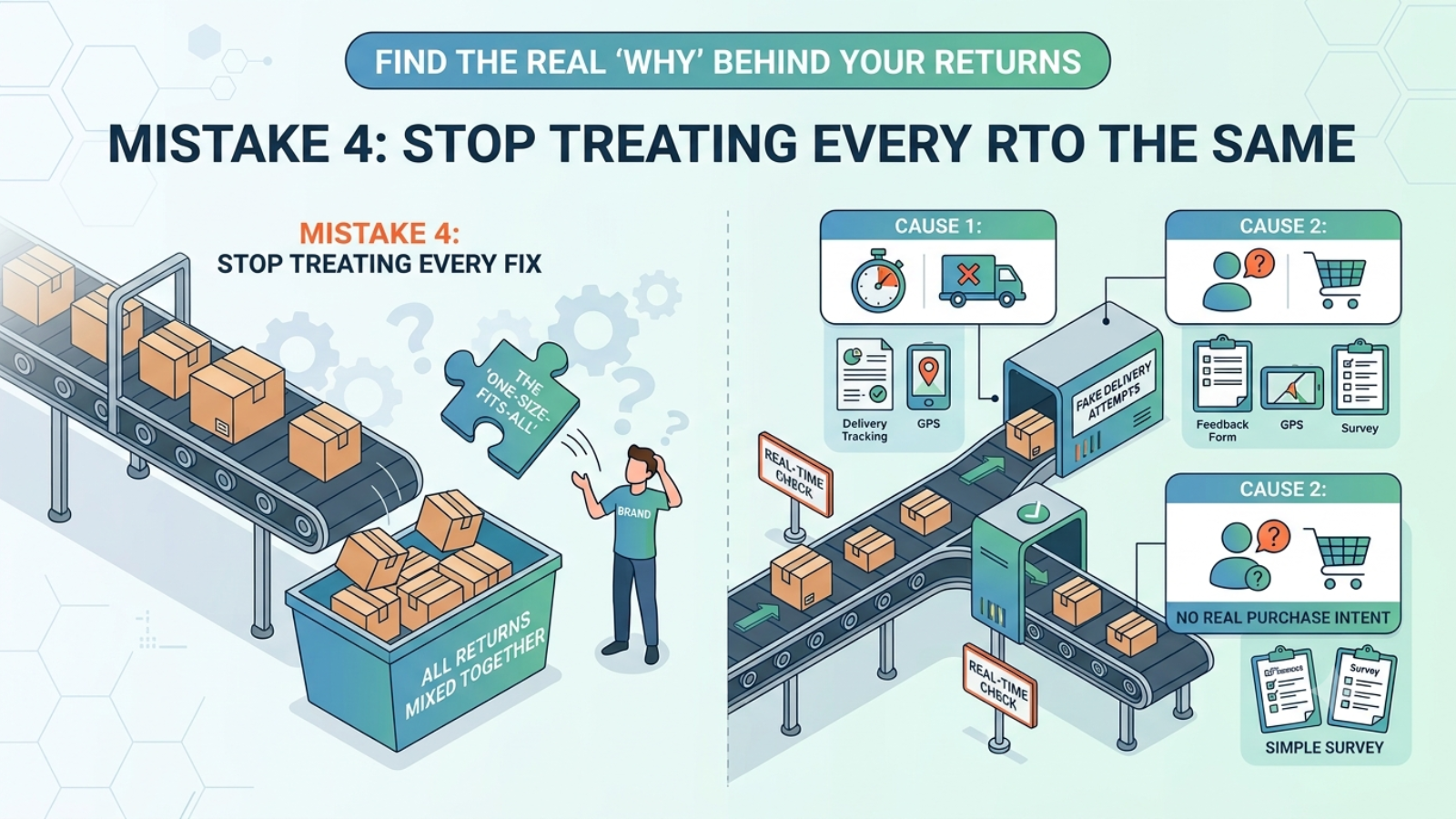 A brand with high RTO from fake delivery attempts needs different interventions than one with high RTO from unverified purchase intent. Applying the wrong fix wastes budget and produces marginal improvement. Diagnose the causes first. Build the interventions around the diagnosis.
Summary: The Complete RTO Reduction Framework
| Stage | Key Actions | What Base.com Provides |
|---|---|---|
| Pre-dispatch | Automated confirmation calls, risk scoring, and COD friction on high-risk segments | Native confirmation workflow, configurable risk routing |
| Carrier allocation | TAT-based allocation, fake-delivery pattern routing, performance data-driven decisions | Carrier performance analytics, automated allocation logic |
| Post-dispatch | Real-time exception alerts, carrier dispute management, and redelivery intervention | Integrated tracking, confirmation record, evidence layer |
How to reduce RTO in ecommerce India without removing COD is an operations problem with a clear, proven framework. The brands that implement all three stages through a connected platform, rather than three separate tools, consistently outperform those that address one stage at a time.
Base.com provides the integrated execution layer that makes this framework operational for Indian D2C brands. Effilo’s result of 60% to 20% RTO is what this approach delivers when it is implemented correctly and completely.
Ready to reduce RTO without removing COD from your catalogue? [Talk to the Base.com team →]

[…] this pincode carry a known return risk? Skipping this step is one of the most common sources of downstream RTO cost, and it is exactly the gap that order management software best for sellers in India is designed to […]
[…] orders, compared to 35% in 2022. The shift to quick commerce for grocery deliveries has also reduced RTO, because a 10-30 minute delivery reaches the customer while they are still actively in the need […]
[…] one feature can reduce effective RTO on COD-heavy brands by 5-8 percentage points, which, at scale, is worth significantly more than any […]
[…] platform built specifically for Indian D2C, marketplace, and B2B sellers, unifying order capture, COD risk scoring, inventory allocation, and dispatch across every channel in one […]