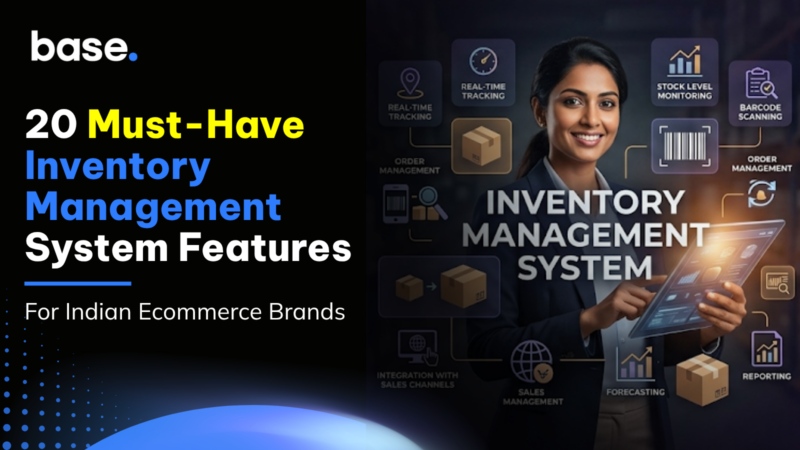
An inventory management system built for a US or European eCommerce brand will miss roughly half of what an Indian seller needs on day one.
India’s eCommerce market crossed $200 billion in 2026. Manual GST return filing leads to penalties averaging ₹50,000 per error, and e-invoicing is now mandatory for businesses with an annual turnover exceeding ₹5 crore. COD return rates run at 25-30%. Festive season order volumes spike 5-10x in 48 hours. And brands routinely sell across Amazon.in, Flipkart, Meesho, their Shopify store, and a quick commerce platform simultaneously, from a single warehouse.
The inventory management system features in India that matter are not just real-time tracking and barcode scanning. They are GST e-invoicing, COD reconciliation, Indian marketplace-native integrations, e-way bill automation, and AI-powered demand forecasting that accounts for Diwali demand curves, not Black Friday ones.
This guide covers all 20 features a serious Indian eCommerce brand must evaluate before choosing an inventory system. Base.com is referenced throughout where its specific module architecture delivers the feature, and where it differs from platforms that only partially address the requirement.
Feature 1: Real-Time Multi-Channel Inventory Sync
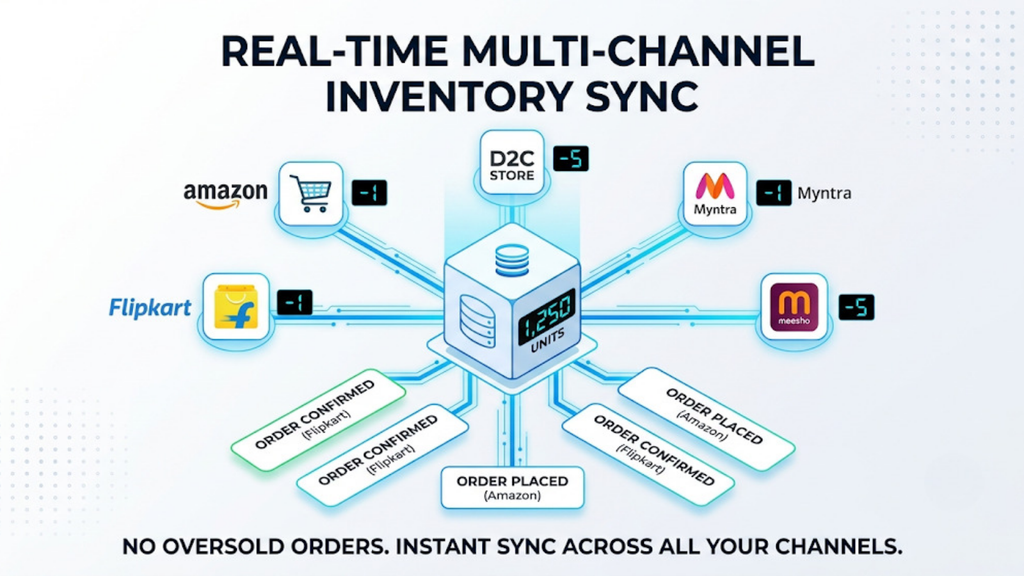
What it is: Every order placed on any connected channel decrements inventory across all channels simultaneously, not on a batch sync cycle.
Why it matters for India: Indian sellers managing Amazon, Flipkart, Meesho, Myntra, and their own D2C store simultaneously face the highest oversell risk in the world during peak traffic. A 15-minute batch sync window during a flash sale can generate hundreds of impossible orders.
What to look for: True real-time sync, not “every 5 minutes”, across all connected channels simultaneously. Base.com’s architecture decrements inventory the moment an order is confirmed, across all 400+ connected channels, because OMS and WMS share one database with no sync handoff.
| Capability | What It Prevents |
| Real-time decrement on order confirmation | Overselling during flash sales |
| Per-SKU allocation by channel | One channel is overselling while another sits idle |
| Multi-location sync | Stock sitting in one warehouse while another channel shows zero |
| Sync failure alerting | Silent desync is going undetected for hours |
Feature 2: GST-Compliant Invoicing and E-Invoicing

What it is: Automatic generation of GST-compliant B2B and B2C invoices, e-invoices via the NIC portal, and QR codes for COD payment against B2C orders.
Why it matters for India: GST inventory management software integrates India’s Goods and Services Tax compliance requirements directly into inventory tracking, creating a unified system that manages stock levels, automates tax calculations, and generates compliant documentation throughout the supply chain. Without this, every stock movement requires manual tax entry, a process that scales linearly with order volume and error rates with team fatigue.
What to look for: Native GST logic, not a bolt-on accounting plugin, that handles GSTR-1, GSTR-3B, HSN/SAC code mapping, input tax credit (ITC) reconciliation, and both B2B and B2C invoice formats without manual configuration per order type.
| Compliance Requirement | What Your IMS Must Handle |
| E-invoicing (IRN generation) | Auto-submission to the NIC portal for B2B transactions above ₹5 crore turnover |
| B2C QR code invoices | Required for COD orders, the system must generate automatically |
| GSTR-1 filing data | Aggregated sales data formatted for direct GST return filing |
| ITC reconciliation | Purchase invoices matched against GSTR-2B for input tax credit claims |
| HSN/SAC code mapping | Per-SKU tax category mapping without manual per-order entry |
Feature 3: E-Way Bill Automation
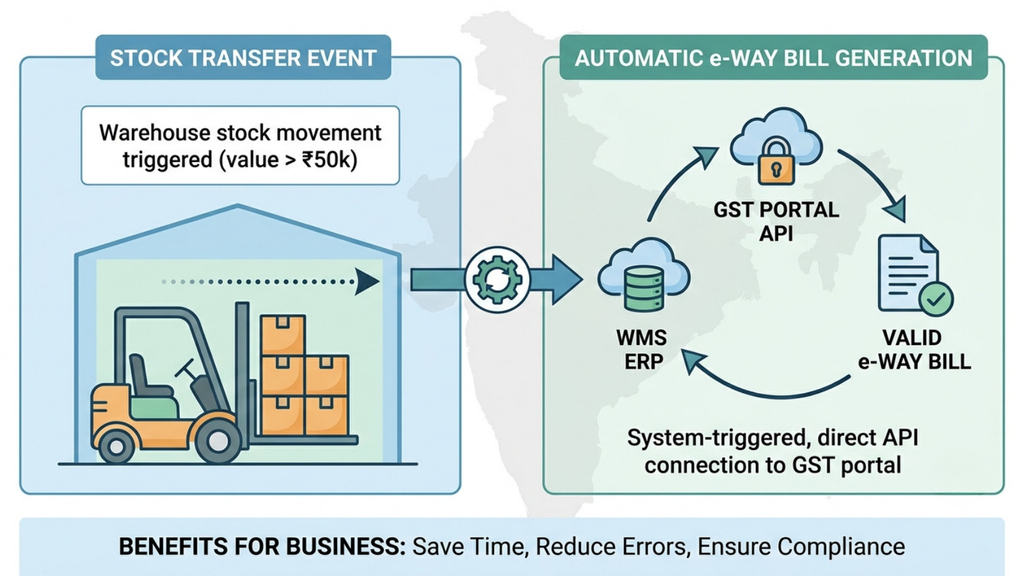
What it is: Automatic generation of e-way bills for all inter-state and high-value intra-state goods movements, triggered by stock transfers and dispatch events.
Why it matters for India: When goods valued above ₹50,000 are moved between warehouses across state borders, an e-way bill must be generated under GST regulations. Even transfers between your own warehouses require proper invoicing, and a good WMS automates this. Brands with multi-state warehouse networks generate dozens of e-way bills daily; manual generation is both time-consuming and error-prone.
What to look for: System-triggered e-way bill generation on stock transfer events, with direct API connection to the GST e-way bill portal, not manual upload.
| E-Way Bill Trigger | Minimum System Requirement |
| Inter-state stock transfers | Auto-generated on warehouse transfer confirmation |
| Customer dispatch above ₹50,000 | System-triggered, not manually initiated |
| Multiple consignments from one PO | Consolidated e-way bill generation |
| Cancellation and amendment | Handled within the system, no portal login required |
Feature 4: Multi-Warehouse Inventory Management

What it is: Granular, per-location stock visibility and control across all warehouses, 3PLs, dark stores, and retail locations simultaneously.
Why it matters for India: 67% of Indian businesses now operate across two or more locations, making spreadsheet-based tracking nearly impossible to sustain. A D2C brand managing a central warehouse in Bhiwandi, a 3PL in Bangalore, and inventory at Amazon FBA centers cannot operate from a single-location inventory system at scale.
What to look for: Per-location stock levels, inter-warehouse transfer management, per-location reorder triggers, and order routing rules that direct each order to the optimal fulfillment location based on proximity, stock availability, and SLA.
| Multi-Warehouse Capability | Business Outcome |
| Per-location real-time stock levels | Eliminates split shipments caused by inventory blind spots |
| Automated inter-warehouse transfers | Rebalances stock before locations run out, not after |
| Per-location reorder points | Prevents one warehouse from going to zero while another overstocks |
| Order routing by location | Routes each order to the closest warehouse with stock |
| 3PL integration | External warehouses visible in the same dashboard as owned locations |
Feature 5: Barcode and QR Code Scanning

What it is: Scan-based receiving, put-away, picking, packing, and dispatch, with validation at every stage to catch errors before they reach the customer.
Why it matters for India: Manual picking and packing generate packing errors that directly cause returns. Return rates in Indian eCommerce run at 20-30% in categories like fashion and electronics; every avoidable wrong-item dispatch adds to this figure and erodes marketplace seller ratings. A scan-based system eliminates the wrong-item class of error.
What to look for: Barcode scanning at inbound receiving (goods receipt), put-away location assignment, pick-list validation, packing confirmation, and dispatch, not just at a single stage.
| Scan Stage | Error It Prevents |
| Inbound receiving | Wrong SKU or quantity booked into stock |
| Put-away | Stock placed in the wrong bin, unlocatable at pick time |
| Picking | Wrong variant (wrong size, colour, model) selected |
| Packing validation | Wrong quantity or extra item packed |
| Dispatch confirmation | The wrong shipment label was applied to the wrong parcel |
Feature 6: Automated Reorder Point Triggers
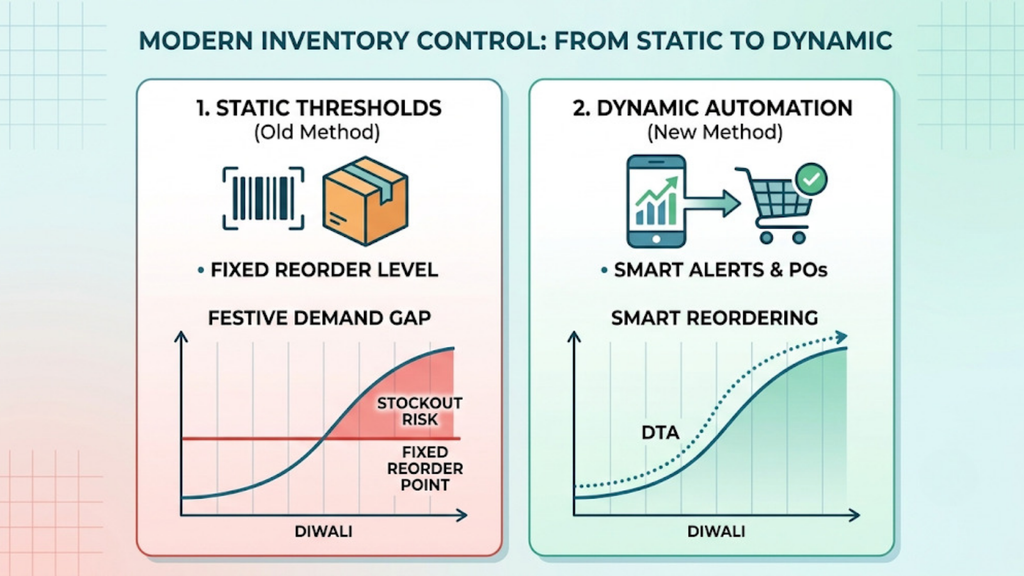
What it is: System-defined stock thresholds that automatically trigger purchase orders or supplier alerts when inventory falls below a set level, calculated per SKU, per location, and per channel velocity.
Why it matters for India: Indian eCommerce demand is spiky and seasonal. A static reorder point set in July will be critically understated for the October festive season demand. The system must account for lead time variability with Indian suppliers, which can be unpredictable, and for the speed at which stock depletes during platform sale events.
What to look for: Dynamic reorder points that adjust based on rolling sales velocity, supplier lead time tracking, and safety stock calculations, not static thresholds set once at setup.
| Reorder Point Component | Why It Matters for Indian Sellers |
| Per-SKU reorder threshold | One threshold for all SKUs causes oversafety on slow movers, stockouts on fast movers |
| Supplier lead time tracking | Indian supplier lead times vary; the system must use actuals, not estimates |
| Safety stock calculation | Buffers for demand spikes during sale events and festive seasons |
| Automatic PO generation | Removes manual purchasing trigger, prevents human delay, causing a stockout |
| Low-stock alert hierarchy | Alert sent to the purchase manager, not just logged in the system |
Feature 7: Demand Forecasting and AI-Based Planning

What it is: Predictive analytics that use historical sales data, seasonality patterns, promotional calendars, and channel-level trends to forecast future demand per SKU, and adjust purchasing recommendations accordingly.
Why it matters for India: AI-assisted predictive insights allow Indian sellers to plan dispatch volumes around peak events like Diwali, IPL, and Big Billion Day, avoiding overstocking. Generic demand forecasting tools calibrated for Western markets do not account for India’s festive calendar. An inventory management system in India must include Diwali, Navratri, Eid, and IPL as first-class demand signals.
What to look for: Forecasting models that are trained on Indian demand patterns, that integrate platform-level promotional calendars (Amazon Great Indian Festival, Flipkart Big Billion Day), and that produce per-SKU, per-channel purchase recommendations, not just aggregate demand curves.
| Forecasting Input | Indian-Specific Requirement |
| Historical sales by channel | Separate velocity curves per marketplace, Amazon and Meesho have different demand shapes |
| Festive season multipliers | Diwali, Navratri, Eid, and regional festival demand patterns are built in |
| Platform sale event calendar | Great Indian Festival, Big Billion Day, and Nykaa sale dates as demand signals |
| New product handling | Forecasting for SKUs without historical data using category comps |
| Stockout impact correction | Removes stockout periods from historical sales to prevent understated forecasts |
Feature 8: Returns and Reverse Logistics Management
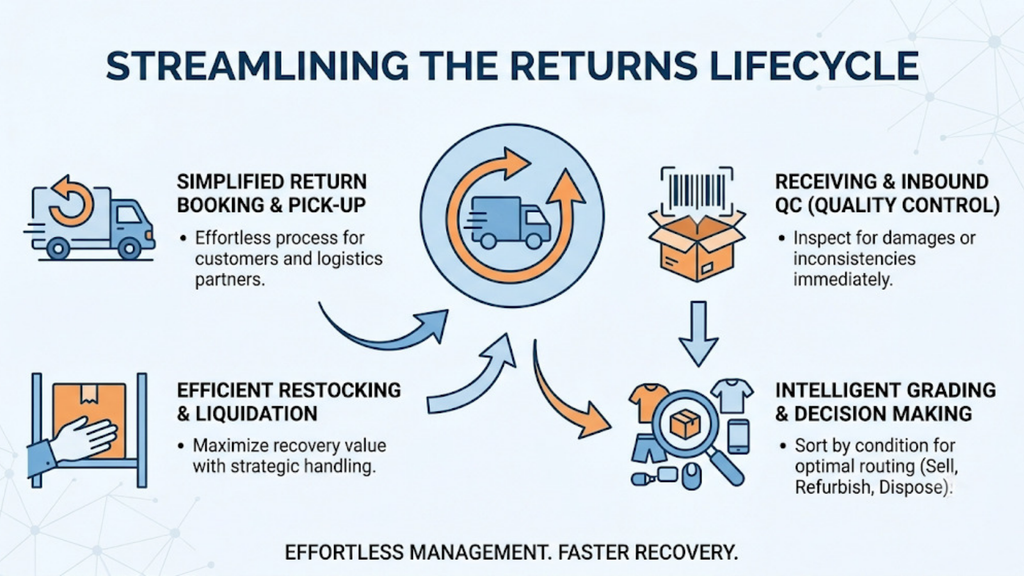
What it is: Automated return initiation, return label generation, transit tracking, quality inspection workflow, and inventory restocking, triggered from a single return event.
Why it matters for India: COD returns alone run at 25-30% in India. Fashion eCommerce return rates are higher. A brand processing 1,000 orders per day at a 25% return rate is managing 250 inbound return units daily, which must be inspected, graded, and restocked or written off without human error. Manual reverse logistics at that volume is operationally unsustainable.
What to look for: Return initiation from the OMS (not just the customer portal), automated return label generation, quality check workflow with accept/reject/write-off categorisation, and automatic inventory restocking for accepted returns, all without manual steps between stages.
| Returns Process Stage | What the System Must Handle Automatically |
| Return initiation | Customer or ops team triggers return, label generated automatically |
| Transit tracking | Return shipment tracked in the same dashboard as outbound orders |
| Quality check workflow | Accepted/damaged/write-off categorisation with photo capture |
| Inventory restocking | Accepted returns added back to available inventory without manual entry |
| COD refund reconciliation | Refund processing tied to QC outcome, not initiated on return request |
Feature 9: Channel-Level Inventory Allocation
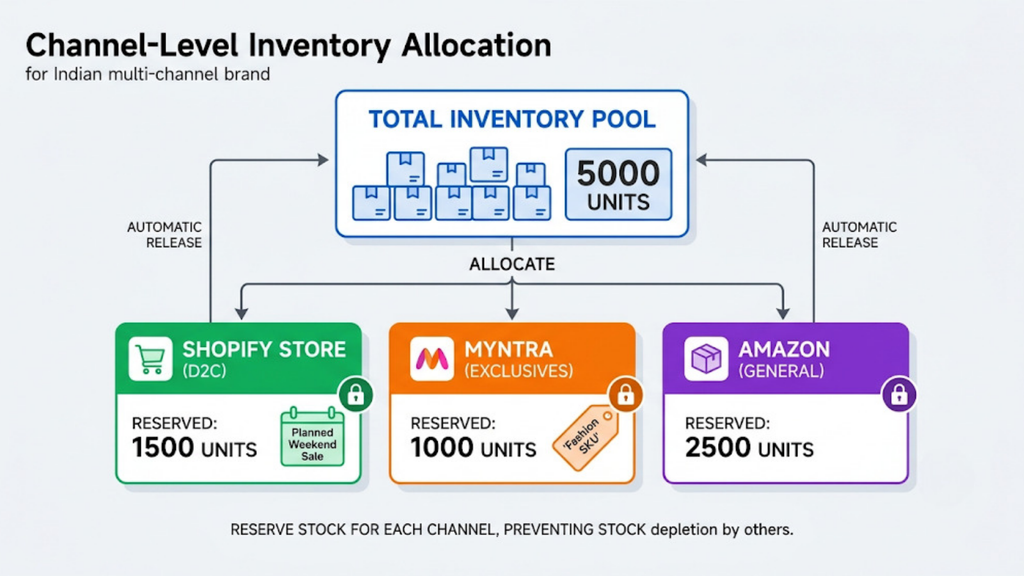
What it is: The ability to reserve and allocate specific stock quantities to specific channels, preventing one marketplace from consuming stock earmarked for another channel or for a planned sale event.
Why it matters for India: Brands running a Myntra exclusive SKU alongside the same SKU on their own Shopify store need channel-level stock allocation. Without it, Myntra orders will deplete the stock that the D2C channel needs for a planned weekend sale. This is a common failure mode for Indian multi-channel sellers that generic inventory tools do not address.
What to look for: Per-channel stock reservation with configurable allocation rules, override capability for planned sales events, and automatic release of unreserved stock back to the pool.
| Allocation Rule Type | Use Case for Indian Sellers |
| Percentage-based allocation | Reserve 40% of stock for Flipkart, 40% for D2C, 20% buffer |
| Quantity-based reservation | Earmark 500 units for Amazon Prime Day before it goes live |
| Priority-based allocation | D2C orders are always fulfilled before marketplace orders when stock is limited |
| Expiry-based release | Unreserved stock auto-released to open pool 24 hours before the sale ends |
Feature 10: Kitting and Bundling Management
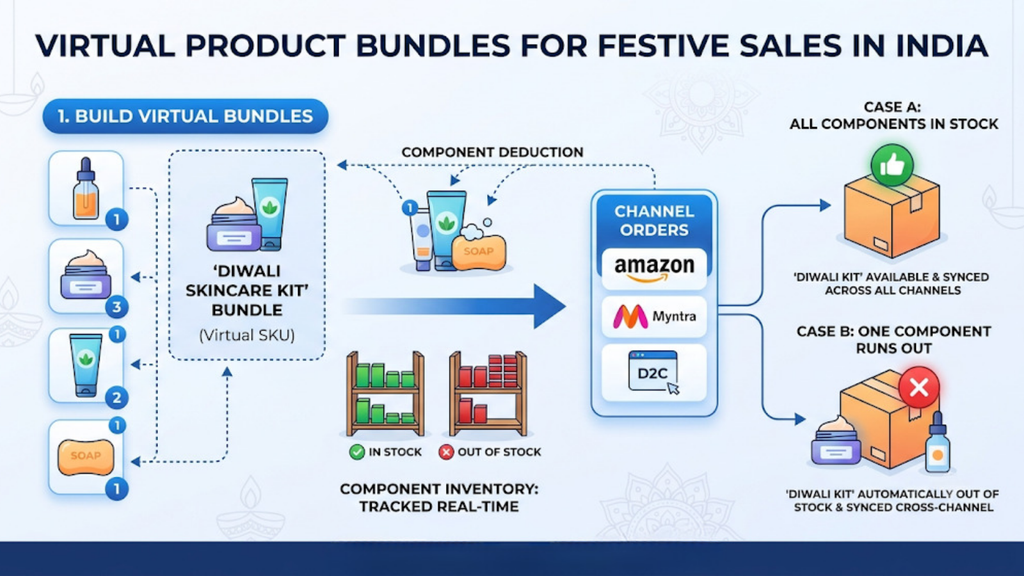
What it is: The ability to create virtual product bundles, combining individual SKUs into a kit, and track component-level inventory in real time as bundle orders are placed.
Why it matters for India: Indian eCommerce festive season sales are heavily bundle-driven. A skincare brand running a “Diwali gift set” bundle across Amazon, Myntra, and their D2C store needs the system to track component stock for each product, not just the bundle as an opaque unit. When one component runs out, the bundle must automatically go out of stock across all channels.
What to look for: Virtual bundle creation without physical repacking, component-level inventory deduction per bundle sale, bundle-level availability calculation based on minimum component stock, and cross-channel bundle status sync.
| Kitting Capability | Business Outcome |
| Virtual bundles (no pre-pack required) | Reduces dead stock from pre-assembled bundles that don’t sell |
| Component-level stock tracking | Prevents bundle oversell when a component runs out |
| Dynamic bundle availability | Bundle automatically goes OOS when any component hits zero |
| Cross-channel bundle sync | Myntra and Shopify both show accurate bundle availability |
Feature 11: Serial Number and Batch Tracking

What it is: The ability to assign and track unique serial numbers or batch codes to individual units, enabling full traceability from supplier delivery through customer dispatch and returns.
Why it matters for India: Pharma, electronics, food and beverage, and ayurvedic product sellers on Indian eCommerce platforms have regulatory traceability requirements. A returned electronics unit must be traceable to its original batch. An expired FMCG batch must be locatable and withdrawable from active stock before dispatch.
What to look for: Batch and serial number assignment at inbound receiving, FIFO/FEFO (First In First Out / First Expiry First Out) picking rules, expiry date tracking with pre-expiry alert, and batch-level recall capability.
| Tracking Type | Applicable Indian Category |
| Serial number tracking | Electronics, high-value items, mobile accessories |
| Batch number tracking | FMCG, pharma, food, beauty products |
| Expiry date management | Food, pharma, health supplements, personal care |
| FIFO/FEFO picking enforcement | Reduces expired stock dispatch, critical for food and pharma |
| Batch recall | Withdraws specific batches from active stock without affecting others |
Feature 12: Purchase Order Management
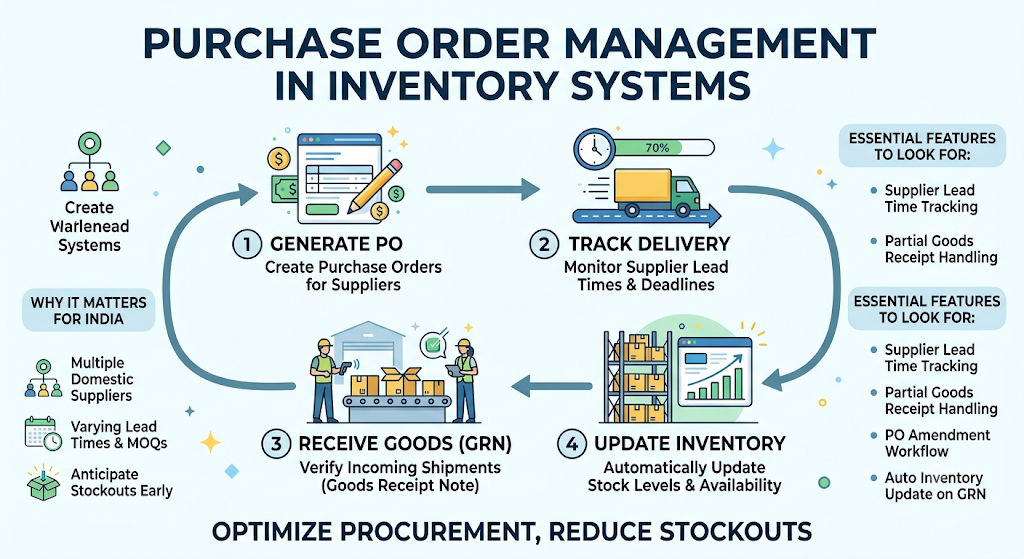
What it is: Creation, tracking, and management of supplier purchase orders, from PO generation through goods receipt and stock update, within the inventory system.
Why it matters for India: Indian eCommerce brands often source from multiple domestic suppliers with varying lead times, MOQs, and payment terms. A PO management module that tracks expected delivery dates, flags overdue POs, and automatically updates inbound stock expectations allows purchasing teams to anticipate stockouts before they happen rather than react after.
What to look for: PO creation with per-supplier lead time tracking, partial goods receipt handling (when suppliers deliver in installments), PO amendment workflow, and automatic inventory update on GRN (Goods Receipt Note) confirmation.
| PO Management Capability | Why Indian Sellers Need It |
| Per-supplier lead time tracking | Accounts for variability in Indian supplier reliability |
| Partial goods receipt | Many Indian suppliers deliver in multiple installments against one PO |
| Automatic reorder PO generation | Triggered by reorder point breach, no manual purchasing step required |
| PO vs. GRN variance tracking | Catches short deliveries before they become inventory discrepancies |
| Supplier performance reporting | Tracks the on-time delivery rate per supplier for procurement decisions |
Feature 13: Dead Stock and Ageing Inventory Reporting
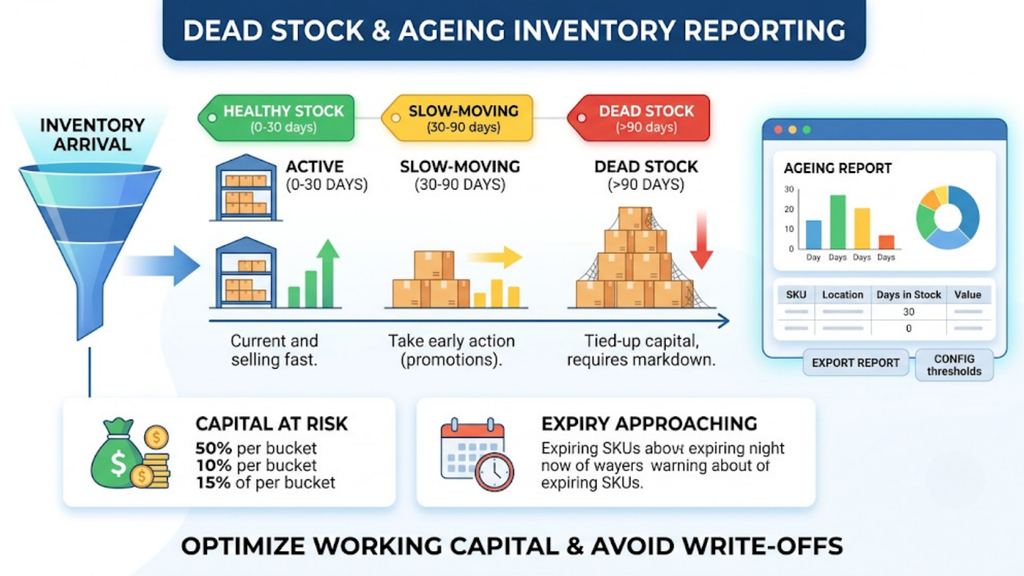
What it is: Automated identification of slow-moving, non-moving, and expiry-approaching stock, with ageing reports that show how long each SKU has been in inventory and how much capital it represents.
Why it matters for India: Dead stock ties up working capital that Indian D2C brands, many of whom operate on thin margins with COD return pressure, cannot afford to have locked in unsold inventory. Identifying ageing stock early enables markdowns, marketplace promotions, or bundle inclusion before the stock becomes a write-off.
What to look for: Configurable ageing thresholds (30/60/90/180 days), per-location ageing visibility, capital-at-risk calculation per ageing bucket, and export capability for finance team review.
| Ageing Report Type | Decision It Enables |
| SKU-level days-in-inventory | Identifies slow movers for markdown or promotion |
| Location-level ageing | Shows if slow movers are concentrated in one warehouse |
| Category-level ageing analysis | Flags entire categories underperforming vs. plan |
| Capital-at-risk by ageing bucket | Gives the finance team accurate working capital exposure |
| Expiry alert by batch | Triggers pre-expiry markdown or return-to-supplier action |
Feature 14: COD Reconciliation and Payment Management
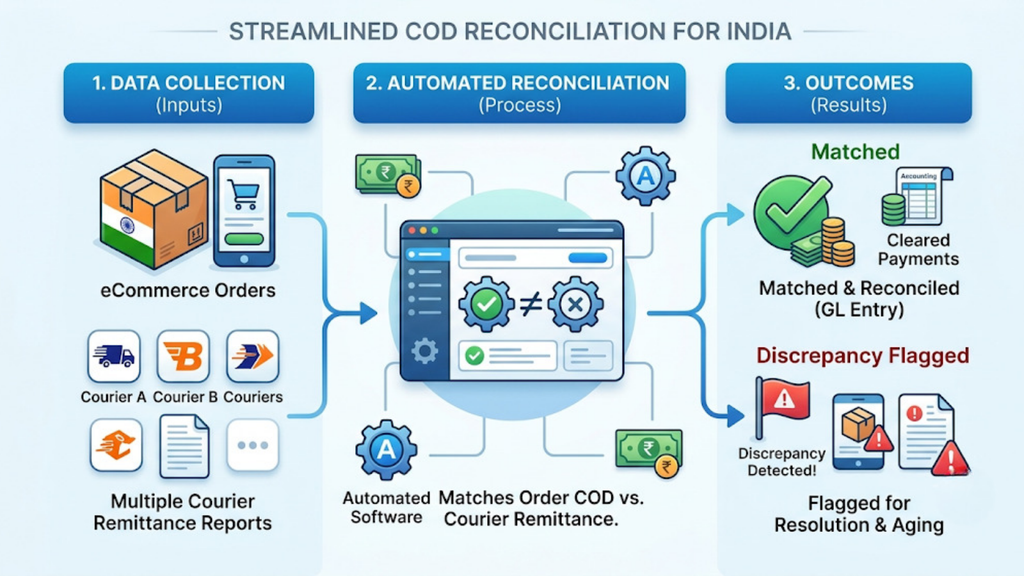
What it is: Automated tracking and reconciliation of Cash on Delivery payments, matching courier remittances against order-level COD amounts and flagging discrepancies for resolution.
Why it matters for India: COD accounts for a significant share of Indian eCommerce volume. Every courier company remits COD collections on different schedules, with deductions for returns and fees. Manual COD reconciliation across five courier partners and three marketplaces is a full-time finance task. Discrepancies go undetected for weeks. An inventory management system with built-in COD reconciliation closes this gap automatically.
What to look for: Per-courier remittance import and matching, order-level COD amount vs. remittance reconciliation, discrepancy flagging with ageing, and integration with accounting software for automated GL entry.
| COD Reconciliation Capability | Business Outcome |
| Per-courier remittance tracking | Know exactly what each courier owes and when |
| Order-level matching | Catch short remittances before they compound |
| Return deduction validation | Verify the courier’s deductions against the actual return records |
| Discrepancy ageing | Flag unresolved differences beyond configurable thresholds |
| Accounting integration | Automatic GL entry on reconciliation, no manual book entry |
Feature 15: Marketplace-Native Integration Depth
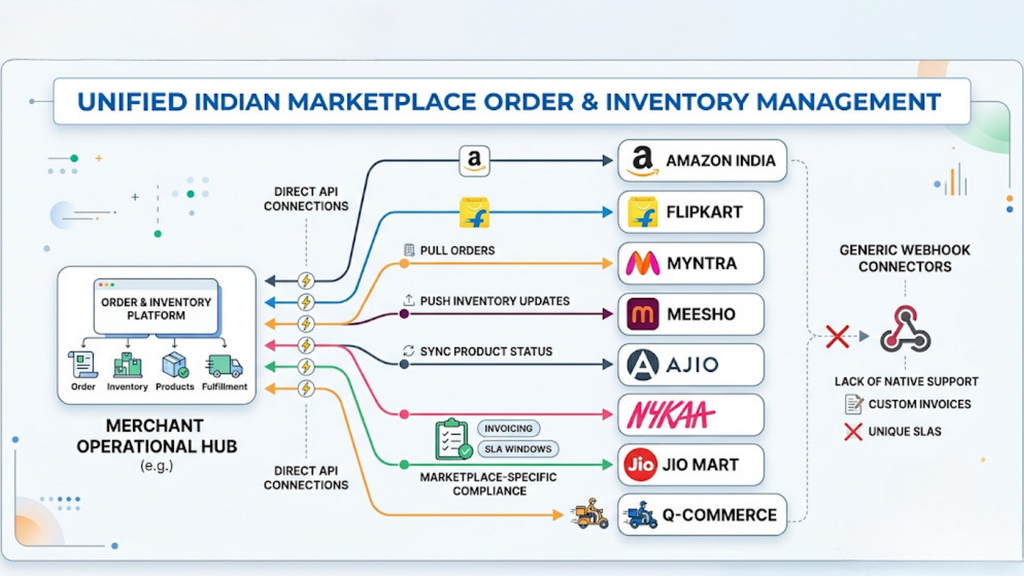
What it is: Direct API integrations with Indian eCommerce marketplaces, not generic webhook connectors, that pull orders, push inventory updates, sync product status, and manage marketplace-specific compliance requirements natively.
Why it matters for India: The specific inventory management system features in India that most differentiate Indian platforms from global ones are marketplace-native integrations. Indian marketplaces have unique order formats, invoice requirements, and SLA structures. A generic API connector that works for Shopify will not natively handle Meesho’s invoice format, Myntra’s dispatch SLA window, or Flipkart’s seller hub OBD (Outbound Delivery) workflow.
What to look for: Native integrations, built and maintained by the platform, for Amazon, Flipkart, Meesho, Myntra, AJIO, Nykaa, JioMart, and quick commerce platforms. Base.com connects to 400+ channels with maintained integrations that handle marketplace-specific compliance requirements natively.
| Marketplace | India-Specific Integration Requirement |
| Amazon | FBA inventory sync, Seller Flex management, and invoice compliance |
| Flipkart | OBD workflow, Flipkart Assured compliance, RTO data sync |
| Meesho | Meesho-specific invoice format, supplier panel integration |
| Myntra | Dispatch SLA window management, quality check compliance |
| AJIO | Jio GST invoice format, portal-specific reporting |
| Blinkit / Zepto | Dark store inventory allocation and rapid replenishment |
Feature 16: Analytics and Inventory Performance Reporting

What it is: Real-time and historical reporting on inventory performance, sell-through rates, channel-level velocity, stockout frequency, fulfillment accuracy, and working capital efficiency, accessible without data export to external tools.
Why it matters for India: Indian eCommerce brands are making purchasing decisions on gut feel, either overstock or understock, consistently. Channel-level sell-through data shows which platform sells a SKU fastest, informing allocation decisions. Stockout frequency data shows which SKUs need higher safety stock. Fulfillment accuracy data flags picking errors before they compound into return rates.
What to look for: Dashboards that show sell-through rate by SKU and channel, stockout frequency by location, inventory turnover ratio, and fulfillment accuracy, without requiring manual data exports or a separate BI tool.
| Report Type | Decision It Directly Informs |
| Sell-through rate by channel | Which channels move which SKUs fastest, informing allocation |
| Inventory turnover ratio | Identifies slow-moving categories eating working capital |
| Stockout frequency by SKU | Shows which products need higher safety stock or faster reorder |
| Fulfillment accuracy rate | Flags picking error patterns before they become returns |
| Channel margin reporting | Shows net margin per channel after returns and fulfillment costs |
Feature 17: Role-Based Access Control
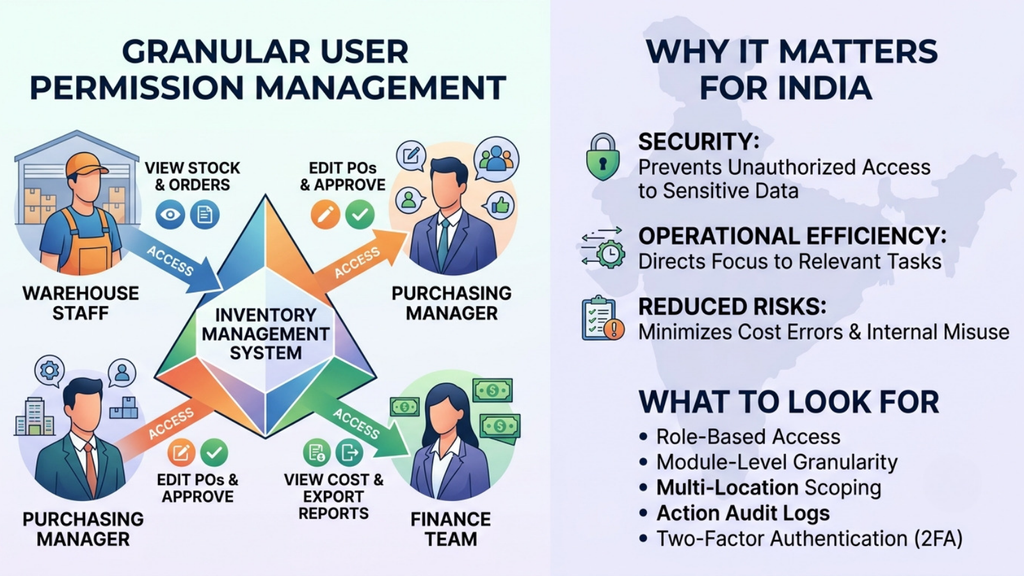
What it is: Granular user permission management, controlling which team members can view, edit, approve, or export specific inventory data, with a full audit trail of all actions taken.
Why it matters for India: Indian eCommerce operations teams typically include warehouse staff, purchasing managers, finance teams, and marketplace managers, all of whom need different levels of system access. Giving warehouse staff access to purchase order approval or giving marketplace managers visibility into cost pricing creates both security and operational risk.
What to look for: Role-based permission sets with module-level granularity, multi-location access scoping (warehouse staff sees only their location), action-level audit logs, and two-factor authentication for sensitive actions.
| Access Control Layer | What It Protects |
| Module-level permissions | Warehouse staff see picking, not purchase costs |
| Location-level scoping | Warehouse A staff cannot see or modify Warehouse B inventory |
| Approval workflows | Purchase orders above the threshold require manager approval |
| Audit trail | Every stock adjustment is logged with the user, timestamp, and reason |
| Data export restrictions | Sensitive cost data cannot be exported without authorisation |
Feature 18: Mobile App and Handheld Device Support

What it is: A mobile application, or mobile-browser-optimised interface, that enables warehouse staff to complete pick, pack, receive, and stock count tasks from handheld devices without desktop workstations.
Why it matters for India: Indian warehouses at mid-scale operate with mobile-first teams. Warehouse staff completing tasks on shared desktop terminals create bottlenecks. A mobile app that supports barcode scanning, picking confirmation, GRN entry, and stock count on an Android device directly improves warehouse throughput without infrastructure investment.
What to look for: A dedicated Android application (iOS support is secondary for Indian warehouse environments), barcode scanning integration with the device camera, offline capability for connectivity-interrupted environments, and full task completion without escalation to a desktop.
| Mobile Capability | Warehouse Throughput Impact |
| Barcode scanning via device camera | Eliminates the dedicated scanner hardware cost |
| Pick list on mobile | Warehouse staff work from handhelds, no shared desktop queue |
| GRN entry on mobile | Inbound receiving completed at the dock without office data entry |
| Stock count on mobile | Cycle counts completed in the warehouse, not transcribed later |
| Offline mode | Connectivity gaps in large warehouses do not halt operations |
Feature 19: API and ERP Integration Capability
What it is: Documented, stable API access and pre-built integrations with common Indian ERP systems, Tally, SAP Business One, Zoho Books, Oracle, and Microsoft Dynamics, enabling inventory data to flow into financial and operational systems without manual export.
Why it matters for India: The specific inventory management system features in India that enterprise buyers evaluate most rigorously are integration capabilities. A brand running SAP for finance, Tally for accounting, and a separate OMS needs inventory data to flow bidirectionally without manual intervention. API quality determines whether a system becomes a true operational backbone or an isolated tool.
What to look for: REST API with comprehensive documentation, webhook support for real-time event streaming, pre-built connectors for Tally and SAP Business One, and a partner ecosystem for custom integration development.
| Integration Type | Indian Business Context |
| Tally integration | Most Indian SMBs run Tally for accounting, and inventory must sync automatically |
| SAP Business One | For mid-market to enterprise Indian brands, PO and GRN data must flow |
| Zoho Books | Common in the ₹2-20 crore GMV range, inventory-finance sync |
| REST API access | Custom integrations with proprietary systems or marketplace tools |
| Webhook support | Real-time event streaming, stock changes push immediately to connected systems |
Feature 20: Scalability and Peak Load Performance
What it is: The technical architecture of the inventory system maintains performance, response time, sync accuracy, and processing throughput at 10x normal order volume without degradation.
Why it matters for India: The specific inventory management system features in India that separate enterprise-grade platforms from SMB tools are peak load capabilities. Diwali and Big Billion Day are not outliers in Indian eCommerce; they are planned events. A system that processes 500 orders per hour reliably but degrades at 5,000 is not suitable for any brand with festive season ambitions. Unicommerce processes 2,500+ shipments in under 10 minutes at peak. Base.com’s cloud architecture scales horizontally with order volume. These are the benchmarks to evaluate against.
What to look for: Cloud-native architecture (not cloud-hosted legacy software), horizontal scaling under load, published performance benchmarks or verifiable client references for peak season performance, and SLA guarantees for uptime during sale events.
| Scalability Dimension | What to Verify Before Committing |
| Peak order processing throughput | Ask for published orders/hour at peak load, not just average |
| Sync frequency under load | Does real-time sync remain real-time at 10x volume? |
| Uptime SLA | What is the contractual uptime guarantee during sale events? |
| Data backup and recovery | RPO and RTO commitments in the event of system failure |
| User concurrency | Does the system degrade when 50 warehouse staff log in simultaneously? |
How Base.com Addresses the Full Feature Set
Most inventory platforms in India address 12-15 of these 20 features natively. The remaining features are either absent, require third-party connectors, or are available only as enterprise add-ons.
Base.com’s architecture addresses the full feature set because its OMS, WMS, and PIM share one data layer. The inventory management system features in India that most platforms struggle to deliver without integration overhead, real-time multi-channel sync, warehouse-level stock management, channel-level allocation, and returns management, are native Base.com capabilities, not connected modules from separate vendors.
| Feature Category | Base.com Coverage |
| Real-time sync | Native, OMS, and WMS share one database |
| GST and e-invoicing | Native, coordinate with the implementation team for the Indian locale |
| Multi-warehouse | Native, per-location stock with configurable routing rules |
| Returns management | Native, automated label, QC workflow, and restock |
| Channel allocation | Native, configurable per-channel reservation rules |
| 400+ marketplace integrations | Native, maintained integrations for all major Indian channels |
| Workflow automation | Native, rules-based, self-serve configuration |
| Analytics | Native, SKU, channel, and location-level dashboards |
Choosing the Right Platform: Matching Features to Scale
Not every eCommerce business needs every inventory management feature from the beginning. The right capabilities depend largely on the stage of growth and operational complexity. Early-stage D2C brands selling through one or two channels should prioritize real-time inventory synchronization, GST-compliant invoicing, basic reorder alerts, and returns management.
As brands expand across multiple marketplaces, features such as multi-warehouse management, channel-wise inventory allocation, demand forecasting, and COD reconciliation become increasingly important.
Scaling businesses operating across five or more sales channels and managing their own fulfillment should look for advanced capabilities like barcode scanning, batch tracking, deep API integrations, and infrastructure that can handle peak-season order volumes.
For enterprises and 3PL operators, robust serial and batch-level traceability, role-based access controls, ERP connectivity, and proven scalability under high transaction loads become essential requirements for maintaining operational efficiency and control.