

Payment reconciliation for D2C brands in India is the process of matching every rupee that should have been received, from marketplace settlements, D2C website transactions, COD remittances, and return credit notes, against what actually landed in the bank account. When the two do not match, the difference is the money you earned and did not collect.
Most Indian D2C founders discover this problem after it has been running for months. The topline looks healthy. Orders are up. But margins are tighter than the spreadsheet predicted. The gap is rarely one large error. It is hundreds of small discrepancies, wrong commission deductions, shipping fee overcharges, return credits never issued, TCS not accounted for, accumulating silently across every settlement cycle.
This post explains the exact failure modes in manual payment reconciliation for D2C brands in India, what it is structurally costing you, and how Base.com’s integrated accounting module closes the loop that manual processes cannot.
Why Payment Reconciliation Is More Complex for Indian D2C Brands Than It Looks
A brand selling on Amazon, Flipkart, Myntra, Meesho, and its own Shopify store is not dealing with five payment streams. It deals with five distinct settlement architectures, each with its own fee structure, deduction logic, return credit timing, claim window, and bank transfer cycle.
Marketplaces like Amazon, Flipkart, Meesho, Myntra, and Nykaa charge several types of fees, commission fees per order, shipping charges based on courier or weight slab, technology fees, platform fees, and others. Each platform has its own fee structure, which means the income you think you’re earning is often reduced by deductions you didn’t fully account for.
Add COD remittances from 4-6 courier partners, each with their own settlement cycle and deduction logic for failed deliveries, and the reconciliation problem compounds further.
Without settlement reconciliation software, most sellers end up losing approximately 2% to 5% of their total revenue to hidden errors. For a brand doing ₹1 crore per month in GMV, that is ₹2-5 lakh per month, leaving the business silently. Annually: ₹24-60 lakh. Payment reconciliation for D2C brands in India is not an accounting hygiene task. It is a margin recovery exercise.
The Five Places Money Disappears Without Reconciliation
Cash rarely disappears all at once; it leaks away through small errors, missed transactions, and unresolved discrepancies that accumulate over time. Without regular reconciliation, businesses lose visibility into where their money is going, making financial decisions based on incomplete or inaccurate records. Here are the five most common places where money silently disappears when reconciliation is overlooked.
1. Commission and Fee Overcharges

Every marketplace applies commissions and fees based on category, weight slab, fulfillment model, and sometimes promotional participation. These rates are not static; they change with policy updates, fee revisions, and seller tier reclassifications.
When a brand manually checks settlements, the check is typically against the expected headline commission rate. It rarely verifies whether the correct weight slab was applied to each shipment, whether the right category commission was used for every SKU, or whether platform fees were applied at the correct rate for the settlement period.
Small overcharges per order, ₹5 to ₹30, are invisible at the individual transaction level. Across 5,000 orders per month, they aggregate to ₹25,000-₹1.5 lakh.
Payment reconciliation for D2C brands in India that operate at the order level, comparing the actual fee applied to the expected fee per SKU and weight, catches these overcharges before the claim window closes.
2. Return Credits Never Issued
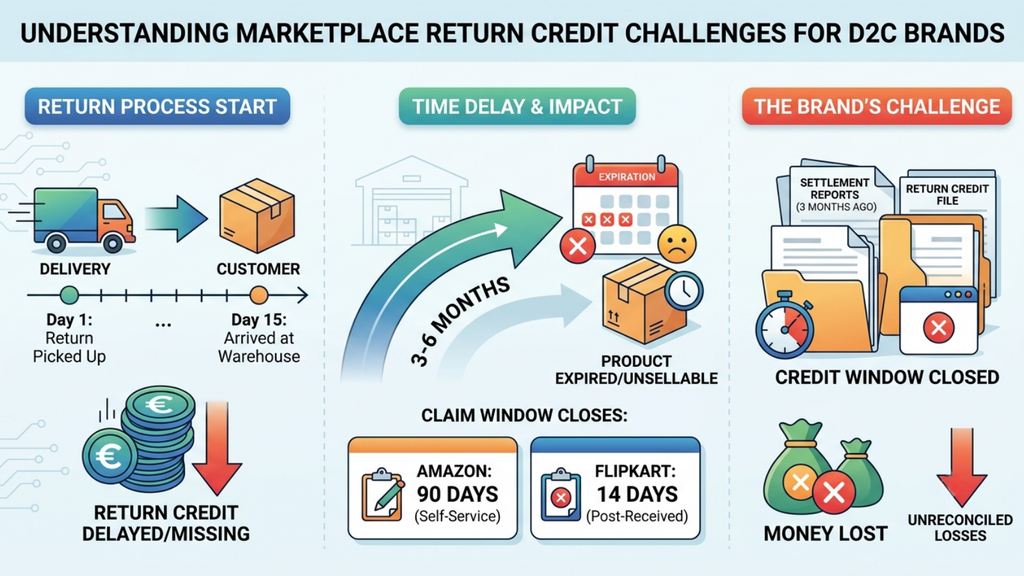
When a customer returns an order, the marketplace is supposed to credit the seller for the return. This credit should reflect the original sale amount minus applicable fees. In practice, return credits are frequently delayed, partially applied, or missing entirely.
Sometimes returns take 3-6 months to reach the seller. By then, the product is often expired or unsellable, and the claim window could be closed. Amazon allows 90 days (self-service), while Flipkart offers only 14 days after the returned product is received.
A brand without systematic payment reconciliation for D2C brands in India will not catch a return credit that was never issued, especially when that return was from three months ago, and the settlement report has been filed. The credit window closes. The money is gone.
3. Inventory Lost or Damaged at the Marketplace Warehouse

Brands using FBA (Fulfillment by Amazon) or similar marketplace-fulfilled models send inventory to marketplace warehouses. Inventory can be lost, damaged, or destroyed during storage or fulfillment. The marketplace is liable for reimbursement in most cases, but only if a claim is filed within the window.
Most sellers are losing money due to undetected deductions, return fraud, missing payouts, lost inventory claims, and accounting errors. Without proper payment reconciliation, sellers may struggle with untracked settlement deductions, delayed or missing payments, and incorrect return adjustments.
Manual payment reconciliation for D2C brands in India rarely includes an inventory reconciliation layer. The brand ships 1,000 units to an Amazon fulfillment center. Over the quarter, 12 units are listed as lost in the settlement reports. Without a system tracking this, the claim is never filed.
4. TCS, TDS, and GST Mismatches
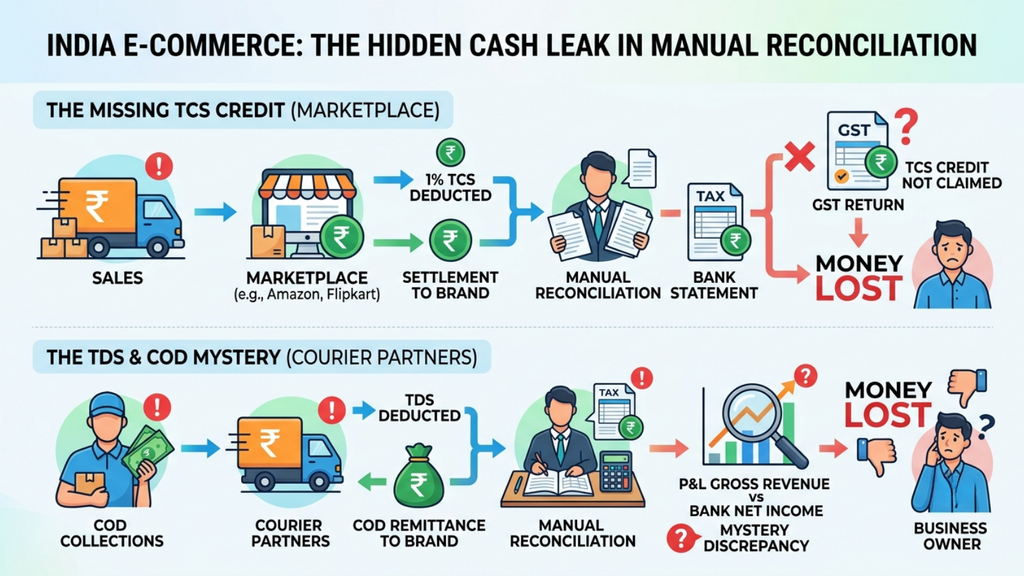
Indian e-commerce has a specific tax complexity that does not exist in most other markets. Marketplaces deduct TCS (Tax Collected at Source) at 1% on every order. This is creditable against the brand’s GST liability, but only if it is correctly accounted for and matched against the brand’s own GST filings.
When payment reconciliation for D2C brands in India is done manually, TCS deductions are frequently either double-counted or missed. The brand’s CA reconciles the bank statement, not the marketplace settlement reports, and the TCS credit gets missed in the GST return. That is money owed back by the government that never gets claimed.
TDS deductions by courier partners on COD remittances add another layer. Each courier deducts TDS at the applicable rate before remitting COD collections. Without matching these deductions at the payment level, the P&L shows COD revenue at gross while the bank reflects net, and the difference is attributed to a mystery.
5. Shipping and Weight Discrepancy Overcharges
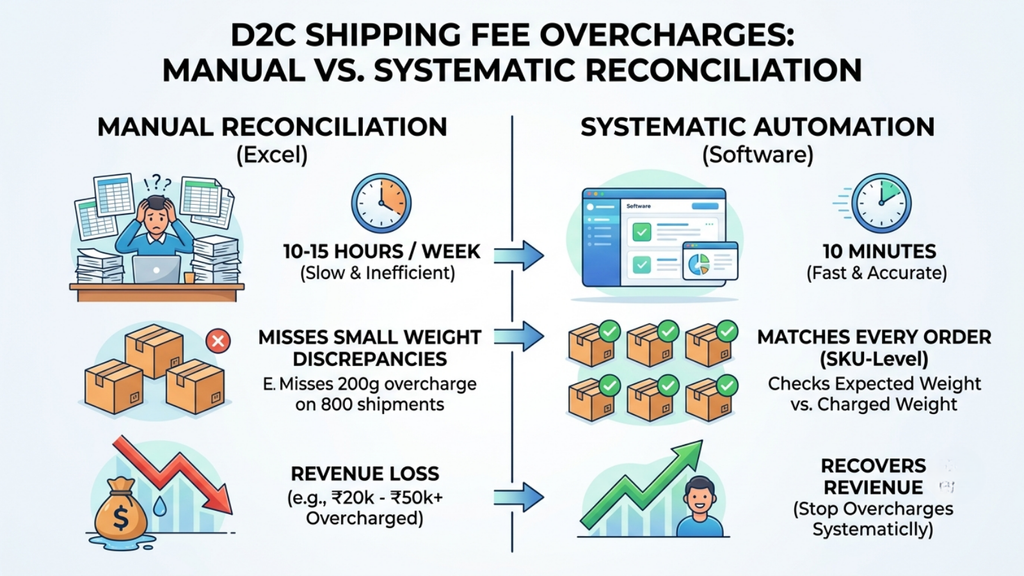
Marketplace shipping fees are charged based on the dead weight or volumetric weight of the shipment, whichever is higher. If the courier partner applies the wrong weight, which happens frequently with manually entered shipment dimensions, the brand is overcharged for shipping.
Manual reconciliation in Excel can take 10-15 hours a week, whereas software can do it in 10 minutes. But more importantly, manual reconciliation at the level of volume required to catch weight discrepancies across thousands of orders is practically impossible. A picker reviewing settlement reports in Excel will catch gross errors. They will not catch a consistent 200-gram weight overcharge on 800 shipments per month.
Payment reconciliation for D2C brands in India that operate at the SKU-shipment level, matching the expected weight against the charged weight for every order, recovers this revenue systematically.
What Manual Reconciliation Actually Looks Like in Practice
The standard manual payment reconciliation process for D2C brands in India runs as follows:
- Download settlement reports from Amazon Seller Central, Flipkart Seller Hub, Myntra Partner Portal, and Meesho separately. Each report is in a different format.
- Download COD remittance reports from each courier partner.
- Export order data from the internal OMS or ERP.
- Build a master reconciliation sheet in Excel, mapping order IDs across all sources.
- Match the expected payment per order to the actual settlement received.
- Flag discrepancies and manually create claims on each marketplace portal.
- Track claim status in a separate sheet.
- Repeat monthly, or more frequently if the team has bandwidth.
This process, done properly, takes 10-20 hours per month for a brand doing 3,000-5,000 orders per month. Done partially, which is the reality for most founder-led or lean ops teams, it catches the large errors and misses the systematic small ones.
The systematic small ones are where most of the money is.
How Base.com Handles Payment Reconciliation for D2C Brands in India
Base.com integrates order management, accounting, and financial reconciliation in a unified platform. Payment reconciliation for D2C brands in India is not a monthly manual exercise in Base.com; it is a continuous automated process running at the transaction level.
1. Automatic Order-to-Ledger Sync
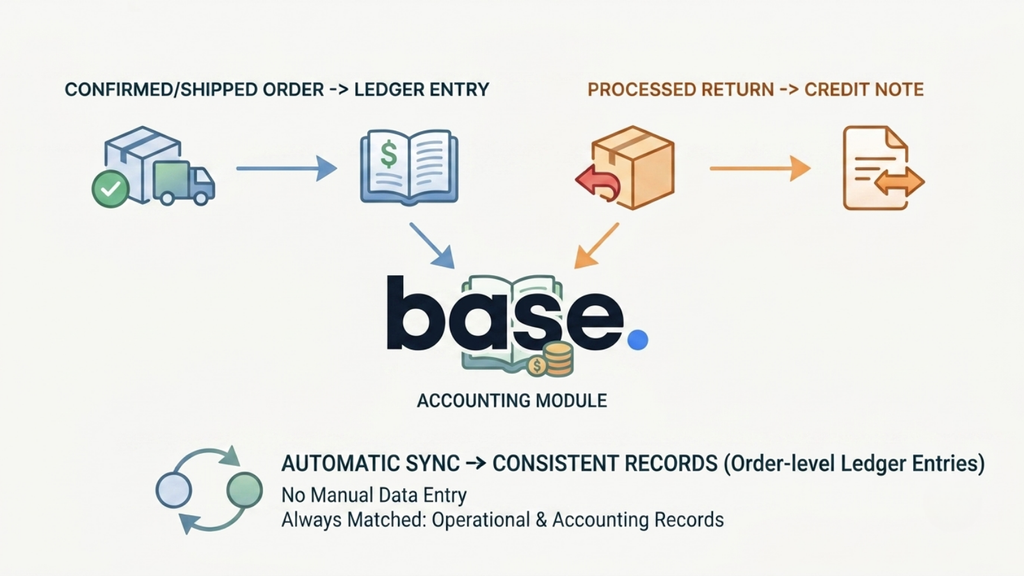
Base.com automatically syncs every confirmed and shipped order as a ledger entry in your accounting module. Returns are synced as credit notes. The moment a return is processed in the OMS, the corresponding accounting entry is created, without manual data entry.
This is the foundational step that most Indian D2C brands skip. Without order-level ledger entries, reconciliation becomes a batch exercise that always runs behind. With automatic sync, the accounting record and the operational record are always the same number.
Unicommerce does not offer automatic order-to-ledger sync. Its accounting integration requires a manual import step. OMS Guru, Browntape, EasyEcom, and FYND have no payment reconciliation capability at all. Among the major Indian OMS providers, Unicommerce and Increff have payment reconciliation features; Base.com delivers it as an integrated accounting module, not a separate reconciliation tool.
| Feature | Base.com | Unicommerce | Increff | EasyEcom | Browntape | OMS Guru | FYND |
| Payment reconciliation | Yes | Yes | Yes | No | No | No | No |
| Auto order-to-ledger sync | Yes | No | No | No | No | No | No |
| Payment tracking | Yes | Yes | Yes | No | No | No | No |
| Invoice creation | Yes | Yes | Yes | No | No | No | No |
| Invoice corrections | Yes | No | No | No | No | No | No |
| Multi-currency support | Yes | Yes | Yes | No | No | No | No |
| Tax calculation | Yes | Yes | Yes | No | No | No | No |
| Tally integration | Yes | Yes | No | No | No | No | No |
| Zoho Books integration | Yes | No | No | No | No | No | No |
2. Tally and Zoho Books Integration Without Manual Export
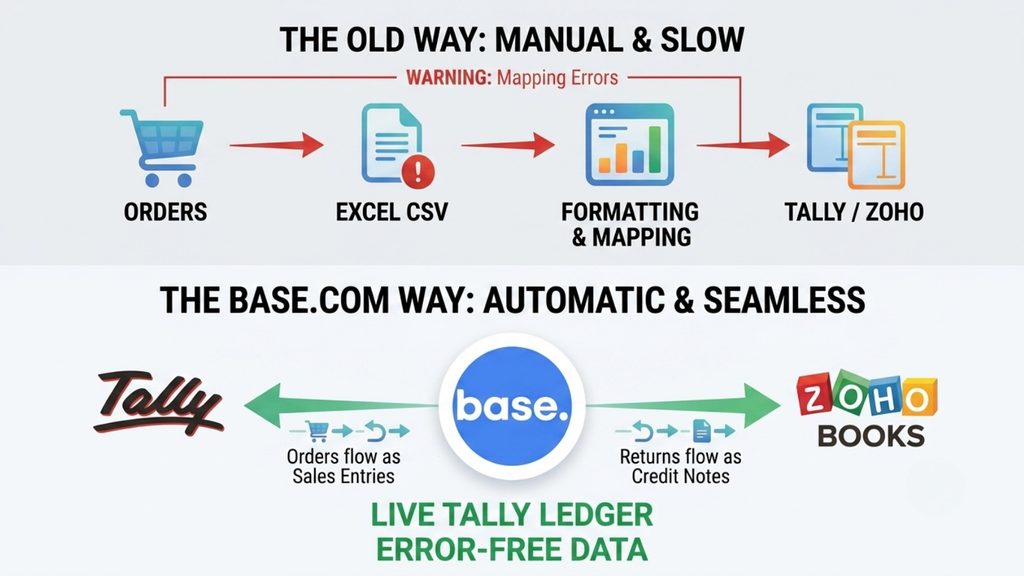
Base.com syncs directly with Tally and Zoho Books. Orders flow in as sales entries. Returns flow in as credit notes. The ledger in Tally reflects the live state of your ecommerce operations without a finance team member downloading, formatting, and importing a report.
This eliminates the most error-prone step in manual payment reconciliation for D2C brands in India, the data transfer between systems. Every time a CSV is downloaded, formatted, and imported, there is an opportunity for mapping errors, formula mistakes, and missed rows.
Base.com removes the manual transfer entirely. The sync is automatic. The Tally entry matches the OMS entry because they come from the same source.
3. Invoice Creation and Corrections
Base.com generates invoices automatically at the point of dispatch. More importantly, it supports invoice corrections, the ability to amend an invoice after it is issued when an error is found.
In Indian ecommerce, invoice corrections matter for GST compliance. If an order is partially returned, the original invoice needs a credit note. If a discount was incorrectly applied, the invoice needs to be revised. Without in-system invoice correction capability, the finance team issues manual credit notes that are not linked to the original order, creating reconciliation gaps that persist for months.
Unicommerce does not offer invoice corrections. No other major Indian OMS competitor in the feature mapping supports this natively.
4. Multi-Currency Support for Cross-Border Sellers
Indian D2C brands selling on Amazon Global, eBay, or Noon receive settlements in USD, AED, or GBP. Manual payment reconciliation for D2C brands in India that handle international channels requires currency conversion at the transaction level, not at the month-end average rate.
Base.com’s multi-currency support applies the correct exchange rate at the time of each transaction. The INR equivalent is recorded at the actual conversion rate, not estimated. This prevents FX discrepancies from accumulating in the P&L as unexplained variance.
5. Sales Register, Receipts, and Audit-Ready Reporting

Base.com maintains a sales register, a complete, ordered record of every transaction, credit note, and payment, that is audit-ready at any point. For Indian D2C brands that undergo GST audits or investor due diligence, having a clean sales register that matches the bank statement is a compliance requirement, not just a best practice.
The Total Business P&L Dashboard in Base.com connects operational data, orders, returns, shipping costs, and fulfillment costs to financial outcomes. This is a feature that Unicommerce explicitly does not offer. The P&L view in Base.com lets a founder or CFO see the actual unit economics per order, per channel, and per SKU, not just the top-line revenue figure that most OMS dashboards report.
The COD Reconciliation Problem Specifically
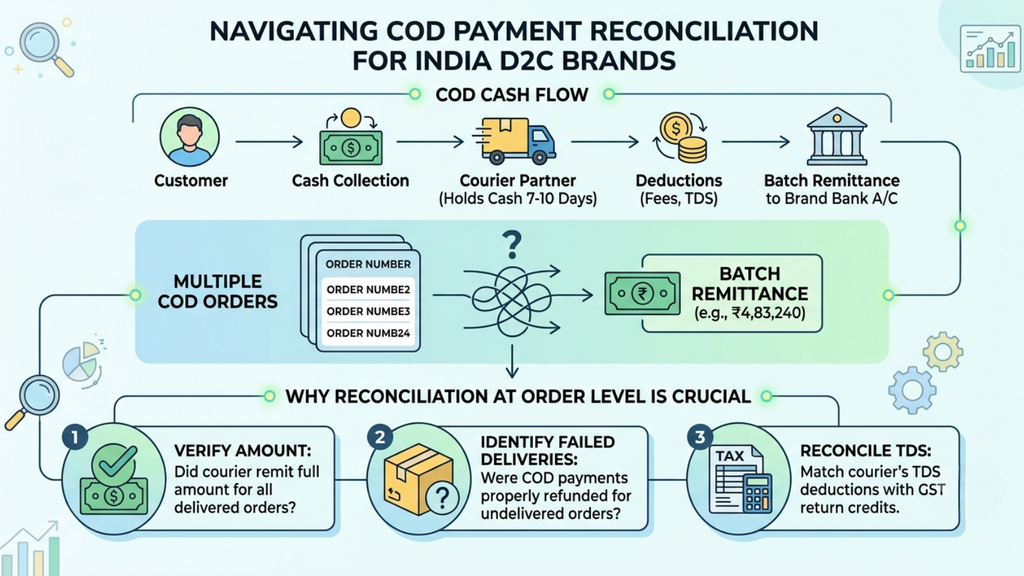
Payment reconciliation for D2C brands in India selling on COD has an additional complexity that prepaid-only brands do not face.
COD orders generate a separate cash flow: the courier collects cash from the customer, holds it for 7-10 days, deducts their remittance fee and any applicable TDS, and then transfers the net amount to the brand’s bank account. This remittance arrives as a batch transfer, not as order-level credits.
Matching a batch COD remittance of ₹4,83,240 to the specific orders it covers requires either a detailed remittance report from the courier (which some partners provide and some do not) or an order-level reconciliation exercise.
Without payment reconciliation for D2C brands in India that handle COD at the order level:
- Brands cannot verify whether the correct amount was remitted for each delivered order.
- Brands cannot identify which failed deliveries had COD collected but not returned to the customer.
- Brands cannot reconcile the TDS deducted by the courier against the TDS credit in their GST return.
Base.com’s COD tracking module records the expected remittance per order at the time of delivery confirmation. When the batch remittance arrives, the system matches it against the expected amounts and flags discrepancies at the order level. This is the level of granularity that payment reconciliation for D2C brands in India needs to recover the full margin, not just the obvious large errors.
Building a Reconciliation-Ready Finance Stack with Base.com
The practical architecture for a D2C brand wanting systematic payment reconciliation in India looks like this:
Layer 1: Order data: Base.com OMS captures every order, return, cancellation, and exchange with timestamps and order-level financial attributes (sale price, discount, applicable commission, shipping fee, expected payout).
Layer 2: Automatic ledger sync: Each shipped order creates a sales entry in Tally or Zoho Books. Each return creates a linked credit note. No manual transfer required.
Layer 3: Settlement matching: Expected payout per order is compared against the actual settlement received. Discrepancies are flagged at the order level with the specific fee component that diverged.
Layer 4: Claims and recovery: Flagged discrepancies generate a claims log. The finance team works from a prioritized list of recoverable amounts, sorted by claim window urgency.
Layer 5: Reporting: The Total Business P&L Dashboard reflects actual realized revenue, not gross GMV, net of all fees, returns, and discrepancies. This is the number that actually matters for business decisions.
Payment reconciliation for D2C brands in India, built on this architecture, runs continuously rather than monthly. Problems are caught within days of occurring, when claim windows are open, and evidence is available.
Why This Problem Gets Worse as You Scale
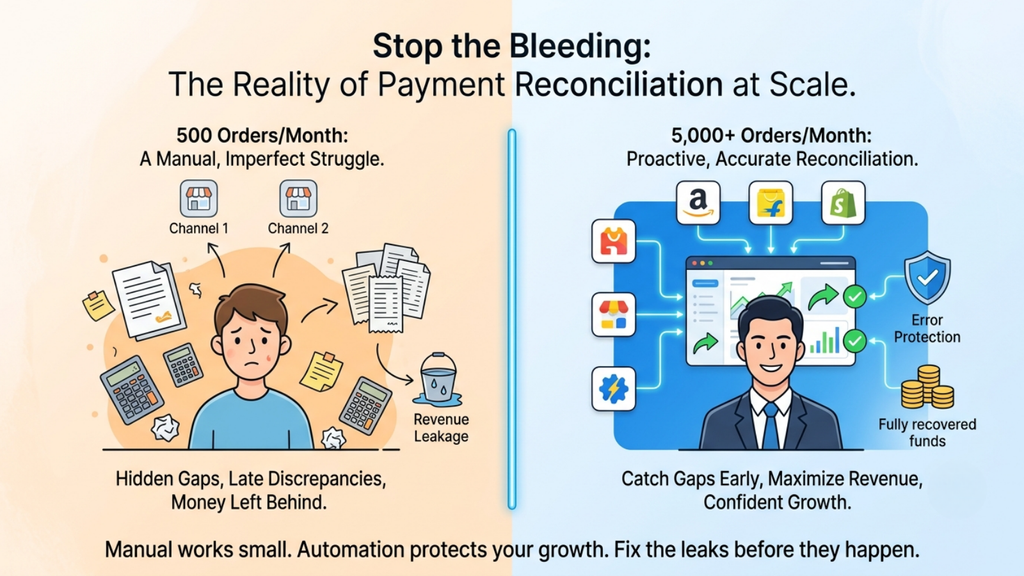
A brand doing 500 orders per month across two channels can manage payment reconciliation in India manually, imperfectly, but manageably. A brand doing 5,000 orders per month across five channels cannot. The volume of transactions, the number of settlement reports, and the variety of fee structures make manual reconciliation structurally incomplete at scale.
Selling on marketplaces is profitable until you realize you’re not recovering everything you’ve earned. Most brands only spot the revenue leakage after the month ends, when the claim window has closed, and the money is gone.
This is the core risk of deferring payment reconciliation for D2C brands in India: the losses that accumulate in months two and three of a manual process are unrecoverable by the time they are discovered. The Amazon claim window is 90 days self-service. The Flipkart claim window for return discrepancies is 14 days post-receipt. By the time a quarterly manual reconciliation catches a systematic error, most of the affected orders are outside the claim window.
Automation does not just make reconciliation faster. It makes previously unrecoverable losses recoverable because it catches them while the window is still open.



[…] costs more per order than a prepaid order, because COD handling fees, higher RTO rates, and longer remittance cycles collectively compress the contribution margin to 40-60% of what the same order would generate on […]
[…] credits per return at the order level, the finance team cannot identify discrepancies until the monthly reconciliation, by which time claim windows on many orders have […]
[…] be customized. The warehouse has no digital view. Catalog management requires a separate tool. Payment reconciliation needs a manual export. The accounting sync to Tally does not happen automatically. And on the WMS […]
[…] payment status directly to order and dispatch records in one system, so COD reconciliation happens automatically rather than through a manual monthly […]
[…] Growing D2C brands selling on 3-5 Indian marketplaces who need consolidated order management and payment reconciliation without a full WMS […]
[…] covers orders, warehouse, and marketplace payment reconciliation together. The reconciliation layer compares what marketplaces owe you against what they actually […]