

India’s D2C market crossed $108 billion in 2026 and is growing at approximately 34.5% CAGR. Behind those numbers sits a structural operations crisis that most brands only partially understand. The national average RTO rate for D2C brands in India sits between 20-30%. For COD-heavy categories like fashion, footwear, and general merchandise, it can touch 40%. A brand doing 500 orders per day at a 25% RTO rate is absorbing 125 failed deliveries daily, at approximately ₹800 average total loss per RTO, that is ₹1 lakh per day, or ₹3 crore per year, silently bleeding from operations.
RTO is one of the D2C fulfillment challenges in India in 2026. Nine others are equally costly and equally preventable.
This article covers all ten, the problem, the scale of the damage, how to solve it operationally, and specifically how Base.com’s actual product modules address each one. Every Base.com capability referenced here is drawn directly from its published product pages and documented features, nothing invented, nothing extrapolated.
Challenge 1: Multi-Channel Overselling
The Problem
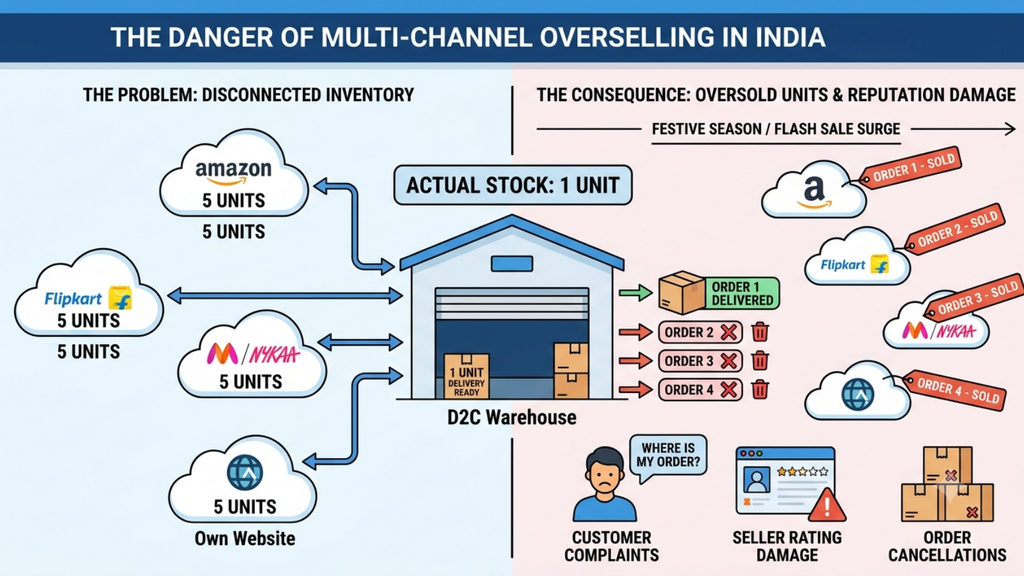
Multi-channel overselling is one of the most common D2C fulfillment challenges in India in 2026. Indian D2C brands typically sell across Amazon, Flipkart, Meesho, their own website, and sometimes Myntra or Nykaa simultaneously.
Each platform shows a separate inventory count. When the same stock is available on five dashboards, and an order comes in from one, the other four still show the original quantity until the seller manually updates them.
During a flash sale or festive season surge, this creates a window, sometimes hours wide, where the same unit is sold multiple times across different channels. The result is cancellations, customer complaints, and marketplace seller rating damage that compounds over time.
The Scale of the Problem
When stock data is not synced properly across channels, the chances of overselling or underselling increase significantly.
Customers may order items that are out of stock, resulting in cancellations and a poor experience. Brands selling on five or more channels without real-time sync report cancellation rates that directly suppress marketplace search rankings, a revenue impact that extends far beyond the cancelled order itself.
How to Solve It
The solution is a single inventory pool that decrements in real time across all channels the moment an order is confirmed, not on a 15-minute batch sync cycle, not at the end of a shift. Every channel must draw from the same number and update simultaneously.
This is the foundational fix for one of the most damaging D2C fulfillment challenges in India in 2026.
How Base.com Solves It Step by Step
Base.com’s Marketplace Manager connects all your sales channels into one system. When a product sells on Amazon, the stock quantity is reduced immediately in the Base.com product warehouse.
That updated quantity is then pushed out to every other connected channel, Flipkart, Meesho, your Shopify store, in the same session. Synchronisation modules ensure peace of mind for retailers afraid of discrepancies between the shop and marketplace platforms.
After selling the product in a shop or in an offer, the system reduces the available product quantity in other sales channels. When the product is out of stock, offers in all marketplaces can be ended automatically. There is no manual step and no sync delay that creates an oversell window.
Challenge 2: Manual Order Processing at Volume

The Problem
Manual order processing is a D2C fulfillment challenge in India in 2026 that grows more damaging at every stage of growth.
Most brands start processing orders manually, downloading order files from each marketplace, consolidating them in a spreadsheet, assigning couriers individually, printing labels one by one, and entering tracking numbers back into each platform.
At 50 orders per day, this takes two hours. At 500 orders per day, it consumes the full shift, and still generates errors.
The Scale of the Problem
One supplement brand using Base cut label generation time from 15 seconds per order down to 4 seconds after implementing automated workflows, saving over 6 hours a day at scale.
Manual clicks were replaced with automated processes across the entire order flow. For a brand processing 1,000 orders per day, manual label generation alone consumes an entire workday every day, before accounting for errors, reprints, and tracking number re-entries.
How to Solve It
The solution is automation rules that trigger the right action at the right time, without a human initiating each step.
When an order is paid, the system generates the shipment, prints the label, issues the invoice, and notifies the customer simultaneously, without anyone clicking anything. For any brand serious about resolving the D2C fulfillment challenges in India in 2026 that come from manual workflows, automation is the only sustainable path.
How Base.com Solves It Step by Step
Base.com’s Workflow Automation module lets you define automatic actions triggered by specific events and conditions. The system will automatically perform a specific action if the indicated event occurs and a specific condition is met.
It will send messages to customers, change order statuses, issue receipts and invoices, send packages, and print labels without your participation.
You configure the rule once, for example, “when payment is confirmed, create shipment and print label”, and the system executes it for every matching order at any volume, without additional effort. Hundreds of shipments can be processed this way simultaneously.
Challenge 3: Picking Errors and Wrong-Item Fulfillment
The Problem
Picking errors are a D2C fulfillment challenge in India in 2026 that most operations teams underestimate because the error only becomes visible when the customer complains.
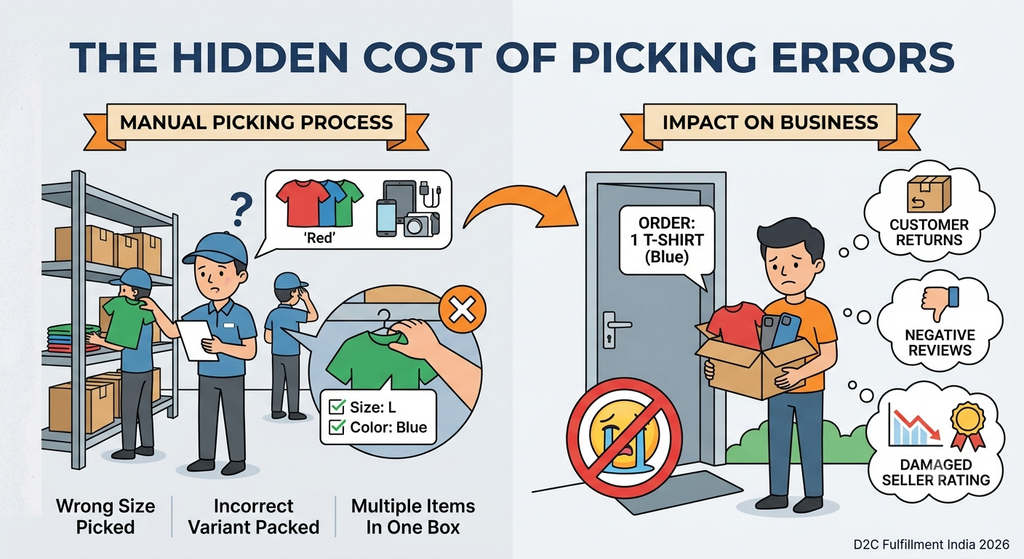
Warehouse staff picking orders manually from memory or paper pick lists make errors. The wrong size is picked. The wrong colour variant is packed. Two items are packed when only one was ordered.
These errors reach the customer as wrong-item deliveries, which generate returns, negative reviews, and damage to the marketplace seller’s rating. In categories like fashion and electronics, where variants are numerous and look similar, error rates on manual picking are consistently higher than most operations managers estimate.
The Scale of the Problem
Wrong-item fulfillment is one of the primary drivers of controllable returns in Indian D2C. Unlike RTO, which is often triggered by customer behaviour, a wrong-item return is entirely the brand’s fault, costs the full reverse logistics fee, and is more likely to generate a negative review than an undelivered order.
Addressing this specific D2C fulfillment challenge in India in 2026 has a direct, measurable impact on return rates.
How to Solve It
The solution is scan-based validation at every stage of the picking and packing process. Each item must be scanned against the order before it is packed. A mismatch must trigger an alert before the parcel is sealed, not after it has been dispatched.
How Base.com Solves It Step by Step
Base.com’s Pick and Pack Assistant is the specific module that addresses this. The Pick and Pack Assistant aids in the correct collection and packing of products and informs the employee when a mistake is detected.
The module features the use of a barcode scanner, which can quickly verify the correctness of EAN or SKU codes of the packaged items.
Finally, the Assistant takes a picture of the parcel so that you can pleasantly impress the customer or have proof in case of a dispute. Every item scanned against the order must match before the system allows packing to proceed.
The parcel photo creates a timestamped record that can be used to resolve customer disputes about what was actually dispatched, reducing fraudulent return claims alongside genuine picking errors.
Challenge 4: High RTO Rates on COD Orders

The Problem
High RTO on COD orders is the most financially damaging of all D2C fulfillment challenges in India in 2026. Cash on Delivery still accounts for approximately 45% of Indian D2C orders.
Less than 2% of prepaid orders are returned, while nearly 26% of non-prepaid orders are returned, reinforcing that RTO challenges are overwhelmingly concentrated in non-prepaid transactions.
Every RTO order costs the brand the forward shipping fee plus the return shipping fee, with zero revenue collected. Each RTO shipment still costs businesses 1.5 to 2 times the original shipping fee. For high-volume brands, this is the single largest operational cost line that most P&Ls do not accurately reflect.
The Scale of the Problem
RTO rates reached nearly 39% during the November 2025 festive season before dropping to about 21% by February 2026, indicating that improvements in order verification and execution can significantly move this metric.
The gap between 39% and 21% represents the commercial value of better pre-dispatch verification and smarter courier selection, a gap that makes this one of the highest-ROI D2C fulfillment challenges in India in 2026 to solve.
How to Solve It
The solution operates on three levels: smarter courier selection based on pin-code delivery performance history, automated shipment status tracking so that failed deliveries are acted on quickly, and shipping notifications to customers that reduce the “I forgot to expect the delivery” failure category.
How Base.com Solves It Step by Step
Base.com’s Shipping Management module integrates with multiple carriers simultaneously and allows you to configure rules that assign specific carriers to specific pin codes based on your routing logic, directing COD orders to the carrier with the highest delivery success rate in that geography rather than defaulting to one carrier for all orders.
Base.com automatically tracks the shipment status with the courier and saves this information in the panel. The system can respond automatically, for example, when a package is damaged or lost.
Additionally, Base.com’s Workflow Automation sends customers automatic SMS or email notifications with tracking links when shipment status changes, reducing the “customer was not home” failure category by keeping buyers informed of arrival windows without manual outreach.
Challenge 5: Fragmented Courier Management
The Problem
Fragmented courier management is a D2C fulfillment challenge in India in 2026 that scales in complexity with every additional carrier a brand adds.
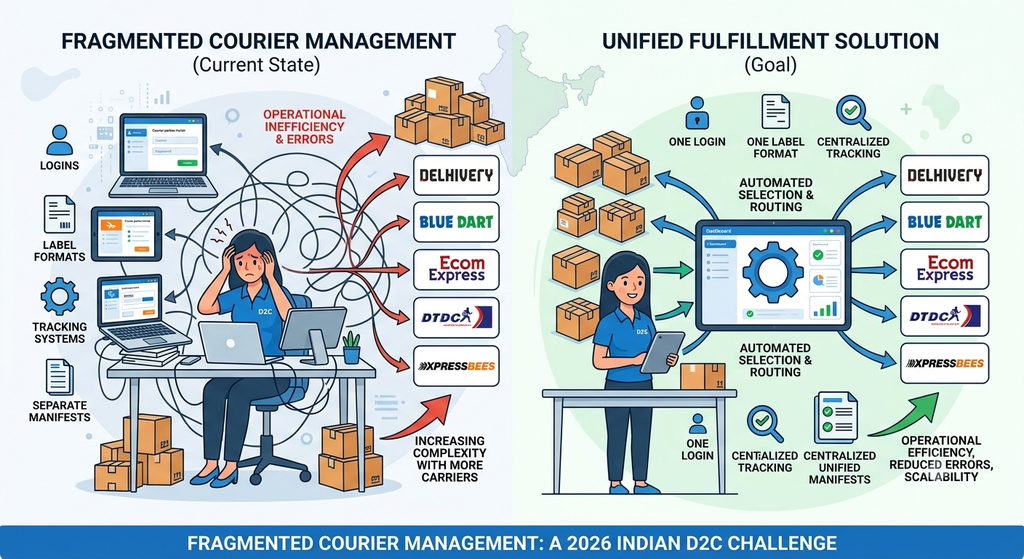
Most Indian D2C brands work with multiple courier partners, Delhivery for some pin codes, Bluedart for high-value shipments, Ecom Express for certain regions, and DTDC for another zone.
Managing these relationships through separate logins, separate label formats, separate tracking systems, and separate manifest submissions takes significant operational time and creates errors when the wrong carrier is selected for an order.
The Scale of the Problem
A brand using five courier partners that manages each separately is running five parallel logistics workflows, five sets of credentials, five tracking integrations, and five monthly billing reconciliations.
The fragmentation compounds as volume grows, and manual carrier selection at high volume introduces consistent assignment errors that directly increase fulfillment cost.
How to Solve It
The solution is a single interface where all carriers are accessible, labels are generated in a unified format, and courier selection can be automated by rule rather than decided manually per order.
Consolidating carrier management into one system is one of the most impactful ways to address the D2C fulfillment challenges in India in 2026 that come from fragmented logistics tooling.
How Base.com Solves It Step by Step
Base.com combines several dozen key carriers and shipping brokers into one system, with constant development of further integrations. Send packages via UPS, FedEx, DHL, and many other national and international providers. No need to log in to their services; manage all your shipments in the intuitive Base.com Order Manager.
You create a shipment from within Base.com, the label is generated for that carrier’s format, the tracking number is forwarded to the marketplace automatically, and the manifest is printed, all without switching systems.
Carrier selection can be fully automated through workflow rules, so the right courier is assigned to each order based on your configured logic, not a manual decision made under time pressure.
Challenge 6: Slow and Inaccurate Warehouse Operations

The Problem
Unstructured warehouse operations are a D2C fulfillment challenge in India in 2026 that compounds invisibly until a brand misses an SLA or a marketplace seller rating drops.
Indian D2C brands managing their own warehouse, even mid-sized ones doing a few hundred orders per day, often operate without a formal Warehouse Management System. Stock is tracked in spreadsheets or in a basic inventory module.
Products are stored without systematic bin locations. Pickers walk the warehouse using intuition or paper lists rather than optimised routes. Inbound receiving is done by manual count without scan validation.
The Scale of the Problem
Base WMS can help boost fulfillment efficiency by up to 25% and optimise warehouse space by up to 20%. Picking can be up to 20% faster and walking distance up to 30% shorter with guided, scan-based picking processes.
For a brand processing 500 orders per day, a 25% efficiency gain is the equivalent of adding a full shift of capacity without hiring additional warehouse staff.
How to Solve It
The solution is a WMS that guides staff through the correct pick path, validates every scan before packing, manages bin locations systematically, and creates a formal inbound receiving process that eliminates stock entry errors at the source.
Solving this particular D2C fulfillment challenge in India in 2026 does not require expensive custom software; it requires the right integrated platform.
How Base.com Solves It Step by Step
Base.com’s WMS module is built into the same platform as the Order Manager; there is no separate system to purchase or integrate. Base WMS guides warehouse staff along the shortest and most efficient route.
Smart pick lists indicate the exact location of each product, eliminating unnecessary steps and significantly reducing the risk of errors. The Packing Assistant tells you what to pack, chooses the right box, and shows a visual guide for the best way to arrange items. It also alerts you to special requirements and checks if the shipment is complete.
For inbound, the Delivery Module handles goods receiving with barcode scanning, quantity and quality checks, and automatic bin assignment, eliminating the manual data entry that introduces stock discrepancies from the moment inventory enters the warehouse.
Challenge 7: Returns Management Without Structure
The Problem
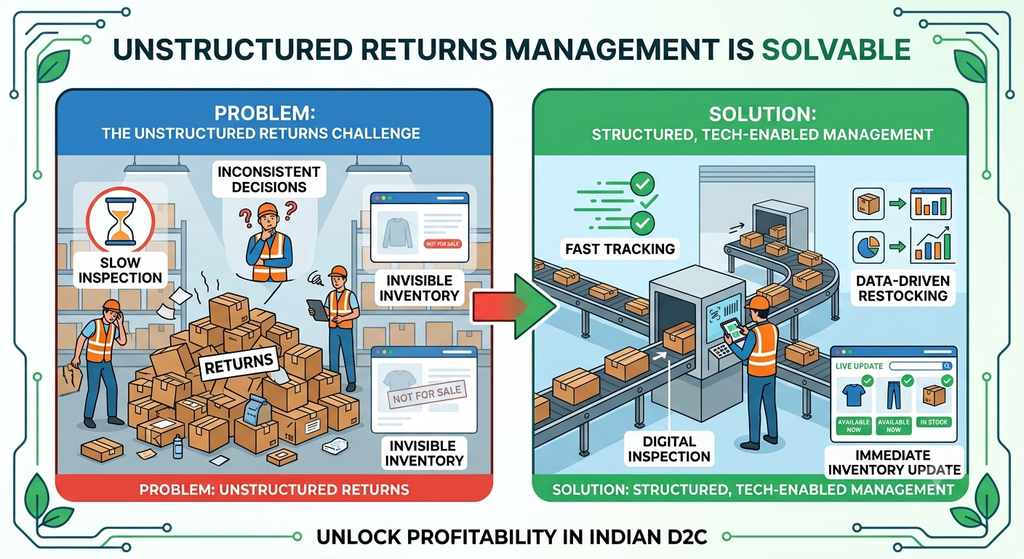
Unstructured returns management is a D2C fulfillment challenge in India in 2026 that most brands treat as unavoidable when it is actually solvable. Returns in Indian D2C are not an edge case; they are a daily volume. A brand at 1,000 orders per day at a 20% return rate is processing 200 inbound returns daily.
Without a structured system, returns sit uninspected for days. When they are finally processed, the inspection is inconsistent, restocking decisions are made without documentation, and the inventory system does not reflect the returned units until someone manually enters them, sometimes days later. In the meantime, those units are invisible to buyers who would have purchased them.
The Scale of the Problem
When COD deliveries fail, brands incur extra shipping costs and lose time without completing the order. Beyond the shipping cost, unprocessed returns block working capital, and money is tied up in returned stock that is not available for resale because it has not been formally received, inspected, and restocked.
This is a D2C fulfillment challenge in India in 2026, where operational speed directly determines how much working capital is freed or locked.
How to Solve It
The solution is a returns intake process that matches each return to the original order, assigns it a status, routes it to the correct warehouse location, and automatically updates inventory when it is accepted back into stock. Every hour a return sits unprocessed is an hour that working capital is unnecessarily locked.
How Base.com Solves It Step by Step
Base.com’s WMS includes efficient returns management. You can define custom return statuses and reasons, and group them by return status. The intuitive return intake process matches each return with the original order and routes products to the appropriate warehouse.
Integrated with the Returns Assistant, the system can trigger automated actions such as sending emails to customers or issuing corrected invoices.
Every return is formally received, linked to its original order, and immediately updates the inventory count when accepted back into stock, meaning those units are visible and available for sale again within the same session they are processed, not days later.
Challenge 8: No Visibility Into Cross-Channel Sales Performance
The Problem
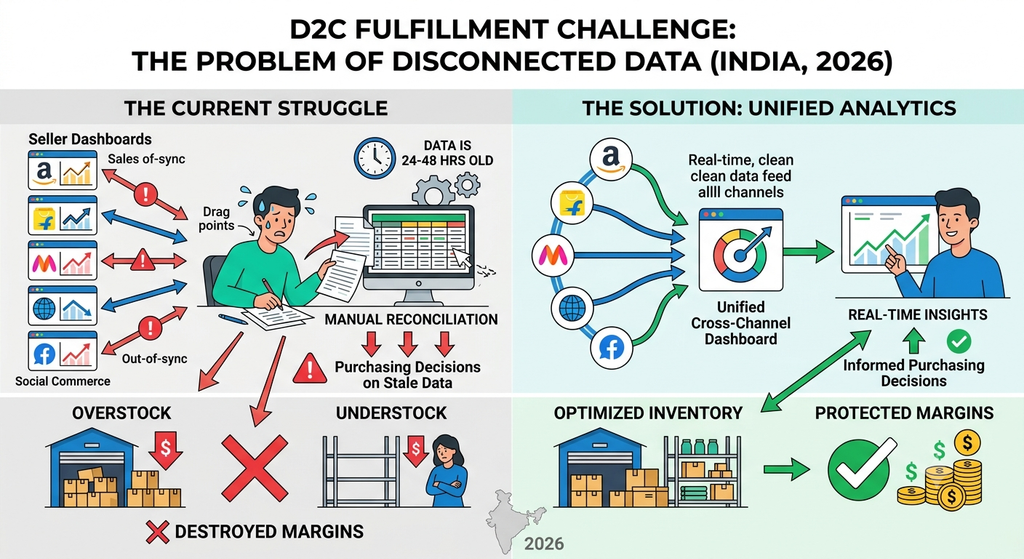
The absence of unified cross-channel analytics is a D2C fulfillment challenge in India in 2026 because purchasing decisions made on stale, fragmented data consistently produce either overstock or understock, both of which destroy margin.
A D2C brand selling on five channels manages five separate seller dashboards, each reporting its own version of sales data.
Comparing performance across channels requires downloading five reports, combining them in a spreadsheet, and manually reconciling format differences before any analysis is possible. By the time this is done, the data is 24-48 hours old.
The Scale of the Problem
Brands making inventory and purchasing decisions without real-time cross-channel data consistently either overstock or understock on fast-moving SKUs during peak periods.
Both errors are more expensive than the time required to build proper reporting, making this a high-priority D2C fulfillment challenge in India in 2026 for any brand serious about margin protection.
How to Solve It
The solution is automated, consolidated analytics that pull data from all connected channels into one view, updated automatically, without manual report downloads or spreadsheet assembly.
Purchasing, allocation, and promotional decisions must be made on live data, not on yesterday’s manually assembled export.
How Base.com Solves It Step by Step
Base.com’s Base Analytics module is built for this specific problem. Base Analytics is a fully automated analytics application that saves time and enables better strategic decisions. It provides reliable sales data across all connected channels for informed decisions.
Rather than logging into five separate dashboards, your team sees all channel performance consolidated in one view, updated automatically, not manually assembled.
This gives purchasing, marketing, and operations teams the data they need to make allocation and restocking decisions based on what is actually selling across all channels right now, not what was selling 48 hours ago on one of them.
Challenge 9: Product Listing Management Across Multiple Marketplaces
The Problem
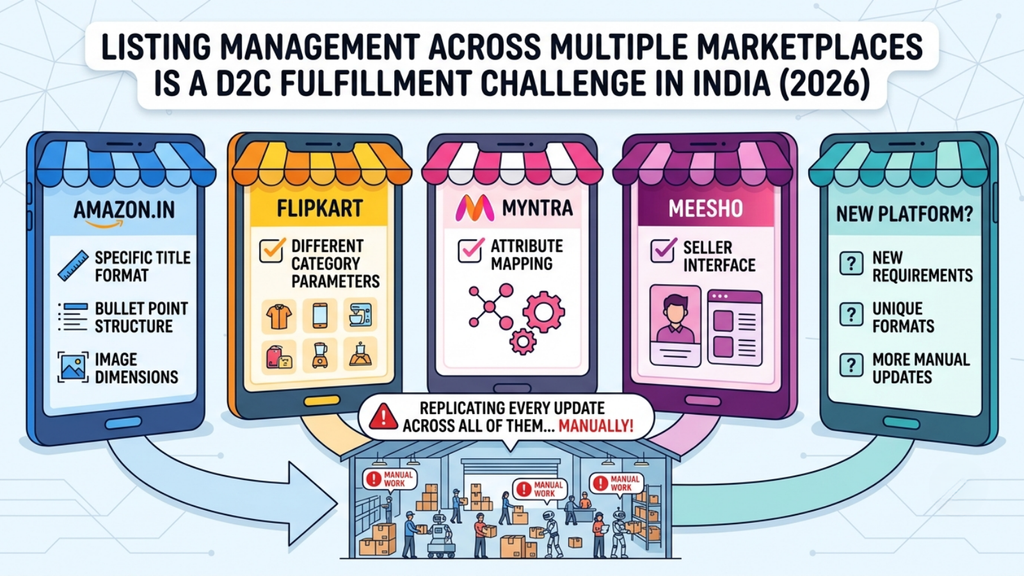
Listing management across multiple marketplaces is a D2C fulfillment challenge in India in 2026 because every platform has different requirements, and every update must be replicated across all of them manually.
Amazon requires a specific title format, bullet point structure, and image dimensions. Flipkart has different category parameters. Myntra requires its own attribute mapping. Meesho has its own seller interface.
A brand selling the same product across five channels must create and maintain five separate listings, each formatted differently, each updated separately when price or availability changes.
The Scale of the Problem
For brands with 50+ SKUs across five channels, this is 250+ individual listings to maintain. Every price change, every stock update, every product description improvement must be replicated manually across all 250. The time cost is high.
The error cost, a listing showing the wrong price on one channel, or staying active after a product sells out, is higher. This is a D2C fulfillment challenge in India in 2026, where the compounding effect of small errors accumulates into significant revenue leakage.
How to Solve It
The solution is a product catalogue managed in one place, with listings pushed and synchronised to all connected channels from that single source of truth. When a price changes, it changes everywhere. When the stock hits zero, all listings go inactive automatically.
How Base.com Solves It Step by Step
Base.com’s Marketplace Manager handles this from a centralised product warehouse. With Base.com, you can conveniently list your products directly from your online store. The integration ranges for over 250 popular marketplaces, including Amazon and many others, so you can consolidate all your sales in one place.
Once you link up the shipping templates, marketplace categories, and prepare an offer template, you will no longer need to do so for each product listing. The system will automatically complete the offer parameters to further reduce the time of your product’s appearance on the marketplace.
Price and stock synchronisation runs automatically; when you update a price in Base.com, it updates on every connected marketplace. When a product sells out, offers across all platforms can be ended automatically without manual intervention on each seller’s dashboard.
Challenge 10: Scaling Operations Without Scaling Headcount
The Problem
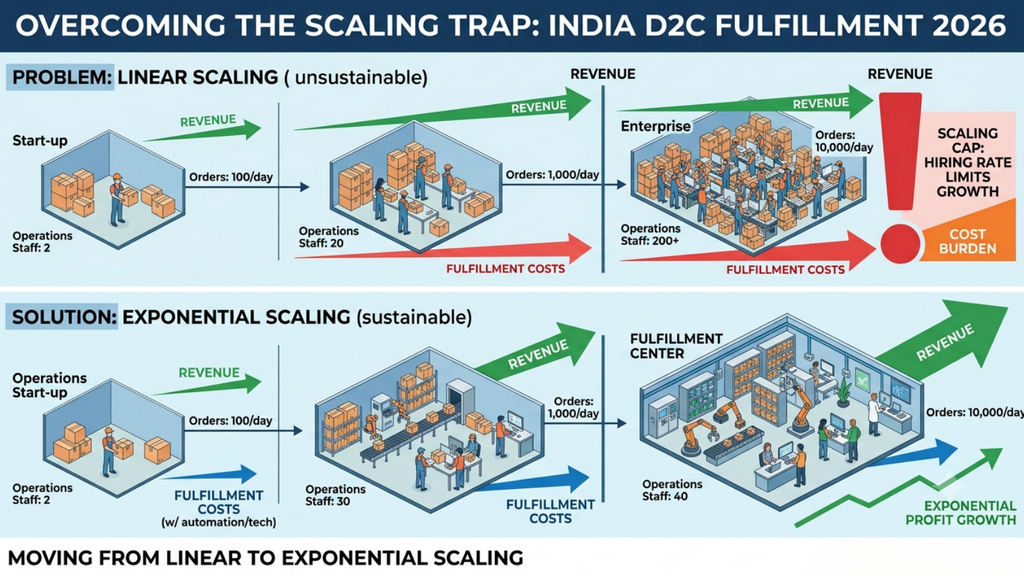
The inability to scale order volume without proportionally scaling the operations team is the most structurally limiting of all D2C fulfillment challenges in India in 2026, because it caps growth at the rate a brand can afford to hire.
As D2C brands grow from 100 to 1,000 to 10,000 orders per day, the instinct is to hire more operations staff at each stage. More pickers, more packers, more people to manage courier submissions, more people to handle returns.
This model makes fulfillment cost grow linearly with order volume, destroying the unit economics that made the brand viable at a smaller scale.
The Scale of the Problem
COD still accounts for 45% of Indian D2C orders and remains a massive working capital drag. In that context, a fulfillment model where cost scales with headcount compounds the working capital problem, because every additional hire is paid whether the orders come in or not, while COD revenue is delayed until courier remittance.
This specific D2C fulfillment challenge in India in 2026 is the one that most directly determines whether a brand achieves profitable scale or plateaus.
How to Solve It
The solution is systematic automation of every step that repeats identically across orders. Shipment creation, label printing, status changes, customer notifications, invoice generation, and manifest submission are identical for every order.
They should never require a human decision. Human attention should be reserved for exceptions, escalations, and decisions that require judgment, not for clicking through the same five-step process on every order, every day.
How Base.com Solves It Step by Step
Base.com’s entire architecture is built around this principle. The Workflow Automation module is the engine that removes the human from every repeating step. The system will automatically perform a specific action if the indicated event occurs and a specific condition is met. Numerous actions can be performed simultaneously.
You configure rules once: when payment is confirmed, create shipment, print label, issue invoice, send customer notification. When the order status reaches “dispatched”, forward the tracking number to the marketplace and send customer SMS. When a return is received, update inventory and issue a correction invoice.
Every one of these actions happens without a person initiating it, at 100 orders per day or 10,000. The WMS module is included in your standard subscription, with no hidden fees. Comparable systems often cost tens or even hundreds of thousands.
The fulfillment infrastructure that decouples headcount from order volume is available within one subscription, not assembled from multiple separately-billed tools.
The Common Thread Across All 10 D2C Fulfillment Challenges in India in 2026
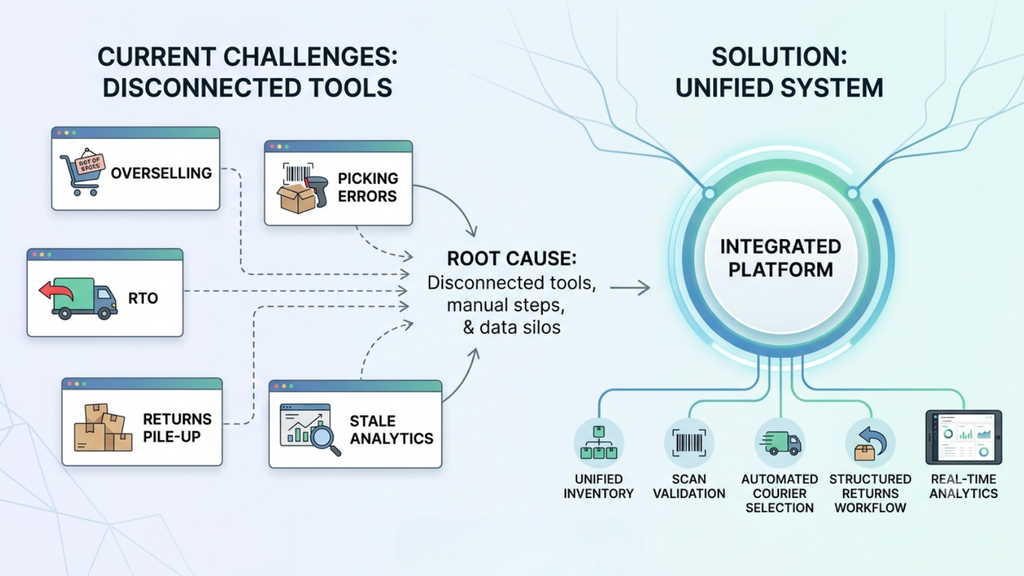
Every challenge in this list shares a single root cause: operations managed through disconnected tools, manual steps, and separate dashboards that do not share data in real time.
Multi-channel overselling happens because inventory is not unified. Picking errors happen because there is no scan validation at the packing stage. RTO persists because courier selection is not automated by historical delivery performance data. Returns pile up because there is no structured intake workflow. Analytics are stale because reports are assembled manually across five separate dashboards.
Base.com addresses all ten D2C fulfillment challenges in India in 2026 from a single platform. Order Manager, Marketplace Manager, WMS, Shipping Management, Workflow Automation, and Base Analytics all share the same data layer.
A sale on Flipkart immediately affects the inventory number that the WMS uses for picking, the Marketplace Manager uses for stock sync, and Base Analytics uses for reporting. No sync required between systems, because there is only one system.
That architecture is not a feature. It is the operational difference between a fulfillment stack that scales with your business and one that becomes the ceiling your business cannot grow past.

[…] against the marketplace or the courier. Amazon reimburses for inventory lost or damaged in its fulfillment network. Couriers have liability policies for damage in transit. Marketplaces have SPF (Seller Protection […]
[…] options, the 3PL vs in-house fulfillment India comparison requires an honest calculation of what in-house fulfillment actually costs at this volume. Most brands […]
[…] treat shipping as label generation. Bulky-SKU sellers need weight and dimensions embedded in the fulfilment logic […]
[…] Marketplace ticket management add-on: Base.com handles platform-side support queries beside catalogue and fulfilment work. […]
[…] gains tend to arrive within weeks, while the full benefit of bundle decomposition and wave planning often only becomes fully visible at the next high-volume event that tests them […]