


A complete ecommerce sale preparation checklist for sellers runs 45 days, not one week. Forecast and procurement close at T-30, pricing and margin at T-14, operations at T-7, and everything freezes at T-3. The items that fail are almost always the ones with deadlines you cannot recover.
Sixty-three checkpoints follow, phased by when each must be done.
Why Phasing Matters More Than Completeness in an Ecommerce Sale Preparation Checklist for Sellers
Most sale checklists are flat lists. Flat lists fail because they hide the dependency order.
You cannot set a discount before you know your landed cost. You cannot book fulfilment centre appointments after the slots are gone. You cannot fix SKU mapping once the sale is live. A checklist that does not tell you when is a list of regrets waiting to happen.
The stakes justify the discipline. Redseer identified a dual-peak pattern in 2025, with GST slab simplification pushing high-ticket purchases past Diwali into a second wave. Plan two windows, not one.
Use this ecommerce sale preparation checklist for sellers as a working document. Assign an owner per section, and record completion dates rather than ticking boxes.
Phase 1: T-45 to T-31: Foundation and Forecast
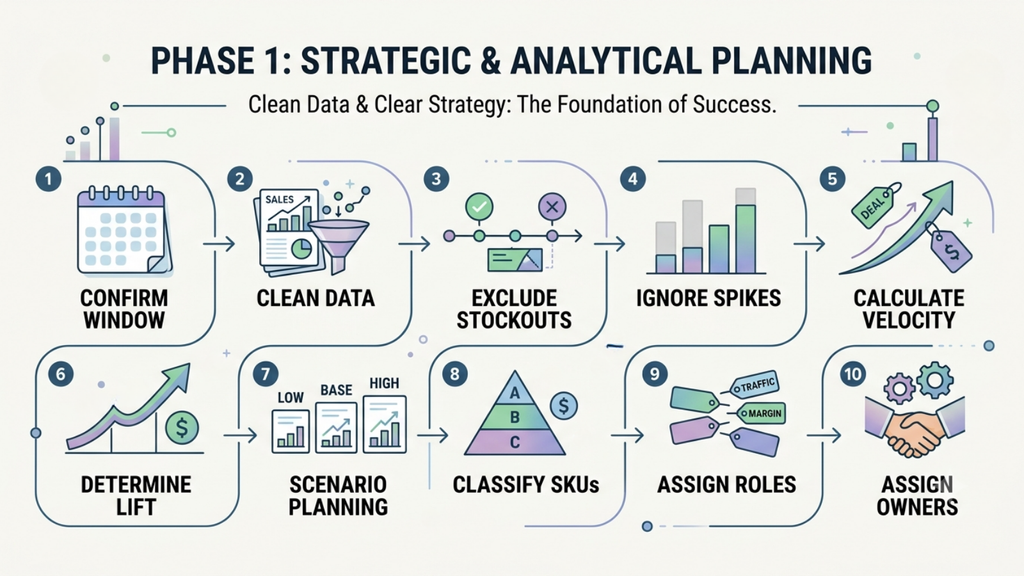
The first phase of any ecommerce sale preparation checklist for sellers is analytical rather than operational. Nothing here requires warehouse capacity, but everything later depends on it.
1. Confirm the sale dates and the commercial window. Traffic builds 24-48 hours before the announced start and does not fall to baseline at close. For a six-day sale, plan nine days.
2. Pull 60 days of clean sales history per SKU per channel. Sixty days, not ninety; Indian demand shifts materially in the pre-festive build-up.
3. Exclude stockout days from the baseline. A SKU that sold 200 units while unavailable for four days did not have a demand of 200.
4. Exclude prior promotional spikes from the baseline. They belong in your lift factor, not your baseline.
5. Calculate a weighted baseline velocity per SKU. Weight recent data more heavily than older data; a flat average understates a SKU that is trending up.
6. Derive promotional lift factors from your own last two cycles, by SKU role. Deal SKUs and full-price catalogue SKUs behave nothing alike.
7. Build three scenarios: low, base, high. Procure to low, contract supplier capacity to base, hold optionality to high.
8. Classify SKUs A/B/C by contribution, not by revenue. Protection and attention follow contribution.
9. Assign each SKU a sale role. Traffic driver, margin SKU, clearance, new launch, or excluded.
10. Name an owner for each section of this checklist. Work that belongs to everyone belongs to no one.
Phase one produces no visible output, which is why it is the phase most often compressed. Resist that. Every quantity, price, and commitment decided later in the list inherits whatever error is left in the baseline built here.
Phase 2: T-30 to T-21: Procurement, Inbound and Capacity
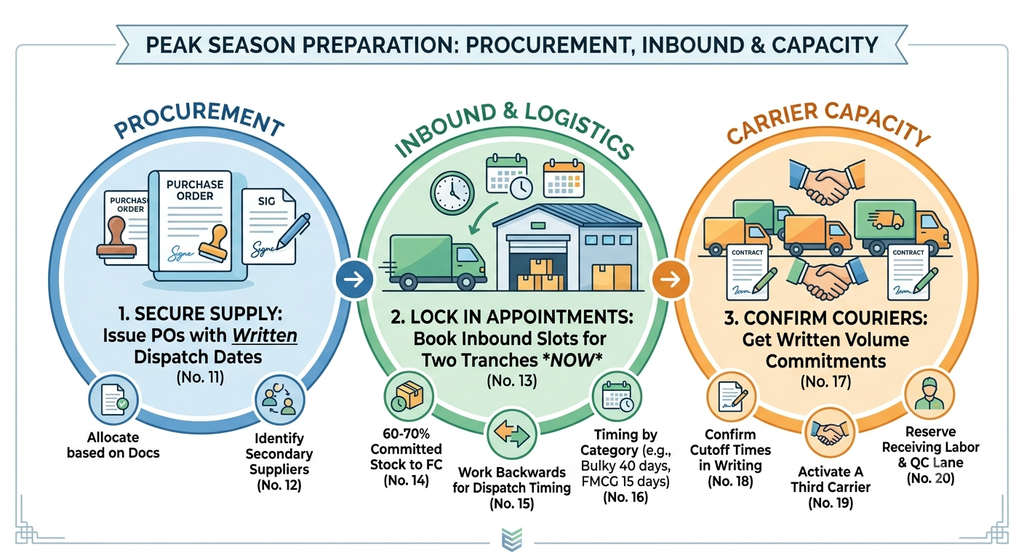
This phase contains most of the unrecoverable deadlines in the whole ecommerce sale preparation checklist for sellers. Miss these and no later effort compensates.
11. Issue purchase orders with written committed dispatch dates. Your suppliers are also everyone else’s suppliers during the festive season, and allocation follows documentation.
12. Qualify a secondary supplier for your top 10 SKUs. You need the relationship and agreed terms, not necessarily the volume.
13. Book fulfilment centre inbound appointments for both tranches now. The second slot is very hard to secure later during festive congestion.
14. Decide your marketplace fulfilment commitment ratio per SKU. A common approach is 60-70% committed, 30-40% held as flexible stock in your own warehouse.
15. Dispatch the first consignment. Work backwards: check-in time plus appointment wait plus transit plus safety margin.
16. Set send timing by category. Bulky home and furniture need 35-45 days; FMCG and food need only 12-18 because shelf life makes early days expensive.
17. Share daily volume forecasts with every courier and request written capacity commitments. Couriers allocate festive pickup capacity against committed volume from named accounts.
18. Confirm courier pickup cutoff times per node in writing. An order is packed 15 minutes after cutoff ships tomorrow.
19. Activate a third carrier if you are running two. Single-carrier dependency fails during exactly the week you cannot afford it.
20. Reserve additional receiving labour and a dedicated QC lane. Unreceived stock is the primary source of phantom stockouts.
Note how many items in this phase end in a written confirmation from a third party. Suppliers, fulfilment centres and couriers all allocate scarce festive capacity against documented commitments, and verbal assurances given in August are worth very little in late September.
Phase 3: T-20 to T-14: Pricing, Margin and Cost
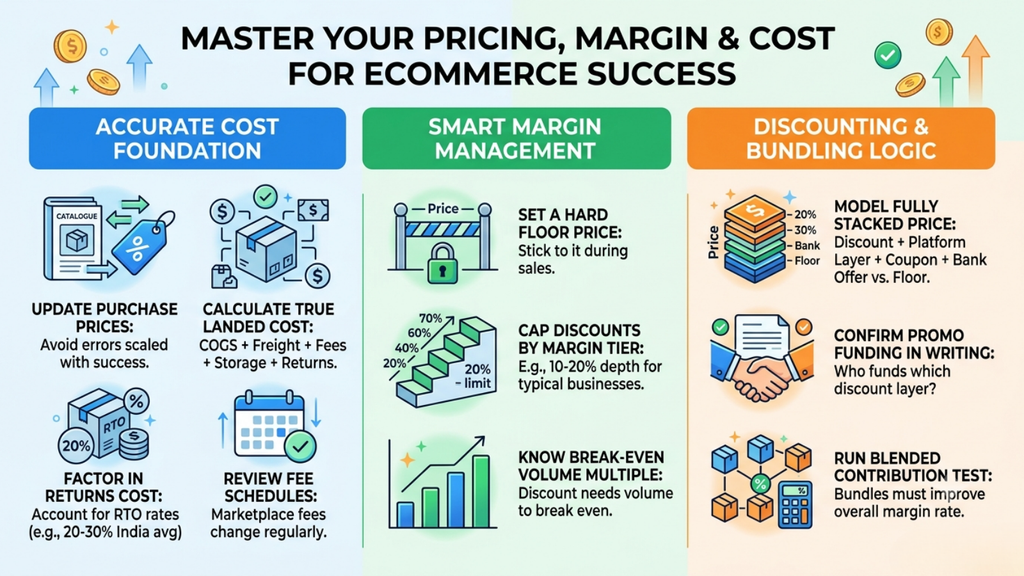
Pricing is the section of an ecommerce sale preparation checklist for sellers where errors scale with success, because a wrong price sells at volume rather than failing loudly.
21. Update purchase prices in your catalogue. Every downstream calculation depends on this figure, and a plan built on last season’s costs is confidently wrong.
22. Recalculate true landed cost per SKU. COGS plus inbound freight and handling, marketplace referral and fulfilment fees, storage per unit, expected returns cost, and payment or COD handling.
23. Load expected returns cost explicitly. India’s average RTO sits between 20-30% against a global benchmark closer to 8-12%, with fashion at 25-30%. Verify against your own courier data.
24. Re-pull current marketplace fee schedules. Fees are revised regularly, and a floor built on an old fee table is not a floor.
25. Set a hard floor price per SKU and store it in the system. A floor that gets adjusted downward during a sale is a preference, not a floor.
26. Cap discount depth by margin tier. Published guidance suggests 10-20% typical, dropping to 5-10% for businesses below 50% gross margin.
27. Calculate the break-even volume multiple for each planned discount. Original contribution margin ÷ (margin − discount). A 20% discount on a 40% margin SKU needs 2x volume to break even.
28. Model the fully stacked price. Your discount plus platform layer plus coupon plus bank offer. Validate the worst case against the floor, not your own discount alone.
29. Confirm who funds each promotional layer in writing. Some platform-funded discounts return through commission adjustments at settlement.
30. Run the blended contribution test on every bundle. Sum component contributions, divide by sum of prices; the bundle must beat that blended rate.
Phase 4: T-14 to T-8: Catalogue, Listings and Promotions
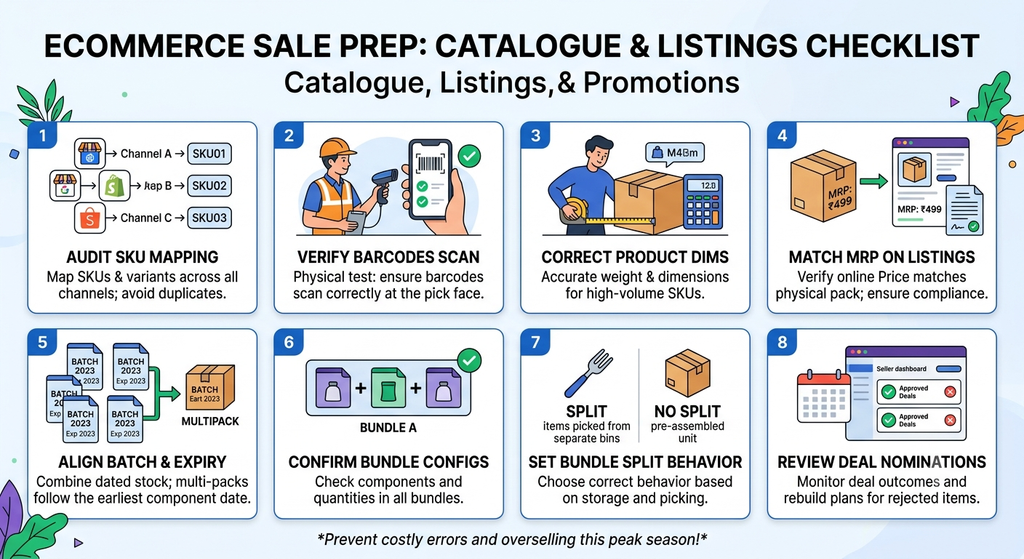
31. Audit SKU-to-listing mapping on every channel, including variants. Unmapped and duplicate-mapped SKUs cause more overselling than genuine shortfalls.
32. Verify barcodes actually scan at the pick face. Present in the data is not the same as working on the floor.
33. Correct weight and dimensional data on A-class SKUs. Wrong dims produce wrong courier rates, wrong carrier recommendations, and billing disputes at volume.
34. Verify MRP on every listing matches the physical pack. This is a compliance matter; consult your legal or compliance team on current requirements.
35. Check batch and expiry alignment for dated stock. A multipack inherits the expiry of its earliest-dating component.
36. Confirm bundle configurations and component quantities. A bundle mapped to the wrong component produces oversell on one SKU and phantom stockout on another.
37. Set bundle split behaviour to match physical storage. Split when components are picked from separate bins; do not split when the bundle is pre-assembled as one unit.
38. Confirm deal nomination outcomes and rebuild the plan for anything rejected. Verify current nomination windows and eligibility in Seller Central and Seller Hub, since deadlines shift annually.
This section of the ecommerce sale preparation checklist for sellers is the one most often rushed, and it produces the highest volume of preventable errors.
Phase 5: T-7 to T-4: Operations and Warehouse Readiness

By this point, decisions are made, and the work shifts to verifying the operation can actually execute them.
39. Cycle count 100% of A-class SKUs and a 10% sample of B-class. Full stocktakes are not feasible mid-season; cycle counting is.
40. Cycle count every shared bundle component. A SKU appearing in several bundles has several hidden demand streams.
41. Set channel-level buffers sized to sync latency and replenishment speed. Under 48-hour replenishment supports 10-12% on A-class; 3-7 days needs 15-20%; imported stock needs 25-30%.
42. Move A-class SKUs to live stock synchronisation. The interval that worked at baseline will not hold at 3.5x volume.
43. Enable reservations at order capture rather than at dispatch. With COD near 45% of Indian D2C orders, an unshipped backlog otherwise consumes your buffer invisibly.
44. Enable automatic listing closure at zero stock and relisting on replenishment. This converts a stockout into a clean unavailability rather than a marketplace defect.
45. Run a full dispatch dry run at volume. Print several hundred labels and a complete manifest in one batch. Queue, printer, and API rate-limit problems only appear in bulk.
Phase 6: T-3 to T-1: Freeze and Verify
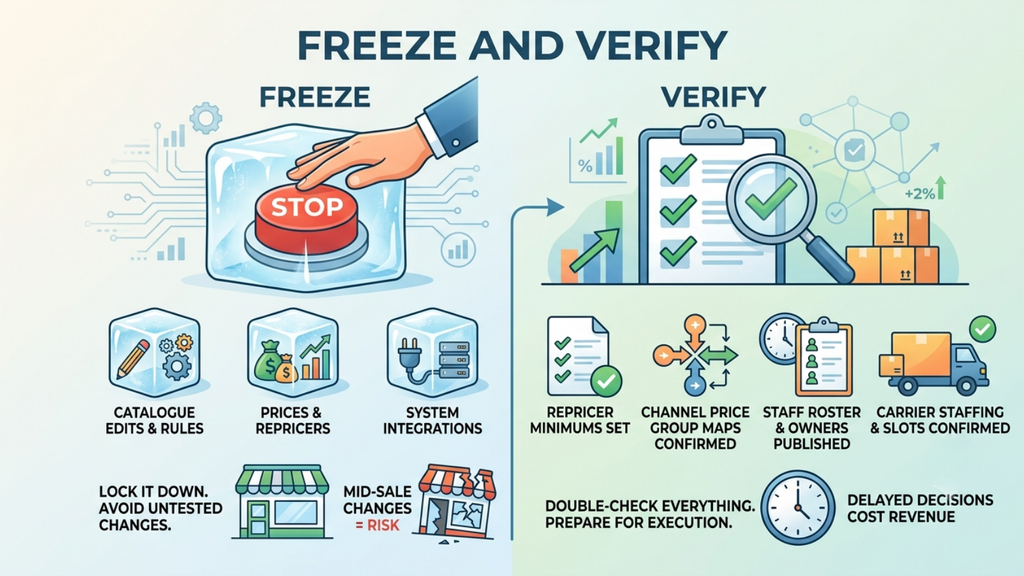
The freeze is the least popular and most important instruction in this ecommerce sale preparation checklist for sellers.
46. Freeze catalogue edits, price groups, repricing rules and integration changes. Every mid-sale change is an untested deployment on your highest-revenue day.
47. Set repricer minimums derived from your calculated floors. An unbounded repricer hands your pricing strategy to your least disciplined competitor.
48. Confirm every channel is reading the price group you intended. Diagram the map: which group is base, which is target, which channel reads which.
49. Publish the shift roster with named owners and decision authority. During a sale, a delayed decision costs more than a slightly wrong one.
50. Confirm pickup slots and day-one staffing with every carrier.
Phase 7: During the Sale: Monitoring and Response
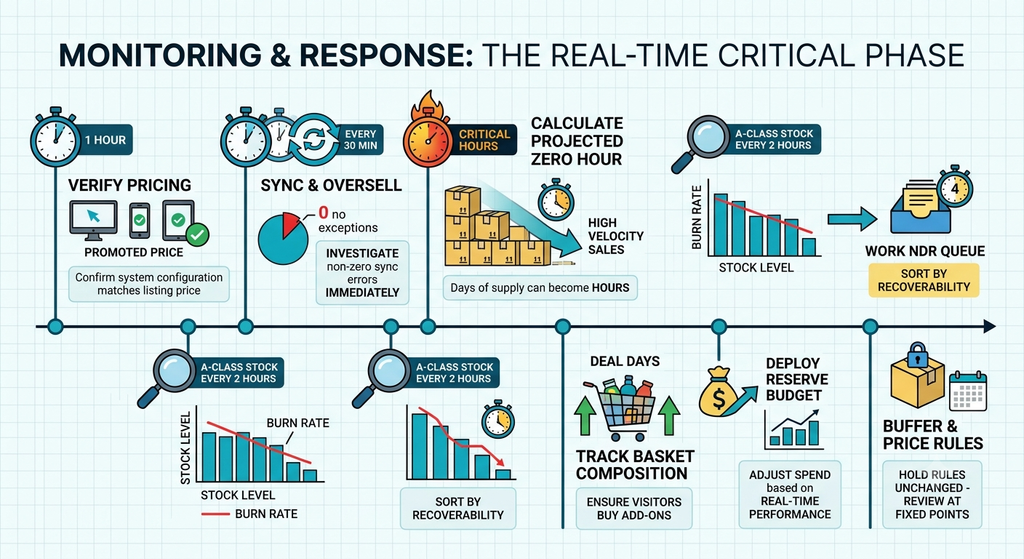
Only this phase happens under real-time pressure, which is precisely why everything else was front-loaded.
51. Verify in the first hour that every promoted SKU shows the intended price on every channel. Configuration that validates in the system can still fail at the listing.
52. Check oversell exceptions and sync error logs every 30 minutes. Any non-zero sync error value warrants immediate investigation.
53. Calculate projected zero hour, not days of supply. At 3.5x velocity, “two days of stock” can mean fourteen hours.
54. Monitor A-class stock against burn rate every two hours.
55. Work the NDR queue within four hours, sorted by recoverability. A wrong-address NDR needs correction before reattempt; a customer-refused COD NDR usually is not recoverable at all.
56. Track basket composition on deal days. If visitors arrive for a traffic-driver SKU and buy nothing else, the strategy failed regardless of how that SKU is sold.
57. Hold buffer logic and price rules unchanged. Review at fixed points, change at fixed points, document every change.
58. Deploy the reserve budget deliberately at the midpoint. Something will convert far above plan and something far below.
Phase 8: Post-Sale: Reconciliation and Learning
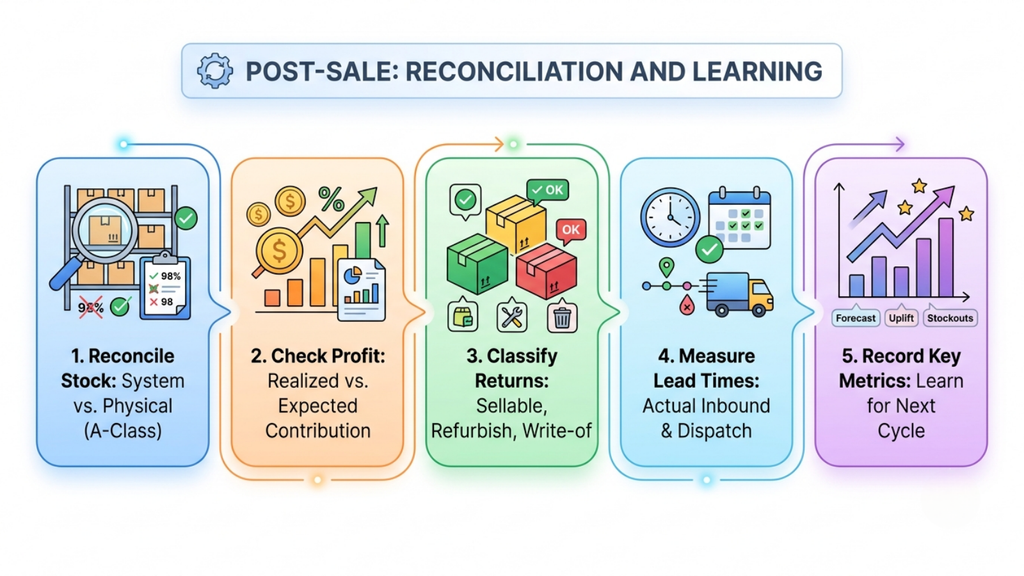
The final phase is what turns a single ecommerce sale preparation checklist for sellers into an operating system that improves each cycle.
59. Reconcile system stock against physical stock on all A-class SKUs within 72 hours.
60. Reconcile expected against realised contribution per SKU from settlement reports. Aggregate variance of 2% can hide a 20% leak on one SKU family.
61. Classify returns properly before restocking. Sellable, refurbishable, write-off. Units restocked without inspection are the most common cause of phantom availability next quarter.
62. Record actual check-in and dispatch lead times, not remembered ones. The next cycle’s inbound calendar is only as good as this cycle’s measured dates.
63. Record the numbers that make the next cycle better. Forecast MAPE and bias, realised versus required volume uplift, stockout hours on A-class, oversell rate, actual check-in lead time, and cannibalisation on bundled anchors.
Item 63 is the one that compounds. An ecommerce sale preparation checklist for sellers used once is a to-do list; used across cycles with measured outcomes, it becomes a capability.
If You Only Have One Week: Triaging the Ecommerce Sale Preparation Checklist for Sellers
Not every seller reads this at T-45. If the sale opens in seven days, this is the triage order.
| Priority | Item numbers | Why first |
| 1 | 31, 32, 36 | Mapping and barcode errors cause more overselling than shortfalls |
| 2 | 21, 22, 25 | Without a floor, every other pricing decision is unanchored |
| 3 | 42, 43, 44 | Sync, reservations, and auto-closure prevent most sale-period failures |
| 4 | 39, 40 | Count what you actually have before promising it |
| 5 | 45 | Discover dispatch problems now, not on day one |
Everything else can wait a cycle. These cannot.
The logic of the ordering is that the top three prevent errors that scale with volume, while the lower two prevent errors that surface once. A mapping fault or an unanchored floor repeats on every order for the entire window; a dispatch problem discovered on day one is painful but bounded.
If you have less than three days, do items 31 and 25 only. Correct mapping and a stored floor between them prevent the two failures that cost the most and are the least visible while they are happening.
Owner Assignment Across the Ecommerce Sale Preparation Checklist for Sellers
A checklist without owners does not execute. This allocation works for most mid-size Indian sellers.
| Section | Typical owner | Escalation |
| Forecast and planning (1-10) | Category or planning lead | Commercial head |
| Procurement and inbound (11-20) | Supply chain lead | COO |
| Pricing and margin (21-30) | Commercial head | CFO or founder |
| Catalogue and listings (31-38) | Ecommerce or catalogue manager | Commercial head |
| Warehouse readiness (39-45) | Warehouse manager | COO |
| Freeze and verify (46-50) | Ecommerce manager | Commercial head |
| Live monitoring (51-58) | Named shift owner | Commercial head |
| Post-sale (59-62) | Finance plus planning lead | CFO |
Give the shift owner in section seven real authority within defined limits. Governance that forces every mid-sale decision upward produces delay at exactly the wrong moment.
Two failure patterns are worth naming. The first is a single person owning three or more sections, which reliably means the least visible one is skipped; pricing and post-sale reconciliation are the usual casualties. The second is finance being brought in only at section eight, by which point every decision that determined the outcome has already been made.
Bring finance into section three. The floors set there govern every subsequent pricing decision, and they are far easier to agree at T-20 than to defend at T-2.
The Five Failure Modes This Ecommerce Sale Preparation Checklist for Sellers Is Built Against
Every item above exists to prevent one of five outcomes.
| Failure | Prevented by | Cost if it happens |
| Overselling | Items 31, 32, 42, 43, 44 | Cancellations, seller-rating damage, listing suppression |
| Stockout | Items 5-7, 39-41, 53-54 | Lost revenue on peak days plus ranking decay |
| Margin leakage | Items 21-30, 47, 60 | Invisible until settlement, then permanent |
| Dispatch failure | Items 17-19, 45, 50, 55 | SLA breach, RTO increase, customer damage |
| Repeating the same errors | Items 10, 63 | Compounds annually |
The third row deserves emphasis. Overselling and stockouts announce themselves. Margin leakage does not; it looks like a successful sale until the settlement report arrives weeks later.
The fifth row is the quietest and the most expensive over time. A seller who runs a chaotic sale and records nothing enters the next one with the same blind spots, which is why items 10 and 63 sit at opposite ends of the list and matter more than their brevity suggests.
Read the table as a diagnostic as well as a preventive. After the sale, identify which of the five actually occurred, then trace back to the items that should have caught it. That is usually more useful than a general post-mortem, because it points at a specific checkpoint rather than at a general sense that things went badly.
How Base.com Supports This Ecommerce Sale Preparation Checklist for Sellers
Base.com bundles order management, product and inventory management, marketplace listing control, shipping, workflow automation and repricing into one platform, with its Product Manager combining ERP, WMS and PIM functions.
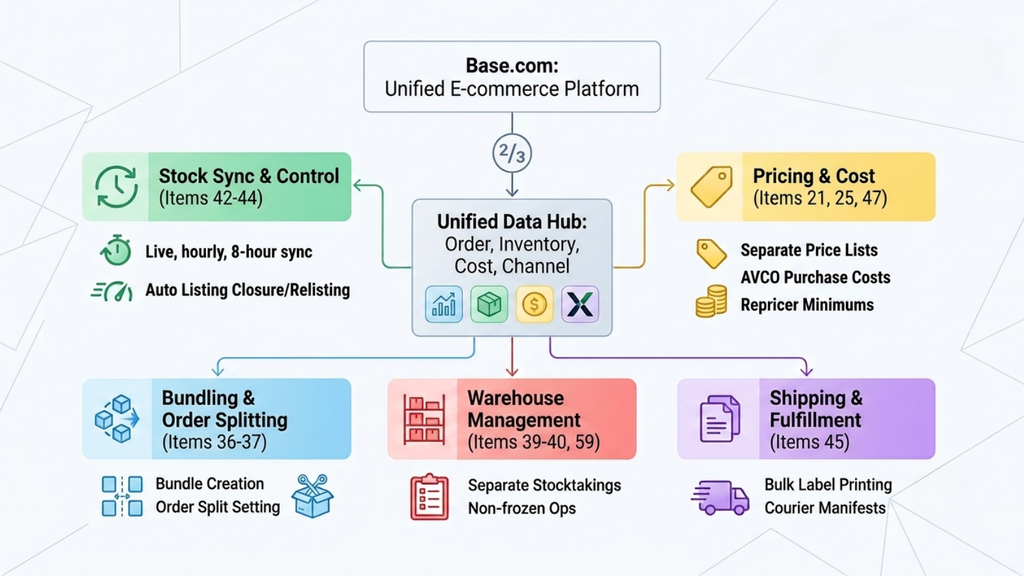
Roughly two-thirds of the items above depend on having order, inventory, cost and channel data in one place rather than reconciled across systems.
- Items 42-44 map to configurable stock synchronisation at eight-hourly, hourly or live intervals, a dedicated Accelerations module for high-volume periods, reservations before payment, and automatic listing closure at zero stock with relisting on replenishment.
- Items 21, 25, 47 map to price groups functioning as separate price lists, purchase price data via AVCO accounting, and repricer minimums with configurable below-minimum behaviour.
- Items 36-37 map to bundle creation in the Product Manager and the split setting under Order → Settings → Order processing.
- Items 39-40, 59 map to separate stocktakings per warehouse, letting you count one node without freezing the operation.
- Item 45 maps to bulk label printing and courier manifest generation from the Order Manager.
Confirm current Indian marketplace and carrier integration coverage with Base.com directly, since public documentation does not enumerate India-specific channel support.
Using This Ecommerce Sale Preparation Checklist for Sellers Across Cycles
The sixty-three items above are not equally difficult. Most take under an hour. What makes them work is sequence and ownership, not effort.
The pattern across every failed sale is the same: something with an unrecoverable deadline was left until it was recoverable only in theory. Supplier commitments, appointment slots, courier capacity, deal nominations and catalogue accuracy all have windows that close quietly.
With Indian festive GMV projected to cross ₹1.15 lakh crore in a 30-35 day window and every marketplace peaking simultaneously, preparation is the only variable fully within your control once the event starts. Base.com consolidates orders, inventory, pricing, and channel sync into one platform, which is what makes a checklist of this length executable rather than aspirational.
Start at T-45. Assign owners. Freeze at T-3. Record what happened.



[…] inventory should be freely shared across all channels. A brand might want to reserve 200 units for Flipkart’s Big Billion Days while keeping another 150 available for their D2C website, where margins are higher. Without […]
[…] weaknesses faster than any other period in a D2C founder’s calendar. Order volume during Big Billion Days, the Great Indian Festival, or a brand’s own flash sale can spike 5-10x above the daily […]
[…] roughly 300 orders a day on average month, spiking to 1,200-1,500 orders a day during its Diwali sale window. Each order carried an average of 1.8 items, many of them fragile, oddly shaped, or dimensionally […]
[…] Indian brands launch around Diwali, Raksha Bandhan, or big marketplace sale events. Order volumes during these windows can spike several times over normal […]
[…] to the top of the queue, removing the need for a supervisor to manually reprioritise during flash sale spikes. This final phase is often the one that determines whether a brand can genuinely scale ecommerce […]
[…] connecting any panel within six weeks of a festive sale. Marketplace volume spikes are the worst possible conditions for discovering a configuration […]
[…] OMS should prioritise the order queue by SLA deadline automatically. Manual prioritisation fails during festive spikes, which is exactly when it matters […]
[…] during the festive season. Indian ecommerce concentrates heavily into the October-November window, when volumes multiply several times over. Go live in a trough […]
[…] events like Big Billion Days can multiply daily order volume several times over. The preparation below keeps label printing from […]