


Inventory accuracy improves when you close the specific points where stock data drifts from physical reality: unverified receiving, visual-only picking, disconnected returns, and manual adjustments with no audit trail. Businesses in 2024 achieved only an 83% average inventory accuracy rate across ecommerce operations, and closing that gap requires ten specific, provable methods rather than one generic fix. This guide covers all ten in detail, along with how to improve inventory accuracy with Base.com specifically, using the same mechanisms described below, so the theory and the practical application sit side by side throughout.
Every method here is proven at real order volume in Indian ecommerce operations, not theoretical best practice imported from a different market. Where relevant, each section shows exactly how to improve inventory accuracy with Base.com’s specific product mechanics, so you can evaluate whether your current tooling already supports it or has a genuine gap.
Why Inventory Accuracy Is Harder to Maintain in Indian Ecommerce
Before the ten methods, it helps to understand why accuracy drifts faster in India than in many other markets.
COD orders account for 55-65% of ecommerce volume in Tier 2 and Tier 3 Indian cities, and COD return rates run at 25-30% nationally. Every one of these returns has to flow back into accurate stock counts, and any gap in that reverse flow compounds quickly at real volume.
Multi-marketplace selling multiplies the problem further. A brand selling across its own website plus Amazon, Flipkart, Meesho, and Myntra has to keep the same stock count consistent across five separate systems, and a sync delay on any one of them creates an accuracy gap the others do not see until it is corrected. The ten methods below directly address these India-specific pressure points, not just generic warehouse best practice, and together they form a complete answer to how to improve inventory accuracy with Base.com in this specific market.
The 10 Proven Ways to Improve Inventory Accuracy

Inventory accuracy is the foundation of efficient order fulfillment, healthy cash flow, and a better customer experience. By combining the right processes, technology, and warehouse practices, businesses can reduce stock discrepancies, minimize costly errors, and maintain reliable inventory records as they scale.
1. Implement Barcode Scanning at Every Touchpoint
Visual matching, a picker or packer eyeballing an item against a printed list, is the single largest source of inventory drift in most warehouses. Industry data shows warehouses without scan validation run error rates of 1-3%, and every one of those errors eventually shows up as a stock count that does not match physical reality.
Scanning has to happen at every touchpoint, not just at packing. Receiving, put-away, picking, and packing each need their own scan confirmation, since an error introduced at receiving corrupts the accuracy baseline before a single order has even shipped.
This is one of the clearest answers to how to improve inventory accuracy with Base.com specifically: scan enforcement is a hard system block, not an optional guideline, meaning label generation simply cannot proceed until every item is verified against what the system expects.
2. Run Cycle Counts Instead of Waiting for Annual Audits
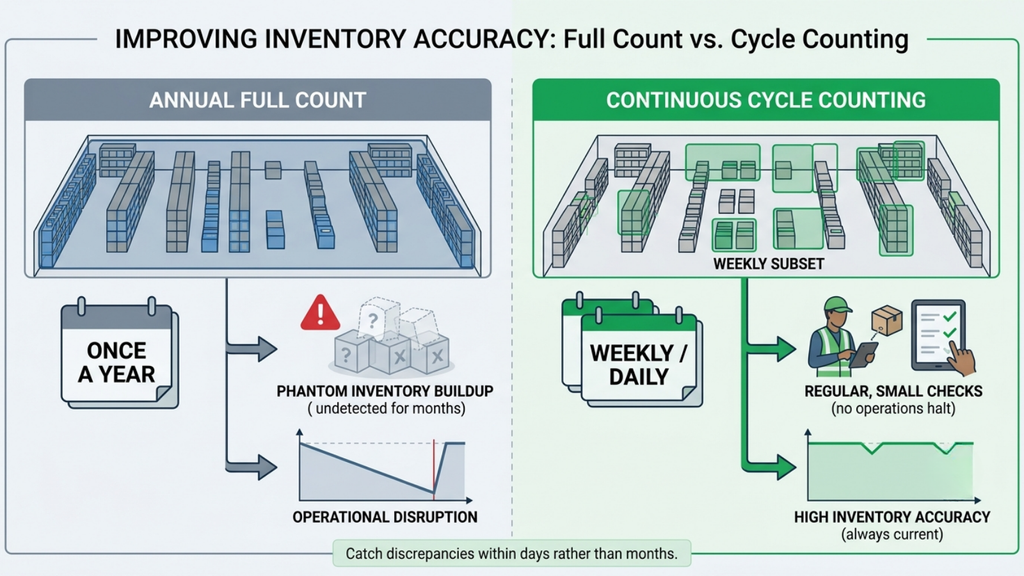
Most warehouses run a full physical inventory count once a year, sometimes once a quarter. Between those counts, phantom inventory– stock the system shows as available but that is actually damaged, misplaced, or already sold- accumulates undetected.
Cycle counting fixes this by counting a rotating subset of SKUs every week without halting operations. Your top 50 fastest-moving SKUs might get counted weekly, with the rest rotating through a longer cycle, catching discrepancies within days rather than months.
The financial case is direct: every percentage point of inventory inaccuracy at 500 daily orders means 5-10 pick failures a day from phantom inventory alone. A disciplined cycle count routine is one of the lowest-cost, highest-leverage answers to how to improve inventory accuracy with Base.com or any comparable system, since it requires no new hardware, only a scheduling discipline.
3. Separate Returns Processing from Forward Fulfilment
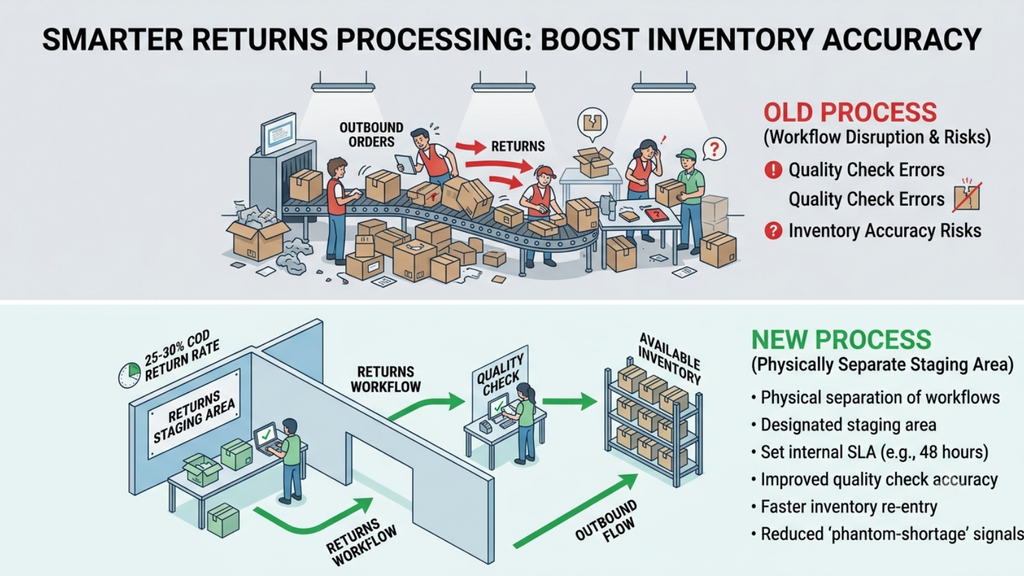
Returns arriving during an active dispatch window, sorted and quality-checked in the same physical space as outbound orders, create both a workflow disruption and an accuracy risk. A rushed quality check under time pressure is far more likely to misclassify a damaged item as saleable, or vice versa.
Designate a physically separate staging area for returns, and set an internal SLA; 48 hours is a reasonable target, from physical receipt to system inventory update. Returns processed within this window re-enter available inventory faster, reducing the phantom-shortage signals that otherwise trigger unnecessary purchase orders.
Any brand asking how to improve inventory accuracy with Base.com should treat this separation as a structural decision, not a minor process tweak, since returns volume in India, driven by COD return rates of 25-30%, represents a meaningful share of total warehouse activity.
4. Use a Single Inventory Ledger Across All Channels

Maintaining separate stock counts per channel, one for your website, one for Amazon, one for Flipkart, is the most common structural cause of overselling and count drift. The moment two channels each believe they hold the last unit of a SKU, one of them is wrong the instant a sale happens on the other.
A single, shared ledger that every channel reads from and writes to eliminates this entirely. When stock sells anywhere, every other channel sees the updated count within seconds, not after a manual export and reconciliation step.
This single-ledger architecture is foundational to how to improve inventory accuracy with Base.com at any real scale, since without one shared source of truth, every other accuracy improvement on this list only fixes accuracy within one channel while leaving the cross-channel gap untouched.
5. Apply FEFO Logic for Batch and Expiry-Sensitive Stock

For FMCG, pharmaceutical, and cosmetics categories, inventory accuracy is not just about quantity; it is about which specific batch ships first. Stock tracked at the SKU level without batch-level granularity can show accurate quantities while still shipping near-expiry stock ahead of fresher inventory.
FEFO, First Expired First Out, logic surfaces the correct batch automatically at the point of picking, removing the need for a picker to manually check expiry dates against a separate spreadsheet. This closes an accuracy gap that pure quantity-tracking systems never catch, since the total count can be technically correct while the specific units shipped are wrong.
Category-specific accuracy like this is a meaningful part of how to improve inventory accuracy with Base.com for FMCG and pharma sellers, since generic inventory tools built for simpler categories often lack batch-level tracking entirely.
6. Decompose Bundles and Kits at the Component Level
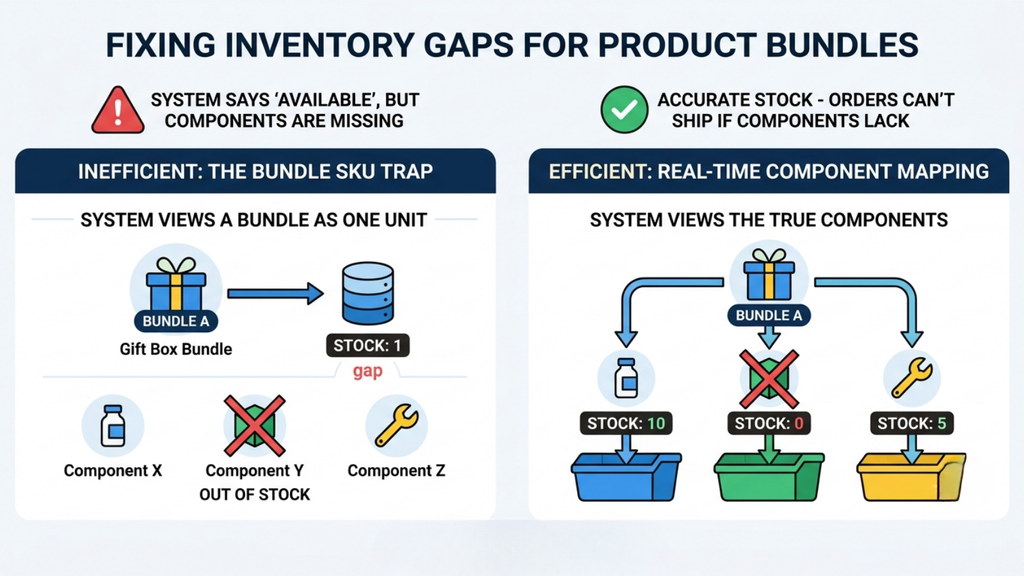
Treating a bundle or kit as a single inventory unit, rather than deducting from its individual components, creates a specific and common accuracy failure. The system can show a bundle as available while one of its physical components is actually out of stock, since nothing in the count reflects the true component-level reality.
Mapping every bundle to its component SKUs at the inventory deduction level, not just the listing level, closes this gap. When a bundle sells, each component’s count reduces individually, keeping the underlying inventory accurate even as bundle composition changes over time.
For any brand with bundles representing a meaningful share of order volume, this is a specific, high-leverage answer to how to improve inventory accuracy with Base.com, since bundle-related discrepancies are otherwise invisible until a picker reaches an empty bin mid-order.
7. Require Reason Codes for Manual Stock Adjustments

Silent manual edits to inventory counts, corrections made without recording why, are one of the most common sources of unexplained stock drift over time. A quantity gets adjusted to “fix” a discrepancy, but without a logged reason, no one can trace whether the adjustment was correct or whether it introduced a new error.
Requiring a reason code on every manual adjustment creates an audit trail that makes drift traceable rather than mysterious. Over time, patterns in these reason codes- a specific SKU repeatedly needing correction, a specific shift generating more adjustments than others- point directly to the root cause worth fixing.
This audit-trail discipline is a quieter but essential part of how to improve inventory accuracy with Base.com, since real-time systems still depend on humans occasionally making manual corrections, and those corrections need the same rigor as any other inventory-affecting transaction.
8. Verify GRN Against Purchase Orders Physically
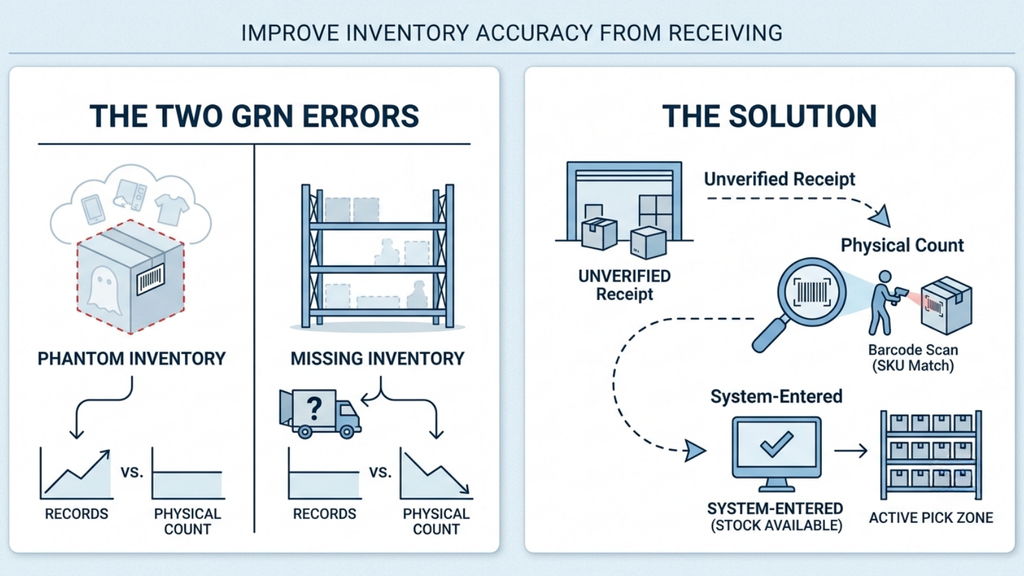
Goods Received Notes made without physical verification against the original purchase order create two categories of error simultaneously: phantom inventory, items recorded as received that were not physically present, and missing inventory, items that arrived but were not recorded.
Every GRN entry should require a physical count confirmation, with a scanned barcode confirming SKU identity, before the goods move to the active pick zone. A three-stage process- unverified receipt, count-verified, system-entered- prevents unverified stock from ever entering circulation as if it were confirmed.
This is one of the earliest-stage answers to how to improve inventory accuracy with Base.com, since an accuracy problem introduced at receiving cannot be fully solved by any downstream fix, no matter how good your picking or packing process is.
9. Set Real-Time, Not Batch, Reorder Thresholds
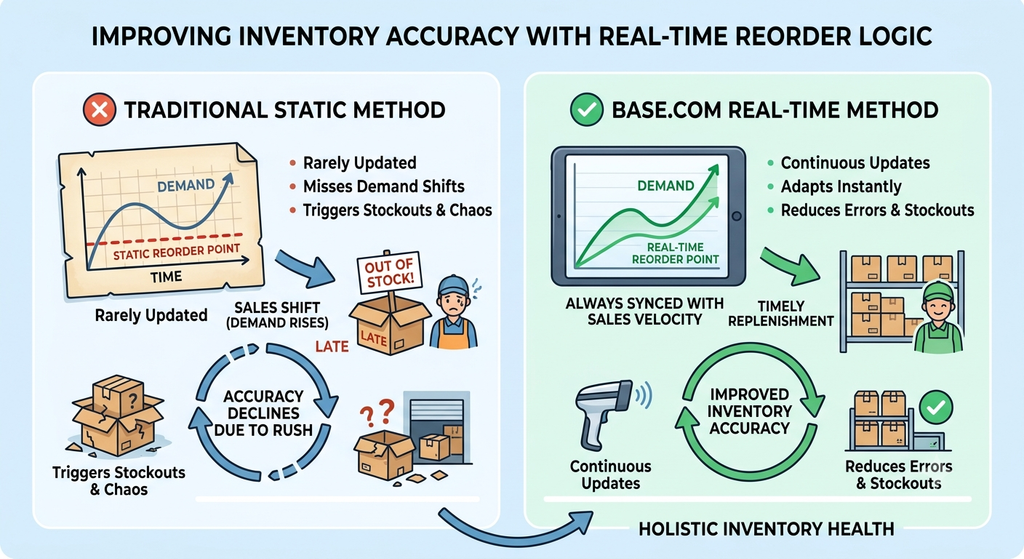
Reorder points calculated from a static number, set once and rarely revisited, drift out of sync with actual sales velocity as demand patterns shift. A threshold that made sense six months ago can trigger far too late, or far too early, once a SKU’s popularity has changed.
Calculating reorder points from live sales velocity, updated continuously rather than recalculated manually once a quarter, keeps replenishment timing aligned with actual demand. This indirectly protects inventory accuracy too, since stockouts and emergency reorders are a common source of rushed, error-prone receiving processes.
Real-time reorder logic is a core part of how to improve inventory accuracy with Base.com holistically, since accuracy and replenishment timing are connected problems, not separate ones, even though they are often managed by different tools.
10. Build a Pre-Peak Inventory Reconciliation Routine
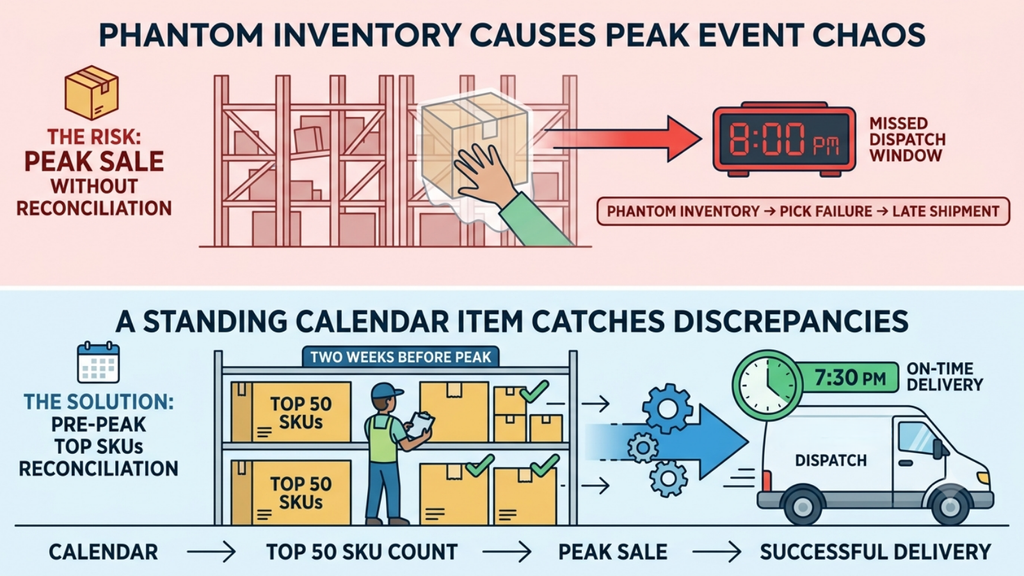
Phantom inventory that goes undetected during normal operations becomes catastrophic during a peak sale event, when a pick failure has far less slack to absorb before it cascades into a missed dispatch window. Running a full physical count of your top 50 SKUs two weeks before any major sale event catches discrepancies while there is still time to correct them.
This routine should be a standing calendar item, not an ad hoc response to a bad previous sale event. Combined with the cycle counting described earlier, a pre-peak reconciliation acts as a final check specifically timed to catch anything the regular cycle count schedule might have missed.
Any comprehensive answer to how to improve inventory accuracy with Base.com has to include this kind of event-driven discipline, since the cost of an inaccurate stock count scales directly with the order volume it affects, and peak events multiply that volume by 5-10x almost overnight.
How Base.com Ties These 10 Methods Together
Each of the ten methods above works as an individual practice, but the real gain comes from running them on one connected system rather than ten separate point solutions. Understanding this connective logic is essential to grasping how to improve inventory accuracy with Base.com holistically, rather than treating each method as an isolated checkbox.
Base.com’s platform is built around exactly this integration: barcode scan enforcement at every touchpoint, a single inventory ledger across every channel, automated returns quality checks, component-level bundle deduction, FEFO logic for batch-sensitive categories, and audit-trailed manual adjustments, all operating from the same underlying stock data rather than requiring separate tools stitched together.
This is ultimately what how to improve inventory accuracy with Base.com means in practice: not implementing ten disconnected fixes, but adopting one system where each of these ten practices reinforces the others, since a scan-enforced pick feeding into a single-ledger system is more reliable than the same scan enforcement operating on a channel-by-channel basis.
Tracking Progress: A 90-Day Accuracy Improvement Timeline
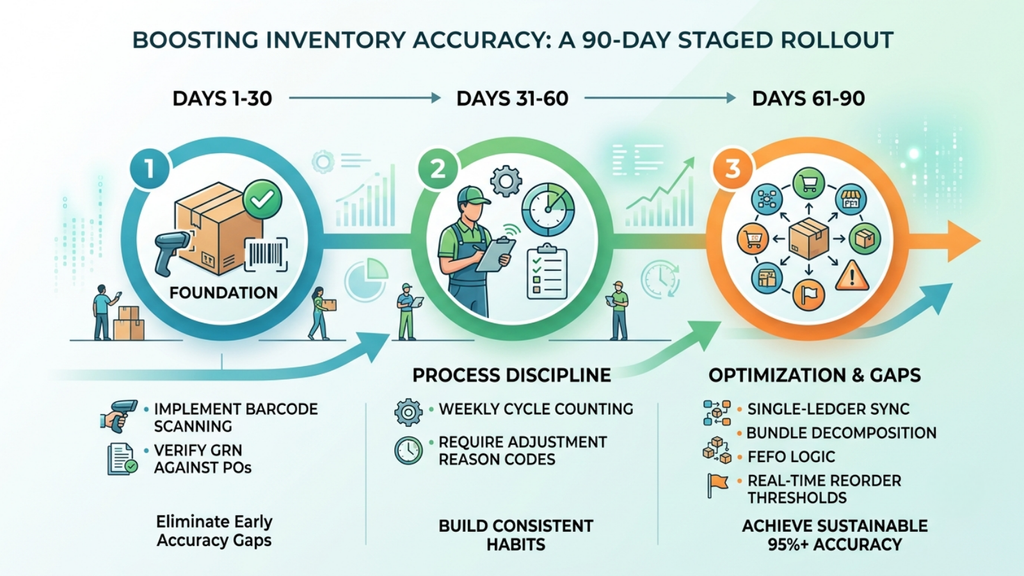
Implementing all ten methods at once is unrealistic for most operations teams. A staged rollout over roughly 90 days is a more practical answer to how to improve inventory accuracy with Base.com or any comparable platform, since it lets each method stabilise before the next one layers on top. This staged approach also makes it easier to isolate which specific method drove which specific improvement, rather than crediting a blanket rollout for gains that actually came from one or two high-leverage changes.
- Days 1-30 should focus on the foundational fixes. Barcode scanning at every touchpoint and GRN verification against purchase orders address the two earliest and most consequential points where accuracy typically breaks down. These two methods alone often account for the largest share of the total improvement achievable.
- Days 31-60 should introduce process discipline. Cycle counting on a weekly rotation and reason-code requirements for manual adjustments both depend on consistent habit-forming more than technology, and a month of foundational fixes gives the team enough stability to add these disciplines without feeling overwhelmed.
- Days 61-90 should address category-specific and structural gaps. Single-ledger channel sync, bundle decomposition, FEFO logic, and real-time reorder thresholds round out the full set, tailored to whichever gaps matter most for your specific category mix.
A brand that completes this 90-day sequence has effectively answered how to improve inventory accuracy with Base.com in full, moving from whatever baseline accuracy it started with toward the 95%+ range that disciplined, systematic implementation makes achievable.
Measuring Inventory Accuracy: What Good Looks Like
A few benchmarks help calibrate whether your current accuracy level needs urgent attention or incremental improvement.
| Accuracy Level | What It Typically Means |
| Below 90% | Urgent structural gaps, likely missing scan enforcement and GRN verification |
| 90-95% | Meaningful room for improvement, likely missing cycle counts or returns separation |
| 95-98% | Solid baseline, focus on category-specific gaps like batch tracking or bundles |
| Above 98% | Strong accuracy, focus shifts to sustaining it through peak events |
Businesses in 2024 achieved only an 83% average inventory accuracy rate across ecommerce operations generally, meaning most brands sit well below the 95%+ range that these ten methods, applied together, can realistically achieve. Benchmarking your current accuracy against this table is the first practical step in any serious plan for how to improve inventory accuracy with Base.com or a comparable system.



[…] in 2024 achieved only an 83% inventory accuracy rate on average across ecommerce operations, and every percentage point below that translates […]
[…] positions itself as a unified platform covering OMS, WMS, inventory management, PIM, and accounting, with 1,500+ global integrations and specific capability depth in warehouse […]
[…] inventory management system features in India that matter are not just real-time tracking and barcode scanning. They are GST […]
[…] ratio per SKU is one of the most immediately actionable inventory analytics, since it catches overstocking or understocking early, before either problem becomes expensive. A […]
[…] from the best inventory management software in India requires looking past marketing pages and into actual operational fit. We […]
[…] software helps streamline receiving, storage, picking, packing, and shipping while improving inventory accuracy, reducing fulfillment errors, and supporting faster business […]
[…] a dirty SKU master. Duplicate SKUs, inconsistent variant naming, and missing barcodes break inventory sync on day one. Clean the master before migration, not […]
[…] platform assigns a unique identity to individual units, which makes returns grading and inventory accuracy far more reliable. Fashion brands lose money to stranded sizes, and this addresses that […]
[…] orders, inventory allocation, warehouse dispatch, and returns across connected […]
[…] phased rollout protects dispatch while you restructure inventory. Split the period into three blocks with defined exit […]
[…] here, always. Duplicate SKUs, inconsistent variant naming, and missing barcodes break inventory sync on day […]