
Stop treating stock as one number. The moment inventory sits in two locations, a combined total becomes a liability, because it promises fulfilment your warehouses cannot deliver. Sellers working out how to manage inventory across multiple warehouses need location-aware stock and rules that decide where each order goes before anyone picks it.
India’s ecommerce market is set to reach roughly ₹19.7 trillion, close to $226 billion, this year at around 12.4% growth. Long-tail catalogues feel that growth is dispersion rather than volume. Thousands of slow-moving titles or SKUs spread thinly across locations produce a specific failure nobody sees coming: plenty of stock, and almost none of it where the order landed.
This guide takes a routing-first view. Instead of walking through warehouse setup, it starts with the four ways multi-location operations actually fail, then works outward to the controls that prevent each one.
The Four Failure Modes That Define Multi-Warehouse Operations

Every multi-location problem traces back to one of four failures. Naming them precisely tells you which control you are missing.
Read each failure mode below against your last month of operations and mark the ones you recognise.
Failure Mode One: Blended Stock Totals That Hide Location
Your system reports 40 units. Twelve sit in Bengaluru, twenty-eight in Delhi, and the order came from Chennai for a customer expecting delivery in two days.
The number was accurate and useless simultaneously. Base.com shows stock warehouse by warehouse rather than as one blended figure, which is the foundation every other control depends on.
Failure Mode Two: Orders Assigned Before Availability Is Checked
Assignment and availability are separate events in most setups. An order gets allocated to the default warehouse, then someone discovers the SKU is not there.
Reassignment costs a day, sometimes two. Base.com routes orders to a location that genuinely holds the inventory, so allocation and availability resolve together.
Failure Mode Three: Transfers That Leave No Trace
Stock moves between locations constantly in a multi-warehouse operation. When those movements happen over phone calls and delivery challans, your system records neither the outbound nor the inbound accurately.
Discrepancies then appear weeks later with no audit trail. Base.com tracks inter-location transfers as structured events inside the same system that holds the stock.
Failure Mode Four: Long-Tail SKUs Stranded in the Wrong Location
This one is specific to wide catalogues. A slow-moving title sits in one warehouse for eight months while demand for it arrives consistently from the opposite region.
Nobody notices because each individual SKU is too small to trigger attention. Across a long-tail catalogue, however, those stranded units represent significant working capital doing nothing.
Why Long-Tail Catalogues Change the Multi-Warehouse Problem
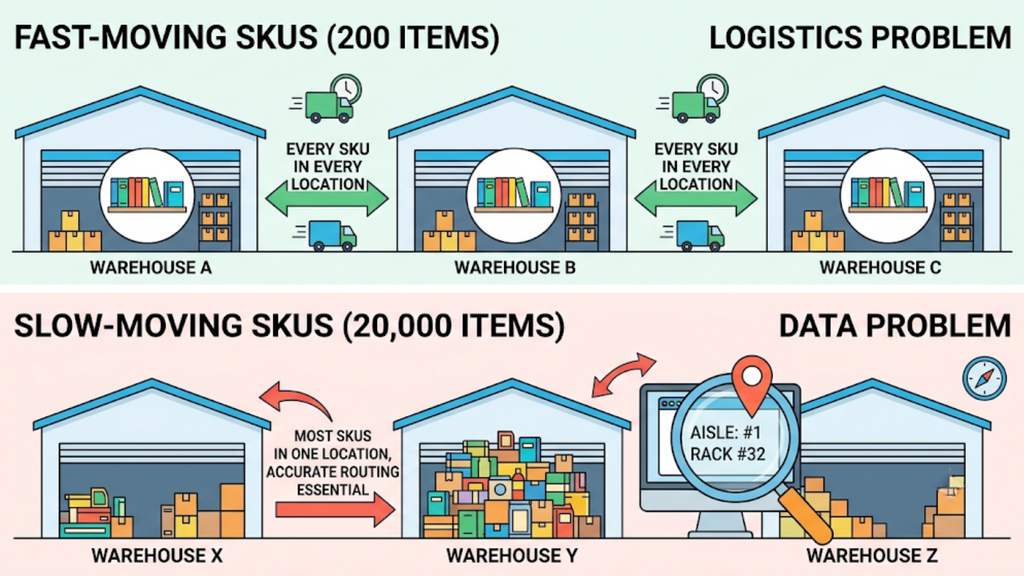
A catalogue of 200 fast-moving SKUs across three warehouses is a logistics problem. A catalogue of 20,000 slow-moving SKUs across the same three warehouses is a data problem.
The difference matters because the two situations reward opposite strategies.
Fast-moving catalogues justify holding every SKU in every location. Demand is predictable enough that duplication costs less than delay. Long-tail catalogues cannot afford that, because stocking 20,000 titles in three places triples your working capital for items that may sell twice a year.
Long-tail sellers therefore hold most SKUs in one location and a small core everywhere. That decision makes routing accuracy essential rather than merely helpful, since the majority of your catalogue exists in exactly one place at any moment.
Book and publishing sellers encounter this most sharply, but the pattern repeats across multi-category retailers, agencies managing several seller catalogues and manufacturers holding both raw materials and finished goods. In each case, knowing a book exists somewhere in stock is not the same as knowing which location actually has it.
Building Location-Aware Inventory: The Five Layers
Multi-warehouse capability is not a single feature. There are five layers that must exist in order, because each one depends on the layer beneath it.
Work upward through the layers below, and stop at the first one your current setup cannot support.
Layer One: Location Masters and Physical Mapping
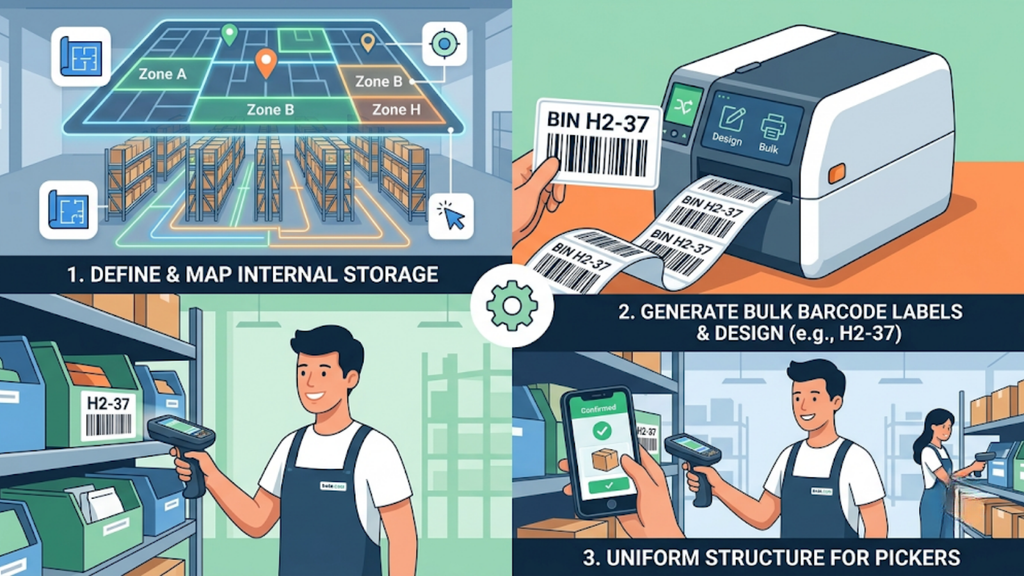
Nothing works until each warehouse exists as a defined entity with mapped internal storage. That means bins, not just an address.
Base.com assigns bin coordinates such as H2-37 within each location and supports bulk barcode printing plus location label design. Pickers in every warehouse then work from the same structure.
Layer Two: Location-Wise Stock Visibility
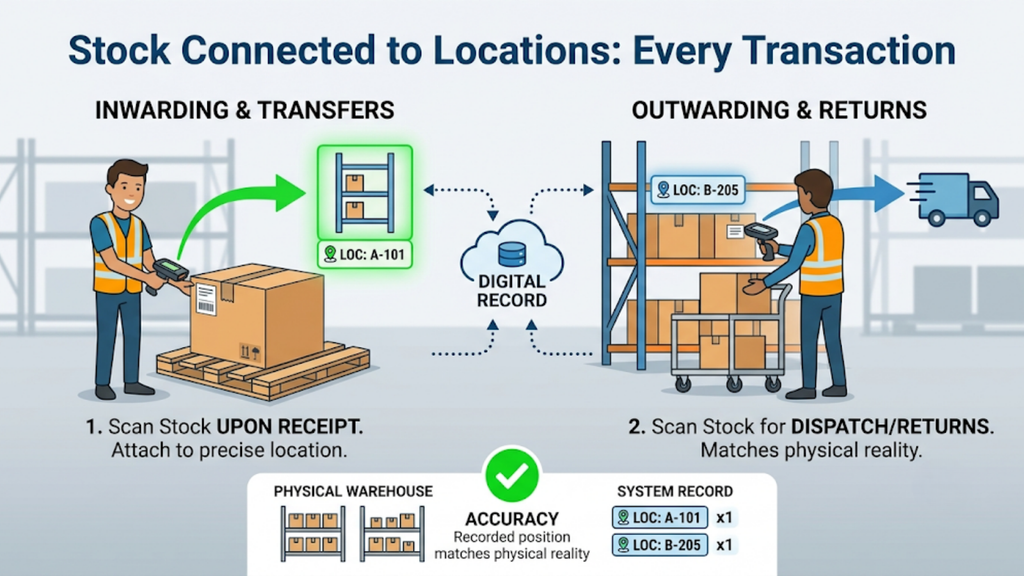
Once locations exist, stock must attach to them at every transaction. Inward, outward, transfer and return events all carry a location.
Base.com structures inwarding and outwarding as scanned events per location. Your recorded position then matches physical reality in each warehouse independently.
Layer Three: Order Routing Rules
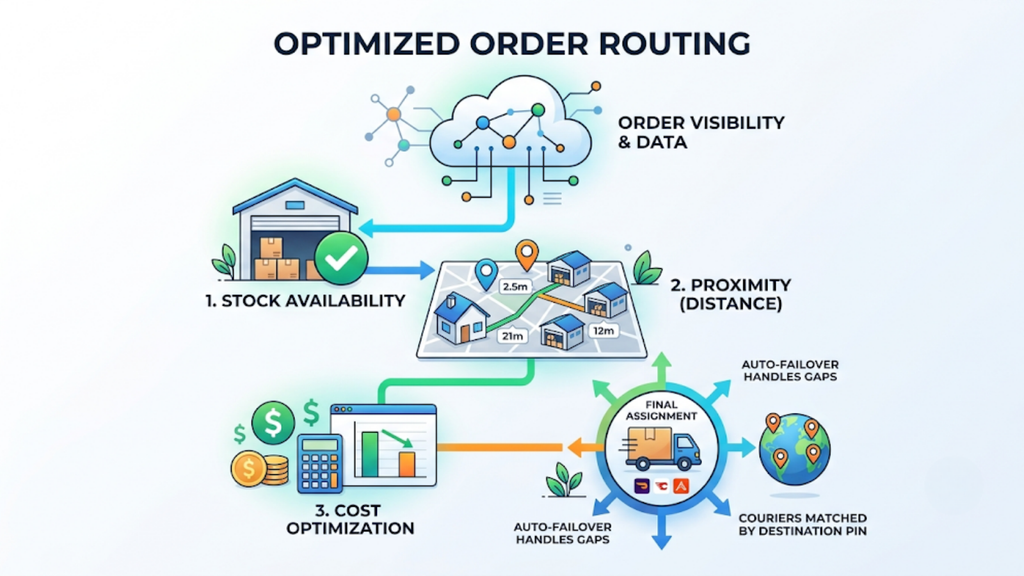
With visibility established, routing becomes possible. Rules should consider stock availability first, then proximity, then cost.
Base.com routes orders based on where inventory is actually available and assigns couriers by destination PIN code, so the warehouse-carrier combination fits the delivery address. Failover handles serviceability gaps automatically.
Layer Four: Transfer Discipline
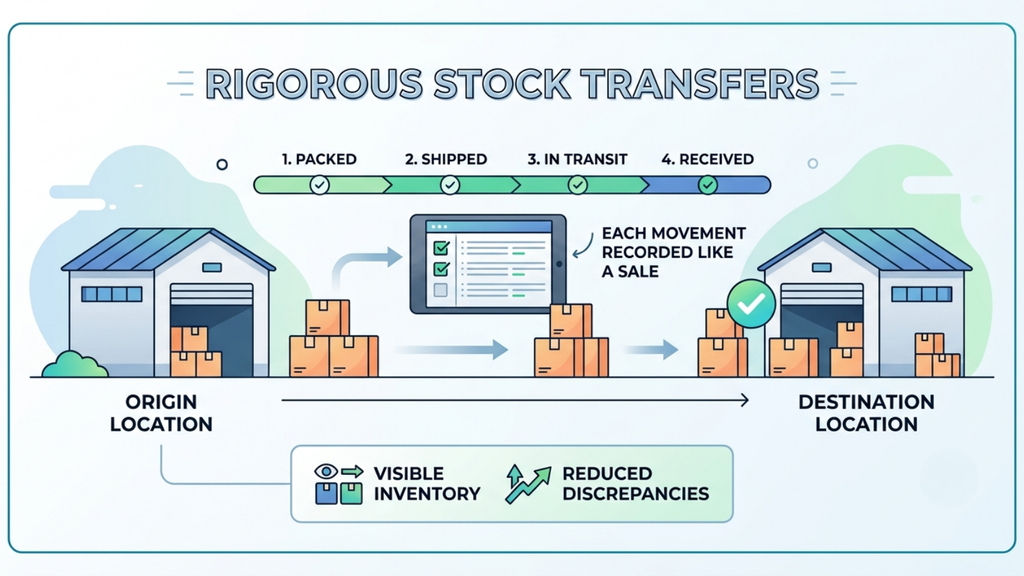
Stock will move between locations, and that movement must be recorded as rigorously as a sale. Anything less reintroduces the discrepancies you just eliminated.
Base.com records transfers as structured movements with both sides tracked. Stock in transit stops being invisible inventory nobody can account for.
Layer Five: Cross-Location Reporting
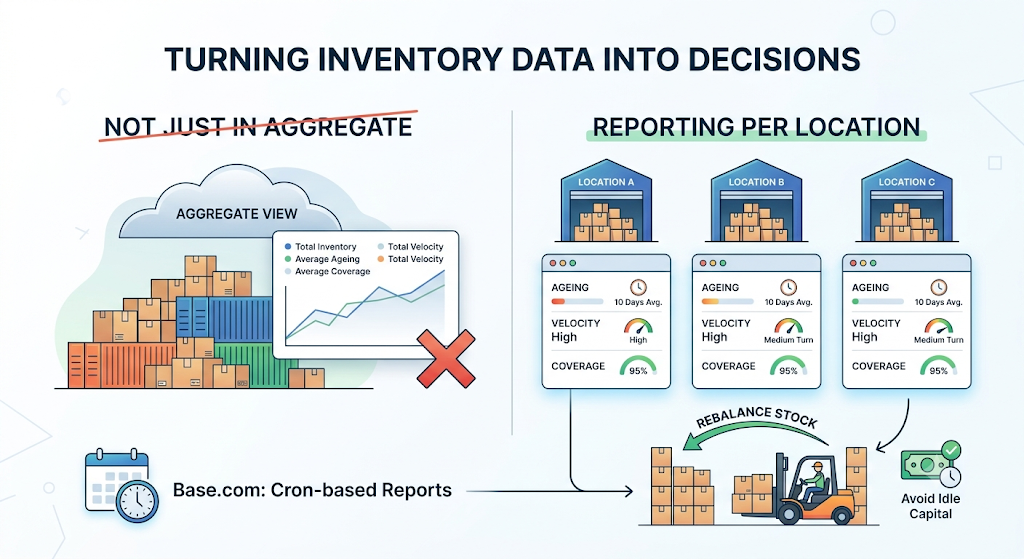
The top layer turns data into decisions. Reporting should show ageing, velocity and coverage per location, not just in aggregate.
Base.com delivers cron-based reports in customisable formats, so stranded long-tail stock surfaces without manual analysis. Teams handling how to manage inventory across multiple warehouses use these reports to rebalance before capital sits idle.
How Should Routing Rules Prioritise One Warehouse Over Another?
Routing looks simple until two warehouses both hold the SKU. Then the rule set decides your delivery speed, your shipping cost and your stock balance simultaneously.
Apply these five criteria in sequence, because their order determines the outcome more than the criteria themselves.
1. Availability Comes Before Everything Else
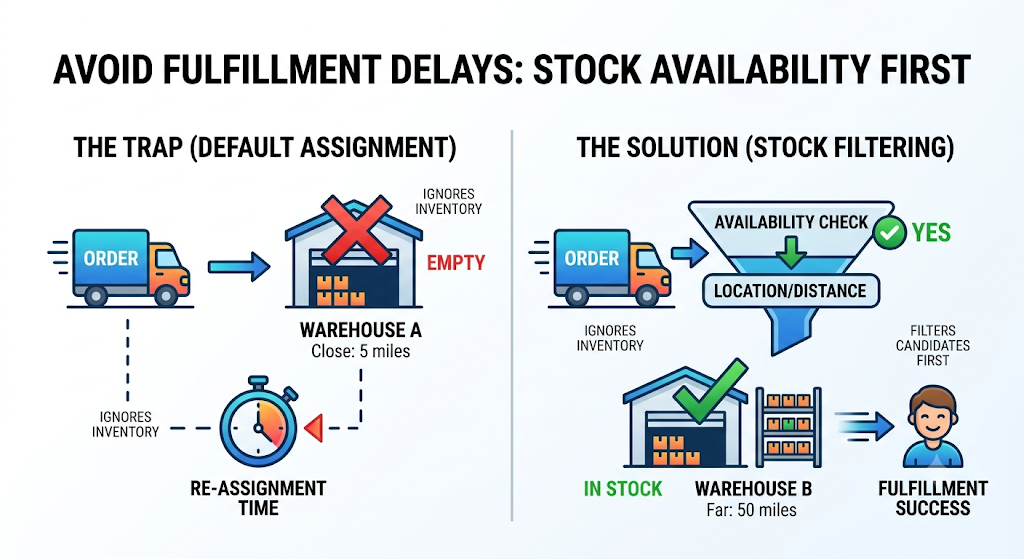
A nearby warehouse without stock is worse than a distant one with it. Availability filters the candidate list before any other consideration applies.
This sounds obvious and fails constantly in practice. Default-warehouse assignment ignores it entirely, which is why reassignment consumes so much operational time.
2. Serviceability Decides Which Carriers Are Even Possible
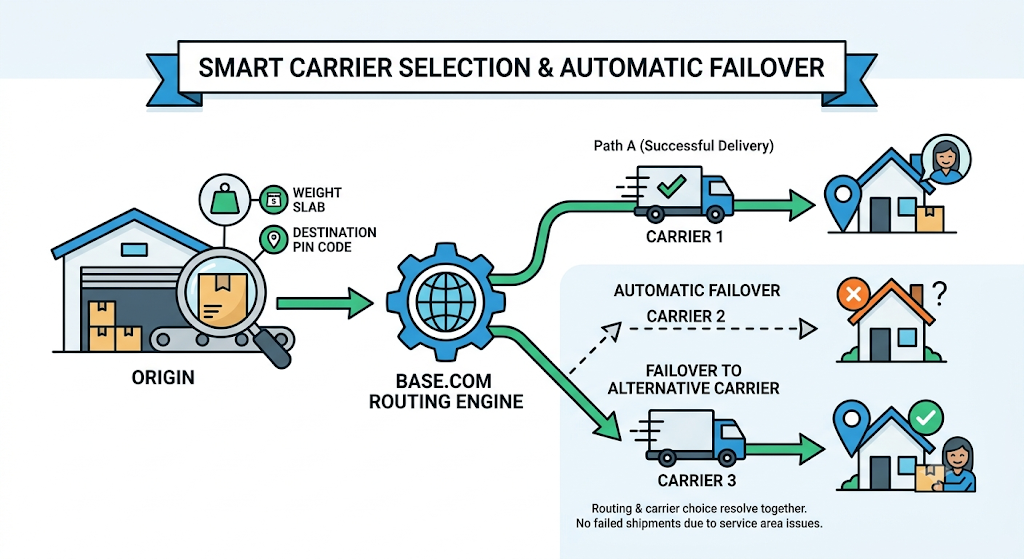
Not every courier services every PIN code from every origin. A warehouse that cannot ship to the destination is not a real option.
Base.com selects carriers by destination PIN code and weight slab, failing over automatically when a partner cannot service an address. Routing and carrier choice resolve together rather than sequentially.
3. Proximity Reduces Both Cost and Transit Time
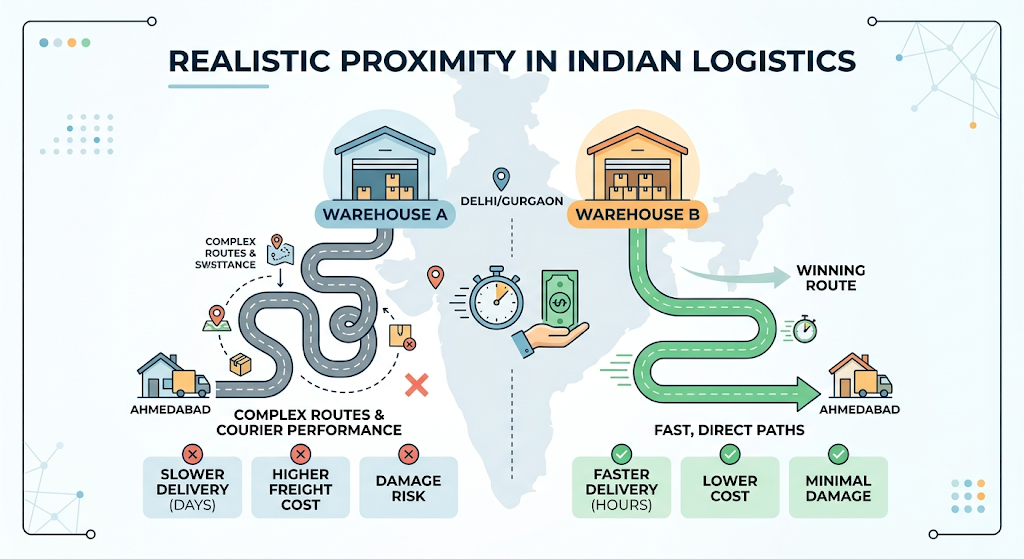
Among locations that hold stock and can ship, closer wins. Shorter transit lowers freight cost, speeds delivery and reduces damage exposure.
Proximity should be measured by realistic delivery time, not straight-line distance. Regional courier performance varies considerably across Indian routes.
4. Stock Depth Prevents Creating New Shortages
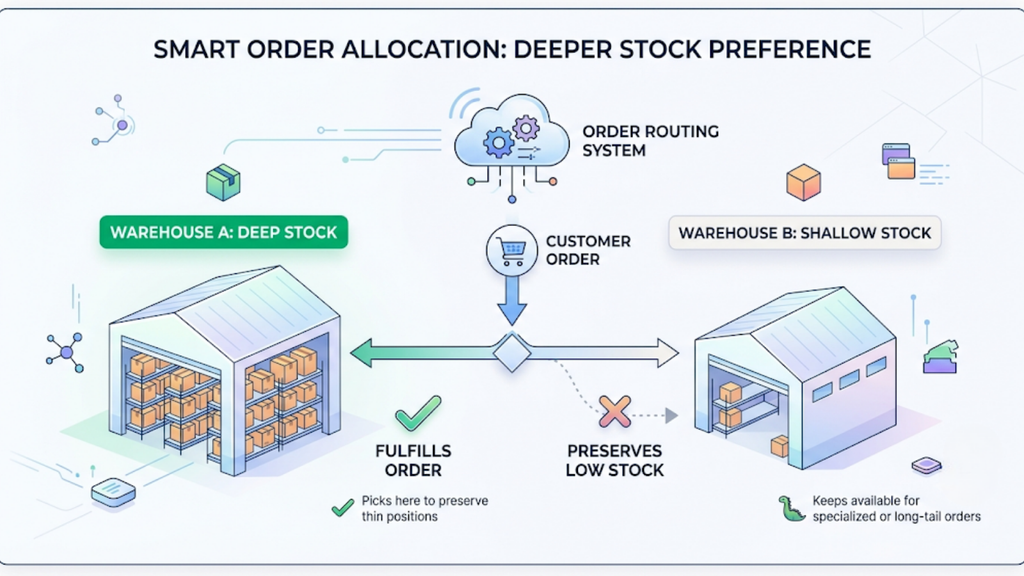
Routing every order to the same well-stocked warehouse eventually empties it. Depth should act as a tiebreaker between otherwise equal options.
Deeper stock takes the order, which keeps thin positions intact for orders only that location can serve. This matters most for long-tail SKUs held in a single place.
5. Consolidation Keeps Multi-Item Orders Together
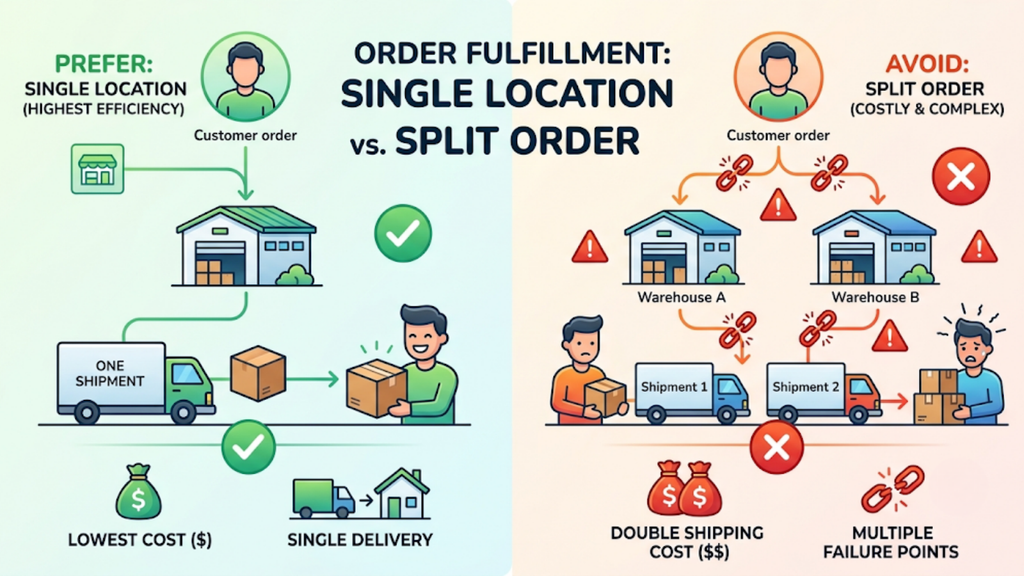
Splitting an order across warehouses doubles your shipping cost and your failure points. Prefer any single location that can fulfil the whole order.
Where splitting is unavoidable, the system should handle it explicitly rather than leaving staff to improvise. Brands solving how to manage inventory across multiple warehouses should test split-order behaviour during vendor demos specifically.
Single Warehouse Versus Multi-Warehouse: What Actually Changes
Adding a second location changes more processes than most sellers anticipate. The table below shows what shifts and what it costs when the shift is not managed.
Score your readiness against each row before committing to a second or third location.
| Process | Single warehouse | Multi-warehouse | Cost of getting it wrong |
| Stock reporting | One number is sufficient | Location-wise visibility required | Orders promised against unreachable stock |
| Order allocation | Implicit, no decision needed | Rule-based routing per order | Reassignment delays, missed SLAs |
| Courier selection | One origin, stable rate cards | Origin-specific serviceability and rates | Undeliverable shipments |
| Stock transfers | Not applicable | Tracked movements with in-transit status | Untraceable discrepancies |
| Replenishment | One reorder point per SKU | Reorder point per SKU per location | Overstock in one place, stockouts elsewhere |
| Returns intake | Single destination | Location-specific return routing | Returns stranded at the wrong site |
| Cycle counting | One schedule | Independent schedules per location | Drift accumulates unnoticed |
| Long-tail placement | Irrelevant | Deliberate decision per SKU | Capital stranded in slow-moving stock |
| Staff processes | One set of habits | Identical structure across sites | Each warehouse invents its own method |
| Reporting | Straightforward | Cross-location comparison needed | No visibility into which site underperforms |
Rows where your current setup sits in the left column represent work to complete before the second location opens, not after.
Where Base.com Fits in a Multi-Location Operation
Broad platforms handle single-warehouse operations competently. Multi-location work exposes gaps, because it demands that every function becomes location-aware rather than location-agnostic.
Check each shortlisted platform against the capabilities below.
- Warehouse-wise stock visibility: Base.com shows inventory location by location rather than as a blended total.
- Location-based order routing: Base.com assigns each order to a warehouse that actually holds the stock.
- Structured stock transfers: Base.com records inter-location movements inside the same system, with both sides tracked.
- Bin-level mapping per site: Base.com assigns shelf coordinates within each warehouse, supported by location label design and bulk barcode printing.
- Scanned inwarding and outwarding: Base.com captures every movement as a timestamped event attached to its location.
- PIN-code courier allocation: Base.com matches the warehouse-carrier combination to the delivery address and fails over when serviceability breaks.
- Marketplace and website order consolidation: Base.com brings all channels into one queue before routing decisions are made.
- Returns routing and condition capture: Base.com scans returns into statuses such as damaged, recoverable and return-to-store at the receiving location.
- Catalogue management across sites: Base.com keeps listings consistent regardless of how stock is distributed.
- Scheduled cross-location reporting: Base.com delivers cron-based reports in customisable formats covering stock, ageing and fulfilment by site.
These capabilities reinforce each other. Routing without transfer tracking produces imbalance nobody can correct, and transfer tracking without reporting means imbalance goes unnoticed until it becomes expensive.
Phasing a Second Warehouse Without Breaking the First
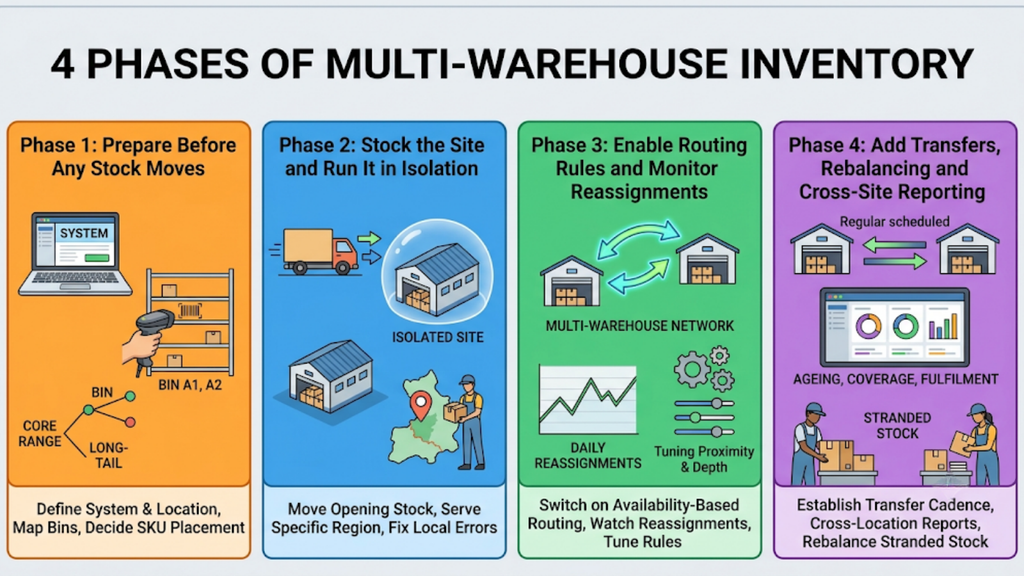
Opening a location is disruptive by nature. Phasing it correctly keeps that disruption contained to the new site rather than spreading to the one already working.
Follow this four-phase approach rather than launching everything simultaneously.
Phase One: Prepare Before Any Stock Moves
Define the new location in your system, map its bins and print location labels before the first consignment arrives. Decide which SKUs will live there and which stay centralised.
Long-tail sellers should resist duplicating the full catalogue. Hold a core range in both locations and keep the tail centralised until demand data justifies otherwise.
Phase Two: Stock the Site and Run It in Isolation
Move opening inventory with transfers recorded properly on both sides. Run the new warehouse serving a defined region only, with no routing complexity yet.
Isolation keeps early errors local. Fix picking, packing and courier issues at the new site before it joins the wider routing pool.
Phase Three: Enable Routing Rules and Monitor Reassignments
Switch on availability-based routing across both locations, then watch reassignment frequency daily. Frequent reassignments signal a data problem, not a rule problem.
Teams executing how to manage inventory across multiple warehouses should treat the first two weeks of routing as a tuning period. Adjust proximity and depth weightings based on what actually happens.
Phase Four: Add Transfers, Rebalancing and Cross-Site Reporting
Establish a regular transfer cadence rather than ad hoc movements. Schedule cross-location reports covering ageing, coverage and fulfilment performance per site.
Rebalancing is where multi-warehouse operations either pay off or quietly fail. Stranded long-tail stock only returns to circulation if someone sees it and acts.
Decide Where Every SKU Should Live, Then Let the System Enforce It
Multi-warehouse operations reward deliberate placement and punish drift. Stock ends up wherever the last consignment was unloaded unless someone decides otherwise and the system holds that decision.
The strategic question for long-tail sellers is not how much stock to hold but where each SKU earns its place. Fast movers justify duplication; the tail rarely does, and routing accuracy is what makes centralisation safe.
Map your locations, establish transfer discipline and switch on availability-first routing before your next peak. If you want a clear plan for how to manage inventory across multiple warehouses across your exact catalogue depth, site count and regional demand mix, book a Base.com operations review and get the rollout mapped to your own numbers.
Frequently Asked Questions
1. How to manage inventory across multiple warehouses without duplicating the whole catalogue?
Hold a fast-moving core range in every location and keep long-tail SKUs centralised in one. Base.com shows stock location by location and routes each order to the warehouse that holds it, so a centralised tail still fulfils reliably without tripling your working capital.
2. What is the biggest mistake when opening a second warehouse?
Launching it inside the routing pool immediately. Run the new site in isolation on a defined region first, fix its local processes, then enable cross-location routing once picking and dispatch are stable.
3. How should stock transfers between locations be recorded?
As structured events with both the outbound and inbound sides tracked, including in-transit status. Base.com records transfers inside the same system holding the stock, so units never vanish between warehouses.
4. Does multi-warehouse operation reduce delivery times?
Yes, when routing is availability-first. Shipping from a location closer to the customer cuts transit time and freight cost, but only if the system confirms stock before assigning the order rather than after.
5. How long does a multi-warehouse rollout take?
Plan for roughly 60 days across the four phases, from location setup through routing tuning and rebalancing cadence. Sellers planning how to manage inventory across multiple warehouses should complete phases one and two before any peak season rather than during it.