

Track every size as its own stock line, sync that line to every marketplace in real time, and match the exact size to the order before packing. Those three controls solve the footwear problem that style-level systems cannot touch. That is the working answer to how to manage size-wise inventory for footwear in 2026.
India’s ecommerce market is set to reach roughly ₹19.7 trillion, close to $226 billion, this year at around 12.4% growth. Footwear absorbs that growth as size fragmentation, not just volume. One style across eight sizes and four colours becomes thirty-two independent stock positions before a single order arrives.
This guide covers size-curve planning, sync rules, floor controls, exchange handling and a 45-day rollout plan for Indian footwear sellers.
Understand Why Footwear Inventory Breaks Differently From Other Categories
Footwear looks like apparel on a spreadsheet and behaves nothing like it in a warehouse. The difference sits in how demand distributes across sizes.
Work through these six category-specific problems before you change any process or system.
1. One Style Splits Into Thirty or More Stock Positions
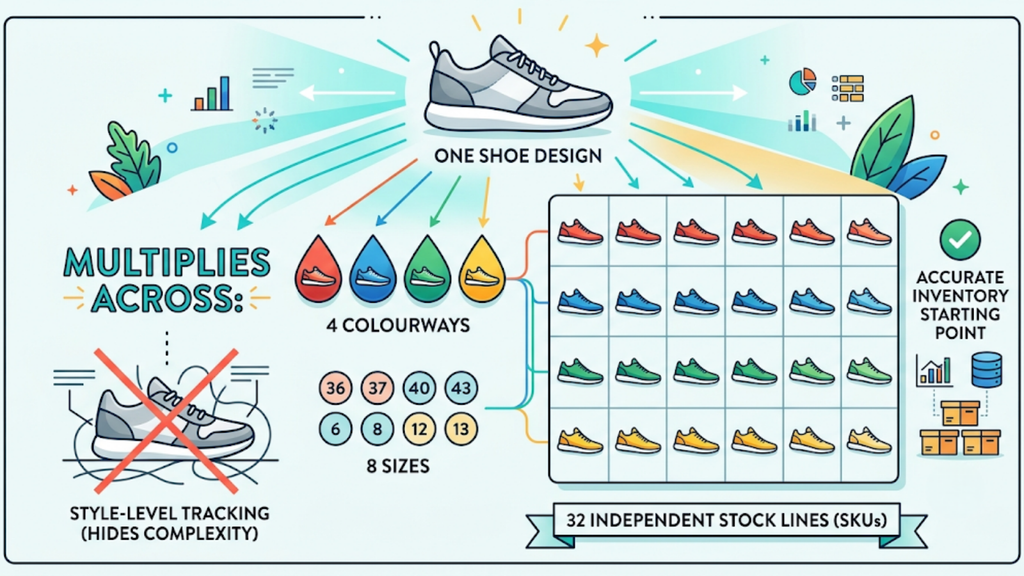
A single shoe design multiplies across sizes and colours instantly. Eight sizes across four colourways produce thirty-two separate things to count, store, list and replenish.
Style-level tracking hides that fragmentation completely. Base.com treats each size-and-colour combination as an independent stock line, which is the structural starting point for accurate footwear inventory.
2. Demand Concentrates Sharply in the Middle Sizes

Footwear demand follows a curve, not a flat distribution. Middle sizes sell out fast while the extremes sit untouched for months.
That imbalance creates the category’s signature failure: a style showing healthy total stock with every sellable size gone. Aggregate numbers therefore mislead your buying team every season.
3. Listings Stay Live After Individual Sizes Sell Out
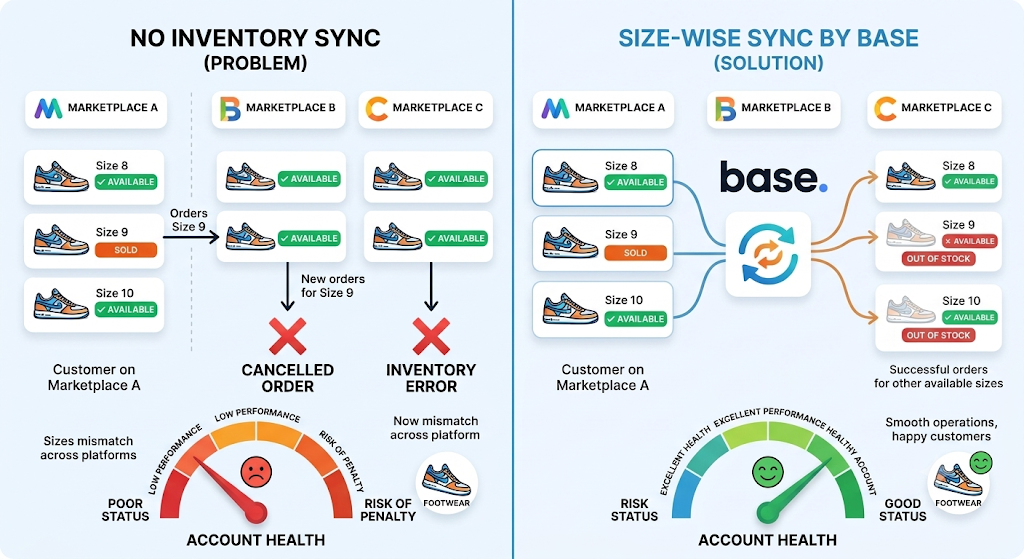
Marketplaces show the style as available while the ordered size no longer exists. Cancellations follow, and account health drops.
Base.com syncs stock wherever a specific size variant appears, so a size that sells out on one marketplace stops showing as available on another. Sellers solving how to manage size-wise inventory for footwear usually fix this first because the penalty arrives fastest.
4. Exchanges Behave Nothing Like StanFootwear generates a return type most categories rarely see: the customer wants the same product in a different size. Treating that as a standard return loses both the sale and the size intelligence.
Base.com tracks exchanges separately from damaged or incorrect-item returns. Teams then see whether a style runs small or large instead of guessing.
5. Reverse Logistics Costs Compound Every Mis-Ship
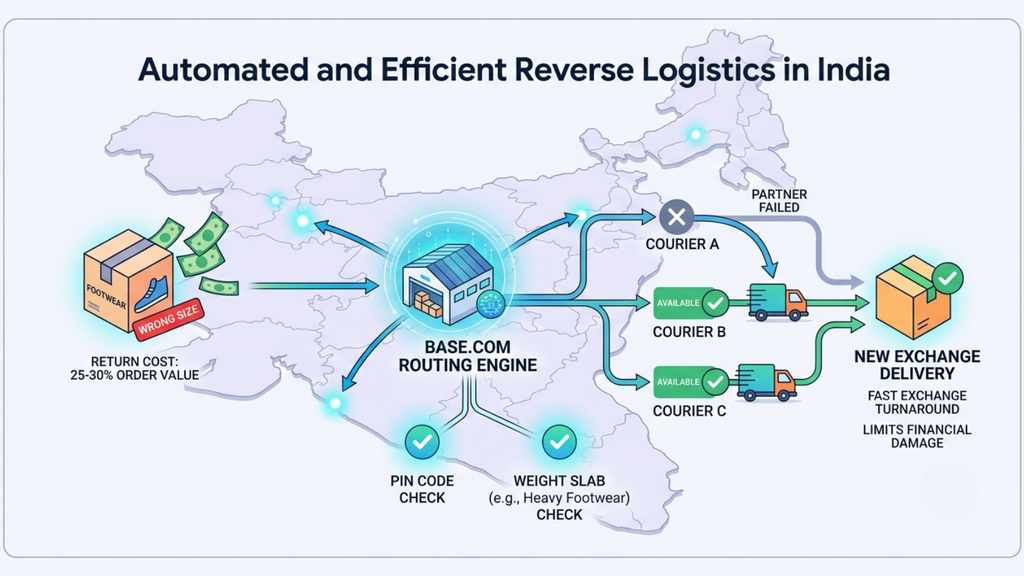
Reverse logistics consumes 25–30% of order value on low-ticket Indian shipments, and footwear ships heavier than apparel. A wrong size sent out therefore costs you twice: once outbound, once inbound.
Fast exchange turnaround limits that damage. Base.com assigns couriers by destination PIN code and weight slab, with automatic failover when a partner cannot service an address.
6. Replenishment Decisions Need Size-Level Sell-Through
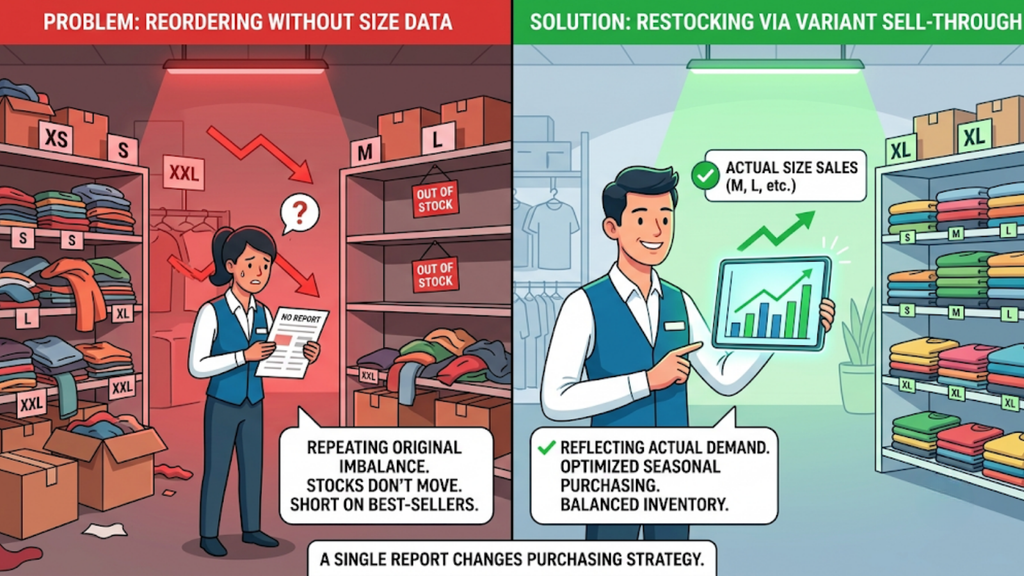
Reordering a style without size data repeats the original imbalance. You restock sizes that never moved and stay short on sizes that emptied in week two.
Base.com reports sell-through at the variant level, so buying decisions reflect the actual size curve. That single report changes seasonal purchasing more than any warehouse change.
How Do You Manage Size-Wise Inventory for Footwear Step by Step?
Size-level accuracy is built in sequence. Each step depends on the one before it, so skipping ahead produces a faster version of the same problem.
Follow these six steps in order across your catalogue, warehouse, and channels.
1. Restructure Your SKU Master Around Size Variants
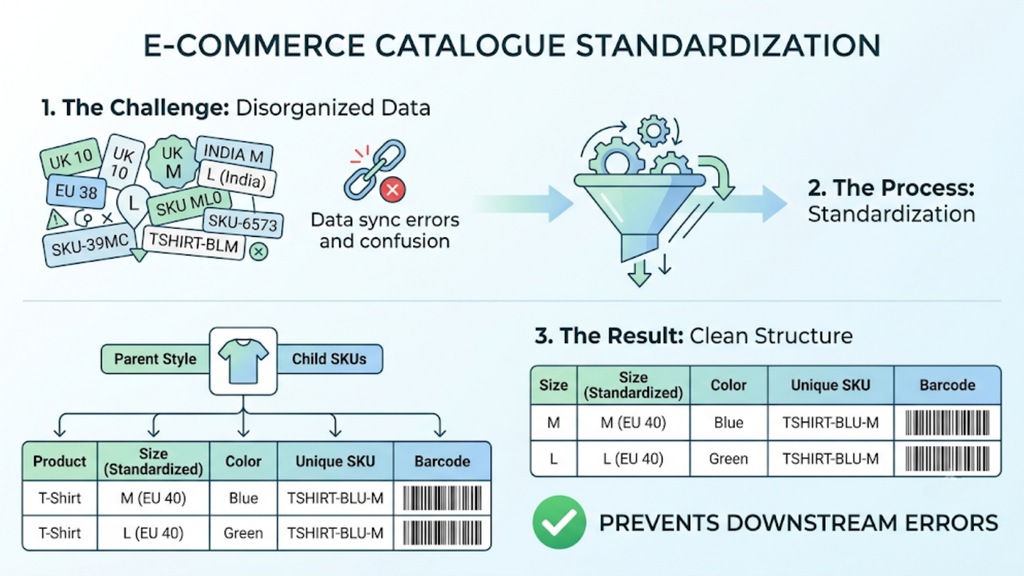
Start with the catalogue, always. Every size and colour combination needs its own SKU code, barcode and parent-style link.
Standardise size notation across the entire catalogue, since UK, EU and India sizing used inconsistently breaks sync silently. Clean structure here prevents nearly every downstream error.
2. Build a Size Curve Per Style Before You Buy
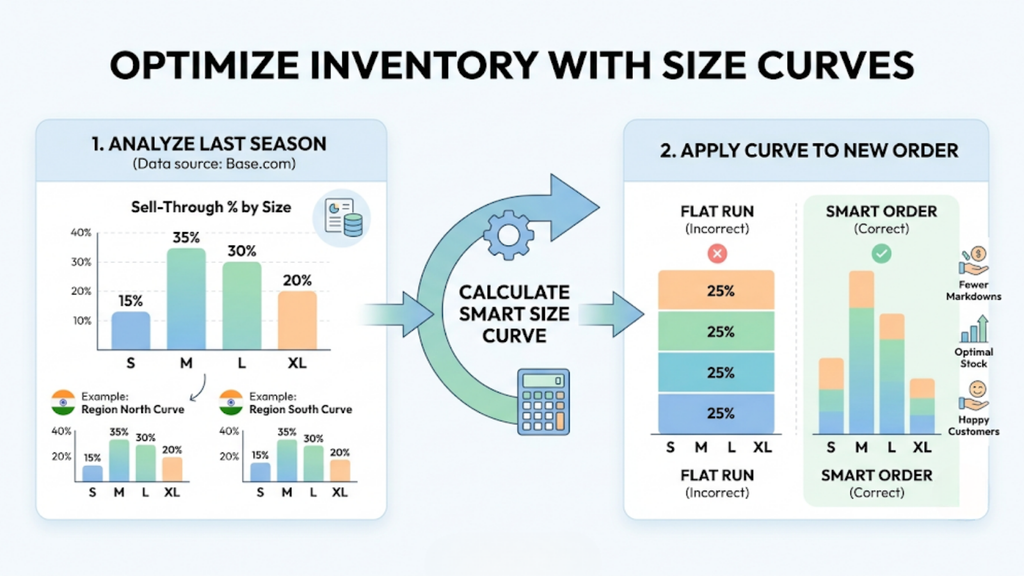
Convert last season’s sell-through into a percentage split across sizes. Apply that curve to purchase quantities instead of ordering flat runs.
Regional differences matter in India, so segment the curve by channel or region where data supports it. Base.com’s variant-level reporting gives you the sell-through history this planning needs.
3. Assign Bin Locations at Size Level, Not Style Level
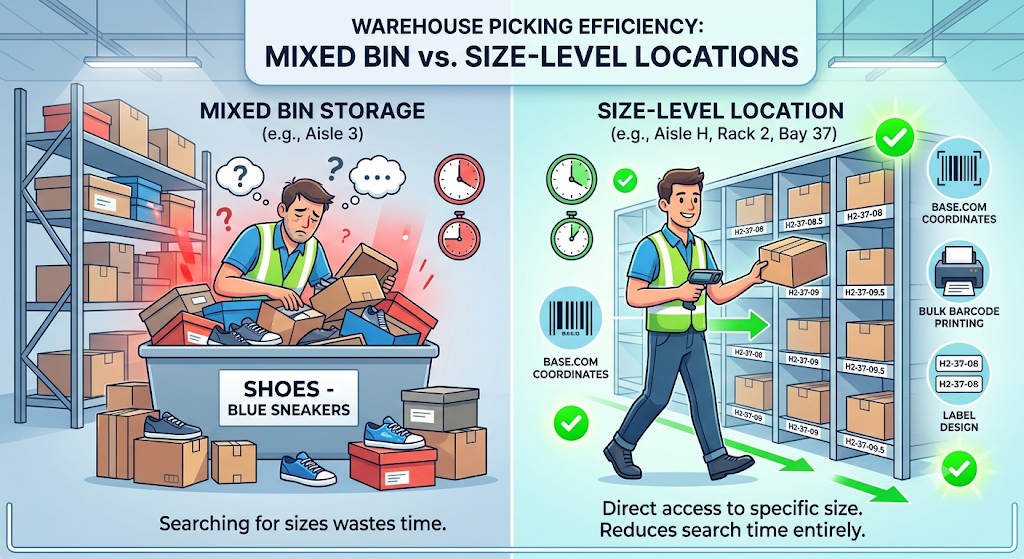
Storing a full style in one bin forces pickers to search boxes. Size-level locations remove that search entirely.
Base.com assigns bin coordinates such as H2-37 to each product, so staff walk directly to the size. Bulk barcode printing and location label design let you label an entire rack system in a few passes.
4. Switch On Real-Time Sync Across Every Marketplace
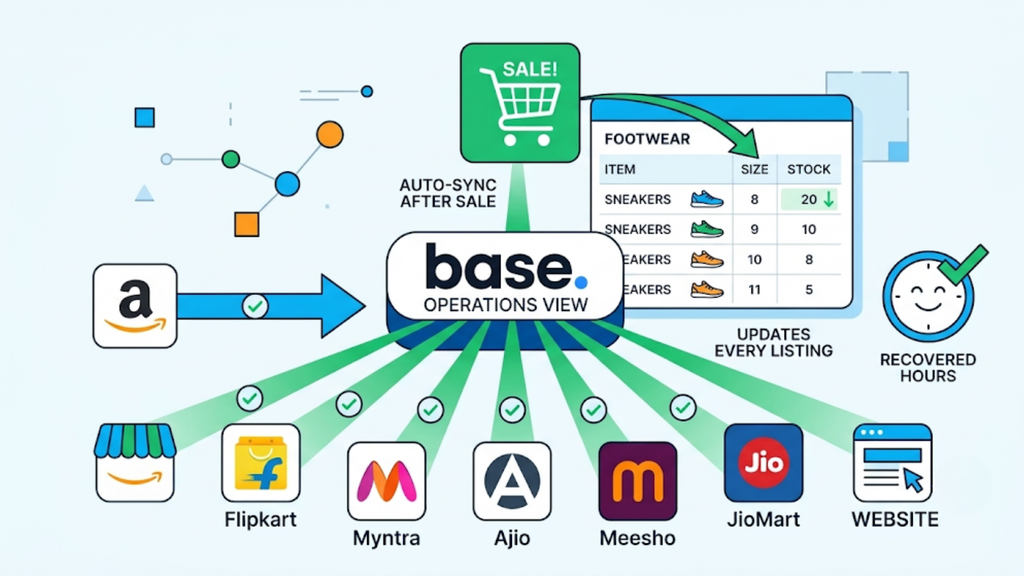
Manual stock uploads cannot keep pace with size-level movement. Sync must happen automatically after each sale.
Base.com consolidates Amazon, Flipkart, Myntra, Ajio, Meesho, JioMart, and your own website into one operations view and updates every listing where the variant appears. Teams learning how to manage size-wise inventory for footwear recover the most hours at this step.
5. Enforce Size Verification at Pick and Pack
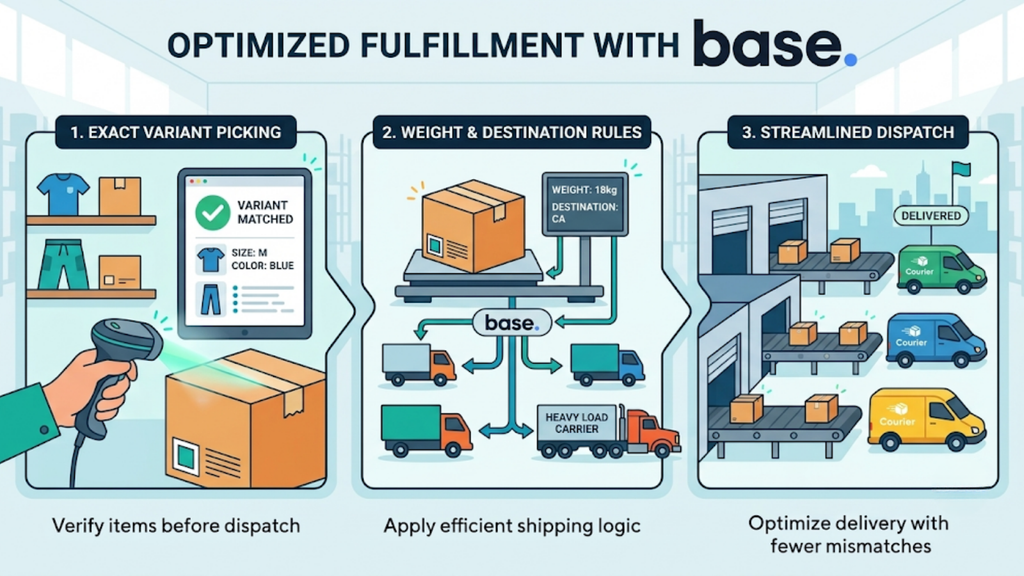
The packing table is where size accuracy either holds or fails. Scanning the exact variant against the order closes the gap.
Base.com supports size-wise and variant-wise pick and pack so mismatches stop before dispatch. Pairing that with weight-based courier rules keeps heavier boxes on carriers that can service the destination.
6. Route Exchanges Back Into Sellable Stock Quickly
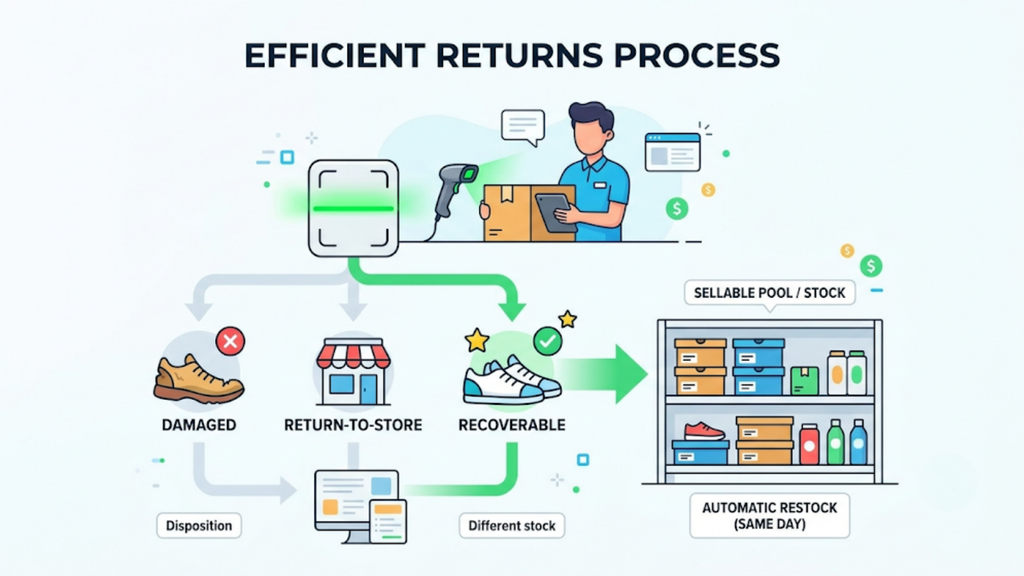
An exchanged pair sitting unrecorded is inventory you have paid for twice. Scanned intake returns it to the sellable pool the same day.
Base.com scans returns into condition-level statuses such as damaged, recoverable, and return-to-store. Recovered pairs re-enter stock automatically instead of waiting for a manual count.
Compare Style-Level Tracking Against Size-Level Tracking
The difference between the two approaches looks small on paper, and large in your P&L. Mapping each failure to its cause makes the case concrete.
Score your current operation against the table below, then count how many rows already cost you money.
| Operational area | Style-level tracking | Size-level tracking | Cost of the gap |
| Stock accuracy | Total per style | Independent count per size and colour | Sold-out sizes appear available |
| Marketplace sync | Style availability pushed to channels | Variant availability pushed per listing | Cancellations, account health penalties |
| Buying decisions | Flat reorders per style | Size-curve-based purchase quantities | Dead stock in extreme sizes |
| Warehouse storage | One bin per style | Bin location per size variant | Pickers search boxes, throughput caps |
| Pick and pack | Visual size check | Scanned variant verification | Wrong size dispatched |
| Returns | Single return bucket | Exchanges separated from damages | No visibility into fit issues |
| Replenishment timing | Triggered on total stock | Triggered per size threshold | Core sizes out, tail sizes overstocked |
| Sale planning | Style-level discounting | Size-level markdown on slow movers | Margin lost on sizes that would sell |
| Multi-warehouse stock | Blended style total | Size availability per location | Orders routed to locations lacking the size |
| Courier allocation | One default carrier | PIN-code and weight-based routing | Slow exchanges, higher reverse cost |
Rows where your current process sits in the left column define your requirement list. Take that list into every vendor conversation.
Match Base.com Capabilities to Footwear-Specific Requirements
Most platforms manage stock counts adequately. Footwear exposes the gaps, because the category demands accuracy at a level generic systems flatten.
Use this checklist to test each shortlisted platform against real footwear operations.
- Independent size and colour stock lines: Base.com tracks each combination separately and keeps it synced everywhere the style is listed.
- Real-time multi-marketplace sync: Base.com pushes variant availability across all channels and multiple seller accounts on the same platform.
- Size-wise pick and pack: Base.com enforces variant verification at packing so size mismatches stop before dispatch.
- Bin-level storage mapping: Base.com assigns shelf coordinates per variant, cutting pick time across large size-fragmented catalogues.
- Exchange and return separation: Base.com records exchanges apart from damaged and incorrect-item returns, preserving fit intelligence.
- PIN-code courier allocation with failover: Base.com selects carriers by destination and weight slab, then moves to the next partner when serviceability fails, which keeps exchange turnaround fast.
- Variant-level sell-through reporting: Base.com shows which sizes actually move, feeding both replenishment and markdown decisions.
- Scheduled automated reports: Base.com delivers cron-based reports in customisable formats, replacing weekly manual pivot work.
- Multi-warehouse visibility: Base.com shows size availability location by location and routes orders accordingly.
- GST-compliant documentation: Base.com generates e-invoices, e-way bills, and payment reconciliation alongside inventory operations.
That combination explains why brands working out how to manage size-wise inventory for footwear often consolidate several tools into one platform.
Budget Realistically Before You Commit to a System
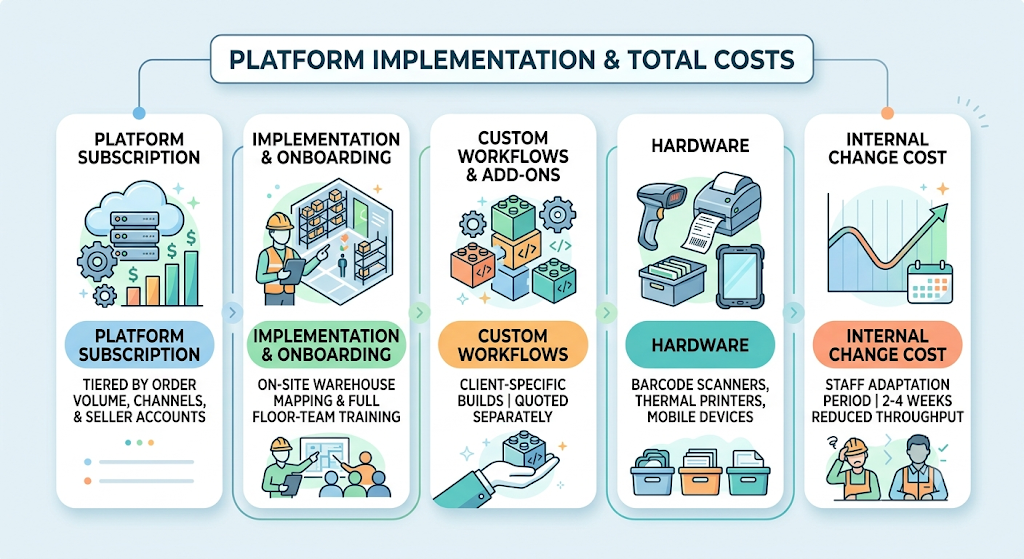
Costs shift with SKU depth, warehouse count, channel count, and add-on scope, so published prices rarely apply directly. Footwear sellers should expect SKU depth to influence tiering more than order volume does.
Build your budget across these five heads rather than the licence line alone.
- Platform subscription, tiered by order volume, active channels, and seller accounts.
- Implementation and onboarding, including on-site warehouse mapping and full floor-team training.
- Custom workflow or add-on development, quoted separately by most vendors, including Base.com for client-specific builds.
- Hardware, covering barcode scanners, thermal label printers, and mobile devices for bin-based picking.
- Internal change cost, meaning two to four weeks of reduced throughput while staff adapts.
Compare platforms on total first-year cost, not monthly subscription. Brands planning how to manage size-wise inventory for footwear should also price the losses they already absorb through cancellations, mis-ships, and dead stock in unsold sizes.
Avoid the Six Mistakes That Undermine Size-Level Accuracy
Most failures here come from process gaps rather than software limits. Each one is preventable with a decision made before go-live.
Check your plan against these six patterns.
- Keeping a single SKU per style. Parent-level SKUs guarantee sync failure at size level. Split every combination into its own code and barcode before migration.
- Mixing sizing standards across the catalogue. UK, EU, and India notations used inconsistently break both listings and picking. Standardise notation catalogue-wide first.
- Buying flat size runs. Ordering equal quantities across all sizes creates dead stock at the extremes every season. Buy against a measured size curve instead.
- Storing full styles in one bin. Pickers then open boxes to find sizes, which silently caps daily dispatch. Assign locations at variant level.
- Lumping exchanges into general returns. You lose the fit data that tells you a style runs small. Track exchanges as their own category from day one.
- Going live during the festive season. Indian ecommerce concentrates heavily into the October–November window, when volumes multiply several times over. Migrate in a trough month.
Run a 45-Day Implementation Plan for Size-Level Control.
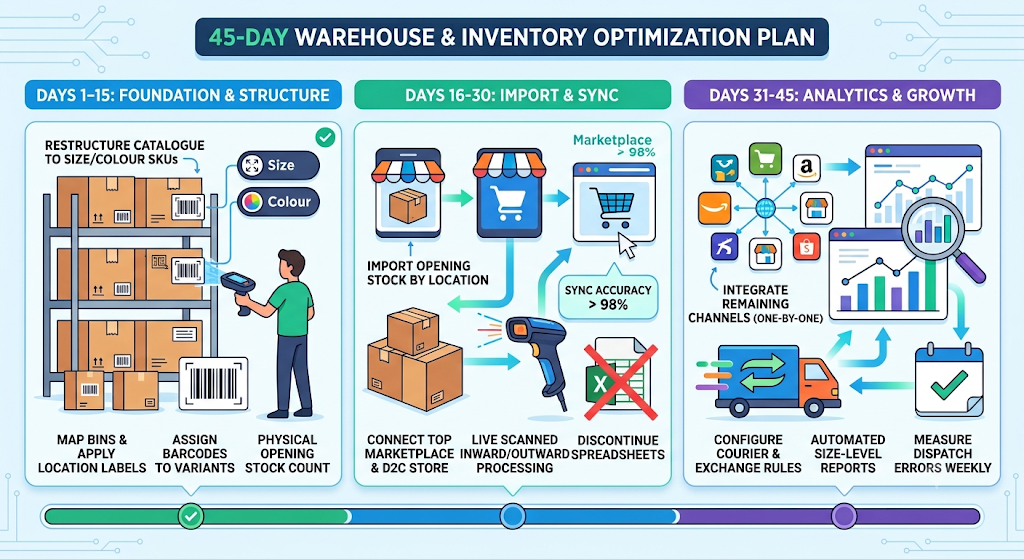
A phased rollout protects dispatch while you restructure inventory. Split the period into three blocks with defined exit criteria.
Treat each checkpoint below as a gate before moving to the next stage.
1. Days 1 to 15: Restructure the Catalogue and Warehouse
Split every style into size and colour SKUs, standardise notation, and assign barcodes to each variant. Map bins at variant level, then print and apply location labels.
Exit criteria: a clean variant-level SKU master signed off, every bin labelled and opening stock counted physically by size.
2. Days 16 to 30: Import Stock and Connect Primary Channels
Import opening quantities against mapped locations, then connect your highest-volume marketplace and your D2C store. Run scanned inwarding and outwarding immediately rather than phasing it in.
Exit criteria: sync accuracy above 98% on connected channels, scanned size verification live at packing, and manual stock uploads discontinued. Brands executing how to manage size-wise inventory for footwear should retire spreadsheets at this checkpoint.
3. Days 31 to 45: Add Remaining Channels and Switch On Reporting
Bring remaining marketplaces online one at a time, never together. Configure exchange statuses, courier rules by PIN code and weight, and scheduled sell-through reports.
Exit criteria: every channel live, exchanges tracked separately, automated size-level reports running and dispatch-error rate measured weekly.
Fix Size-Level Accuracy Before Your Next Season Lands
Footwear brands rarely regret restructuring early. They regret doing it while new season stock arrives and order volumes climb week on week.
Audit your size-level gaps, restructure your SKU master, and commit to a 45-day rollout in a low-volume month. If you want a clear plan for how to manage size-wise inventory for footwear across your exact style count, size range, and channel mix, book a Base.com operations review and get the implementation mapped to your own numbers.