

An inventory management system in India does one job: it keeps the number your system shows and the number in your warehouse the same. When those two numbers diverge- and they always do without the right system- you oversell on channels, stock out on bestsellers, hold dead inventory you cannot see, and make procurement decisions on data that is already wrong.
For Indian D2C brands operating across Amazon, Flipkart, Myntra, Meesho, and a D2C website simultaneously, the divergence happens fast. For example, a return lands in the warehouse but is not quality-checked and restocked for four days. A stock transfer between two nodes is recorded manually and entered incorrectly. An RTO arrives but is not counted back into available inventory until the weekly reconciliation. Each event is small. In aggregate, they produce an inventory picture that has nothing to do with reality.
This post breaks down the features of an inventory management system in India that actually move the needle for growing D2C brands, and where the major platforms in the Indian market differ on each one.
Why Most Brands Outgrow Their First Inventory Management System in India Quickly
The first inventory management system in India that most D2C founders use is a spreadsheet. It works until it does not. The failure mode is predictable: the spreadsheet cannot update in real time, cannot enforce rules, cannot sync across channels, and cannot flag problems automatically.
Next, the second system most brands move to is whichever OMS their marketplace integration requires or recommends. Often, these tools handle order routing well. Many of them handle inventory counts poorly. They track what was shipped but not what was returned, what was damaged in transit, what is on a purchase order, or what is allocated to a pending order but not yet dispatched.
An inventory management system in India that only counts outbound transactions is an incomplete system. The D2C growth stage requires inventory visibility across the full cycle: inbound, storage, allocation, dispatch, and returns. Each stage changes the number.
Notably, Indian D2C as a segment is growing at approximately 40% CAGR. The India ecommerce market is at $226 billion. At that scale and velocity, the brands that build inventory discipline early scale without operational chaos. The ones that do not spend their growth capital on firefighting stockouts, overstock write-offs, and overselling cancellations.
Feature 1: Real-Time Multi-Channel Stock Sync
Why it Matters
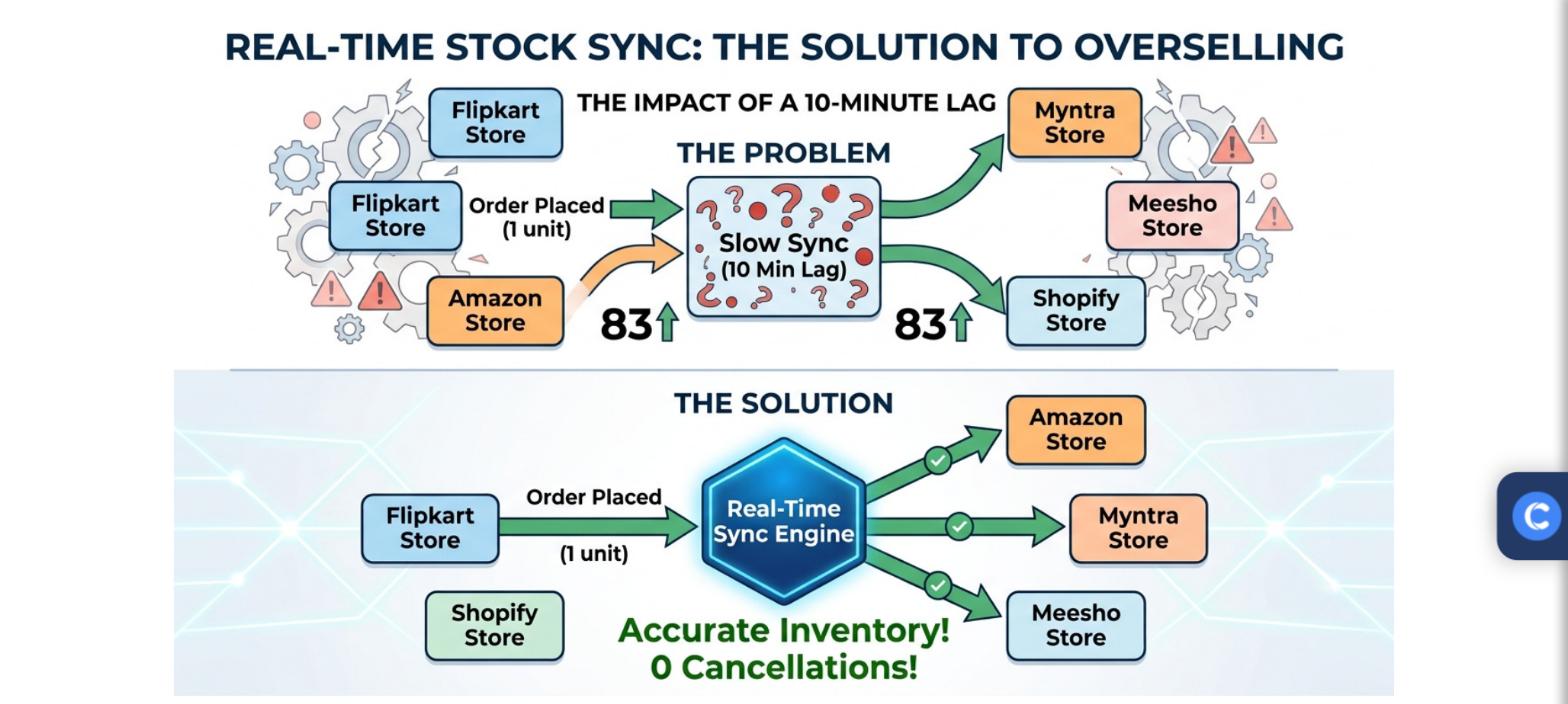
When a customer buys a unit on Flipkart, that unit must be deducted from available inventory on Amazon, Myntra, Meesho, and your Shopify store immediately, not after a 10-minute sync interval.
In practice, a 10-minute lag across five channels at 500 orders per day means the system is running on outdated inventory data for approximately 83 orders at any given moment. Some of those orders will be placed on inventory that no longer exists. The result is overselling, marketplace cancellations, and SLA penalties.
Where Platforms Differ
For instance, Unicommerce offers real-time sync on paid plans with a 10-minute delay on the free tier. Increff syncs inventory and orders in under 30 seconds. EasyEcom, Browntape, OMS Guru, Vinculum, and FYND all offer stock sync but do not comparably publish latency specifications.
Base.com’s inventory management system in India syncs stock across all channels in real time from a unified inventory pool. Every sale, return, cancellation, and adjustment updates the same central count immediately. Delta-based updates mean only changed quantities are pushed, reducing sync overhead while maintaining accuracy. The system validates inventory before pushing updates, ensuring channel counts are never inflated by a processing lag.
What This Prevents
Overselling on one channel while stock exists on another. Marketplace cancellation penalties from SLA violations. The whipsaw effect of manually correcting channel counts after an oversell often creates under-stocking on other channels.
Feature 2: Inventory Allocation Per Channel
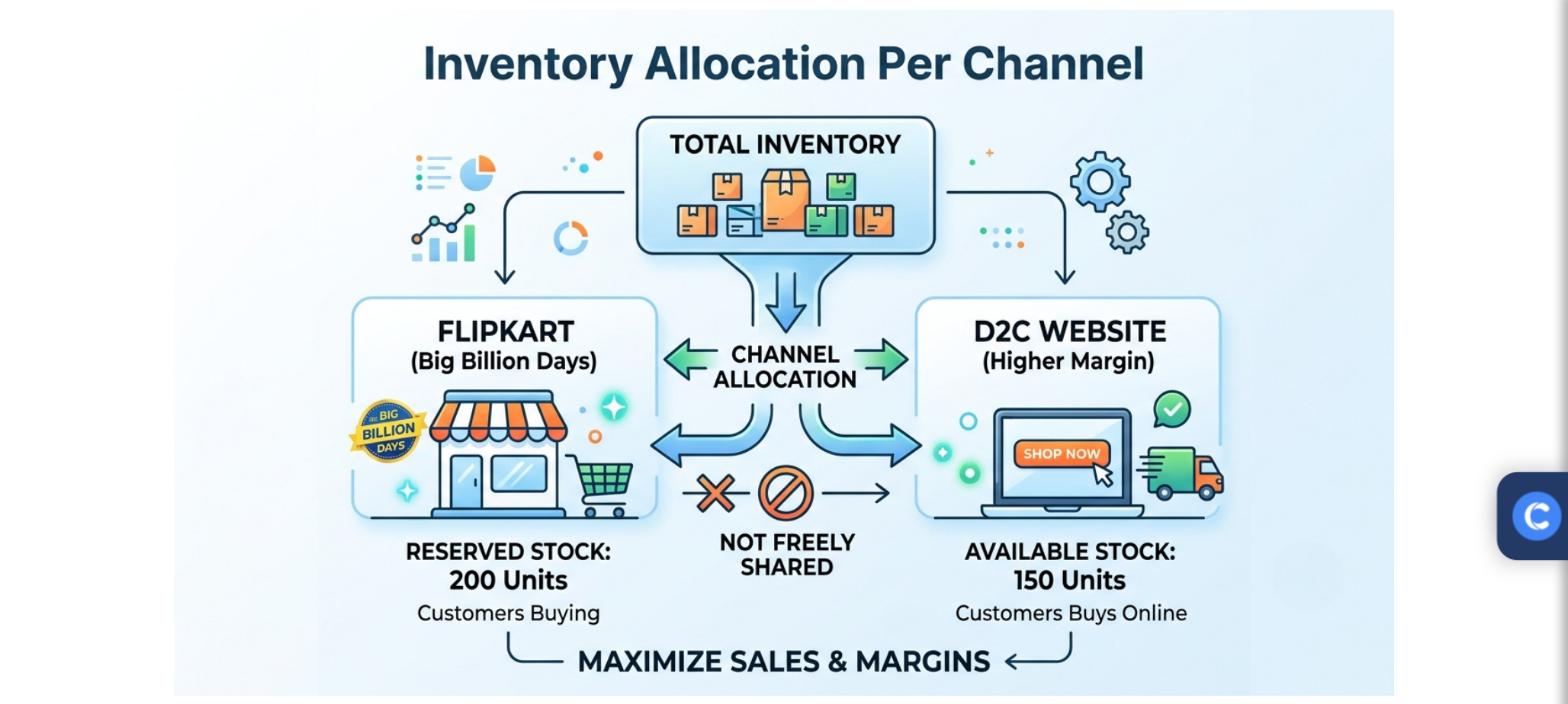
However, not all inventory should be freely shared across all channels. A brand might want to reserve 200 units for Flipkart’s Big Billion Days while keeping another 150 available for their D2C website, where margins are higher. Without channel-level allocation, the inventory management system in India treats all stock as a single undifferentiated pool.
What Good Allocation Looks Like
Base.com’s inventory management system in India supports inventory allocation per channel. You define how many units of a SKU are available to each channel. When one channel’s allocated units run out, the system does not automatically pull from another channel’s reserve. Orders on the depleted channel are blocked until you manually or programmatically adjust the allocation.
As a result, this gives operations teams the ability to manage channel-level stock commitments during sale events, protect D2C margins by not oversupplying marketplace channels, and test new channels with controlled inventory exposure before opening the full catalogue.
Competitive Landscape
Similarly, both Unicommerce and Increff support inventory allocation per channel. Vinculum, Browntape, OMS Guru, and FYND also support this feature at the basic level. It is widespread enough that its absence is a disqualifier for any inventory management system in India used at scale. The differentiation is in the granularity of the allocation rules and how they interact with real-time sync.
Feature 3: Multi-Warehouse Management

Generally, most D2C brands with more than ₹2-3 crore monthly GMV operate from more than one fulfillment location. A primary owned warehouse, a 3PL node in another city, and possibly a marketplace-operated node like FBA or Flipkart Advantage. Each location has its own stock count. Orders need to be routed to the warehouse closest to the customer, with the right inventory, at the lowest fulfillment cost.
An inventory management system in India that sees all warehouses as one does not give you the location-level information you need to make those routing decisions correctly.
How Base.com Handles Multi-Warehouse
Base.com manages multiple warehouse nodes from a single dashboard. Each warehouse has its own bin configuration, stock levels, channel allocation rules, and fulfillment SLAs. The system routes orders to the optimal fulfillment node based on inventory availability, proximity to the delivery pincode, and configurable priority rules.
Cross-location order allocation, splitting an order across two warehouses when no single node has all the items, is supported natively. This prevents the situation where an order is rejected by the primary warehouse because one SKU is out of stock there, even though another node has it.
Competitive Gaps
In contrast, Browntape and OMS Guru have no multi-warehouse management. FYND does not support it at the WMS level. Vinculum does not offer multi-warehouse WMS capability. EasyEcom supports multi-warehouse inventory sync but lacks the bin-level location control that differentiates physical warehouse management from count tracking.
Unicommerce and Increff both support multi-warehouse management properly. Among these three, Base.com, Unicommerce, and Increff, the differentiators are in the depth of bin-level control and the integration between warehouse management and the broader inventory management system in India.
| Feature | Base.com | Unicommerce | Increff | EasyEcom | Browntape | OMS Guru | FYND |
| Multi-warehouse management | Yes | Yes | Yes | Yes | No | No | No |
| Inventory allocation per channel | Yes | Yes | Yes | Yes | Yes | Yes | Yes |
| Real-time stock visibility | Yes | Yes | Yes | Yes | Yes | Yes | Yes |
| Bin-level tracking | Yes | Yes | Yes | No | No | No | No |
| Barcode scanning | Yes | Yes | Yes | No | No | No | No |
| Stock alerts | Yes | Yes | Yes | Yes | Yes | Yes | Yes |
| Batch tracking | Yes | Yes | Yes | No | No | No | No |
| Multi-warehouse WMS | Yes | Yes | No (limited) | No | No | No | No |
Feature 4: Batch Tracking, LOT Management, and FIFO/FEFO Enforcement
Why It Matters for Indian D2C
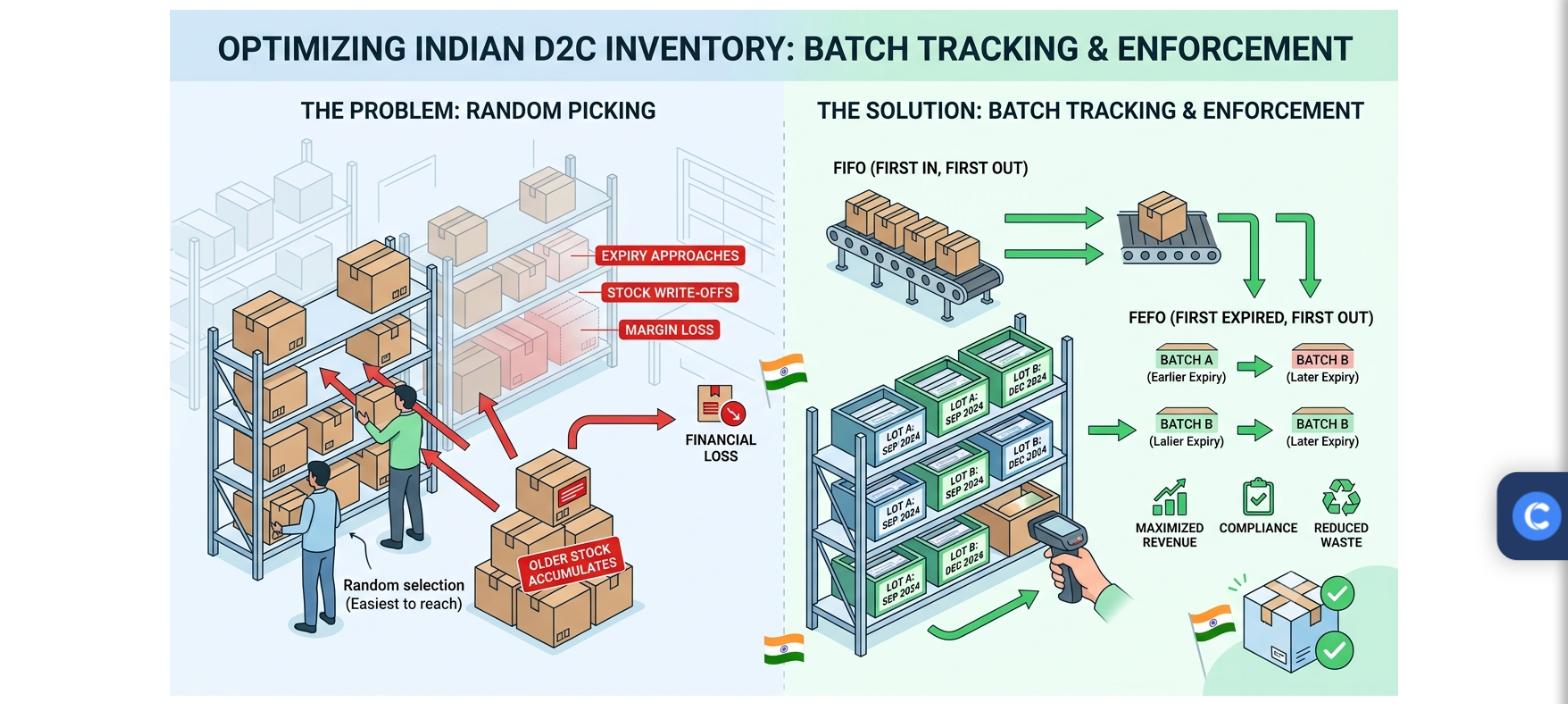
Specifically, batch tracking is a compliance requirement for FMCG, nutraceuticals, beauty, pharma-adjacent, and food categories. It is also a financial protection mechanism for any brand where products have a shelf life or where a manufacturing defect in one batch could require a recall.
Without batch tracking in your inventory management system in India, a warehouse team picks whichever unit is physically easiest to reach, often the newest stock, because it was placed in front. Older batches accumulate at the back. When their expiry approaches, you either rush a markdown or write them off. Both outcomes destroy margin.
Here, FIFO (First In First Out) enforcement ensures the oldest stock ships first. FEFO (First Expired First Out) is the relevant method for products where expiry dates vary between batches. A nutraceutical batch manufactured in November may expire before a batch manufactured in October if the latter has a longer shelf life due to a formulation change.
Base.com’s Batch and LOT Tracking
Base.com’s inventory management system in India assigns LOT and batch numbers at inbound. Pick instructions route warehouse staff to the correct batch based on FIFO or FEFO rules configured per SKU category. A picker cannot select a newer batch when an older batch is available and in-policy, the barcode scan verifies the batch against the pick instruction.
Ultimately, this closes the shelf-life leakage that most Indian D2C brands in health, beauty, and food categories lose silently every quarter.
Where Competitors Fall Short
Batch tracking is a significant differentiator between platforms. Unicommerce supports batch management with FIFO/FEFO enforcement. Increff supports batch-level tracking with inventory health monitoring. EasyEcom, Browntape, OMS Guru, and FYND do not support batch tracking.
For any Indian D2C brand in a category with shelf life or batch-specific compliance requirements, the absence of batch tracking in an inventory management system in India is a hard disqualifier.
Feature 5: Stock Reservation and Inventory Control
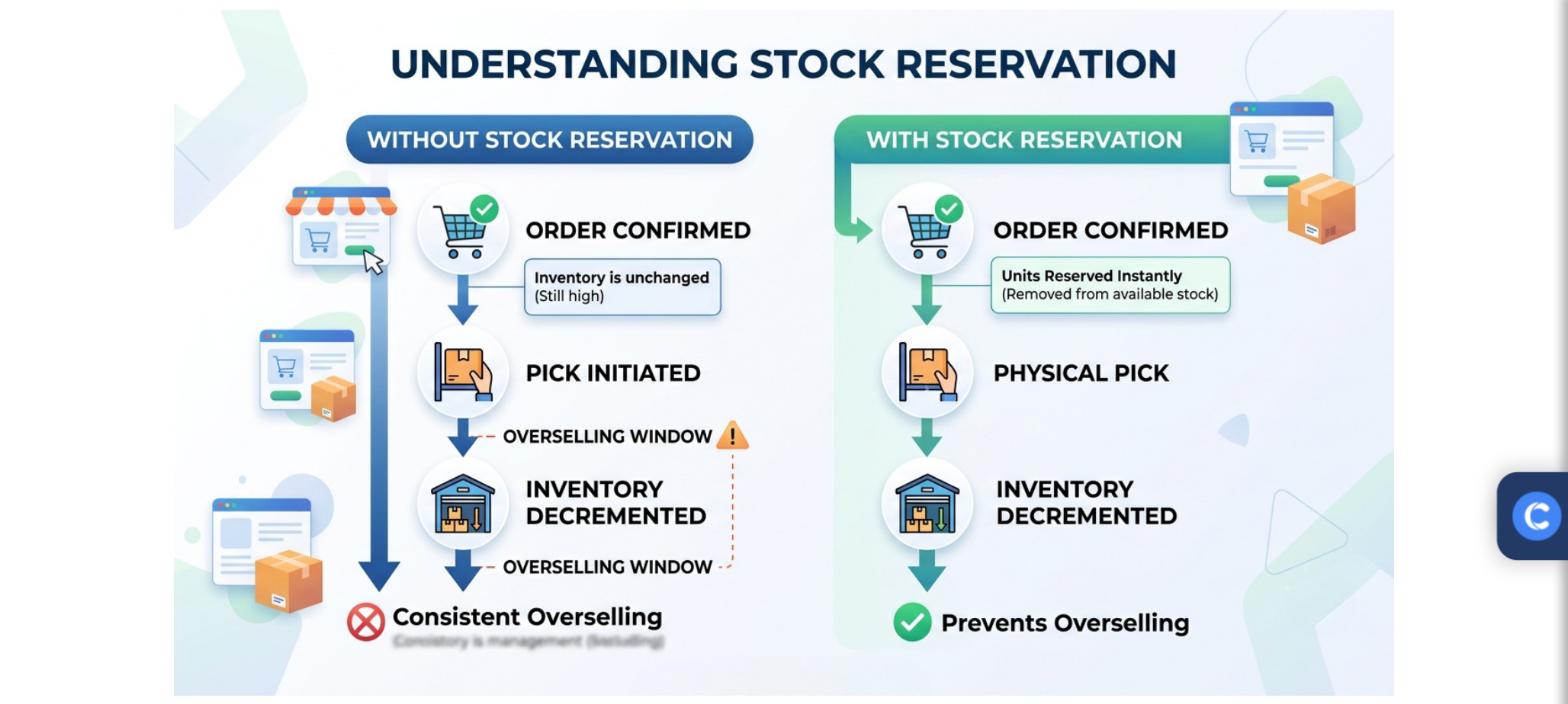
In short, stock reservation is the mechanism that prevents the same unit from being committed to two orders on two channels simultaneously. Without it, real-time sync alone does not prevent overselling; it only reduces the window during which overselling can occur.
When an order is confirmed, the inventory management system in India immediately reserves the required units. Those units are removed from available inventory across all channels before the physical pick happens. A second order on a different channel that arrives one second later sees the correct reduced inventory.
Without stock reservation, the sequence is: order confirmed → pick initiated → inventory decremented. Between confirmation and inventory decrement, other channels see inflated available stock. At high order volumes, this window produces consistent overselling.
Base.com’s Inventory Control Module
Base.com’s inventory control system reserves stock at order confirmation. The reservation is channel-aware; a reserved unit on Amazon is not visible as available on Flipkart. The reservation releases automatically if the order is cancelled or fails processing. There is no manual step required to synchronize reservations across channels.
Additionally, this is integrated with the broader inventory management system in India; stock reservation interacts with channel allocation rules, meaning a reserved unit on one channel cannot exceed the allocation defined for that channel.
Feature 6: Inventory Health Tracking, Aging, Velocity, and Dead Stock
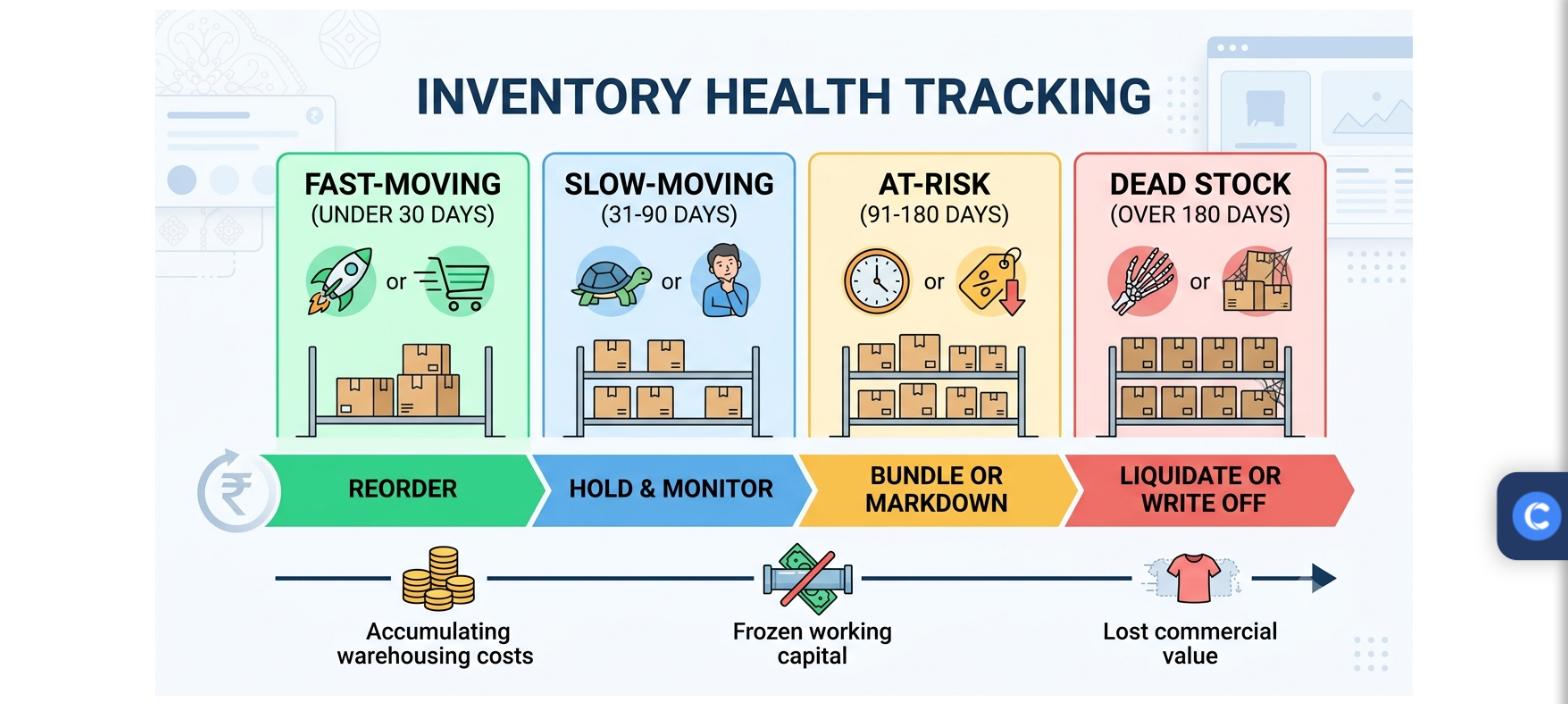
An inventory management system in India that only shows you how many units you have is giving you half the picture. The other half is how long those units have been sitting and how fast they are moving.
Indian D2C brands operating at 2-3 inventory turns per year, which is common at the early growth stage, have inventory sitting for 120-180 days. During that time, warehousing costs accumulate, fashion and trend-sensitive SKUs lose commercial value, and working capital that could fund new product launches or marketing sits frozen on a shelf.
Inventory health tracking separates SKUs into velocity tiers: fast-moving (under 30 days), slow-moving (31-90 days), at-risk (91-180 days), and dead (over 180 days). Each tier requires a different operational response: reorder for fast-moving, hold and monitor for slow-moving, bundle or markdown for at-risk, liquidate or write off dead.
What Base.com and Competitors Offer
By comparison, Increff’s inventory management system in India is specifically strong here. It offers inventory aging analysis, sales velocity reports, and category/SKU-wise insights, designed for brands with high SKU counts where manual monitoring is impossible.
Unicommerce offers inventory forecasting and low stock notifications as part of its centralized inventory database. It provides advanced dashboards with channel-specific alerts.
Base.com’s warehouse efficiency dashboard tracks aging inventory by bin; stock that has not moved in 30, 60, or 90 days is flagged automatically. The Total Business P&L Dashboard connects aging inventory to financial exposure, showing the working capital locked in each aging bucket. This is a level of financial-operational integration that neither Unicommerce nor Increff offers in a single dashboard.
Feature 7: Bundles, Kits, and Product Variant Management
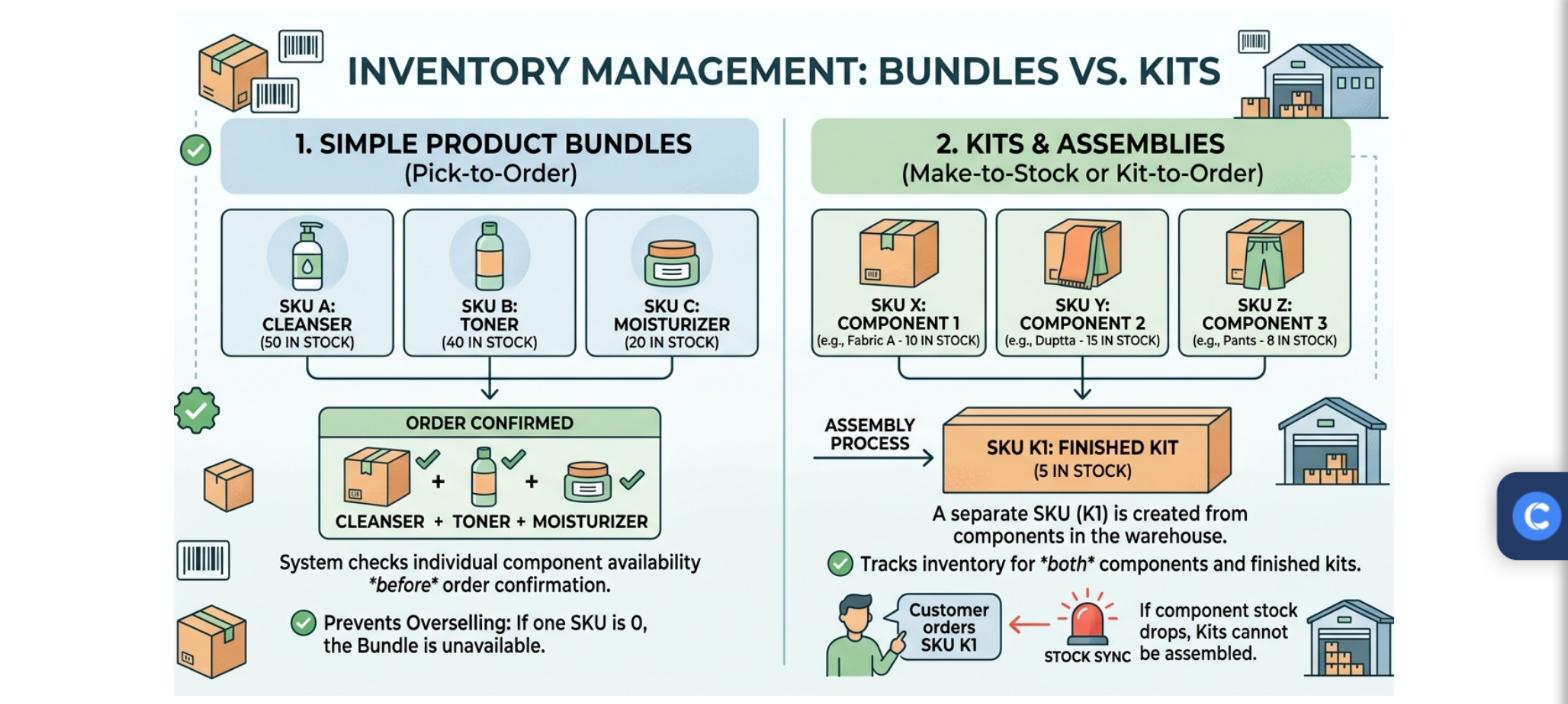
Meanwhile, D2C brands increasingly use product bundles to increase average order value and manage inventory across SKUs. A skincare brand bundles a cleanser, toner, and moisturizer. A nutrition brand bundles protein powder with a shaker. A fashion brand bundles a kurta set with a dupatta.
Without bundle management in the inventory management system in India, every bundle sale requires a manual deduction from three separate SKU counts. Overselling on a bundle happens when the system shows the bundle as available, but one component SKU is already at zero.
Moreover, kit management is the more complex version: a kit is assembled from components at the warehouse level, and the inventory management system must track both component stock and finished kit stock. Kits assembled to order require the system to check component availability before confirming the order, not after.
How Base.com Handles This
Base.com’s inventory management system in India supports product variant management and bundle/kit configurations at the catalogue level. A bundle sale decrements each component SKU in real time. The system checks component availability before order confirmation. If one component is out of stock, the bundle is shown as unavailable.
Unicommerce offers bundles and kits management explicitly as a feature within its inventory module. This is one area where Unicommerce’s depth is worth noting; it lists bundles and kits as a named capability within its centralized inventory database.
Vinculum, Browntape, OMS Guru, and EasyEcom support product variants management for channel-level data but do not offer full kit/bundle inventory logic.
Feature 8: Omnichannel Inventory, Online, Offline, and Dark Store Unified
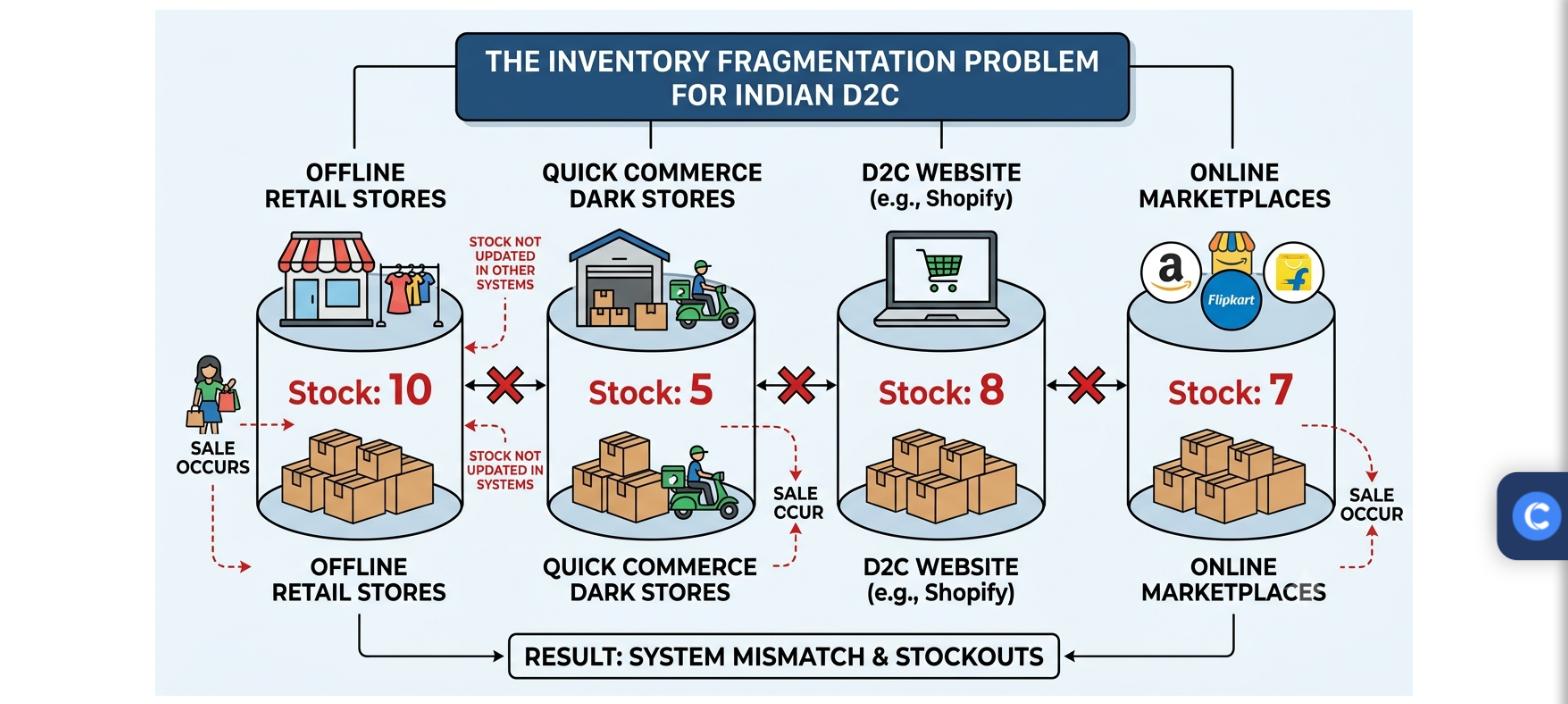
Separately, Indian D2C brands adding offline retail, pop-up stores, or quick commerce channels face an inventory split that most systems handle badly. Offline stores have their own stock. Quick commerce dark stores have their own stock. The D2C website has its own stock. Marketplaces have their own stock.
Without a unified inventory management system in India, the same SKU has four separate inventory records in four systems. A sale in the offline store is not reflected in the online availability. A quick commerce fulfillment depletes dark store stock without updating the Shopify storefront. The result is a persistent mismatch between where the stock physically is and where the system thinks it is.
Base.com’s Unified Inventory View
Base.com supports offline order integration and omnichannel inventory management from a single platform. Physical store stock, dark store stock, and online channel stock are all managed in the same inventory pool with location-level allocation rules.
Unicommerce explicitly supports a unified inventory view across online and offline, integrates with POS and ERP systems, and includes hyperlocal fulfillment capabilities. Increff offers a single view of inventory across all sales channels with dynamic allocation based on demand.
Browntape, OMS Guru, and EasyEcom do not offer offline order integration at the inventory level. FYND, as a platform built for omnichannel retail, handles this well but requires significant integration work.
For Indian D2C brands entering quick commerce or offline retail, the inventory management system in India must handle this unification from day one; retrofitting it later means a data migration and reintegration project while the business is running.
Feature 9: Return Inventory Processing and Restock Speed
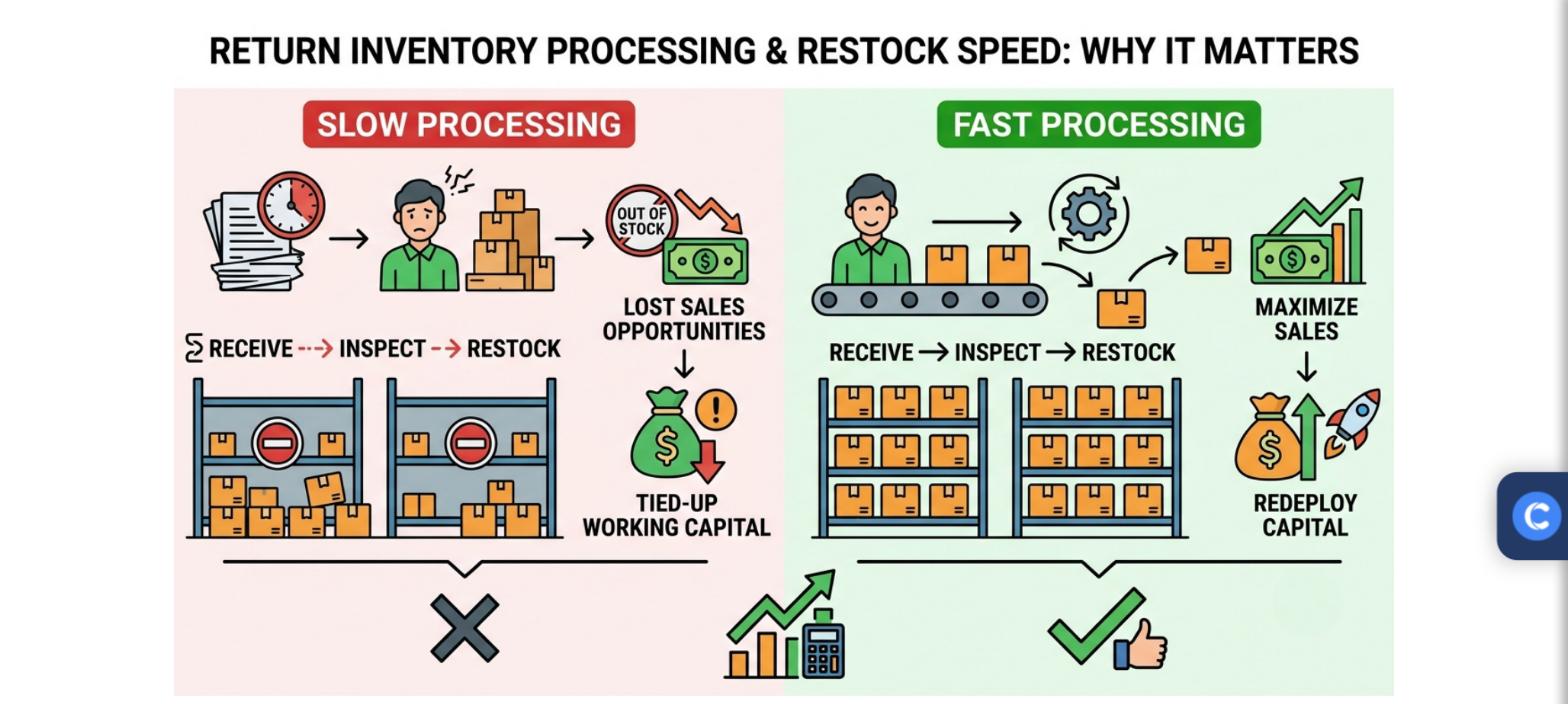
Importantly, returns in Indian ecommerce are not low. COD return rates run 25-30% across categories. Fashion D2C sees 30-45% RTO. Every returned unit that sits uninspected in a returns bay is a unit not counted in available inventory. The inventory management system in India shows lower stock than actually exists. Reorders fire earlier than necessary. Working capital gets deployed into stock you already have but cannot see.
The inventory management system in India must close the returns loop: a returned unit is received, inspected, categorized as sellable or damaged, and restocked to its bin location, with the available inventory count updating immediately upon restock, not at the end of the day or after a manual audit.
What Base.com Integrates
Base.com’s returns processing integrates directly with the inventory management system in India. A returned unit scanned at inbound generates an inspection task. The inspection outcome, sellable, damaged, or refurbish, determines the next inventory action. Sellable units are restocked to their bin location, and the channel-visible inventory count updates immediately. Damaged units are quarantined with their status logged against the original order for claim purposes.
This 48-hour or faster return-to-restock cycle prevents phantom stock buildup. The inventory management system in India reflects reality rather than a snapshot from the last manual reconciliation.
Return reconciliation, matching returned units against expected credits from marketplaces, is a separate financial function. Base.com handles both the physical return-to-inventory workflow and the financial credit tracking in the same system.
Feature 10: Inventory Reports, Channel-Wise Performance, and Demand Forecasting

An inventory management system in India that tracks stock but cannot tell you which SKUs are growing, which are dying, and which channels are driving velocity is a data system without insight. The reports layer is where operational data becomes a decision-making input.
Relevant reports for a growing D2C brand:
- Inventory turnover by SKU and category
- Channel-wise sell-through rate
- Aging analysis by value bucket
- Stockout frequency per SKU
- Reorder velocity per supplier
- Return rate by SKU and channel
What the Platforms Offer
Overall, all eight major platforms in the competitive mapping support sales reports, returns reports, and inventory reports at the basic level. The differentiation is in depth.
Unicommerce offers advanced dashboards with channel-specific alerts and routine performance reports. Increff specifically offers inventory aging analysis, sales velocity reports, and category/SKU-wise insights, oriented toward brands optimizing a large catalogue. FYND provides omnichannel reporting with unified reports across channels and real-time retail analytics.
Base.com’s inventory management system in India provides inventory reports, channel-wise performance reports, order fulfillment reports, and customer reports, with the Total Business P&L Dashboard overlaying financial outcomes onto operational metrics. Channel-wise performance in Base.com shows not just which channel sold the most but which channel contributed the most to actual margin after fees and fulfillment costs.
EasyEcom offers advanced reporting with business intelligence features. Browntape and Vinculum offer basic sales and inventory reports without the analytics depth of the top-tier platforms.
Choosing the Right Inventory Management System in India: Decision Framework
Finally, growing D2C brands evaluating an inventory management system in India should run their evaluation against this criteria set:
| Criteria | What to Verify |
| Sync speed | Is it truly real-time across all channels, or interval-based? |
| Channel allocation | Can you reserve inventory per channel separately? |
| Multi-warehouse | Does it manage physical warehouse locations, not just counts? |
| Batch tracking | Does it enforce FIFO/FEFO at the pick level? |
| Returns integration | Does a returned unit immediately update available inventory? |
| Bundle/kit logic | Does a bundle sale decrement components in real time? |
| Offline/omnichannel | Can it unify online, offline, and quick commerce in one pool? |
| Reporting depth | Does it show velocity, aging, and channel margin, not just counts? |
| Scalability | Can it handle 10x your current order volume without architectural changes? |
Base.com, as an inventory management system in India, satisfies all nine criteria. The features that separate it from the competitive field, digital warehouse view, in-system barcode creation, automatic Tally/Zoho sync, AI-assisted catalogue listing, and the Total Business P&L Dashboard, are not inventory management features in isolation. They reflect a platform designed around the complete operational lifecycle of an Indian D2C brand: from inbound stock to customer delivery to returns processing to financial reconciliation, in one connected system.
An inventory management system in India that handles only the middle of that chain, in order to dispatch, is a partial solution. At the growth stage, partial solutions create partial visibility, and partial visibility creates margin leakage that compounds every month.


[…] Inventory management covers everything between a purchase order being raised and a product reaching a customer. That includes receiving stock, storing it, tracking it across locations, and updating counts the moment something sells, returns, or gets damaged. […]
[…] practices to follow, since manual tracking cannot keep pace with multi-channel order volume. It centralizes inventory, order, and workforce data into one system instead of […]
[…] Inventory management software tracks what you have, where it sits, and when to reorder. It is purpose-built, narrow, and usually quick to set up. Base.com’s order execution layer often sits alongside this kind of tool for sellers who are not yet ready for a full ERP migration. […]
[…] Inventory synchronisation […]