

The best software to manage Amazon, Flipkart, and Myntra orders is whichever tool solves the problem currently costing you the most money. Most sellers buy features. Better sellers diagnose the symptom first, then buy the fix.
This guide works backwards from ten problems Indian marketplace sellers actually face, then names the part of the best software to manage Amazon, Flipkart, and Myntra orders that fixes each one. Each section names the symptom, the tool that addresses it, and how to tell whether that problem is yours today.
How do you diagnose which marketplace problem is costing you money right now?
Marketplace operations fail quietly. Revenue keeps arriving while margin leaks through penalties, returns, and errors nobody attributes correctly.
Read the symptom column below and find the row that describes your week. Each row points to one component of the best software to manage Amazon, Flipkart, and Myntra orders. That row points to the section worth reading first, rather than reading all ten.
| # | Symptom you notice | Underlying problem | Section |
| 1 | Staff switching between seller panels all day | Orders are fragmented | Problem one |
| 2 | Cancelling orders you cannot fulfil | Inventory does not sync | Problem two |
| 3 | Customers receiving wrong items | Picking has no verification | Problem three |
| 4 | Penalties after every sale event | Dispatch misses SLA windows | Problem four |
| 5 | Settlements smaller than expected | Marketplace payments unreconciled | Problem five |
| 6 | High undelivered and RTO rates | Delivery attempts fail repeatedly | Problem six |
| 7 | Returned stock sitting on the dock | Reverse logistics has no process | Problem seven |
| 8 | One courier failing entire regions | Single-carrier dependency | Problem eight |
| 9 | Growth blocked by warehouse capacity | No fulfilment infrastructure | Problem nine |
| 10 | GST filings taking days to reconcile | Compliance data lives in silos | Problem ten |
India’s ecommerce market runs at roughly $226 billion, and COD return rates between 25% and 30% mean several of these problems overlap for most sellers simultaneously.
Problem one: why do your orders sit scattered across three separate seller panels?
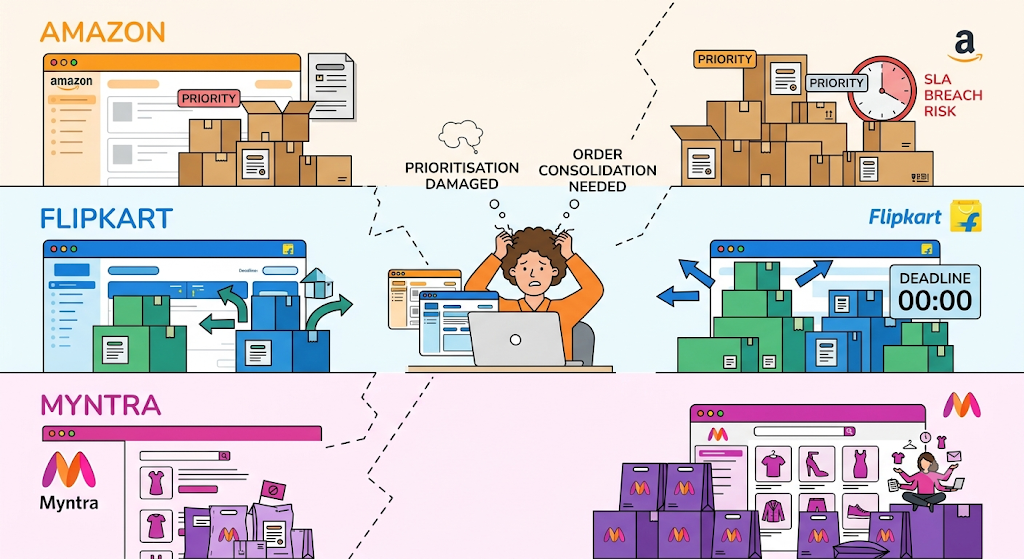
Selling on Amazon, Flipkart and Myntra means three dashboards, three dispatch queues and three sets of rules. Your team spends its day switching tabs rather than shipping orders.
Fragmentation costs time, but the real damage is prioritisation. Order consolidation is the first job any part of the best software to manage Amazon, Flipkart, and Myntra orders must perform. Nobody can see which order is closest to breaching its SLA when the orders live in different systems.
The symptom: staff log into multiple panels daily and still miss urgent orders.
The tool: Base.com. Base.com consolidates marketplace orders into a single queue, allocates inventory against them, and pushes dispatch confirmations back to each platform. Because warehouse execution and returns run on the same system, stock counts stay consistent rather than drifting between tools.
Channel-aware prioritisation matters most here. A Flipkart order facing a tight dispatch window rises above a less urgent one automatically, rather than waiting for somebody to notice.
What changes once you fix this
- One queue replaces three panels, ordered by urgency rather than arrival
- Dispatch decisions follow SLA pressure instead of individual judgement
- Inventory, orders and returns stop disagreeing with each other
Cost of ignoring it: penalties accumulate on whichever marketplace your team checks last.
Problem two: why do you keep cancelling orders you cannot actually fulfil?

Selling the same stock across three marketplaces without synchronised inventory guarantees overselling. Each platform believes it has your full quantity available.
Cancellations damage more than the single order, which is why inventory sync sits at the centre of the best software to manage Amazon, Flipkart, and Myntra orders. Amazon account health, Flipkart seller ratings, and Myntra standing all degrade with every failed fulfilment.
The symptom: you cancel orders weekly, and your seller ratings keep slipping.
The tool: Unicommerce. Unicommerce carries India’s deepest marketplace connector library and has handled years of Amazon, Flipkart, and Myntra edge cases. Its inventory allocation logic maintains a single stock pool and updates every channel as quantities move.
Sellers on many channels gain most from that accumulated maturity, because rare failure modes have already been encountered by somebody else.
What changes once you fix this
- Every marketplace sees accurate available quantity continuously
- Cancellation rates fall, protecting account health scores
- Buffer stock becomes unnecessary, releasing working capital
Cost of ignoring it: buffer inventory sits idle across three platforms to prevent a problem software solves.
Problem three: why do customers keep receiving the wrong item in their parcel?

Manual picking works until similar-looking variants multiply. A picker comparing two nearly identical shades will eventually grab the wrong one.
Myntra sellers feel this most, because fashion catalogues multiply into size and colour combinations that look alike on a shelf. Warehouse accuracy separates the best software to manage Amazon, Flipkart, and Myntra orders from basic order tools.
The symptom: wrong-item complaints arrive regularly, and returns exceed your category norm.
The tool: Increff. Increff tracks inventory at piece level, assigning identity to individual units rather than counting a bin. Scan verification at pick and pack stops the wrong unit from leaving the building.
The same granularity makes returns grading reliable, because the system knows exactly which unit came back and in what condition.
What changes once you fix this
- Wrong-item shipments largely disappear from your return mix
- Returns grading becomes accurate instead of approximate
- Marketplace quality complaints stop threatening your listings
Cost of ignoring it: each wrong shipment costs forward freight, return freight, a replacement, and usually the customer.
Problem four: why do penalties arrive after every major marketplace sale event?
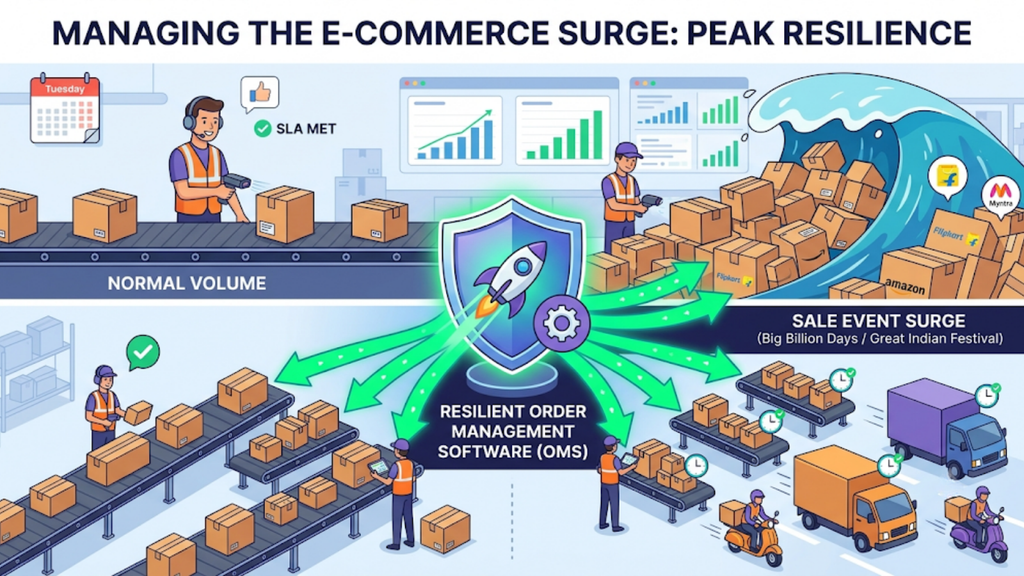
Sale events multiply order volume without extending dispatch windows. Processes that work on ordinary Tuesdays collapse under Big Billion Days or Great Indian Festival volume.
Flipkart penalises SLA breaches most aggressively, and those penalties compound across thousands of orders during a spike. Peak resilience is where the best software to manage Amazon, Flipkart, and Myntra orders proves itself.
The symptom: every sale event ends with penalty deductions and exhausted staff.
The tool: Omniful. Omniful was built after quick commerce existed, so it handles compressed dispatch windows natively rather than through adaptation. Sellers combining marketplace orders with Blinkit or Zepto volume get consistent handling across both rhythms.
Its architecture assumes throughput spikes rather than treating them as exceptions.
What changes once you fix this
- Peak volume routes through the same process as normal days
- Dispatch prioritisation holds under load rather than degrading
- Overtime stops functioning as your capacity plan
Cost of ignoring it: your most profitable days generate your largest penalty deductions.
Problem five: why is marketplace settlement consistently lower than you expected?
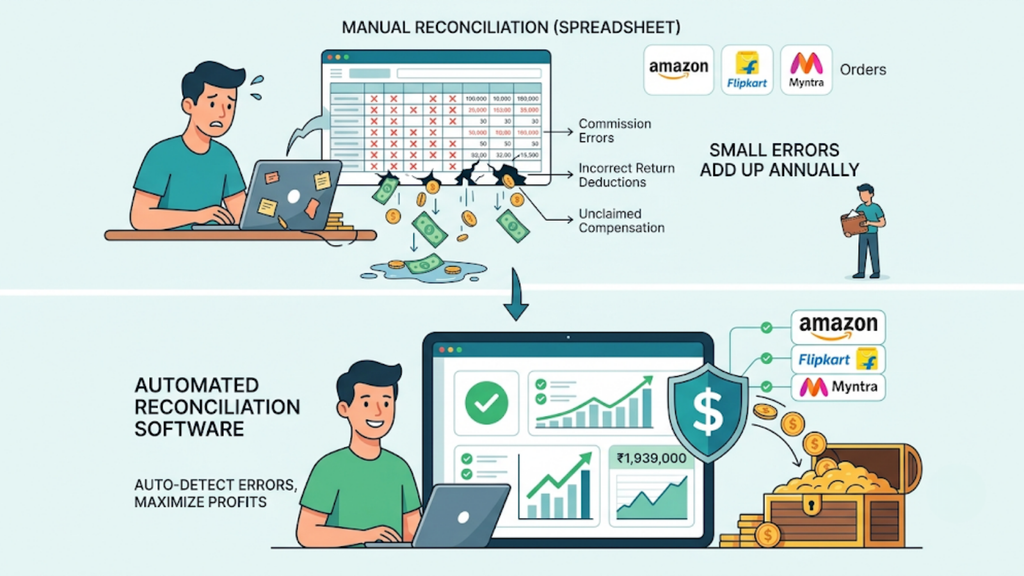
Marketplace settlements carry commission errors, incorrect return deductions, and unclaimed compensation. Sellers who never reconcile simply accept whatever arrives.
The amounts look small individually and meaningful annually, so reconciliation belongs inside the best software to manage Amazon, Flipkart, and Myntra orders rather than in a spreadsheet. Nobody chases a deduction worth a few hundred rupees, and that is exactly why they persist.
The symptom: you cannot explain the gap between expected and received settlement.
The tool: EasyEcom. EasyEcom reconciles marketplace payments against order records, flagging discrepancies between what each platform owes and what it actually paid. It covers orders and warehouse operations alongside that reconciliation.
Sellers mixing marketplace revenue with B2B distribution get both flows in one system.
What changes once you fix this
- Discrepancies surface automatically instead of going unnoticed
- Claims get filed while marketplace windows remain open
- Channel profitability reflects money received, not money invoiced
Cost of ignoring it: unclaimed deductions compound quietly across every settlement cycle.
Problem six: why do so many of your marketplace deliveries fail on the first attempt?
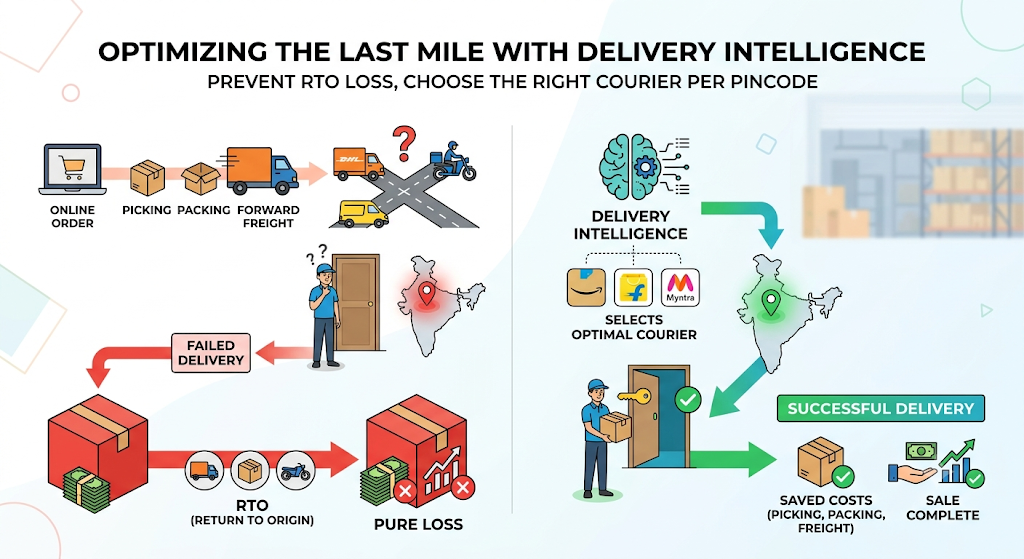
Failed delivery attempts convert into RTO, and RTO converts into pure loss. The order consumed picking, packing, and forward freight before returning unsold.
Courier performance varies sharply by pincode, so the partner that performs well in one state may fail badly in another. Delivery intelligence extends the best software to manage Amazon, Flipkart, and Myntra orders past dispatch.
The symptom: your undelivered rate climbs and RTO costs exceed your return costs.
The tool: ClickPost. ClickPost focuses on post-purchase logistics intelligence, allocating each shipment to the carrier most likely to deliver it successfully in that pincode. Its NDR workflows contact customers before a courier marks an attempt failed.
It complements an order platform rather than replacing one, sitting downstream of dispatch.
What changes once you fix this
- Carrier selection follows delivery data rather than flat rate cards
- NDR resolution happens within the window that still allows delivery
- RTO volumes fall without changing anything about your product
Cost of ignoring it: every failed delivery costs freight twice and returns nothing.
Problem seven: why does returned stock sit unprocessed on your inbound dock?
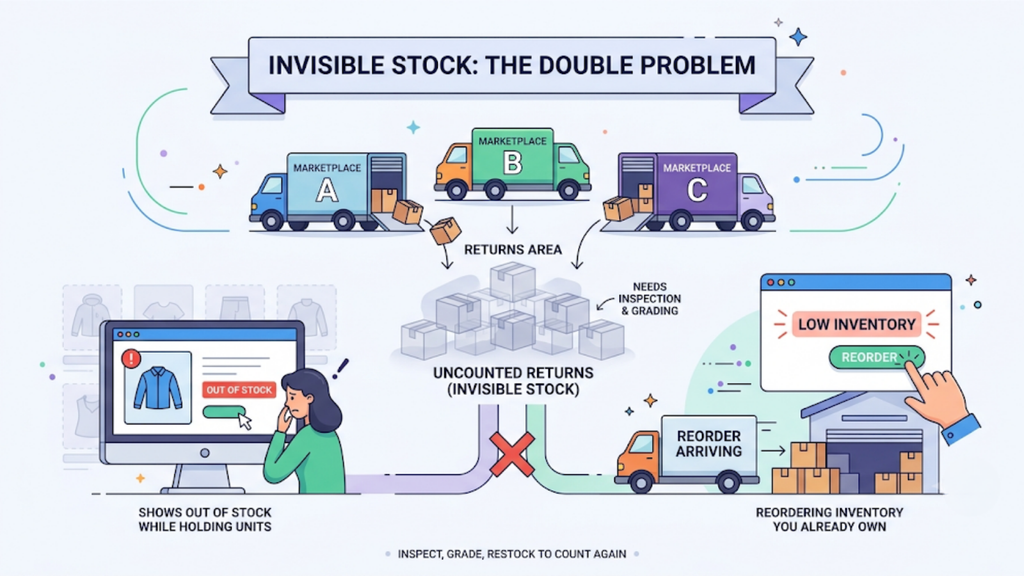
Returned units arriving from three marketplaces need inspection, grading, and restocking before they count as inventory again. Until then, they are invisible stock.
Invisible stock causes two problems simultaneously. You show as out of stock while holding units, and you reorder inventory you already own.
The symptom: returned parcels accumulate faster than your team opens them.
The tool: Shipway. Shipway handles returns automation alongside shipping, structuring the reverse flow from customer request through pickup to receipt. Automated customer communication reduces the support load that returns generate.
Sellers with high customer-initiated return rates, particularly in fashion, gain the most structure here.
What changes once you fix this
- Returned units move from dock to sellable inventory quickly
- Return status queries resolve without an agent answering them
- Reorder decisions reflect stock you actually hold
Cost of ignoring it: you buy inventory that is already sitting unopened in your warehouse.
Problem eight: why does one courier failure disrupt your entire regional delivery?
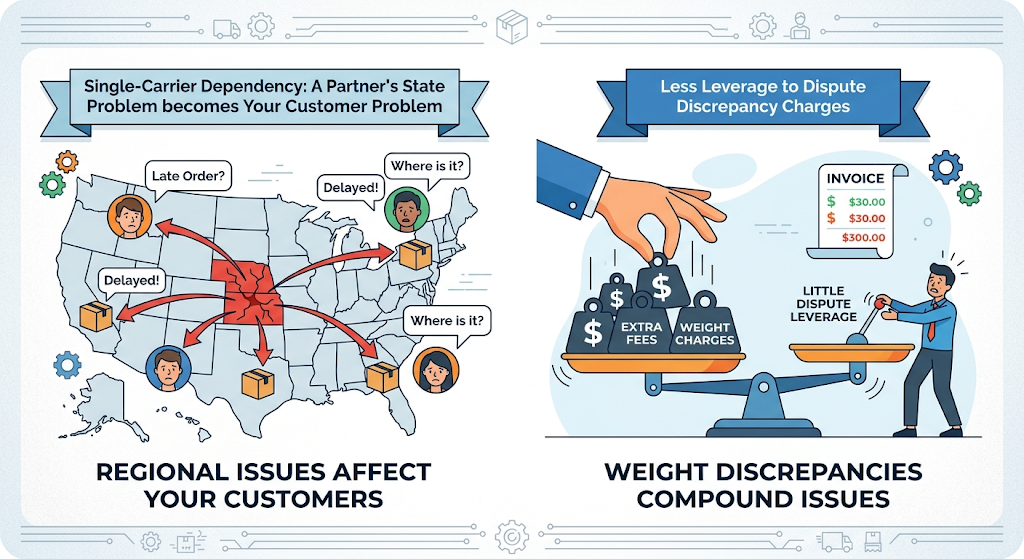
Single-carrier dependency turns a partner’s regional problem into your customer problem. When that courier struggles in a state, every order to that state suffers.
Weight discrepancy charges compound the issue, because a single carrier relationship gives you little leverage to dispute them.
The symptom: delivery complaints cluster by region, and weight charges keep surprising you.
The tool: Shiprocket. Shiprocket aggregates a broad courier network, comparing rates and serviceability by pincode before booking each pickup. Sellers gain fallback options when one partner underperforms in a specific region.
Its weight discrepancy dispute handling addresses a cost most sellers absorb silently.
What changes once you fix this
- Regional failures reroute to an alternative carrier automatically
- Rate comparison happens per shipment rather than per contract
- Weight disputes get filed rather than written off
Cost of ignoring it: one partner’s bad month becomes your customers’ bad experience.
Problem nine: why has warehouse capacity become the limit on your growth?

Some sellers hit a ceiling that software cannot lift, because the constraint is physical space and staffing rather than process. Hiring a warehouse team is a genuine business decision, not a default.
Marketplace fulfilment adds specific requirements, labelling standards, packaging rules, and pickup schedules that a small team learns slowly.
The symptom: you turn down growth because you cannot dispatch more than you do today.
The tool: Eshopbox. Eshopbox operates fulfilment centres with its own software controlling them, handling marketplace dispatch requirements on your behalf. Sellers skip warehouse hiring entirely and keep merchandising in-house.
Per-order pricing scales linearly, so model the point where in-house fulfilment becomes cheaper before committing.
What changes once you fix this
- Capacity stops constraining how much you can sell
- Marketplace packaging and labelling compliance becomes somebody else’s discipline.
- Fixed warehouse cost converts into variable per-order cost
Cost of ignoring it: you cap revenue at whatever your current space allows.
Problem ten: why does GST and TCS reconciliation consume days every month?
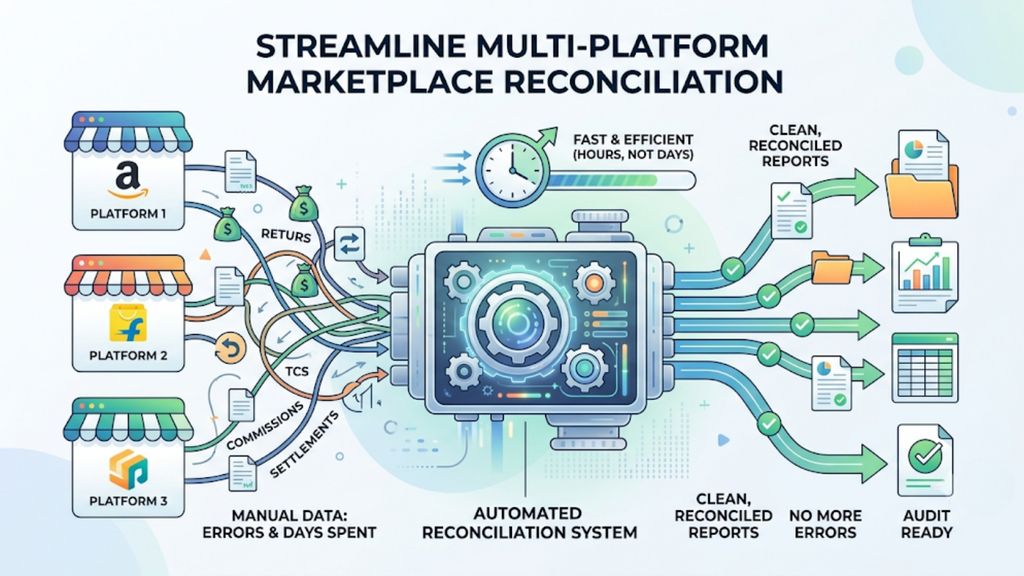
Marketplace selling generates TCS entries, commission invoices, return credits, and settlement adjustments across three platforms. Reconciling them manually takes days your finance team does not have.
Errors here surface during assessment, long after they became expensive to fix.
The symptom: monthly filing requires multiple people and several spreadsheets.
The tool: TallyPrime. TallyPrime handles GST, stock, batches, and compliance reliably, and remains the system most Indian accountants already know. Marketplace settlement and TCS entries flow into a familiar ledger structure.
Marketplace order data reaches it through connectors rather than native integration, so pairing it with an order platform matters.
What changes once you fix this
- Filing becomes a review task rather than a reconstruction task
- TCS and commission entries map to orders automatically
- Compliance risk during assessment drops substantially
Cost of ignoring it: finance time disappears into work software should perform.
Which two problems should an Indian marketplace seller fix first?
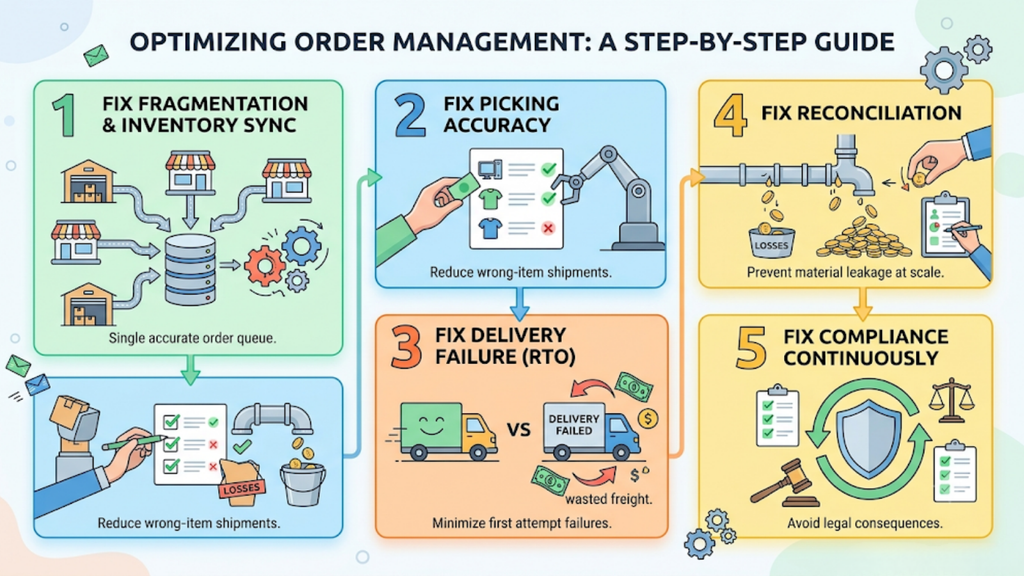
You cannot fix ten problems simultaneously, and buying every part of the best software to manage Amazon, Flipkart, and Myntra orders at once produces ten half-finished projects. Sequence by cost rather than by irritation.
- Fix fragmentation and inventory sync together. These two share a solution, and everything downstream depends on accurate stock and a single order queue.
- Fix picking accuracy next if returns exceed your category norm. Wrong-item shipments are the most expensive error you control directly.
- Fix delivery failure next if RTO exceeds returns. Failed first attempts cost freight twice and recover nothing.
- Fix reconciliation once volume makes leakage material. Small deductions matter only at scale, but at scale they matter a lot.
- Fix compliance continuously rather than at deadlines. This is the only problem on the list with legal consequences.
How do these tools combine without creating a fragmented stack?
Most sellers run two or three of these tools rather than all ten. The best software to manage Amazon, Flipkart, and Myntra orders behaves well alongside others, and these five rules keep the combination manageable.
- One system owns inventory. Two tools holding stock counts will eventually disagree, and your team will trust neither.
- Orders flow downstream only. Marketplaces feed the order platform, which feeds warehouse and shipping. Loops create duplicate dispatches.
- Returns write back to inventory automatically. Manual restocking is where accuracy dies.
- Finance reads operational data. Reconciliation should use the same order records your warehouse acted on.
- Every connector needs a named owner. Marketplace APIs change, and connectors fail quietly.
What mistakes do sellers make when choosing marketplace order software?

These five mistakes appear across sellers of every size. None of them get solved by adding another tool.
- Buying features rather than fixing symptoms. Start from the problem costing you money, not from a comparison table.
- Treating three marketplaces identically. Amazon punishes inconsistency, Flipkart punishes late dispatch, Myntra punishes quality failures.
- Buying analytics before operations. Better reporting on a broken process documents the problem in more detail.
- Comparing tools across categories. A shipping aggregator and an order platform solve different problems entirely.
- Migrating close to a sale event. Never attempt a cutover within six weeks of a major festive period.
Final Thoughts
Base.com addresses the first three problems on this list together: fragmented orders, inventory drift, and picking errors, because all three share one root cause. Orders, stock, and warehouse execution running on separate systems guarantees they will eventually disagree.
That consolidation matters most for sellers running their own warehouse across several marketplaces. Sellers still choose their own couriers, analytics, and accounting tools.
The decision usually comes down to arithmetic. When marketplace penalties, cancellations, and wrong-item returns together cost more than software would, the case makes itself.