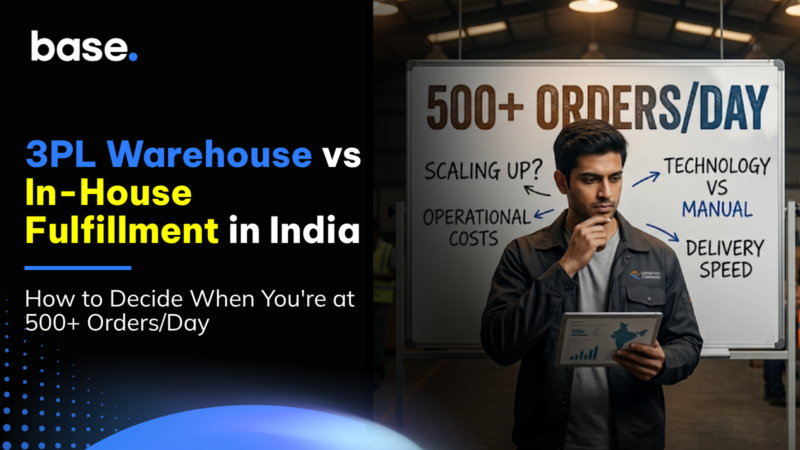
3PL vs in-house fulfillment in India is the operational decision that most Indian D2C founders delay until it becomes a crisis. Orders are piling up. The warehouse team is working twelve-hour shifts. Wrong shipments are increasing. CPT windows are being missed. The founder is spending three hours a day on fulfillment decisions instead of growth decisions.
At 500+ orders per day, approximately 15,000+ orders per month, the fulfillment model question has a financial answer that can be calculated. For direct-to-consumer brands, fulfillment represents roughly 10 to 15 percent of total revenue, which means even modest efficiency improvements have a measurable impact on the bottom line.
WMS implementation ROI averages 30% reduction in fulfillment labor costs. Warehouse Management Systems optimize pick paths, automate replenishment, and reduce errors. ROI for a WMS implementation is typically realized within 6-18 months for merchants shipping 500+ orders daily.
This post gives Indian D2C founders at the 500+ orders per day threshold a specific, numbers-driven framework for the 3PL vs in-house fulfillment India decision, and answers the 15 questions that come up most often in this conversation.
The Real Cost of In-House Fulfillment at 500+ Orders Per Day
Before evaluating 3PL options, the 3PL vs in-house fulfillment India comparison requires an honest calculation of what in-house fulfillment actually costs at this volume. Most brands undercount.
Layer 1: Warehouse space. At 500 orders per day with an average of 2-3 SKUs per order and typical FMCG or fashion product dimensions, a brand needs 3,000-6,000 square feet of operational warehouse space. In Mumbai’s Bhiwandi, Bengaluru’s Peenya, or Delhi NCR’s Kundli industrial zones, commercial warehouse rent runs ₹18-35 per square foot per month. A 4,000 square foot warehouse costs ₹72,000-₹1,40,000 per month in rent alone, before utilities, security, loading dock access, and annual escalation clauses.
Layer 2: Labor. 500 orders per day with an average 3-item order requires a pick team, a pack team, a receiving team, a QC function, a returns processing team, and a dispatch team. At 5,000 units picked per day, a warehouse operates with 20-35 people across two shifts. At ₹15,000-25,000 per person per month, including PF, ESIC, and incentives, the monthly labor cost is ₹3-8.75 lakh. Labor instability is usually more damaging than rent. A month of overtime, retraining, temp labor, late shipments, and support tickets spreads across multiple lines and hides the real total.
Layer 3: Technology. A WMS, OMS integrations, barcode scanners, label printers, packing station equipment, racking systems, and CCTV. Initial capex: ₹5-15 lakh. Monthly software and maintenance: ₹30,000-₹1 lakh.
Layer 4: Error costs. In-house operations typically run a 1-3% error rate, mispicks, wrong labels, and damaged shipments. At 500 orders per day with 1.5% error rate, that is 7-8 wrong shipments per day. Each generates a return (₹150-200 reverse logistics) and a replacement shipment (₹80-150 forward logistics). Daily error cost: ₹1,600-₹2,800. Monthly: ₹48,000-₹84,000.
Total in-house fulfillment cost at 500 orders per day:
- Rent: ₹72,000-₹1,40,000
- Labor: ₹3,00,000-₹8,75,000
- Technology: ₹30,000-₹1,00,000
- Error costs: ₹48,000-₹84,000
- Packaging: ₹75,000-₹1,50,000 (at ₹5-10 per order)
Monthly total: ₹5.25-₹12.49 lakh. Per-order cost: ₹35-83.
This is the number the 3PL vs in-house fulfillment India comparison needs to beat, not the 3PL’s headline pick-and-pack fee, but the 3PL’s all-in cost versus this number.
The Real Cost of a 3PL at 500+ Orders Per Day in India
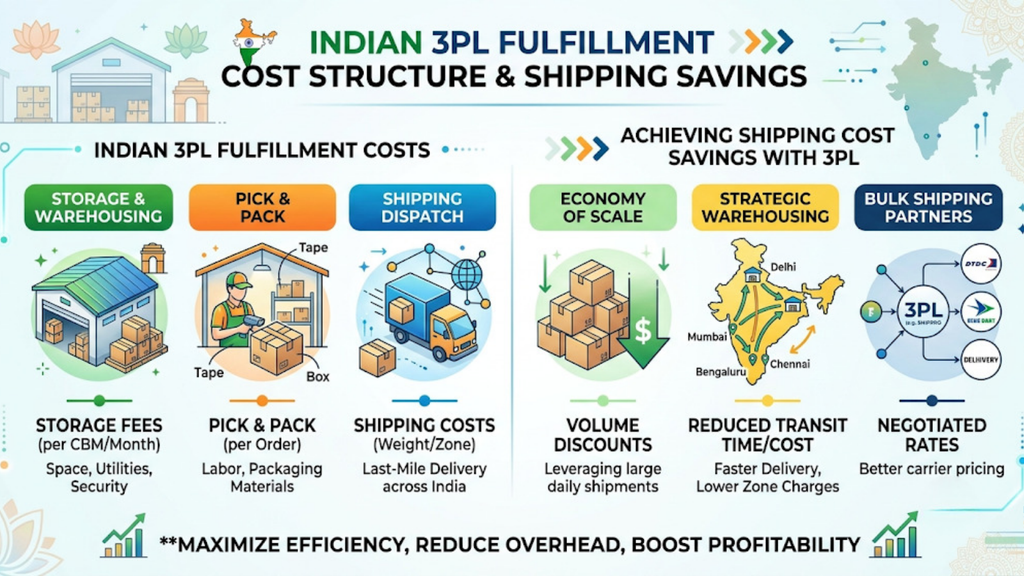
Indian 3PLs operating from Bhiwandi, Palava, Bilaspur, or Bengaluru’s Hoskote zone price fulfillment on a per-order model with separate storage, pick, pack, and handling fees. The typical Indian 3PL cost structure for a brand at 15,000 orders per month:
- Storage: ₹8-20 per sq ft per month for the physical space your inventory occupies
- Pick fee: ₹8-15 per order (first item)
- Pack fee: ₹5-12 per order including basic packaging material
- Additional item pick: ₹3-6 per additional item
- Inbound receiving: ₹50-150 per pallet
- Returns processing: ₹25-60 per return
All-in per-order cost excluding shipping: ₹18-45.
The shipping cost differential is the variable that most changes the 3PL vs in-house fulfillment India math. A major 3PL shipping 5 million packages per month negotiates carrier rates 20-40% below what a merchant shipping 10,000 packages monthly can achieve. For a merchant averaging ₹80 in shipping cost per order, a 25% reduction saves ₹20 per order, often covering the entire 3PL pick-and-pack fee.
For an Indian brand at 500 orders per day (15,000 per month) with ₹80 average shipping cost:
- In-house shipping cost: ₹80 per order
- 3PL negotiated shipping: ₹60-68 per order (25% savings)
- Per-order shipping saving: ₹12-20
- Monthly shipping saving: ₹1.8-3 lakh
This shipping saving alone frequently covers the 3PL’s fulfillment fee. The 3PL vs in-house fulfillment India comparison at 500 orders per day often shows 3PL as cost-neutral or cheaper before the operational benefits are even considered.
The 500 Orders Per Day Inflection Point: Why This Number Matters
Outsourcing to a 3PL provider typically becomes the more economical option once a business ships 500 or more orders per month consistently. For Indian D2C brands, the relevant threshold is 500 orders per day, approximately 100x that volume, where the operational complexity of in-house fulfillment creates specific failure modes.
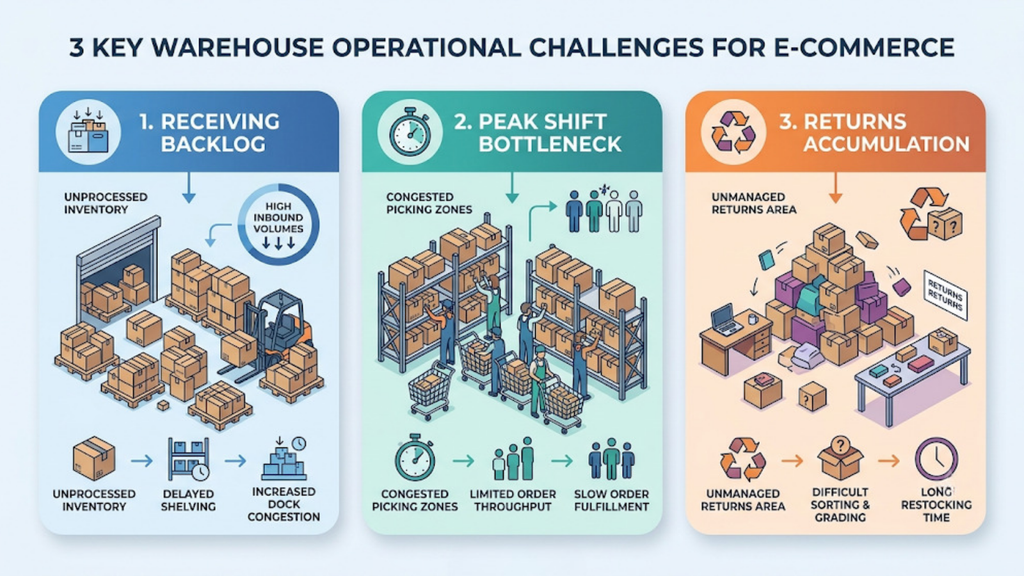
At 500 orders per day, a warehouse processing manually has three structural problems:
- The receiving backlog. Inbound stock arrives daily. Unloading, counting against the PO, creating the GRN, and shelving to the correct bin takes 3-4 hours with an adequate receiving team. At 500 orders per day, the outbound pressure on the warehouse team means receiving gets deprioritized. Stock sits in the receiving bay uninspected for 24-48 hours. It is not available for order fulfillment during that window. Effective inventory decreases by 5-10% of daily receipts until the receiving backlog clears.
- The peak shift problem. Order volumes for Indian D2C brands are not evenly distributed across the day. 60-70% of orders arrive between 10 AM and 4 PM. At 500 orders per day, the peak hour sees 50-75 new orders per hour entering the processing queue. A team sized for average throughput cannot process peak volume without CPT misses.
- The returns accumulate. At 25-30% RTO rate, 500 orders per day generates 125-150 returns per day. Processing 150 returns, inbound scan, inspection, disposition, and restock, requires dedicated capacity. Without it, returns stack up, available inventory counts diverge from physical counts, and reorders fire on phantom stock that is physically present but systemically invisible.
Base.com’s WMS, whether running on in-house infrastructure or integrated with a 3PL’s system, is the platform that manages these three problems. The 3PL vs in-house fulfillment India decision affects who owns the physical infrastructure. Base.com provides the operational control layer regardless of which side of that decision is chosen.
How Base.com Works Across Both Models
The 3PL vs in-house fulfillment India decision does not change the need for an OMS and WMS. It changes where the physical operations happen. Base.com integrates with both models from the same platform.
1. In-House with Base.com
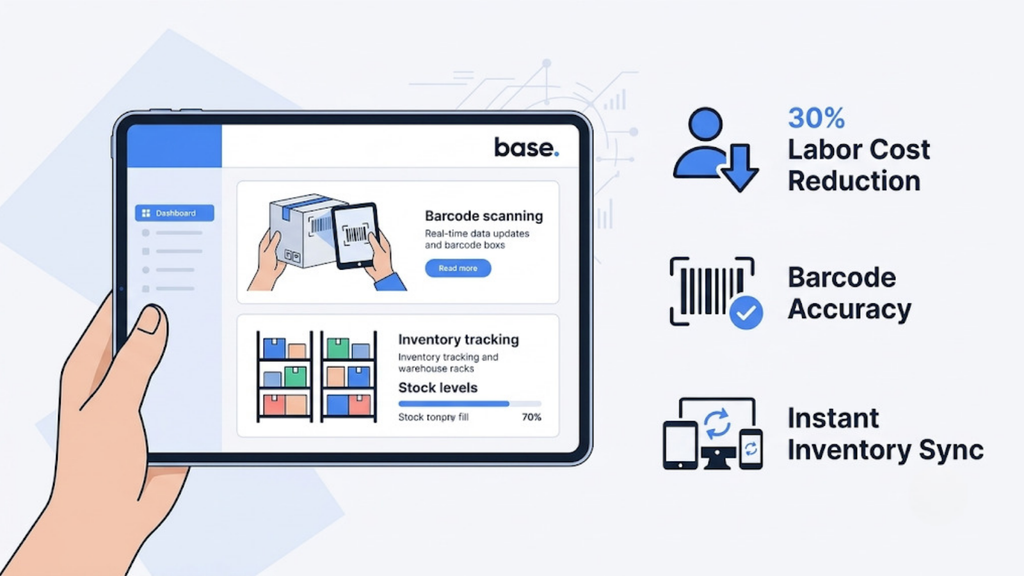
For brands choosing to keep fulfillment in-house, Base.com’s WMS manages the physical warehouse:
Digital warehouse view with custom zones, racks, and bins configured to the warehouse layout. Every pick instruction routes the team to the correct physical location. Barcode-verified picking at the location and cart level eliminates the 1-3% pick error rate that in-house operations run without system enforcement. In-system barcode and MRP tag creation removes the external barcode generation step. Returns processing integrates with live inventory, a return inspected and restocked at the bin updates available channel counts immediately.
WMS implementation ROI averages 30% reduction in fulfillment labor costs. For a brand spending ₹6 lakh per month on warehouse labor, a 30% reduction is ₹1.8 lakh per month in recovered cost, ₹21.6 lakh per year. This payback typically justifies the WMS investment within the first quarter of operation.
2. 3PL Integration with Base.com
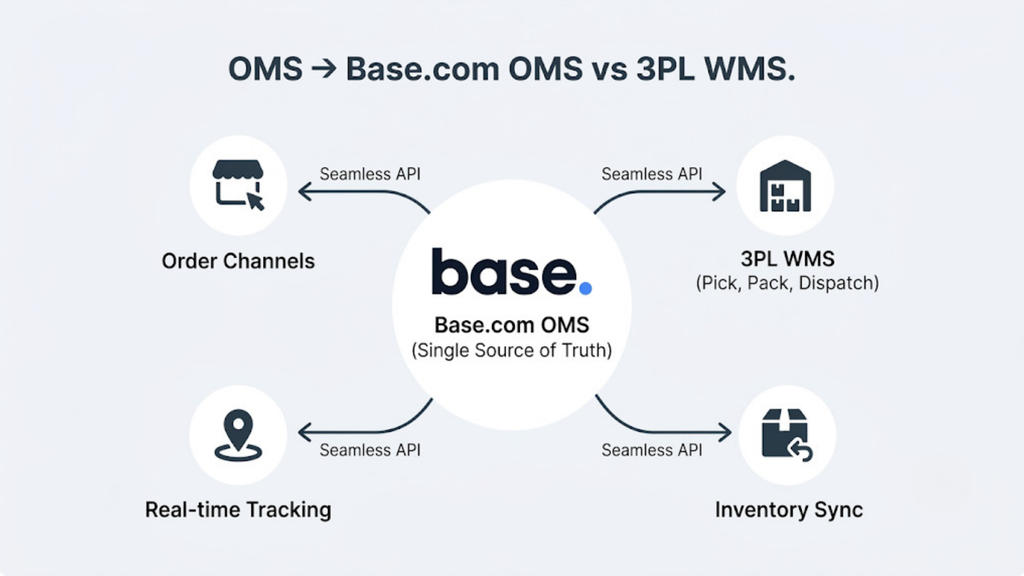
For brands choosing a 3PL, Base.com integrates with the 3PL’s own WMS through API connections. Orders confirmed in Base.com’s OMS are pushed to the 3PL’s system automatically. The 3PL’s WMS handles physical pick, pack, and dispatch. Tracking updates return to Base.com and propagate to all channel integrations. Inventory counts from the 3PL’s system sync back to Base.com’s central inventory pool.
This integration means the brand maintains full order and inventory visibility in Base.com regardless of which physical node is fulfilling the order. The 3PL vs in-house fulfillment India decision changes the physical execution layer. Base.com’s OMS remains the single source of truth for inventory, orders, returns, and financial data.
3. The Hybrid Model
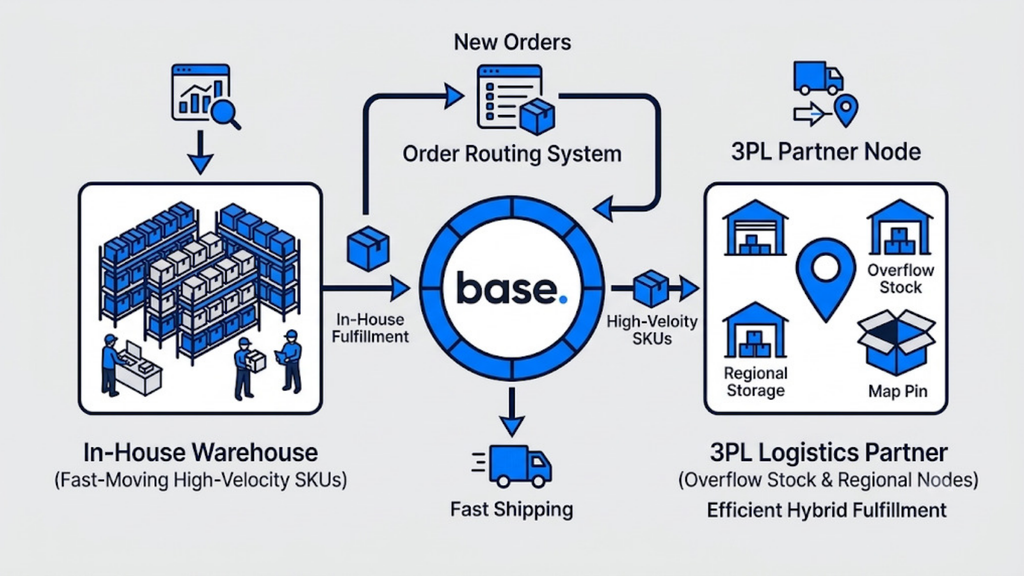
40% of mid-market merchants use hybrid fulfillment. For Indian D2C brands, the hybrid model typically looks like: A-class, high-velocity SKUs fulfilled from an in-house warehouse with tight brand control. B and C-class SKUs, overflow volume, and geographic expansion nodes are handled by 3PL partners.
Base.com’s multi-warehouse management supports this architecture natively. Both the in-house warehouse and the 3PL node appear as separate fulfillment nodes in the same system. Orders are routed to the correct node based on SKU, stock availability, proximity, and SLA rules. Inventory counts at both nodes feed the same channel-visible pool. The 3PL vs in-house fulfillment India hybrid decision is operationally manageable in Base.com because both nodes are treated as equal warehouses in the routing logic, not as separate systems requiring manual coordination.
15 Questions Indian D2C Founders Ask About 3PL vs In-House Fulfillment India
As Indian D2C brands scale across marketplaces, quick commerce, and their own websites, one operational question becomes unavoidable: should you continue managing fulfillment in-house or partner with a third-party logistics (3PL) provider? The right choice depends on your order volumes, growth stage, margins, customer expectations, and long-term operational strategy, making it one of the most important decisions founders face.
Q1: My current in-house cost per order is ₹45. The 3PL quote is ₹38. Should I switch?
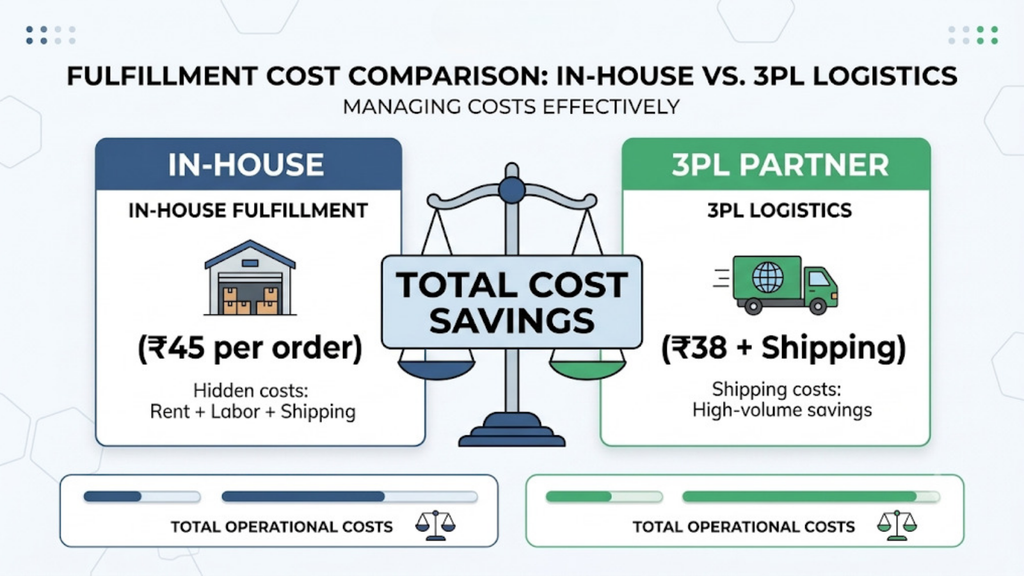
Not on the pick fee alone. Get the 3PL’s all-in shipping rate for your top 10 delivery zones and add it to their pick fee. Compare the combined number against your current per-order total cost, including rent, labor, technology, error costs, and your shipping rates. The shipping rate differential, typically ₹12-20 per order in the 3PL’s favour due to carrier volume, is where the real saving is. If the total 3PL cost, including shipping, is lower by more than ₹8-10 per order, the economics favour switching.
Q2: We have a very specific unboxing experience. Can a 3PL replicate it?
Most Indian 3PLs can handle custom tissue, inserts, branded tape, and specific folding instructions at a value-added service fee of ₹8-20 per order above standard pick-pack. The question is whether the 3PL can execute it consistently at 500 orders per day without supervision. Ask for a reference brand that runs a similar unboxing experience through the 3PL and speak to their operations team directly. If they cannot provide one, the execution risk is real.
Q3: We sell on Amazon, Flipkart, and our own website. Can a 3PL handle all three channels simultaneously?
Yes, provided the 3PL integrates with Base.com or a comparable OMS that feeds it orders from all channels simultaneously. The 3PL does not need separate interfaces for each channel. It needs one feed from the OMS. Base.com pushes orders from all channels to the 3PL’s system in a standardized format, with channel-specific invoice and label templates generated automatically.
Q4: Our RTO rate is 28%. Will a 3PL help or hurt this?
A 3PL does not directly affect the RTO rate. RTO is driven by COD non-acceptance, address errors, and courier delivery performance, none of which are within a 3PL’s control. What a 3PL can do is process returns faster, reducing the time returned units sit outside available inventory. If your 3PL has a 48-hour return inspection SLA, your inventory count is more accurate, and phantom stock is reduced. Base.com’s returns processing module enforces this SLA regardless of whether returns go to an in-house or 3PL node.
Q5: We plan to add a second city warehouse. Should we go 3PL for the second node?
At 500 orders per day from a single node, adding a second node in a different city almost always favours 3PL. Setting up your own warehouse in a second city requires a new lease, new hiring, new equipment, and a new WMS configuration. A 3PL in that city gives you immediate access to infrastructure, staff, and carrier relationships without 4-6 months of setup time. Base.com routes orders to both nodes from the same dashboard, the second node being a 3PL is invisible to the order processing workflow.
Q6: What happens to our data if we switch 3PLs?
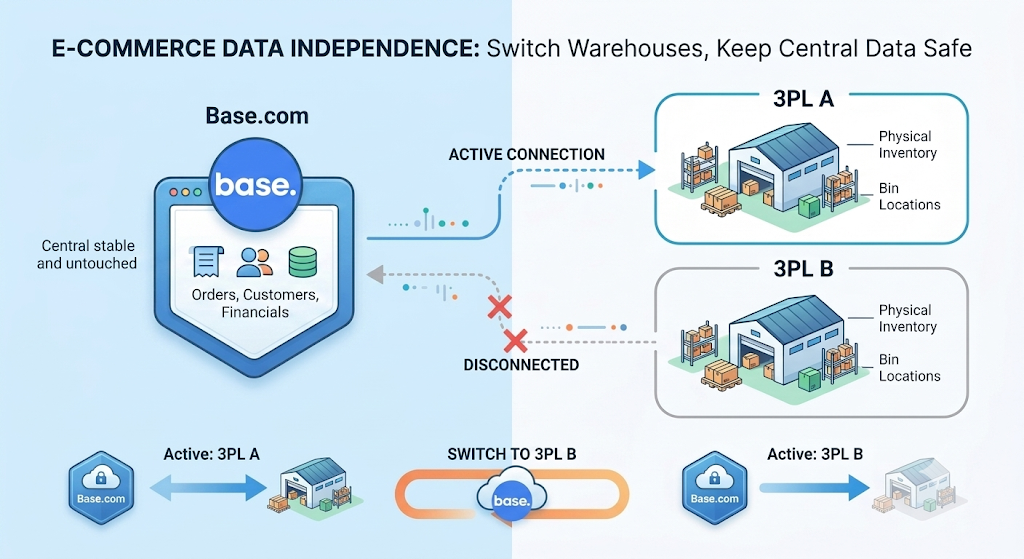
Your order history, inventory records, and financial data live in Base.com, not in the 3PL’s system. The 3PL’s WMS holds the physical warehouse data (bin locations, pallet positions). Your OMS data is independent. Switching 3PLs requires reconnecting Base.com to the new 3PL’s system and migrating physical inventory, but your order history, customer data, and financial records are unaffected.
Q7: The 3PL wants a ₹50,000 per month minimum commitment. Is this negotiable?
Minimums are standard in 3PL contracts and usually negotiable at your volume level. At 15,000 orders per month, you are a significant account for most Indian mid-market 3PLs. Request a minimum that matches your current volume with a step-up clause that increases the minimum only when your monthly orders consistently exceed a new threshold. Avoid signing minimums at 150% of current volume to incentivize growth, the growth does not always arrive on the assumed timeline.
Q8: How quickly can a 3PL go live?
A typical Indian 3PL onboarding at 500 orders per day takes 3-6 weeks from contract signing to first order dispatch. The timeline includes inventory transfer from your current location, bin configuration in the 3PL’s WMS, OMS integration setup, and parallel running (both systems active simultaneously for 1-2 weeks to validate accuracy). Base.com’s 3PL integration typically takes 5-10 working days once the 3PL provides its API credentials.
Q9: What SLAs should we contractually require from a 3PL?
Minimum contractual SLAs for Indian D2C 3PL agreements at 500 orders per day: same-day dispatch for orders received before 12 PM (or 2 PM for next-day courier pickup); pick accuracy above 99.2%; return processing within 48 hours of receipt; inventory cycle count monthly with less than 0.5% variance; uptime of WMS and API integration above 99.5%. Require financial penalties, typically 5-10% of the month’s fee, for SLA breaches, not just remediation promises.
Q10: Our product has a shelf life. Can a 3PL manage FEFO?
Yes, but verify explicitly. Ask the 3PL whether their WMS supports batch and expiry tracking with FEFO enforcement at the pick level. Many Indian 3PLs support batch tracking in their WMS but enforce FEFO only when the picker manually checks, which is inconsistent. If the 3PL’s WMS does not have system-enforced FEFO (barcode rejection of a wrong-batch pick), it is the same as manual FEFO, which means you are trusting the picker, not the system.
Q11: What does the transition from in-house to 3PL actually look like operationally?
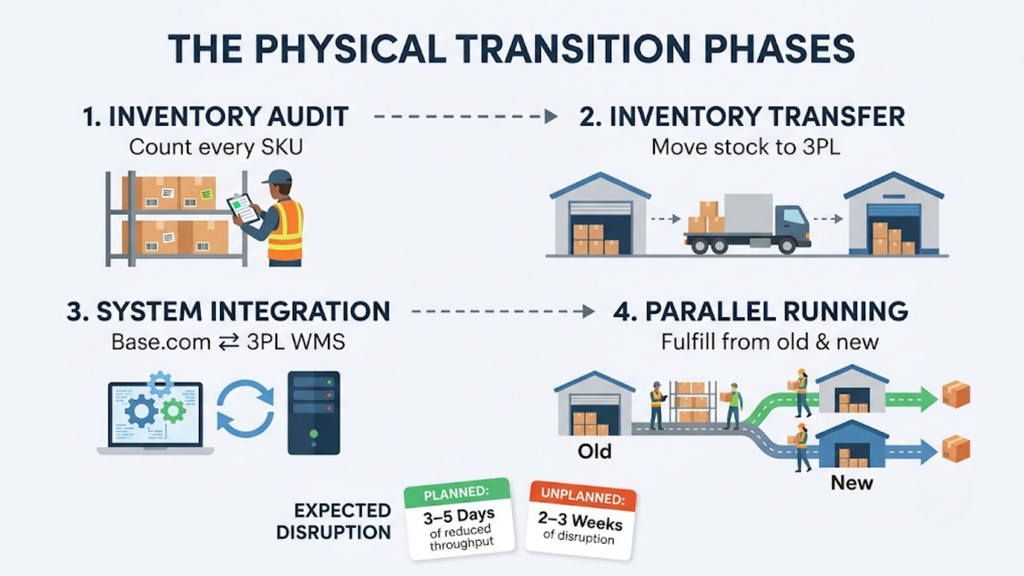
The physical transition has four phases: inventory audit (count every SKU in the current warehouse), inventory transfer (move stock to the 3PL’s facility via commercial vehicle), system integration (connect Base.com to the 3PL’s WMS), and parallel running (keep the old warehouse active for orders in the pipeline while the 3PL fulfills new orders). Total disruption if planned correctly: 3-5 days of reduced throughput. Unplanned transitions, moving in a hurry, can cause 2-3 weeks of fulfillment degradation.
Q12: How do we handle a sale event like Big Billion Days if we are on a 3PL?
Give the 3PL a 3-week notice of the expected volume spike. Provide SKU-level velocity forecasts. The 3PL pre-stages your fast-moving inventory in forward pick positions, increases staffing for the event dates, and allocates additional packing stations. The operational responsibility shifts to the 3PL’s capacity planning team. Contractually, ensure your agreement has a surge capacity clause; the 3PL commits to processing 2-3x normal daily volume during sale events without SLA degradation.
Q13: We want to start shipping to Tier 2 and Tier 3 cities. Does 3PL vs in-house matter?
For Tier 2 and 3 coverage, a 3PL network with nodes in multiple cities delivers faster and cheaper than a single in-house warehouse. Third-party logistics providers secure carrier rates 15 to 40 percent below what individual merchants pay at retail. A 3PL in Bhiwandi ships to Gujarat Zone 1 (same-day pickup, next-day delivery). Your in-house warehouse in Noida ships to Gujarat Zone 3 or 4 (2-3 day transit). Faster delivery in Tier 2 reduces RTO; customers waiting longer for COD deliveries refuse more often. The 3PL vs in-house fulfillment India decision for Tier 2 expansion almost always resolves toward 3PL for the geographic coverage benefit.
Q14: How does the 3PL integration work with Base.com specifically?
Base.com connects to a 3PL’s system via API. Confirmed orders in Base.com push to the 3PL’s WMS as pick instructions. The 3PL’s system sends back shipment confirmation, AWB number, courier assigned, tracking ID, which Base.com receives and propagates to the marketplace and to the customer notification. Inventory deductions happen in Base.com’s central pool when the 3PL confirms dispatch. Returns from the 3PL’s physical location update Base.com’s available inventory after the 3PL’s inspection confirms sellable units. The brand sees the full order lifecycle in Base.com regardless of where the physical fulfillment happens.
Q15: What is the right time to bring fulfillment back in-house after a 3PL phase?
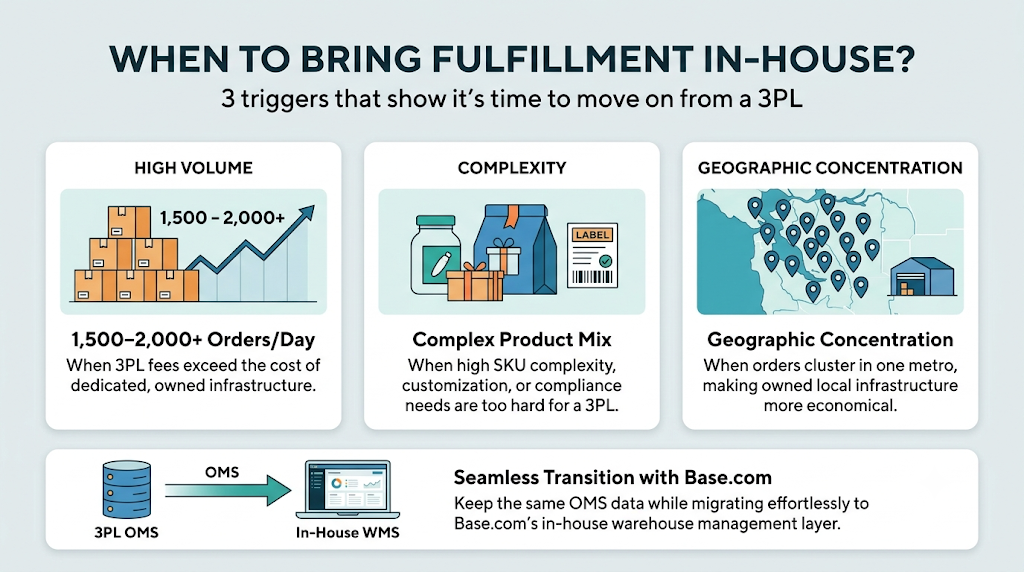
Brands bring fulfillment back in-house when they have reached 1,500-2,000+ orders per day and the 3PL’s per-order fees now exceed the cost of dedicated in-house infrastructure; their product mix has become so specific that a 3PL cannot handle SKU complexity, customization, or compliance requirements; or they have reached geographic concentration in one metro region where owned infrastructure is more economical than shared. At that scale, Base.com’s WMS provides the in-house warehouse management layer, with the same OMS data from the 3PL phase migrating seamlessly to the in-house operation.
The Decision Framework: 3PL vs In-House Fulfillment India at 500+ Orders Per Day
Use this framework to resolve the 3PL vs in-house fulfillment India decision for your specific situation.
| Criteria | Favour In-House | Favour 3PL |
| Unboxing complexity | High (custom, handcrafted) | Low (standard brand elements) |
| SKU count | Under 50 SKUs | 50+ SKUs |
| Geographic coverage | Single metro focus | Multi-city, Tier 2+ expansion |
| Seasonal variance | Low (even monthly volume) | High (festive spikes over 2x) |
| Shelf life/batch requirements | Complex FEFO needed | Standard products |
| Working capital | Available for capex | Better deployed in growth |
| Founder time | Available for ops oversight | Better spent on product/growth |
| Current error rate | Under 1% | Above 1.5% |
| Second warehouse need | Not imminent | Within 6-12 months |
| Order volume trajectory | Plateau | Growing 20%+ monthly |
Brands scoring 7+ on the 3PL column should be in active 3PL evaluation. Brands scoring 6+ on the in-house column should invest in WMS infrastructure and operational systems before reconsidering. Most brands at 500 orders per day in India land somewhere in the middle, which is why the hybrid model, managed through a platform like Base.com that treats both nodes equivalently, is the most common correct answer.
The 3PL vs in-house fulfillment India decision is ultimately not about which model is cheaper in isolation. It is about which model, supported by the right OMS and WMS infrastructure, produces the lowest total fulfillment cost and the highest operational reliability at your current and projected volume.