

A Warehouse Management System (WMS) is software that controls and tracks every physical movement of stock inside a warehouse, from the moment it arrives at the dock to the moment it leaves as a dispatched order. It directs where stock is stored, sequences how it gets picked, confirms what goes into every package, and updates inventory the instant something moves. For Indian sellers, warehouse management software in India also has to account for COD volumes, multi-marketplace dispatch rules, and GST-compliant stock transfers, which most global systems are not built to handle.
That is the direct answer. The rest of this guide covers how a WMS actually works, how it differs from a basic inventory tool, and what to look for in warehouse management software in India built for the way Indian fulfilment actually runs.
What Is a Warehouse Management System (WMS)?
A WMS is the operational brain of a warehouse. It does not just record stock counts. It actively directs the physical work: where an item gets stored on arrival, which bin a picker walks to, which order gets packed first, and which courier a shipment gets manifested against. Without a WMS, these decisions rest on individual judgment, a picker’s memory of where things are, a supervisor’s gut sense of which order is urgent. That works at low volume. It collapses once order counts climb past a few hundred a day.
India’s ecommerce market has crossed $226 billion, and D2C brands are scaling at a 40% CAGR. That growth means more SKUs, more warehouse floor space, and more simultaneous sales channels, all of which increase the coordination cost of running a warehouse without directed software. Warehouse management software in India exists to remove that coordination cost. It turns warehouse operations from a set of individual decisions into a directed, repeatable, measurable process.
WMS vs. Inventory Management System: What Is the Difference?
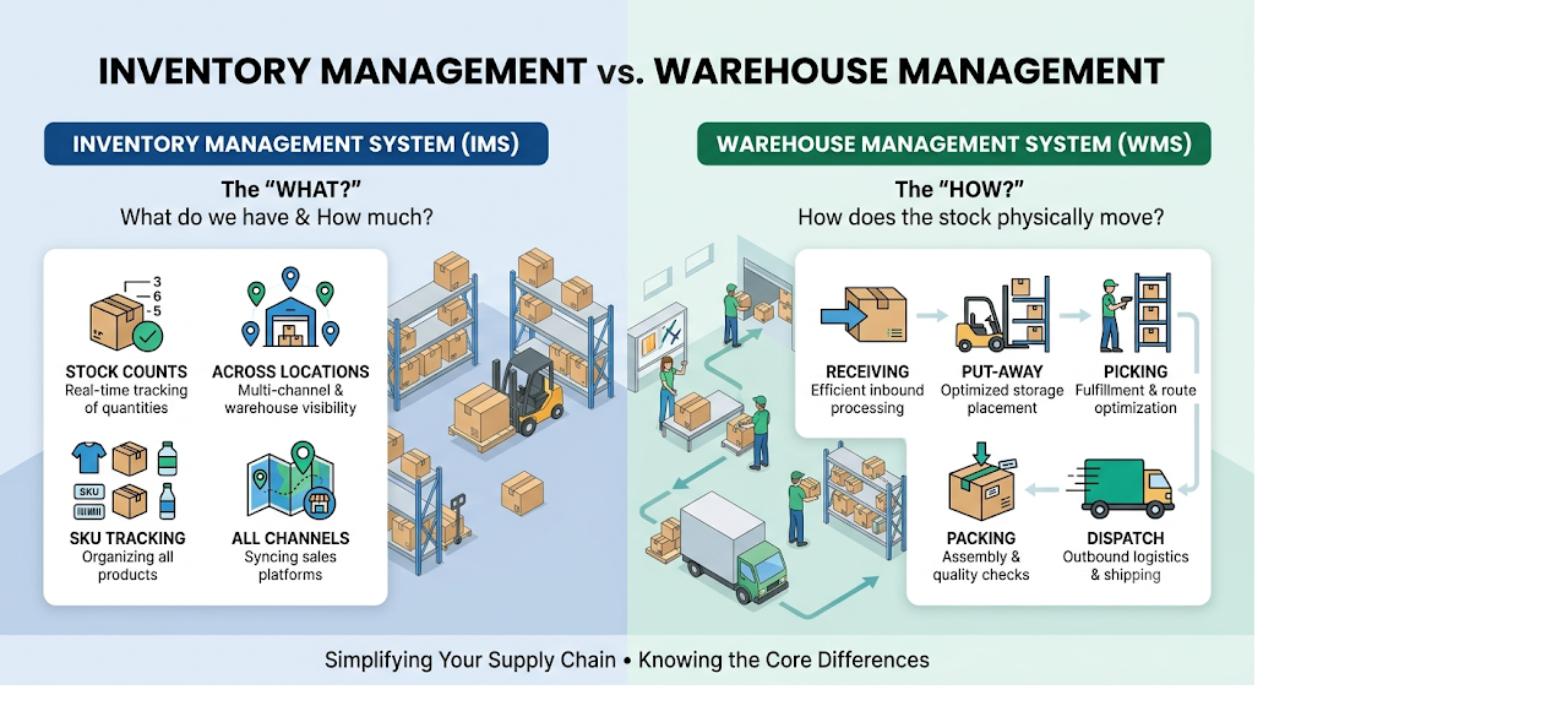
These two terms get used interchangeably, and that confusion causes real buying mistakes. They solve different problems, even though they share data. An inventory management system answers “what do we have, and how much of it?” It tracks stock counts across SKUs, locations, and channels. A Warehouse Management System answers “how does that stock physically move?” It governs receiving, put-away, picking, packing, and dispatch on the floor.
| Question | Inventory Management System | Warehouse Management System |
|---|---|---|
| What stock exists and where | Yes | Yes, at bin level |
| How stock physically moves | No | Yes |
| Pick path and pick sequencing | No | Yes |
| Labor and task assignment | No | Yes |
| Reorder point calculation | Yes | Sometimes, if integrated |
| Dock and dispatch scheduling | No | Yes |
Most growing Indian brands need both, working from one shared data layer. Warehouse software that operates disconnected from inventory data creates a second source of truth, and that gap is exactly where stockouts and overselling start.
Why Warehouse Management Software in India Looks Different From Global WMS
Global WMS platforms are built around assumptions that do not hold in Indian ecommerce. Three differences matter most.
COD volume changes the dispatch calculus. Cash on delivery accounts for 55-65% of ecommerce orders in Tier 2 and Tier 3 cities, the fastest-growing zones for Indian D2C brands. A WMS built for a prepaid-first market has no logic for pincode-level COD risk at the dispatch step. Warehouse management software in India needs that logic built in, not added later.
Return volume is a warehouse workflow, not an afterthought. COD return rates run at 25-30% nationally, well above prepaid return rates. A WMS that treats returns as a separate, disconnected process creates inventory blind spots the moment reverse shipments start arriving at scale.
Multi-marketplace dispatch rules are non-negotiable. Amazon, Flipkart, Meesho, and Myntra each apply different manifest formats, different SLA windows, and different penalty structures for late dispatch. A generic WMS treats every order the same. Warehouse management software in India has to apply channel-specific rules at the point of label generation. This is why brands that adopt global WMS platforms unmodified for the Indian market consistently run into gaps around COD handling, return workflows, and marketplace-specific compliance.
Core Functions of Warehouse Management Software in India
Every functional WMS is built around six operational stages. Each one solves a distinct failure point on the warehouse floor.
1. Inbound and Receiving
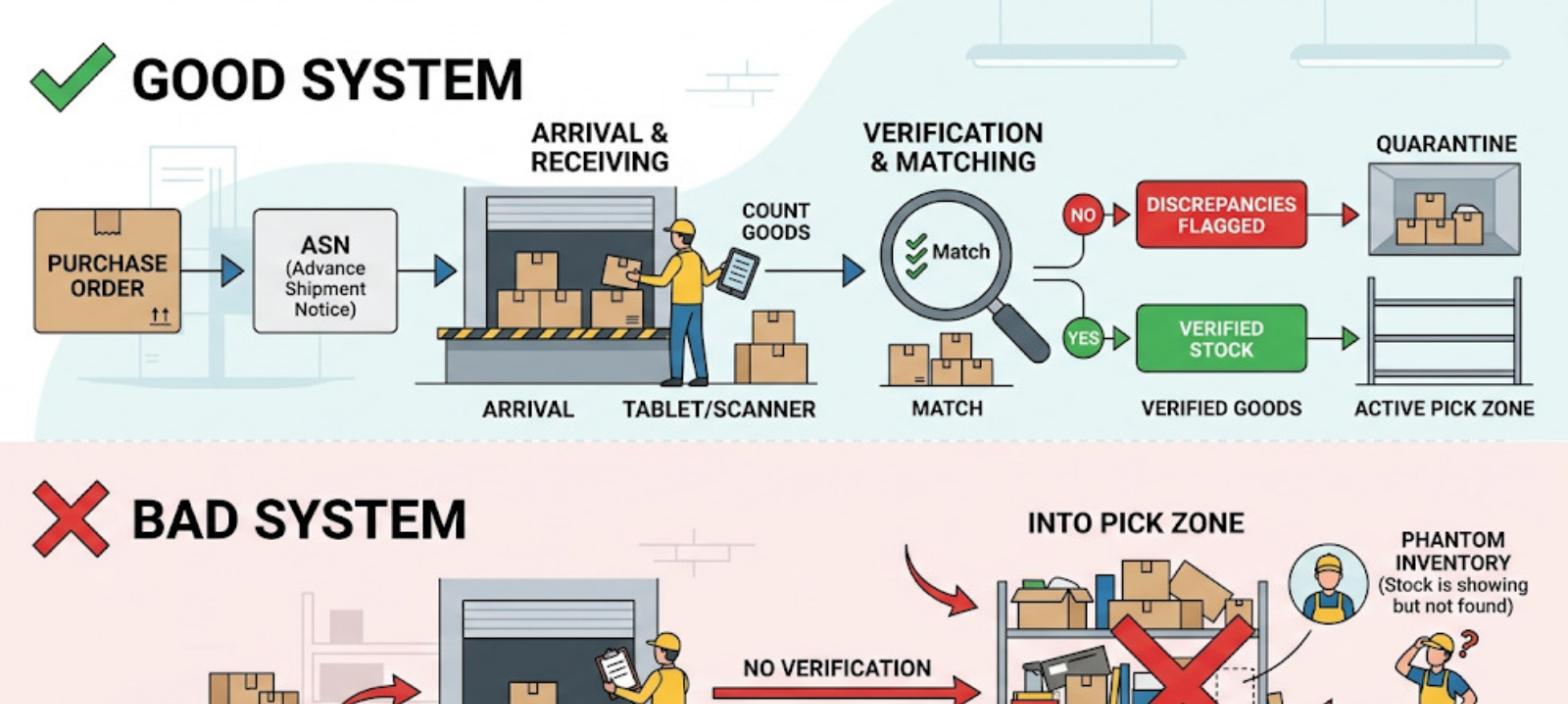
Stock arrives against a purchase order or an Advance Shipment Notice (ASN). A good system matches what physically arrives against what was ordered, flags discrepancies immediately, and only moves verified stock into the active pick zone. Skipping this step is the single most common cause of phantom inventory, stock the system shows as available that does not actually exist on the shelf.
2. Slotting and Bin Management
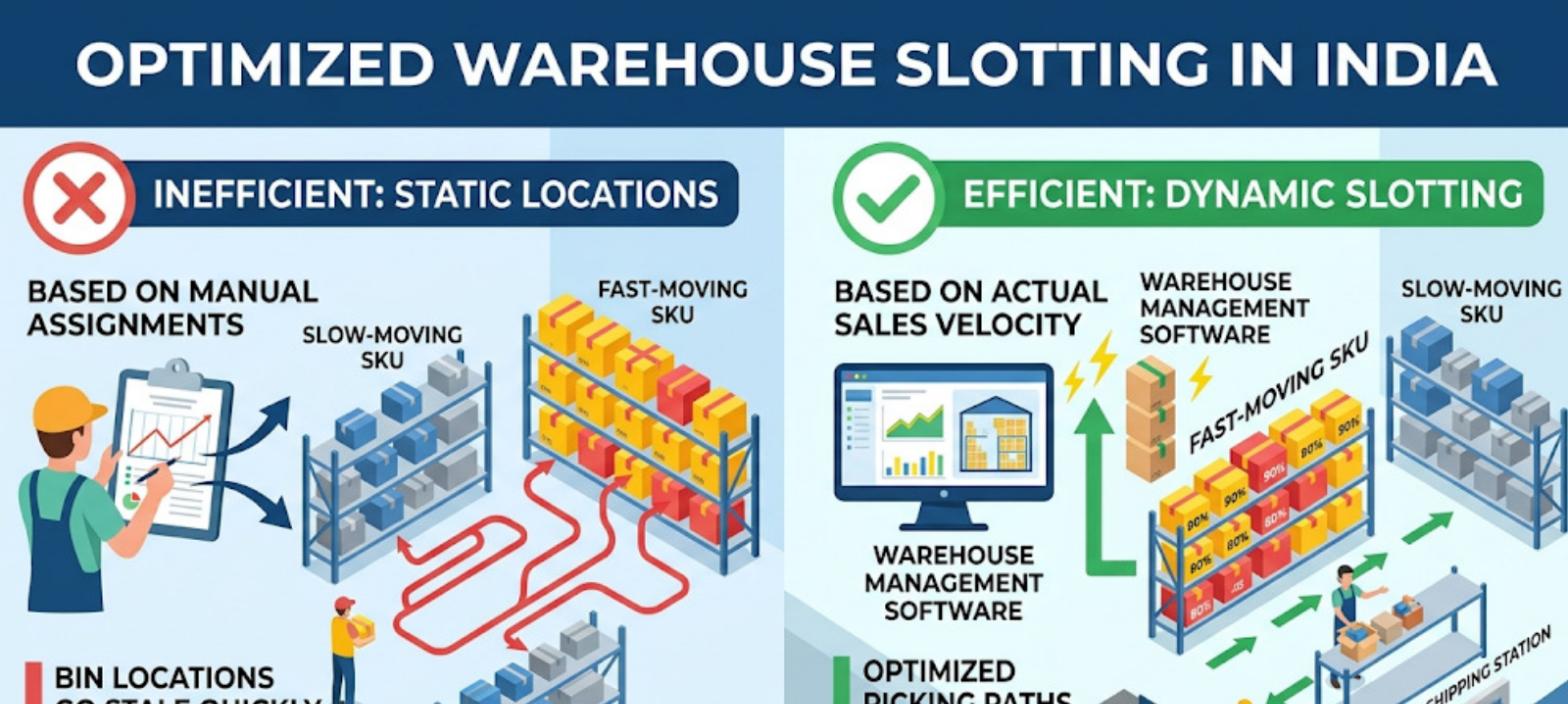
Slotting determines where each SKU sits on the warehouse floor. Fast-moving SKUs belong closest to the packing station. Warehouse management software in India should generate slotting recommendations from actual sales velocity, not from static, manually assigned bin locations that go stale within weeks of any product mix change.
3. Pick, Pack, and Wave Planning

This is the core of daily operations. The WMS sequences pick lists by bin location rather than order receipt order, batches similar orders into waves, and enforces scan confirmation at packing so no shipment leaves without item-level verification.
4. Labor and Task Management
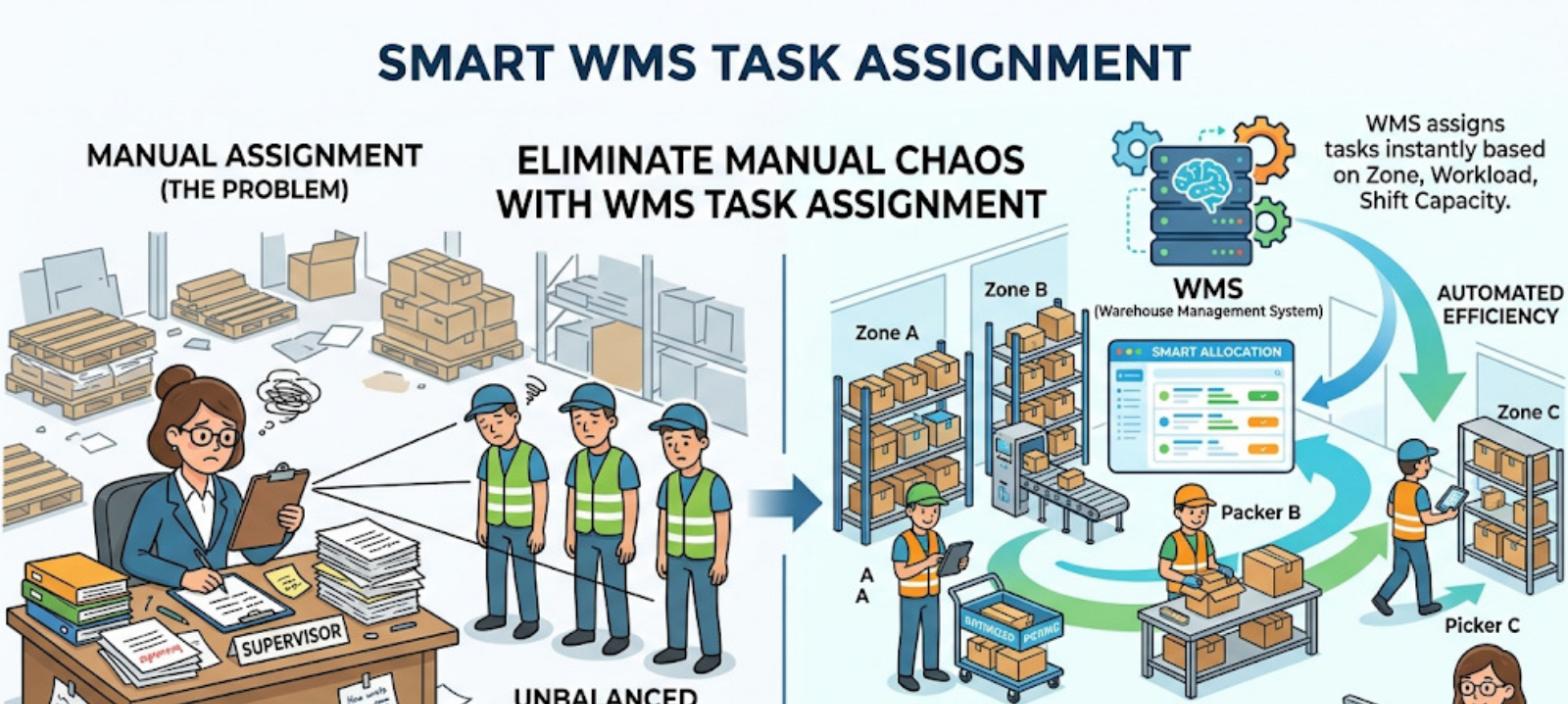
A WMS assigns tasks to specific pickers and packers based on zone, current workload, and shift capacity. Without this, supervisors spend hours manually balancing floor assignments, time that should go toward exception handling instead.
5. Dispatch and Carrier Integration

Once an order is packed, the WMS generates a shipping label, assigns the correct courier based on serviceability and cost, and creates a scan-ready manifest before the courier arrives. This step directly protects dispatch TAT metrics on every marketplace a brand sells on.
6. Returns and Reverse Logistics
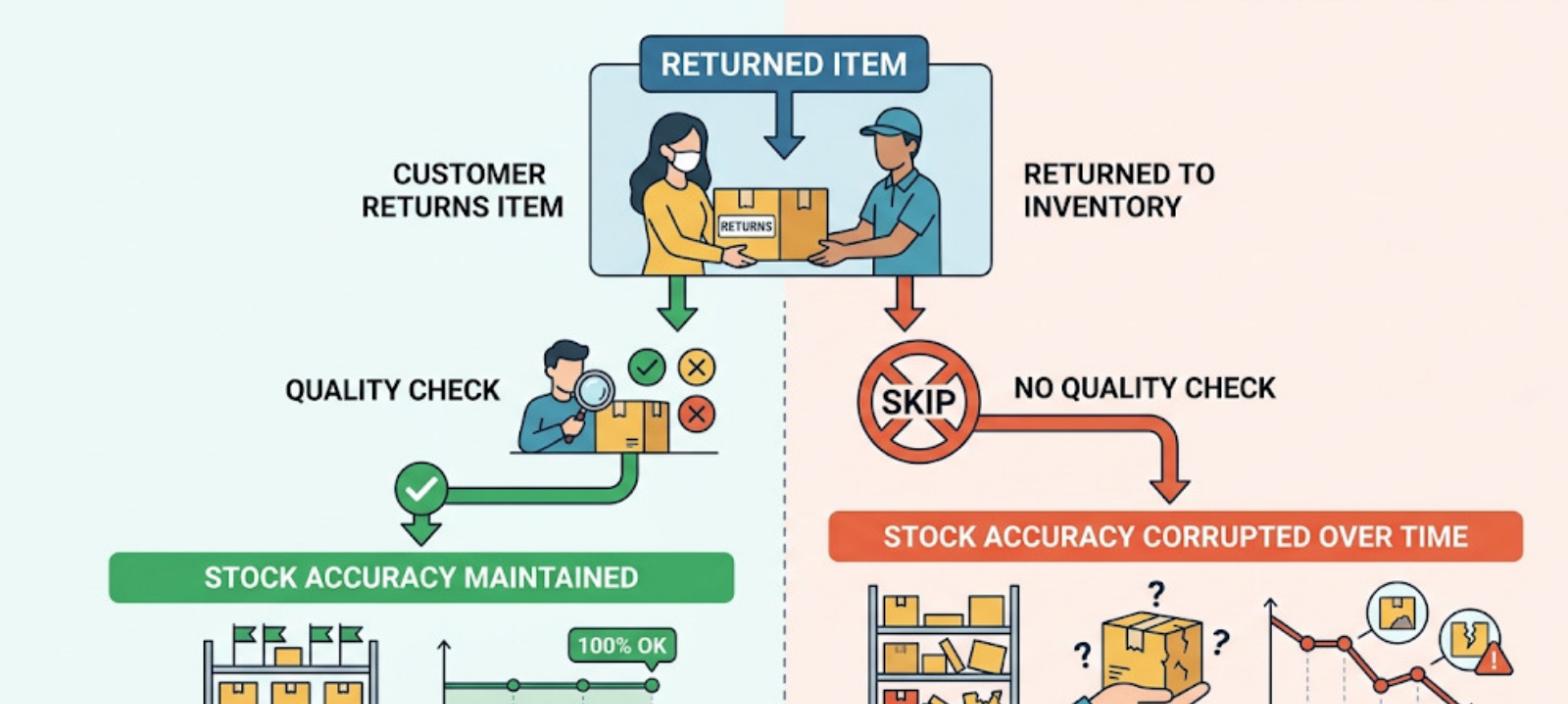
A returned item needs to trigger a quality check before it re-enters available inventory. Warehouse management software in India that skips this step lets damaged or incomplete returns quietly corrupt stock accuracy over time.
What are the Different Types of WMS Deployment
Not every WMS is built the same way, and the deployment model affects both cost and flexibility.
| Deployment Type | Description | Best Fit |
|---|---|---|
| Standalone WMS | Purpose-built warehouse software, integrates with existing OMS/ERP | Brands with an established tech stack needing warehouse-specific depth |
| ERP-embedded module | Warehouse functions built into a larger ERP system like SAP | Enterprises already running SAP for finance and distribution |
| Cloud-based WMS | Hosted, subscription-based, faster to deploy | Growing D2C and marketplace sellers scaling quickly |
| On-premise WMS | Installed locally, higher control, higher maintenance overhead | Large enterprises with dedicated IT infrastructure |
Most growing Indian D2C and marketplace sellers get the fastest time to value from cloud-based warehouse management software in India, since it requires no hardware investment and can go live in days rather than months.
Manual Warehouse Operations vs. Warehouse Management Software in India
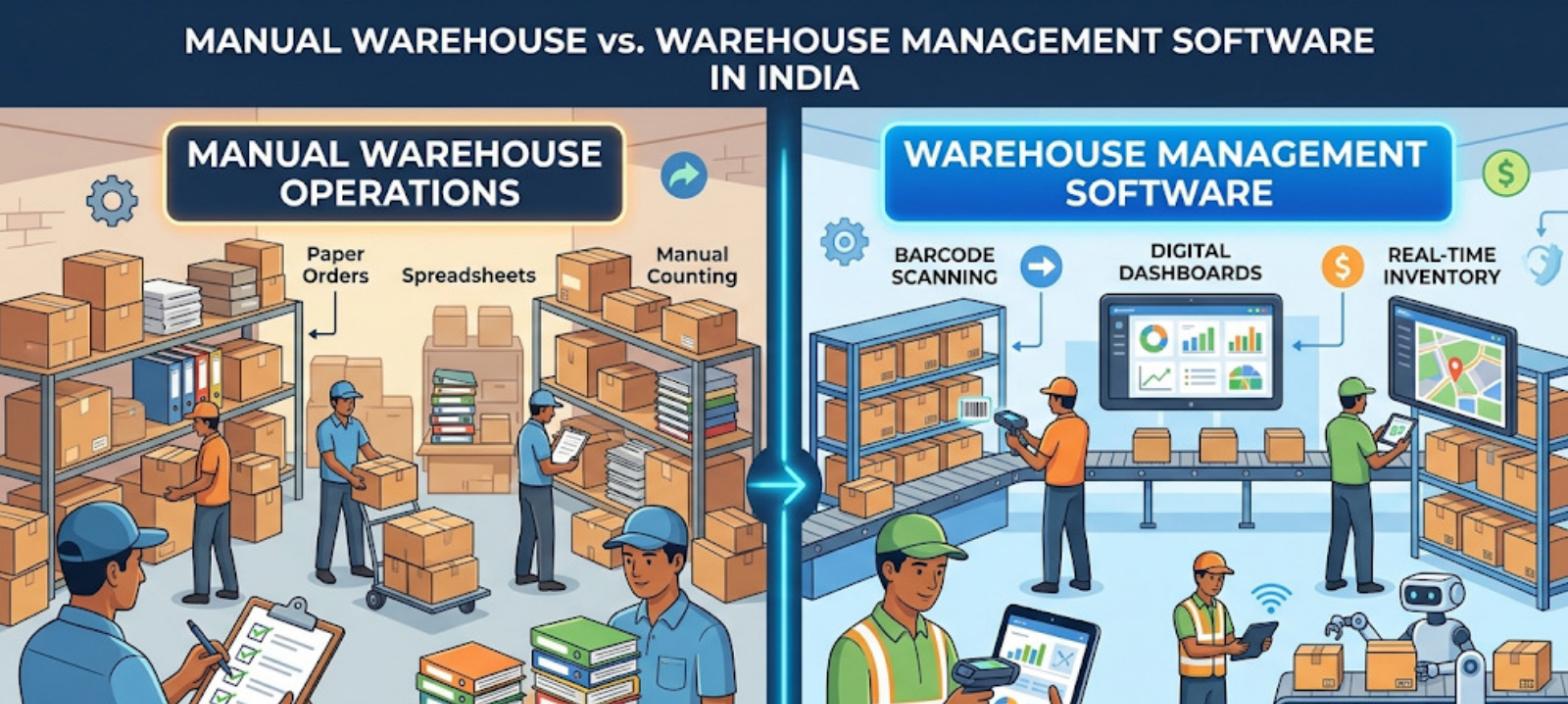
Many Indian businesses still manage warehouse operations using paper-based processes, spreadsheets, and manual coordination. While this approach may work for smaller operations, increasing order volumes and higher customer expectations make warehouse management software essential for improving accuracy, speed, and operational efficiency.
| Capability | Manual Process | Warehouse Management Software in India |
|---|---|---|
| Pick list sequencing | Order-receipt order, unoptimised | Bin-location sequenced, route-optimised |
| Packing verification | Visual check by packer | Barcode scan confirmation, system-enforced |
| Slotting | Static, rarely updated | Velocity-based, continuously updated |
| Labor assignment | Supervisor judgment | System-directed by zone and workload |
| Dispatch manifest | Manually compiled | Auto-generated, scan-ready |
| Returns processing | Manual sorting and tracking | Automated QC workflow with inventory reabsorption |
| Error rate at scale | Rises sharply above 200-300 orders/day | Remains stable across volume spikes |
A mispicked item costs an Indian ecommerce seller between Rs. 200 and Rs. 600 once reverse shipping, customer service, repacking, and reshipping are accounted for. At 500 daily orders and a 2% error rate, that is roughly Rs. 1.2 lakh a month in pure correction cost, a cost that scan-enforced warehouse management software in India largely eliminates.
What to Look for When Evaluating Warehouse Management Software in India
Use this checklist to separate genuine operational depth from a feature list.
| Evaluation Criteria | What to Check |
|---|---|
| Marketplace-aware dispatch | Channel-specific manifest and SLA logic for Amazon, Flipkart, Meesho, Myntra |
| COD and RTO handling | Pincode-level risk flagging before label generation |
| Scan enforcement | Hard system block on label generation until every item is scanned |
| Slotting intelligence | Velocity-based bin recommendations, not static assignment |
| Kit and bundle support | Component-level pick instructions, not composite bundle entries |
| Returns workflow | Automated QC and inventory reabsorption on physical receipt |
| SAP or ERP connectivity | Native connector for depot and distributor-linked operations |
| Real-time visibility | Live dashboard for pick queue, packing status, and SLA countdowns |
Brands evaluating warehouse management software in India should walk through this list against their actual daily order mix, not a generic demo script.
Signs You Need to Move Beyond a Spreadsheet or Basic WMS
A few operational patterns show up consistently right before a warehouse outgrows its current setup.
- Pick errors climb above 1.5-2% and stay there despite additional training.
- Supervisors spend more time manually reassigning floor tasks than reviewing exceptions.
- Dispatch delays spike every time order volume crosses 2-3x the daily average during a sale.
- Returns sit unprocessed for more than 48 hours after physical receipt.
- Only 6% of companies report full supply chain visibility, and most warehouses without a proper WMS discover SLA breaches only after they have already happened.
If two or more of these apply, the operational cost of staying manual, or staying on a basic stock-tracking tool, already exceeds the cost of implementing full warehouse management software in India.
Dock Scheduling and Cross-Docking: The Layer Most Indian Warehouses Skip
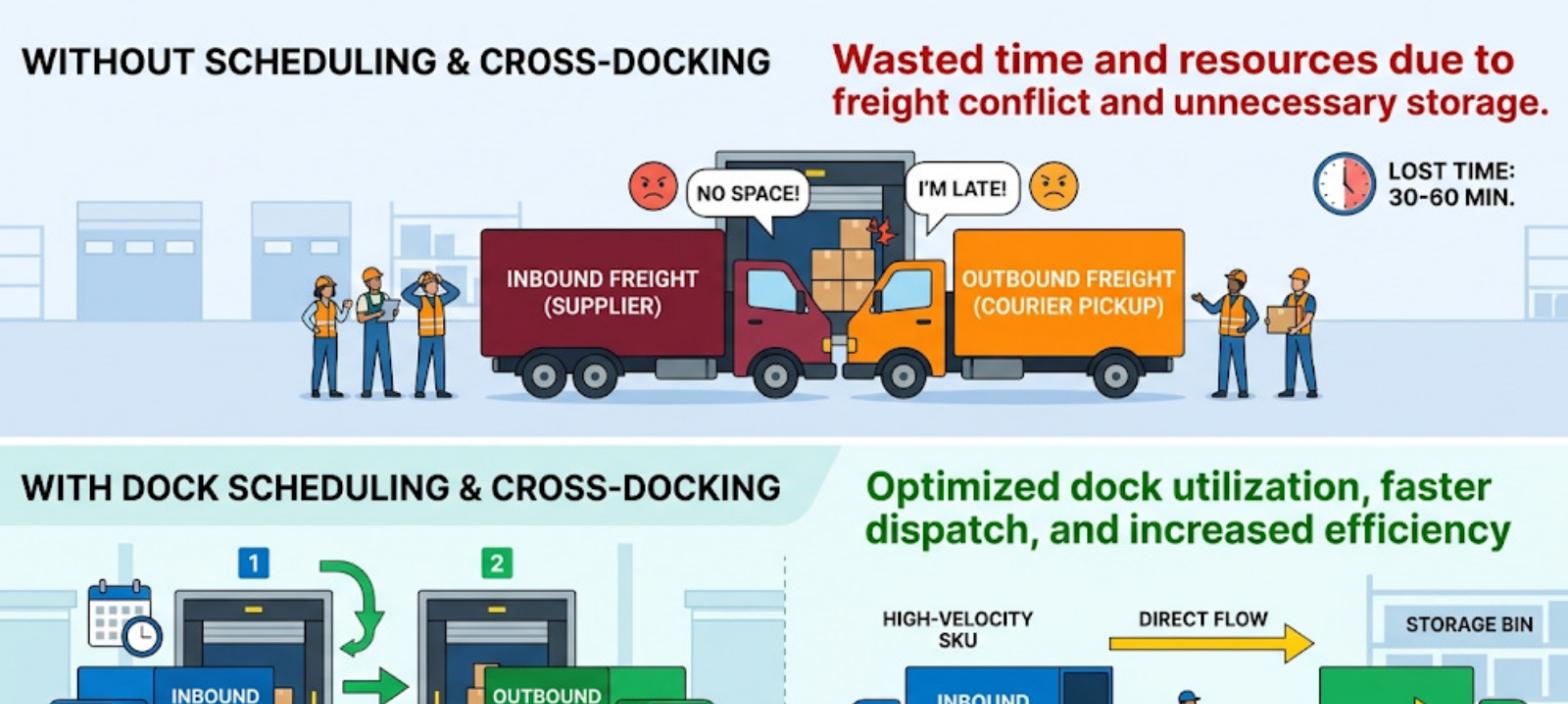
Inbound and outbound freight competing for the same dock space is one of the most common, and most overlooked, sources of warehouse delay in India. Sales-day stock replenishment often arrives at the exact moment outbound dispatch needs the same loading bay. Dock scheduling assigns fixed time windows to inbound and outbound trucks, so a supplier delivery does not block a courier pickup during peak dispatch hours. Without this, warehouse staff loses 30-60 minutes per incident just resolving loading bay conflicts on a busy day.
Cross-docking takes this further. High-velocity SKUs arriving from a supplier can move directly from the inbound dock to an outbound shipment, bypassing storage entirely, when demand for that SKU is already confirmed. This is especially useful during sale events, where fresh stock needs to reach customers within hours of arrival rather than sitting in a bin first. Warehouse management software in India that includes dock scheduling and cross-docking logic gives operations managers a structural advantage during high-volume periods, when every hour of dock congestion translates directly into missed courier cut-offs.
Cycle Counting Cadence: Keeping Stock Accurate Between Full Audits
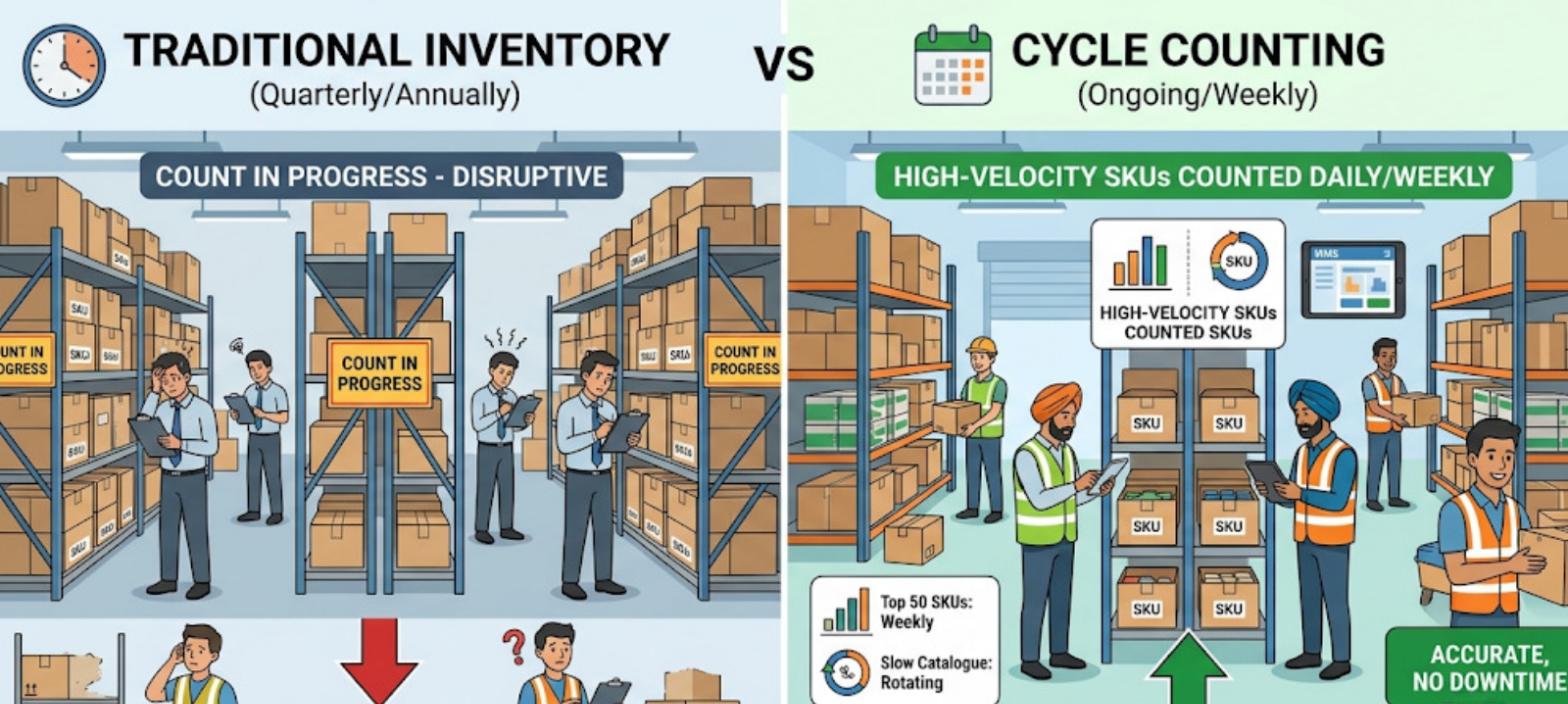
Most Indian warehouses run a full physical inventory count once a quarter, sometimes once a year. Between those counts, phantom inventory, stock recorded as available that is actually damaged, misplaced, or already picked, accumulates silently. Cycle counting solves this by counting a rotating subset of SKUs every week without halting warehouse operations. A brand can count its top 50 fast-moving SKUs weekly and its slower-moving catalogue on a longer rotation, catching discrepancies within days rather than months.
The financial case is direct. Businesses in 2024 achieved only an 83% average inventory accuracy rate across ecommerce operations. Every percentage point of inaccuracy at 500 daily orders means 5-10 pick failures a day from phantom inventory alone, each one a disruption that pulls a supervisor away from the floor to investigate. Good warehouse management software in India should generate discrepancy reports automatically after every cycle count and push corrected counts into the live inventory record with a full audit trail, so silent stock drift never has room to accumulate.
How Base.com’s Warehouse Management System Works
Base.com’s WMS is built specifically for Indian D2C, marketplace, and B2B fulfilment operations, not adapted from a system designed for a different market. Base.com generates pick lists sequenced by bin location automatically, with batch picking for single-item orders and zone-based picking for multi-item orders. Pickers follow a directed route with no backtracking and no reliance on memory.
At the packing station, Base.com enforces barcode scan confirmation for every item before a label can be generated. Kit and bundle orders are decomposed into component-level pick instructions, so packers see every individual item required rather than a single composite bundle entry that hides missing components.
Base.com’s dispatch layer applies channel-specific rules automatically. Orders from Amazon, Flipkart, Meesho, and Myntra are manifested according to each platform’s format and SLA window, with COD orders flagged for pincode-level RTO risk before the label is generated, not after a failed delivery attempt.
On the returns side, Base.com triggers an automated quality check the moment a return is logged by the courier. Saleable items re-enter available inventory immediately. Damaged items are tagged for write-off, and marketplace claims are pre-populated where the platform API supports it. For enterprise sellers running SAP alongside their fulfilment operations, Base.com connects natively rather than through a manual CSV bridge. This is the operational depth that separates purpose-built warehouse management software in India from a basic inventory tracker rebranded as a WMS.
The ROI of Warehouse Management Software in India
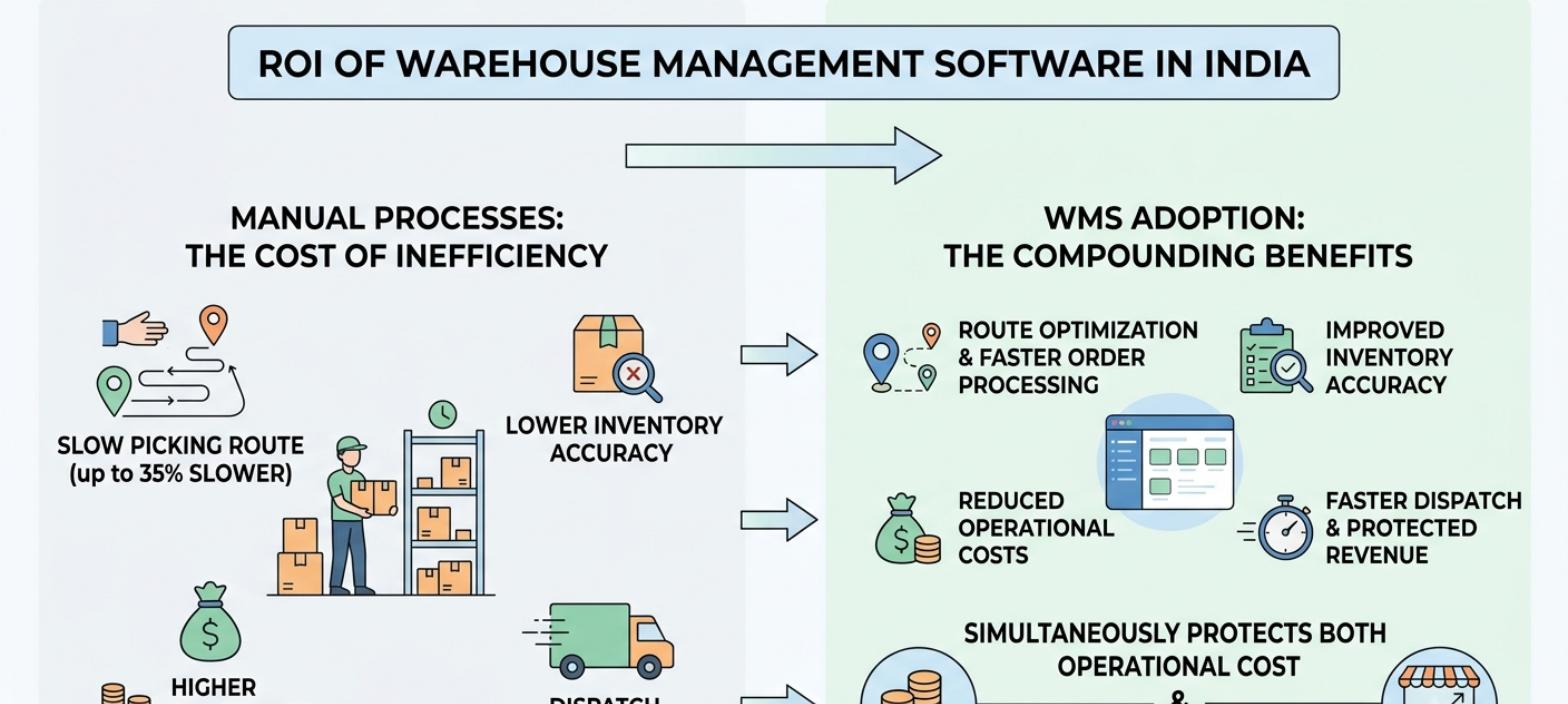
Warehouse inefficiency rarely shows up as one large visible loss. It accumulates through dozens of small failures every single day. Manual, unoptimised pick list sequencing can slow processing by up to 35% compared to a route-optimised system. At 400 orders a day across three pickers, that inefficiency is the equivalent of losing an entire worker’s worth of output, without anyone being idle.
Businesses relying on manual warehouse processes incur roughly 30% higher operational costs than those running an integrated WMS. Businesses in 2024 also achieved only an 83% average inventory accuracy rate across ecommerce operations, and each percentage point below that translates directly into failed picks during active dispatch windows.
Beyond direct cost, dispatch delays caused by warehouse inefficiency compound into marketplace penalties. A brand that consistently misses dispatch SLAs sees its listing rank drop across every platform it sells on, not just the order that was late. This is the compounding case for warehouse management software in India: it protects both operational cost and channel-level revenue simultaneously.
Implementation Timeline
Moving from manual or semi-manual warehouse operations to a proper WMS does not require a multi-month rollout.
- Week 1: Floor mapping — assign bin coordinates, aisle number, shelf row, and position to every active SKU location.
- Week 1: Courier and marketplace integration — connect carrier APIs and marketplace accounts so manifest generation and SLA tracking work from day one.
- Week 2: Slotting and wave configuration — set initial slotting based on the last 90 days of sales velocity, and configure wave sizes to match current picker capacity.
- Week 2-3: Parallel run — operate the new WMS alongside existing manual processes briefly to validate pick accuracy before full cutover.
- Week 3 onward: Live monitoring — track pick error rate and dispatch TAT weekly for the first month to catch configuration gaps early.
Brands that follow this sequence typically see measurable throughput improvement within the first week of go-live, with full stabilisation of warehouse management software in India within two to three weeks.