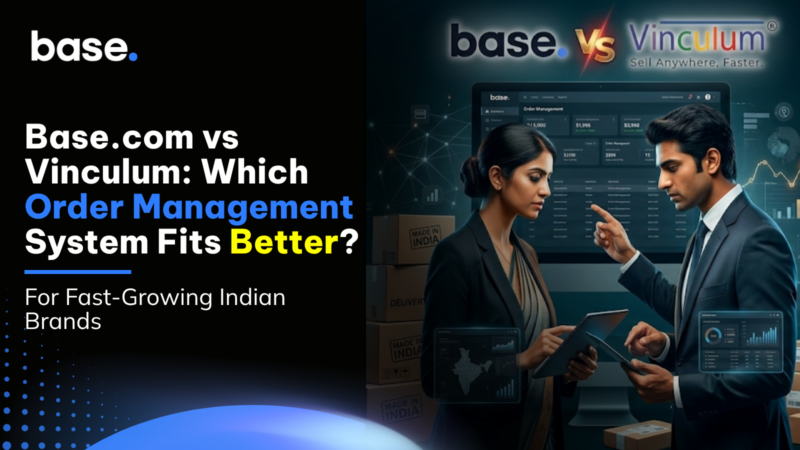
Base.com India vs Vinculum is a comparison that Indian D2C founders and operations leads are increasingly running as they scale past ₹5 crore monthly GMV and discover that their current platform has structural limits. Vinculum is a well-known name in Indian ecommerce operations; it ranked first overall in the Amazon integrator scoring dataset used for this comparison, above Unicommerce, EasyEcom, Browntape, and others. That is a meaningful credential.
But ranking first on an Amazon integrator scorecard does not mean Vinculum is the right OMS for a D2C brand building a scalable operations stack. The Amazon integrator evaluation measures one dimension, marketplace connector reliability. A full OMS decision involves warehouse management depth, inventory control, accounting integration, catalog management, customization flexibility, and the completeness of the financial reporting layer.
The Base.com India vs Vinculum comparison, drawn directly from the competitive feature data, reveals a significant capability asymmetry. Vinculum is strong at order routing and marketplace connectivity. It has hard structural gaps in WMS, accounting, PIM, and customization that affect every brand past the early growth stage. This post makes that comparison explicit and specific.
How Both Platforms Position Themselves
Vinculum positions itself as a scalable OMS for enterprise and complex multi-channel retail operations. Its integrations cover Shopify, Magento, WooCommerce, Amazon, and eBay. Its order management handles automated order allocation, multi-carrier integration, and order splitting based on fulfillment centers. Its customization is described as suitable for complex businesses.
Base.com positions itself as a unified platform covering OMS, WMS, inventory management, PIM, and accounting, with 1,500+ global integrations and specific capability depth in warehouse operations, financial reconciliation, and catalog management.
The Base.com India vs Vinculum question is fundamentally: do you need an OMS that routes orders well, or an OMS that manages the entire operational lifecycle? For brands with 100 orders per day with a single warehouse and clean marketplace channels, Vinculum may cover the need. For brands at 500+ orders per day with a physical warehouse, multi-channel catalog, and a finance team that needs clean P&L data, the comparison resolves clearly.
OMS Capabilities: Where Vinculum Holds Ground
Starting with what Vinculum does well is the correct analytical approach. The Base.com India vs Vinculum comparison should be honest about each platform’s strengths before addressing gaps.
1. Order Sync and Multi-Channel Support
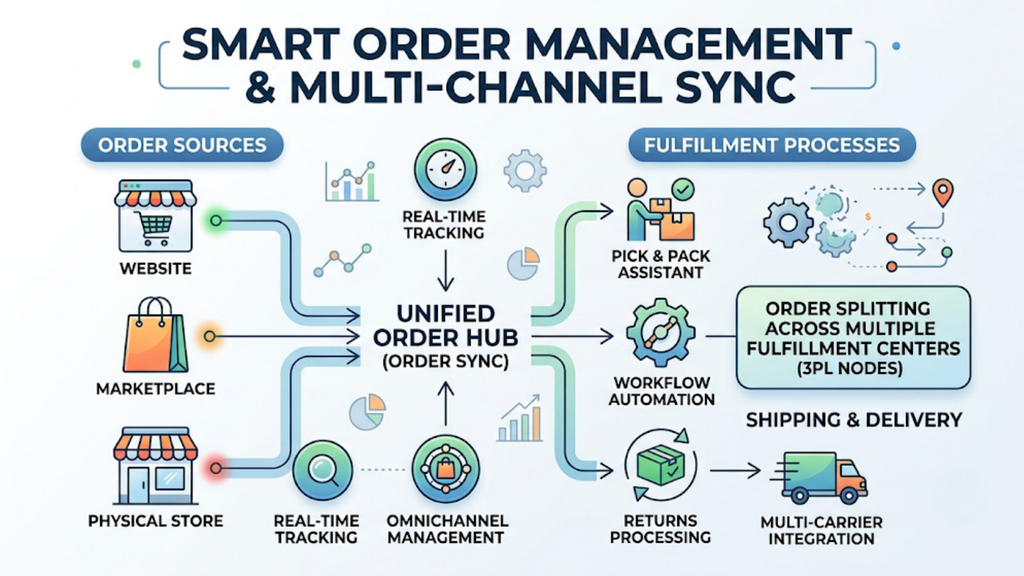
Both platforms support real-time order tracking, multi-channel order sync, omnichannel order management, pick and pack assistant, returns processing, and workflow automation for pick and pack.
Vinculum handles order bulk processing, real-time order tracking, and multi-carrier integration. Its order splitting supports splitting across fulfillment centers, relevant for brands operating multiple 3PL nodes without a unified warehouse management system.
2. Amazon Integrator Ranking
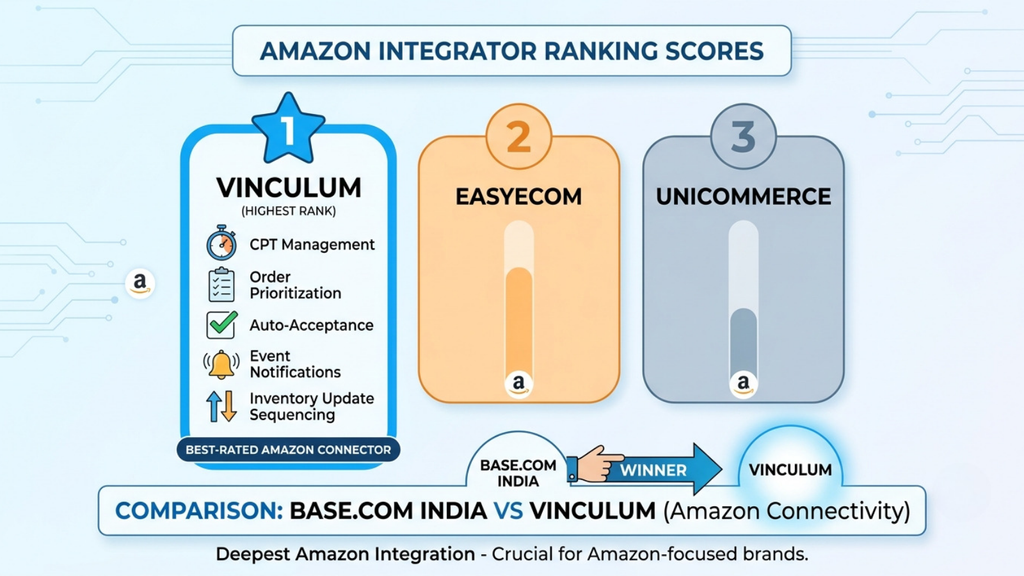
The competitive data includes an Amazon integrator ranking score across 11 platforms. Vinculum scored 1, the highest rank, indicating it was the best-rated Amazon marketplace connector in this specific evaluation. Unicommerce scored 3. EasyEcom scored 2. Base.com India vs Vinculum on the narrow Amazon connectivity dimension goes to Vinculum.
What this means in practice: Vinculum’s Amazon connector handles CPT management, order prioritization, auto-acceptance, event notifications, and inventory update sequencing at a level that Amazon’s own evaluation rated highest. For a brand that is exclusively Amazon-focused and needs the deepest possible Amazon integration, this matters.
What it does not mean: that Vinculum is the better full-platform choice for a brand operating across Amazon, Flipkart, its own D2C website, and a physical warehouse.
3. Order Prioritization Gap in Vinculum
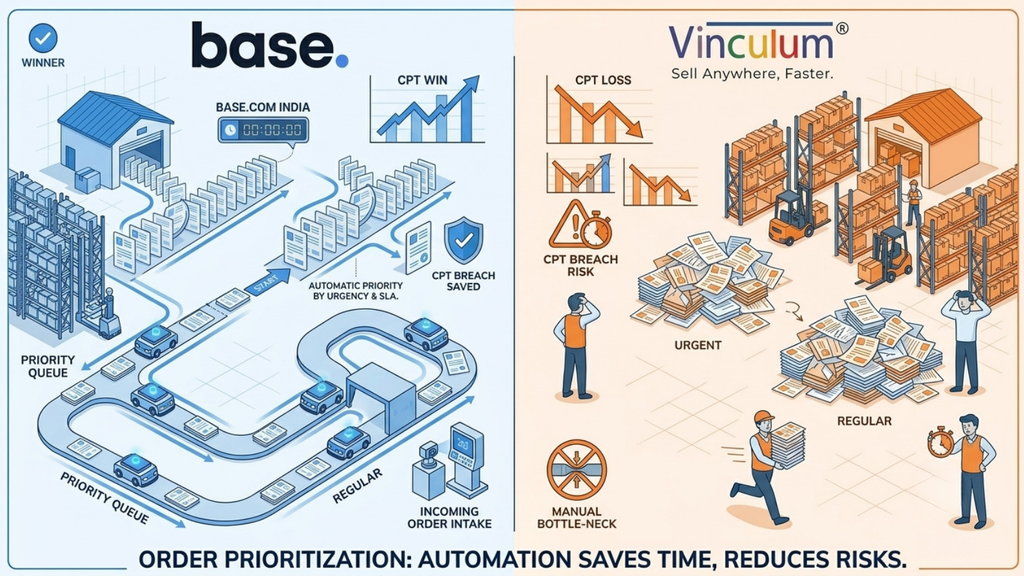
Despite ranking first on Amazon connectivity, Vinculum has a notable OMS gap: order prioritization is absent. The competitive feature data shows Vinculum as NO for order prioritization, while both Base.com and Unicommerce support it.
For a brand processing 500 orders per day across CPT windows, the absence of dynamic order prioritization means the warehouse team manually determines which orders to process first. At scale, this is a consistent source of CPT breaches on time-sensitive orders, exactly the scenario the Amazon integrator ranking was designed to prevent.
Base.com India vs Vinculum on order prioritization: Base.com wins. The system automatically sorts the order queue by CPT urgency and SLA requirements. Vinculum requires manual management of the dispatch sequence.
4. Order Split by Channel
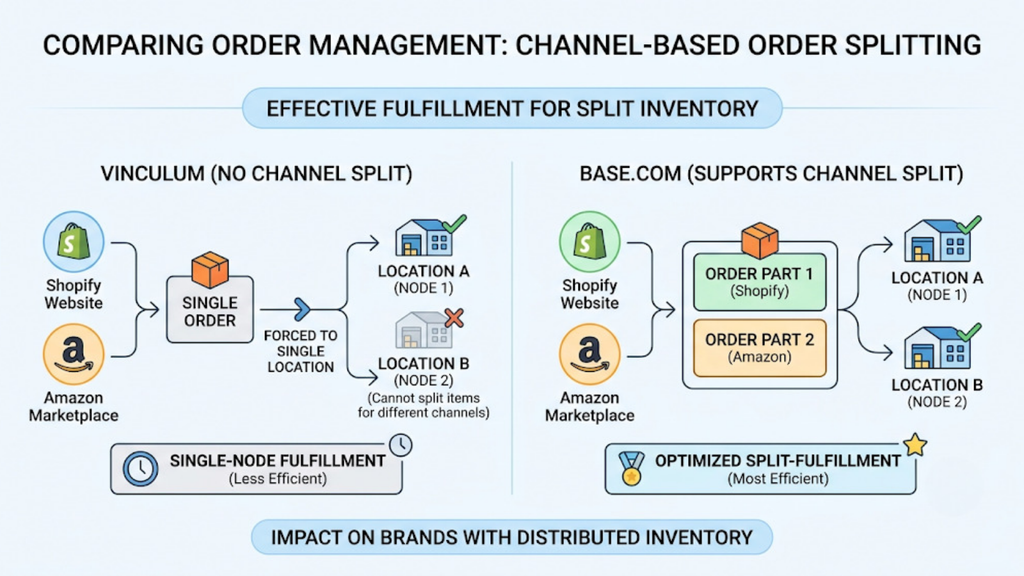
Vinculum does not support order split by channel. Base.com supports it. For a brand running split inventory across nodes with different channel allocations, the inability to split an order by channel forces a single-node fulfillment decision even when split-fulfillment would be more efficient or the only viable option.
WMS: The Most Significant Gap in the Base.com India vs Vinculum Comparison
This is where the Base.com India vs Vinculum comparison becomes decisive for any brand running a physical warehouse operation.
Vinculum Has No WMS
The competitive data is unambiguous on this point. Vinculum: No WMS. No rack/shelf allocation. No barcode scanning. No order picking and packing module.
The data shows Vinculum with YES on stock sync and real-time stock visibility, inventory count tracking at the location level. But it has no physical warehouse management capability. No digital warehouse view. No bin-level configuration. No barcode-verified pick. No cart scanning. No in-system barcode creation.
For a brand that stores inventory in a physical warehouse and needs the system to manage what happens between inbound receipt and outbound dispatch, Vinculum requires a separate WMS tool. That tool’s data must be manually or via API reconciled with Vinculum’s OMS. Every integration point between systems is a potential for data divergence, sync delay, and operational error.
Base.com India vs Vinculum on WMS is not a feature comparison; it is a binary. Base.com has a WMS. Vinculum does not.
What Base.com’s WMS Covers That Vinculum Cannot
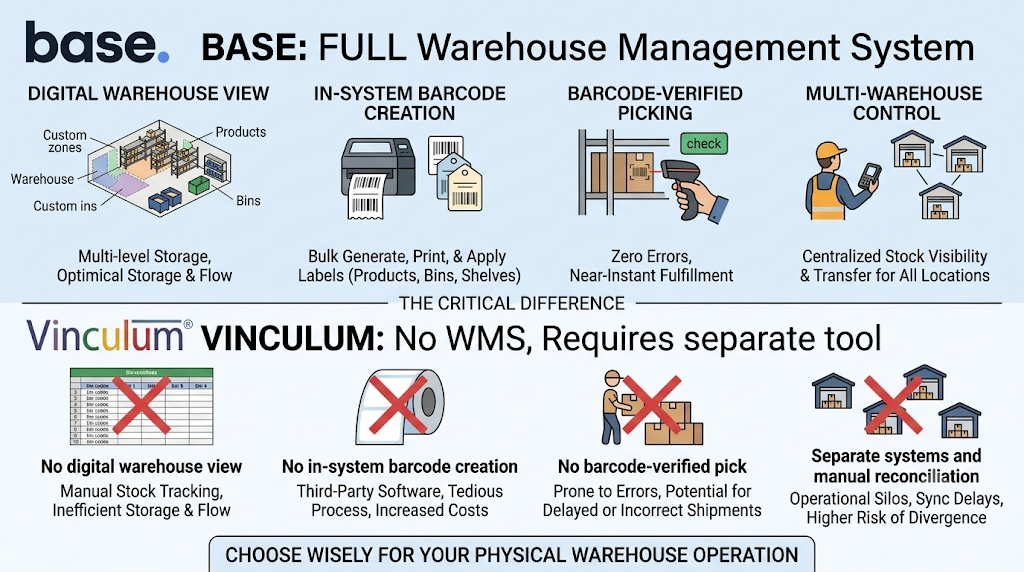
Base.com’s WMS provides:
A digital warehouse view, a spatial map of the warehouse with custom zones, aisles, racks, shelves, and bins. Each location carries a scannable identifier. The warehouse team operates against a system-defined physical layout.
In-system barcode and MRP tag creation, product barcodes are generated within Base.com and printed directly from the platform. For brands receiving untagged stock from Indian suppliers, this removes the external barcode creation and application workflow.
Barcode scanning on location and on cart, two verification checkpoints per pick. Location scanning confirms the picker is at the right bin. Cart scanning confirms the item picked is the correct SKU. Wrong-item shipments, the primary controllable source of returns, are eliminated at the pick stage.
Rack and shelf allocation, SKUs assigned to specific physical locations, with the system tracking where every unit lives. High-velocity SKUs can be assigned to bins closest to the dispatch bay, reducing pick walk time.
Order picking and packing, pick instructions generated per order or per batch, sorted by location, with barcode verification at each step. Packing confirmation before label generation.
Multi-warehouse management, multiple physical nodes managed from the same WMS, with node-level bin configurations and inventory counts. Inter-node stock transfers tracked from dispatch at Node A to receipt at Node B.
This is the operational infrastructure that converts a warehouse from a cost center into a fulfillment accuracy engine. Vinculum’s absence in this category means brands on Vinculum are running their warehouse on a separate system, with all the data integrity and integration overhead that entails.
Inventory Management: Gaps That Compound at Scale
As order volumes grow, even small inventory management gaps can quickly compound into costly operational and financial problems.
Batch Tracking and Multi-Warehouse Management
The feature data shows Vinculum as NO on both batch tracking and multi-warehouse management in the inventory module.
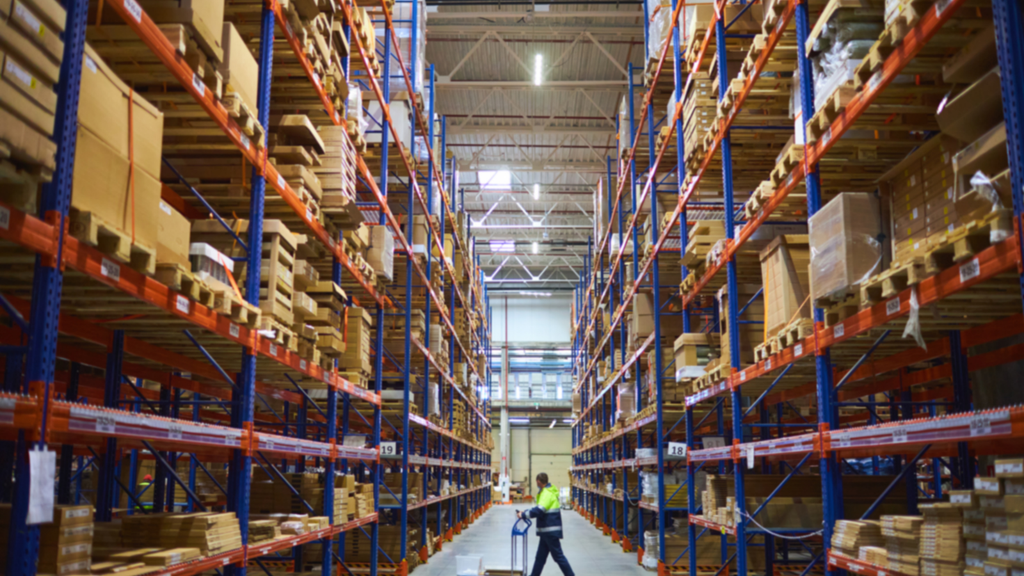
Batch tracking is a compliance requirement for FMCG, nutraceuticals, beauty, and pharma-adjacent categories in India. Without it, FIFO/FEFO enforcement is impossible. Older stock accumulates at the back of the warehouse while newer stock ships. Expiry-related returns, markdown costs, and occasional compliance failures are the downstream consequences.
Multi-warehouse management absence in Vinculum’s inventory module means brands operating multiple fulfillment nodes cannot manage consolidated inventory positions across nodes from within the platform. Each node’s inventory is tracked separately, requiring manual consolidation for accurate total availability figures.
Base.com India vs Vinculum on inventory management: Base.com supports batch tracking with FIFO/FEFO enforcement, LOT-level identification, and multi-warehouse management with real-time stock visibility across all nodes.
Stock Reservation and Inventory Control
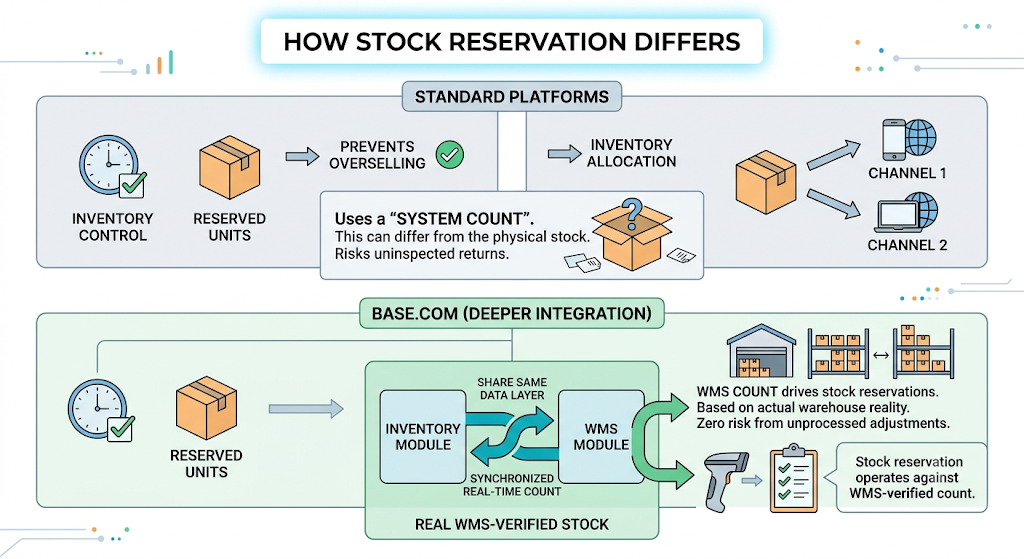
Both platforms support inventory allocation per channel and inventory control/stock reservation. This is the mechanism that prevents overselling, reserving units at order confirmation before the physical pick, removing them from channel-visible inventory immediately.
Where Base.com adds depth: stock reservation in Base.com operates against the WMS-verified physical count, not a system count that may diverge from physical reality through uninspected returns or unprocessed adjustments. Because the WMS and inventory module share the same data layer, the count that drives the reservation is the same count that the warehouse operates against.
ERP and Accounting: A Hard Vinculum Gap

The feature data is explicit: Vinculum has NO on ERP/Accounting, NO on invoice creation, NO on payment reconciliation, NO on multi-currency support, and NO on tax calculation.
For a growing Indian D2C brand, this means:
No invoices generated within Vinculum. Every order’s invoice is created in a separate tool or manually.
No payment reconciliation. Marketplace settlement matching, COD remittance reconciliation, and order-level credit tracking all require external tools or manual spreadsheet work.
No multi-currency support. Brands selling on international marketplaces need currency conversion at the transaction level. Vinculum cannot do this.
No tax calculation. GST-compliant invoicing, TCS tracking, and ITC reconciliation all require external accounting tools.
Base.com India vs Vinculum on accounting is a clean comparison: Base.com covers the full financial stack, invoice creation, invoice corrections, payment reconciliation, payment tracking, multi-currency support, tax calculation, automatic Tally sync, and Zoho Books integration. Vinculum covers none of it.
For a brand processing 2,000 orders per day, the absence of accounting integration in Vinculum means the finance team is doing all of the following in external tools or manually: generating invoices, reconciling marketplace settlements, tracking COD remittances, matching return credits, calculating GST, and maintaining the Tally ledger. The operational cost of this gap is a full-time finance team function that Base.com automates.
PIM: Vinculum Has No Catalog Management
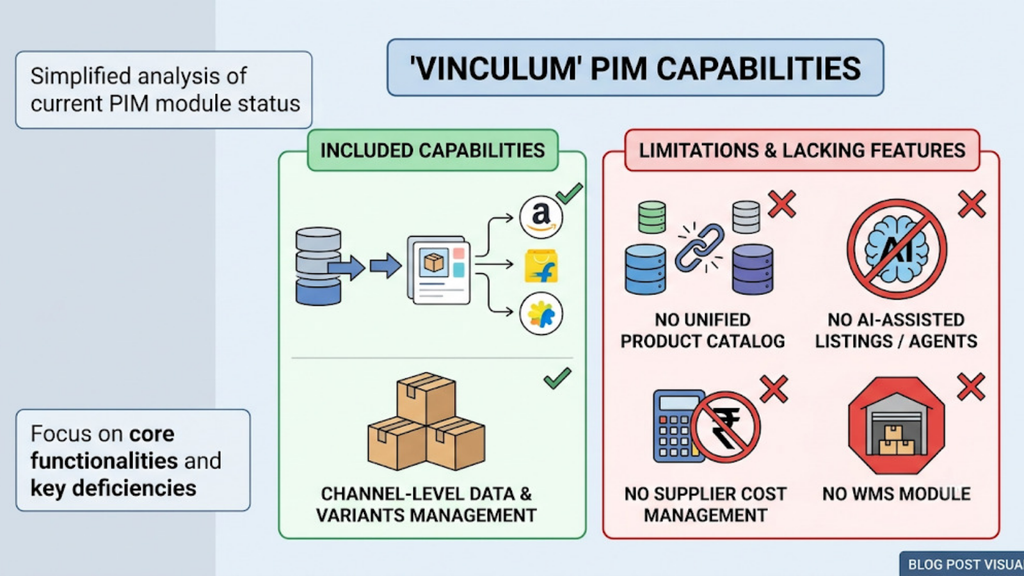
The data shows Vinculum as NO on the full PIM module, no complete PIM, no AI-assisted listings to marketplaces, no AI listing agents, no supplier cost management, no unified catalog, and no WMS module.
Vinculum does support pushing the catalog to marketplaces, the basic function of sending product data to channel APIs. It supports channel-level data and product variants management. These are table-stakes catalog capabilities.
What Vinculum does not have: a system where product images, text fields, pricing tiers, variant configurations, and channel-specific attributes are all maintained in one place and pushed to all channels from that single record. No AI listing agent automatically lists a new product across connected channels when created. No supplier cost per SKU is feeding into the margin calculation.
Base.com India vs Vinculum on PIM: Base.com’s complete PIM is a unique differentiator in the Indian OMS market. For brands managing 200+ active SKUs across 5+ channels with regular new product launches, the PIM gap in Vinculum creates ongoing manual catalog management overhead.
Customization: The Operational Flexibility Gap
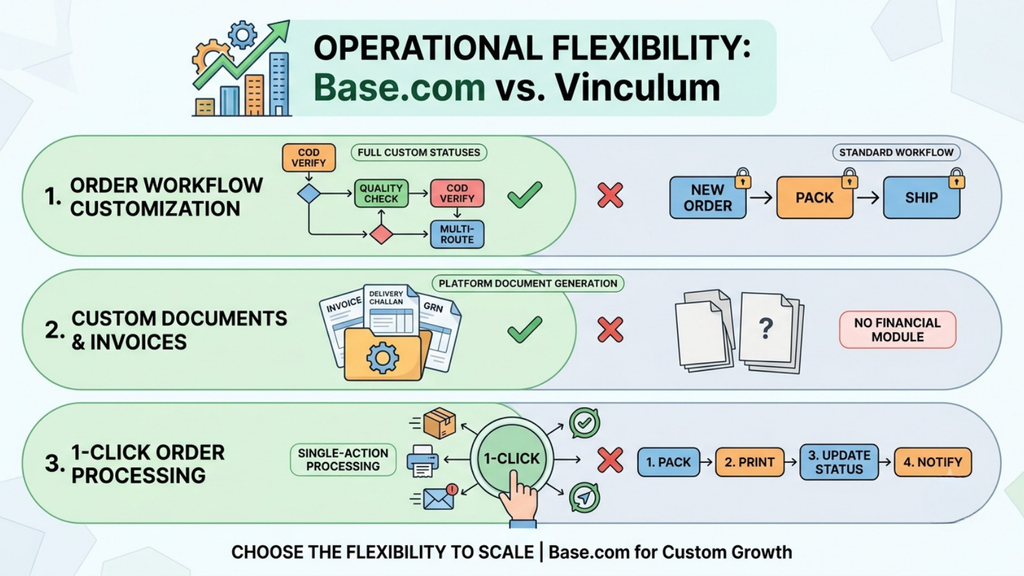
As businesses scale, standardized workflows often become a limitation, making operational flexibility and customization essential for efficient growth.
1. Order Statuses and Workflow Configuration
Base.com supports fully customized order statuses; the brand defines every step in its fulfillment workflow and what happens at each transition. Vinculum’s customization is described as suitable for complex businesses, but it does not offer custom order statuses.
In the Base.com India vs Vinculum context, this matters most for brands with COD verification workflows, B2B order processing steps, quality check stages, or multi-location routing logic that does not fit a standard OMS status model. Base.com accommodates all of these through custom status configuration. Vinculum does not.
2. Custom Documents and Invoices
Base.com generates custom invoices, GRNs, and delivery challans within the platform. Vinculum has no invoice creation capability at all; the document generation question is moot because the financial module does not exist.
3. 1-Click Order Processing
Base.com’s 1-click processing, a single action that packs, prints a label and invoice, updates order status, triggers customer notification, and updates tracking, has no equivalent in Vinculum. For operations teams processing hundreds of orders per shift, this is a measurable throughput difference.
Reporting and Analytics: The P&L Visibility Gap

Both Vinculum and Base.com provide sales reports, returns reports, inventory reports, channel-wise performance reports, order fulfillment reports, and customer reports. The reporting surface area is comparable.
The differentiation is in the Total Business P&L Dashboard that Base.com provides, and Vinculum does not. Channel-wise revenue net of fees and fulfillment costs, margin per SKU, working capital tied in aging inventory, and COD remittance recovery rate; these financial-operational connections require a separate analytics tool for Vinculum users.
Base.com India vs Vinculum on financial reporting: Vinculum produces operational data. Base.com connects operational data to financial outcomes in a native dashboard without a separate BI tool.
Integration Depth: 1,500 vs Limited
Base.com’s 1,500+ global integrations cover India, the US, Europe, the Middle East, LatAm, and Southeast Asia, 300+ marketplace integrations, plus bespoke integrations including digital scales for weight management, Base Caller, Slack, Discord, and Google Drive.
Vinculum integrates with Shopify, Magento, WooCommerce, Amazon, and eBay. These are the core channels for Indian ecommerce but represent a fraction of Base.com’s coverage.
For brands operating domestically on Amazon and Flipkart, this integration breadth difference may not be immediately material. For brands expanding to the UAE, UK, or Southeast Asian channels, or brands that have built internal workflows around Slack or Google Drive, the Base.com India vs Vinculum integration comparison becomes a growth ceiling question. Vinculum’s integrations serve today’s channels. Base.com’s integrations serve today’s channels and wherever the brand scales next.
Vinculum also does not offer the customer service module (Responso) that Base.com includes, a unified panel for social conversations across Instagram, Facebook, and WhatsApp with AI-assisted workflows and website chatbot integration.
The CRM Gap
The data shows Vinculum as NO on CRM, customer segmentation, and customer support integration. Base.com supports customer segmentation and customer support integration within the platform.
For Indian D2C brands where repeat purchase rate is a primary growth lever, the ability to segment customers within the operational platform, by order history, channel, product category, or RTO rate, and use that segmentation for targeted communication is a differentiator that Vinculum cannot offer.
Summary: When to Choose Base.com vs Vinculum
The Base.com India vs Vinculum decision has a relatively clean answer when mapped against specific operational profiles:
- Choose Vinculum when: The brand is exclusively Amazon-focused, needs the highest-rated Amazon marketplace connector for CPT compliance and order management, and handles warehouse operations, accounting, and catalog management in separate dedicated tools that the team is already invested in. Vinculum’s Amazon ranking is legitimate, for a pure Amazon seller who needs the best possible marketplace connector and manages everything else externally, Vinculum earns its position.
- Choose Base.com when: The brand needs a unified operational platform, OMS, WMS, inventory, PIM, and accounting in one system. When the warehouse needs physical management depth: bin locations, barcode-verified picking, digital warehouse view, and in-system barcode creation. When the finance team needs automatic Tally sync rather than a weekly manual export-import. When the brand is managing a multi-channel catalogue across 5+ platforms and needs AI-assisted listing management. When cross-border expansion is planned, a single platform needs to handle Indian and international channels. When the P&L needs to connect operational metrics to financial outcomes without a separate BI tool.
For Indian D2C brands scaling from ₹5 crore to ₹50 crore monthly GMV, the operational requirements shift decisively toward the Base.com profile: physical warehouse management, multi-channel catalog discipline, automated financial reconciliation, and data-driven P&L visibility. The Base.com India vs Vinculum comparison at this scale resolves clearly in Base.com’s favor, not because Vinculum is a poor product, but because Vinculum was built for a narrower operational scope than what fast-growing Indian D2C brands require.