

Inventory management is the process of tracking, controlling, and optimising stock as it moves from supplier to warehouse to customer. It answers three questions in real time: what you have, where it is, and how much you need to reorder. For Indian sellers running multiple channels, the right inventory management system in India replaces manual stock counts with automated, real-time visibility across every warehouse and marketplace.
That is the short answer. The rest of this guide breaks down how inventory management actually works, why it looks different for Indian D2C and marketplace sellers than it does anywhere else, and what to look for in an inventory management system in India built for the way this market actually operates.
What Is Inventory Management?
Inventory management covers everything between a purchase order being raised and a product reaching a customer. That includes receiving stock, storing it, tracking it across locations, and updating counts the moment something sells, returns, or gets damaged.
At its core, inventory management solves one operational problem: matching supply to demand without tying up excess cash in stock that sits idle. Too little inventory causes stockouts and lost sales. Too much inventory locks up working capital and increases holding costs.
India’s ecommerce market has crossed $226 billion, and D2C brands are growing at a 40% CAGR. Growth at that pace multiplies SKU counts, warehouse locations, and sales channels simultaneously. Manual tracking that worked at 50 orders a day breaks down completely at 500.
A system built for this market needs to do more than count stock. It needs to reconcile that stock across every channel a brand sells on, often within the same hour a sale happens.
Why Inventory Management Matters More in India Than Anywhere Else
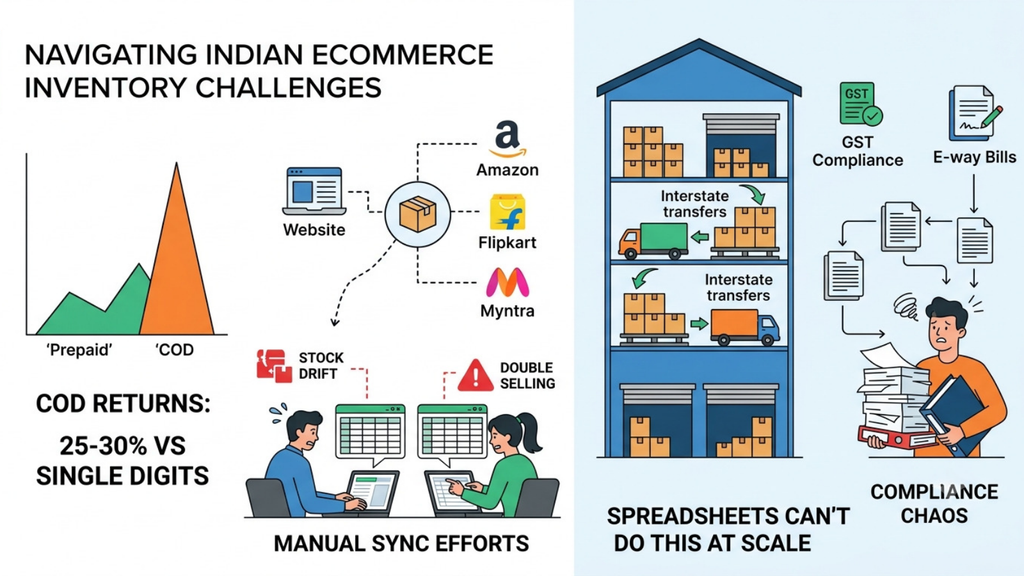
Global inventory management principles do not translate cleanly to Indian ecommerce. Three structural realities make an inventory management system in India fundamentally different from a Western equivalent.
- COD dominance changes the return equation. Cash on delivery accounts for 55-65% of ecommerce volume in Tier 2 and Tier 3 cities, the fastest-growing markets for Indian D2C brands. COD return rates run at 25-30% nationally, compared to single digits for prepaid orders elsewhere. Every one of those returns has to flow back into available inventory correctly, or stock counts drift from reality within weeks.
- Channel fragmentation is the default, not the exception. A typical Indian D2C brand sells through its own website, Amazon, Flipkart, Meesho, and Myntra at the same time. Each of these platforms holds its own inventory count unless a system synchronises them. Without real-time sync, the same unit can sell twice on two different channels within minutes of each other.
- GST and multi-warehouse compliance add a layer manual systems cannot handle. Indian sellers operating from multiple depots need inventory data that reconciles cleanly with GST filings, e-way bills, and interstate stock transfers. A spreadsheet cannot do this at scale without daily manual reconciliation.
This is why generic global software, built for single-warehouse, prepaid-first markets, consistently underperforms in India. An inventory management system in India has to be built around COD, multi-channel selling, and GST compliance from day one, not adapted for it later.
The Core Components of an Inventory Management System in India
Every functional inventory platform built for this market is structured around five components. Missing any one of them creates a blind spot that eventually costs money.
1. Stock Tracking and Visibility

This is the foundation. Every SKU needs a real-time count that reflects what is physically on the shelf, not what a report said three days ago. Barcode or QR-based scanning at receiving, picking, and packing keeps this count accurate without manual entry errors.
2. Reorder Point and Replenishment Logic
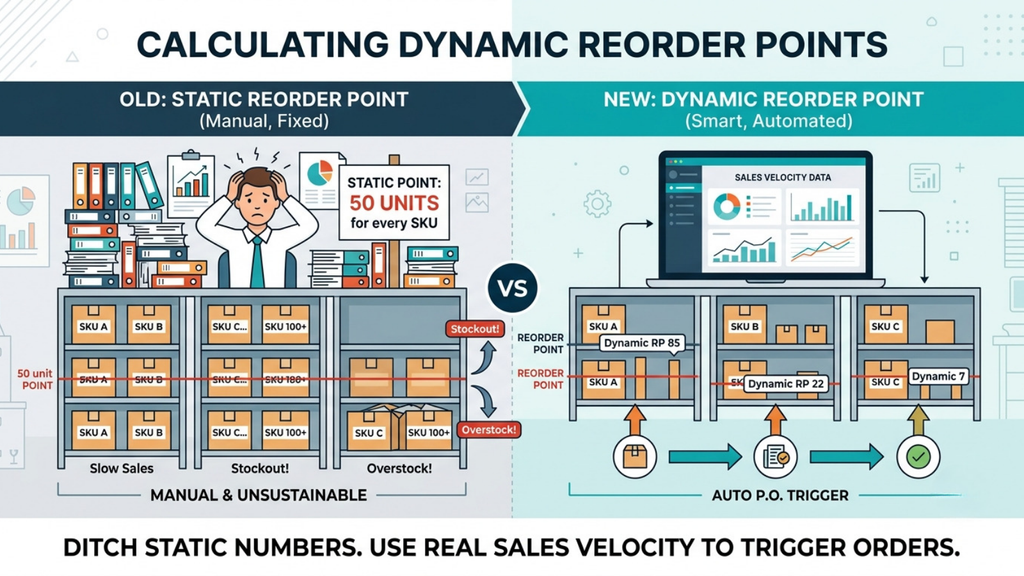
A reorder point is the stock level at which a new purchase order should trigger automatically. Setting this manually across hundreds of SKUs is not sustainable. A proper system calculates reorder points using actual sales velocity, not a static number set once and forgotten.
Multi-Location and Multi-Channel Sync
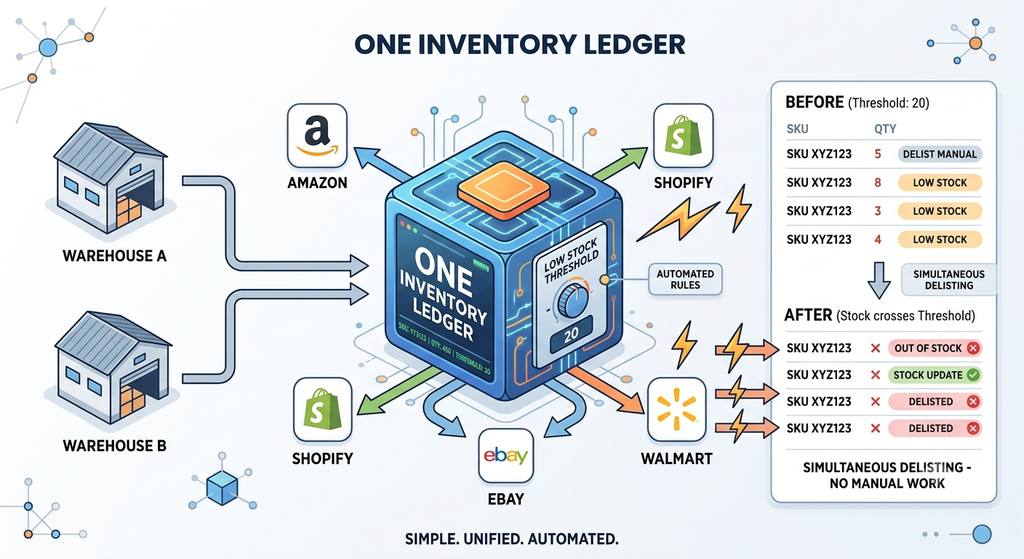
Brands operating from two or more warehouses, or selling on four or more channels, need one inventory ledger that every channel reads from. When stock on any SKU crosses a configured threshold, the system should reduce or delist that item everywhere simultaneously, with no manual update required.
3. Batch, Expiry, and Lot Tracking
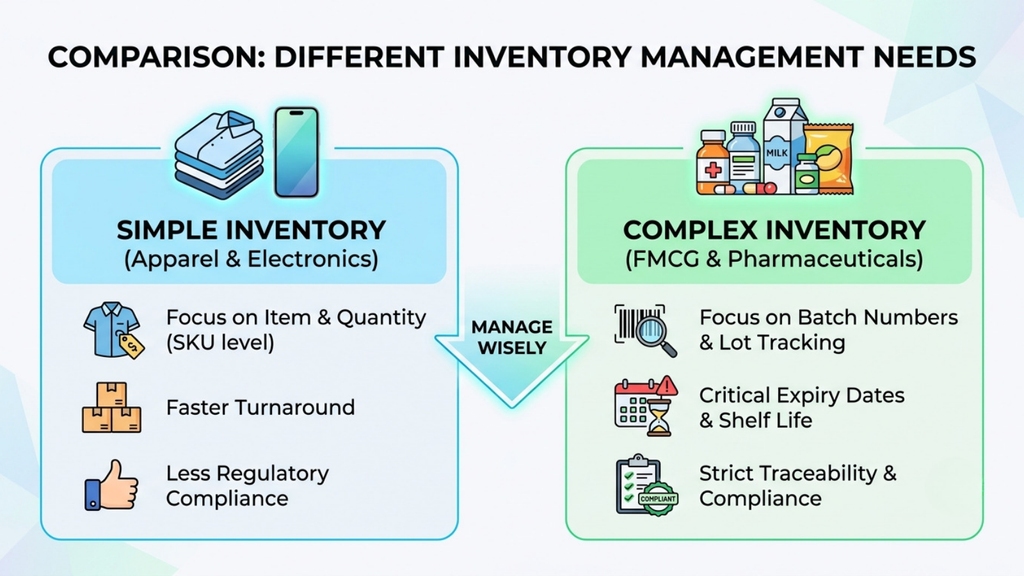
FMCG and pharmaceutical sellers cannot ship inventory management the same way apparel or electronics sellers do. Batch numbers, expiry dates, and lot-level traceability are compliance requirements, not optional features, for categories where freshness or shelf life determines saleability.
4. Returns and Reverse Inventory
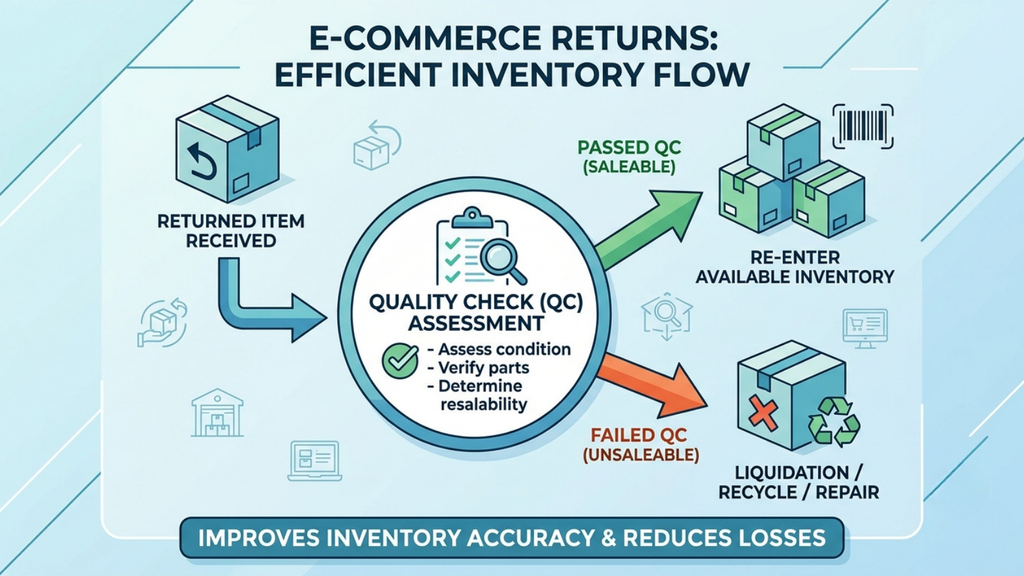
Given India’s 25-30% COD return rate, reverse inventory flow deserves the same rigor as forward fulfilment. A returned item should trigger an automatic quality check, and only saleable stock should re-enter available inventory. Skipping this step is one of the most common reasons stock counts stop matching reality.
Types of Inventory Management Methods
Before choosing software, it helps to understand the underlying methods that any inventory platform will apply to your stock.
- Periodic vs. Perpetual Inventory
Periodic inventory counts stock at fixed intervals, weekly or monthly. Perpetual inventory updates the count continuously, the moment a sale, return, or stock transfer happens. At any volume above 100-150 orders a day, periodic counting cannot keep pace with actual movement, and perpetual tracking becomes the operational baseline.
- FIFO, LIFO, and FEFO
FIFO (First In, First Out) moves the oldest stock first, standard for most retail categories. LIFO (Last In, First Out) is rarely used in Indian ecommerce due to tax and audit complications. FEFO (First Expired, First Out) prioritises stock by expiry date rather than receipt date, essential for FMCG, pharma, and cosmetics sellers managing shelf-life-sensitive inventory.
- ABC Analysis
ABC analysis segments SKUs by contribution to revenue or order volume. A-category SKUs, typically the top 20% by velocity, deserve the tightest tracking and best warehouse placement. C-category SKUs, the slow movers, can tolerate looser monitoring. This segmentation directly feeds warehouse slotting and replenishment priority.
Manual Inventory Tracking vs. an Inventory Management System in India
Many growing businesses in India still rely on spreadsheets, notebooks, or manual stock registers to manage inventory. While these methods may work initially, increasing order volumes, multiple sales channels, and expanding warehouses make manual tracking slow, error-prone, and difficult to scale.
| Capability | Manual / Excel | Inventory Management System in India |
| Stock updates | Batch, once or twice daily | Real-time, on every transaction |
| Multi-channel sync | Manual export per channel | Automatic, unified ledger |
| Reorder triggers | Set manually per SKU | Calculated from live sales velocity |
| Returns reconciliation | Manual matching | Automated three-way match |
| GST and multi-warehouse reporting | Manual compilation | System-generated, audit-ready |
| Error rate at scale | Rises sharply above 200 orders/day | Remains stable at any volume |
| Time required monthly | 3-5 working days | Under 4 hours |
Manual tracking works at low volume. It stops working the moment a brand adds a second warehouse, a third sales channel, or crosses roughly 150-200 orders a day. Retailers using automated inventory management software save 20-30% in operational costs compared to those still relying on spreadsheets.
What an Inventory Management System in India Must Solve For
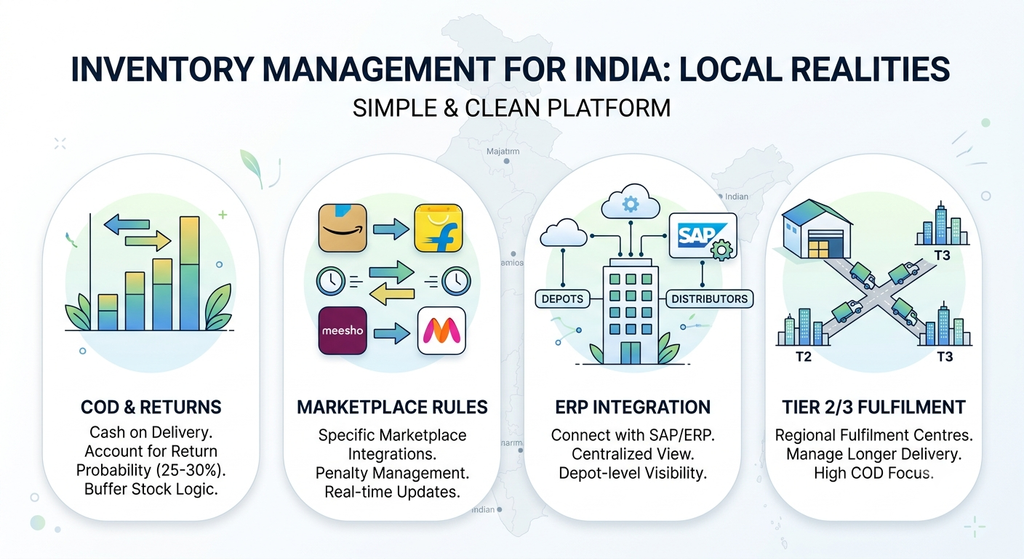
Not every platform built for inventory tracking is built for the Indian market. The right inventory management system in India has to account for realities that most global software ignores entirely.
- COD-aware stock allocation. Because 25-30% of COD orders return, a system needs to hold buffer logic that accounts for this return probability rather than treating every sale as final at the point of order.
- Marketplace-specific inventory rules. Amazon, Flipkart, Meesho, and Myntra each apply different inventory update windows and different penalty structures for stockouts or overselling. An inventory management system in India needs native integrations with each platform, not a generic API wrapper.
- Depot-level and SAP-linked visibility. Larger FMCG and pharma sellers operate through distributor networks and depot structures that need to reconcile with SAP or existing ERP systems. Inventory data that cannot speak to SAP creates a second, disconnected source of truth.
- Tier 2 and Tier 3 fulfilment complexity. A meaningful share of India’s ecommerce growth is coming from smaller cities with longer delivery windows and higher COD concentration. Inventory allocation logic needs to account for regional fulfilment centres, not just a single central warehouse.
Signs Your Business Has Outgrown Manual Inventory Tracking
A few patterns show up consistently right before a brand’s manual process breaks down completely.
- Stock discrepancies appear weekly, not monthly, between what the spreadsheet shows and what the warehouse physically holds.
- The same SKU oversells across two channels within the same day.
- Someone spends more than half a day every week just reconciling numbers across marketplaces.
- Return-to-stock updates lag by more than 48 hours after physical receipt.
- Businesses in 2024 achieved only an 83% inventory accuracy rate on average across ecommerce operations, and every percentage point below that translates directly into failed picks and missed dispatches.
If two or more of these apply, the cost of staying manual already exceeds the cost of switching to automated software.
How to Choose an Inventory Management System in India
Use this checklist when evaluating any platform against your actual operational needs, not just its feature list.
| Evaluation Criteria | What to Check |
| Marketplace integrations | Native, API-based sync with Amazon, Flipkart, Meesho, Myntra, and your own website |
| COD handling | Return-rate-aware inventory buffers, not just flat stock counts |
| Multi-warehouse support | Real-time stock visibility across every depot and fulfilment centre |
| Batch and expiry tracking | FEFO logic for FMCG, pharma, and cosmetics categories |
| ERP and SAP connectivity | Native connector, not a manual CSV bridge |
| Update frequency | Real-time or near-real-time sync, not batch updates every few hours |
| Reporting depth | SKU-level, channel-level, and depot-level breakdowns, not just aggregate totals |
| Implementation time | Days, not months, to go live |
Brands evaluating an inventory management system in India should treat this table as their actual due diligence checklist, not marketing copy from a vendor’s homepage.
How Base.com Approaches Inventory Management
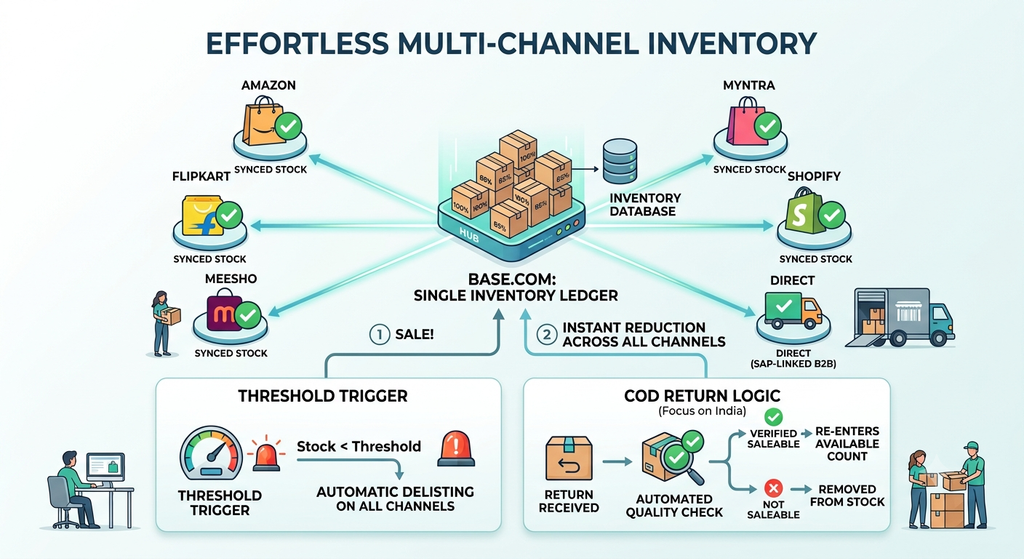
Base.com is an order and warehouse management platform built specifically for Indian D2C and B2B sellers, not a global system adapted for the Indian market after the fact.
Base.com maintains a single inventory ledger across every channel a brand sells on: Amazon, Flipkart, Meesho, Myntra, Shopify, and direct SAP-linked distribution. When stock on any SKU crosses a configured threshold, Base.com automatically reduces or delists that item across every connected channel at once. There is no manual export, no column mapping, and no lag between a sale on one platform and an updated count on another.
Base.com’s inventory logic is built around India’s COD reality specifically. Return probability is factored into available stock projections rather than treated as a surprise after the fact. Returns trigger an automated quality check on receipt, and only verified saleable stock re-enters the available count.
For FMCG and pharmaceutical sellers, Base.com supports batch-level and expiry-aware tracking with FEFO logic built in, so stock nearing expiry moves first rather than sitting until it becomes unsellable. For brands running SAP alongside their ecommerce operations, Base.com connects natively rather than requiring a manual bridge between systems.
This is what a functional inventory system looks like when it is designed around Indian selling patterns from the first line of code, not retrofitted from a platform built for a different market.
Demand Forecasting: The Layer Most Sellers Skip

Reorder points solve for steady-state demand. They do not solve for spikes. Indian ecommerce runs on spikes: Big Billion Days, the Great Indian Festival, Diwali, and brand-specific flash sales that push order volume to 5-10x the daily average within a 48-72 hour window.
A reorder threshold calculated from average daily sales will trigger too late for a sale event and too early during a slow month. Demand forecasting solves this by layering seasonality, campaign calendars, and historical event-day velocity on top of the base reorder logic.
Practically, this means pulling your top-selling SKUs from the last comparable sale event, checking current stock against projected sale-day velocity, and placing replenishment orders 10-15 days ahead rather than reacting to a stockout alert mid-event. Brands that skip this step consistently run out of their best-selling SKUs on the exact days those SKUs matter most.
An inventory management system in India that only tracks current stock, without layering forecasted demand on top of it, is solving half the problem. The other half, knowing what you will need before you need it, is where most manual processes and even some software platforms fall short.
Common Inventory Management Mistakes Indian Sellers Make
A few mistakes show up repeatedly across Indian D2C and marketplace sellers, regardless of category or size.
- Treating every channel as a separate inventory pool. Sellers who maintain separate stock counts for their website, Amazon, and Flipkart inevitably oversell on one channel while sitting on unsold stock on another. A single ledger, not five spreadsheets, is the only durable fix.
- Ignoring return probability until the return actually happens. Given COD return rates of 25-30%, treating every order as a guaranteed sale overstates available inventory and understates the working capital actually tied up in transit.
- Updating stock in batches instead of continuously. A four-hour sync window is adequate at 50 orders a day. At 300 orders a day across two or more channels, that same window can leave inventory off by 60-80 units before the next correction runs.
- Skipping cycle counts between full physical audits. Waiting for an annual or quarterly stock take to catch discrepancies means phantom inventory- stock the system shows as available, but that is actually damaged, misplaced, or already sold- accumulates undetected for months.
- No reason code on manual stock adjustments. Silent edits to inventory counts, made without recording why a number changed, are one of the most common sources of unexplained stock drift over time. Every manual adjustment should carry a logged reason.
The Real Cost of Poor Inventory Management
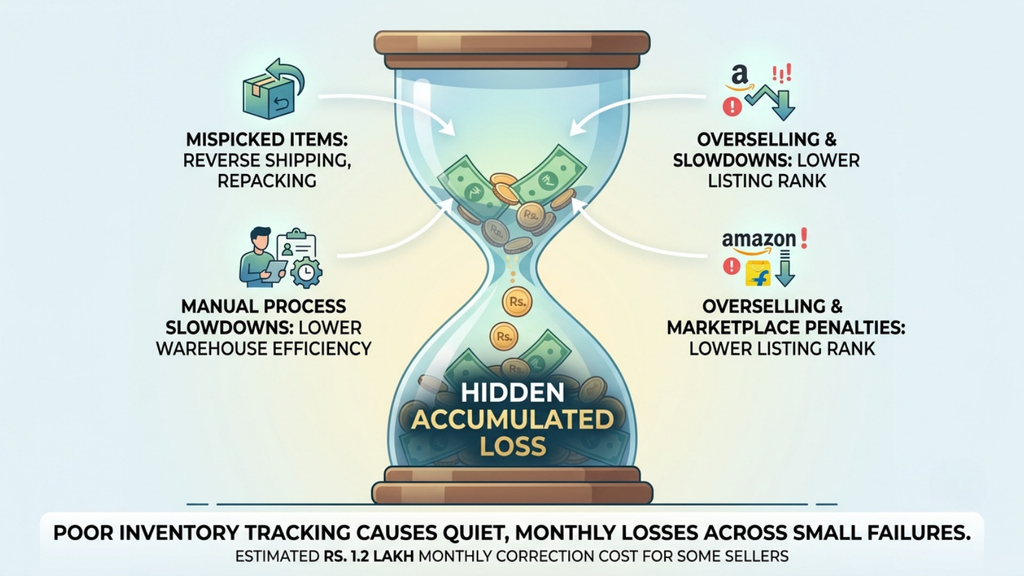
Poor inventory tracking rarely shows up as one large, visible loss. It accumulates quietly across dozens of small failures every month.
A mispicked item for an Indian ecommerce seller costs between Rs. 200 and Rs. 600 once reverse shipping, customer service, repacking, and reshipping are accounted for. At 500 daily orders and a 2% error rate, that is 10 incorrect shipments a day and roughly Rs. 1.2 lakh a month in pure correction cost.
Manual, disconnected inventory processes slow warehouse operations by up to 35% compared to automated alternatives. Businesses relying on manual order processing incur roughly 30% higher operational costs than those running an integrated, automated platform.
Overselling due to poor channel sync carries a second, less visible cost: marketplace penalties and listing rank drops. A single oversold SKU on Amazon or Flipkart can trigger account-level performance flags that reduce visibility across your entire catalogue, not just that one product.
Getting Started: Implementation Timeline
Moving from manual tracking to a proper inventory management system in India does not need to take months. A realistic implementation sequence looks like this.
- Week 1: SKU and warehouse mapping. Consolidate your SKU master so the same product code is used across every channel, not channel-specific variants.
- Week 1: API enablement. Confirm marketplace accounts are API-enabled, not just accessible through seller portals, so real-time sync is possible from day one.
- Week 2: Inventory migration and threshold configuration. Set reorder points and buffer logic based on actual sales velocity, not arbitrary round numbers.
- Week 2-3: Parallel run. Run the new system alongside existing manual tracking briefly to validate accuracy before fully switching over.
- Week 3 onward: Live monitoring. Track accuracy weekly for the first month to catch any mapping errors before they compound.
Brands that follow this sequence typically see the new setup fully operational within two to three weeks, with measurable accuracy improvement from the first week of go-live.