

The right inventory management techniques to increase fill rates start with visibility and end with discipline. Only 6.2% of businesses report a perfect 100% fill rate, and 44% experience stockouts at least once a month, according to a 2026 survey of 400 operators.
India’s ecommerce market is approximately $226 billion, and fill rate directly determines how much of that demand actually converts into revenue rather than a lost sale. A good item fill rate typically sits between 85% and 95%, and closing that last gap is where the right inventory management techniques to increase fill rates make the biggest difference.
Why Fill Rate Deserves This Much Attention
Fill rate measures the percentage of customer demand met directly from available stock, without a stockout, a backorder, or a delayed shipment. Roughly 85% of businesses still rely on spreadsheets as their primary inventory tool, and that gap between manual tracking and real fill rate performance is exactly where the right inventory management techniques to increase fill rates create the most value.
Only about 35.8% of operators currently fulfill 90-95% of orders from existing stock without reordering, and another 29.8% sit at 80-89%. That gap between the top and middle performers is rarely explained by a single missing tool. It usually comes down to which inventory management techniques a business has actually implemented to increase fill rates versus which ones exist only as policy on paper.
Technique 1: ABC Analysis
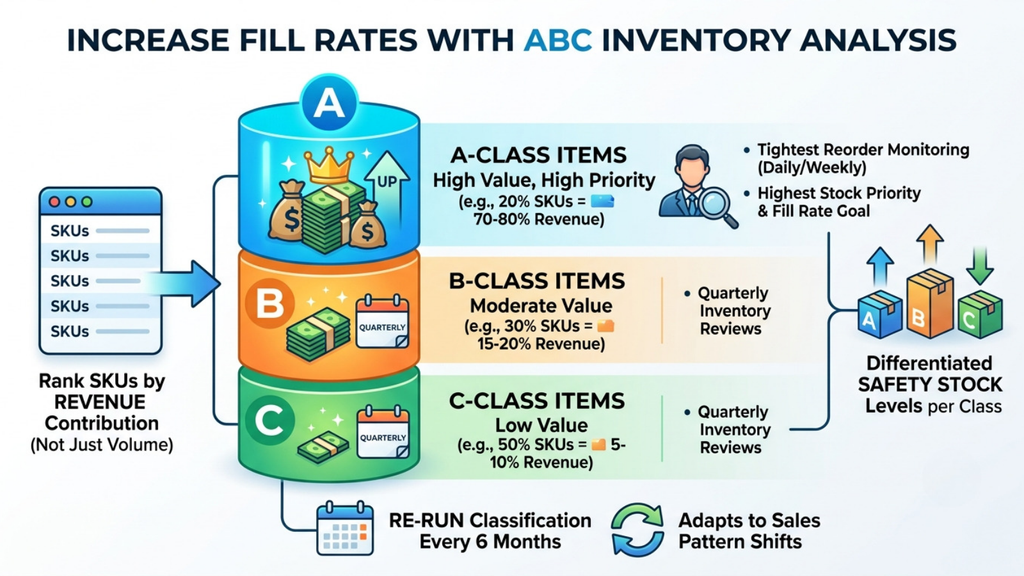
ABC analysis ranks SKUs by their contribution to annual usage value, splitting inventory into three tiers so attention and stock investment go where they matter most. This is one of the foundational inventory management techniques to increase fill rates because it stops businesses from treating every SKU with the same level of scrutiny.
- Rank every SKU by revenue contribution, not just unit volume.
- Assign A-class items the tightest reorder monitoring and highest stock priority.
- Review B and C class items quarterly instead of weekly to save operational time.
- Set differentiated safety stock levels per class instead of one flat buffer.
- Re-run the classification every 6 months as sales patterns shift.
A-class items typically represent 70-80% of revenue from just 20% of SKUs, which is why this technique sits first among inventory management techniques to increase fill rates. Getting the classification wrong means spreading attention evenly across items that do not deserve equal priority.
How Base.com Helps
Base.com automatically tags SKUs by revenue contribution and order frequency, so A-class items get priority stock allocation and faster reorder alerts without a manual classification exercise every quarter.
Technique 2: Safety Stock Optimization
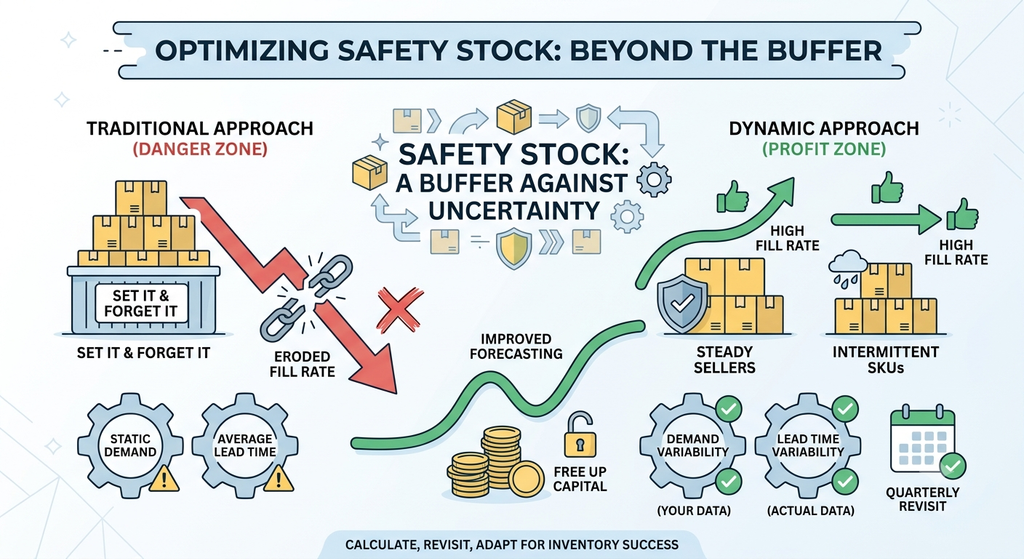
Safety stock is the buffer that absorbs demand spikes and supplier delays without triggering a stockout. Among the inventory management techniques to increase fill rates, this is the one most businesses set once and never revisit, which quietly erodes fill rate over time as demand patterns change.
- Calculate safety stock from your own demand variability, not a competitor’s benchmark.
- Factor in supplier lead time variability, not just average lead time.
- Revisit safety stock levels quarterly, not annually.
- Use different safety stock formulas for intermittent-demand SKUs versus steady sellers.
- Free up capital by lowering buffers only after forecasting accuracy actually improves.
How Base.com Helps
Base.com recalculates safety stock per SKU per warehouse using live order velocity, so buffers stay accurate as demand shifts instead of running on a number set once at launch.
Technique 3: Reorder Point and Economic Order Quantity
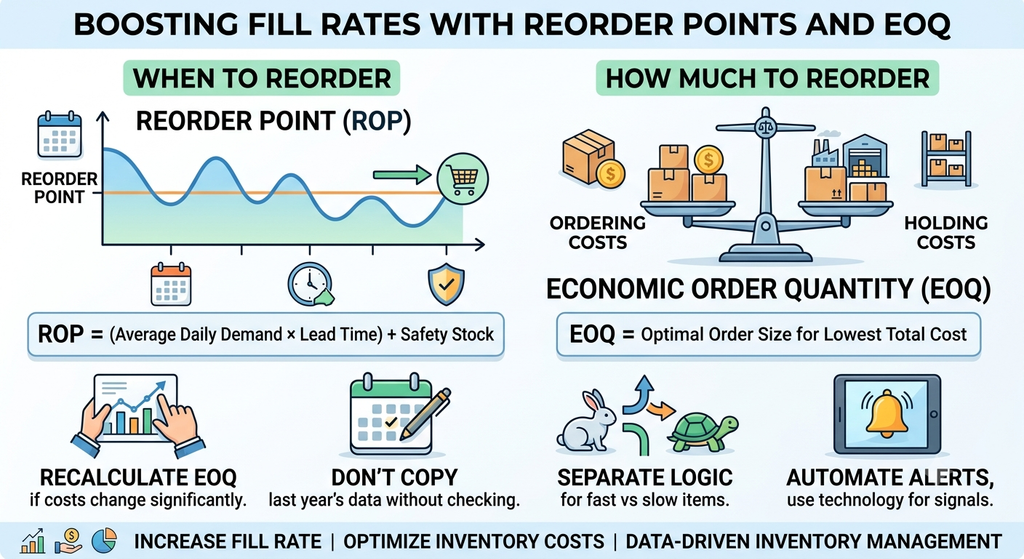
Reorder points and economic order quantity (EOQ) decide when to reorder and how much. Get either one wrong and fill rate suffers immediately, either through excess holding cost or an unnecessary stockout. This is one of the more mathematically precise inventory management techniques to increase fill rates.
- Set reorder points using average daily demand multiplied by lead time, plus safety stock.
- Recalculate EOQ whenever ordering cost or holding cost changes materially.
- Avoid copying reorder points from last year without checking current demand data.
- Separate reorder logic for fast-moving and slow-moving SKUs.
- Automate reorder point alerts instead of relying on manual stock checks.
How Base.com Helps
Base.com continuously updates reorder points per SKU per warehouse based on live order velocity, replacing static monthly averages with numbers that reflect what is actually selling right now.
Technique 4: Cycle Counting
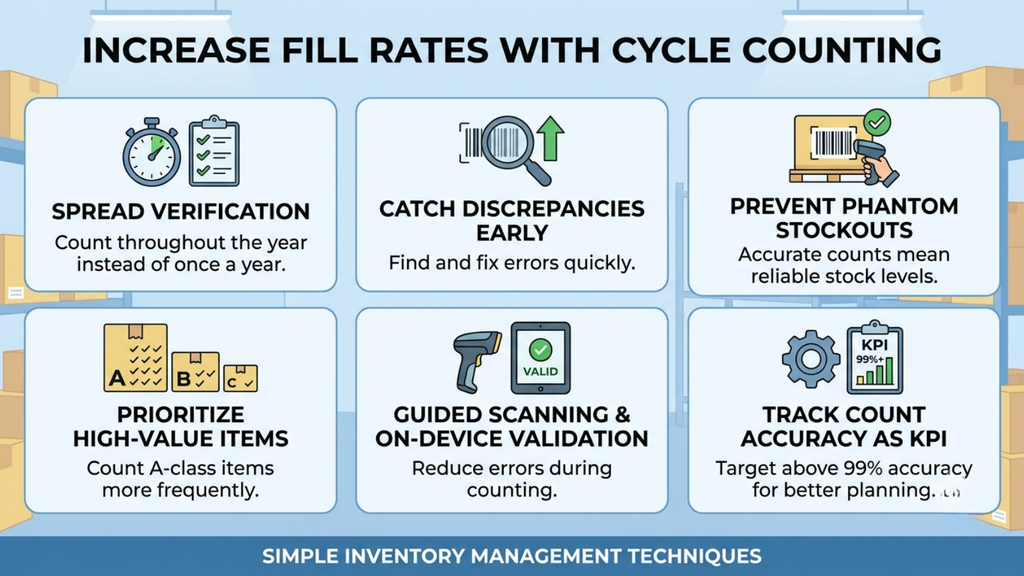
Annual full physical counts are disruptive and only catch errors once a year. Cycle counting spreads verification across the year instead, catching discrepancies early. This is one of the quieter inventory management techniques to increase fill rates, since accurate counts prevent the phantom stockouts caused by inaccurate system data.
- Prioritize A-class items for higher-frequency counts.
- Use guided scanning and on-device validation to reduce counting errors.
- Set variance thresholds that trigger an immediate recheck rather than waiting for the next cycle.
- Rotate count responsibility across shifts to avoid blind spots.
- Track count accuracy as its own KPI, separate from fill rate.
Accuracy above 99% is achievable with guided scanning and on-device validation, and that accuracy is a direct input into every other technique on this list, since reorder points and safety stock calculations are only as good as the stock data feeding them.
How Base.com Helps
Base.com flags stock discrepancies in real time as orders move through the system, surfacing count issues immediately instead of waiting for the next scheduled physical count.
Technique 5: Demand Forecasting

Poor forecasting is one of the most common root causes of low fill rate. Demand forecasting, done well, is consistently ranked among the highest-impact inventory management techniques to increase fill rates because it directly informs every other technique on this list.
- Use at least 12 months of historical data before trusting a forecast model.
- Layer in seasonality and festive-period spikes specific to your category.
- Segment SKUs by demand volatility before applying a single forecasting method.
- Compare forecast accuracy against actuals monthly, not just at year-end.
- Adjust forecasts immediately after a major marketing push or price change.
How Base.com Helps
Base.com forecasts reorder points per SKU per warehouse using live order velocity, not static monthly averages, which matters most in a market with 40% CAGR D2C growth and unpredictable festive demand curves.
Technique 6: Just-In-Time Inventory
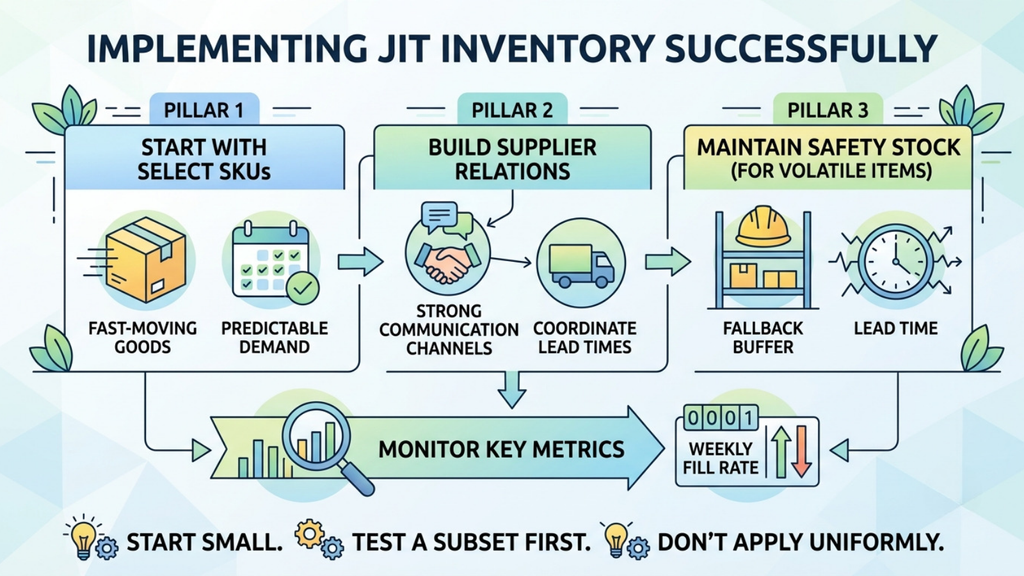
Just-in-time (JIT) inventory keeps stock levels lean by ordering closer to actual demand, reducing holding costs. Used carefully, it is one of the more capital-efficient inventory management techniques to increase fill rates, though it requires tighter supplier coordination than a buffer-heavy approach.
- Apply JIT selectively to fast-moving, predictable SKUs first.
- Keep a fallback safety stock for categories with volatile supplier lead times.
- Build strong supplier communication channels before reducing buffers aggressively.
- Monitor fill rate weekly during the first few months of a JIT rollout.
- Avoid applying JIT uniformly across a full catalog without testing on a subset first.
How Base.com Helps
Base.com’s real-time order and stock data lets sellers identify which SKUs are stable enough for a JIT approach and which still need a traditional safety stock buffer, based on actual sales patterns rather than guesswork.
Technique 7: Multi-Warehouse Stock Allocation

Distributing inventory intelligently across warehouses, rather than concentrating it in one location, is one of the inventory management techniques to increase fill rates that also improves delivery speed. A brand running three warehouses with unsynced stock data risks both stockouts in one location and overselling in another.
- Position fast-moving SKUs closer to your highest-demand regions.
- Rebalance stock between warehouses based on real order patterns, not fixed allocations.
- Avoid manual stock transfers that lag behind actual regional demand shifts.
- Set warehouse-specific reorder points rather than one blanket number.
- Review warehouse allocation quarterly as regional demand evolves.
India’s D2C sector is growing at roughly 40% CAGR, and that growth is rarely even across regions, which is exactly why static warehouse allocation quietly undermines fill rate over time even when overall stock levels look sufficient on paper.
How Base.com Helps
Base.com’s real-time sync module updates stock across every connected warehouse the moment an order is placed, cancelled, or returned, so allocation decisions are based on current data rather than a weekly export.
Technique 8: Vendor and Supplier Collaboration
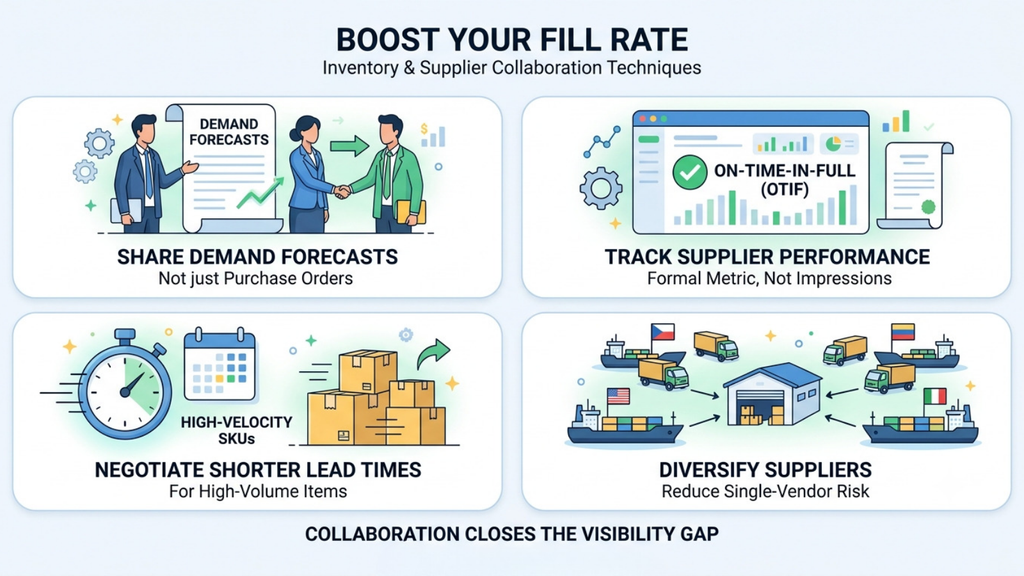
Fill rate depends as much on supplier reliability as on internal stock management. Vendor-managed inventory and closer supplier collaboration are among the inventory management techniques to increase fill rates that businesses often underinvest in, despite the direct impact on stockouts.
- Share demand forecasts with key suppliers instead of only sending purchase orders.
- Track supplier on-time-in-full performance as a formal metric, not an informal impression.
- Negotiate shorter lead times for your highest-velocity SKUs specifically.
- Diversify suppliers for categories where a single-vendor delay has caused past stockouts.
- Review vendor performance quarterly alongside your own fill rate numbers.
Supplier delays are one of the least visible causes of low fill rate, since they get logged as a stockout internally when the actual root cause sits upstream. Treating vendor collaboration as one of the core inventory management techniques to increase fill rates, rather than a procurement afterthought, closes that visibility gap.
How Base.com Helps
- Base.com’s SAP and distributor ERP integration gives procurement teams real-time visibility into which vendors are consistently causing fulfillment delays, so supplier reviews are based on data rather than anecdote.
Technique 9: FIFO and FEFO for Perishable and Batch-Tracked Stock
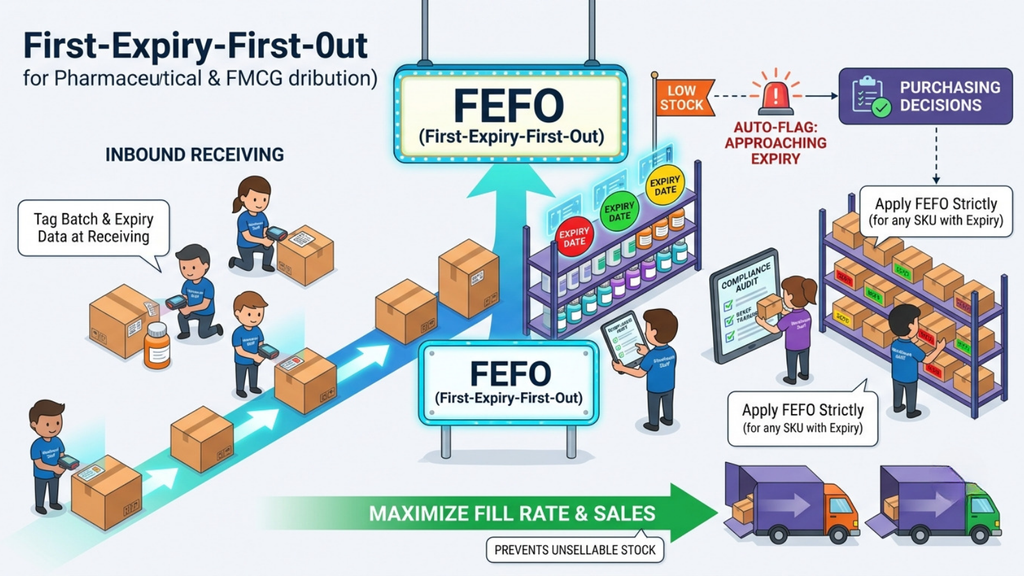
For FMCG and pharmaceutical distribution, First-In-First-Out (FIFO) and First-Expiry-First-Out (FEFO) prevent stock from ageing past its useful shelf life. This is one of the more category-specific inventory management techniques to increase fill rates, since expired stock effectively removes itself from available inventory.
- Apply FEFO strictly for any SKU with an expiry date, not just high-value items.
- Tag batch and expiry data at the point of receiving, not later in the cycle.
- Flag stock approaching its expiry window automatically, tied to purchasing decisions.
- Audit FIFO or FEFO compliance at the warehouse floor level periodically.
- Train warehouse staff specifically on the difference between FIFO and FEFO picking logic.
Pharma distributors that skip this discipline often discover the cost only at reconciliation time, when expired batches show up as unsellable stock that quietly lowers fill rate for weeks without anyone flagging it as an inventory management issue rather than a sales problem.
How Base.com Helps
Base.com’s platform gives FMCG and pharma clients a real-time view of batch and expiry data across every connected distributor and warehouse, automatically flagging ageing stock before it becomes unsellable.
Technique 10: Real-Time Inventory Visibility Through Automation
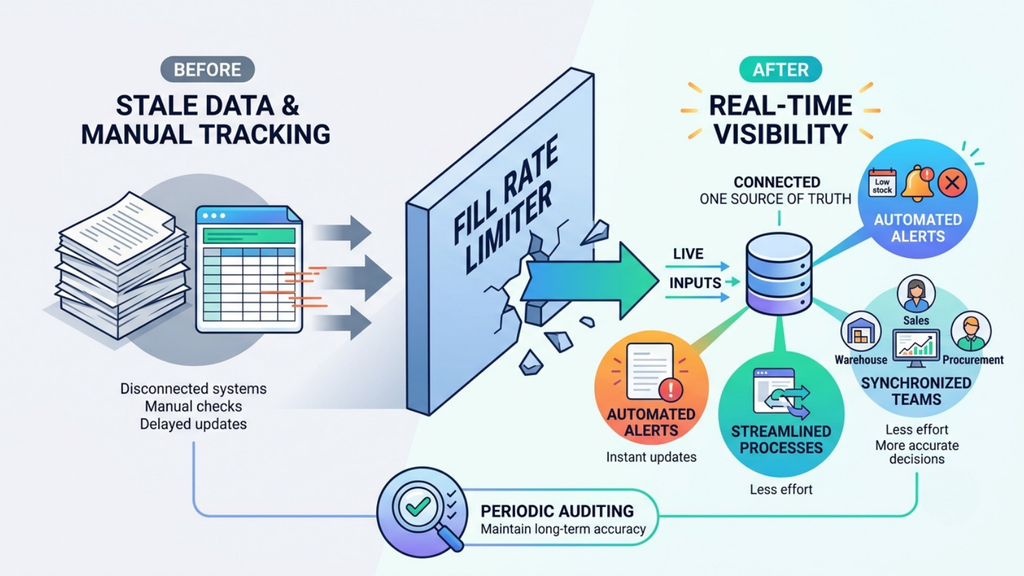
Manual tracking is the single biggest limiter across all the inventory management techniques to increase fill rates listed above, since none of them work well on stale data. Real-time visibility, achieved through automation, is what makes every other technique on this list actually effective in practice.
- Replace spreadsheet-based tracking with a system that updates stock in real time.
- Connect order, inventory, and procurement data into one source of truth.
- Automate stockout and low-stock alerts instead of relying on manual checks.
- Give warehouse, sales, and procurement teams the same live data, not separate exports.
- Audit system accuracy periodically even after automation is in place.
Businesses that skip this final technique often find that the first nine inventory management techniques to increase fill rates on this list underperform their expected results, simply because the data feeding them lags reality by hours or days rather than reflecting it in real time.
How Base.com Helps
Base.com connects order execution, inventory, and procurement into one real-time system, so every technique on this list, from ABC analysis to FEFO, runs on current data instead of a snapshot from last week’s export.
Common Mistakes That Undo These Techniques

Even businesses that adopt several of the inventory management techniques to increase fill rates listed above often see limited improvement, because a few common mistakes quietly cancel out the gains.
The first mistake is applying a technique once and never revisiting it. Safety stock, reorder points, and ABC classifications all decay in accuracy as demand patterns shift, so a technique set up correctly a year ago may already be working against current fill rate rather than for it.
The second mistake is running these techniques on inaccurate underlying data. Duplicate SKUs, inconsistent unit-of-measure conventions, and stale warehouse mappings quietly corrupt reorder points and EOQ calculations, no matter how sound the formula behind them is.
The third mistake is treating these as independent techniques rather than a connected system. ABC analysis informs safety stock levels, which inform reorder points, which depend on accurate cycle counts. Applying one in isolation limits how much the fill rate actually improves.
Base.com addresses all three by keeping master data clean at the point of entry, updating every technique’s inputs in real time rather than on a scheduled batch, and connecting the outputs of one technique directly into the next, so ABC classification, safety stock, and reorder points stay aligned automatically.
Quick Recap: Inventory Management Techniques to Increase Fill Rates
| Technique | Primary Fill Rate Impact |
| ABC analysis | Focuses on stock investment where it matters most |
| Safety stock optimization | Absorbs demand spikes without overstocking |
| Reorder point and EOQ | Prevents both stockouts and excess holding costs |
| Cycle counting | Catches inaccurate stock data early |
| Demand forecasting | Improves the accuracy of every downstream decision |
| Just-in-time inventory | Reduces holding costs on predictable SKUs |
| Multi-warehouse allocation | Prevents regional stockouts and overselling |
| Vendor collaboration | Reduces supplier-side fulfillment delays |
| FIFO and FEFO | Prevents expired or ageing stock loss |
| Real-time visibility | Makes every other technique actually work |
This table is a fast way to see which inventory management techniques to increase fill rates matter most for a given business stage, though most Indian sellers eventually need several of these working together.
Which Techniques Matter Most at Different Business Stages
A single-warehouse D2C brand usually gets the fastest fill rate improvement from safety stock optimization and better reorder points. A multi-warehouse FMCG or pharma distributor typically sees the biggest gain from multi-warehouse allocation, vendor collaboration, and FEFO discipline, since those techniques address the specific complexity of a distributed network.
Roughly 29.8% of operators currently fulfill only 80-89% of orders from existing stock, meaning at least 1 in 10 orders needs a reorder or partial shipment. Closing that gap is rarely about one single technique. It is about layering several of the inventory management techniques to increase fill rates together, on top of a system that keeps the underlying data accurate.
Businesses that treat inventory management techniques to increase fill rates as a one-time project, rather than an ongoing discipline, tend to see fill rates improve initially and then quietly slide back down within two to three quarters as demand patterns shift and no one revisits the original setup.