

COD order management in India is not a payment method problem. It is an operational infrastructure problem. The brands struggling with RTO, remittance delays, and working capital strain are not struggling because they offer COD. They are struggling because their systems were not built to manage COD at scale.
COD still accounts for approximately 45% of Indian D2C orders, down from higher levels a few years ago, but still the dominant payment method across Tier 2 and Tier 3 India. Removing it is not a realistic option for any brand selling beyond the top eight metros. The economics of COD, managed poorly, are brutal. On average, Indian D2C brands are losing ₹180-₹350 per COD order returned once forward and reverse logistics, repackaging, and the cost of capital locked in inventory are included.
The brands at 21% RTO are not lucky. They have built specific systems. COD order management in India, executed correctly through an OMS like Base.com, converts one of the biggest cost centres in Indian ecommerce into a manageable, controllable operational function.
What COD Order Management in India Actually Involves
Most brands think of COD as a checkout option. Operationally, it is a workflow that starts at order placement and does not end until cash is reconciled in the bank, days after delivery.
The full COD lifecycle in Indian D2C has seven distinct stages, each with its own failure mode:
- Order placement: Customer places a COD order. No payment is collected. Intent is unverified.
- Pre-dispatch verification: The brand confirms the order with the customer before picking and packing. This is the highest-leverage intervention in COD order management in India and the step most brands skip.
- Pick, pack, and dispatch: The order is fulfilled and handed to the courier. At this point, forward shipping cost is incurred regardless of what happens next.
- Delivery attempt: The courier attempts delivery. If the customer is unavailable or refuses, the order enters NDR (Non-Delivery Report) status. NDR automation refers to the practice of automatically engaging customers via WhatsApp or voice call the moment a delivery attempt fails, rather than waiting for the logistics partner’s next scheduled attempt.
- Cash collection: Successful delivery collects cash from the customer. The courier holds this cash.
- COD remittance: The courier remits collected cash to the brand’s account. Courier partners can take 7-14 days to remit COD payments after delivery. This is the working capital lag that compounds with order volume.
- COD reconciliation: The brand matches the remittance received against the orders delivered, identifying shortfalls, deductions, and discrepancies.
COD order management in India that does not have a system managing all seven stages will fail at one or more of them predictably as order volume scales.
The Real Cost Structure of COD at Scale
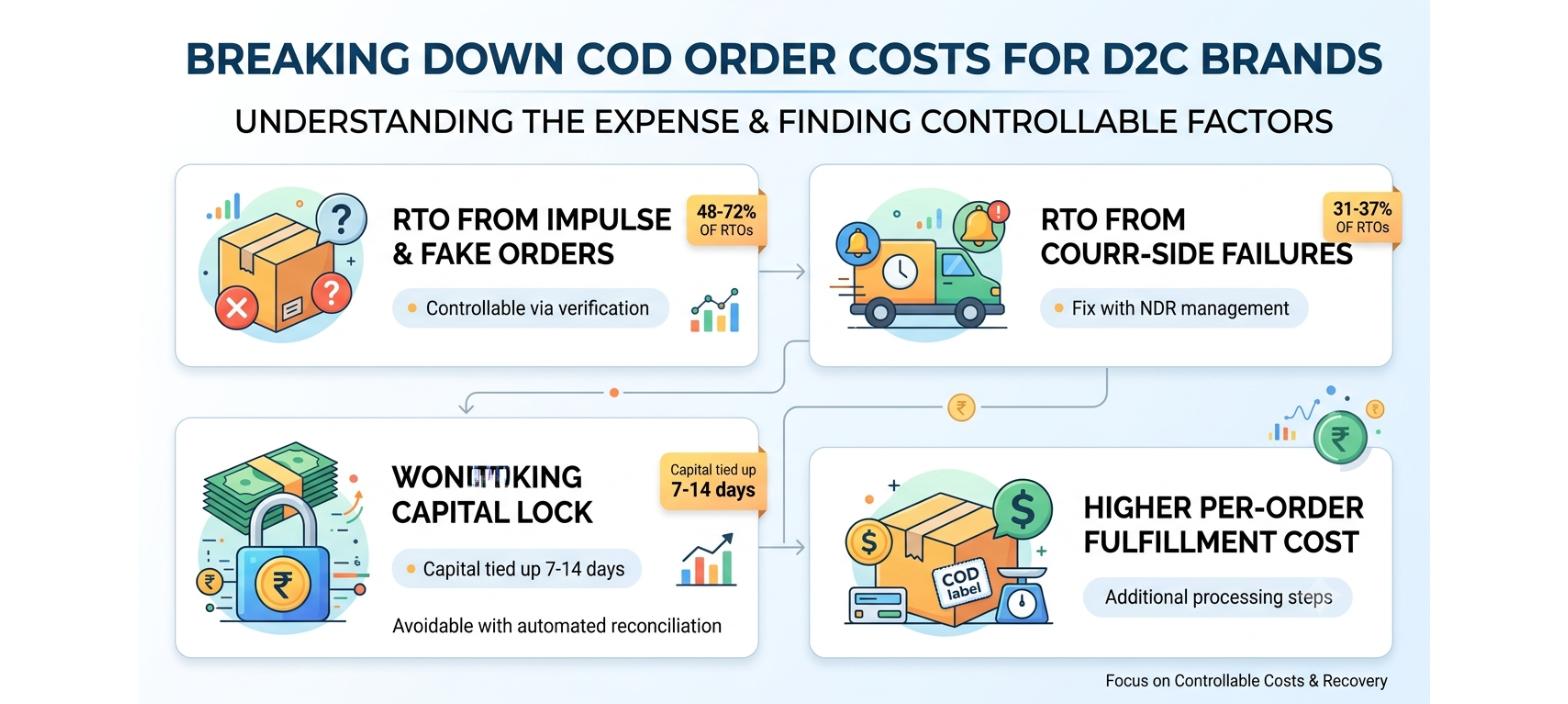
For most Indian D2C brands, COD orders cost 50-100% more to fulfill than prepaid orders, and the net contribution margin on COD is typically 8-15 percentage points lower.
This is not a reason to eliminate COD. It is a reason to understand exactly where those costs come from and which of them are controllable.
- RTO from impulse orders and fake orders. Address errors, impulse refusals, and fake orders collectively account for 48-72% of all RTOs. All three are controllable before dispatch through pre-verification workflows.
- RTO from courier-side delivery failures. Delivery attempts during working hours, inadequate notifications, and inflexible rescheduling cause legitimate refusals from customers who actually wanted the product. NDR management rescues these orders.
- Remittance discrepancies. Courier partners remit COD in batches. Without order-level matching, brands cannot identify which orders were underpaid, which had unauthorized deductions, and which COD amounts are still outstanding. This is a recoverable loss that manual reconciliation consistently misses.
- Working capital lock. Every COD order dispatched locks capital until the courier remits, 7-14 days post-delivery. At high order volumes, this is a persistent working capital drain that limits inventory investment and marketing spend.
- Higher per-order fulfillment cost. COD order management in India requires additional warehouse steps, a COD label, cash collection instructions to the courier, and generates more customer service interactions than prepaid.
The structural costs are the floor. The controllable costs are the variable. COD order management in India that eliminates controllable costs moves the contribution margin on COD orders significantly closer to prepaid parity.
How Base.com Enables Systematic COD Order Management in India
Base.com manages the full COD lifecycle from a single OMS, from order creation through pre-dispatch verification, fulfillment, courier integration, NDR tracking, remittance matching, and accounting sync. COD is not a special case requiring workarounds. It is a first-class workflow in the platform.
1. Custom Order Statuses for COD Verification Workflows
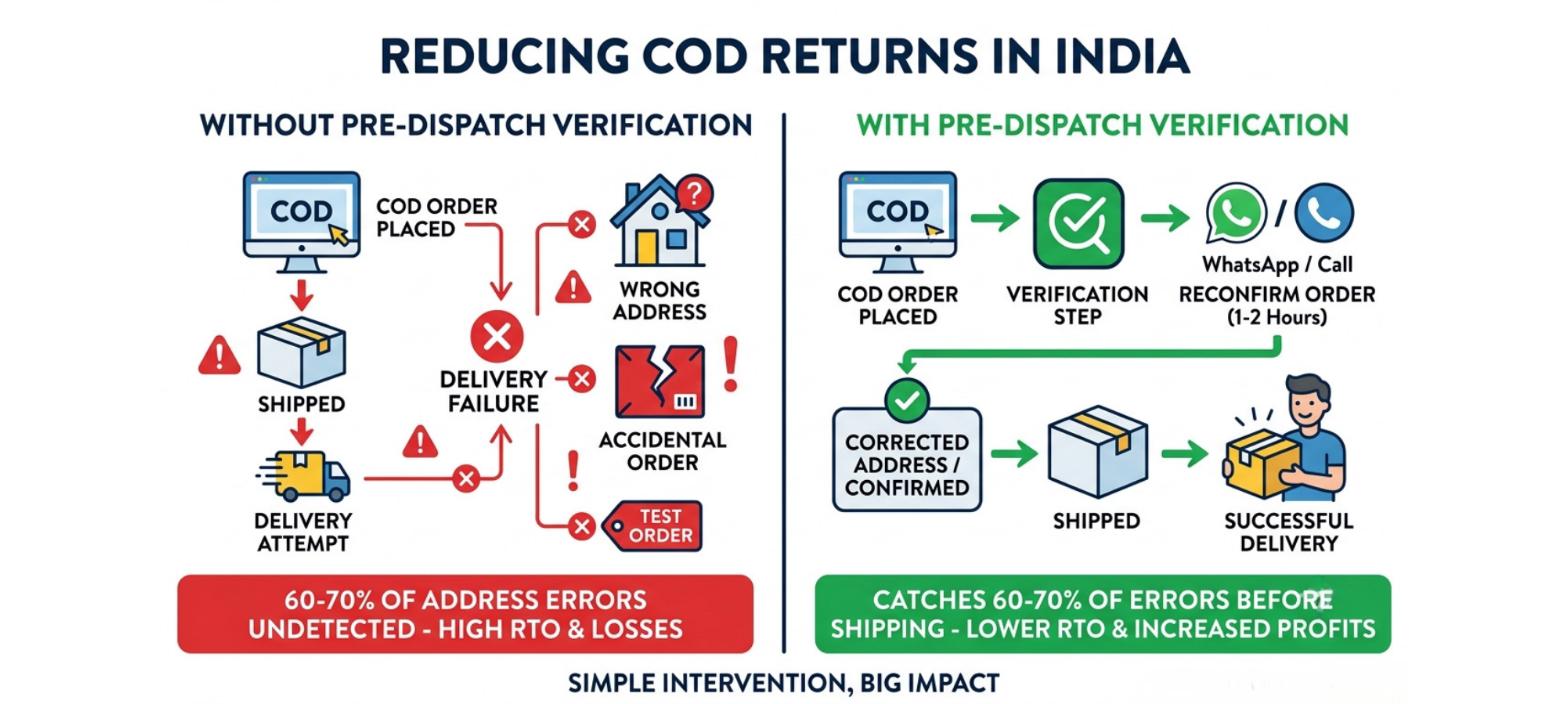
The most impactful intervention in COD order management in India is pre-dispatch verification. When a COD order is placed, reconfirming it via WhatsApp message, automated call, or human call within 1-2 hours catches accidental orders, wrong addresses, and test orders, catching 60-70% of address errors before shipping.
Base.com makes this operationally practical through custom order statuses. Instead of the standard workflow, New → Picked → Packed → Dispatched, a COD-specific workflow can be configured as:
2. New COD → Pending Verification → Verified COD → Ready for Picking → Packed → Dispatched
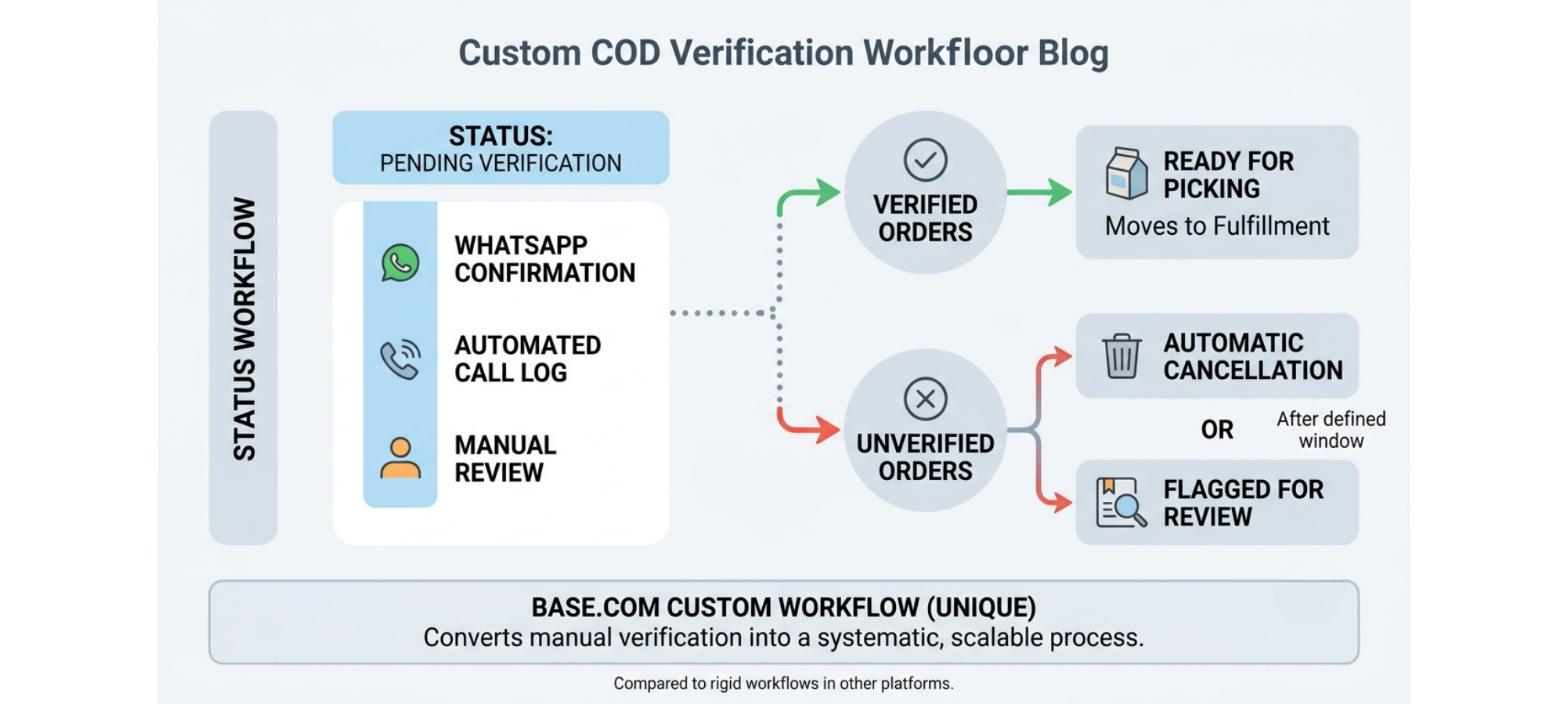
A COD order sits in “Pending Verification” until the customer confirms via WhatsApp or an automated call logs a positive response. Only verified orders move to “Ready for Picking.” Unverified orders after a defined window are automatically cancelled or flagged for manual review.
No other major Indian OMS platform in the competitive landscape offers custom order status workflows. Unicommerce uses fixed statuses. EasyEcom, OMS Guru, Browntape, and FYND have no equivalent customization. This single capability in Base.com converts the pre-dispatch verification step from a manual, error-prone process into a systematic, scalable workflow embedded in the order lifecycle.
3. COD-Specific Order Fields and Tagging

Base.com supports custom additional fields on orders. COD orders can carry a verification status field (confirmed, unverified, attempted, failed), a risk tier field (based on pincode RTO history or customer order history), a verification timestamp, and a verifier ID.
These fields are not decorative. They feed directly into reporting. COD order management in India that tracks verification status at the order level can measure: what percentage of COD orders were verified before dispatch, what the RTO rate is on verified vs. unverified orders, and which courier or pincode combination produces the highest failure rate even after verification.
This data closes the measurement loop. COD order management in India without measurement is operations running on instinct. With order-level data flowing through Base.com, it is operations running on evidence.
4. 1-Click Processing for Verified COD Orders
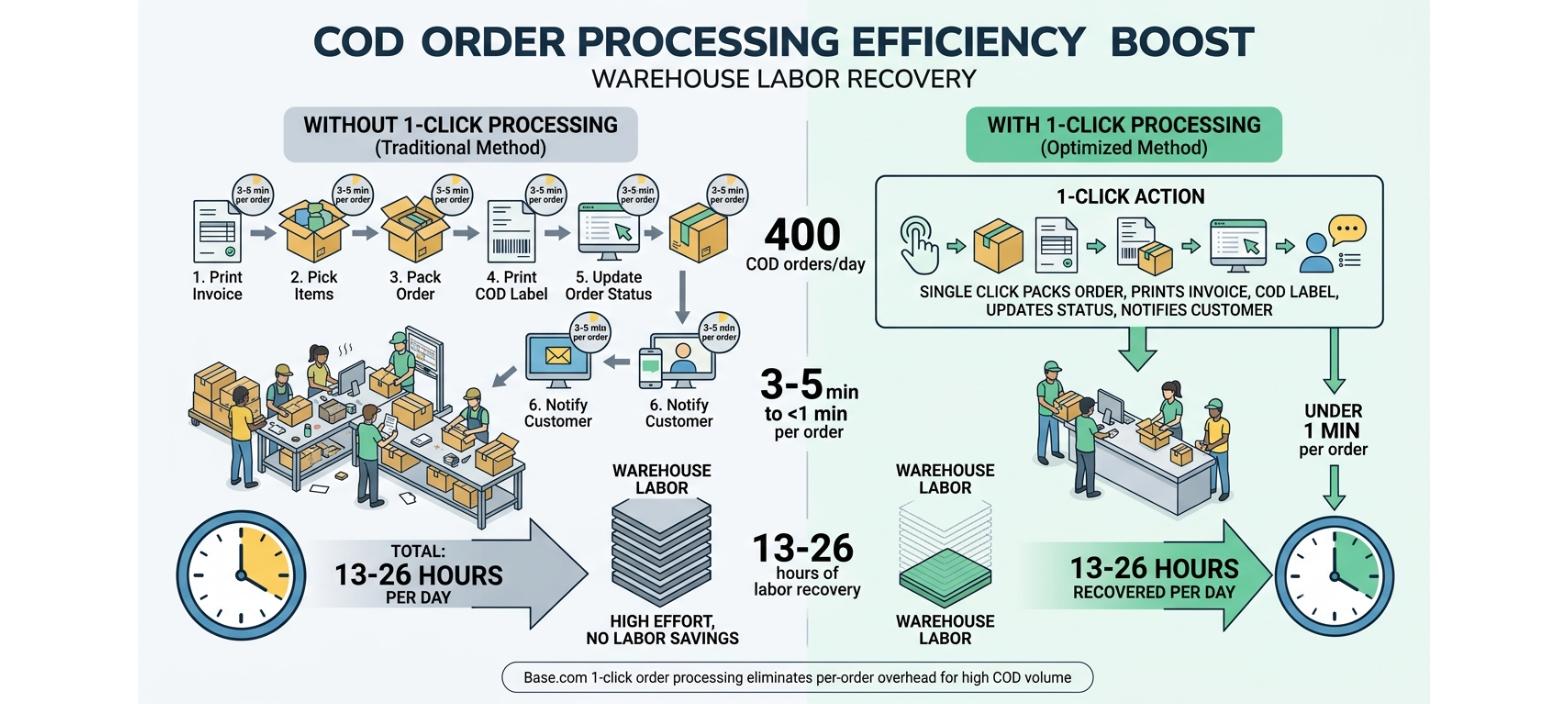
Once a COD order clears verification, it should move through pick, pack, and dispatch as fast as a prepaid order. Base.com’s 1-click order processing, a single action that packs the order, prints the COD label and invoice, updates the order status, and triggers a customer notification, eliminates the per-order processing overhead that slows COD operations at volume.
For a warehouse processing 400 COD orders per day, 1-click processing reduces per-order handling time from 3-5 minutes to under 1 minute. That is the equivalent of recovering 13-26 hours of warehouse labor per day, without adding headcount.
COD order management in India, which is slow at the warehouse level, undermines the gains from pre-dispatch verification. The verification step filters out bad orders before dispatch. The 1-click processing step ensures good orders reach the courier before the CPT window closes. Both are required.
NDR Management: Rescuing Orders After First Delivery Failure
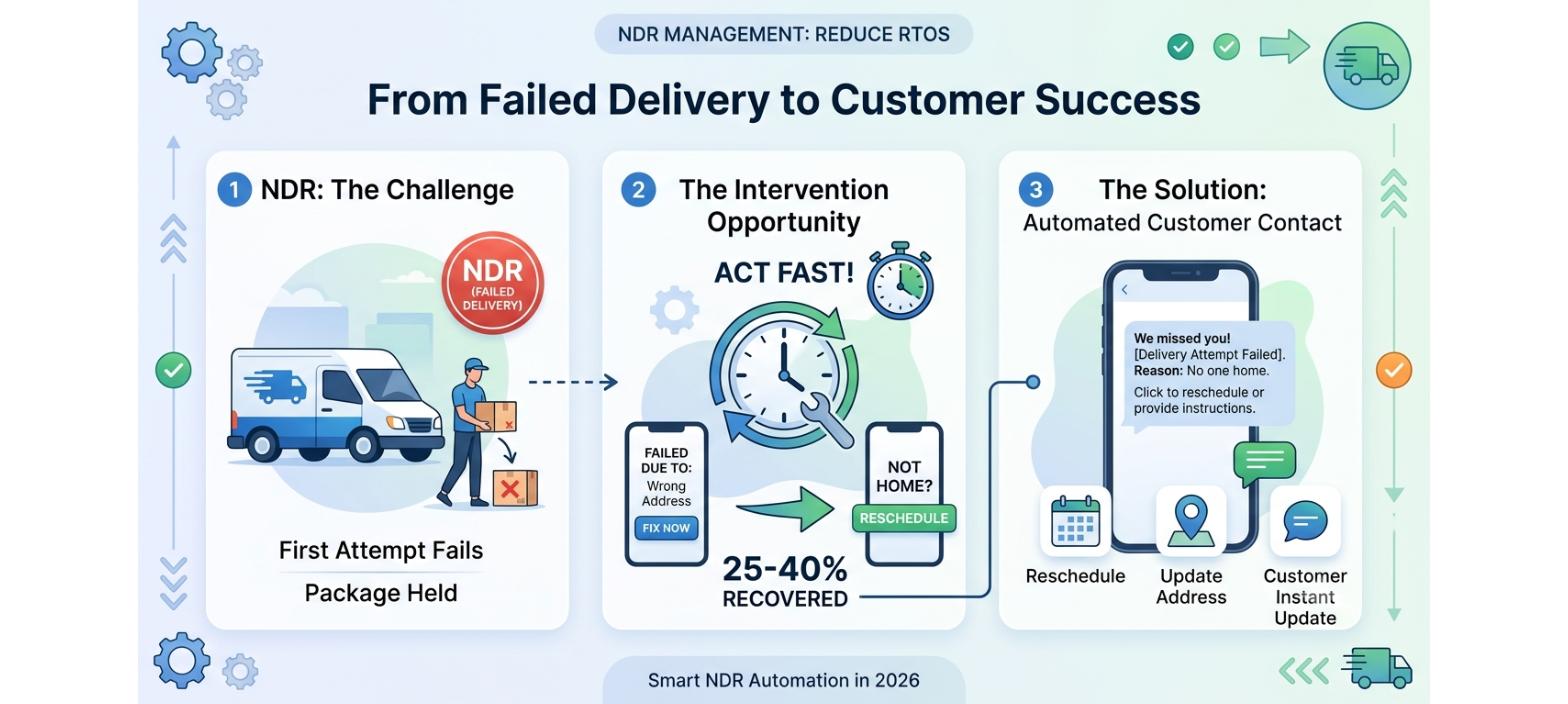
Not every delivery failure is a true RTO. Brands that implement active NDR management typically recover 25-40% of shipments that would otherwise have become RTOs.
An NDR occurs when a courier attempts delivery and fails. The package is held pending reattempt or return. The window between the first failed attempt and the return decision is the intervention opportunity. In 2026, leading D2C brands use NDR automation to instantly message customers with delivery failure reasons, offer to reschedule delivery, or collect updated delivery instructions.
How Base.com Surfaces NDR Data
Base.com’s shipping integrations with courier partners, Shiprocket, Ecom Express, Delhivery, and others, bring NDR events into the OMS in real time. When a delivery attempt fails, the NDR status updates in Base.com’s order dashboard. The operations team sees which orders are at risk before the courier makes the return decision.
The NDR order list in Base.com becomes an active intervention queue. Operations or customer service can contact the customer, confirm a redelivery time, and update the courier with revised delivery instructions, all from within the platform, with the contact and intervention logged against the order.
COD order management in India without NDR visibility is passive. You learn about failed deliveries when the package arrives back at your warehouse. COD order management in India with NDR visibility in the OMS is active; you are intervening before the return happens.
Pincode-Level Risk Intelligence for COD
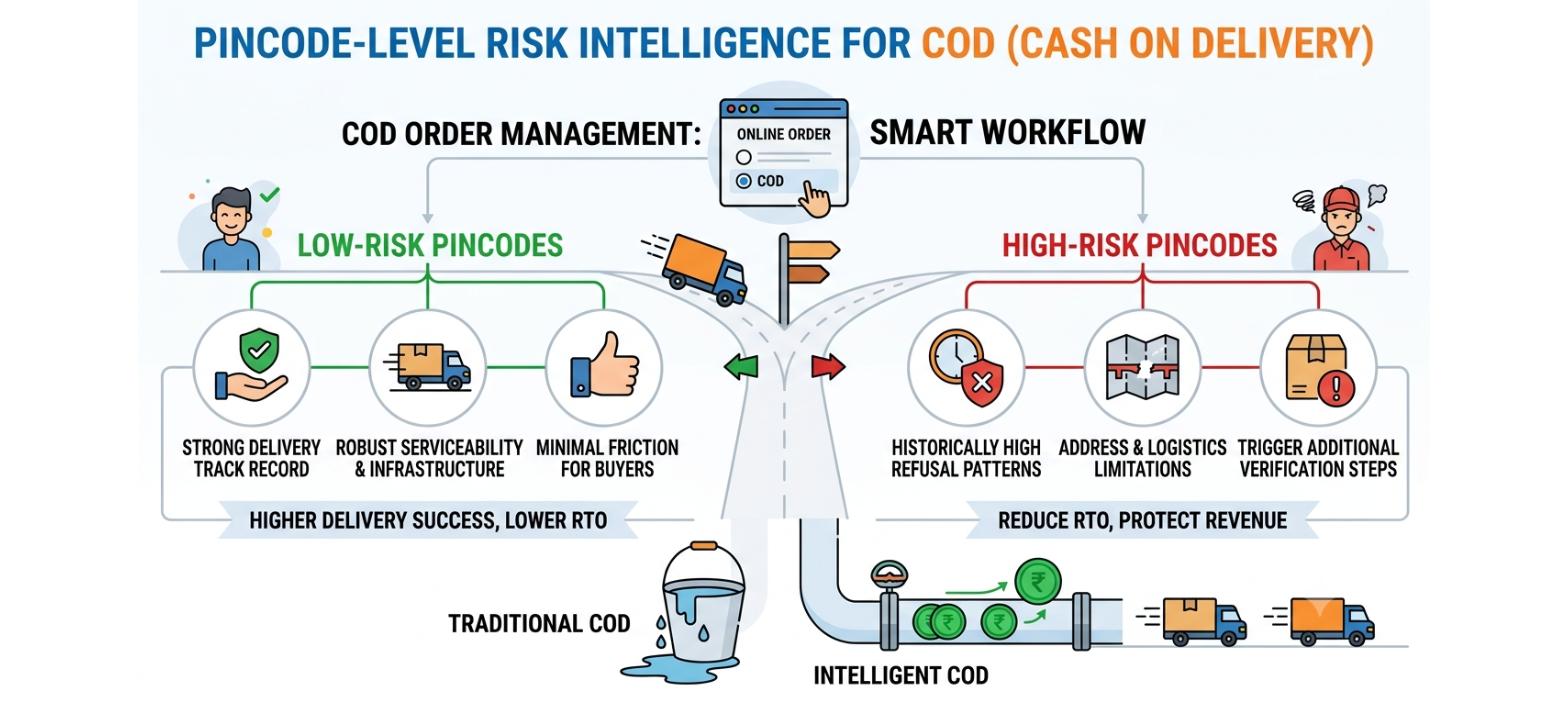
Industry data from 142 Indian D2C brands shows that COD represents 58-64% of orders in Tier 2 and Tier 3 markets, yet contributes to 76-83% of total RTO volume. Not all pincodes are equal. Some have structural delivery failure rates driven by courier serviceability gaps, address infrastructure limitations, or historically high refusal patterns.
COD order management in India that applies the same workflow to all pincodes is leaving money on the table. High-risk pincodes should trigger additional verification steps. Some may warrant restricting COD entirely for first-time buyers. Low-risk pincodes with strong delivery track records should flow through with minimal friction.
Base.com’s custom order fields and order grouping capabilities allow pincode-based order segmentation within the COD workflow. Orders from high-risk pincodes can be automatically grouped into a “High Risk COD” status requiring a higher-touch verification, a voice call rather than a WhatsApp message, or a mandatory partial advance payment before dispatch.
This is COD order management in India operating at the level that separates brands at 21% RTO from brands at 39% RTO. The difference is not the courier. It is the operational system applied before the courier receives the package.
Optimizing COD Management with Reconciliation, Prepaid Conversion, and Cash Flow Insights
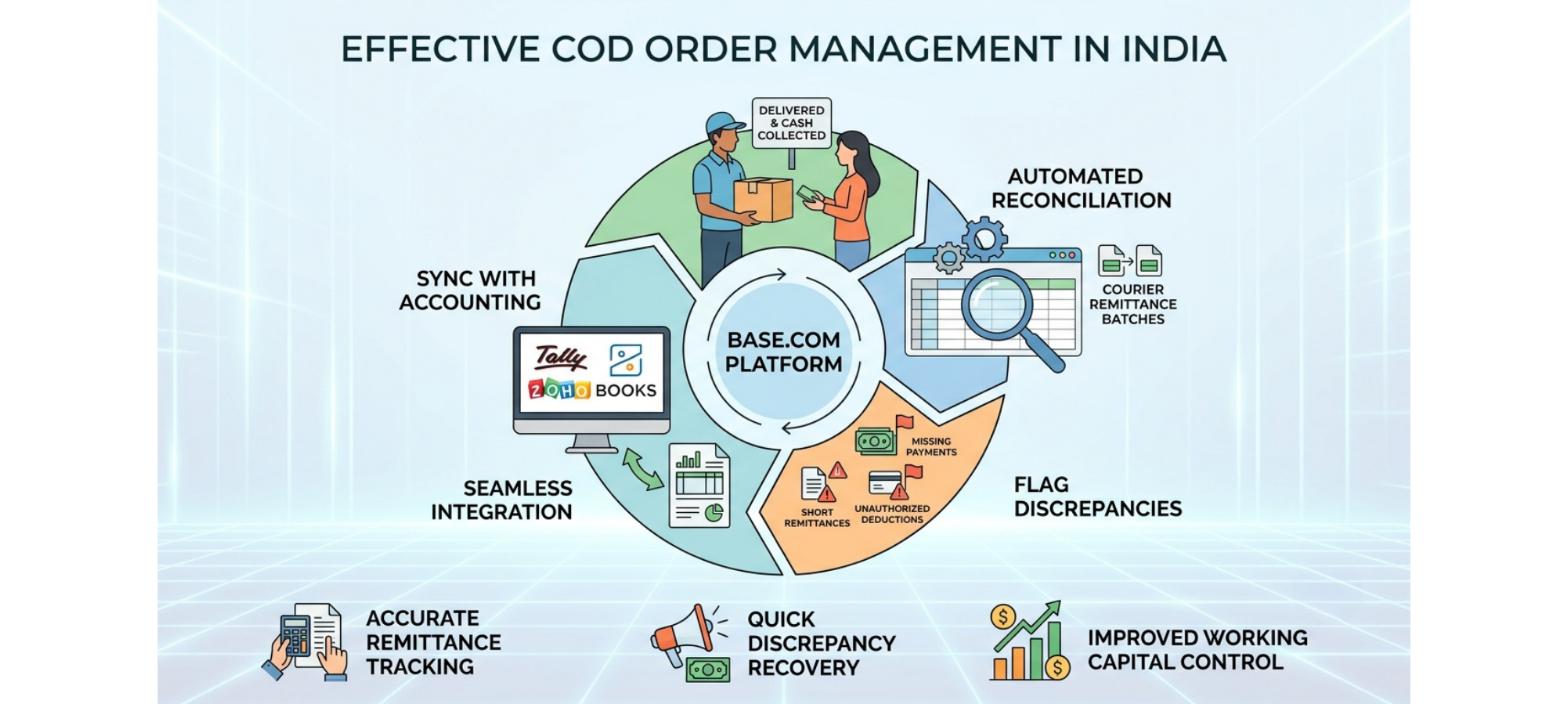
Effective COD order management in India requires more than successful deliveries; it demands accurate remittance tracking, reduced COD dependence, and improved working capital control. Base.com records the expected COD amount for every order, automatically reconciles courier remittance batches, and flags missing payments, short remittances, or unauthorized deductions at the order level. The reconciled data also syncs with Tally and Zoho Books, enabling finance teams to recover discrepancies quickly without manual effort.
Beyond reconciliation, Base.com helps brands reduce COD risk by tracking COD rates across channels, products, and geographies to identify the best opportunities for prepaid conversion. Its Total Business P&L Dashboard connects operational metrics such as COD percentage, RTO rate, and return rate with their financial impact, giving founders and finance teams complete visibility into cash flow, working capital, and overall profitability.
Key Capabilities
- Order-level COD remittance reconciliation
- Detection of short payments and unauthorized deductions
- Automatic accounting sync with Tally and Zoho Books
- Channel-wise COD and prepaid conversion analytics
- Working capital and cash flow visibility through the P&L Dashboard
- Faster dispute resolution and improved profitability
The Operational Stack for Smart COD Order Management in India
The brands achieving 21% RTO while running 45% COD order volumes are operating a defined stack:
- Pre-dispatch: Custom order status workflow in Base.com places COD orders in verification. WhatsApp or IVR confirmation before picking. High-risk pincodes route to enhanced verification.
- Fulfillment: Verified COD orders move through 1-click processing with COD-specific labels. Barcode-verified picking eliminates wrong-item shipments that compound into returns.
- NDR management: Failed delivery attempts surface in Base.com’s order dashboard in real time. Customer outreach is logged against the order. Rescheduled deliveries update courier instructions.
- Remittance reconciliation: Expected COD amounts per order are matched against courier batch remittances. Discrepancies are flagged within the dispute window. Shortfalls are escalated.
- Accounting sync: COD remittances sync to Tally or Zoho as order-level receipts. The P&L reflects actual collected COD, not expected COD.
- Reporting: Channel-wise COD rate, RTO rate by pincode, NDR recovery rate, and remittance discrepancy rate tracked weekly. Decisions on prepaid incentives, pincode COD restrictions, and courier allocation are made from data, not instinct.
This is COD order management in India as a system, not as an afterthought.