

ERP vs OMS ecommerce in India is one of the most searched and most misunderstood software decisions that Indian D2C founders face as they scale. Both systems touch inventory, orders, and fulfillment. The overlap in surface-level descriptions makes the choice feel harder than it is.
The confusion is understandable. Businesses that handle physical products often reach a point where spreadsheets, basic integrations, and manual processes no longer keep up with growing demand. This is when decision-makers begin searching for a platform that can coordinate inventory, orders, fulfillment, and operations at scale. The confusion begins when four common software categories appear in the search results: WMS, OMS, IMS, and ERP. Each of these systems solves a different part of the operations puzzle.
The ERP vs OMS ecommerce in India question has a specific answer for Indian D2C brands, one shaped by the realities of multi-channel marketplace selling, high COD volumes, GST compliance, and fulfillment speed expectations that are unlike anywhere else in the world.
This post explains what an ERP does, what an OMS does, where they differ across 15 specific operational dimensions, and why Base.com, as a unified OMS and WMS platform, is the correct starting point for most growing Indian D2C brands navigating this decision.
What an ERP Is, and What It Was Built For
An ERP (Enterprise Resource Planning) system is a broad operational platform designed to manage a company’s core business processes: accounting, procurement, manufacturing, human resources, supply chain, and finance. Traditional ERPs, SAP, Oracle, and Microsoft Dynamics were built for manufacturers, distributors, and large enterprises with complex multi-department workflows.
However, traditional ERPs are designed for manufacturers or wholesalers, not digital-first brands. D2C ERPs are built to sync real-time orders, manage multi-channel inventory, and support faster fulfilment.
Still, an ERP’s strength is financial control and cross-department data integration. It knows your accounts payable, your supplier contracts, your employee payroll, your manufacturing costs, and your inventory, all in one system. For a large enterprise with 50 departments and a complex P&L, an ERP is the correct backbone.
For a D2C brand doing ₹2-20 crore monthly GMV, selling on Amazon, Flipkart, and its own website, with a 5,000 square foot warehouse and a team of 20, an ERP is a tool designed for a problem three times the size of the one being solved. It is powerful, but getting the setup right can take time, training, and outside help, making it a less approachable option for companies that mainly want straightforward order, inventory, and production control.
What an OMS Is, and What It Was Built For
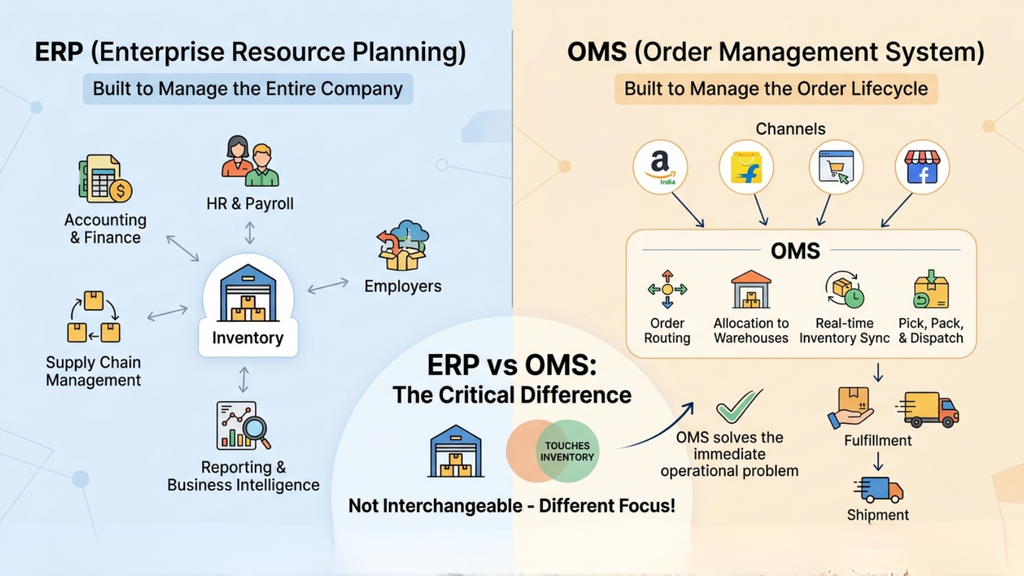
An OMS manages the order lifecycle from purchase to shipment, routing, allocation, and channel sync. A dedicated OMS was built specifically for the ecommerce operational problem: multiple channels feeding orders into one system, inventory that must be kept accurate across all of them in real time, and a fulfillment workflow that converts confirmed orders into dispatched shipments efficiently.
The ERP vs OMS ecommerce in India comparison starts from this fundamental design difference. An ERP was designed to run a company. An OMS was designed to run the order-to-dispatch cycle of an ecommerce operation. They solve different problems. The fact that both touch inventory is not evidence that they are interchangeable.
At its core, ecommerce order management is how you handle everything that happens to an order from the moment a customer clicks “buy” until the money is collected, the goods are delivered or returned, and the books are reconciled.
Base.com is a unified OMS, WMS, inventory management, PIM, and accounting platform built specifically for multi-channel ecommerce brands. It is the ERP vs OMS ecommerce in India answer for Indian D2C brands that need operational depth without ERP complexity.
15 Specific Differences Between an ERP and an OMS for Indian D2C Brands
Understanding the ERP vs OMS ecommerce in India question requires going beyond broad descriptions. These 15 operational dimensions reveal where each system is strong and where each is weak for an Indian D2C context.
1. Real-Time Multi-Channel Order Sync
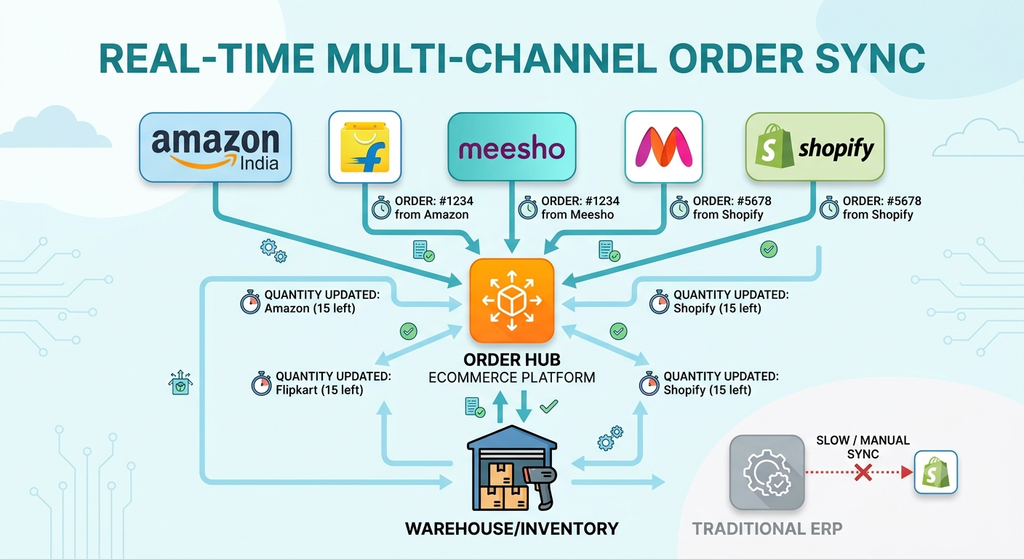
An ERP manages orders, but was not designed for the velocity and channel diversity of Indian e-commerce. Syncing orders from Amazon, Flipkart, Meesho, Myntra, and a Shopify store simultaneously, in real time, with inventory updates propagating to all channels within seconds, is an e-commerce-native problem that traditional ERPs solve poorly or through expensive custom integrations.
Specifically, Base.com’s OMS syncs orders in real time from 300+ channels, including all major Indian marketplaces. The central inventory pool updates the moment a sale occurs on any channel. Every other channel’s visible inventory reflects that update in the next sync cycle.
In short, ERP vs OMS ecommerce in India on this dimension: OMS wins decisively for brands selling across multiple Indian channels simultaneously.
2. Warehouse Physical Operations

An ERP tracks inventory counts. It does not manage physical warehouse operations, bin locations, pick routes, barcode scanning, or packing station workflows. A separate WMS is typically required alongside an ERP.
Here, Base.com combines OMS and WMS in one platform. Digital warehouse view, custom zones and bins, location and cart-level barcode scanning, in-system barcode and MRP tag creation, pick pack assistant with location-sorted picklists, all native to the platform. No separate WMS required.
Overall, ERP vs OMS ecommerce in India on warehouse operations: a standalone OMS like Base.com with integrated WMS is the more practical architecture for brands under ₹100 crore annual revenue.
3. COD Order Management

COD orders are an Indian e-commerce-specific operational challenge. High RTO rates, pre-dispatch verification requirements, COD remittance reconciliation, and COD surcharge management are not problems that a traditional ERP was designed to handle.
For example, Base.com supports custom order statuses that enable COD verification workflows. A COD order sits in a “Pending Verification” status before entering the pick queue. Only verified orders proceed to picking. COD remittances are tracked at the order level and reconciled against courier batch payments. The accounting sync to Tally captures COD remittances as order-level receipts automatically.
In practice, ERP vs OMS ecommerce in India on COD management: this is a uniquely Indian ecommerce problem. An ERP does not solve it. Base.com does.
4. Implementation Timeline and Complexity
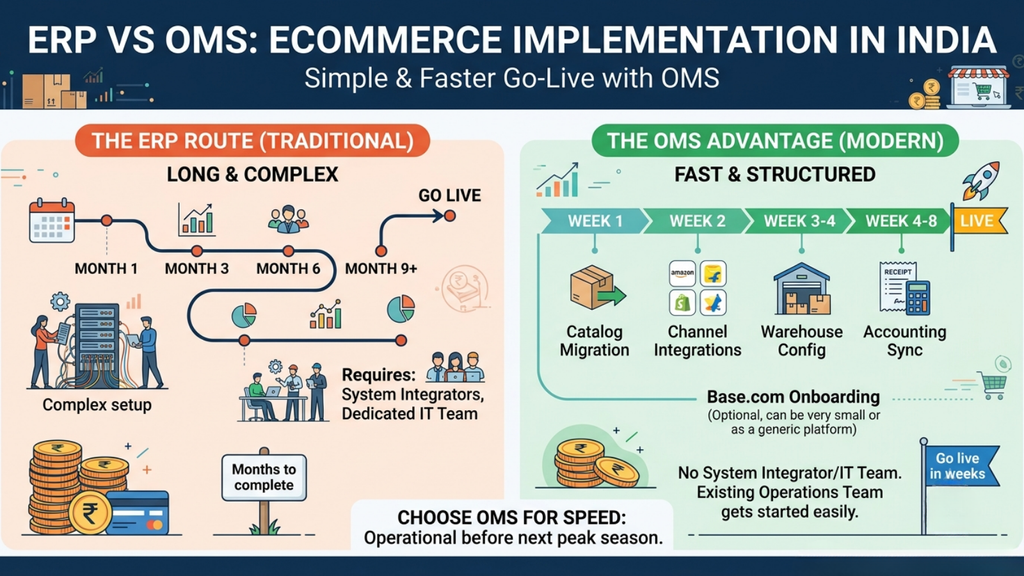
ERP implementation timelines often stretch over several months, and costs can add up to hundreds of thousands. The platform is powerful, but getting the setup right can take time, training, and outside help.
By comparison, a dedicated OMS implementation is measured in weeks, not months. Base.com onboarding follows a structured sequence: catalog migration, channel integrations, warehouse configuration, and accounting sync activation. Most brands live within 4-8 weeks. The operational team does not need a system integrator or a dedicated IT team.
As a result, ERP vs OMS ecommerce in India on implementation: OMS wins for any brand that needs to be operational before the next quarter’s peak season.
5. Marketplace-Specific Compliance and SLA Management

Indian marketplaces, Amazon, Flipkart, Myntra, have specific SLA requirements: CPT (Carrier Pickup Time) windows, dispatch SLAs, invoice format requirements, and seller performance metrics. An ERP has no concept of a CPT window or a Flipkart listing compliance requirement.
For instance, Base.com fires CPT breach alarms for all at-risk orders within one hour of cutoff. Order prioritization automatically sorts the processing queue by SLA urgency. Channel-specific invoice templates generate compliant invoices for each marketplace’s format requirements. Auto-acceptance of orders based on a live inventory picture prevents processing delays that cause CPT failures.
Put simply, ERP vs OMS ecommerce in India on marketplace compliance: this is an OMS domain entirely. No ERP in the Indian market has a native CPT alarm and marketplace SLA enforcement.
6. Inventory Sync Speed and Oversell Prevention
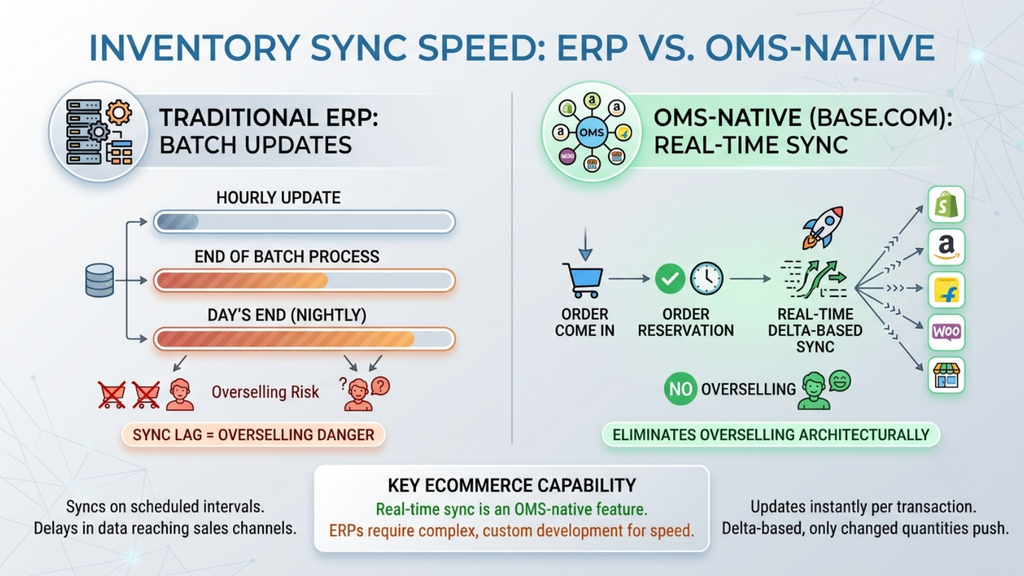
An ERP updates inventory as transactions are recorded, which may happen hourly, at the end of a batch process, or at day’s end, depending on configuration. Real-time inventory sync across five channels simultaneously requires an event-driven architecture that traditional ERPs do not have natively.
Meanwhile, Base.com’s inventory sync is real-time and delta-based. Only changed quantities are pushed to channels. Stock reservation fires the moment an order is confirmed, before the physical pick, before the next sync cycle. Overselling from sync lag is eliminated architecturally.
In other words, ERP vs OMS ecommerce in India on inventory sync: real-time ecommerce inventory sync is an OMS-native capability. ERPs require significant custom development to achieve equivalent speed.
7. Returns and RTO Processing
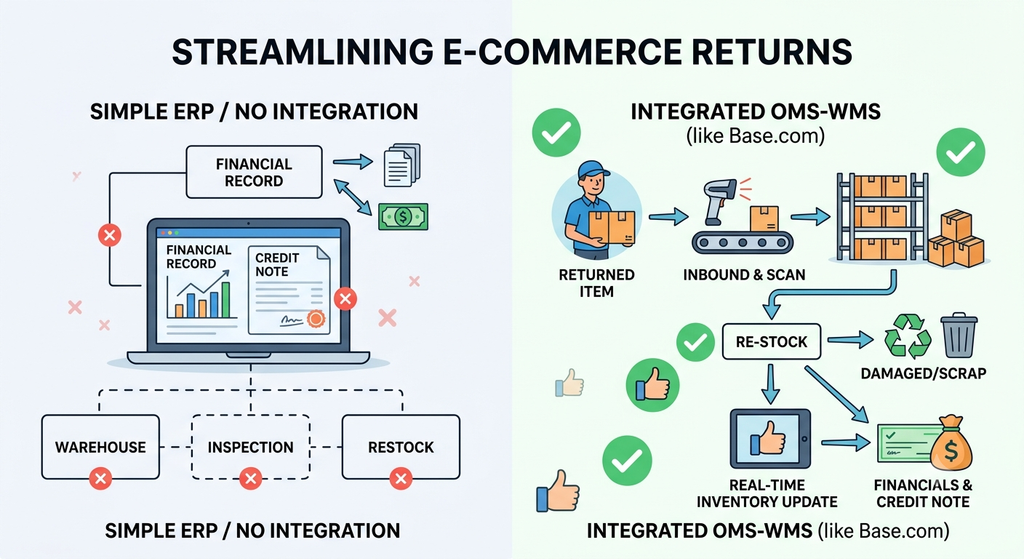
Meanwhile, returns in D2C require serious attention. Your ERP or OMS should support return authorizations, channel attribution, inspection workflows (re-stock vs scrap), reverse logistics, and inventory updates.
An ERP handles the financial dimension of returns, credit notes, refund processing, accounts receivable adjustments. It does not handle the physical warehouse dimension, inspection queues, sellable vs. damaged classification, bin-level restock, or the 48-hour restock SLA that prevents phantom stock buildup.
Here, Base.com’s returns module handles both CRET and RTO returns in a unified workflow, barcode-scanned at inbound, routed to the correct inspection queue, classified at disposition, and restocked to the bin with an immediate inventory count update. The credit note is generated automatically in the accounting module at the same time the return is processed in the WMS.
Therefore, ERP vs OMS ecommerce in India on returns: operational returns processing requires OMS-WMS integration. An ERP alone produces financial returns records without warehouse closure.
8. Catalog and Product Information Management
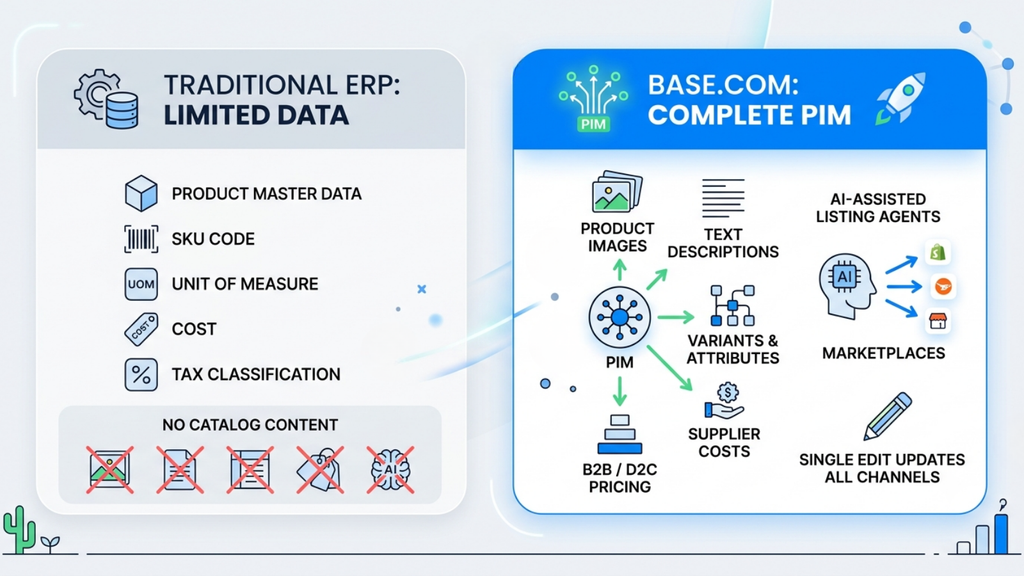
An ERP stores product master data, SKU code, unit of measure, cost, and tax classification. It does not manage marketing catalog content: product images, descriptions, attribute matrices, channel-specific pricing, and AI-assisted listing to marketplaces.
Also, Base.com includes a complete PIM. Product images, text fields, variant configurations, channel-level data, supplier costs, and multiple price tiers (D2C, marketplace, B2B) are maintained in one place. AI-assisted listing agents push new products to connected channels automatically. When a product description is updated, it updates across all connected channels from a single edit.
ERP vs OMS ecommerce in India on catalog management: ERPs are not catalog tools. Base.com’s PIM is.
9. Accounting Integration Architecture

An ERP is the accounting system. All financial entries originate in the ERP: sales, purchases, inventory adjustments, returns, payroll, and GST filings. The integration direction is: other systems push data to the ERP for recording.
Instead, Base.com is an OMS that integrates with accounting software. Orders sync automatically to Tally and Zoho Books as ledger entries. Returns sync as credit notes. The accounting software remains the system of record for financial reporting; Base.com ensures the operational data flows to it without manual intervention.
Consequently, ERP vs OMS ecommerce in India on accounting: if a brand already has Tally as its accounting backbone, adding Base.com as an OMS gives it operational depth without replacing the financial system of record. This is the most common correct architecture for Indian D2C brands at ₹5-50 crore annual revenue.
10. Customer Service Integration

An ERP has no customer service module relevant to D2C ecommerce. Customer interactions, order queries, return requests, and complaint handling happen outside the ERP in separate CRM or helpdesk tools that are rarely integrated with order data.
Furthermore, Base.com includes a customer service module (Responso) with a unified panel for Instagram, Facebook, and WhatsApp conversations. AI-assisted customer service agents and workflows. Website chatbot integration. When a customer asks about their order status, the support agent sees the full order history, tracking status, and return record in the same interface as the conversation.
Notably, ERP vs OMS ecommerce in India on customer service: OMS-native customer service integration is a Base.com-specific differentiator with no ERP equivalent.
11. Multi-Warehouse Routing Intelligence
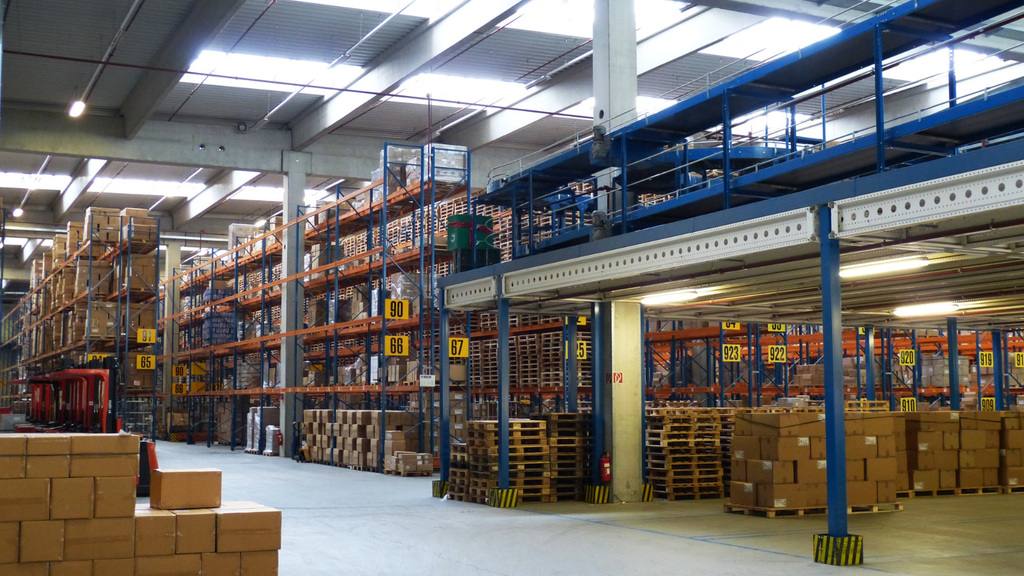
An ERP knows how much stock exists at each location. It does not route orders to the optimal node based on proximity, carrier serviceability, SLA window, and channel allocation rules applied simultaneously.
Meanwhile, Base.com routes every incoming order through a multi-layer routing engine: stock availability check, channel allocation rules, proximity to delivery pincode, carrier serviceability, and SLA urgency, in that sequence, automatically, without manual intervention. Cross-location order allocation splits multi-item orders across nodes when no single node has all items.
ERP vs OMS ecommerce in India on fulfillment routing: Intelligent order routing is a core OMS capability. ERPs track stock positions; they do not make routing decisions.
12. Payment Reconciliation at Order Level
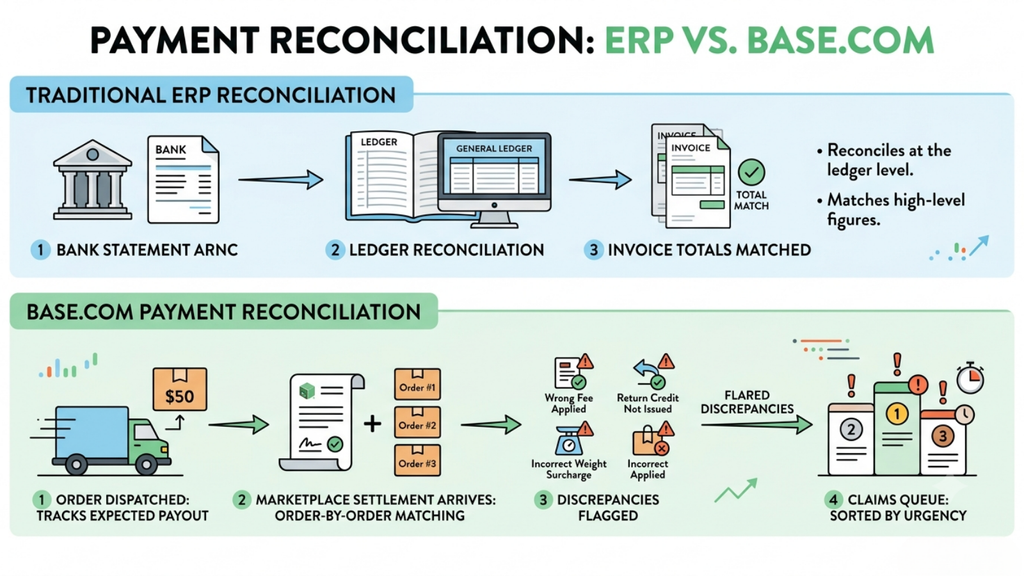
An ERP reconciles at the ledger level, and bank statements match invoice totals. It does not match each order’s expected marketplace payout against the actual settlement received, item by item, identifying specific discrepancies within each marketplace’s claim window.
Meanwhile, Base.com’s payment reconciliation tracks expected payout per order at dispatch. When marketplace settlement arrives, it is matched order by order. Discrepancies, wrong fee applied, return credit not issued, and weight surcharge applied incorrectly are flagged at the order level within the claim window. Discrepancy data feeds directly into a claims queue, sorted by urgency.
Again, ERP vs OMS ecommerce in India on payment reconciliation: order-level marketplace reconciliation is an ecommerce-specific function that ERPs do not perform. Base.com does it natively.
13. Total Business P&L at Channel Level
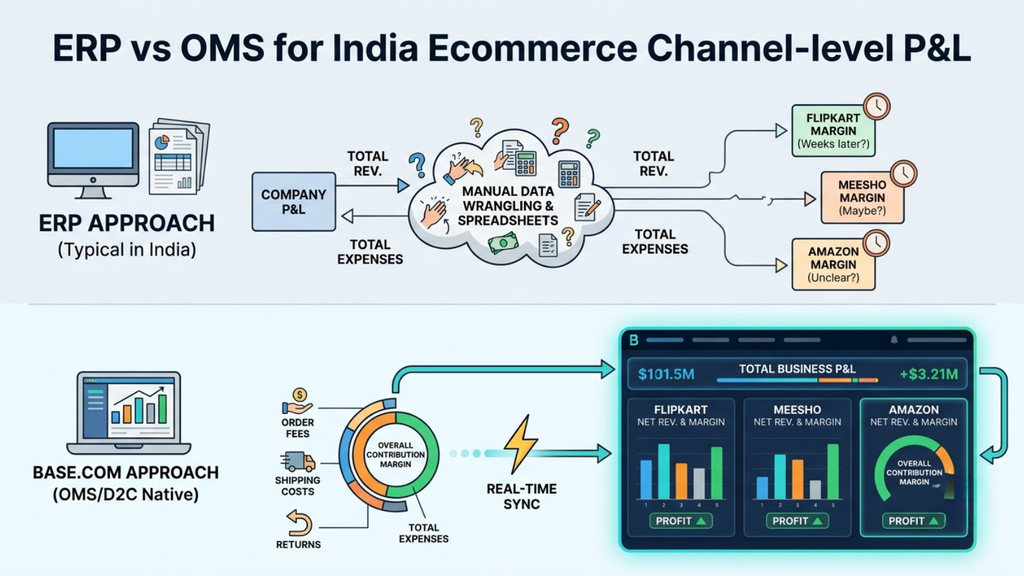
An ERP produces a P&L at the company level, total revenue, total cost of goods, total operating expenses, and net profit. Getting to channel-level contribution margin, revenue from Flipkart net of Flipkart fees, fulfillment costs, and return costs, requires significant custom reporting configuration.
Base.com’s Total Business P&L Dashboard provides channel-wise realized revenue net of all operational costs, shipping, fulfillment, and returns, connected to operational metrics in real time. A founder can see not just what Meesho contributed to gross GMV, but what it contributed to actual margin after all costs.
ERP vs OMS ecommerce in India on channel-level P&L: Base.com’s integrated financial-operational dashboard is a D2C-native reporting tool. ERPs produce accounting P&Ls, not operational margin views.
14. Scalability Without Implementation Cost
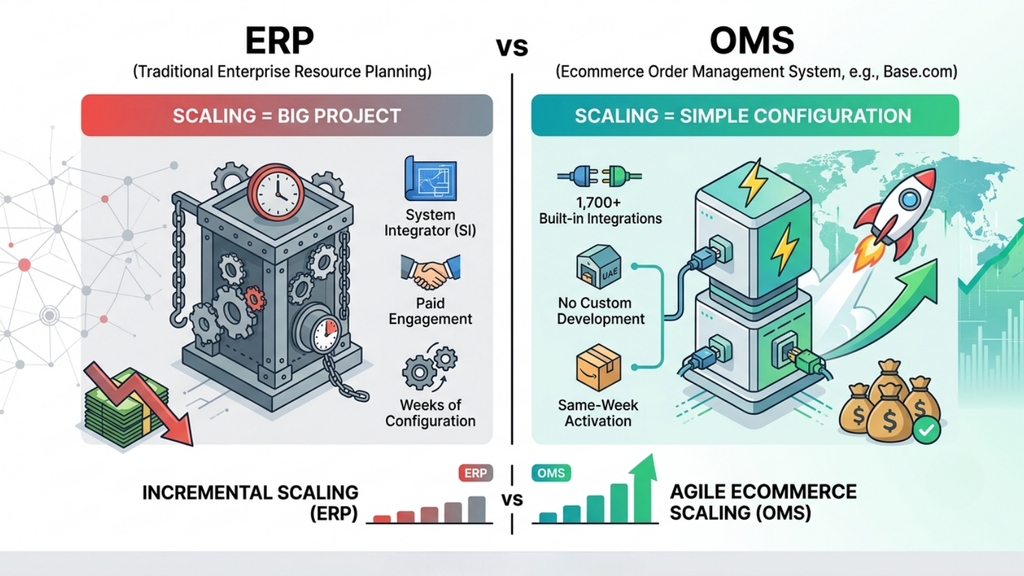
Scaling an ERP, adding new users, new modules, and new integrations typically requires a system integrator, a paid implementation engagement, and several weeks of configuration. Adding a new marketplace integration or a new warehouse node to an enterprise ERP is a project, not a configuration.
Again, Base.com’s 1,700+ global integrations are already built. Adding a new marketplace, a new courier partner, or a new warehouse node is a configuration change within the existing platform, no custom development, no system integrator. A brand that adds Amazon UAE, opens a second warehouse, and onboards a new 3PL can connect all three within the same week.
Additionally, ERP vs OMS ecommerce in India on scalability: OMS platforms are built for ecommerce scale without integration cost. ERP integrations are one-time investments that rarely scale incrementally.
15. Total Cost of Ownership for Indian D2C Scale
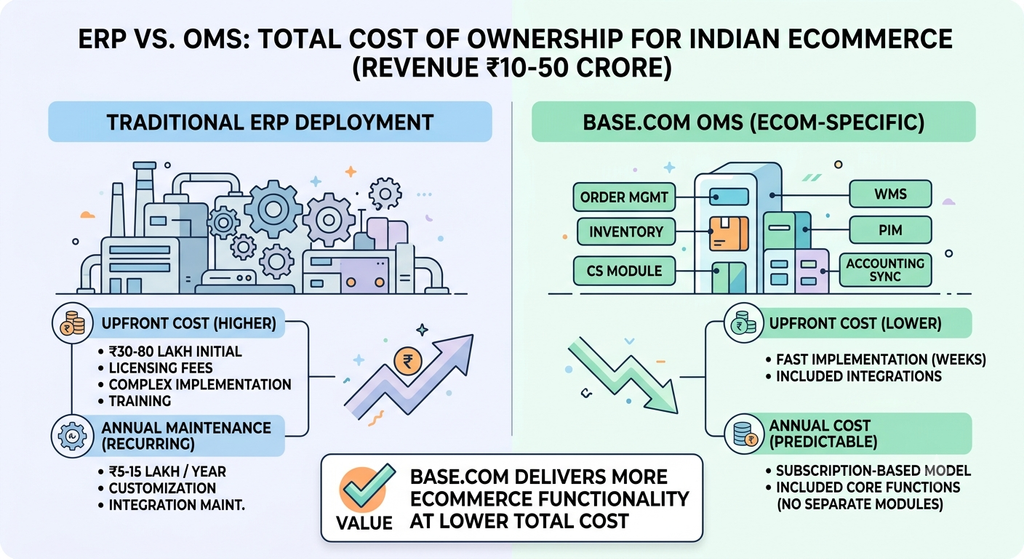
An ERP’s total cost of ownership includes licensing, implementation, training, ongoing customization, annual maintenance, and integration maintenance for each connected system. For a brand with an annual revenue of ₹10-50 crore, a full ERP deployment can cost ₹30-80 lakh upfront with ₹5-15 lakh in annual maintenance.
Here, Base.com’s cost model is built for ecommerce brands at this revenue range. The platform is subscription-based. Implementation is weeks, not months. Integrations are included. The accounting sync, PIM, WMS, and customer service module are part of the platform, not separate paid modules requiring additional licensing.
Finally, ERP vs OMS ecommerce in India on total cost: for brands under ₹50 crore annual revenue, a dedicated OMS like Base.com delivers more ecommerce-relevant functionality at significantly lower total cost than a traditional ERP deployment.
When You Need an ERP Alongside Your OMS
The ERP vs OMS ecommerce in India question has a nuanced answer for large or complex organizations. These are not mutually exclusive systems at enterprise scale.
A D2C ERP that can’t talk to your ecommerce ecosystem is like using a smartphone without internet access. It is best to integrate with a ready-to-use OMS. When orders flow in, the system should automatically update stock levels, track shipments, and sync financial entries without a single CSV upload or manual sync.
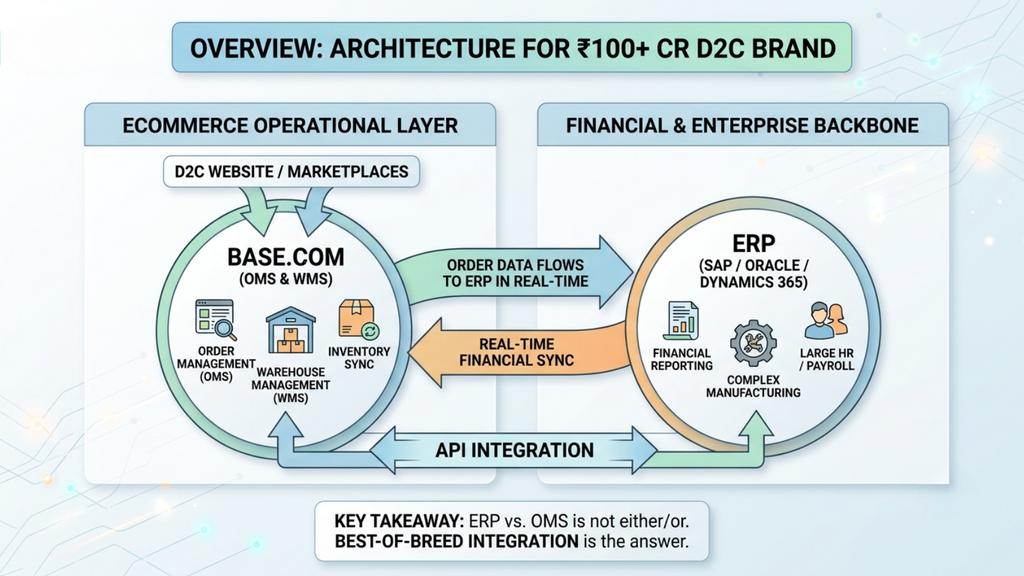
The correct architecture for a brand at ₹100+ crore annual revenue with complex manufacturing, multi-entity finance, and large HR requirements is: ERP as the financial and enterprise backbone, with Base.com as the ecommerce OMS and WMS layer, integrated so that order data from Base.com flows to the ERP’s ledger in real time.
This is exactly how Base.com’s Tally and Zoho Books integration works: Base.com handles the operational ecommerce layer, accounting systems handle the financial reporting layer, and the two stay synchronized automatically. For larger brands that have SAP or Oracle as their ERP, Base.com connects to those systems through API integration.
The ERP vs OMS ecommerce in India decision is therefore not always either/or. It is: which system handles the ecommerce operational layer? For Indian D2C brands, that answer is consistently an OMS, with Base.com providing the most complete implementation of that layer available in the Indian market.
The Decision Framework: Which One Does Your Brand Actually Need?
Use this framework to resolve the ERP vs OMS ecommerce in India decision for your specific operational profile.
| Situation | Recommendation |
| Selling on 2+ Indian channels, 200+ daily orders | OMS (Base.com) first |
| Managing your own physical warehouse | OMS + integrated WMS (Base.com) |
| COD orders forming 30%+ of volume | OMS with COD workflow support (Base.com) |
| The finance team on Tally needs an automatic sync | OMS with Tally integration (Base.com) |
| Multi-warehouse with routing requirements | OMS with multi-warehouse routing (Base.com) |
| Expanding to international channels | OMS with global integrations (Base.com) |
| Complex manufacturing, multi-entity finance, HR | ERP as backbone, Base.com as OMS layer |
| Revenue above ₹100 crore with compliance complexity | ERP + Base.com integrated |
| Under ₹2 crore revenue, single channel | Neither marketplace seller tool is sufficient |
Base.com brings these e-commerce critical capabilities together in a single platform by combining OMS, WMS, inventory management, PIM, accounting integrations, and customer service tools. Instead of replacing accounting software like Tally or enterprise ERPs such as SAP and Oracle, Base.com complements them by becoming the operational layer that powers day-to-day ecommerce execution.
As your brand grows, Base.com scales with you, integrating seamlessly with existing financial systems while eliminating manual processes, reducing operational complexity, and providing complete visibility across every sales channel.
For Indian ecommerce brands looking to build an efficient, scalable, and future-ready operations stack, Base.com offers the practical foundation that delivers immediate operational impact without the cost and complexity of a traditional ERP deployment.


[…] reconciliation: The brand matches the remittance received against the orders delivered, identifying shortfalls, deductions, and […]
[…] software. Base.com automatically syncs to Tally and Zoho Books. This is not a feature gap; it is an architectural difference. Any brand doing more than 500 orders per day will feel this difference as a daily operational cost […]
[…] typically runs ₹8,000-25,000 a month, depending on SKU count and warehouse locations. A full ERP implementation, by contrast, often requires ₹10-40 lakhs upfront in licensing, customization, and consultant […]
[…] Business One is a full ERP system covering finance, inventory, sales, purchasing, and CRM in a single platform, widely used by […]
[…] Business One is a full ERP system covering finance, inventory, warehouse operations, purchasing, and CRM in a single platform, widely […]