ERP vs inventory management software comes down to scope. ERP runs your entire business, finance, procurement, HR, and inventory on one connected platform. Inventory management software does one job well: tracking stock levels, locations, and movement. Most Indian sellers start with inventory software and outgrow it once operations span multiple warehouses, distributors, and sales channels.
What Is the Real Difference Between ERP and Inventory Management Software
Inventory management software tracks what you have, where it sits, and when to reorder. It is purpose-built, narrow, and usually quick to set up. Base.com’s order execution layer often sits alongside this kind of tool for sellers who are not yet ready for a full ERP migration.
ERP is broader by design. The ERP vs inventory management software distinction starts here: ERP connects inventory to accounting, procurement, sales, and HR, so a stock movement updates the general ledger automatically. Inventory software rarely touches financials at all.
India’s ecommerce market is approximately $226 billion, and a large share of that volume runs through sellers still deciding between these two categories. The right choice depends less on company size and more on how many departments actually need to see inventory data in real time.
Which Costs More: ERP vs Inventory Management Software in India
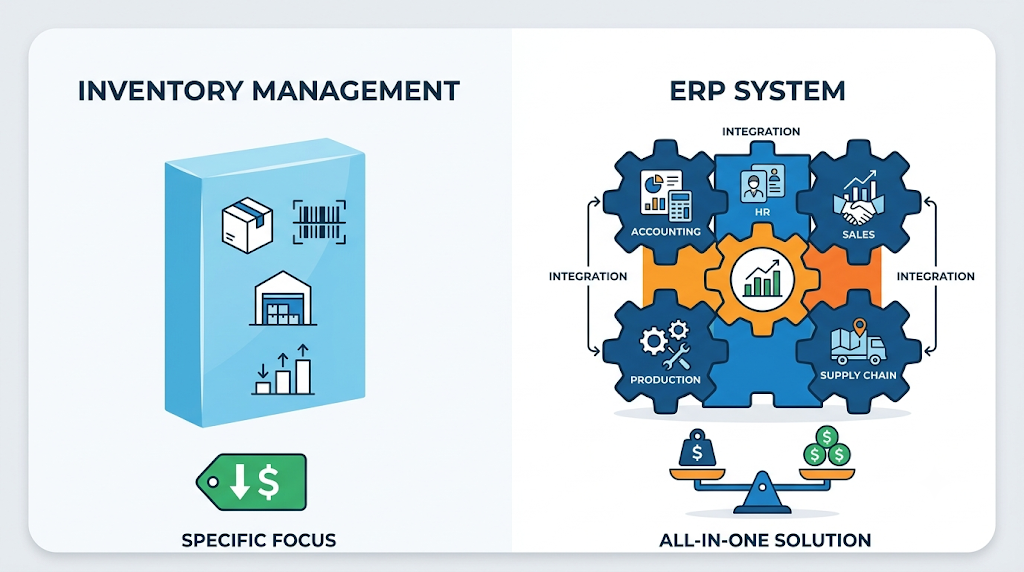
Cost is where the ERP vs inventory management software conversation usually starts, and where it is most frequently misunderstood. Inventory software is cheaper upfront and faster to launch. ERP costs more but replaces multiple disconnected tools.
Upfront Investment
A standalone inventory management software subscription for a mid-sized Indian D2C brand typically runs ₹8,000-25,000 a month, depending on SKU count and warehouse locations. A full ERP implementation, by contrast, often requires ₹10-40 lakhs upfront in licensing, customization, and consultant fees, plus a multi-month rollout.
Ongoing Operational Cost
Inventory management software rarely needs a dedicated internal team to run day-to-day, since the interface is built for warehouse staff, not IT specialists. ERP usually needs at least one internal administrator or a retained consultant to handle configuration changes, user roles, and periodic upgrades.
| Cost Factor | Inventory Management Software | ERP |
| Upfront cost | Low, subscription-based | ₹10-40 lakhs typical |
| Implementation time | 1-3 weeks | 3-9 months |
| Scope | Stock tracking only | Finance, HR, procurement, inventory |
| Best fit | Single or a few warehouses | Multi-department, multi-entity |
| GST and accounting sync | Usually needs integration | Usually built-in |
| Customization depth | Limited | Extensive, often consultant-led |
This table is the fastest way to see where the ERP vs inventory management software decision actually splits for Indian sellers. Cost alone should not decide it, since the two tools solve different operational problems.
Why Do Indian Distributors Outgrow Standalone Inventory Management Software
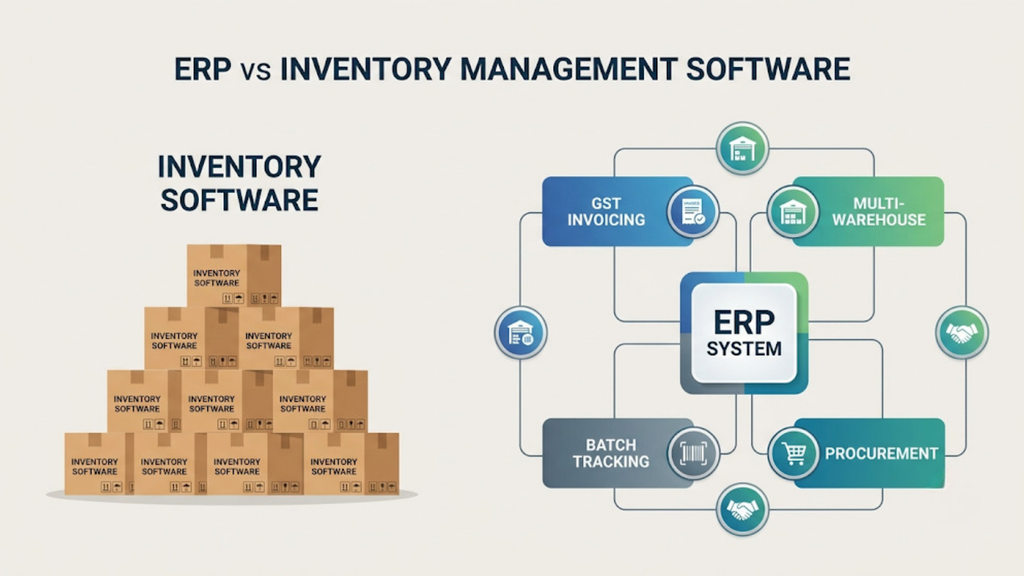
Inventory management software works well until a distributor starts juggling purchasing, GST-compliant invoicing, and multi-warehouse stock in one workflow. At that point, the ERP vs inventory management software gap becomes an operational bottleneck, not a preference.
India’s D2C sector is growing at roughly 40% CAGR, and that growth typically forces a rethink of the ERP vs inventory management software question within 18 to 24 months of crossing ₹25-50 crore in annual revenue. Inventory software alone cannot reconcile purchase orders, GST filings, and stock movement in one system.
Base.com’s clients running FMCG and pharma distribution networks usually reach this crossroads earlier than D2C brands, because distributor-level batch tracking and SAP-linked procurement demand deeper integration than standalone inventory software provides.
How Does ERP vs Inventory Management Software Affect Multi-Warehouse Operations
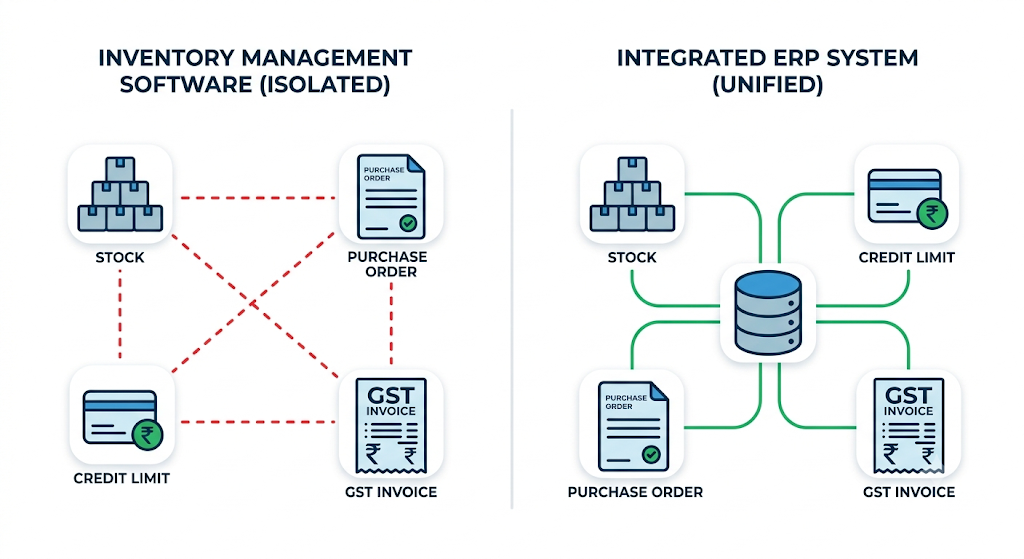
Distribution in India often means dozens of distributor warehouses, each generating purchase orders, stock transfers, and returns. This is where ERP vs inventory management software stops being a cost question and becomes a data-integrity question.
Inventory software alone can track stock per warehouse. It usually cannot connect that stock data to a distributor’s outstanding credit limit, a pending purchase order, or a GST invoice without manual reconciliation. An ERP does this natively because inventory is one module among several that share the same database.
Base.com bridges this gap for D2C clients by connecting order execution directly into existing SAP and ERP environments, so sellers get real-time stock visibility without needing to replace their inventory management software or their ERP.
Is ERP Overkill for Small and Mid-Sized Indian Sellers
Not always, but often, at least initially. The ERP vs inventory management software question for a seller doing under ₹10 crore a year usually favors inventory software, because the operational complexity an ERP is built for does not yet exist.
When Inventory Software Is Enough
A single-warehouse D2C brand selling on two marketplaces rarely needs payroll, multi-entity accounting, and procurement workflows bundled into one platform. Inventory management software covers stock tracking, reorder alerts, and basic reporting without the implementation overhead of an ERP.
Signs a Seller Is Ready for ERP
The mistake most Indian sellers make is delaying the ERP vs inventory management software decision too long, waiting until reconciliation errors and stockouts become a weekly occurrence before evaluating a change.
Which Integrates Better With SAP, Tally, and GST Workflows: ERP or Inventory Software
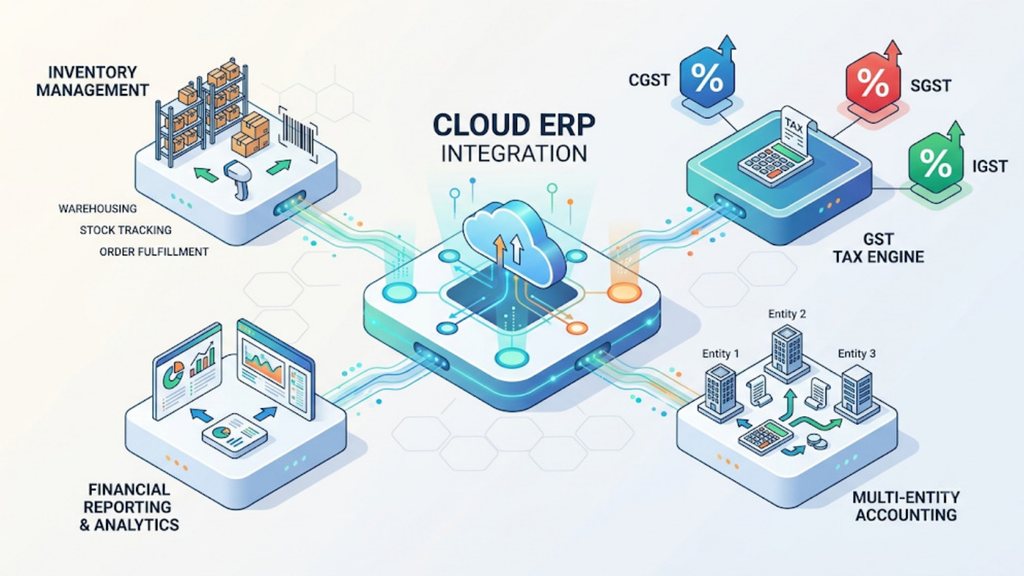
Most Indian businesses already run some combination of Tally, SAP, or a GST-compliant billing tool. The ERP vs inventory management software decision often comes down to which one plugs into that existing stack with the least friction. Roughly 60% of Indian SMEs have already shifted some part of their operations to cloud-based systems, and integration depth is usually the deciding factor in that shift.
Things ERP Handles Natively
- Direct GST calculation on every sale and purchase entry, including CGST, SGST, and IGST splits.
- Automatic HSN and SAC code mapping at the product level.
- Ledger updates the moment a stock transaction is recorded, with no separate export step.
- Multi-entity and multi-GSTIN support for distributors operating across states.
Things Inventory Software Still Needs
- A separate connector or export routine to sync stock data into Tally or a GST filing tool.
- Manual reconciliation whenever the connector breaks after a software update.
- An added integration cost that is rarely included in the original subscription price.
ERP systems typically include native GST handling, HSN and SAC code management, and direct ledger updates. Inventory management software usually needs a separate integration or export step to sync with Tally or a GST filing tool, which introduces a reconciliation lag every filing cycle. That lag is small for a single-location seller, but it compounds fast for a distributor filing GST returns across 10 or more states.
Base.com’s platform connects natively with SAP SD/WM workflows and distributor ERPs, closing this exact integration gap for FMCG and pharma clients who need inventory, GST, and procurement data to move in sync without manual exports.
Can Inventory Management Software Handle Festive Season Demand Like an ERP
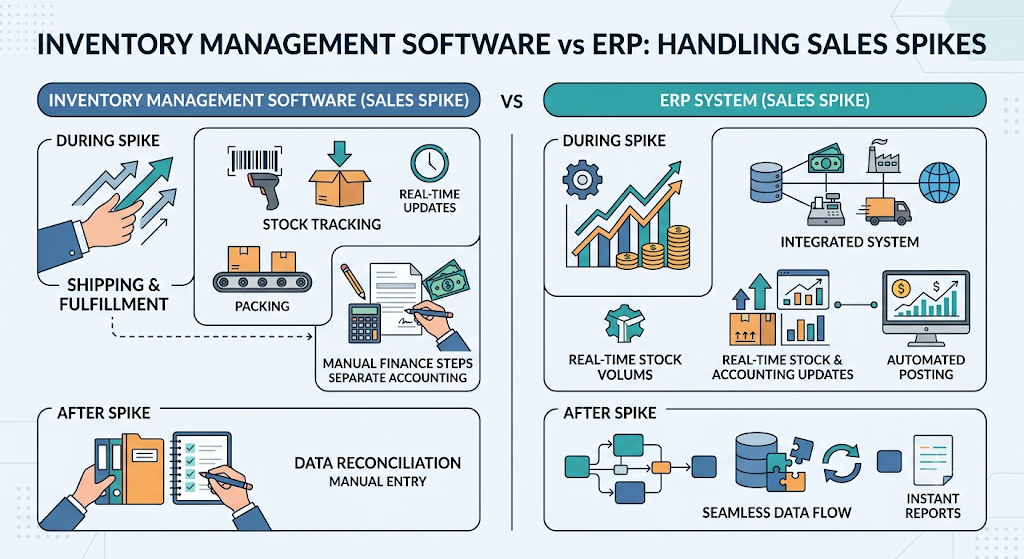
Diwali and Republic Day sale windows push Indian order volumes up sharply within days. Both ERP and inventory management software can technically handle a volume spike, but the ERP vs inventory management software distinction shows up in how cleanly that spike reconciles afterward.
During the Spike
Inventory software tracks the stock movement in real time but leaves purchasing, financial reconciliation, and distributor settlements as separate manual steps. An ERP captures the same stock movement and updates procurement and accounting simultaneously.
After the Spike
Post-festive reconciliation under inventory software alone can take days of manual cross-checking against purchase records. Under ERP, the same reconciliation typically takes hours, since procurement and accounting were already updated in step with the sales data.
Base.com’s infrastructure scales with order volume regardless of which system it sits alongside, absorbing festive-season spikes without requiring either an ERP or inventory management software to be replaced.
How Does Base.com Approach ERP vs Inventory Management Software
Base.com does not force sellers to choose between ERP and inventory management software. It was built to sit on top of whichever system a client already runs, connecting order execution directly to SAP, WMS, and distributor ERPs, or to standalone inventory software where that is what the business uses. Below is the module-by-module breakdown of how this plays out in practice.
Module 1: Order-to-Inventory Sync

Inventory management software alone: Stock levels update per warehouse, but purchase orders and financial records need a manual bridge to stay in sync with what inventory software shows.
ERP alone: Stock, purchasing, and accounting stay in sync natively, but ERP implementations are often too slow and too rigid to adapt to fast-changing marketplace order flows.
Base.com’s layer: Connects directly into whichever system exists, ERP or inventory management software, and keeps order execution, stock counts, and exception handling synced in real time without asking the seller to migrate either system first.
Module 2: RTO and COD Return Intelligence
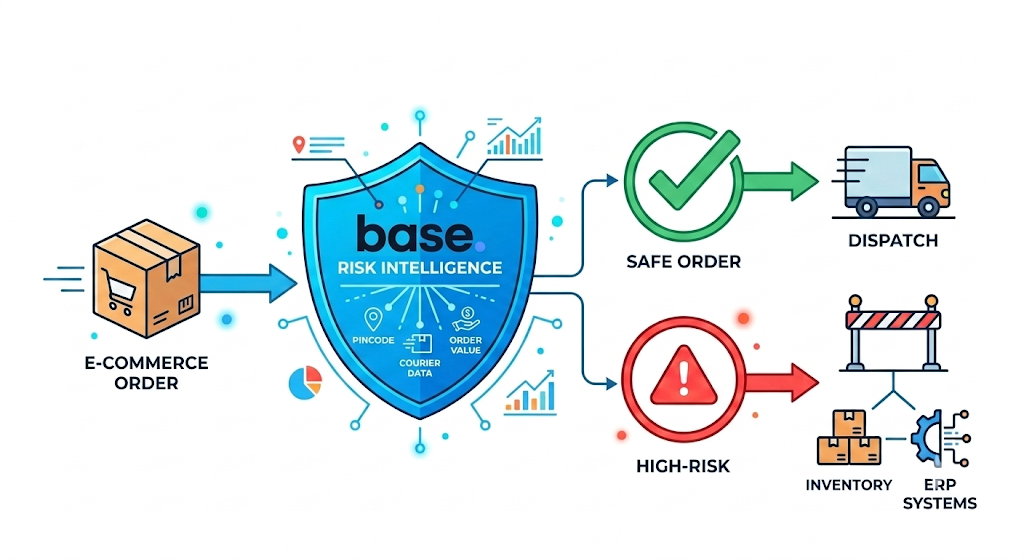
Inventory management software alone: Logs a return once it happens. It does not connect that return to a courier risk score or a pincode-level pattern before dispatch.
ERP alone: Can log the financial impact of a return accurately, but rarely includes live courier or pincode risk scoring as a native feature.
Base.com’s layer: Scores every COD order for return risk before dispatch, using pincode history, courier performance, and order value, then feeds that decision back into whichever inventory or ERP system the seller already runs.
Module 3: SAP, WMS, and ERP Integration
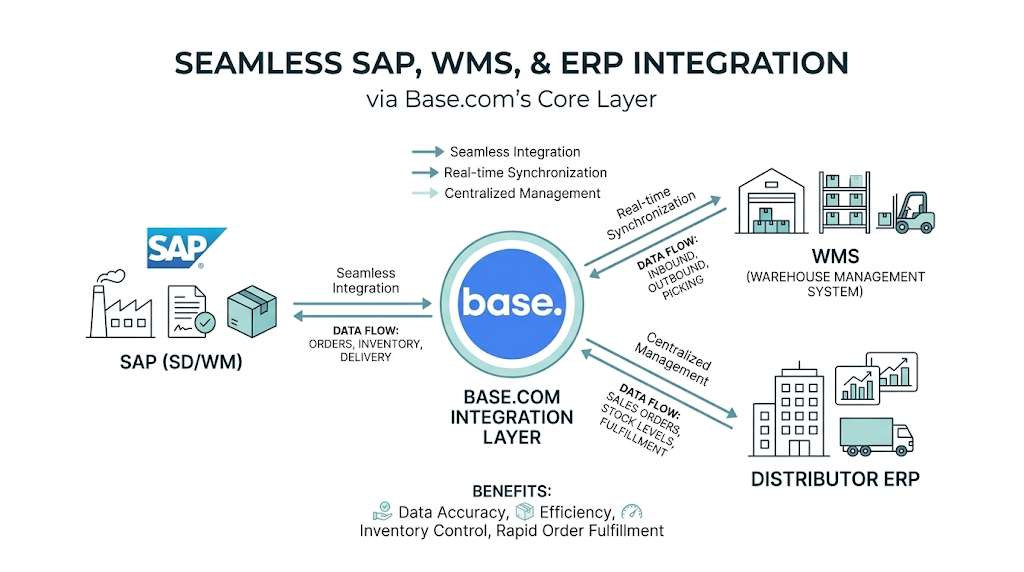
Inventory management software alone: Typically needs a custom connector or middleware to talk to SAP or a WMS, and that connector needs ongoing maintenance.
ERP alone: Usually has native SAP or WMS compatibility, but customizing it for India-specific distributor workflows can take months.
Base.com’s layer: Connects natively with SAP SD/WM workflows, third-party WMS platforms, and distributor ERPs without custom middleware, which shortens the timeline for FMCG and pharma clients regardless of which core system they run.
Module 4: RPA and Exception Handling
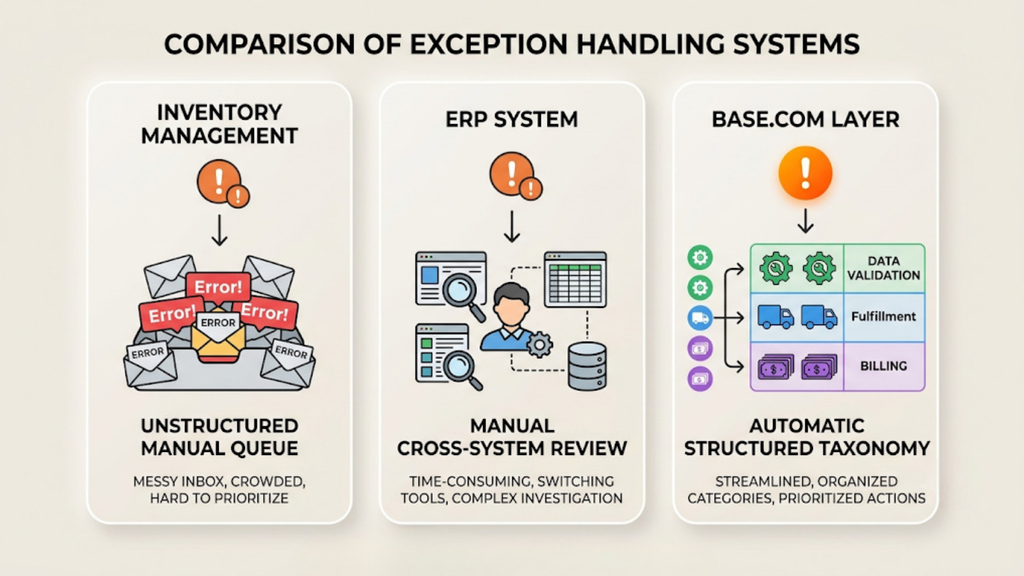
Inventory management software alone: Exceptions like a mismatched PO usually land in a manual queue with no automated escalation path.
ERP alone: Can flag exceptions within its own module, but cross-system exceptions, like a WMS mismatch against an ERP purchase order, often still require manual review.
Base.com’s layer: Automatically escalates unmatched or exception cases to a structured error taxonomy instead of a manual inbox, regardless of whether the underlying system is an ERP or inventory management software.
Module 5: Demand and Reorder Prediction
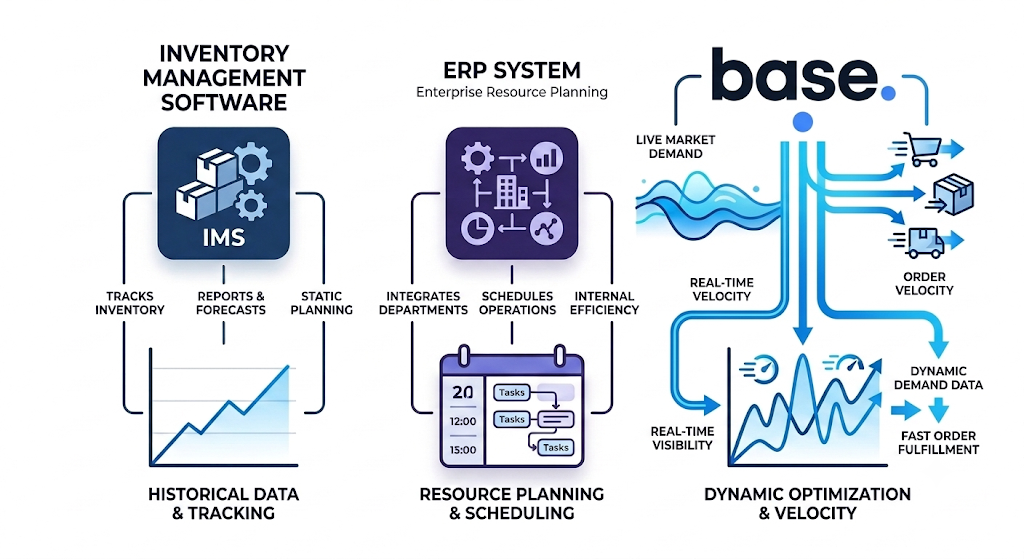
Inventory management software alone: Sets reorder points based on historical averages, rarely adjusting in real time to a sudden demand shift.
ERP alone: Can theoretically forecast demand using historical sales and procurement data, but most ERP forecasting modules update on a scheduled cycle, not continuously.
Base.com’s layer: Forecasts reorder points per SKU per warehouse using live order velocity, which matters most in a market with 40% CAGR D2C growth and unpredictable festive demand curves.
Each of these five modules shows the same pattern. Whether a seller runs ERP, inventory management software, or both, the real-time layer that connects order execution to stock and exception handling is what Base.com adds on top, without forcing a system replacement.
Can a Seller Actually Need Both ERP and Inventory Management Software
A growing number of Indian FMCG and pharma distribution networks do not resolve the ERP vs inventory management software question with a single answer. They run both, deliberately, at different layers of the business.
In this setup, ERP handles the financial and procurement backbone: purchase orders, vendor credit terms, GST invoicing, and ledger reconciliation. A lighter, specialized inventory management software layer handles day-to-day warehouse operations: picking, packing, barcode scanning, and shelf-level stock counts, because warehouse staff often need a faster, simpler interface than a full ERP screen provides.
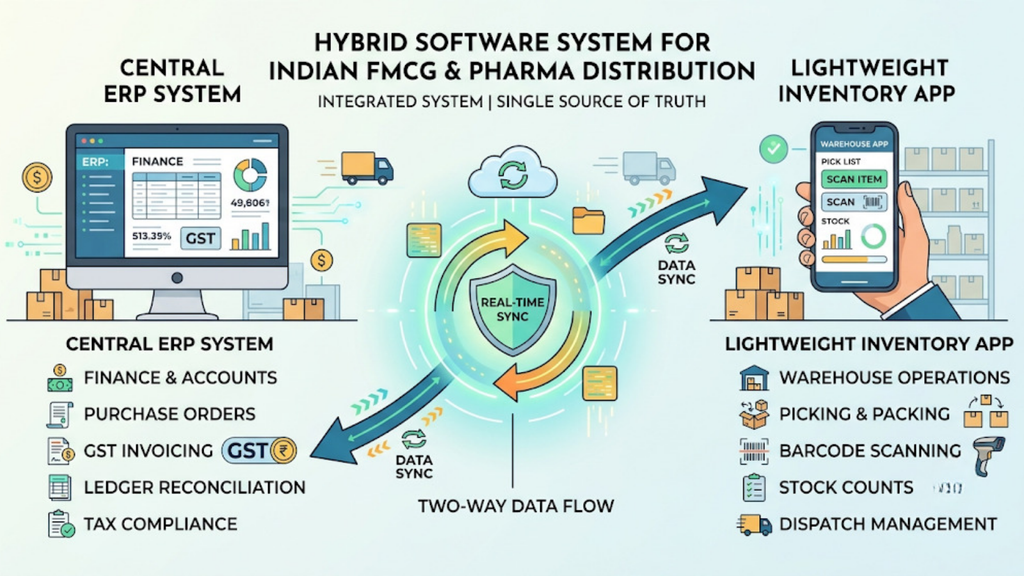
This hybrid model works only if the two systems stay synchronized in real time. Without that synchronization, the ERP vs inventory management software split creates two sources of truth instead of one, which defeats the purpose of running either system carefully.
Base.com is often the layer that keeps this hybrid setup working, syncing order execution and stock movement between the ERP and the inventory management software so neither system drifts out of alignment with the other. For sellers who have already invested in both, replacing either one is rarely necessary. What is necessary is a connective layer that keeps them talking to each other continuously, not just during a nightly batch job.
Which Should You Choose: ERP or Inventory Management Software
| Your Situation | Better Fit |
| Single warehouse, 1-2 sales channels | Inventory management software |
| Multi-warehouse FMCG or pharma distribution | ERP |
| Need GST-linked accounting built in | ERP |
| Fast-growing D2C brand under ₹25 crore | Inventory management software, for now |
| Complex procurement and vendor credit terms | ERP |
| Scaling past ₹50 crore in the next 18 months | Plan for ERP migration |
This framework reflects how the ERP vs inventory management software decision actually plays out for Indian sellers at different stages, not a one-size-fits-all recommendation.
Is ERP Better Than Inventory Management Software
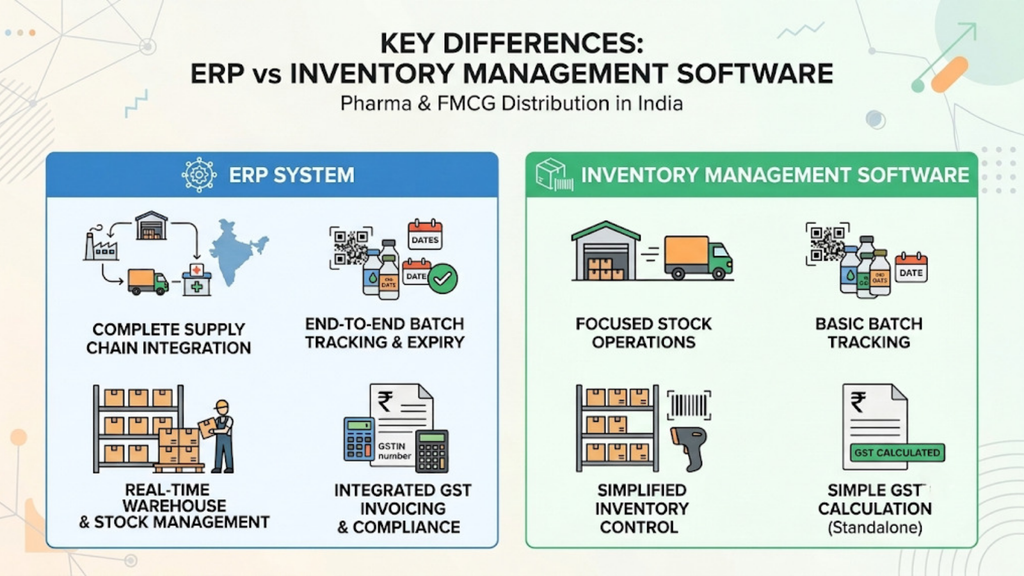
Pharmaceutical and FMCG distribution in India runs on batch tracking, expiry management, and GST-compliant invoicing at a scale that quickly outpaces standalone inventory management software. The ERP vs inventory management software question here usually resolves toward ERP once a distributor network crosses 15-20 locations. COD return rates in Indian ecommerce run at 25-30%, and pharma distribution carries its own version of this risk through expired or near-expiry stock sitting unsold.
Where Inventory Software Breaks Down
- Batch and expiry data stay siloed at each individual warehouse or distributor location.
- Reconciling stock across 20-30 distributors manually can take days every cycle.
- No native link between stock ageing and purchasing decisions, so slow-moving batches often get reordered anyway.
- Compliance reporting for regulated categories needs a manual export, not a built-in report.
What ERP Adds for Regulated Distribution
- A single ledger where batch, expiry, and financial data update together.
- Automated flags when a batch approaches its expiry window, tied directly to purchasing.
- Multi-distributor visibility without needing a separate reconciliation step each month.
- Audit-ready reporting built into the same system that runs procurement.
Inventory management software can track batch numbers at a single warehouse. It struggles to reconcile that data across 20 or 30 distributors without an ERP-level financial and procurement layer sitting underneath it.
Base.com’s platform gives FMCG and pharma clients a real-time view of stock health across every connected distributor and warehouse, whether that data originates in a full ERP or a simpler inventory management software setup, closing the visibility gap either way.
Hidden Costs Indian Sellers Miss When Comparing ERP vs Inventory Management Software

Every ERP vs inventory management software comparison eventually runs into cost categories that do not show up in a subscription quote. Inventory software carries lower upfront costs but often hides integration costs when it needs to talk to accounting or SAP.
What Inventory Software Hides
Integration costs surface later, once a seller needs the inventory system to talk to Tally, a GST filing tool, or SAP. That connector work and its ongoing maintenance rarely appear in the original subscription quote.
What ERP Hides
ERP carries the opposite risk. Implementation quotes rarely include the internal time cost of training staff across departments or the risk of a multi-month rollout disrupting daily operations mid-migration.
Indian sellers evaluating ERP vs inventory management software should price both the visible subscription or licensing cost and the invisible integration or training cost before deciding either way.
What Are the Common Myths About ERP vs Inventory Management Software

Every ERP vs inventory management software conversation in India runs into the same three myths. Addressing them directly is more useful than repeating them.
Myth 1: ERP Is Only for Large Enterprises
Mid-sized Indian FMCG distributors adopt ERP well before they reach enterprise scale, usually once distributor count and GST complexity outpace what inventory software can handle alone.
Myth 2: Inventory Software Is Just a Temporary Stopgap
For single-warehouse, low-complexity sellers, it can remain the right tool indefinitely. The ERP vs inventory management software decision is about fit, not about one option being inherently more mature than the other.
Myth 3: Switching to ERP Means Starting From Zero
A structured migration preserves historical stock and order data, so the switch adds capability rather than resetting operational history.
None of these three myths change the underlying decision criteria. Some misconceptions delay a decision that Indian sellers eventually need to make anyway.
The Final Verdict for Indian D2C Brands
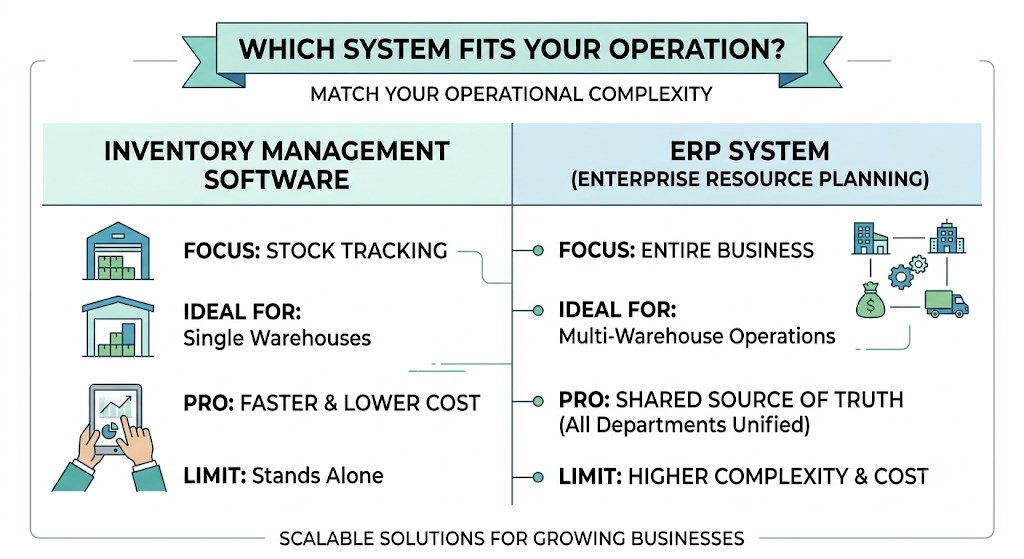
ERP vs inventory management software is not a question of which one is universally better. It is a question of which one matches your current operational complexity. Inventory management software wins on speed and cost for single-warehouse, low-complexity operations. ERP wins once procurement, accounting, and multi-warehouse stock all need to share one source of truth.
For sellers weighing ERP vs inventory management software in 2026, the practical signal to watch is reconciliation pain. If stock, purchasing, and financial records increasingly disagree with each other, that is a sign that inventory software alone is no longer enough. Base.com’s order execution platform is built to work alongside either system, so the ERP vs inventory management software decision does not have to be resolved before order automation improves.
Sellers who wait too long to make this call usually do so under pressure, right after a festive-season reconciliation failure exposes exactly where a standalone inventory management software setup could not keep up with ERP-level complexity.