

To avoid stockouts during ecommerce sales, run live stock synchronisation, reserve inventory at order capture, keep a 10-20% buffer on A-class SKUs sized to your replenishment speed, and monitor projected zero hour rather than days of supply. Most sale-period stockouts are not shortages. They are visibility failures.
That distinction decides whether you fix the right problem.
What a Stockout Actually Costs an Indian Seller
IHL Group’s 2026 Inventory Distortion Study puts the global cost of out-of-stocks and overstocks combined at $1.7 trillion a year, equal to 6.2% of global retail sales, with 65.6% of that attributed to out-of-stocks and 34.4% to overstocks. That figure covers all global retail, not Indian ecommerce specifically.
The foundational consumer research on the subject, Gruen, Corsten and Bharadwaj’s study of more than 71,000 consumers across 29 countries, found a global average out-of-stock rate of 8.3%, and reported that when an item is missing, roughly 31% of shoppers buy it elsewhere and about 9% do not buy at all.
Read that second figure carefully. Nearly a third of the demand you lose to a stockout does not wait for you. It converts for a competitor, during a sale window, at the moment your acquisition spend is highest.
This is why understanding how to avoid stockouts during ecommerce sales matters more than the raw unit loss suggests. The cost is the margin on units you did not sell, plus the acquisition spend you burned driving traffic to an unavailable listing, plus the ranking decay that follows on marketplaces that reward sales velocity.
Why Sale Periods Produce Stockouts at Roughly Twice the Normal Rate
ECR Europe research found that promotional items go out of stock at approximately twice the rate of non-promoted items.
That research is dated, but it describes exactly what still happens during Big Billion Days and Great Indian Festival. Promotion concentrates demand into a narrow window on a narrow set of SKUs, precisely the conditions under which forecasting error and system latency compound.
Three mechanisms drive the doubling, and each one changes how to avoid stockouts during ecommerce sales in practice:
- Velocity outruns visibility. A sync interval that was adequate at 40 orders a day is not adequate at 400. The gap between what you have and what your listings think you have widens with volume.
- Demand concentrates on hero SKUs. Your forecast error on a deal SKU is larger in absolute units than your error across the entire long tail combined.
- Replenishment slows exactly when you need it fastest. Your suppliers, your transporters, and your fulfilment centres are all running at capacity in the same weeks.
The Five Root Causes of Sale-Period Stockouts
Most sellers diagnose every stockout as “we did not buy enough.” Usually that is wrong. A useful way to think about how to avoid stockouts during ecommerce sales is to recognise that only one of these five causes is actually a shortage.
|
Root cause |
What is happening |
The actual fix |
|---|---|---|
|
True zero |
You genuinely have no units anywhere |
Buy more, or replenish faster |
|
Phantom stockout |
System shows zero; physical stock exists |
Cycle counting, receiving discipline |
|
Latency stockout |
Stock exists and is available; the channel does not know yet |
Faster synchronisation |
|
Allocation stockout |
Stock exists but in the wrong pool or node |
Multi-warehouse separation, routing rules |
|
Reservation stockout |
Stock is committed to unshipped orders |
Reserve at capture, expire abandoned reservations |
1. True Zero Is the Rarest and the Most Honest
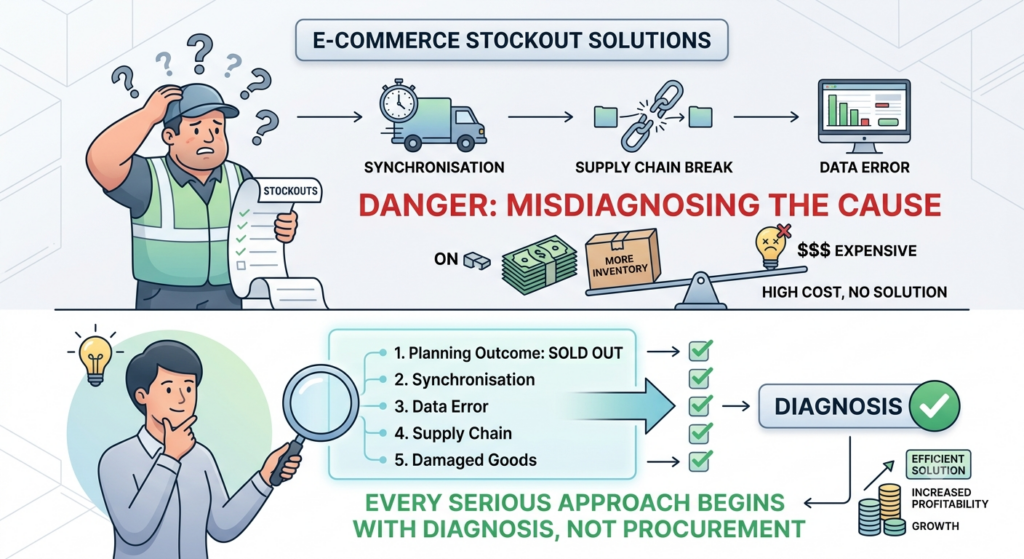
If you sold every unit you had and cannot restock, that is a planning outcome, not a systems failure. Record it, raise the multiplier next cycle, and move on.
The danger is misclassifying the other four as this one. Buying more inventory to solve a synchronisation problem is expensive, and it does not work, which is why every serious approach to how to avoid stockouts during ecommerce sales begins with diagnosis rather than procurement.
2. Phantom Stockouts Come From Receiving, Not Selling
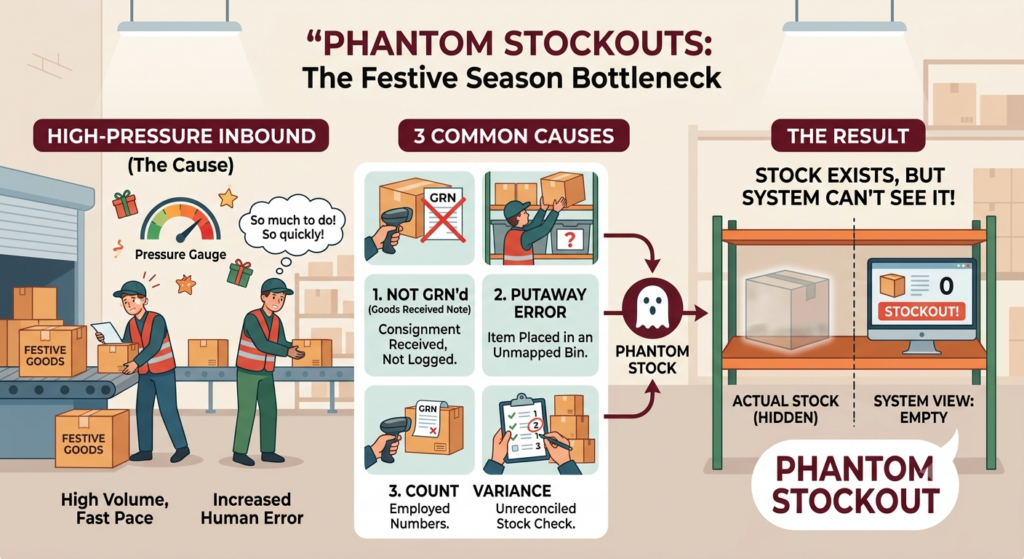
A phantom stockout is stock you own, sitting in your warehouse, invisible to your system. It typically originates at inbound: a consignment received but not GRN’d, a putaway to an unmapped bin, or a count variance never reconciled.
During festive inbound, receiving is under the most pressure it faces all year. That is exactly when phantom stock is created.
3. Latency Stockouts Are the Most Common and the Most Fixable
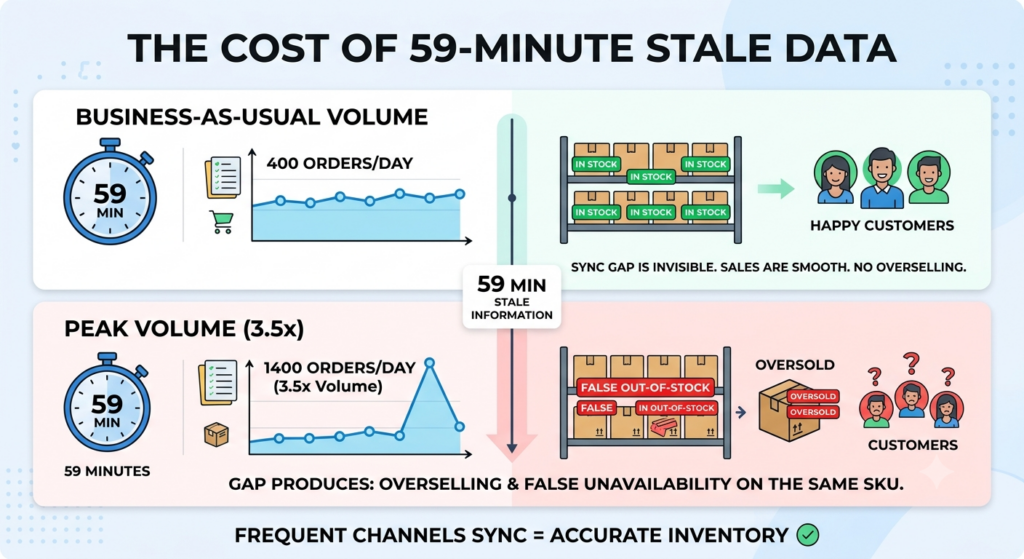
If your channel sync runs hourly and you are dispatching 400 orders a day, your listings are working from information up to 59 minutes stale.
At business-as-usual volume, that gap is invisible. At 3.5x volume it produces both overselling and false unavailability, sometimes on the same SKU within the same hour.
4. Allocation Stockouts Follow From Marketplace Commitment
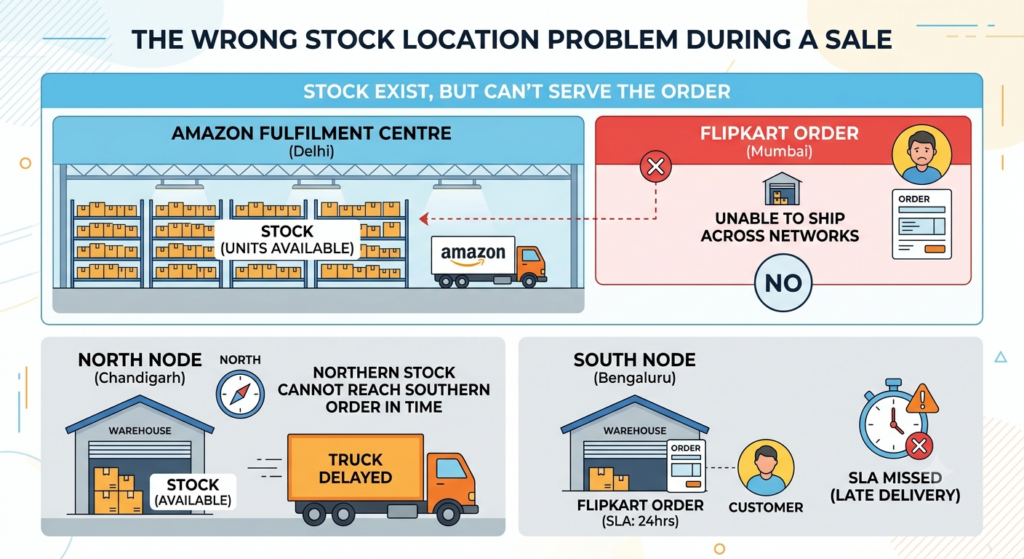
Stock inside an Amazon fulfilment centre cannot serve a Flipkart order. Stock at your northern node cannot serve a southern order inside the SLA.
The units exist. They are simply in the wrong place, and during a sale you cannot move them.
5. Reservation Stockouts Are India’s Specific Problem
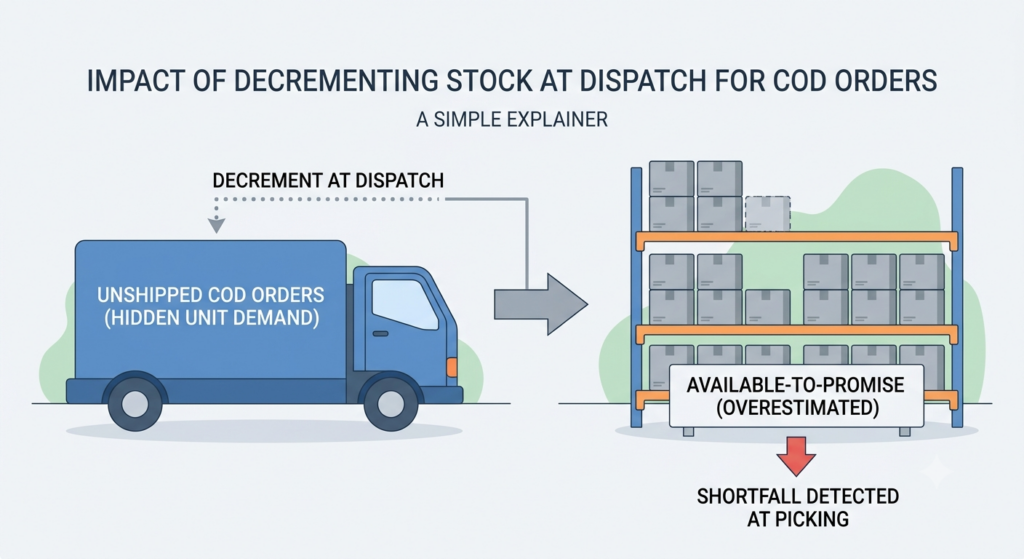
COD still accounts for roughly 45% of Indian D2C orders, down from 55% in 2024 according to one 2026 industry survey. Treat that as directional and verify against your own data.
If your system decrements stock at dispatch rather than at order capture, every unshipped COD order is invisible to your available-to-promise figure. You keep selling units already spoken for, then discover the shortfall at picking.
Top 20 Ways to Avoid Stockouts During Ecommerce Sales for Indian Sellers
These are grouped by the layer they act on. Working through how to avoid stockouts during ecommerce sales systematically means addressing all five layers, because a weakness in any one of them defeats strength in the others.
Forecasting and Demand Signals (1-4)
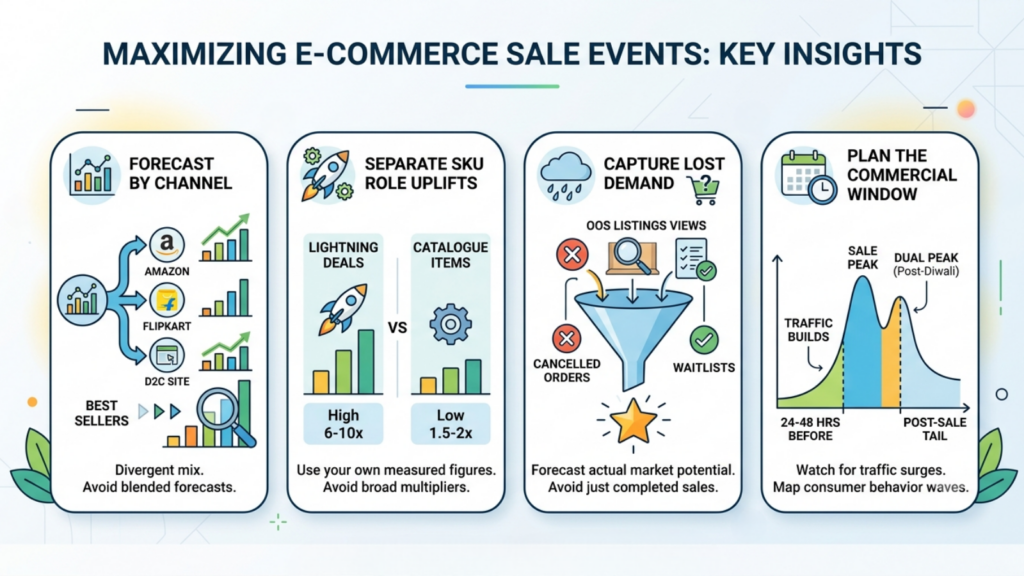
1. Forecast at SKU-channel level, never at SKU level. Your Amazon mix, Flipkart mix, and D2C mix diverge during sales. A blended forecast is wrong for every channel simultaneously, and the error concentrates on your best sellers.
2. Use separate uplift multipliers by SKU role. A lightning-deal SKU can run 6-10x baseline while a full-price catalogue SKU runs 1.5-2x. Applying one multiplier across the catalogue guarantees you understock heroes and overstock the tail. These ranges are planning heuristics, not published benchmarks; replace them with your own measured figures after one cycle.
3. Capture lost demand, not just completed sales. Track cancelled orders, out-of-stock listing views, and waitlist signals. Forecasts built only on what you sold will systematically understate demand for SKUs that stocked out, which repeats the shortage next cycle.
4. Plan the commercial window, not the official sale dates. Traffic builds 24-48 hours before the announced start and does not fall to baseline immediately after. Redseer also identified a dual-peak pattern in 2025, with GST slab simplification pushing high-ticket purchases into a second post-Diwali wave.
Systems and Synchronisation (5-8)

5. Move A-class SKUs to live stock synchronisation for the sale window. This is the single highest-leverage change available. It converts most latency stockouts into non-events without buying a single additional unit.
6. Reserve stock at order capture, not at dispatch. With COD near half of Indian D2C orders, this is what keeps your available-to-promise figure honest while a backlog builds.
7. Set reservation expiry to match your payment window. Abandoned prepaid carts should release inventory automatically. Reservations that never expire create the same shortage as a genuine sale, with none of the revenue.
8. Separate committed stock into its own warehouse in your system. Units inside a marketplace fulfilment centre must not appear in your self-ship available pool. If they do, every downstream calculation is built on a number that is not true.
Warehouse and Physical Accuracy (9-12)

9. Cycle count 100% of A-class SKUs at T-7. Full stocktakes are not feasible mid-season; cycle counting is. Count the SKUs that matter and sample the rest.
10. Ring-fence receiving capacity during the sale. Add a dedicated inbound lane and QC bench so GRN work does not queue behind outbound picking. Unreceived stock is the primary source of phantom stockouts.
11. Enforce scan-verified picking and packing. A mispick creates two errors at once: the wrong SKU leaves and the right SKU shows as consumed. Both push you toward a false zero.
12. Quarantine returns before restocking. Units restocked without inspection inflate your available figure with stock you cannot actually ship, which produces a stockout at picking rather than at the listing.
Supply Chain and Replenishment (13-16)
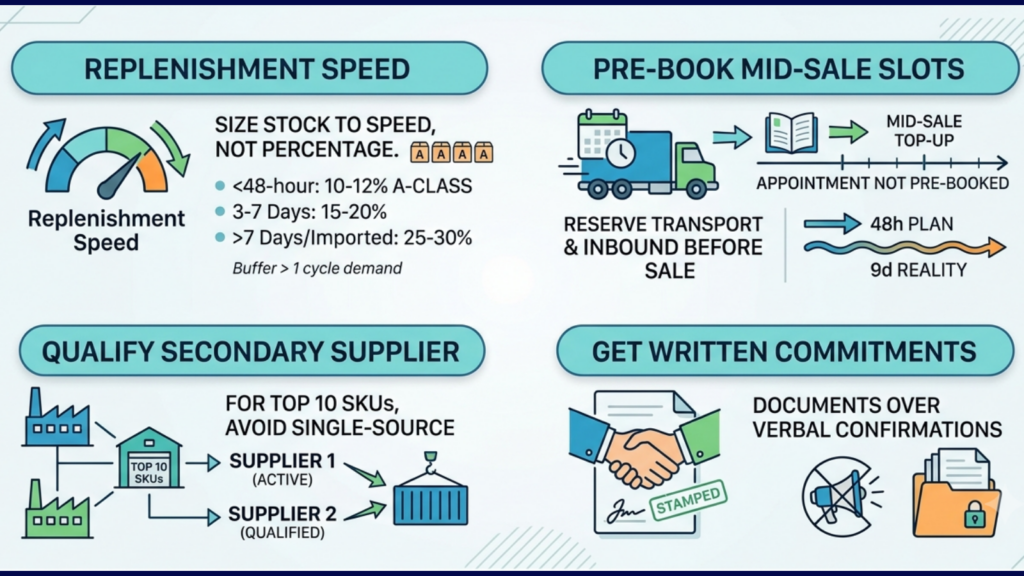
13. Size safety stock to replenishment speed, not to a fixed percentage. Under 48-hour replenishment supports 10-12% on A-class; 3-7 days needs 15-20%; imported or slow-replenishment stock needs 25-30%. A buffer smaller than one replenishment cycle of demand is decorative.
14. Pre-book mid-sale replenishment slots. Reserve transport and inbound appointments for a top-up consignment before the sale opens. Trying to book them during festive week is how a 48-hour replenishment becomes a nine-day one.
15. Qualify a secondary supplier for your top 10 SKUs. Single-source dependency on your highest-velocity SKUs is the risk with the worst payoff profile. You do not need volume from the second supplier, only a working relationship and agreed terms.
16. Get written dispatch commitments, not verbal confirmations. Your suppliers are also everyone else’s suppliers during the Indian festive season. Allocation goes to whoever has a documented commitment.
Channel and Commercial Levers (17-20)
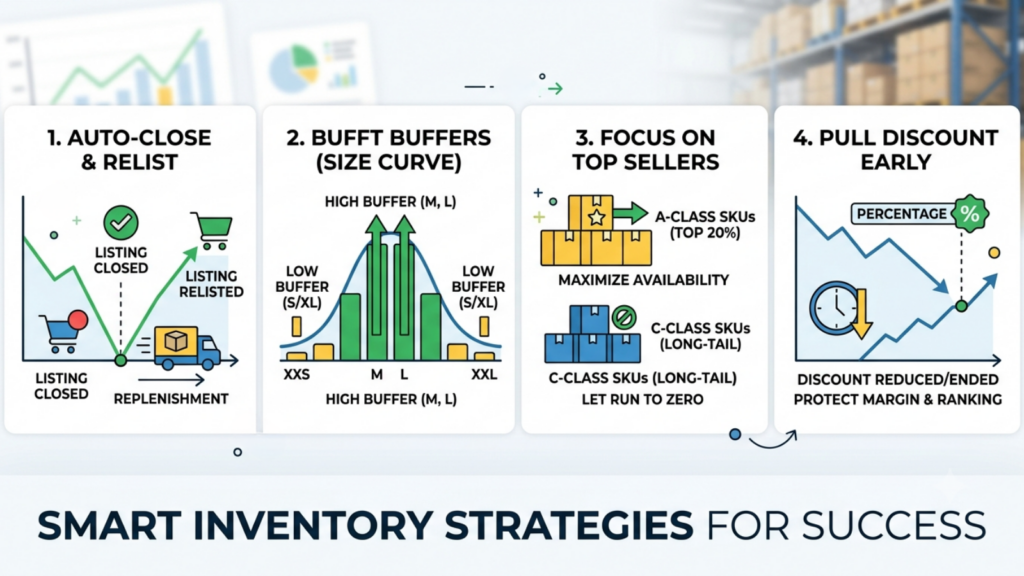
17. Automate listing closure at zero stock and relisting on replenishment. This does not prevent the stockout, but it prevents the stockout from becoming an oversell and a marketplace defect. It also puts the SKU back on sale the moment inbound posts, including overnight.
18. Buffer the middle of the size curve, not uniformly. In fashion and footwear, running out of M and L is a revenue event. Running out of XXS is not. Uniform buffers spend money in the wrong place.
19. Deliberately let C-class SKUs run to zero. Concentrating protection on the top 20% of SKUs is how you fund it. Long-tail stockouts during a sale cost very little, provided listings close cleanly.
20. Pull the discount before you run out, not after. If a hero SKU is tracking to zero mid-window, reducing the discount slows velocity and extends availability. Ending the promotion early protects both the ranking signal and the margin on remaining units.
How Stockout Risk Differs by Category for Indian Sellers
The twenty tactics above apply everywhere, but the pressure point moves with what you sell. Any practical answer to how to avoid stockouts during ecommerce sales has to account for category, because the dominant root cause differs.
|
Category |
Dominant stockout cause |
Where to concentrate effort |
|---|---|---|
|
Fashion and apparel |
Size-curve depletion, slow returns processing |
Buffer middle sizes; process returns within 48 hours |
|
Beauty and personal care |
Variant and shade skew |
Buffer by variant, not by product |
|
Consumer electronics |
Allocation across marketplace pools |
Warehouse separation and commitment discipline |
|
Home, kitchen, furniture |
Physical space, slow reverse logistics |
Plan buffer in cubic metres, not units |
|
FMCG and food |
Quick-commerce replenishment cadence |
Hold buffer centrally, push to dark stores often |
|
Health and supplements |
Subscription commitments consuming sale stock |
Ring-fence subscription units from promotional pools |
Fashion deserves particular attention. With Indian fashion return rates commonly reported around 25-30%, a quarter of dispatched units come back, and slow returns processing turns recoverable inventory into a mid-sale stockout. Verify that range against your own courier and returns data rather than adopting it directly.
Electronics sits at the opposite end. Domestic returns are low, commonly cited at 5-8%, so the binding constraint is rarely supply. It is almost always allocation, units committed to one marketplace pool while demand arrives on another.
Build an Early-Warning System, Not a Stockout Report
The most useful shift in how to avoid stockouts during ecommerce sales is moving from lagging indicators to leading ones. A stockout report tells you what already cost you money.
|
Leading signal |
Threshold |
Response |
|---|---|---|
|
Days of supply on A-class SKU |
Under 1.5x remaining sale window |
Trigger replenishment or reduce discount |
|
Hourly burn rate vs forecast |
Above 130% of plan |
Recalculate projected zero hour |
|
Sync error count |
Any non-zero value |
Investigate immediately |
|
Unpicked order ageing |
Beyond one pick cycle |
Add pick capacity before stock ages |
|
Count variance at cycle count |
Above 2% on A-class |
Recount and hold sync until resolved |
|
Reservation pool as % of on-hand |
Rising faster than dispatch |
Check COD backlog and reservation expiry |
Calculate projected zero hour rather than days of supply during a sale. At 3.5x velocity, “two days of stock” can mean fourteen hours.
Ownership is the part of how to avoid stockouts during ecommerce sales that no software provides. Assign one named owner per shift with authority to close a listing or pull a discount without escalation. During a sale window, the cost of a delayed decision exceeds the cost of a wrong one.
The First 60 Minutes: A Stockout Recovery Playbook
When a stockout does happen, sequence matters. These steps are ordered deliberately.
- Minutes 0-5: Confirm which of the five causes it is. Check physical stock before doing anything else. If units exist, this is a phantom, latency, allocation, or reservation problem, and buying inventory will not fix it.
- Minutes 5-15: Stop the bleeding on the channel. Close or suppress the listing so the stockout does not become an oversell and a marketplace defect. Automated closure should already have done this.
- Minutes 15-30: Check adjacent pools. Stock at another node, unreceived inbound sitting on the dock, or expired reservations may be recoverable within the window.
- Minutes 30-45: Decide the commercial response. Options are replenish, redirect demand to a substitute SKU, or accept the stockout and protect margin elsewhere. Redirecting to a substitute preserves the traffic you already paid for.
- Minutes 45-60: Log the event with its root cause. Not for reporting. For next cycle’s forecast, which will otherwise repeat the error.
Recovery is the last line of defence in how to avoid stockouts during ecommerce sales turning into permanent lost revenue, and recovery speed matters more than recovery elegance. A SKU restored in four hours during a six-day sale has lost 3% of the window. A SKU restored on day four has lost half of it.
How Base.com Supports Stockout Prevention During Sale Events
Base.com is an ecommerce operating system combining order management, product and inventory management, marketplace listing control, shipping and workflow automation in one platform. Its Product Manager module explicitly combines ERP, WMS and PIM functions.
Five capabilities map onto the root causes above, covering four of the five layers involved in how to avoid stockouts during ecommerce sales.
1. Live Synchronisation and the Accelerations Module Address Latency
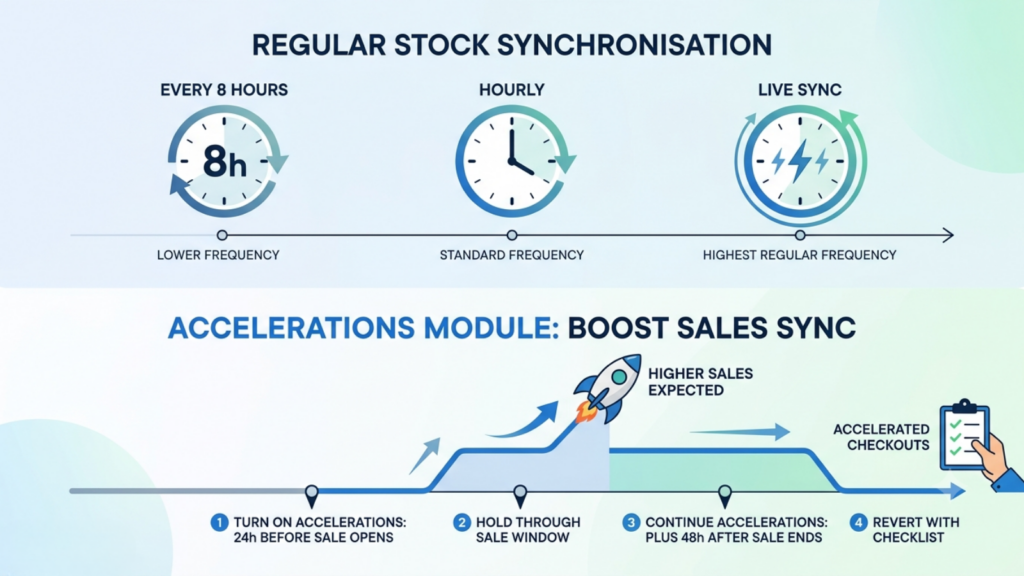
Base.com offers stock synchronisation on a configurable cadence, every eight hours, hourly, or live, and ships a dedicated Accelerations module that raises synchronisation frequency for periods when higher sales are expected.
Latency stockouts are the most common category and the cheapest to eliminate. Turn Accelerations on 24 hours before the sale opens, hold through the window plus 48 hours, then revert deliberately with a checklist.
2. Reservations at Capture Address the COD Backlog

Base.com’s Product Manager supports reserving products before orders are paid, which keeps unshipped COD orders visible in your available-to-promise figure rather than hidden until picking.
3. Multi-Warehouse Separation Addresses Allocation

Base.com supports assigning one or more warehouses to an inventory, each with separate stock levels, documents, deliveries, and stocktakings. Marketplace-committed stock stays in its own pool and never inflates your self-ship availability.
4. Automatic Listing Closure and Relisting Contains the Damage
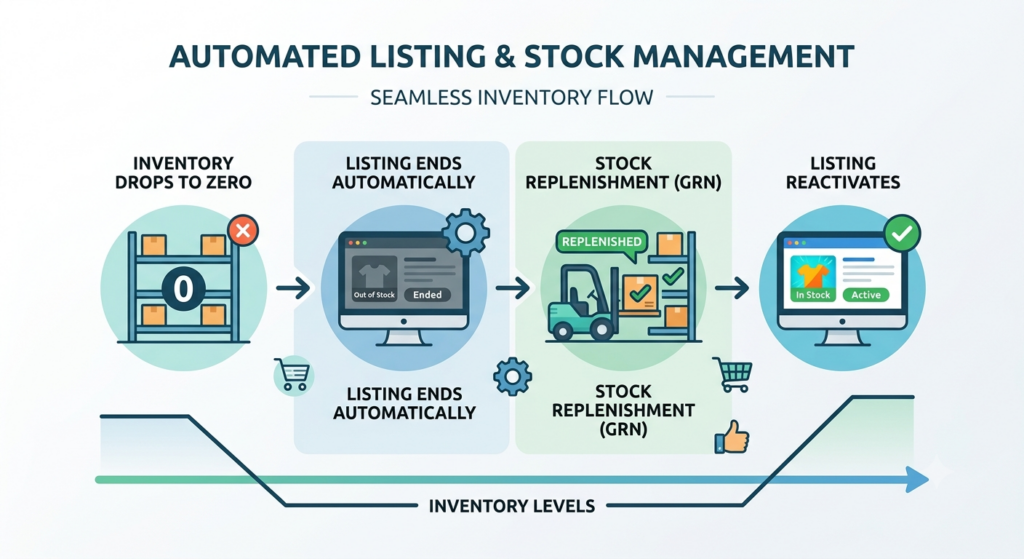
Listings end automatically when stock reaches zero and reactivate on replenishment. This is what makes the deliberate C-class strategy safe, and it removes the delay between an inbound GRN and the SKU returning to sale.
5. Stocktakings and Bundle Splitting Address Phantom Stock
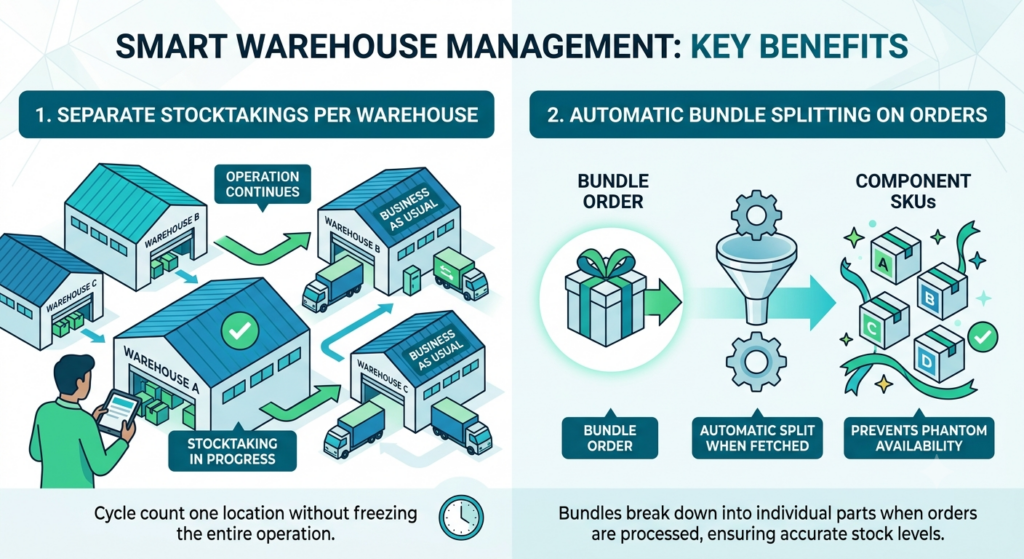
Separate stocktakings per warehouse let you cycle count one node without freezing the whole operation. Bundles can be configured to split automatically into component SKUs when an order is fetched, which prevents the component-level drift that produces phantom availability during festive hamper season.
Metrics That Tell You Whether Prevention Worked
|
Metric |
Formula |
Target during sale |
|---|---|---|
|
Stockout hours, A-class |
Hours at zero ÷ total sale hours |
Under 2% |
|
Phantom stockout rate |
Phantom events ÷ total stockout events |
Under 10% |
|
Sync latency |
Dispatch to channel update |
Under 5 minutes |
|
Mean time to recovery |
Zero-stock detection to relisting |
Under 4 hours |
|
Count accuracy, A-class |
Matching counts ÷ total counts |
Above 98% |
|
Lost demand captured |
Cancelled orders and OOS views logged |
100% of events |
Targets are directional planning benchmarks constructed for this article, not published industry standards. Calibrate them against your own last two cycles.
Track root cause on every event, because the mix of causes tells you where your version of how to avoid stockouts during ecommerce sales is actually failing. If more than a third of your events are phantom, latency, or reservation stockouts, your problem is systems, and no amount of additional purchasing will solve it.
Seven Mistakes That Undermine How to Avoid Stockouts During Ecommerce Sales
- Diagnosing every stockout as a shortage. Four of the five root causes are not shortages, and buying more inventory fixes none of them.
- Running hourly sync through a 3.5x volume event. The interval that worked at baseline will not hold at peak.
- Decrementing stock at dispatch. In a COD-heavy market, this guarantees the shortfall surfaces at picking rather than at the listing.
- Buffering uniformly across sizes and variants. Protection ends up sitting on SKUs that never needed it.
- Letting the receiving queue behind outbound. Unreceived stock is stock you own and cannot sell.
- Restocking returns without inspection. It inflates availability with units that fail at picking.
- Measuring stockouts only after the sale. By then, the leading signals that would have prevented them are gone.
Learning How to Avoid Stockouts During Ecommerce Sales Is Mostly a Visibility Discipline
The brands that run clean sale windows are not the ones that bought the most inventory. They are the ones whose systems tell them the truth quickly enough that acting still helps.
Four of the five root causes cost nothing to fix in inventory terms. They cost attention, configuration, and process discipline. Live synchronisation, reservations at capture, warehouse separation, receiving capacity, and automated listing control between them eliminate the majority of sale-period stockouts without a single additional purchase order.
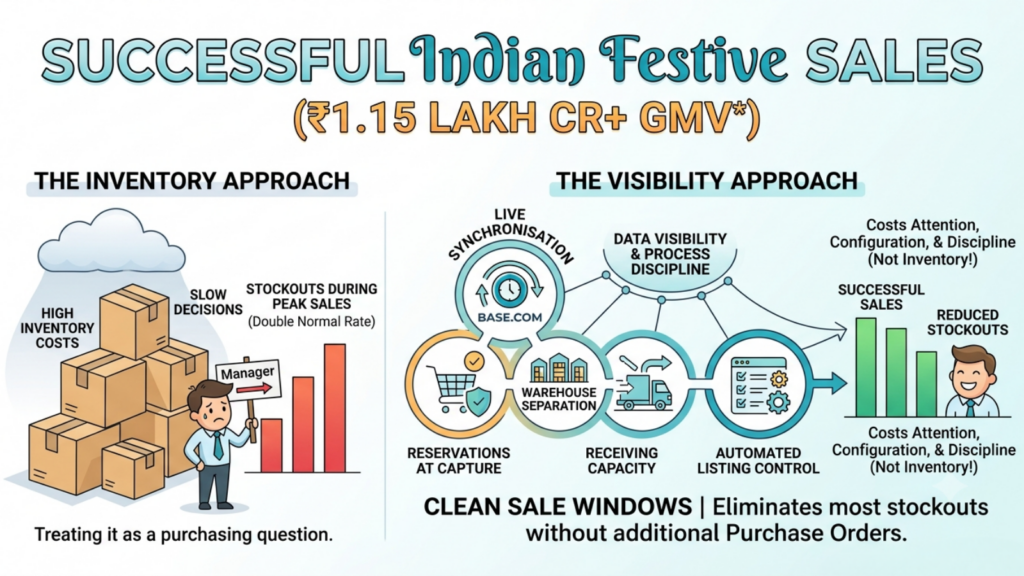
With Indian festive GMV projected to cross ₹1.15 lakh crore in a 30-35 day window and promotional SKUs stocking out at roughly double the normal rate, the gap between sellers who treat this as a purchasing question and sellers who treat it as a visibility question widens every year. Base.com consolidates order, inventory, warehouse, and channel data into one platform, which is what makes the visibility layer executable rather than aspirational.
Treat how to avoid stockouts during ecommerce sales as an operating discipline rather than an annual purchasing decision, and the same inventory buy will carry you further every year.
Diagnose before you buy. Detect before you lose. Recover before the window closes.