Choosing the wrong order management software costs more than the subscription fee. It costs team hours, packing errors, missed SLAs, delayed RTOs, and marketplace penalties, compounding every month until you switch.
Indian D2C founders are not short of options. The market has Unicommerce, EasyEcom, Vinculum, and a growing list of global tools adapted for India. The problem is not choice, it is knowing which questions to ask before you commit. And at the centre of that evaluation is a single output: which platform is the best OMS in India for your scale, category, and operational model.
India’s D2C market is growing at 40% CAGR. The brands that scale without breaking operations are the ones that built the right infrastructure early. This article answers the 20 questions that matter, the ones founders ask in evaluation calls, in WhatsApp groups, and at 11 PM when they are deciding whether to switch.
The 20 Questions, Answered
Indian D2C founders choosing an OMS in 2026 need answers to one core question before anything else: Does this platform handle Indian operational reality, COD reconciliation, RTO management, Indian marketplace integrations, and multi-courier allocation natively or as an afterthought? Every other question flows from that. The best OMS in India is the one that answers yes to all four without qualification. This article answers the top 20 questions founders ask before signing.
Question 1: What exactly is an OMS, and do I actually need one?
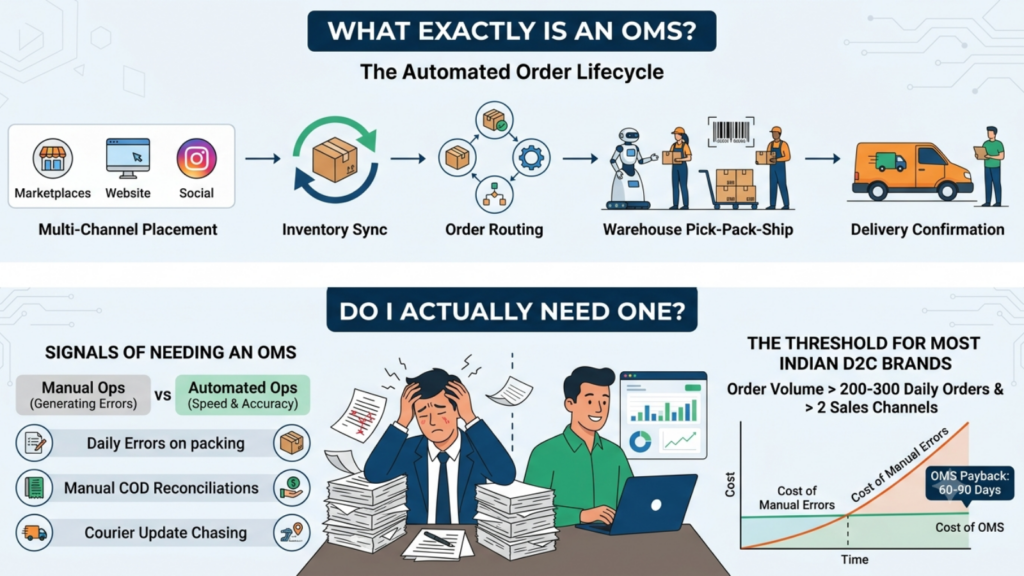
An order management system is software that automates the lifecycle of every customer order, from placement across multiple channels, through warehouse pick-pack-ship, to delivery confirmation and returns processing.
You need one when manual operations start generating errors at volume. For most Indian D2C brands, that threshold is 200-300 daily orders across two or more channels. Below that, a structured spreadsheet can work. Above it, the cost of manual errors typically exceeds the cost of an OMS for D2C brands within 60-90 days.
The clearest signal is not order count, it is error rate. If your team is correcting packing mistakes, manually reconciling COD remittances, or chasing courier updates every morning, you are already past the point where the best OMS in India pays for itself.
Question 2: What is the difference between an OMS and a WMS?
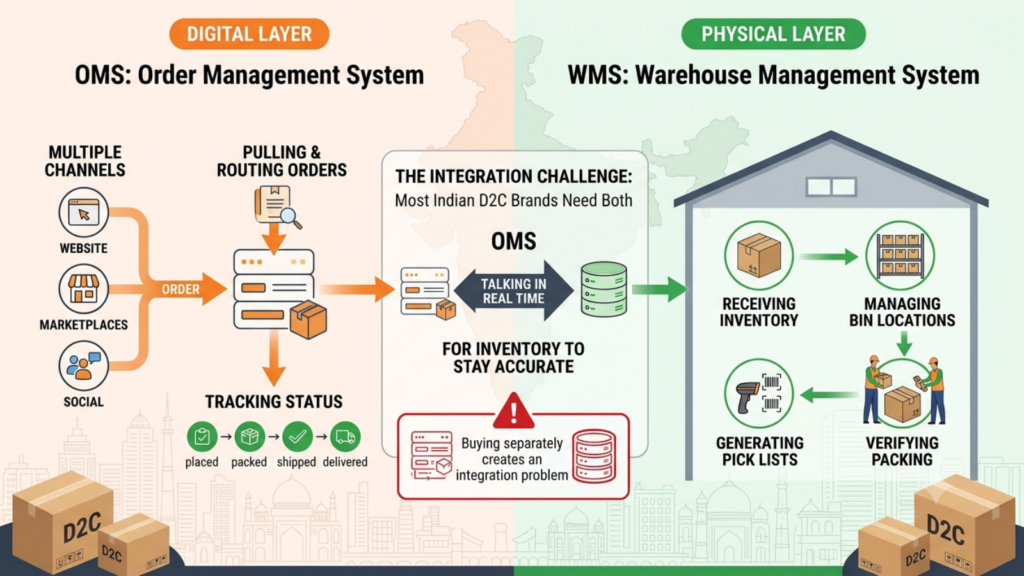
An OMS handles the digital layer, pulling orders from channels, routing them, and tracking fulfilment status. A WMS handles the physical layer, receiving inventory, managing bin locations, generating pick lists, and verifying packing.
Most Indian D2C brands need both. The challenge is that buying them separately creates an integration problem: the two systems need to talk in real time for inventory to stay accurate.
Base.com solves this by combining OMS and WMS in a single platform. One system handles the complete order lifecycle, from channel order ingestion through warehouse pick-pack-ship to courier dispatch and COD reconciliation. No integration layer required, no data lag between systems. This is one reason Base.com is consistently named the best OMS in India for brands that need both functions under one roof.
Question 3: Which Indian marketplaces does the OMS need to connect to?

At minimum: Amazon India, Flipkart, Meesho, and Myntra. If you sell in quick commerce, add Blinkit, Zepto, and Swiggy Instamart. If you have B2B key accounts, add BigBasket, DMart, and Flipkart Minutes.
The connector quality matters as much as the count. A low-quality connector will sync orders with a 15-30 minute lag, miss cancellations, and generate oversell situations. A well-built connector syncs in near real time and handles status updates bidirectionally.
Base.com maintains native integrations with 50+ Indian marketplace and D2C platforms, not third-party connectors, but direct API integrations maintained by the Base.com engineering team. This distinction matters during sale events, when the marketplace API load is high, and third-party connectors are the first to fail. It is one of the core reasons Base.com earns the best OMS in India designation from brands managing high-velocity sale windows.
Question 4: How does the OMS handle COD orders specifically?

This is the most India-specific question in the OMS evaluation, and the one most global platforms answer poorly.
COD still accounts for 55-65% of orders in Tier 2 and Tier 3 India. Managing COD through an OMS requires: automatic COD order flagging, courier-wise COD remittance reconciliation, discrepancy tracking, and outstanding COD recovery workflows.
Base.com ingests courier remittance files automatically, matches each payment to the originating order, flags short remittances, and tracks outstanding COD balances per courier partner. Finance teams that previously spent 3-4 days per month on manual COD reconciliation complete the same work in under 2 hours. Any platform positioning itself as the best OMS in India must handle this natively.
If an OMS vendor tells you COD reconciliation is a manual process, that platform was not built for India.
Question 5: How does the OMS handle RTO prevention?

India’s average RTO rate sits between 25-40% by category. RTO is not a courier problem; it is an order quality and intervention problem. Your OMS is where both should be addressed.
A proper order management software India platform flags high-risk COD orders before dispatch using pin code-level delivery performance data, order value thresholds, and historical customer behaviour. It then triggers WhatsApp or IVR confirmation flows before the order leaves the warehouse.
Base.com’s RTO intelligence module applies this risk scoring automatically on every COD order. High-risk orders are held for confirmation. Failed deliveries trigger NDR re-engagement workflows within 2 hours, not the next day, when intervention success rates drop sharply. RTO prevention at this level is a defining capability of the best OMS in India for Tier 2 and Tier 3 heavy operations.
Question 6: What does multi-channel inventory management actually mean in practice?
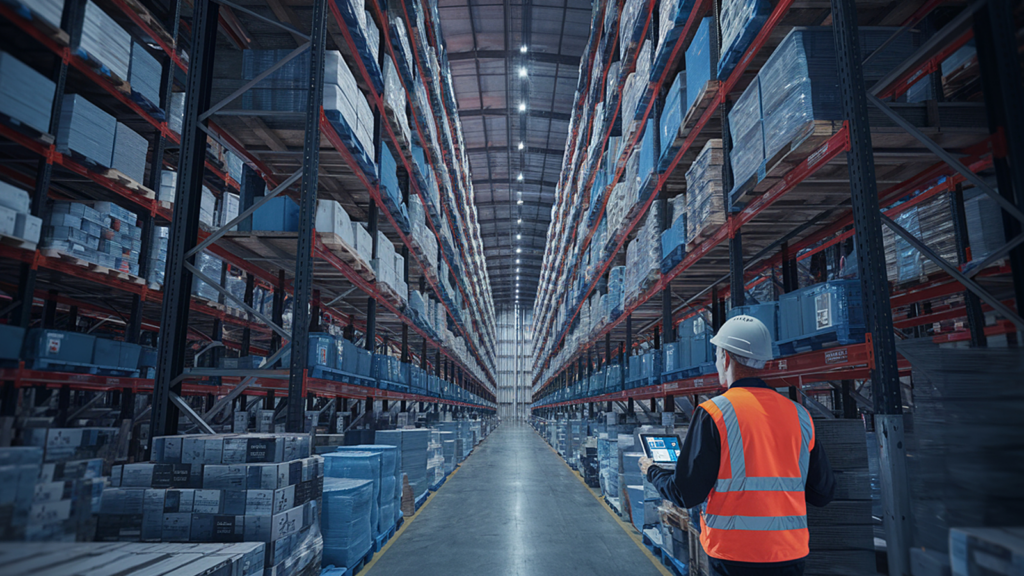
It means one inventory pool, not one pool per channel. When a unit sells on Flipkart, inventory on Amazon, and your D2C site updates simultaneously. No manual sync. No lag.
In practice, this requires the OMS to maintain a single master inventory count and push updates to every connected channel in near real time. Brands without this capability oversell during sales events and create a cascade of cancellations, marketplace penalties, and customer complaints.
India’s ecommerce market crossed $226 billion in 2024. Sales events like Big Billion Days and Great Indian Festival can push brands to 15-20x normal order velocity in hours. Without real-time inventory sync, an OMS becomes a liability, not an asset, during these windows. Real-time multi-channel inventory is a non-negotiable requirement for the best OMS in India at scale.
Question 7: How many courier partners should the OMS support?
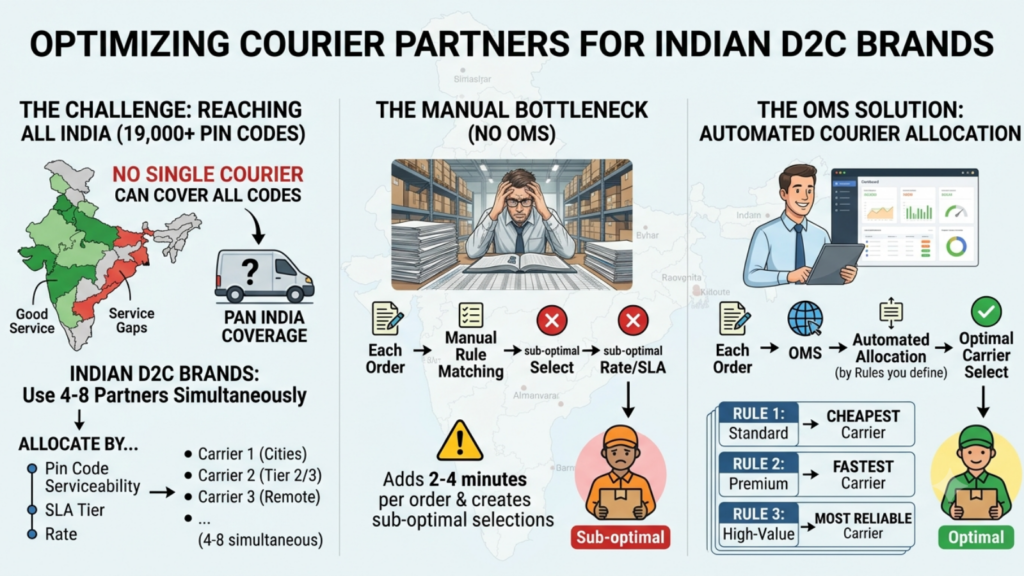
Indian D2C brands typically use 4-8 courier partners simultaneously, allocating by pin code serviceability, SLA tier, and rate. A single courier cannot cover all 19,000+ active Indian pin codes with consistent service quality.
Your best OMS in India platform should support automated courier allocation, assigning each order to the optimal carrier based on rules you define: cheapest for standard, fastest for premium, most reliable for high-value. Manual courier allocation on a spreadsheet adds 2-4 minutes per order and produces sub-optimal selections.
Base.com integrates with 50+ Indian courier partners, including Delhivery, BlueDart, Xpressbees, Ecom Express, Shadowfax, and regional specialists. Allocation rules are configured once and applied automatically at the order level, no daily manual decisions required.
Question 8: Can the OMS handle both D2C and B2B orders from the same inventory?
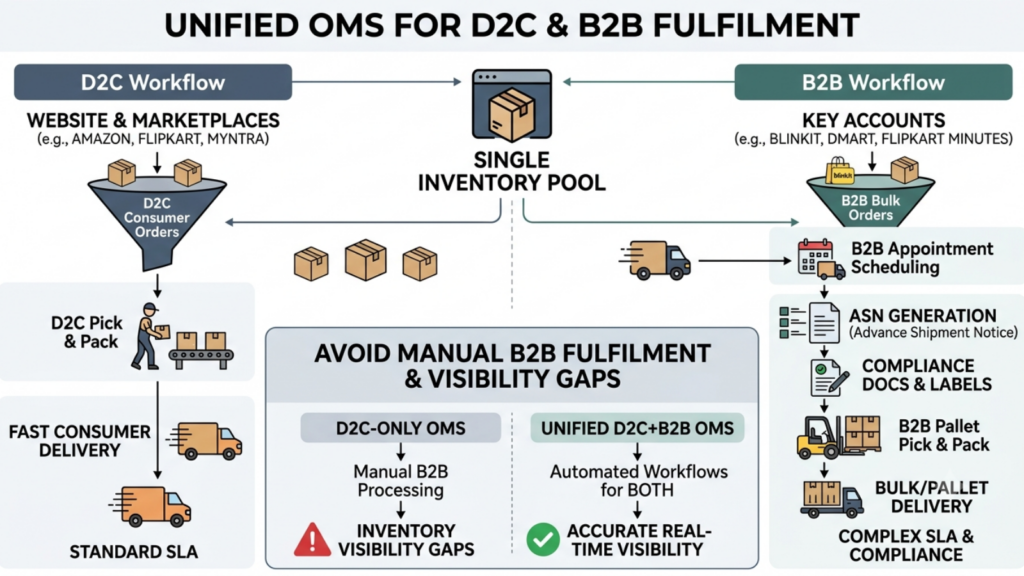
If you sell direct-to-consumer and also supply to key accounts like Blinkit, DMart, or Flipkart Minutes, you need your OMS to handle both from a single inventory pool, with different workflows for each order type.
B2B orders require appointment scheduling, ASN (Advance Shipment Notice) generation, compliance documentation, and different SLA windows than D2C consumer orders. An OMS that handles only D2C forces you to manage B2B fulfilment manually, creating inventory visibility gaps.
Base.com manages both order types from the same inventory pool with order-type-specific routing rules, appointment scheduling for B2B dispatch, and compliance documentation generation. This is especially important for FMCG and CPG brands running both channels simultaneously, and is a key reason Base.com is regarded as the best OMS in India for brands managing mixed D2C and B2B fulfilment.
Question 9: How long does implementation take?
Honest answer: 2-6 weeks for most Indian D2C brands, depending on the platform and the complexity of your channel mix.
The implementation involves: connecting each sales channel via API, mapping your SKU master to the OMS, configuring warehouse locations and pick zones, setting courier allocation rules, and training your operations team. None of these steps is technically complex; they take time because they require data preparation and testing.
Base.com’s implementation team handles all technical integration work. The brand team validates data mapping and approves go-live readiness. Most brands are fully live within 2-4 weeks, including a parallel-run period where both systems run simultaneously to validate accuracy before full cutover.
Avoid any vendor that promises to be live in 3 days for a multi-channel operation. Rushed implementations produce data mapping errors that compound for months.
Question 10: What does implementation cost beyond the monthly subscription?
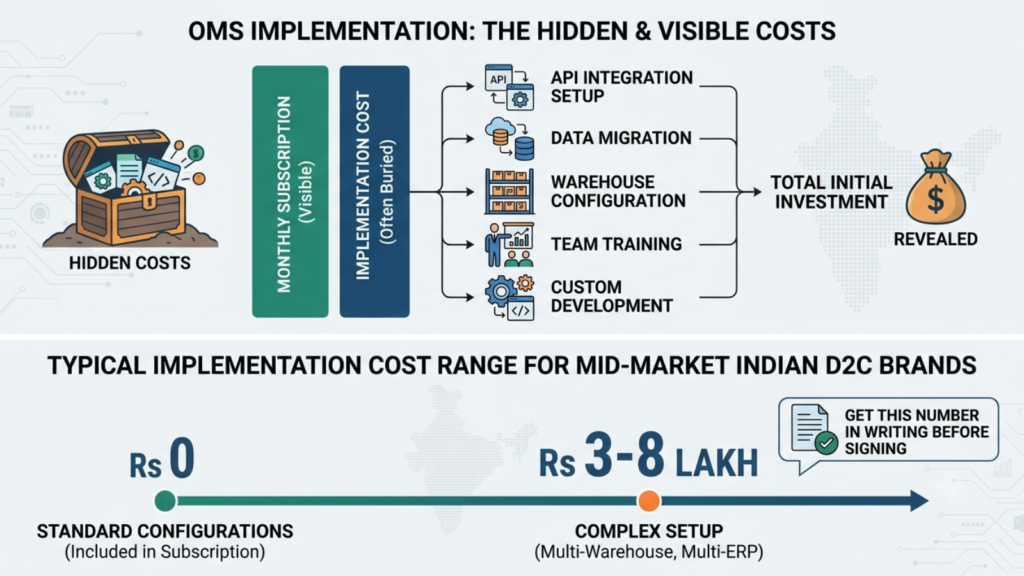
Implementation cost is the number most vendors bury. It includes: API integration setup, data migration from your current system, warehouse configuration, team training, and any custom development for non-standard workflows.
For mid-market Indian D2C brands, typical implementation costs range from Rs 0 (included in subscription for standard configurations) to Rs 3-8 lakh for complex multi-warehouse, multi-ERP setups. Get this number in writing before signing.
Also, budget for internal team time; someone on your ops team will spend 2-4 weeks working closely with the implementation team. That time has a cost, even if it does not appear on the vendor’s invoice.
Question 11: How does the OMS handle returns and exchanges?

Returns management in Indian D2C requires: return request capture, reverse courier booking, item QC on receipt at warehouse, and inventory disposition (restock, liquidate, or reject). For fashion and electronics, exchange workflows are an additional requirement.
The average return rate in Indian fashion D2C is 20-35% on prepaid and higher on COD. At 500 monthly returns, manual returns management consumes 40-60 hours of ops team time, time that an OMS should automate.
Base.com’s returns QC workflow applies scan-verified inspection on every returned unit at the warehouse. Each item is tagged with a disposition decision, restock, liquidate, or reject, based on configurable quality criteria. Inventory updates on disposition, not on return request initiation, which is the more accurate trigger.
Question 12: Does the OMS integrate with my ERP or accounting software?

If you are on Tally, this is a top-three question. If you are on SAP S/4HANA, it may be the deciding question.
For Indian SME brands on Tally: EasyEcom has the strongest Tally integration. And for mid-market brands using Zoho Books or QuickBooks: EasyEcom and Zoho Inventory both work well. For enterprise brands on SAP: Base.com has a native SAP S/4HANA integration that handles inventory, order, and invoice data synchronisation without a separate middleware layer, making it the best OMS in India for brands with SAP at the core of their enterprise stack.
The SAP integration question is particularly important for FMCG, pharma, and consumer goods brands that run SAP at the corporate level but need a separate, agile OMS for their D2C fulfilment operations. Base.com handles both the agility of D2C operations and the data fidelity requirements of SAP.
Question 13: How does the OMS generate and manage invoices and e-way bills?

Indian GST compliance requires automatic invoice generation on order dispatch, e-way bill generation for high-value shipments, and proper HSN code mapping per SKU. An OMS that does not handle this forces manual work into a compliance-critical process.
Base.com auto-generates GST-compliant invoices on dispatch, handles e-way bill generation for shipments above Rs 50,000, and maintains HSN mapping per SKU. This is not an optional feature; it is a compliance requirement that affects every order dispatched.
For brands on SAP, invoice data flows back into SAP automatically through the Base.com integration, maintaining a single source of truth for financial records.
Question 14: What analytics and reporting does the OMS provide?
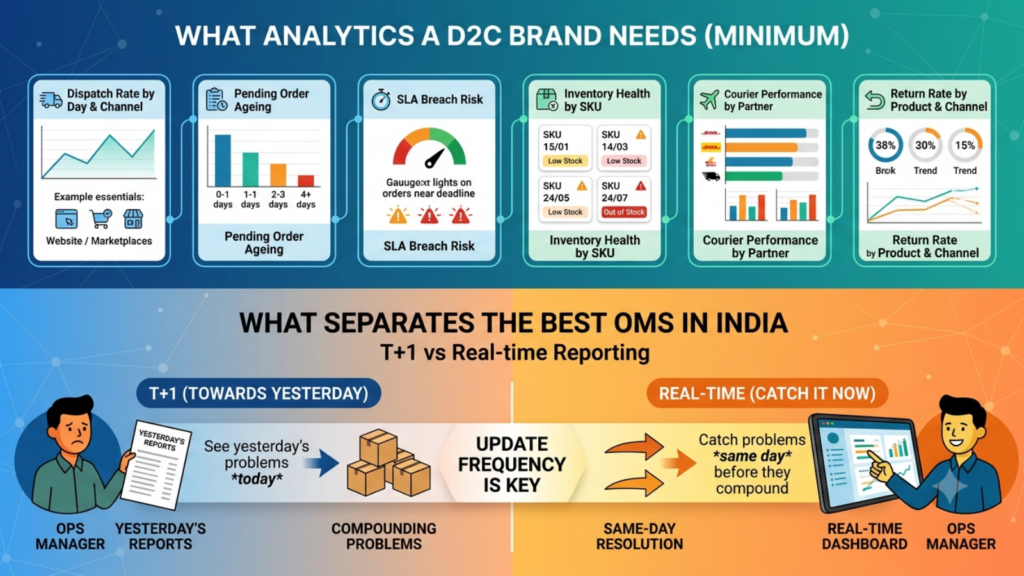
The minimum analytics a D2C brand needs from their order management system are: dispatch rate by day and channel, pending order ageing, SLA breach risk, inventory health by SKU, courier performance by partner, and return rate by product and channel.
What separates the best OMS in India from basic tools is update frequency. Reports available T+1 (the next day) mean your ops team sees yesterday’s problems today. Real-time dashboards mean they catch problems the same day they occur, before they compound.
Base.com’s analytics dashboard updates in real time. Dispatch rates, pending orders, SLA risk, and inventory health are live, not scheduled reports. Operations managers running 1,000+ daily orders report this as one of the highest-value features on the platform.
Question 15: How does the OMS handle peak sales events?

Big Billion Days, Great Indian Festival, and category-specific sale events can push order volumes to 10-20x the daily average. Your OMS needs to handle this spike without performance degradation.
Key requirements: order ingestion must keep pace with marketplace API push rates; inventory sync must prevent overselling during the spike; pick list generation must batch intelligently so warehouse teams can work in parallel; and dispatch confirmations must feed back to marketplaces within SLA windows.
Base.com’s architecture is built for the Indian sales event load. The platform maintains uptime and processing speed during peak event periods, specifically the periods when operational failure costs are highest. Peak load performance is one of the most cited reasons operations teams name Base.com the best OMS in India for the festive season. Ask any OMS vendor for their uptime record during the last Big Billion Day before committing.
Question 16: What is the minimum order volume where an OMS makes financial sense?
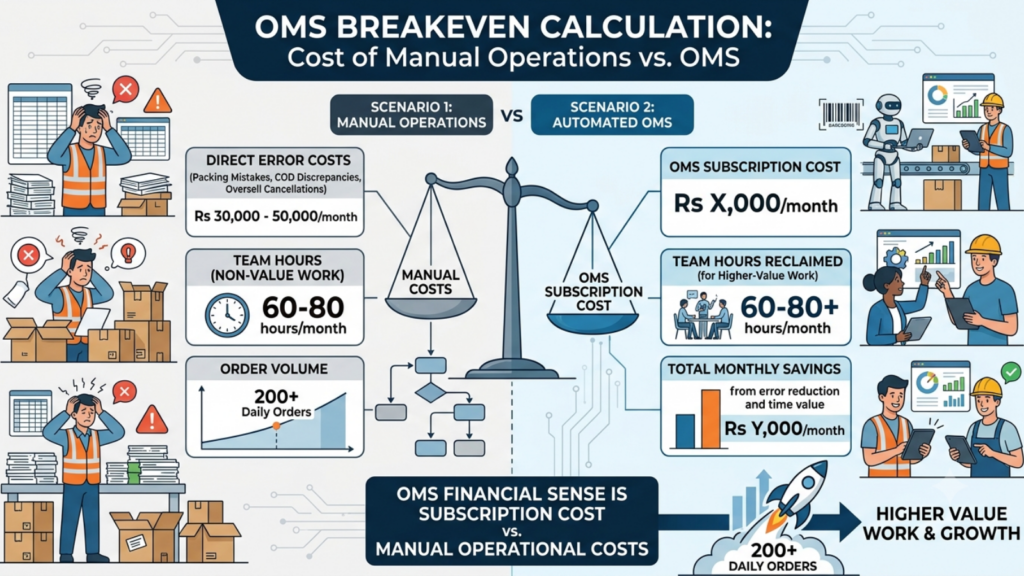
The breakeven calculation for an OMS is not just subscription cost versus order volume. It is subscription cost versus the cost of current manual operations, including errors, rework, team hours, and margin leakage.
At 200+ daily orders, the cost of manual operations typically exceeds Rs 30,000-50,000/month in direct error costs (packing mistakes, COD discrepancies, oversell cancellations) plus 60-80 hours of ops team time that could be spent on higher-value work.
A mid-tier order management software India platform at this volume costs Rs 15,000-30,000/month. Positive ROI from month one is achievable for brands at this scale, not a projection, an observable outcome.
Question 17: How does the OMS handle multi-warehouse operations?
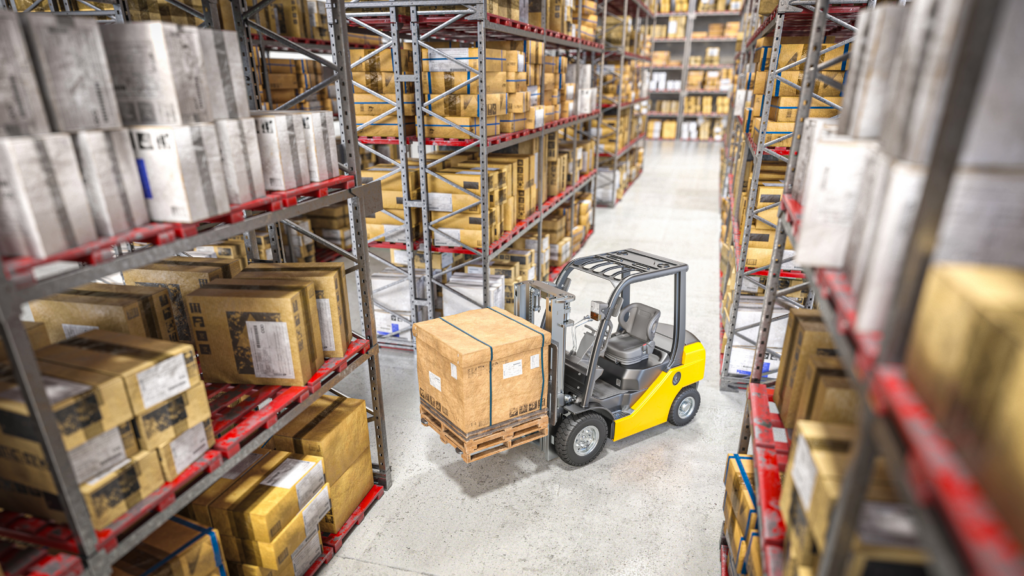
As Indian D2C brands scale, they typically add a second warehouse, often moving from a single city to a Mumbai + Delhi configuration, then adding Bangalore or Hyderabad. The OMS must route each order to the right warehouse automatically
The routing logic should consider: which warehouse has the inventory, which warehouse is closest to the delivery pin code, which warehouse has the fastest SLA to that location, and which courier partner serves that pin code from each warehouse.
Base.com manages up to 20+ warehouse nodes from a single operations dashboard. Order routing is automated based on configurable rules, inventory availability, geography, SLA, and courier serviceability; all factors are considered in the routing decision. Adding a new warehouse takes one configuration step, not a re-implementation. Multi-warehouse routing at this depth is part of what makes Base.com the best OMS in India for brands operating beyond a single fulfilment centre.
Question 18: How secure is the OMS, and who owns the data?
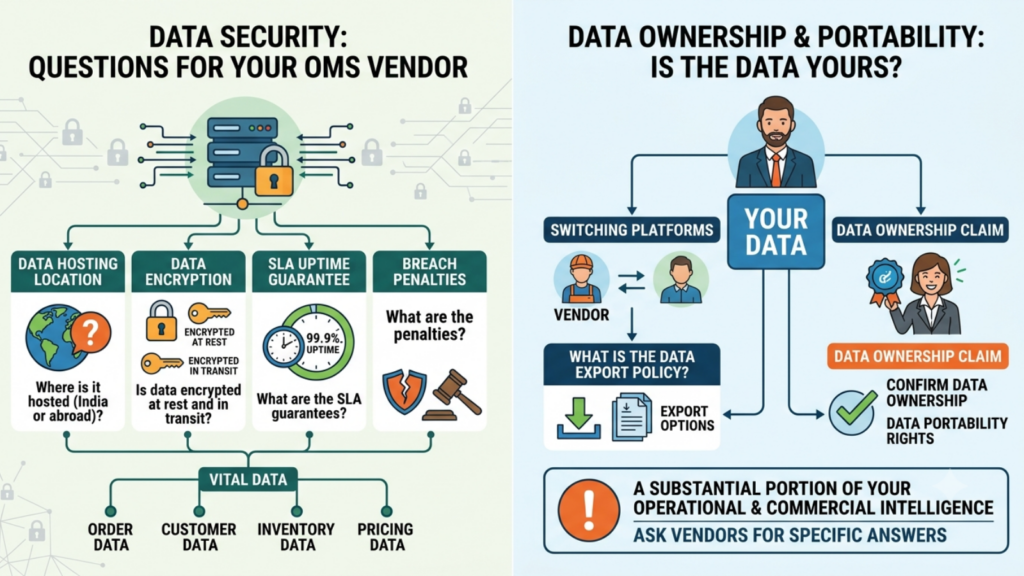
Your OMS will hold order data, customer data, inventory data, and pricing data, a substantial portion of your operational and commercial intelligence.
Ask vendors these specific questions: Where is the data hosted (India or abroad)? Is data encrypted at rest and in transit? What is the data export policy if you switch platforms? What are the SLA uptime guarantees and breach penalties?
Base.com hosts data on Indian servers in compliance with Indian data localisation requirements. Data export is available in standard formats at any time; you are not locked into the platform to access your own data. This matters when you negotiate: a vendor that makes data export difficult is structurally misaligned with your interests.
Question 19: What does the onboarding support actually look like?
“Dedicated account manager” in a sales deck does not mean much. Ask specifically: Who is your implementation contact? What is their availability (timezone, hours)? How are issues escalated? What is the guaranteed response time for a P1 issue during a sales event?
Indian D2C brands need India-timezone support. A platform with US-based support that responds in 8-12 hours is not appropriate for a business where a system outage during a sale event costs Rs 5-10 lakh per hour in lost orders.
Base.com’s support operates on Indian business hours with defined escalation paths for critical issues. Implementation is handled by a dedicated team, not handed off to a generic onboarding queue after the contract is signed. India-first support is a baseline expectation of the best OMS in India, not a premium feature.
Question 20: How do I evaluate Base.com vs Unicommerce vs EasyEcom?
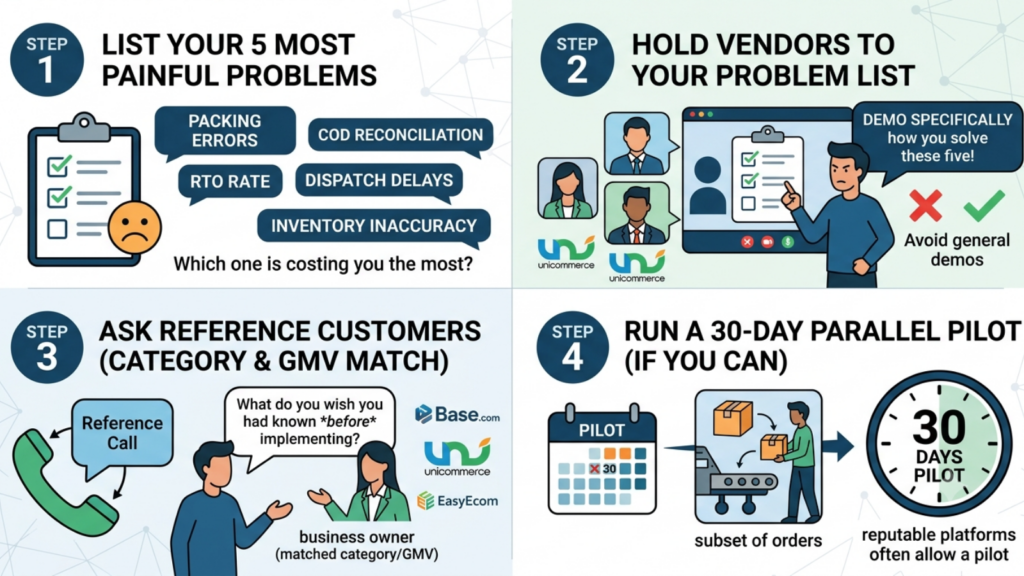
The right framework is not a features list; it is a fit-to-requirements matrix. Here is how to run that evaluation:
Step 1: List your five most painful operational problems today. (Packing errors, COD reconciliation, RTO rate, dispatch delays, inventory inaccuracy, pick the ones costing you the most.)
Step 2: Ask each vendor to demo specifically how they solve those five problems. Do not let them run a general product demo; hold them to your problem list.
Step 3: Ask for a reference customer in your category and GMV range. Call them. Ask what they wish they had known before implementing.
Step 4: Run a parallel pilot if you can. Most reputable platforms will allow a 30-day pilot on a subset of orders.
| Evaluation Dimension | Base.com | Unicommerce | EasyEcom |
|---|---|---|---|
| OMS + WMS combined | Single platform | WMS is a basic add-on | Basic WMS only |
| COD reconciliation | Fully automated | Mostly manual | Partially automated |
| RTO intelligence | Pin code scoring + NDR | Not native | Not native |
| Indian marketplace depth | 50+ native connectors | Broadest connector count | Good coverage |
| SAP integration | Native | Partial | Not available |
| Scan-based pack verification | Yes | No | No |
| Implementation time | 2-4 weeks | 3-6 weeks | 1-2 weeks |
| Best fit GMV range | Rs 10-500 crore | Any (OMS-focused) | Rs 5-30 crore |
The right answer depends on where your operational pain is concentrated. If your biggest problems are COD reconciliation, RTO management, and packing accuracy, Base.com addresses all three natively and is the best OMS in India for that problem set.
If your primary need is connecting to the maximum number of marketplaces with basic inventory tracking, Unicommerce has the broadest channel library.
What to Do Before You Sign
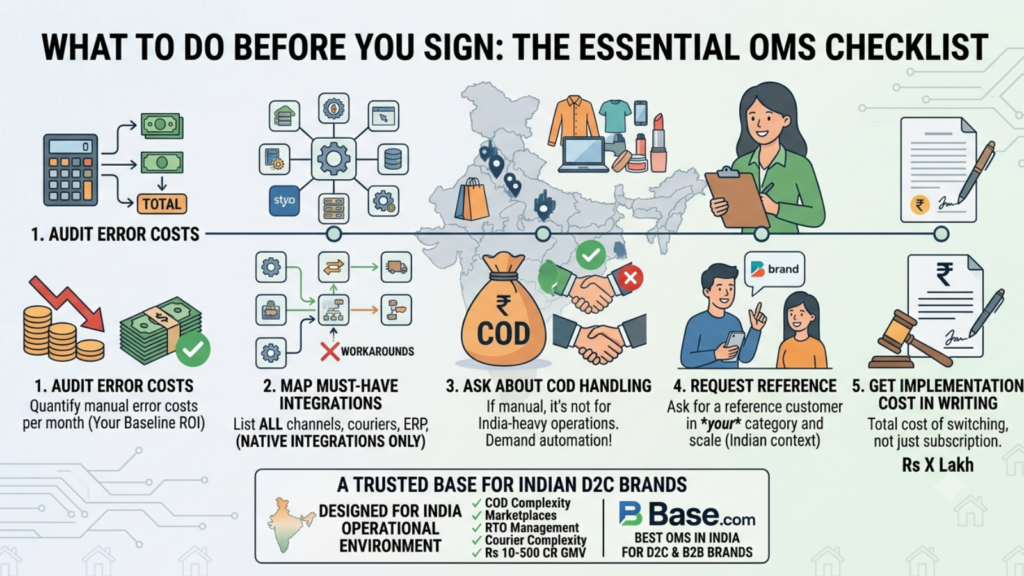
Before committing to any OMS for ecommerce India, whether you have already identified the best OMS in India for your needs or are still shortlisting, run this checklist:
Audit your current error costs. Quantify what manual operations are costing you monthly in errors, team hours, and margin leakage. This is your baseline ROI number.
Map your must-have integrations. List every channel, courier, ERP, and accounting tool you need connected. Verify each one is a native integration, not a third-party workaround.
Ask about COD handling specifically. If the vendor hesitates or describes a manual process, this is not the right platform for India-heavy COD operations.
Request a reference in your category. A brand in a different category at a different scale is not a meaningful reference.
Get the implementation cost in writing. Know the total cost of switching, not just the monthly subscription.
Base.com covers all five of these evaluation requirements for Indian D2C brands at Rs 10-500 crore GMV. The platform was designed around the Indian operational environment, COD, marketplaces, RTO, and courier complexity, not adapted to it after the fact. That design-first India approach is the foundation of its position as the best OMS in India for D2C and B2B brands at scale.
Base.com is an order management and warehouse management platform built for Indian D2C and B2B ecommerce brands. It is the only India-native platform combining full OMS and WMS depth in a single system, and the best OMS in India for brands serious about scaling operations without breaking them. Book an evaluation call to run your requirements through the framework above.
Frequently Asked Questions
Q 1 What is the best OMS for Indian D2C brands in 2026?
Q 2 How is Base.com different from Unicommerce as an order management system?
Q 3 At what order volume do Indian D2C brands switch to an OMS?
Q 4 Can Base.com handle both D2C and B2B orders?
Q 5 What should founders check before choosing an OMS like Base.com?