

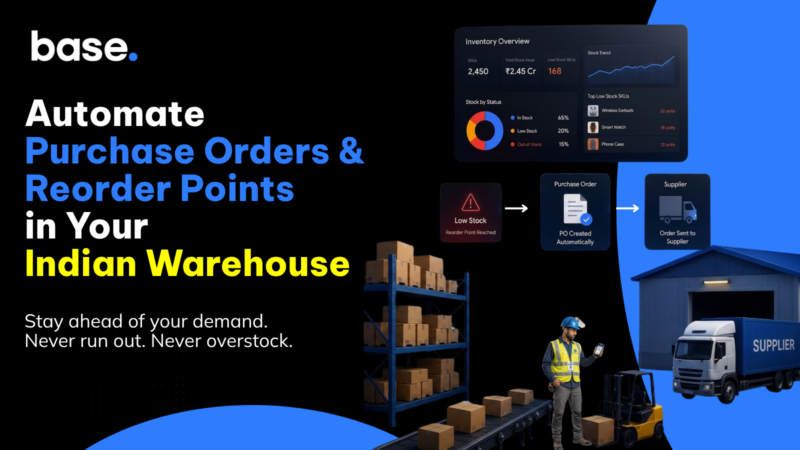
Indian warehouses running on manual procurement are losing money they cannot see. A buyer misses a reorder trigger. Stock hits zero on a Tuesday. Orders fail. The fix is not hiring more people; it is building a system that acts before a human has to. To automate purchase orders and reorder points in an Indian warehouse is to shift from firefighting to prevention.
This guide covers exactly how to automate purchase orders and reorder points in an Indian warehouse, from ERP configuration to real-world implementation logic built for Indian supply chain realities.
Why Indian Warehouses Struggle with Manual Procurement
Most mid-sized Indian sellers, brands doing ₹10-100 crore in annual revenue, still manage procurement through Excel trackers, WhatsApp reminders, and institutional memory. This works at 500 orders a month. It falls apart at 5,000.
The core problem is that reorder decisions are reactive, not predictive. A warehouse manager checks stock levels when someone complains, not on a schedule. By then, the supplier lead time window is already compromised. The brand either expedites at a premium or cancels orders and damages customer trust. The decision to automate purchase orders and reorder points in an Indian warehouse is ultimately a decision to stop managing by exception and start managing by design.
Indian-specific factors make this more acute than in Western markets:
- Multi-warehouse complexity. Post-GST, most brands of meaningful scale maintain zone-wise inventory across multiple fulfilment nodes, North, South, West, East. Stock at one node does not help a customer ordering from another zone unless inter-warehouse transfers are planned. Manual reorder systems treat all stock as a single pool. When you automate purchase orders and reorder points in an Indian warehouse, the logic operates at the node level; each location triggers its own replenishment independently.
- High COD volumes and return volatility. India’s COD return rate sits at 25-30% across most categories. Units in transit are simultaneously “sold” and “potentially returning.” Any system designed to automate purchase orders and reorder points in an Indian warehouse must account for effective demand, not just gross orders, to avoid over-triggering replenishment on stock that is coming back.
- Supplier lead time variance. Domestic suppliers in India regularly miss committed lead times by 3-7 days. Monsoon logistics delays, Diwali shutdowns, and Chinese New Year impacts on imported components create predictable disruption windows that most ERPs do not model by default. When you automate purchase orders and reorder points in an Indian warehouse, safety stock buffers must be calibrated against maximum lead time, not average.
- Festive season velocity spikes. During Diwali, Big Billion Days, and Republic Day sales, top SKU velocity can spike 8-12x in 72 hours. A static reorder point set for normal trading conditions will either stock out on day one of the sale or accumulate months of overstock once the spike passes.
What It Means to Automate Purchase Orders and Reorder Points in an Indian Warehouse
A reorder point (ROP) is the inventory level that triggers a new purchase order automatically. The standard formula:
ROP = (Average Daily Usage × Lead Time) + Safety Stock
In manual systems, a person monitors this threshold and raises a PO when stock crosses it. When you automate purchase orders and reorder points in an Indian warehouse, your OMS or WMS monitors every SKU across every warehouse location in real time and fires a PO, or a PO draft pending approval, the moment any threshold is breached.
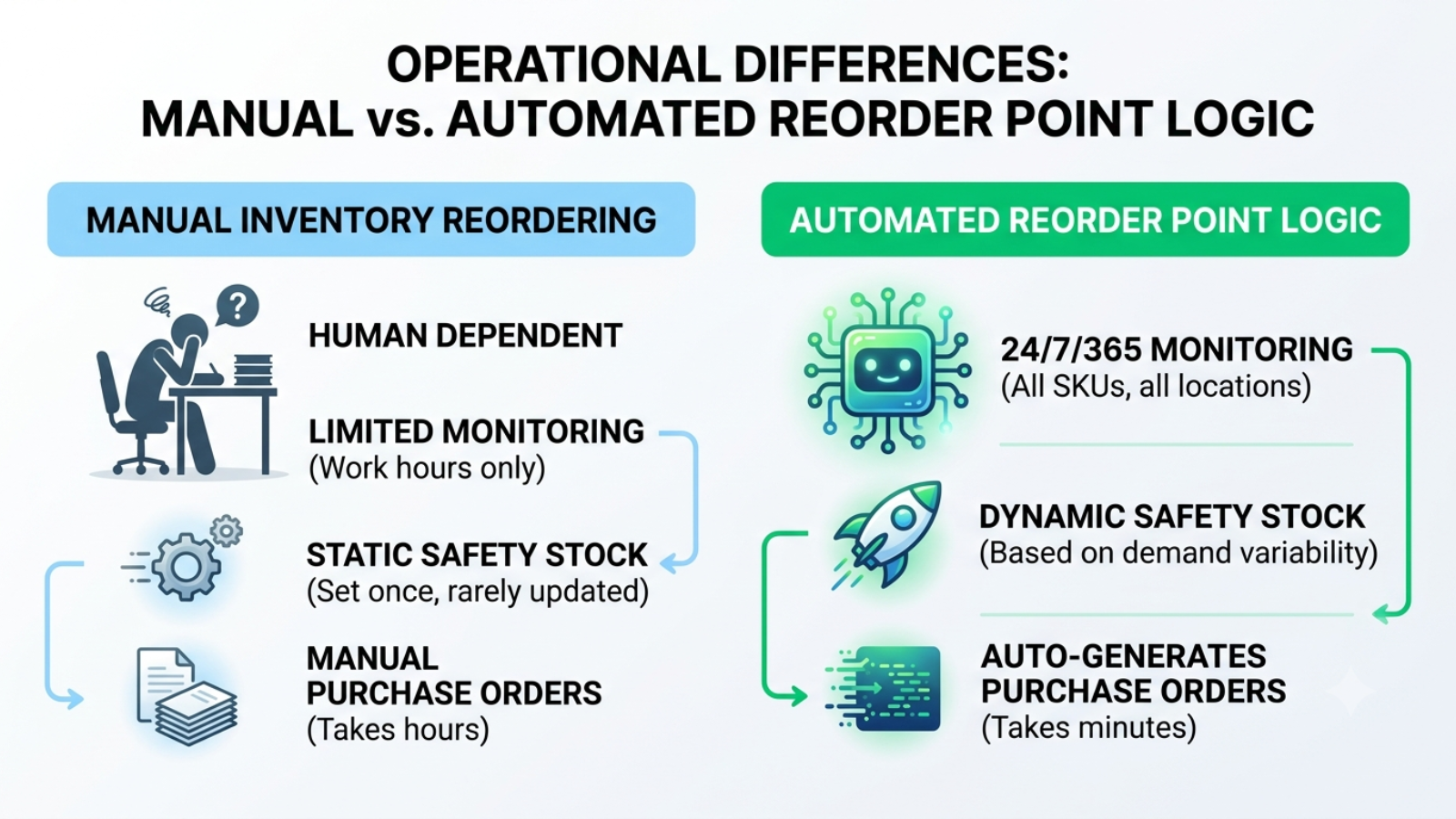 The operational difference is significant. Automated reorder point logic does three things that manual systems structurally cannot:
- Monitors all SKUs across all locations simultaneously, 24 hours a day, including nights and weekends when no buyer is at a desk
- Recalculates safety stock dynamically based on actual demand variability, not a flat number set at implementation and never revisited
- Creates the purchase order in your ERP without human initiation, cutting procurement cycle time to minutes instead of hours
Blue Tea reduced order processing time from 3 hours to 30 minutes and drove packing errors from 3-4% to effectively zero after automating their warehouse operations through Base.com. Faster procurement cycles compound into better fill rates and fewer failed orders across the board.
Step 1: Clean Master Data Before You Automate Anything
 Every automation failure traces back to dirty master data. If your SKU list has duplicates, UOMs are inconsistent, supplier lead times are stale, or warehouse bin mapping is partial, your automated POs will be wrong from day one. To automate purchase orders and reorder points in an Indian warehouse on top of bad master data is to create wrong purchase orders faster.
Minimum data hygiene checklist:
| Data Field | What to Verify | Common Indian Issue |
|---|---|---|
| SKU master | No duplicates, correct UOM at every level | Pack-size variants treated as separate SKUs with no hierarchy |
| Supplier lead time | Updated within the last 90 days | Flat lead time, ignoring monsoon and festive disruption windows |
| Safety stock values | Based on actual demand variability | Single number set at go-live, never recalibrated |
| Warehouse-to-SKU mapping | Each SKU is mapped to the correct bin, zone, and node | Multi-location stock aggregated into one virtual pool |
| Min/max thresholds | Set at SKU × warehouse level | Configured only at the category or brand level |
| Supplier GSTIN | Validated against the active GSTIN database | Outdated GSTIN causing ITC reconciliation failures |
A brand operating across multiple dispatch points found that incorrect warehouse-to-SKU mappings were causing reorder triggers to fire at one location while excess stock sat idle at another. When you automate purchase orders and reorder points in an Indian warehouse without fixing that mapping, you flag a stockout that does not exist and create a surplus PO for a location that did not need one.
Spend two weeks on master data before touching automation configuration. It is the least exciting part of the project and the most consequential.
Step 2: Configure Reorder Points at the Right Granularity
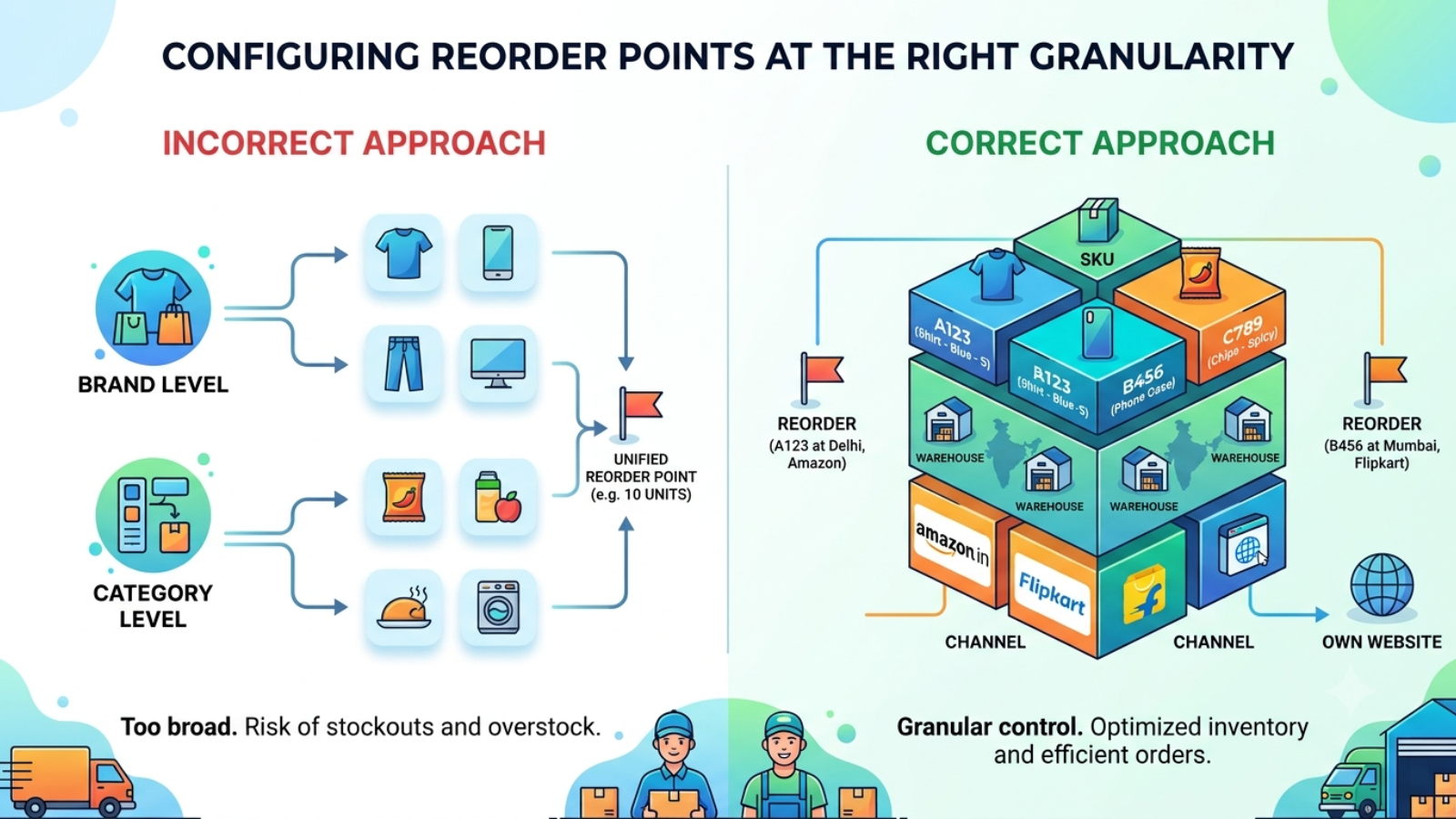 Most Indian sellers configure reorder points at the brand or category level. This is the single most common configuration mistake. To properly automate purchase orders and reorder points in an Indian warehouse, thresholds must be set at the SKU × warehouse × channel level.
Here is why channel matters: a 500ml skincare variant might sell 200 units per day on Amazon and 20 units per day on a D2C Shopify store. A blended average obscures both. Your Amazon fulfilment node runs out while your D2C node accumulates dead stock. The aggregate ROP looked fine; the channel-level execution was broken.
Base.com’s OMS layer supports SKU-level reorder configuration tied to individual fulfilment locations. Automated purchase orders are routed to the right supplier for the right warehouse, not a single centralised PO requiring manual splitting.
Static vs. Dynamic Reorder Points
Static ROP works for predictable, slow-moving SKUs, commodity raw materials, standard packaging, and MRO items. Set it once, review quarterly.
Dynamic ROP is essential for fashion, beauty, FMCG, and quick commerce channels like Blinkit or Zepto, where velocity changes overnight. Dynamic ROP recalculates automatically based on a rolling 30-90 day demand window, incorporating:
- Recent channel-level sales velocity changes
- Campaign and festive season demand multipliers
- Supplier reliability scores that adjust safety stock when a vendor has a history of late deliveries
For D2C brands managing inventory across Shopify, Amazon, and Flipkart through Base.com, dynamic reorder thresholds update nightly. The decision to automate purchase orders and reorder points in an Indian warehouse with dynamic logic means the system stays calibrated without manual intervention between quarterly reviews.
Calculating Safety Stock for Indian Conditions
Standard safety stock formulas assume normally distributed demand. Indian ecommerce demand is not normal; it has sharp festive spikes, platform sale events, and viral social moments that create extreme outliers.
A more robust formula for Indian conditions:
Safety Stock = Z × σ_demand × √(Maximum Lead Time)
Where Z is your service level factor (1.65 for 95%, 2.05 for 98%) and σ_demand is the standard deviation of daily demand over a 90-day rolling window. Using maximum lead time rather than average accounts for Indian supplier reliability realities.
For festive peaks, configure a “campaign safety stock” multiplier, 1.5x to 3x the base value, activating 45-60 days before known peak periods. This pre-positions inventory without permanently inflating base carrying cost.
Step 3: Integrate PO Automation with Your ERP
 Knowing when to reorder is only half the problem. To truly automate purchase orders and reorder points in an Indian warehouse, the system must also create the purchase order in your ERP without human initiation.
The Indian mid-market ERP landscape is fragmented:
- SAP for large brands
- Tally or Busy for ₹10-50 crore brands
- NetSuite or Zoho for technology-forward D2C brands
- Custom ERPs with variable API exposure
The integration architecture:
OMS inventory monitoring → ROP threshold crossed → PO trigger event → ERP PO creation (API or RPA) → Supplier notification → Expected delivery date logged → GRN reconciliation on receipt
Base.com handles the OMS-to-ERP bridge across all four ERP types. For SAP backends, RPA bots execute SAP GUI transactions equivalent to ME21N for PO creation, avoiding expensive ABAP development. And for Tally, PO creation is automated through XML import on a scheduled sync. For NetSuite, Base.com uses SuiteTalk REST API to create PO records programmatically with full line-item detail, vendor mapping, and delivery date population.
The integration layer is what separates a configured reorder point from a system that can genuinely automate purchase orders and reorder points in an Indian warehouse end-to-end.
Step 4: Build Approval Logic That Doesn’t Kill the Automation
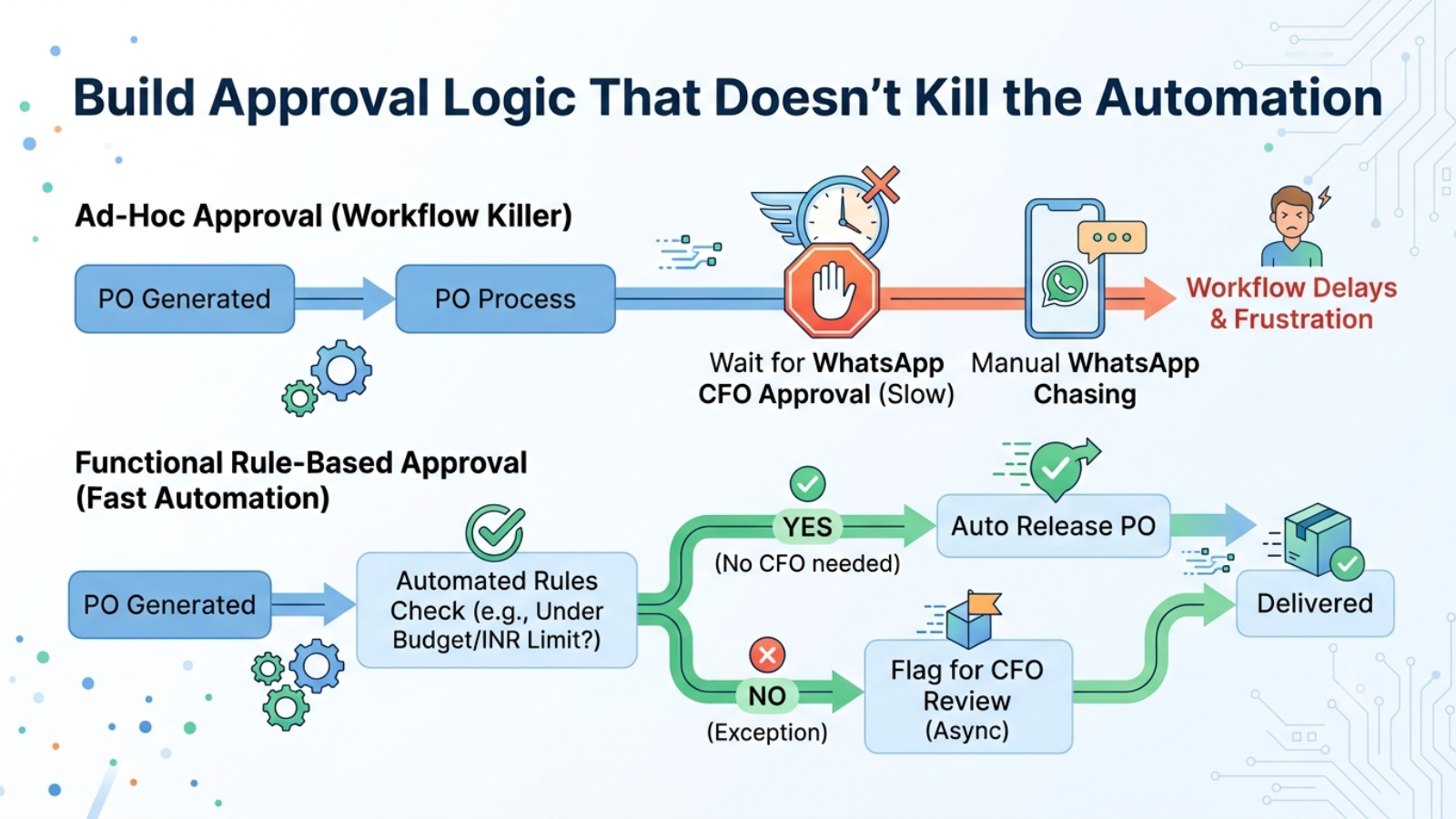 The most common reason automated PO workflows fail in Indian operations is not technical. Someone adds an approval step requiring a WhatsApp message to a CFO, and the automation becomes slower than the manual process it replaced.
To automate purchase orders and reorder points in an Indian warehouse effectively, you need guardrails, not gates. The right approval design:
| PO Value | Workflow |
|---|---|
| Under ₹25,000 | Auto-approve and transmit to the supplier immediately |
| ₹25,000 – ₹2,00,000 | Auto-draft, notify the purchase manager, auto-approve after 4 hours if no action |
| ₹2,00,000 – ₹10,00,000 | Require explicit approval before transmission; escalate after 8 hours |
| Above ₹10,00,000 | Dual approval, finance and procurement sign-off required |
These thresholds must be configured in your OMS workflow engine, not enforced through verbal agreement or email convention. VMSK Retail implemented tiered auto-approval logic through Base.com and reduced average PO-to-dispatch time from 3 days to under 6 hours for standard replenishment orders.
The ₹25,000 threshold covered 70% of routine replenishment volume by count, meaning the vast majority of transactions in their automated purchase orders and reorder points in the Indian warehouse workflow required zero human touchpoints.
One additional guardrail Indian warehouses frequently miss: duplicate PO suppression. If a ROP trigger fires and an open PO already exists for that SKU and supplier, the system must not create a second one. Without this, a brief inventory sync delay results in two POs for the same replenishment need, supplier confusion, overstock on receipt, and a reconciliation headache.
Step 5: Handle the Indian Supplier Reality
 Indian suppliers, particularly in textiles, FMCG, and electronics components, frequently lack EDI or API capability. They receive purchase orders by email, WhatsApp PDF, or phone. This does not block automation; it shapes the notification layer.
When a PO is generated automatically in a system built to automate purchase orders and reorder points in an Indian warehouse:
- The system generates the PO as a formatted PDF
- PDF auto-emails to the supplier’s registered address with a confirmation link
- Supplier confirms expected delivery via a simple web form, no login required
- Confirmation updates open PO status and expected receipt date in the OMS
- If no confirmation within 24 hours, an escalation alert fires to your procurement team
This eliminates the send-and-track loop for buyers entirely. They are alerted only when a supplier is non-responsive or a delivery date is at risk.
For suppliers with API capability, Base.com supports direct PO transmission and ASN sync, closing the loop from reorder trigger to stock receipt without a single manual entry. Conceptkart and Kashmirbox use this hybrid approach: full API automation with capable suppliers, PDF-plus-confirmation with traditional vendors, all within the same procurement workflow.
Step 6: Resolve the UOM Problem Before It Breaks Your Automation
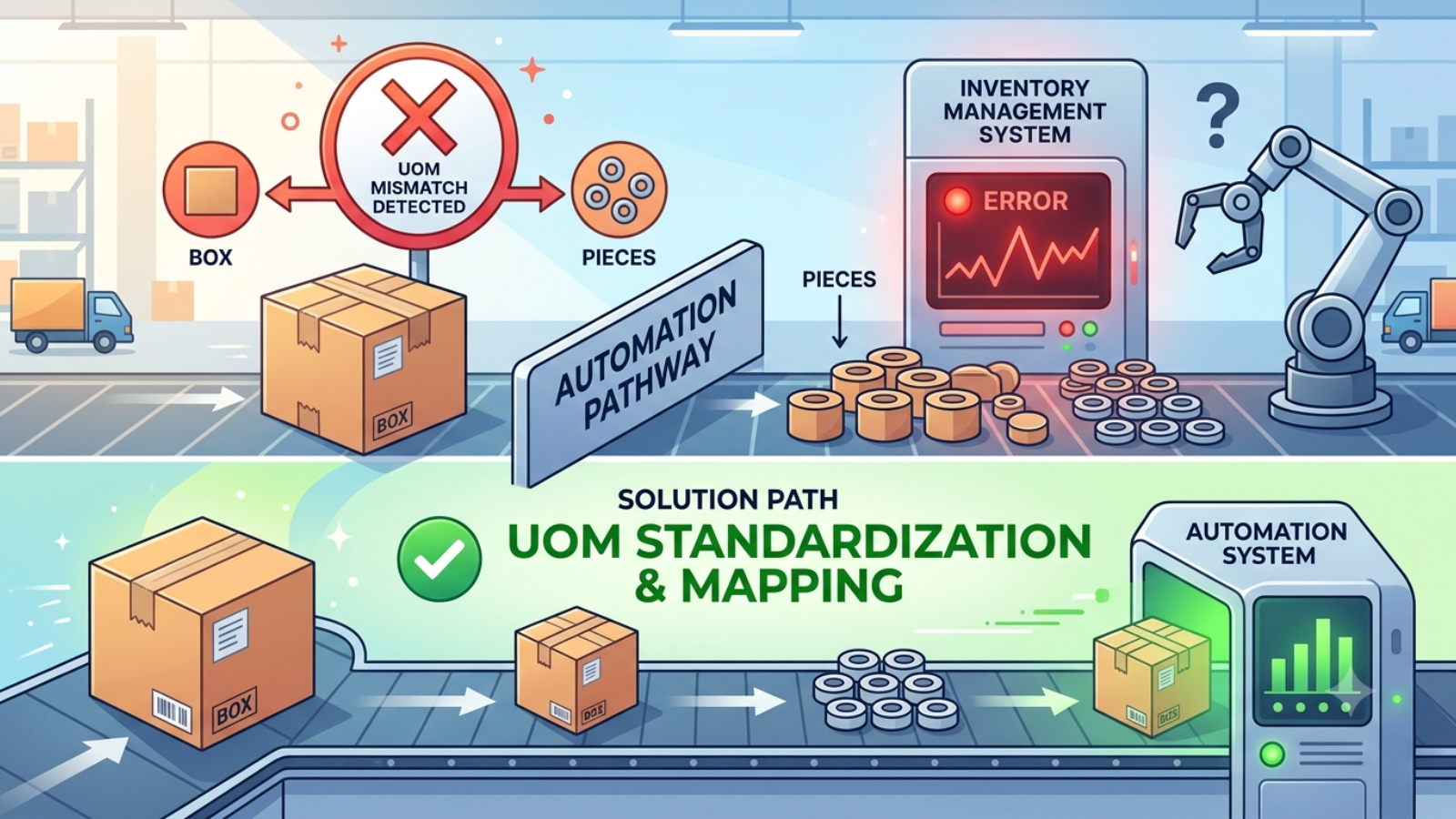 UOM mismatches are among the most persistent operational failures when Indian warehouses try to automate purchase orders and reorder points. A PO raised in “boxes” gets received in “pieces.”
The GRN posts incorrectly. Inventory levels are miscalculated. The next reorder trigger fires at the wrong threshold. The system built to automate purchase orders and reorder points in an Indian warehouse now creates errors in every procurement cycle.
UOM conversion factors must be locked at the SKU-supplier level before automation goes live:
| Level | Example | Conversion |
|---|---|---|
| Selling unit | 1 piece (end consumer) | Base unit |
| Inner pack | 12 pieces | 12:1 |
| Master carton | 6 inner packs | 72:1 |
| Pallet | 20 master cartons | 1,440:1 |
When the system creates a PO, it should specify both the purchase UOM and its base-unit equivalent, allowing GRN teams to record receipts in the units they physically count while the system converts them automatically.
Eveready’s integration through Base.com flagged persistent PO/SO UOM mismatches during initial reconciliation, units ordered in one denomination, fulfilled in another. Resolving UOM at the master data level before enabling automation prevented a class of inventory discrepancy that would have compounded invisibly over months.
Step 7: Monitor, Calibrate, and Improve
 Automation does not mean set-and-forget. The first 60 days of any system built to automate purchase orders and reorder points in an Indian warehouse will surface gaps invisible during configuration.
Weekly review checklist for the first 90 days:
- POs that triggered but should not have, usually return spikes, temporarily deflating net inventory below the ROP threshold
- Stockouts that occurred despite automation being live, ROP, or safety stock set too low for actual demand variability
- Suppliers with delivery dates consistently later than committed, flag for safety stock buffer increase
- SKUs where the PO quantity is systematically wrong, usually a UOM or demand calculation issue
- Duplicate POs that bypassed suppression logic indicate a timing gap in the inventory sync
Base.com’s procurement health dashboard surfaces automated purchase order and reorder points in an Indian warehouse, exceptions as actionable alerts, misfired triggers, overdue POs, and miscalibrated ROP parameters, so your team reviews genuine exceptions rather than manually cross-referencing ERP and WMS data.
After 90 days of live operation with regular calibration, most Indian warehouses find that automated procurement handles 85-90% of purchase order volume with zero human intervention. The remaining 10-15%, large-value POs, new supplier relationships, and anomalous demand events, are where your procurement team’s judgment adds the most value.
Full Implementation Timeline
| Phase | Weeks | Key Actions |
|---|---|---|
| Data foundation | 1-2 | SKU master audit, supplier lead time update, UOM conversion mapping, GSTIN validation |
| ROP configuration | 3 | Set thresholds at SKU × warehouse × channel; configure static vs. dynamic logic; set safety stock formula |
| ERP integration | 4 | Connect OMS trigger to ERP PO creation; test on 10 representative SKUs |
| Approval and notification | 5-6 | Configure tiered approval thresholds; build supplier notification and confirmation workflow |
| Controlled go-live | 7-8 | Full SKU set live; daily monitoring; procurement team on standby for exceptions |
| First calibration | 9-12 | Review misfires and missed triggers; adjust ROP parameters; lock supplier reliability scores |
| Steady state | 13+ | Weekly exception review; quarterly parameter refresh; seasonal multipliers before peak periods |
Building an effective NDR management process is about shifting from delayed reactions to real-time, system-driven execution. When brands combine instant detection, reason-based workflows, automated outreach, and seamless carrier coordination, recoverable failures stop turning into RTOs and start converting into successful deliveries.
The impact compounds quickly. Faster recovery, lower return costs, stronger customer experience, and a more predictable fulfilment operation.
For Indian D2C brands, the takeaway is clear: NDR is not a post-delivery problem; it is a controllable operational layer. The brands that treat it that way consistently outperform on both cost and delivery success.
Base.com is an order and warehouse management platform built for Indian D2C and B2B brands. It integrates with SAP, Tally, NetSuite, Shopify, Amazon, Flipkart, and quick commerce channels to automate procurement, fulfilment, and inventory workflows end-to-end.



[…] Issue purchase orders with written committed dispatch dates. Your suppliers are also everyone else’s suppliers […]
[…] reorder points from live sales velocity, updated continuously rather than recalculated manually once a quarter, […]
[…] and inventory planning is significant: demand is expanding by one-third annually, which means a reorder point set in 2025 is structurally understated for 2026 […]
[…] continuously updates reorder points per SKU per warehouse based on live order velocity, replacing static monthly averages with numbers that […]
[…] reorder point is the stock level at which a new purchase order should trigger automatically. Setting this […]
[…] it, returns stack up, available inventory counts diverge from physical counts, and reorders fire on phantom stock that is physically present but systemically […]