


Indian brands deliberately oversell inventory on Flipkart and Amazon simultaneously because order management software in India fails to synchronize inventory in real-time, creating a 15-30-minute lag window in which the same unit is sold twice.
Without proper order management software in India, brands using manual processes or legacy systems cannot update stock levels across all channels within seconds of an order confirmation, leading to 8-12% of sellers facing overselling incidents during high-traffic sale periods.
The problem intensifies during Big Billion Days and Great Indian Sale events when order velocity jumps 400-600% within the first hour.
A brand listing 50 units on both platforms expects sequential sales, but simultaneous purchases across channels exhaust physical inventory before order management software in India reconciles stock levels. Without the best OMS India solutions, brands face systematic overselling during peak traffic periods.
What Does Simultaneous Overselling Actually Cost Indian Brands
Overselling on Flipkart and Amazon creates direct financial penalties that Indian D2C and wholesale brands absorb quarterly. Flipkart’s seller penalty structure charges ₹100-500 per cancelled unit, depending on product category, while Amazon India imposes a 2-4% order defect rate hit that impacts Buy Box eligibility.
When a fashion brand oversells 200 units during a weekend sale, the immediate cost breakdown includes cancellation fees (₹20,000-40,000), refund processing charges (₹8,000-12,000), and lost customer lifetime value estimated at ₹15,000-25,000 per disappointed buyer who never returns.
Beyond monetary losses, marketplace trust scores drop measurably. Flipkart’s Seller Performance Index reduces by 0.5-1.2 points per overselling incident, pushing brands below the 4.0 threshold required for premium placement in search results.
How Inventory Lag Creates the Overselling Window
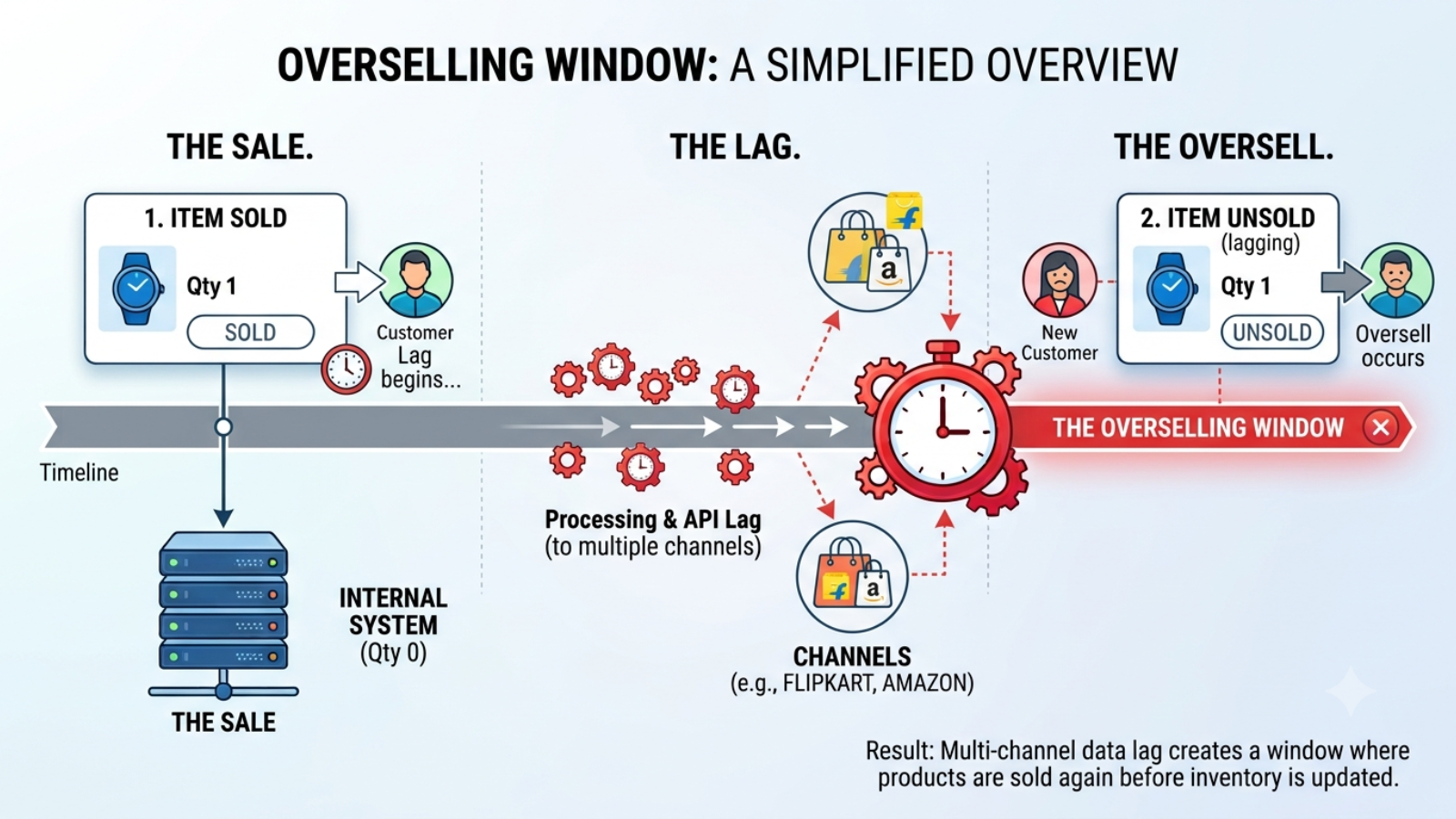 Inventory updates on Flipkart and Amazon do not happen instantly, even with API integrations. Multi-channel order management requires a technical infrastructure that processes stock changes across all platforms within seconds, but most brands lack this capability.
When a customer completes checkout on Flipkart at 11:00:00 AM, the order confirmation triggers an inventory deduction API call to the seller’s backend system. Without proper order management software in India, this system then pushes updated stock counts to Amazon’s Seller Central with 8-25 minute propagation delays depending on API queue load and server response times.
Inventory Sync Timeline Across Channels:
| Event | Flipkart Time | Amazon Time | Physical Inventory |
|---|---|---|---|
| Initial stock available | 100 units | 100 units | 100 units |
| Order placed | 11:00:00 AM | – | 100 units |
| Order confirmed | 11:00:15 AM | 100 units | 100 units (not yet picked) |
| Inventory deduction processed | 11:00:45 AM | 100 units | 99 units (picked) |
| Stock update sent to Amazon | 11:01:30 AM | 100 units | 99 units |
| Amazon reflects new stock | 11:08:00 AM | 99 units | 99 units |
During the 8-minute gap between 11:00:15 AM and 11:08:00 AM, Amazon still displays 100 units available. If another customer orders during this window, both platforms have sold the same physical unit.
This is precisely why order management software in India with real-time synchronization has become non-negotiable for brands selling across multiple marketplaces.
This inventory sync delay compounds when brands sell on 4-6 marketplaces simultaneously (Flipkart, Amazon, Myntra, Ajio, their own Shopify store, and quick-commerce platforms like Zepto or Blinkit). Effective multi-channel order management becomes impossible without automated e-commerce systems that handle real-time data flow.
Why Manual Inventory Management Guarantees Overselling
67% of Indian brands with annual revenue under ₹10 crore manage marketplace inventory through Excel sheets updated twice daily. This manual approach creates systematic overselling because human inventory clerks cannot process real-time order data across 5-8 sales channels simultaneously. This is why order management software in India has become essential for scaling operations beyond basic single-channel selling.
A typical manual workflow involves downloading order reports from each marketplace at 10 AM and 6 PM, consolidating them in a master Excel file, calculating remaining stock, and then uploading new inventory counts to each platform’s seller panel. The best OMS India solutions eliminate this 8-hour blind spot through automated synchronization.
Between the 10 AM update and the 6 PM update, an 8-hour blind spot exists where the Excel sheet shows outdated inventory while orders continue flowing in. Brands compensate by maintaining a 15-20% buffer stock, but high-velocity SKUs during sale periods still oversell.
The error rate in manual inventory management reaches 12-18% during festivals when temporary staff handle order processing. Data entry mistakes, duplicate order counting, and miscalculated returns create phantom inventory that exists in seller systems but not in physical warehouses.
The Strategic Choice: Overselling vs. Lost Sales
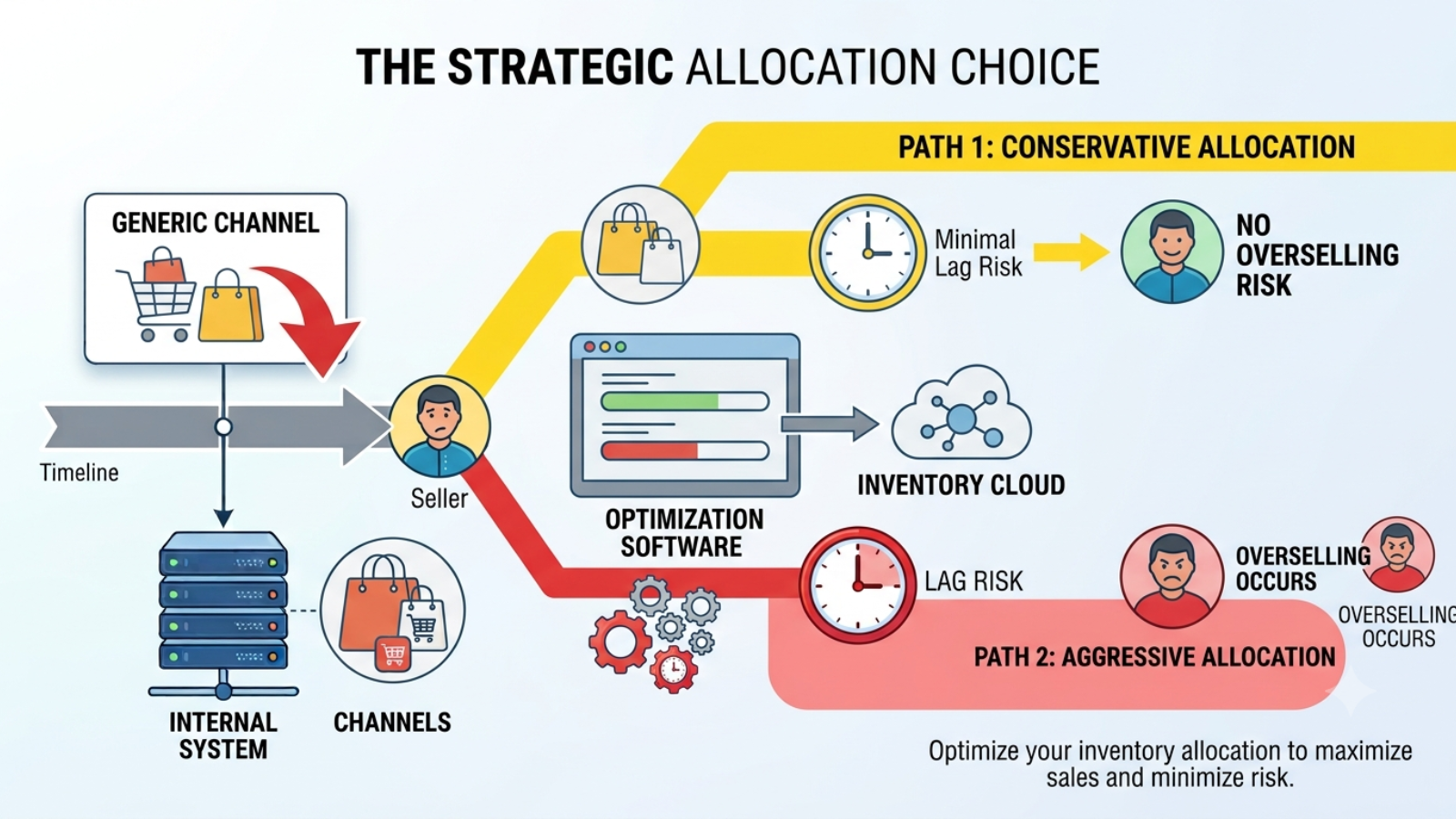 Indian brands face a calculated trade-off between overselling risk and the opportunity cost of conservative inventory allocation. Listing 100 units on Flipkart only and keeping Amazon stock at zero eliminates overselling but sacrifices 40-50% of potential sales volume. This dilemma drives demand for order management software in India that optimizes inventory allocation dynamically.
E-commerce analytics from 2025 show that brands listing inventory on both platforms simultaneously capture 78% more customer reach compared to single-platform sellers. The logic is simple: buyer behavior favors platform-specific loyalty, with 43% of shoppers purchasing exclusively on Flipkart and 38% only on Amazon. Advanced multi-channel order management handles this complexity through intelligent allocation rules.
When brands allocate 50 units to Flipkart and 50 to Amazon separately, they avoid overselling but create a different problem. If Flipkart demand reaches 70 units and Amazon demand is 30 units, the brand loses 20 Flipkart sales while 20 Amazon units sit idle. Effective ecommerce automation in India eliminates this inefficiency through shared inventory pools.
Dynamic reallocation requires real-time decision-making that manual systems cannot execute. By the time a brand realizes Flipkart’s stock is depleted in 2 hours while Amazon’s inventory remains, the sales window has closed. This is where order management software in India delivers measurable ROI through preventing lost sales.
Overselling vs. Stock-Out Cost Comparison:
| Scenario | Units Available | Flipkart Sales | Amazon Sales | Overselling Incidents | Lost Sales | Net Revenue Impact |
|---|---|---|---|---|---|---|
| Conservative split (50-50) | 100 | 50 | 50 | 0 | 30-40 units | ₹30,000-60,000 loss |
| Aggressive dual listing (100-100) | 100 | 60 | 55 | 10-15 units | 0 | ₹10,000-25,000 loss |
| Real-time sync (100 shared) | 100 | 65 | 35 | 0 | 0 | ₹0 optimal |
The middle row shows why brands choose aggressive overselling despite penalties. Losing ₹10,000-25,000 in cancellation fees is financially preferable to losing ₹30,000-60,000 in missed sales from conservative inventory splits.
How Base.com Prevents Overselling Across Flipkart and Amazon
For Indian brands selling across multiple marketplaces, overselling isn’t just an operational headache; it’s a trust problem. One inventory mismatch during Big Billion Days can mean cancelled orders, negative reviews, and seller penalties. Base.com is built specifically to prevent this, and here’s how it works.
1. Sub-3-Second Inventory Sync
The moment an order lands on Flipkart, Base.com updates Amazon’s stock count within 2.8 seconds. Legacy systems using scheduled API polling take 8-25 minutes to do the same, an eternity during high-velocity sales events.
2. Webhook-First Architecture
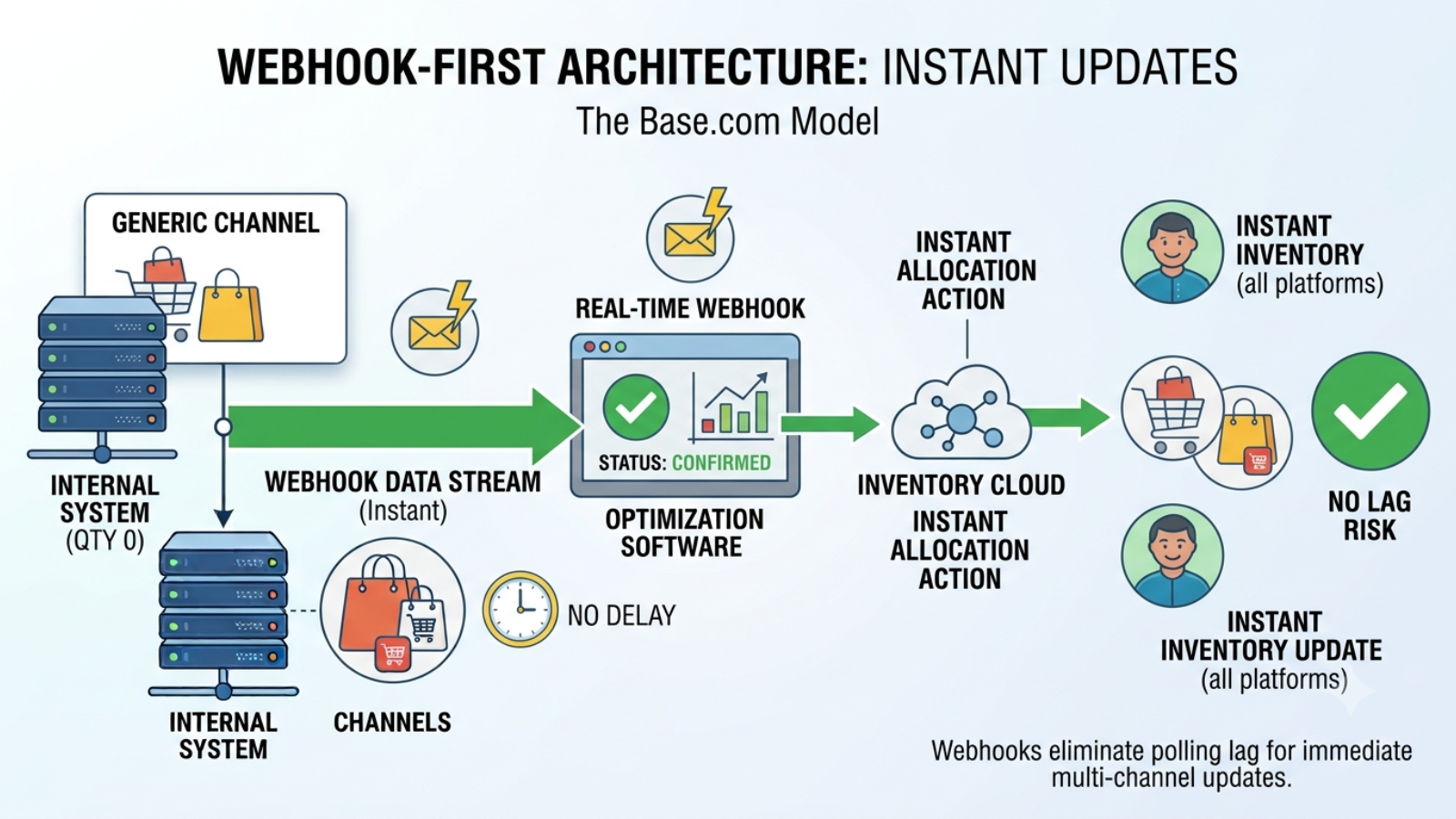 Base.com doesn’t poll for updates on a timer. It maintains persistent connections that listen for order webhooks in real time, triggering inventory actions the instant an order is confirmed, not minutes later.
3. Three Parallel Actions on Every Order
When a webhook fires, Base.com simultaneously reserves inventory in the central ledger, pushes deduction calls to all connected channels, and logs the transaction with a timestamp and order ID. All three happen at once, not in sequence.
4. Peak-Load Processing at Scale
During sale events like Great Indian Sale or Big Billion Days, Base.com processes 400-600 inventory transactions per second. No channel ever displays stale stock during the moments that matter most.
5. SKU-Level Allocation Rules
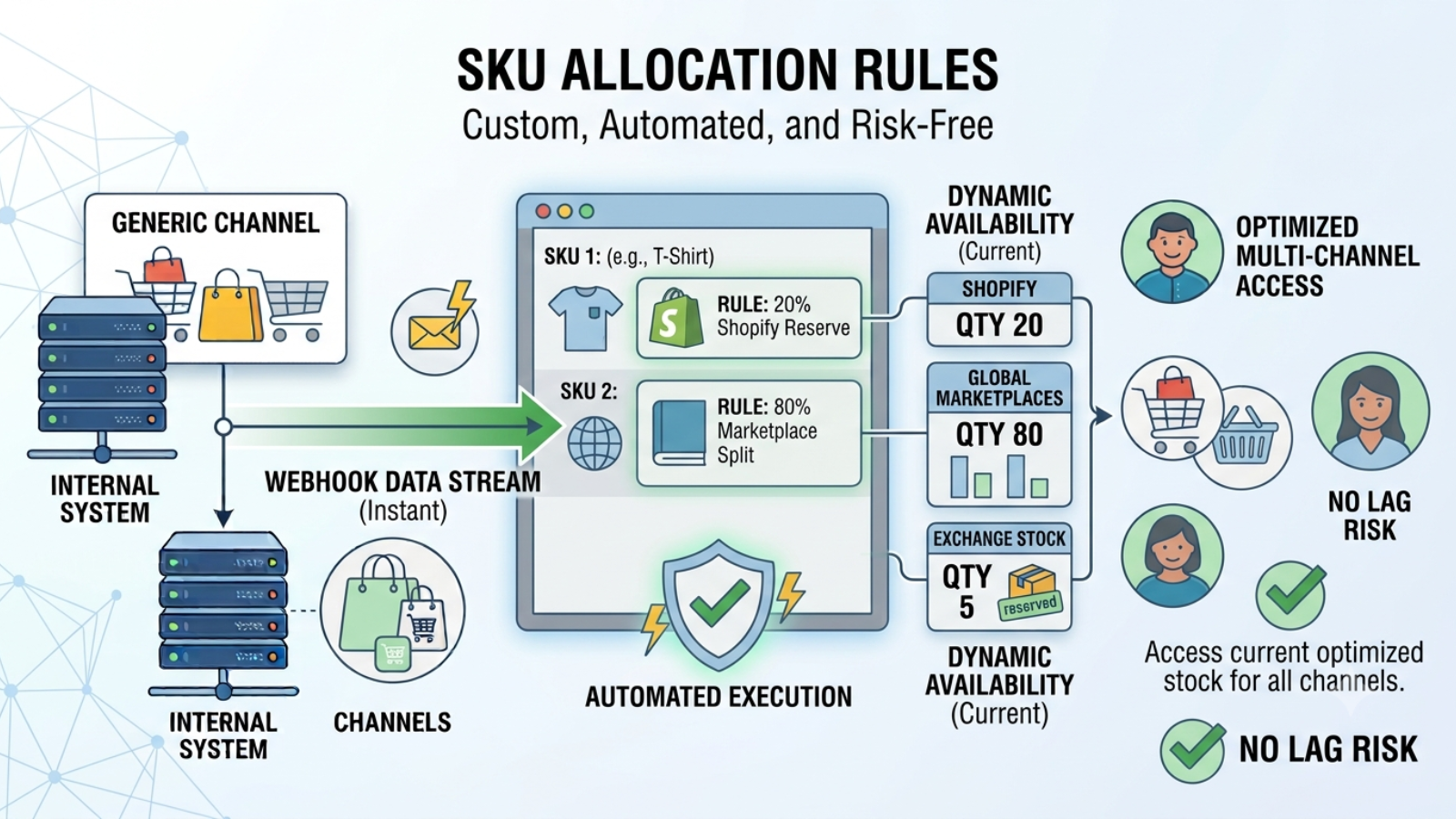 Brands can configure intelligent rules per SKU, reserve 20% for direct Shopify sales, share the remaining 80% across marketplaces, or hold back 5 units for return exchanges. These rules run automatically, with zero manual intervention required.
6. Proactive Listing Suppression
When Flipkart stock drops below a configured threshold, Base.com automatically marks the Amazon listing as Out of Stock, even though physical inventory still exists. This eliminates the scenario where simultaneous orders from two channels oversell the same units.
7. Automated Returns Restocking
Returned units are added back to the available inventory pool the moment they pass quality inspection, and all channels are updated within seconds. No more stock sitting in “received but not restocked” limbo for days.
8. Instant Cancellation Release
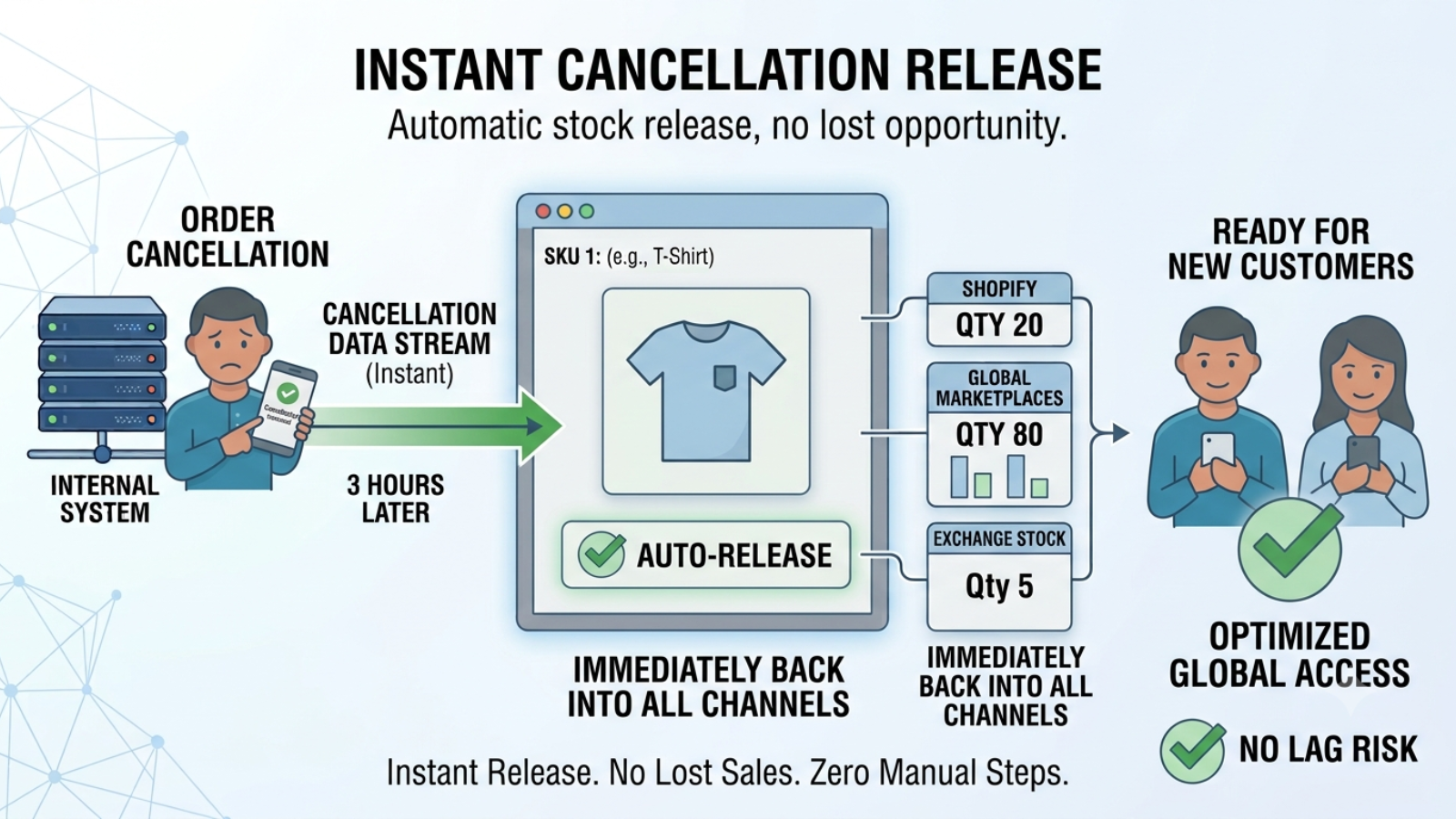 If a customer cancels within hours of ordering, the reserved unit is immediately released back into the pool and made visible across all channels, no manual step needed, no lost sales opportunity.
9. Warehouse Pick-Scan Sync
When warehouse staff scans a picked item, Base.com marks that unit as allocated and removes it from available inventory across every channel simultaneously. Brands report a 92-97% reduction in “order confirmed but stock unavailable at pick time” incidents.
10. Complete Inventory Audit Trails
Every inventory movement is logged with a timestamp, channel, order ID, and user action. When a discrepancy surfaces during stock verification, Base.com’s audit tool traces exactly where and when each unit moved, making root-cause analysis minutes-long, not days-long.
11. Multi-Warehouse Order Routing
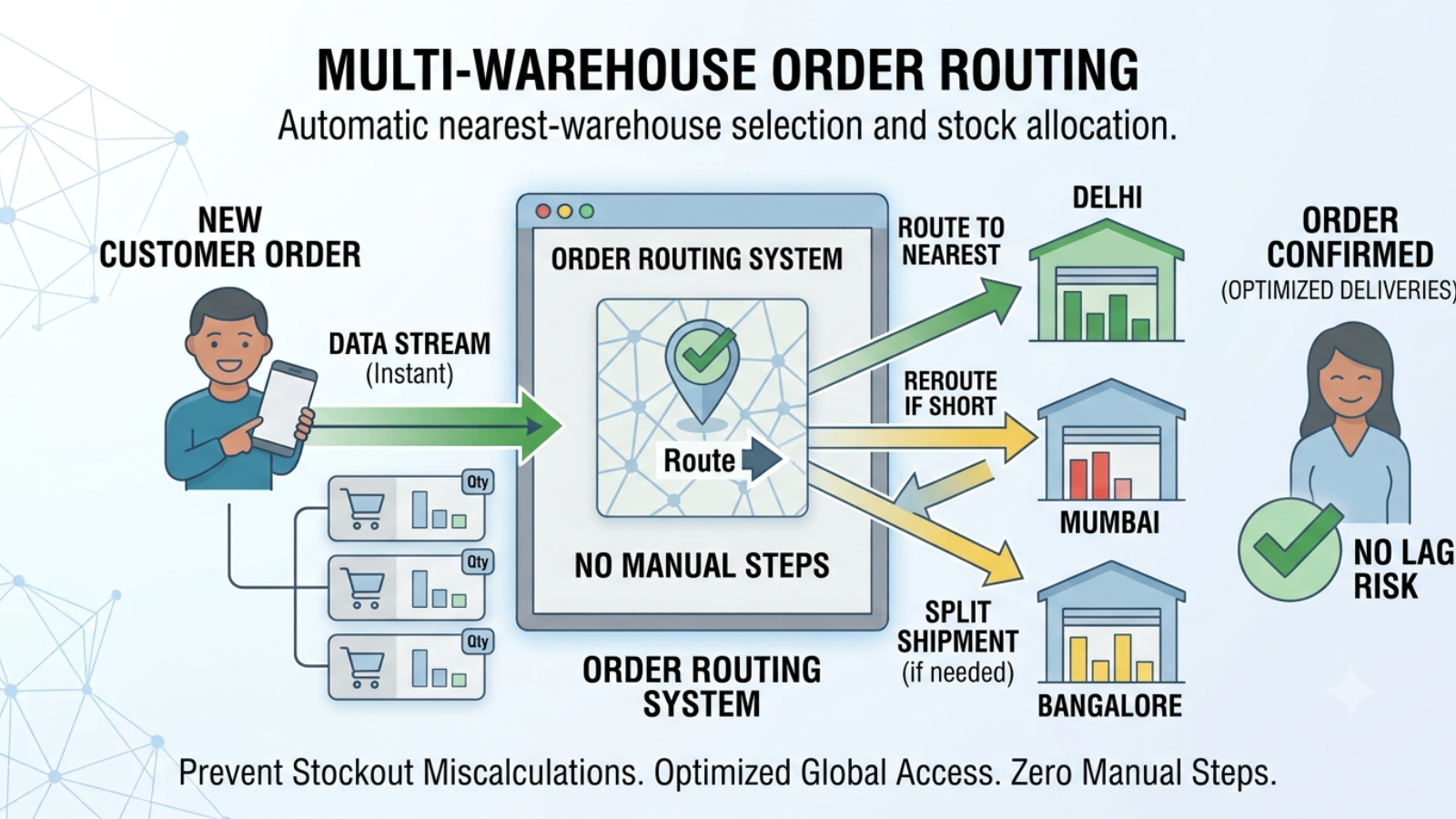 For brands operating warehouses across Delhi, Mumbai, and Bangalore, Base.com routes each order to the nearest available warehouse automatically. If one location is short on stock, it either splits the shipment across warehouses or reroutes the entire order, preventing the common mistake of showing total inventory on every marketplace listing regardless of where stock actually sits.
12. Dark Store and Quick-Commerce Inventory Isolation
Platforms like Zepto, Blinkit, and Swiggy Instamart require hyper-localized stock in specific dark store hubs. Base.com tracks inventory per location, so a Zepto Hub A order only deducts from that hub’s pool, not from Flipkart or Amazon warehouse stock. This prevents brands from accidentally promising same-day delivery across eight zones from one shared inventory pool.
13. B2B and B2C Inventory Separation
When a large Udaan or Jumbotail wholesale order arrives, it shouldn’t wipe out the stock reserved for Flipkart and Amazon consumers. Base.com lets brands define hard rules, for example, 60% of inventory locked for B2C, 40% available for B2B, with automatic B2B rejection if B2C stock drops below a safety threshold.
14. Seasonal Demand Forecasting
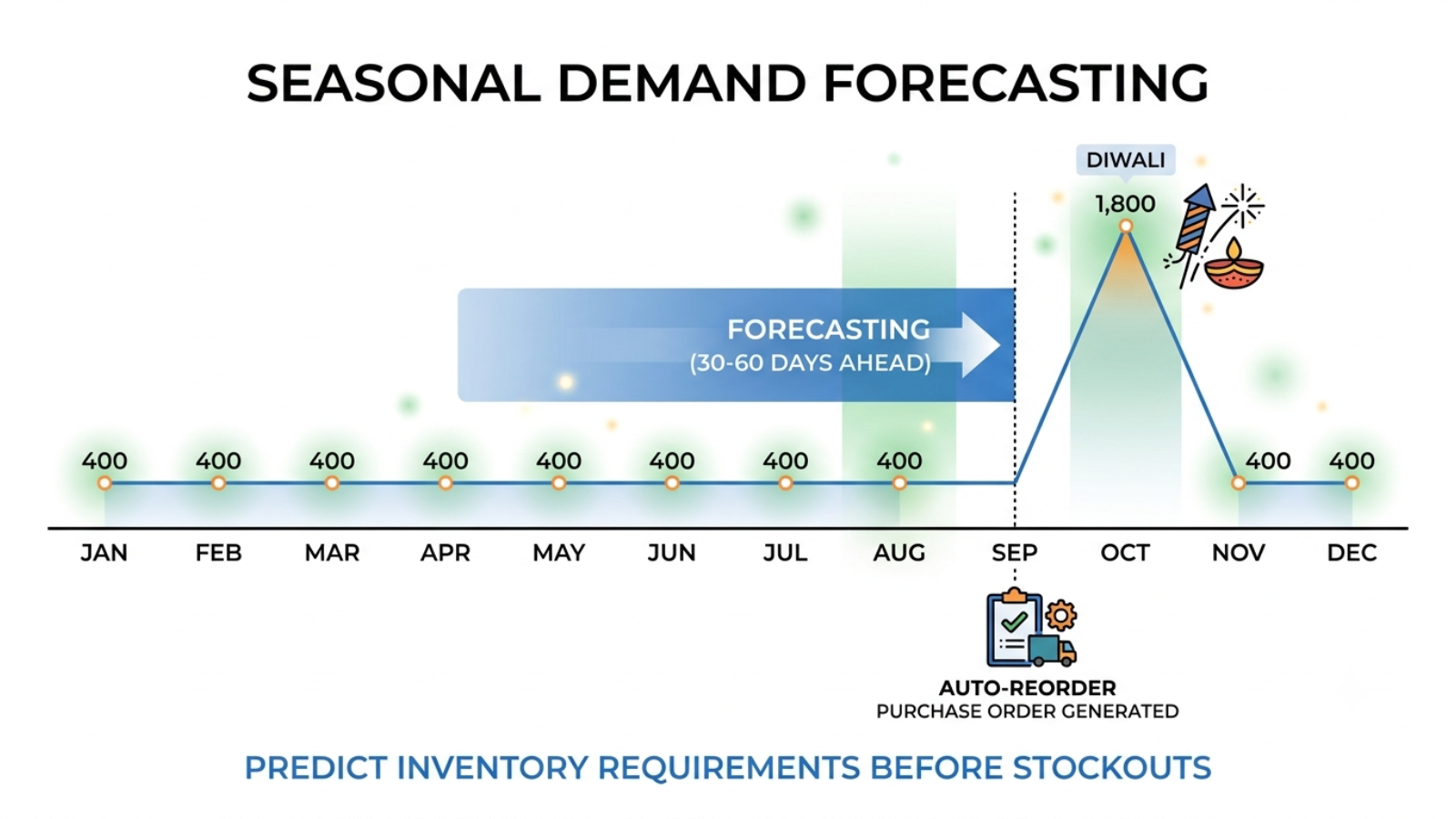 Base.com analyzes historical sales velocity by month, week, and day of week to predict inventory requirements 30-60 days ahead. A personal care brand selling 400 units monthly on average but 1,800 during Diwali needs that visibility in advance, not after stockouts have already happened. Auto-reorder triggers generate purchase orders before inventory hits critical lows.
15. API Rate Limit Optimization
Flipkart and Amazon cap third-party API calls at 60-120 requests per minute. For a brand with 500+ SKUs across both platforms, a naive full-catalog refresh would require 1,000 API calls, taking 10+ minutes. Base.com batches same-second changes and pushes delta-only updates, reducing that to 20-40 calls completed in under 30 seconds without breaching rate limits.
Across all fifteen capabilities, the underlying logic is the same: close the gap between what your marketplace listings show and what your warehouses actually hold. That gap is where overselling lives, and Base.com is built to eliminate it.
Cost-Benefit Analysis: Base.com vs. Manual Inventory Management
Indian brands evaluating Base.com against manual Excel-based inventory management see ROI within 45-60 days based on eliminated overselling penalties alone. The financial comparison includes direct costs and opportunity costs. When evaluating order management software in India, brands must calculate the total cost of manual processes, including hidden expenses like staff time, error correction, and lost customer lifetime value.
Monthly Cost Comparison (₹10 Crore Annual Revenue Brand):
| Cost Category | Manual Management | Base.com OMS | Savings with Base.com |
|---|---|---|---|
| Overselling penalties | ₹80,000-120,000 | ₹2,000-5,000 | ₹75,000-115,000 |
| Time to listings live | 1 week | 3 hours | 56X |
| Lost sales from process gaps | ₹150,000-200,000 | ₹10,000-20,000 | ₹140,000-180,000 |
| Staff time on inventory reconciliation | ₹60,000-80,000 | ₹15,000-20,000 | ₹45,000-60,000 |
| System subscription cost | ₹0 | ₹25,000-35,000 | – |
| Warehouse labour | ₹60,000-80,000 | 0 | ₹60,000-80,000 |
| Net monthly savings | – | – | ₹295,000-400,000 |
| Increase in revenue from resource reallocation | – | +20-40% | +20-40% |
The net savings of ₹235,000-320,000 monthly translate to ₹28-38 lakh annually for a brand with ₹10 crore revenue. For brands crossing ₹25-50 crore annual revenue, the savings scale proportionally as overselling incidents and manual reconciliation costs increase with transaction volume.
Integration Timeline and Migration from Manual Systems
Brands migrating from manual inventory management to Base.com typically complete integration in 7-14 days, depending on data cleanliness and the number of sales channels to connect. The migration process involves five key phases:
- Data export and cleaning (2-3 days): Export existing inventory data from Excel or legacy systems, clean duplicate entries, and verify SKU mapping across channels
- Base.com account setup (1 day): Configure warehouse locations, create user roles, set up product catalog
- API integration (2-4 days): Connect Flipkart Seller Hub, Amazon Seller Central, Shopify store, and any other platforms
- Rule configuration (1-2 days): Set inventory allocation rules, safety stock thresholds, channel priorities
- Parallel run and cutover (2-3 days): Run Base.com alongside the existing system to verify accuracy, then switch fully to Base.com
During the parallel run phase, brands maintain their manual processes while Base.com operates in read-only mode to validate that inventory calculations match. Once verified, the cutover happens during a low-traffic period (typically Sunday late night) to minimize disruption.
Customer Experience Impact of Overselling
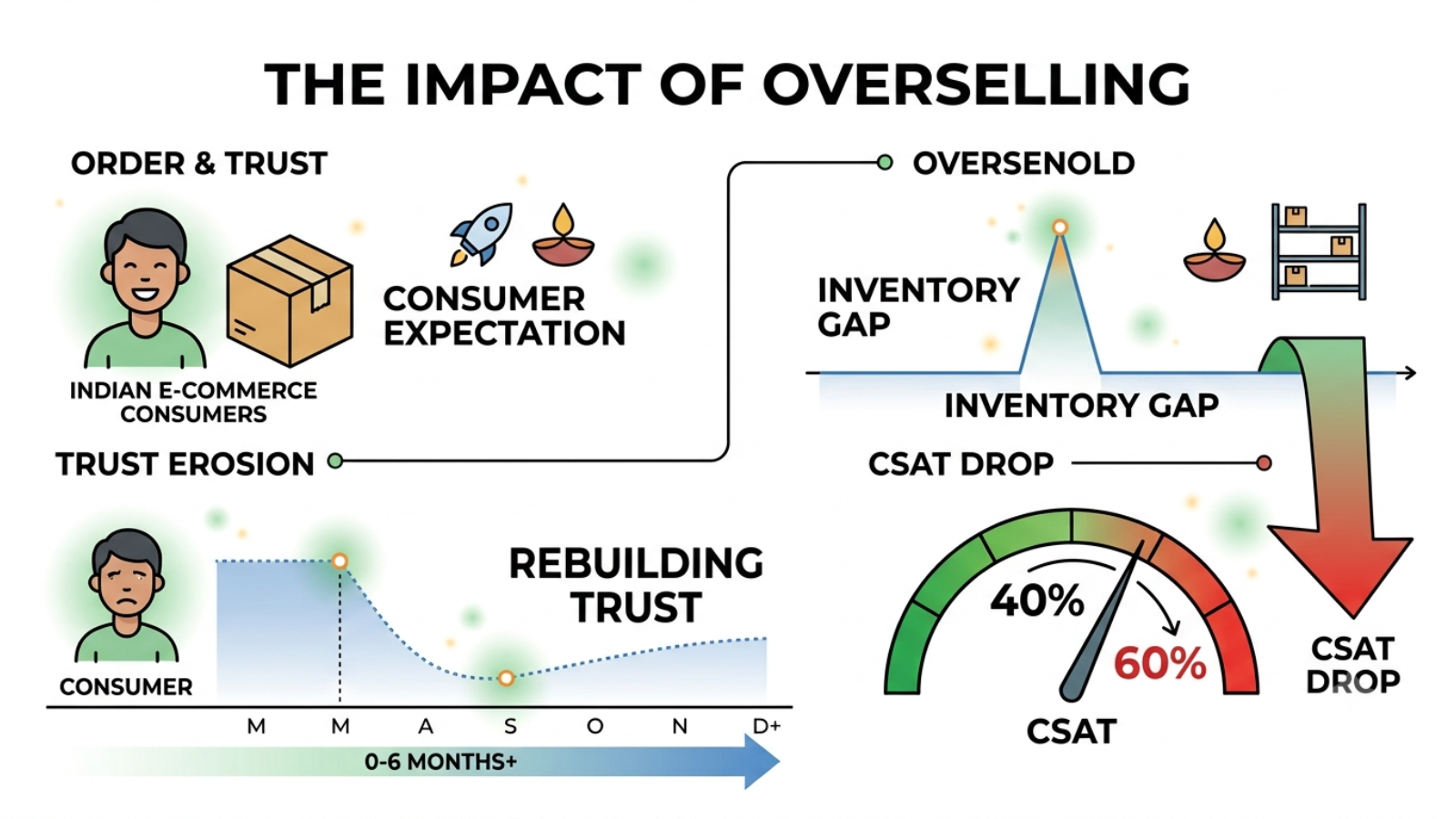 Beyond financial penalties, overselling damages customer trust that takes months to rebuild. Indian e-commerce consumers shopping on Flipkart and Amazon expect order confirmation to guarantee delivery. When brands cancel orders after confirmation due to inventory unavailability, customer satisfaction scores drop by 40-60% according to 2025 marketplace analytics.
Repeat purchase rates decline measurably after overselling incidents. A customer who experiences order cancellation is 67% less likely to purchase from that brand again within the next 6 months. For D2C brands building long-term customer relationships, this behavioral impact far exceeds the immediate cancellation penalty.
Base.com prevents these customer experience failures by ensuring that inventory shown on marketplaces always reflects real-time availability. The system’s 2-3 second sync time means customers see accurate stock counts at the moment they add items to cart, reducing post-purchase cancellations to near zero.
Why Do Other OMS Tools Fall Short on Overselling Prevention
Several inventory management tools serve Indian brands, but most lack the sub-second synchronization required to prevent overselling during high-velocity sale events.
When evaluating order management software in India, brands often discover that most of the OMS use scheduled API polling at 5-15 minute intervals rather than real-time webhook-based updates.
During a Big Billion Days first-hour rush, where a brand receives 80 orders per minute across platforms, 5-minute polling intervals create a 400-order processing lag. By the time the system polls for new orders, 400 orders have accumulated, all attempting to reserve inventory simultaneously, resulting in overselling.
Base.com’s webhook architecture processes each order individually within milliseconds of confirmation, eliminating batch processing lag. This technical difference is why brands migrating from polling-based tools to Base.com report an 85-95% reduction in overselling incidents within the first 30 days.
Bottom Line: Automation vs. Marketplace Penalties
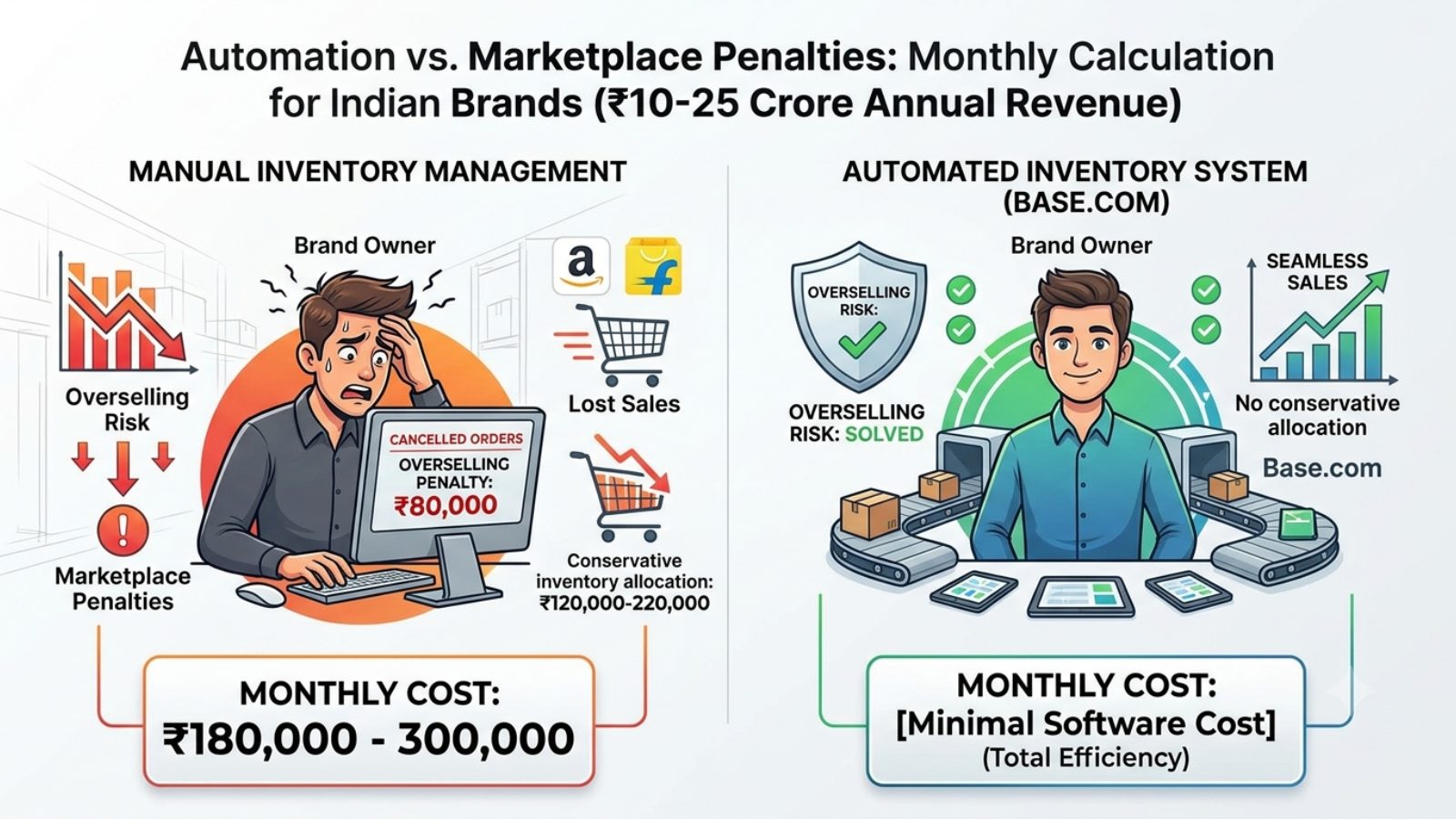 Indian brands choosing between manual inventory management with overselling risk and automated systems like Base.com face a simple calculation. Monthly overselling penalties and lost sales from conservative inventory allocation total ₹180,000-300,000 for brands with ₹10-25 crore annual revenue.
Base.com subscription costs ₹25,000-45,000 monthly, depending on order volume and features, creating net savings of ₹135,000-255,000 monthly or ₹16-30 lakh annually. The ROI calculation becomes more compelling as brands scale beyond ₹25 crore revenue, where overselling incidents increase proportionally with transaction volume.
For brands serious about scaling, investing in order management software in India transitions from optional to mandatory as they cross the ₹10 crore annual revenue threshold.
Beyond direct cost savings, automated inventory management frees up 60-80 hours monthly that brand teams previously spent on manual reconciliation, Excel updates, and firefighting overselling issues. This time, reallocated to customer acquisition, product development, or expansion planning generates additional business value that financial analysis often underestimates.
The decision framework is straightforward: brands prioritizing growth velocity and customer experience adopt real-time inventory systems, while brands prioritizing cash conservation and accepting operational inefficiency maintain manual processes until overselling costs force change.



[…] Multi-channel overselling is one of the most common D2C fulfillment challenges in India in 2026. Indian D2C brands typically sell across Amazon, Flipkart, Meesho, their own website, and sometimes Myntra or Nykaa simultaneously. […]
[…] Manual returns management becomes increasingly difficult as D2C brands scale across multiple marketplaces in India. Tracking returned products through spreadsheets, emails, or disconnected systems often delays inventory updates, creates stock inaccuracies, and increases the risk of overselling. […]
[…] on Amazon, Flipkart, Myntra, and your own website without synced stock data leads to overselling the same SKU across channels. This is one of the most common order management challenges in ecommerce, since […]
[…] real time across all channels. Every sale, return, adjustment, and transfer updates the same count. Overselling from sync lag is eliminated by architecture, not by manual […]