base.blogBase Analytics

CategoryBase Analytics

Base.com vs EasyEcom: Which Platform Handles Festive Season Sales Better?

B
Base.com vs EasyEcom comparison for managing festive season ecommerce sales

The Base.com vs EasyEcom question has a clear answer for Indian D2C brands operating above Rs 10 crore GMV: Base.com handles festive season sales better. Base.com’s real-time inventory sync, scan-based pack verification, automated COD reconciliation, and RTO intelligence are purpose-built for peak load. EasyEcom is a capable mid-market platform, but its limited WMS depth, basic analytics...

Top 20 Questions Indian D2C Founders Ask Before Choosing an OMS (Answered)

T
Indian D2C founder evaluating the best order management system for business growth

Choosing the wrong order management software costs more than the subscription fee. It costs team hours, packing errors, missed SLAs, delayed RTOs, and marketplace penalties, compounding every month until you switch. Indian D2C founders are not short of options. The market has Unicommerce, EasyEcom, Vinculum, and a growing list of global tools adapted for India. The problem is not choice, it is...

How to Set Up a Returns Management Process That Does Not Kill Your Margins

H
Illustration of an ecommerce returns management process to reduce margin loss for Indian D2C brands

Returns are not a customer service problem. They are a margin problem, and in Indian ecommerce, they are an unusually large one. India’s average ecommerce return rate is 20-30% across categories. In fashion D2C, that number climbs to 35-40%. In some COD-heavy Tier 3 markets, return-to-origin rates hit 50% on specific SKUs during peak season. India’s D2C market is growing at 40% CAGR...

COD Return Rates by Product Category in India: 2026 Report

C
COD return rates by product category in India for the 2026 ecommerce report

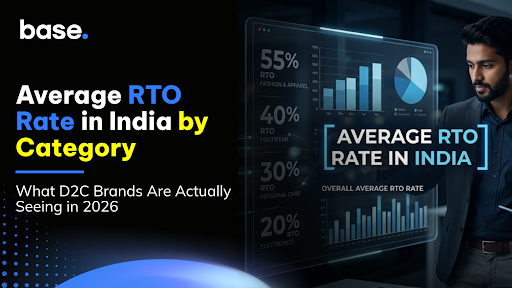
India’s cash-on-delivery return problem is not uniform across categories. Understanding COD return rates by category in India 2026 is the single most important diagnostic step for any Indian D2C brand losing margin to returns. Fashion returns 25-40% of COD orders. Electronics returns 10-15%. Beauty sits at 18-22%. If you are managing returns as a blended number, you are making inventory and...

What Is an OMS, and Do D2C Brands in India Actually Need One?

W
Order management system helping D2C brands in India centralize ecommerce operations

An OMS, or order management system, is the operational backbone that receives, processes, and tracks every order across every sales channel in one place. If you are building a D2C brand in India and selling on more than one channel, an OMS for D2C brands in India is not optional past ₹5 crore revenue. Without it, you are managing a scaling business on spreadsheets and WhatsApp. This guide breaks...

How to Manage Shopify, Amazon, and Flipkart orders in a single dashboard in India

H
Managing Shopify, Amazon, and Flipkart orders through a unified ecommerce dashboard

Indian D2C brands selling on Shopify, Amazon, and Flipkart simultaneously lose 2-3 hours daily switching between portals, manually syncing inventory, and reconciling order statuses across tabs. The fix is straightforward: manage Shopify, Amazon, and Flipkart orders in a single dashboard in India, one screen, all channels, real-time sync. This guide covers exactly how to manage Shopify, Amazon...

How Effilo Reduced RTO from 60% to 20% Using Base.com’s Automated Confirmation and Intelligent Shipping Allocation

H
Effilo reducing RTO with Base.com through automated order confirmation and intelligent shipping allocation

The single most effective thing you can do to reduce RTO for D2C brands in India is to stop treating it as a logistics problem and start treating it as an operations problem. Brands that bring RTO down sustainably do not do it by switching couriers or renegotiating rates. They do it by fixing the decision-making layer that sits between an order being placed and that order reaching the...

How Blue Tea Scaled Multi-Warehouse Operations Without Losing Control With Base.com

H
Blue Tea scaling multi-warehouse operations with Base.com for centralized ecommerce fulfilment

Multi-warehouse order management software for D2C brands in India is the infrastructure decision that separates brands that scale cleanly from brands that scale chaotically. For Blue Tea, one of India’s fast-growing premium beverage brands, the gap between those two outcomes came down to one platform decision. This is the detailed story of how Blue Tea went from fragmented, manual, multi...

Top 10 Courier Partners for D2C Brands in India Ranked by RTO Rate and Delivery Speed

T
Top courier partners for D2C brands in India ranked by RTO rate and delivery speed

D2C brands lose ₹180-250 per RTO order (reverse shipping + repackaging + lost COD opportunity). Reducing RTO by 3% on 5,000 monthly COD orders saves ₹27,000-37,500 per month. The best courier partner for D2C brands in India is not one name, it is a routing strategy. Delhivery leads on a pan-India scale. Blue Dart wins on RTO rates. Xpressbees dominates fashion COD. Shadowfax owns same-day metro...

Quick Commerce for D2C Brands: The Complete Guide (2026)

Q
D2C brand fulfilling quick commerce orders through Blinkit and Zepto

If you’re running a D2C brand in India right now, you’ve already felt the pressure building. Customers who once happily waited 2-3 days for a delivery are now annoyed if their order takes longer than 30 minutes. That’s not hyperbole – Blinkit, Zepto, and Swiggy Instamart have permanently rewired what Indian urban consumers consider “normal.” And once...

Time of publication
Category
Tags