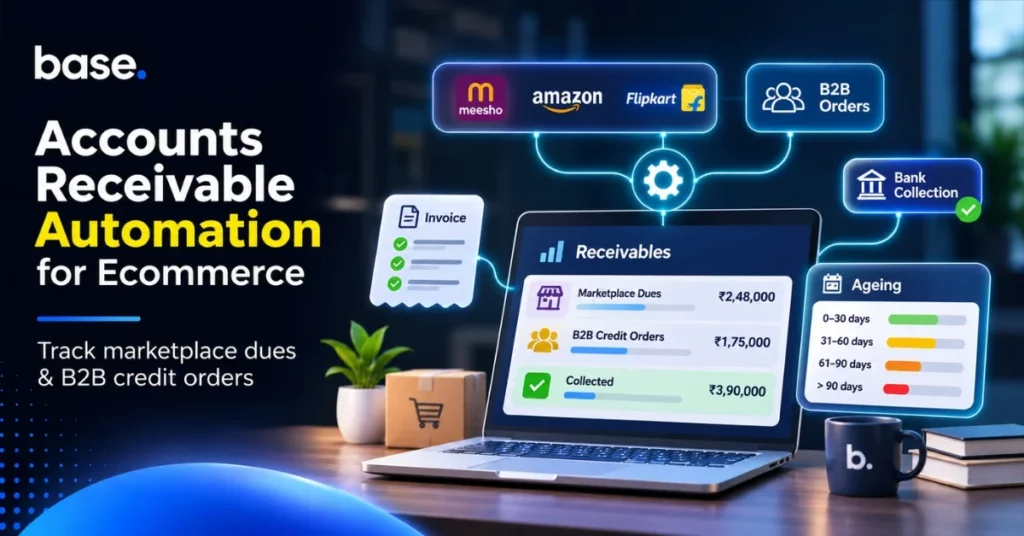
Ecommerce businesses can use accounts receivable automation to manage the money owed by marketplaces, payment providers, distributors and B2B customers. It brings order, invoice, settlement and bank information into a repeatable process, so teams can see what is expected, what has arrived and what is still overdue. This is particularly evident when marketplace payouts include multiple orders and deductions, and wholesale customers pay on credit or in partial instalments.
This guide covers the monitoring of marketplace dues, B2B credit orders from invoice to collection, ageing and collection performance measurement. It also outlines the features of receivables software and the role of order management: Organised order and invoice records can complement finance workflows, but an ecommerce order platform is not a full-fledged accounts receivable ledger or collections system.
What is ecommerce accounts receivable automation?
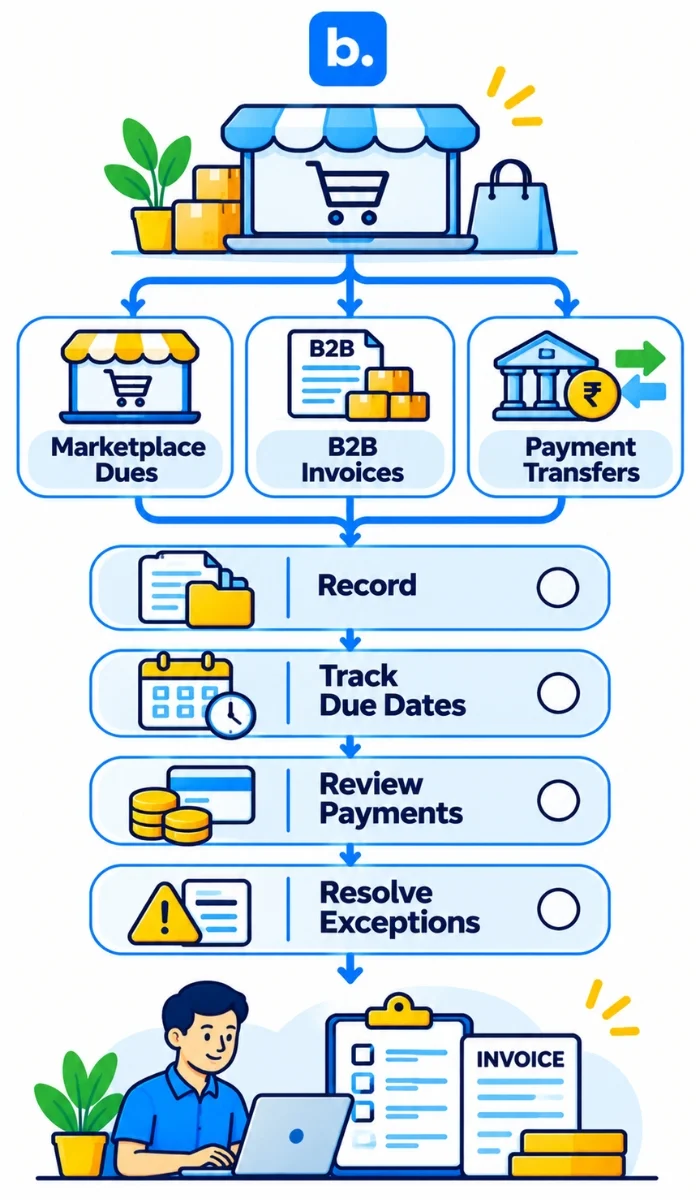
Accounts Receivable (AR) refers to the amount of money that customers or business partners owe for goods or services that have been provided. In ecommerce, receivables may encompass B2B invoices that are yet to be paid, marketplace settlements owed to a seller, COD remittances, or payment-provider funds that have not yet been deposited into the bank. Accounts receivable automation involves software and standardized workflows to generate or send invoices, monitor due dates and payment status, and flag exceptions and give teams up-to-date outstanding balances.
AR is not the same as accounts payable (AP): AR is money owed to the business, AP is money owed by the business to suppliers. Each team may have to reconcile accounts payable and receivable separately as they have different counterparties, records and control steps. Similarly, vendor reconciliation in accounts payable is not the same as reconciling marketplace receivables. Accounts payable systems are used to manage the supplier side, and accounts receivable records are used to keep track of the amounts owed to the business.
The goal for ecommerce businesses is to make receivables visible and follow them up, not to assume that all payments will be collected or matched without review. The process should maintain the supporting order, invoice, settlement report and bank record.
Where do ecommerce businesses have unpaid invoices?
There are multiple sales and collection flows that can result in a balance that requires follow-up:
- Holds or reserves indicated by the marketplace that have not yet been released.
- Unpaid B2B credit orders and distributor invoices after agreed due date.
- Partial payments from customers that leave an invoice partially unpaid.
- Any refunds, returns, credit notes or marketplace deductions that alter the anticipated net settlement.
- Bank receipts that are not allocated to an order or invoice and the payer reference is not clearly identifying an order or invoice.
- COD remittances or payment-provider transfers that are anticipated but not yet recorded in the bank.
Maintain separate records for gross sales, deductions, amounts due and bank cash received. A net settlement does not necessarily mean that the orders, fees or adjustments are the same.
How do sellers know how much marketplace dues are?
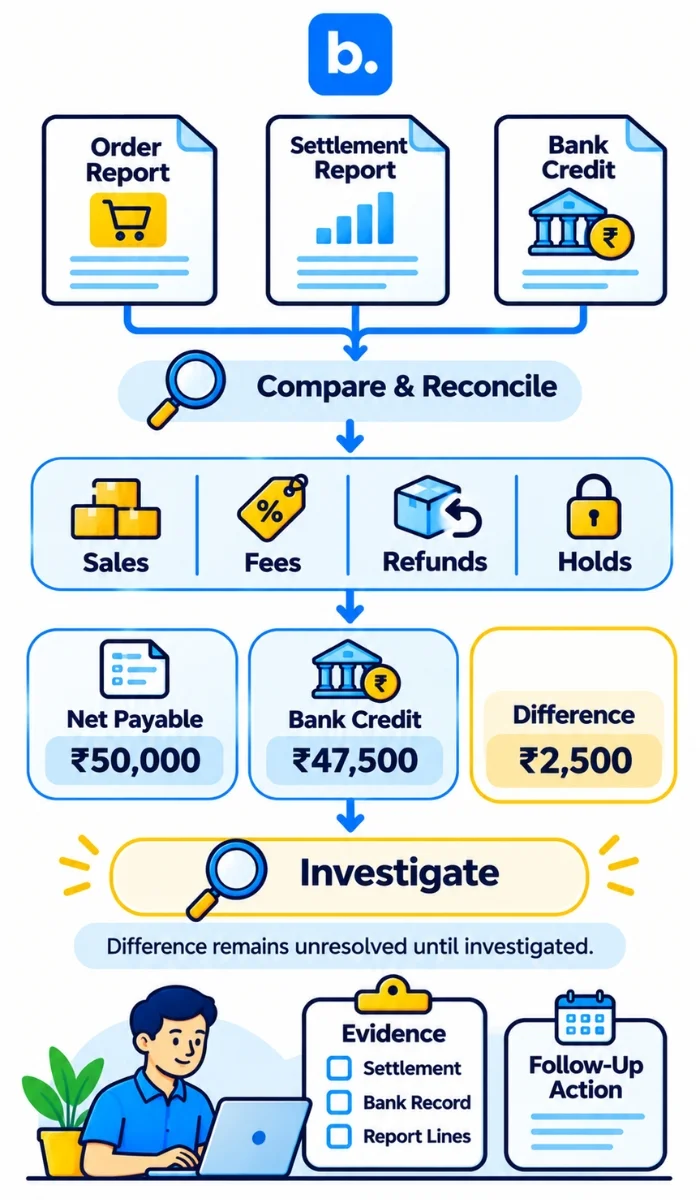
Apply a settlement control to compare order or transaction data with the marketplace settlement report and the bank credit. Record expected payout dates from the marketplace terms or report, but do not treat an estimated date as guaranteed.
- Collect the sales/order report, settlement statement and bank statement for the same review period. Retain original downloads for audit trail and follow-up.
- Record gross sales, commissions and other fees, refunds, deductions, holds or reserves, and net amount payable separately by settlement ID.
- Check the net payable in the report against the amount credited to the bank. Where available, link each bank credit to its settlement reference.
- Include any differences that have not been resolved: settlement not received, partial transfer, unexplained deduction, refund adjustment, or bank credit with no settlement reference.
- Assign an owner, evidence and next action to each difference. Adhere to marketplace claim or query procedures and deadlines for that account.
For instance, if the settlement statement indicates that the net payable is ₹50,000 and the bank credit is ₹47,500, then record the difference of ₹2,500 as an unresolved amount, not as an assumed fee. Check the detailed settlement lines and subsequent adjustments before closing it.
For the matching method and worked examples, see What Is Payment Reconciliation? Meaning, Process and Example for Ecommerce. If you are a D2C brand focused on India, read Payment Reconciliation for D2C Brands in India: Why Manual Processes Are Costing You Lakhs.
What are the best practices for B2B credit orders?
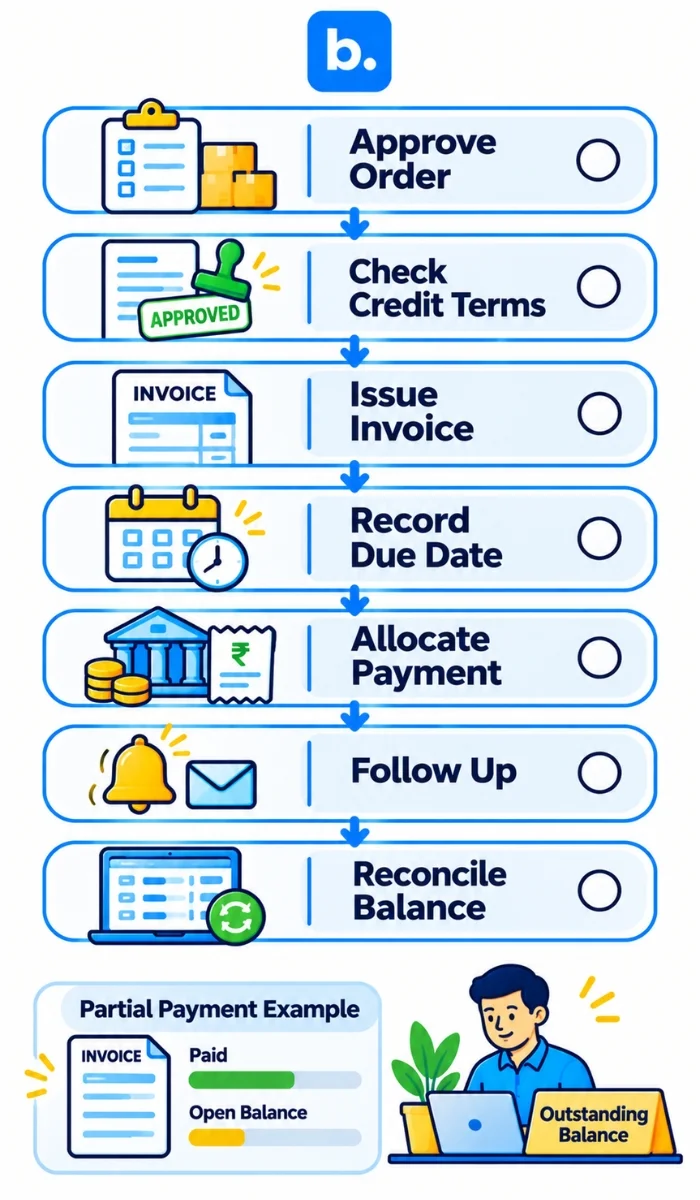
A controlled B2B receivables process links the customer order to the invoice and then tracks the balance until it is paid or resolved. Credit terms and limits should be approved under the business’s own policy; do not assume an order system makes credit decisions.
- Create and approve the customer order, recording the customer account and the agreed products, quantities and prices.
- Ensure that the credit terms and any credit limit have been approved by the responsible person prior to dispatch or fulfilment.
- Create a sales invoice from the approved order or fulfilment record and verify customer information, invoice reference, amount and applicable tax fields.
- Record the invoice date, due date, original amount and any agreed payment milestones in the accounting or receivables record.
- Apply full or partial receipts to the appropriate customer and invoice. Store unidentified receipts in an exception queue until the payer and purpose are confirmed.
- Remind and escalate overdue invoices as per documented customer terms and internal policy. Maintain communication logs and notes on disputes.
- Compare closing balance with customer statements, bank receipts, credit notes and adjustments; record any discrepancy.
A partial payment should reduce the open invoice by the amount paid, not mark it as paid. Where the accounting process permits, keep the undisputed and disputed amounts separate if a customer disputes a line.
What are the ways to automate receivables tracking in ecommerce?
The appropriate workflow will depend on the way the business sells and the finance systems that are in place. Some helpful automation can be:
- Generation of invoices from order or fulfilment records, subject to human review if necessary.
- Outstanding balances and due dates for customers in the accounting/receivables system.
- Payment-status updates from connected systems, with clear handling for failed or delayed synchronisation.
- Reminders and escalation tasks set in approved policy.
- Reports and exception queues for overdue, partially paid or unidentified items.
- Reconciliation support to match settlement or bank data with invoices and order references.
- Synchronisation of accounts with duplicate prevention, audit history and a retry process.
While automation can minimise repetitive checking, it cannot establish that a deduction is valid, that a customer will pay, or that a tax treatment is correct. Specify who approves exceptions and who can adjust a balance or close an item.
What is the purpose of accounts receivable ageing?
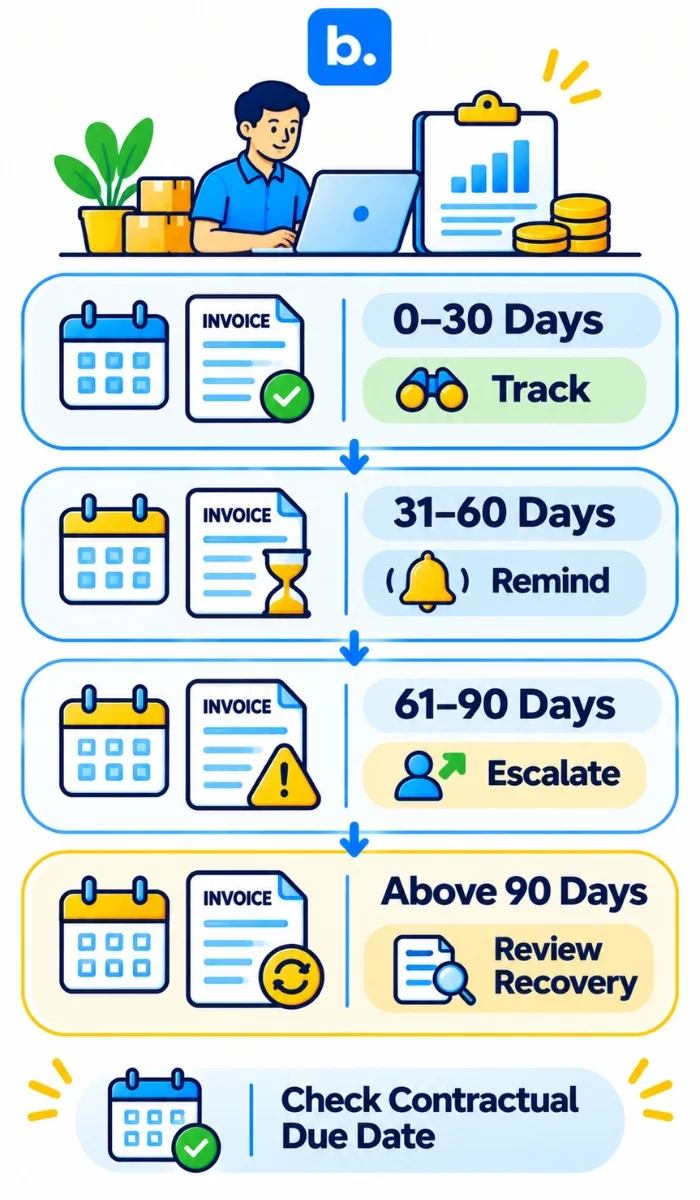
An ageing report is a report that categorizes unpaid balances based on the length of time they have been outstanding, usually by the due date or by some other clearly defined basis. The following categories are examples of monitoring bands only and are not required accounting or statutory classifications. Establish credit terms and risk policy bands.
| Age band | Receivable status | Recommended action |
|---|---|---|
| 0–30 days | Current | Track payments and verify invoice delivery. |
| 31–60 days | Overdue | Remind and look for any disagreements or missing documents. |
| 61–90 days | High-risk overdue | Call the customer and discuss credit exposure per company policy. |
| Above 90 days | Long-outstanding | Escalate for recovery review and review further credit under policy. |
Always use the same cut-off date and add the invoice date, due date, open amount, customer and follow-up owner. A balance is overdue only if its contractual due date has passed.
What are the key features to consider when choosing accounts receivable automation software?
Compare AR automation software to the real-life collection and reconciliation processes the business requires. Request vendors to show realistic examples such as a partial receipt, an overdue invoice, an unidentified bank credit and settlement with deductions.
| Feature | Questions to ask | Evidence to request |
|---|---|---|
| Invoice management | Are there any options to generate or import invoices and then track them back to the customer order? | A demonstration with representative order and invoice records. |
| Outstanding reports | Are there open balances by customer, due date, channel and currency available for teams to see? | Sample customer ledger and ageing report. |
| Payment tracking | What is done with full, partial, delayed and unidentified receipts? | Test cases with part-payments and unclear references. |
| Reminders and credit controls | Are reminders able to be sent according to the business’s approved schedule? Are credit decisions kept with authorised staff? | Demonstration of workflow and permissions. |
| Reconciliation | Are settlement statements and bank credits comparable to invoices or transactions? | Exception queue and reconciliation output. |
| Accounting integrations | Which accounting connections, fields and sync directions are supported? What is the procedure for retries and duplicates? | Existing integration documentation or sandbox test. |
| Auditability | Are users able to view who changed, approved or closed an item? | Walkthrough of audit-log and access-control. |
When considering an accounts receivable automation software purchase, it’s important to look for software that has proven capabilities, integration capabilities, auditability and clear ownership of exceptions, not just “touchless” collections.
What are the metrics used to measure receivables performance?
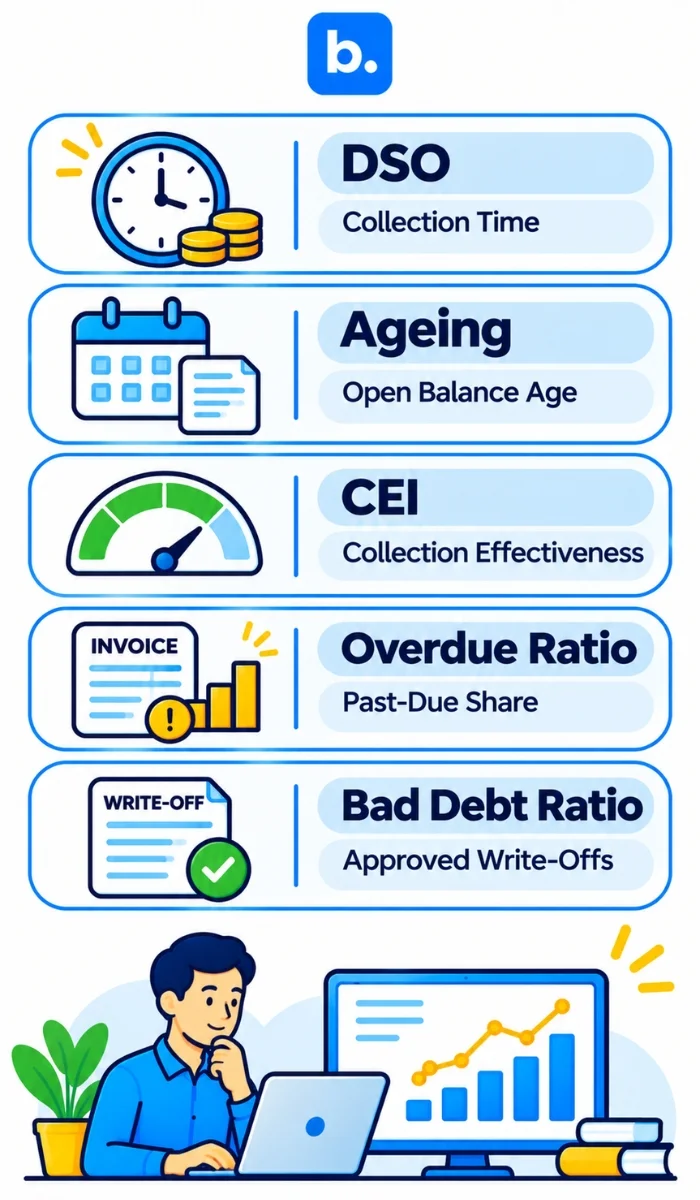
Use the same definitions for each measure, data source and reporting period. Metrics are not universal performance targets, but they do support investigation.
| Metric | What it measures | Practical note |
|---|---|---|
| Days Sales Outstanding (DSO) | The average number of days to collect sales on credit. | State the method of calculation and the period; seasonality and sales mix will impact interpretation. |
| Receivables ageing | The number of days that open invoices have been outstanding. | Review by due date, customer and dispute status. |
| Collection Effectiveness Index (CEI) | The percentage of receivables collected during a specific time frame. | Apply the same formula and ignore or adjust it the same way. |
| Overdue receivables ratio | Share of receivables past their due date. | Specify by invoice or by outstanding value. |
| Bad debt ratio | The percentage of receivables that have been written off or deemed uncollectible in accordance with the business’s accounting policy. | Do not consider forecast amounts as confirmed losses, use the accounting team’s approved definition. |
Compare trends with explanations: late customer approvals, disputed deliveries, missing invoices, settlement holds or unallocated receipts can call for different corrective actions.
Where does base.com fit in ecommerce receivables workflows?
At base.com, we help businesses organise ecommerce operations across sales channels. Our India Order Manager page explains orders from various marketplaces and stores, order processing, invoice generation and forwarding of invoices to online accounting services. Our India pricing page also explains how to generate and forward invoices to supported online accounting systems. These order and invoice records can be used to assist a business’s overall receivables process.
Our Order Manager is an order management system, not a complete accounts receivable ledger. The documented product information does not provide full AR ledger management, automated customer credit scoring or credit-limit approval, debt collection, automated customer payment reminders, bank-receipt matching or settlement reconciliation in all marketplaces. Outstanding balances, ageing, collection controls and financial reconciliation may require businesses to use their accounting or dedicated receivables software.
Conclusion
The first step in effective receivables tracking is to link each expected amount to evidence: an order or invoice, marketplace settlement information, customer payment terms and the bank receipt. Ecommerce teams can reduce overdue balances by assigning clear follow-up ownership, reviewing ageing, resolving unmatched credits and separating confirmed payments from estimates. Our order-management and invoice workflows can help maintain organised operational records and accounting hand-offs at base.com, but additional accounting or receivables software might be required for ledger management, collections, ageing and financial controls.