Indian businesses can reach overseas customers through established marketplaces, but choosing one involves more than comparing audience size. Product fit, seller eligibility, fees, fulfilment, payment settlement and destination requirements all affect whether a channel is practical. This guide compares international marketplaces for Indian sellers: Amazon Global Selling, Etsy, eBay, Lazada, Shopee and Noon. There is no single best platform for every business: Amazon and eBay offer broad international reach, Etsy suits products that meet its creative standards, and Noon offers a defined route to selected Middle Eastern markets. Lazada and Shopee are relevant to Southeast Asia, but their local presence does not by itself confirm that Indian businesses can register directly.
Why Indian sellers are exploring international marketplaces
International sales can reach customers where products have demand, reduce reliance on one domestic channel and test overseas interest before building a local store. Indian-made and specialist products may benefit from marketplace discovery.
Listing is only one part. Assess customer preferences, shipping, settlement and currency conversion, returns, support and destination documentation. Requirements vary by item and country. Choose by product, target buyer and ability to fulfil reliably.
International marketplaces for Indian sellers compared
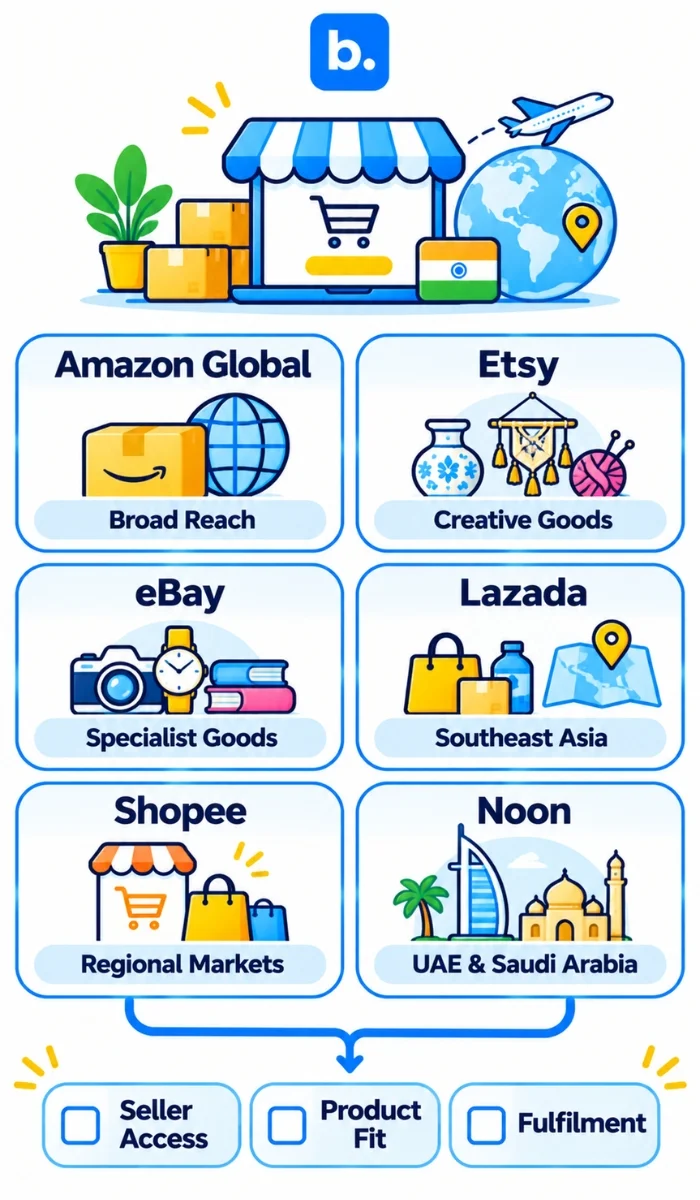
Use this table to shortlist, not as confirmation of universal Indian seller access. Check current official documentation before committing stock or marketing spend.
| Marketplace | International markets | May suit | What Indian sellers should check |
|---|---|---|---|
| Amazon Global Selling | North America, Europe, Middle East and Asia-Pacific marketplaces | Brands, manufacturers and established product businesses | Registration, product-specific requirements, fulfilment route and current fees |
| Etsy | International destinations enabled by shop delivery settings | Handmade, seller-designed, qualifying vintage and craft-supply products | Creativity rules, India onboarding, GSTIN and Payoneer requirements |
| eBay | Buyers across numerous international markets | Collectibles, specialist goods, accessories and varied catalogues | India export eligibility, listing rules, shipping and seller performance |
| Lazada | Southeast Asian marketplaces | Brands researching Southeast Asian customers | Available cross-border programme and seller onboarding from India |
| Shopee | Southeast Asia and selected other regions | Sellers researching mobile-led consumer markets | Country-specific access, programme eligibility and fulfilment route |
| Noon | UAE and Saudi Arabia for its India programme | Sellers targeting selected Middle Eastern customers | Eligibility, listing, pricing, product and fulfilment requirements |
Marketplace reach, seller registration and fulfilment access are separate questions. Verify each one for the intended market.
1. Amazon Global Selling
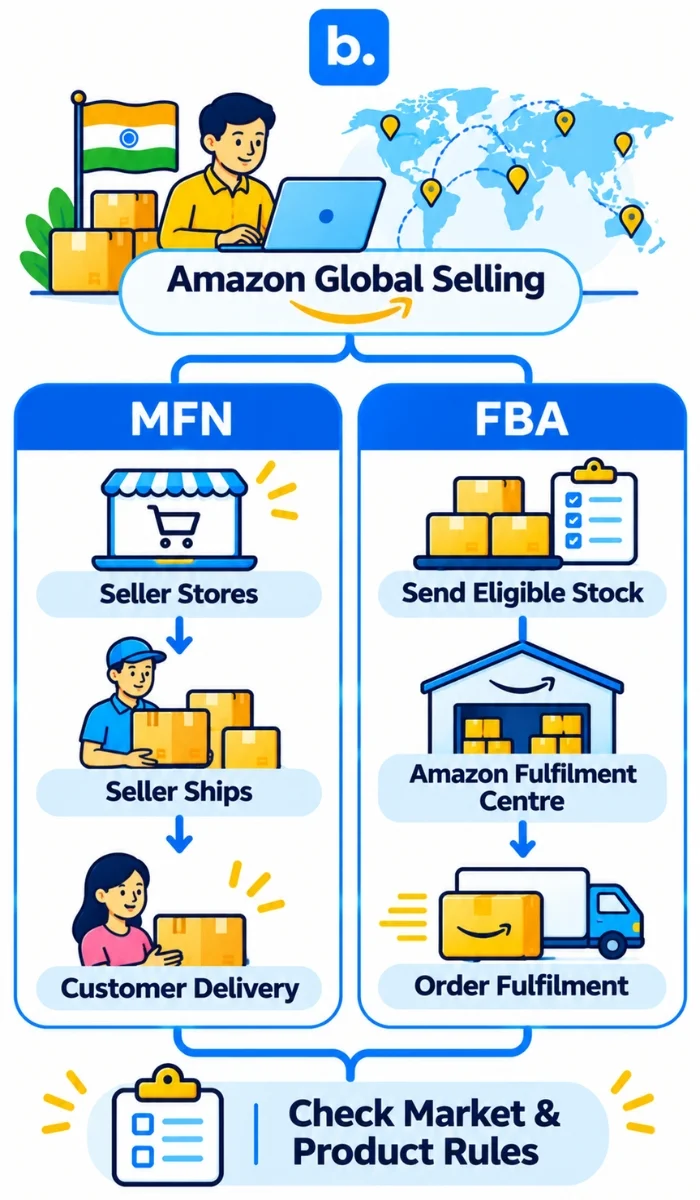
Amazon Global Selling provides Indian businesses a route to list on Amazon marketplaces outside India. Amazon’s India programme describes access to 18+ marketplaces across North America, Europe, the Middle East and Asia-Pacific. Its official pages outline registration and product listing, and identify identity and business documents that may be requested. Additional licences or documentation depend on the product and destination, so do not treat one registration checklist as a universal export checklist.
Sellers can choose between Merchant Fulfilled Network (MFN), where the seller arranges fulfilment, and Fulfilment by Amazon (FBA), where eligible inventory is placed in Amazon fulfilment centres and Amazon handles fulfilment functions for orders. Compare the route, product eligibility, shipping, fees and returns for the specific marketplace before choosing. Relevant official references: Amazon Global Selling from India, its registration guide and export FAQs.
Amazon may suit manufacturers, exporters and D2C brands prepared to build a structured export operation and check compliance and fulfilment requirements market by market. Product examples in Amazon’s guidance include home textiles, apparel, jewellery, beauty and selected consumer goods, but category requirements differ.
2. Etsy
Etsy is not a general-purpose outlet for every mass-produced product. Its Creativity Standards focus on items made, designed, handpicked or sourced by the seller, including qualifying handmade goods, original designs, vintage items and craft supplies. Indian makers of jewellery, textiles, artwork, home décor and personalised gifts may consider it when the product genuinely fits those rules. Review Etsy’s official selling categories and standards before creating listings.
Etsy’s India payment guidance says new shops opened in India can currently sell internationally, require GSTIN verification and must use Payoneer to accept Etsy Payments. It also states a one-time USD 10 shop set-up fee and that Indian shops enrolled in Etsy Payments cannot accept domestic sales at present. These details can change, so check Etsy’s current India seller payment and onboarding guidance before applying. Etsy may suit a creative, differentiated catalogue, but its access conditions and product rules make it a poor fit for some conventional mass-market ranges.
3. eBay
eBay offers Indian businesses a route to international buyers across many markets, with a broad catalogue that can include collectibles, specialist products, accessories and other categories. Its Export from India hub describes global selling from one account, listing and shipping preparation. eBay’s India cross-border trade guidance describes seller documentation and shipping considerations. Check the account-specific eligibility for any shipping programme; a programme name is not a guarantee that every seller or item qualifies.
Before listing, prepare accurate descriptions, condition details, destination settings and realistic shipping estimates. Include packaging and international shipping costs when assessing margin, and plan how to handle customer questions and returns. eBay may be useful for sellers with diverse or specialist products whose buyers are distributed internationally, especially when product variety matters more than a narrow, country-specific storefront strategy.
4. Lazada
Lazada’s official site describes its Southeast Asian presence, and its Open Platform documents seller and service-provider APIs. Neither source confirms that an Indian business can open a seller account directly.
For an Indian brand, the key question is the current onboarding route. Lazada’s presence in a country does not establish direct registration access for every overseas seller. Cross-border programmes, seller location requirements and fulfilment arrangements can vary. Confirm eligibility with Lazada and obtain current programme terms before paying for listings, moving stock or planning a launch. Lazada may be worth researching for a deliberate Southeast Asian expansion, but include it in the sales plan only after you confirm the route from India and the practical fulfilment model.
5. Shopee
Shopee’s official country selector lists markets including Singapore, Malaysia, Indonesia, Thailand, the Philippines and Vietnam, as well as selected other regions. That demonstrates marketplace presence, not that an Indian business can register as a seller in those markets. Its official marketplace page does not establish a standard India seller onboarding programme.
Confirm country-specific seller access and cross-border programmes through official seller resources before planning inventory. Rules and fulfilment differ by market. Shopee may interest sellers researching mobile-first consumer markets, but do not treat it as interchangeable with Lazada. Check eligibility before preparing stock.
6. Noon
Noon is relevant to sellers targeting selected Middle Eastern markets. Its Seller Help Centre identifies an India-to-UAE and India-to-KSA Global Selling opportunity for eligible Indian sellers. The programme should not be generalised to every Noon market or every seller.
Noon’s Global Selling overview links to the India onboarding route. The India-to-UAE and KSA setup guide describes product setup, HSN information, USD pricing, fulfilment and seller documentation. It also explains that programme terms and product eligibility apply. Read the current instructions in full and confirm the details for your products before applying. Noon may suit an Indian seller with a specific UAE or Saudi Arabia strategy and the capacity to meet the programme’s operational requirements.
How to choose the right international marketplace
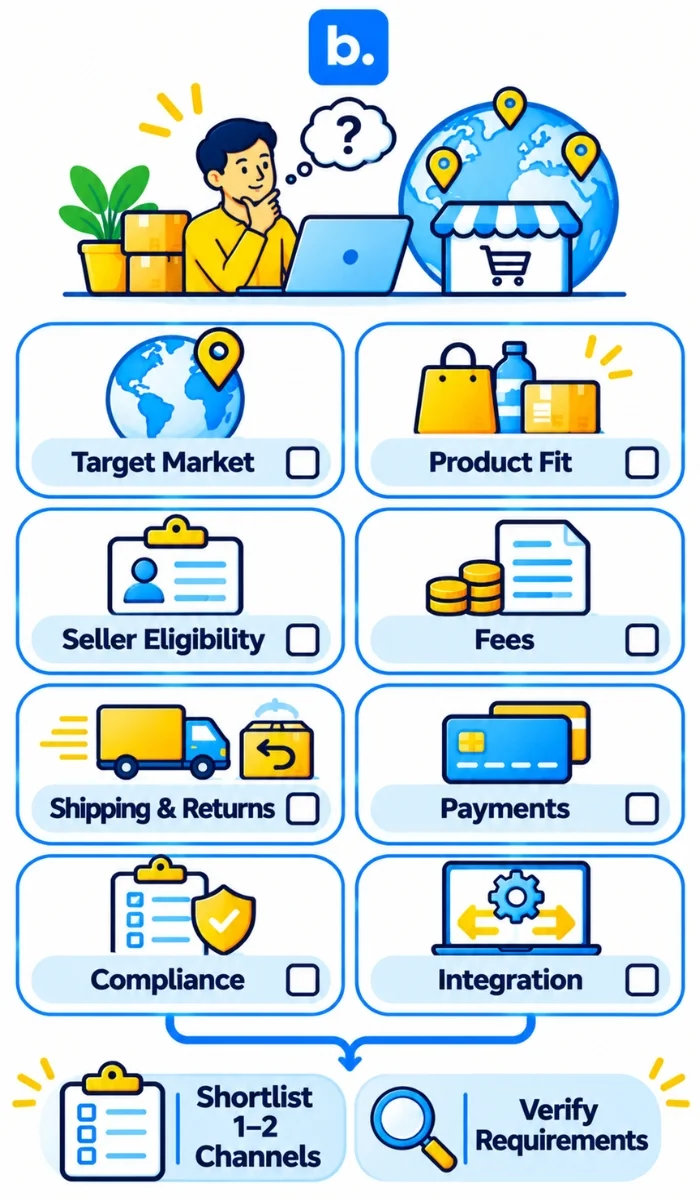
Start with product, target customer and fulfilment ability. A smaller relevant market may be a better start than a large audience if it can be served reliably and profitably.
| Factor | What to check |
|---|---|
| Target market | Where is there evidence of demand for this product? |
| Product suitability | Does the catalogue fit the marketplace audience and rules? |
| Seller eligibility | Can an Indian business register directly or use a supported programme? |
| Fees | What listing, selling, payment, fulfilment and optional service charges apply now? |
| Shipping and returns | Can orders and returns be handled at viable cost and service levels? |
| Payments | How are proceeds settled, in which currency and through which provider? |
| Compliance | What product, export and destination requirements apply? |
| Integration | Can the marketplace connect to the seller’s current operations tools? |
Shortlist one or two options. Validate registration, product acceptance, landed economics, payment and returns before scaling. Reassess fees and policies from official sources because they change.
What Indian sellers need to prepare before selling internationally
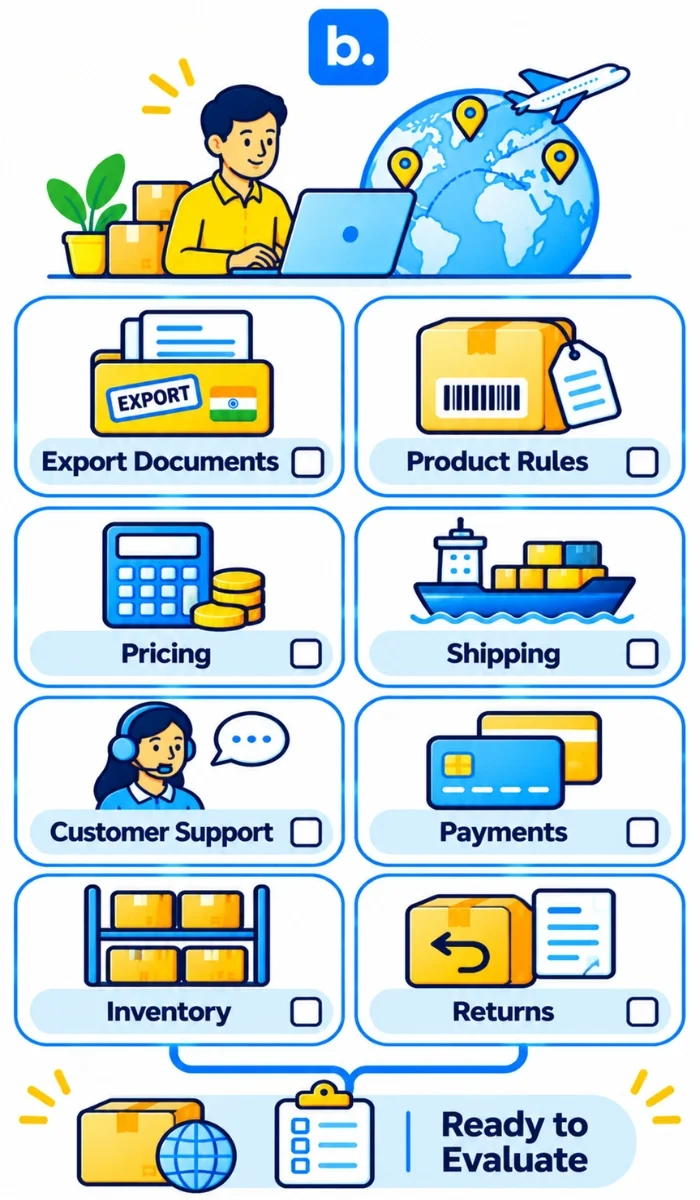
Prepare operations as well as listings:
- Business and export documents: Check applicable business registrations and export documents, including IEC where required. Confirm product- and destination-specific requirements with official sources or a qualified adviser.
- Product readiness: Verify marketplace rules, labelling and destination standards for the exact item.
- Pricing: Allow for marketplace charges, shipping, packaging, payment costs, currency movements and returns.
- Shipping and fulfilment: Decide whether orders ship from India, use a marketplace fulfilment programme or follow another arrangement.
- Customer service: Plan for overseas queries, time zones, delays and returns.
- Payments: Understand settlement currency, payment provider, conversion and withdrawal arrangements.
- Inventory: Decide the stock allocation for each channel and how to prevent overselling.
This is a preparation framework, not legal or tax advice. Requirements depend on product, marketplace and destination. Confirm them with the relevant marketplace and government authorities.
Why ecommerce integration matters when selling on multiple international marketplaces
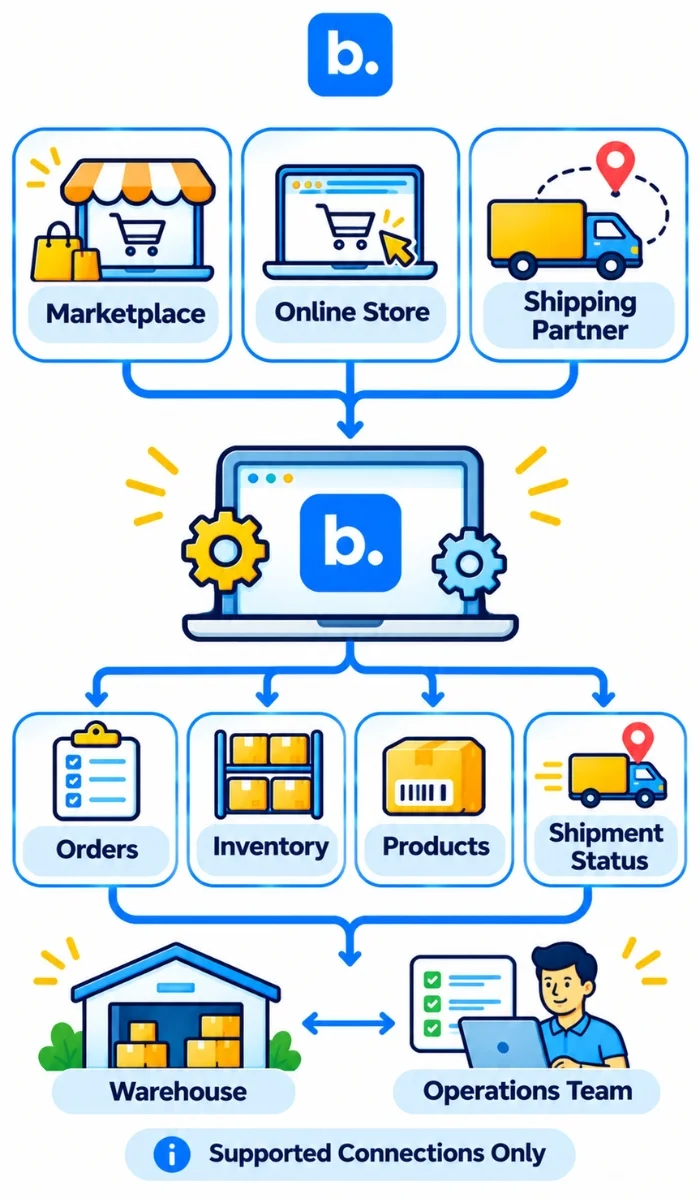
Multiple marketplaces, a Shopify store and fulfilment partners can scatter orders, stock updates, shipment statuses, returns and settlement records across separate tools.
An ecommerce integration platform transfers agreed information between connected stores such as Shopify, marketplaces, shipping, warehouse and finance systems. Check which order, product, stock and shipment data each connection moves and how errors are handled. Ecommerce platform integration does not establish international compliance.
The ecommerce integration platform guide explains connections and data ownership. A multichannel integration platform can reduce repeated entry; verify each marketplace and provider connection.
How an order management system helps manage international marketplace orders
An order management system (OMS) manages order workflows, inventory information and fulfilment operations across connected sales channels. It can bring supported orders into one view, help teams monitor order status, coordinate processing and shipment tasks, and surface pending orders or exceptions. Actual capabilities depend on the product and integrations.
An integration platform focuses on connecting systems and transferring agreed information. An OMS focuses on the operational rules and workflow for orders, stock and fulfilment. Some products offer both. Neither should be assumed to manage every international tax, customs, payment or marketplace compliance requirement. For a broader explanation, see what an order management system does. The related guide to managing Shopify, Amazon and Flipkart orders in one dashboard offers an example of connected channel operations.
When comparing OMS software, check supported channels, stock sync, status mapping and exceptions. Integration and order processing are related but distinct.
How Base helps connect ecommerce operations
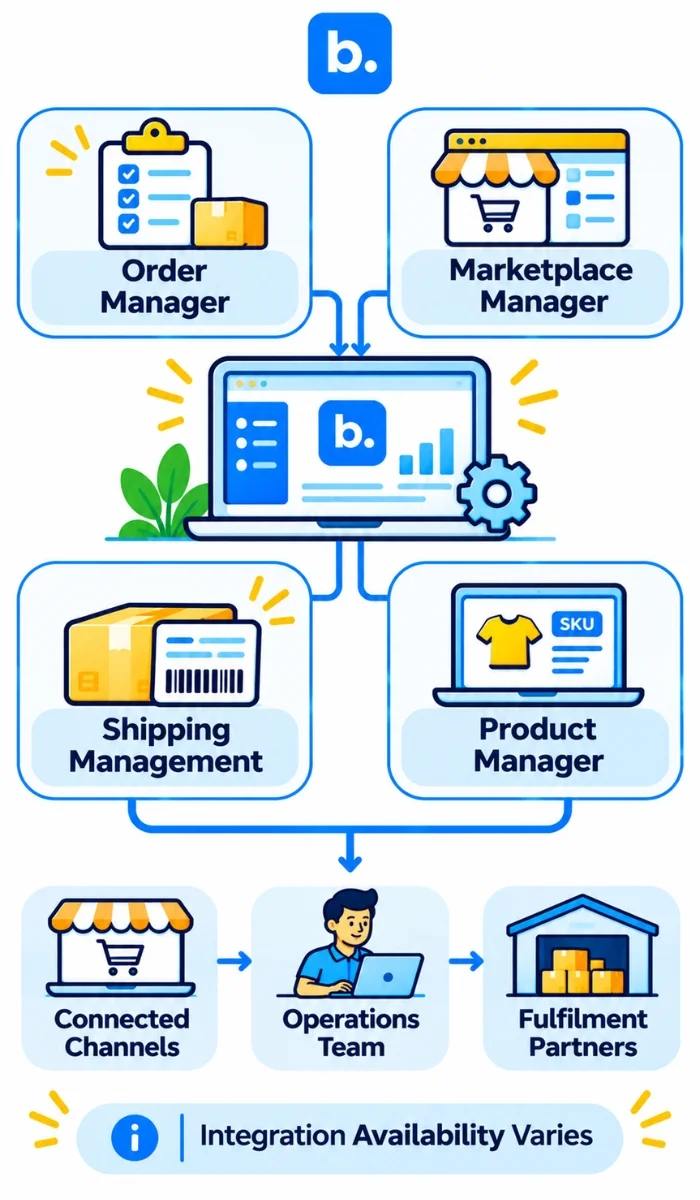
Base provides operational tools for supported connected channels. Order Manager brings orders from connected stores and marketplaces into one place for processing. Marketplace Manager supports marketplace listing and order workflows where the relevant integration is available. Shipping Management supports shipment creation, labels and tracking through available carrier integrations. Product Manager supports central product information and channel-specific product data.
Which marketplace, store, carrier and system is available depends on the specific integration and seller setup. Do not assume that Base connects directly to all six marketplaces in this comparison or automates international tax, customs or currency conversion. Check the integrations relevant to your destination and processes. Explore our guide to order management software for ecommerce businesses or request a demo to see whether our connected order and shipping workflows fit your operations.
Conclusion
The right international marketplaces for Indian sellers depend on product fit, market, seller eligibility, fulfilment costs and the ability to manage orders reliably. Amazon Global Selling and eBay offer broad reach; Etsy suits qualifying creative products; Lazada and Shopee merit research subject to Indian seller access; Noon has a defined India-to-UAE and KSA route. Shortlist carefully, verify current rules and test operations before expanding. Consider how integration and OMS tools can support your next stage.