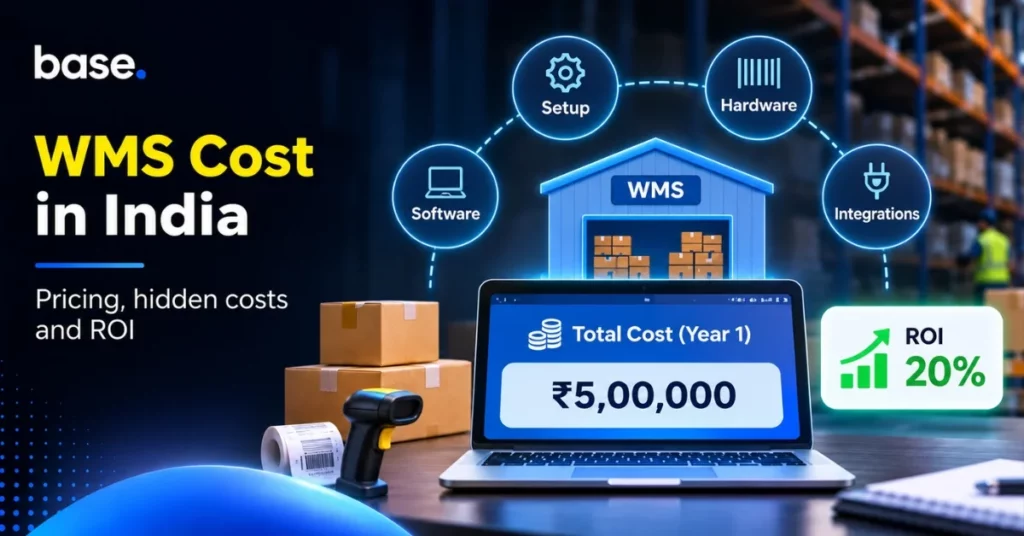
You are an Indian ecommerce business processing 500 orders a day and want to move from using spreadsheets to a warehouse management system. One vendor offers low monthly fees and another offers a high up-front fee but low ongoing fees.
Which is the cheapest option?
Warehouse management systems will have a lot of hidden costs besides just the monthly fee. You will also need to account for set up, integrations, data migration, barcode scanners, training and support.
For example, a ₹20,000 monthly fee could become a ₹5 Lakh investment in the first year.
This guide explains all the costs involved in a WMS in India, including those not highlighted by vendors. You will also learn how to work out if it is a good investment.
What is a Warehouse Management System?
A Warehouse Management System (WMS) helps you manage your stock and warehouse. This includes receiving goods, storing goods, picking, packing and dispatch.
Depending on the software you choose you may also get features like barcode scanning, bin level tracking, cycle counting, returns and batch/serial tracking.
Not all will be required by your business.
| Type of Software | Main Purpose | Typical Cost Factors |
|---|---|---|
| Basic Stock Management | Track stock levels and movement | Number of users, SKUs and locations |
| WMS | Manage warehouse operations | Number of users, warehouses, processes and hardware |
| OMS | Manage orders from sales channels | Number of orders, sales channels and integrations |
| ERP | Link your finance, procurement and stock | Number of modules, users and set up |
If you are only storing 100 SKUs in a small stockroom and processing 20 orders a day, a basic stock management software may be sufficient.
However, if you are processing hundreds of orders, having multiple storage bins and making frequent picking errors, you may want to consider a dedicated WMS. Before looking at the costs, determine what issues you are facing in your warehouse.
How Much Does a Warehouse Management System Cost in India?
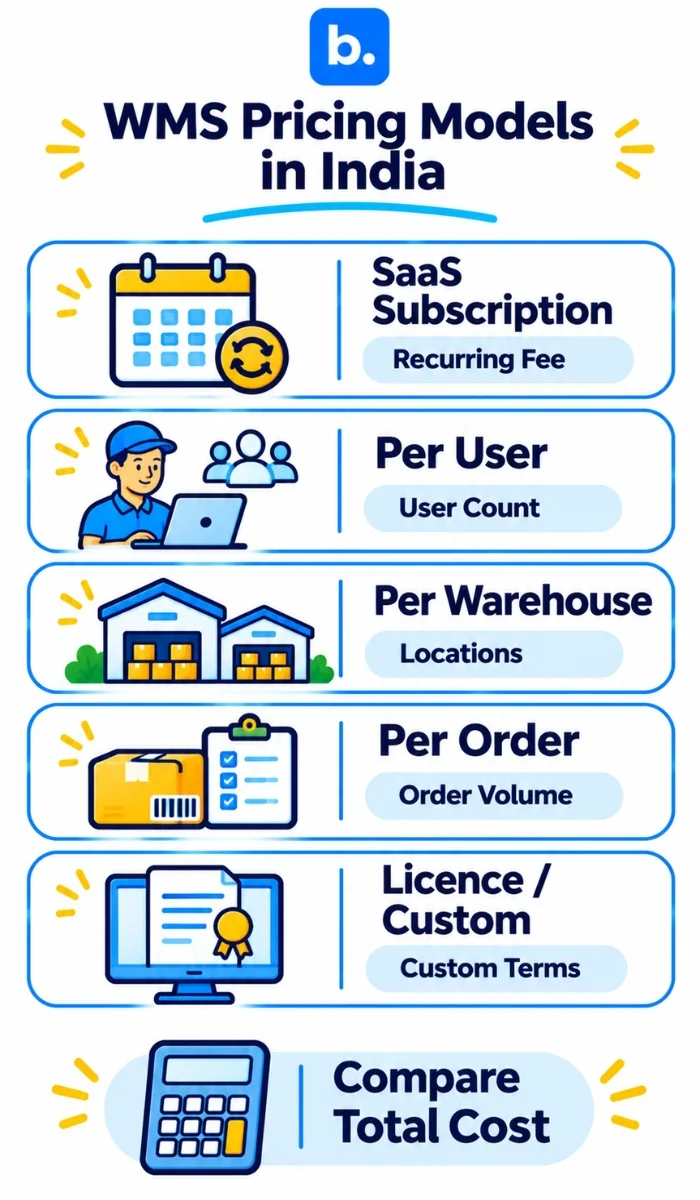
The warehouse management system cost in India will depend on the size of your warehouse, number of users, orders processed daily and the number of integrations and features you need.
Here is a guide:
| Business Needs | Illustrative Example Price | Description |
|---|---|---|
| Basic Stock Management | ₹1,000 – ₹5,000 | Basic stock tracking with limited warehouse features. |
| Small Ecommerce Warehouse | ₹5,000 – ₹20,000 | Basic stock and fulfilment features. |
| Growing Multichannel Business | ₹20,000 – ₹75,000 | More users, integrations and warehouse features. |
| Large or Custom WMS | ₹75,000+ | Advanced warehouse features or multiple warehouses. |
| Enterprise | Custom Price | Advanced set up. |
These price ranges are illustrative examples, not verified market averages or vendor quotations. Actual WMS pricing will depend on your warehouse requirements, number of users, integrations and features. Basic stock management software may not be a full WMS. Your quote may also exclude GST, set-up, hardware, extra users and integrations.
WMS Pricing Models in India
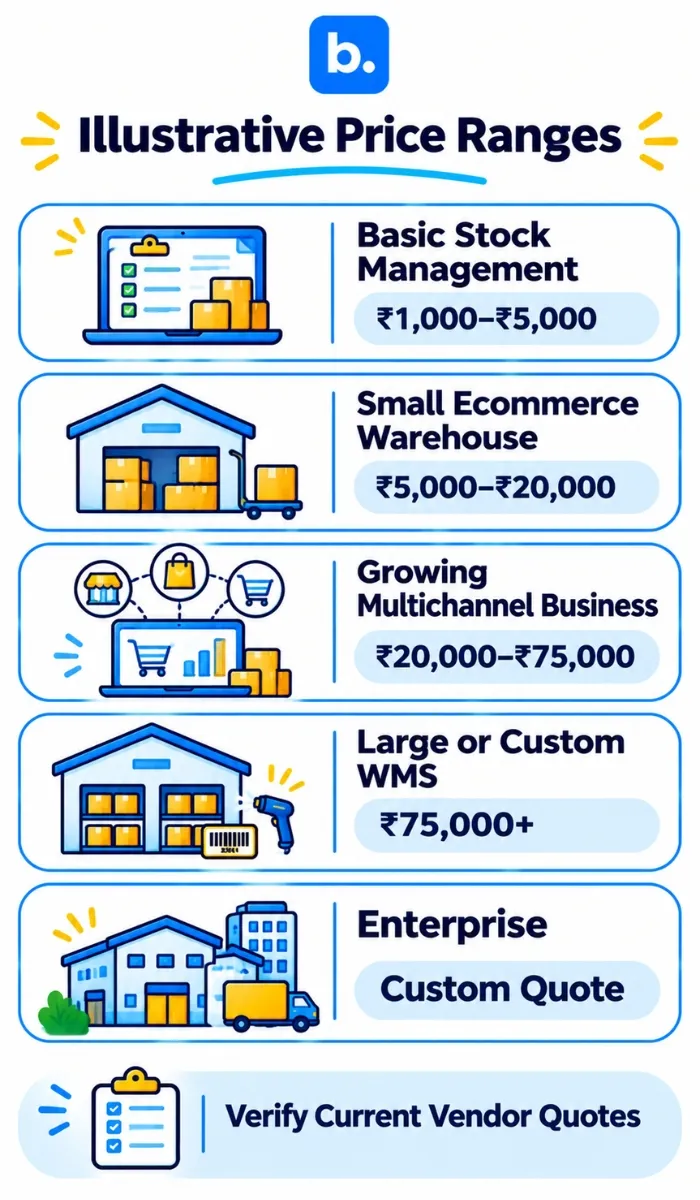
Vendors will offer different pricing models. Some will have a flat rate, while others will charge based on users, warehouses or orders.
Monthly/Annual SaaS Fee
You will pay a recurring fee for using the cloud-based software.
You may also pay for extra modules, integrations or increased usage limits. However, hosting and standard updates may be included.
Per User
You will pay based on the number of users.
Check if they charge for named users or concurrent users. If you have multiple shifts in your warehouse, you may want to know if they charge for this.
Per Warehouse
You will pay based on the number of warehouses.
Opening another warehouse may increase your subscription and set up fees.
Per Order
Some vendors will charge based on orders.
You may pay more during peak periods like Diwali or festive sales.
One-Time Licence or Enterprise
You will pay a one-time licence fee or negotiate a custom price. You may also pay extra for infrastructure, maintenance, support and upgrades.
| Pricing Model | Description | Pros | Cons |
|---|---|---|---|
| SaaS | Monthly or annual fee. | Easy to budget. | Extra modules/upgrades. |
| Per User | Pay per user. | Easy to scale. | More expensive for more users. |
| Per Warehouse | Pay per warehouse. | Easy to budget. | More expensive for more warehouses. |
| Per Usage | Pay per order. | Easy to budget. | More expensive during peak times. |
| Licence or Custom | One-time or negotiated price. | Custom. | More expensive to start with. |
Illustrative Monthly WMS Fee
If a vendor offers the following:
| Cost | Monthly |
|---|---|
| Base Fee | ₹12,000 |
| Extra Users (5) | ₹4,000 |
| Extra Integration | ₹3,000 |
| Total Software Cost | ₹19,000 |
This would cost ₹19,000 a month before GST and ₹2,28,000 a year. This is just an example.
When asking for quotes, check how much you will be charged for an annual commitment, renewal and cancellation. WMS software vendors may use a combination of pricing models.
What Affects WMS Software Pricing?
You may get vastly different quotes for 2 warehouses processing the same number of orders.
One may have simple products and open shelving, while another may require expiry tracking, multiple picking areas and custom ERP integrations.
Below are the key factors:
| Cost Factor | Simple | Complicated | Impact |
|---|---|---|---|
| Warehouses | 1 Warehouse | Multiple Warehouses | Extra licences and set up. |
| Users | Few Users | Multiple Shifts | Extra charges for more users. |
| SKU Complexity | Simple Products | Variants, Batches & Serials | Extra modules. |
| Orders | Stable Orders | High Peaks | Usage based. |
| Processes | Simple Picking | Wave Picking & Advanced Putaway | Extra features. |
| Integrations | Standard Integrations | Custom APIs | Extra development & maintenance. |
| Implementation | Standard Cloud | Custom Infrastructure | Extra hosting & IT costs. |
| Support | Standard Support | Dedicated Support | Extra support fees. |
When asking for quotes, give realistic numbers for orders processed daily, peak times, SKUs and number of warehouses.
Ask how much the price will increase as your business grows. A price that works for 1 warehouse may be expensive for 3 new warehouses.
Hidden Costs of Using a Warehouse Management System
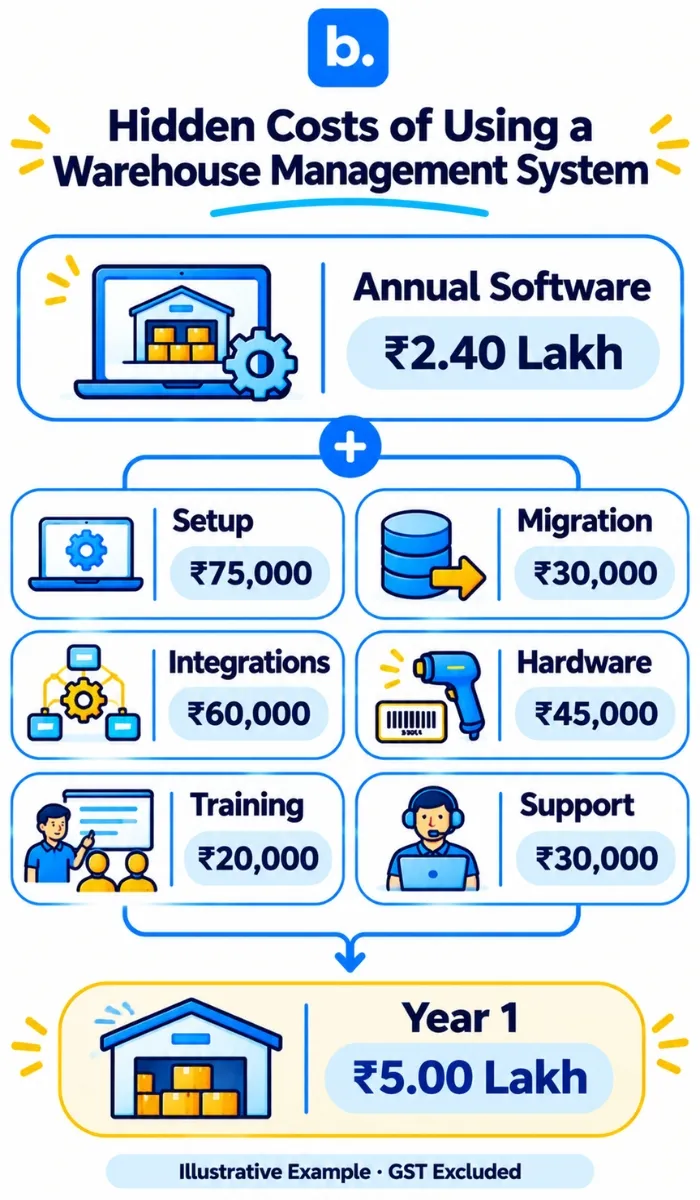
Monthly fees are often the easiest to identify. However, your budget can change based on set up.
Even if 2 WMS systems are similar in price, you may pay very different amounts for set up.
Set Up & Configuration
You will need to set up your warehouse, bins, user permissions and picking rules.
If you have multiple warehouses, you may need to set up each one.
Data Migration
You will need to transfer your product details, SKU codes, barcodes and stock information.
Incorrect opening stock can cause issues straight away. So include reconciling and testing in your budget.
Integrations
You may need extra fees to integrate your WMS with Shopify, Amazon, Flipkart, Meesho, OMS or ERP.
Standard integrations are usually easier to budget for than custom APIs.
Hardware
You may need to invest in some hardware like barcode scanners, label printers, mobile devices, workstations and warehouse Wi-Fi.
Check the compatibility of any devices.
Training
Your warehouse team will need training on receiving, scanning, picking, packing and adjusting stock.
Training will take time away from your usual operations.
Support & Maintenance
You may be charged extra for premium support, customisations and technical support.
Disruption
You may need extra staff, extra stock checks and less dispatch during set up.
Growth
You may be charged extra for extra warehouses, users, orders and integrations.
Illustrative WMS Cost in 1st Year
| Cost | Example Price |
|---|---|
| WMS Fee | ₹2,40,000 |
| Set Up | ₹75,000 |
| Data Migration | ₹30,000 |
| Integrations | ₹60,000 |
| Barcode Scanners & Printers | ₹45,000 |
| Training | ₹20,000 |
| Extra Support | ₹30,000 |
| Total | ₹5,00,000 |
This example uses a ₹20,000 monthly fee. It does not include GST, internal labour or other costs.
Note how much more the total cost is. The WMS fee would be ₹2.4 Lakh but the total investment is ₹5 Lakh. Some costs may not be incurred every year.
Cloud or On-Premise Warehouse Management System Software?
Cloud-based warehouse management system software will be hosted by the vendor. On-premise software will be hosted by your business.
Cloud-based options will often be cheaper to start with but may not be the most economical over a few years.
| Cost Factor | Cloud WMS | On-Premise WMS |
|---|---|---|
| Upfront Costs | Often cheaper | Sometimes more expensive. |
| Hosting | Usually by vendor. | Usually by business. |
| Maintenance | Often included in the subscription. | Internal or vendor support. |
| Updates | Often by vendor. | May need scheduled updates. |
| Customisations | Depends on platform. | Depends on licence & infrastructure. |
| Scalability | Depends on plan & platform. | Depends on infrastructure. |
| Internet | Usually requires internet. | Depends on set up. |
| Longterm | Subscription & extra fees. | Maintenance, infrastructure & updates. |
Smaller businesses may prefer SaaS to avoid investing in infrastructure.
Sometimes larger businesses will consider on premise or private options if they have specific infrastructure, security or customisations.
Try to compare vendors on the same features, support and costs over 3-5 years.
How Much Does a Warehouse Management System for Small Business Cost?
Small business warehouse management systems will not need all the features of enterprise software.
Small ecommerce warehouses will likely only need accurate stock tracking, barcode scanning, receiving, picking, packing and order integrations.
Basic stock management systems may be sufficient if your storage is simple.
| Business Scenario | Software | Main Focus |
|---|---|---|
| Small Stockroom & Low Orders | Basic Stock Management | Accurate Stock. |
| 1 Warehouse & Increasing Orders | Entry Level WMS | Scanning & Picking. |
| Multiple Marketplaces | OMS with Stock Integrations | Orders & Stock. |
| Multiple Warehouses | More Advanced WMS | Stock per Warehouse & Transfers. |
| High Volume 3PL | Advanced WMS | Client Stock & Processes. |
Some inventory software offers free or low-cost entry plans with limits on orders, users and warehouses. However, these are often inventory & order management system tools, so their entry level pricing is not representative of a dedicated WMS. For a comparison of the two, see OMS vs WMS for ecommerce sellers.
Before signing up, ask about minimum number of users, maximum orders per month, barcode features, integrations, set up support and extra charges for extra warehouses.
How to Work Out the Total Cost of Ownership of a WMS
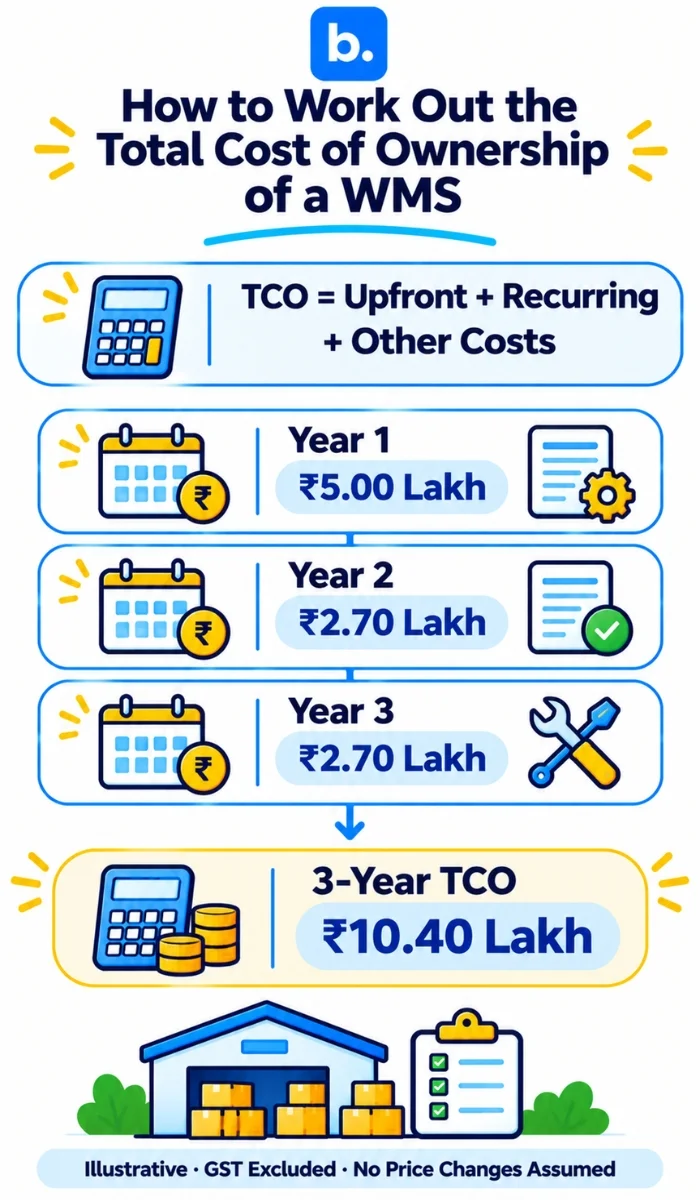
Total cost of ownership (TCO) is the total you pay to buy, set up and run the software within a given timeframe.
This will give you a better idea of how much you are paying.
WMS TCO = Upfront Costs + Recurring Costs + Other Costs.
Illustrative 3 Year Cost
| Cost | Year 1 | Year 2 | Year 3 |
|---|---|---|---|
| WMS Fee | ₹2,40,000 | ₹2,40,000 | ₹2,40,000 |
| Set Up & Data Migration | ₹1,05,000 | ₹0 | ₹0 |
| Integrations | ₹60,000 | ₹0 | ₹0 |
| Hardware | ₹45,000 | ₹0 | ₹0 |
| Training | ₹20,000 | ₹0 | ₹0 |
| Extra Support | ₹30,000 | ₹30,000 | ₹30,000 |
| Total | ₹5,00,000 | ₹2,70,000 | ₹2,70,000 |
Total TCO (Example)
₹10,40,000
This assumes no changes to the WMS fee or extra support. It also assumes no extra hardware or integrations. It does not include GST or other costs.
You should also factor in any increases in price, extra users, extra warehouses, new devices, internal IT costs and any migration costs if changing vendors.
Work out the 3 year TCO for each of your shortlisted providers.
How to Work Out the Return on Investment of a WMS
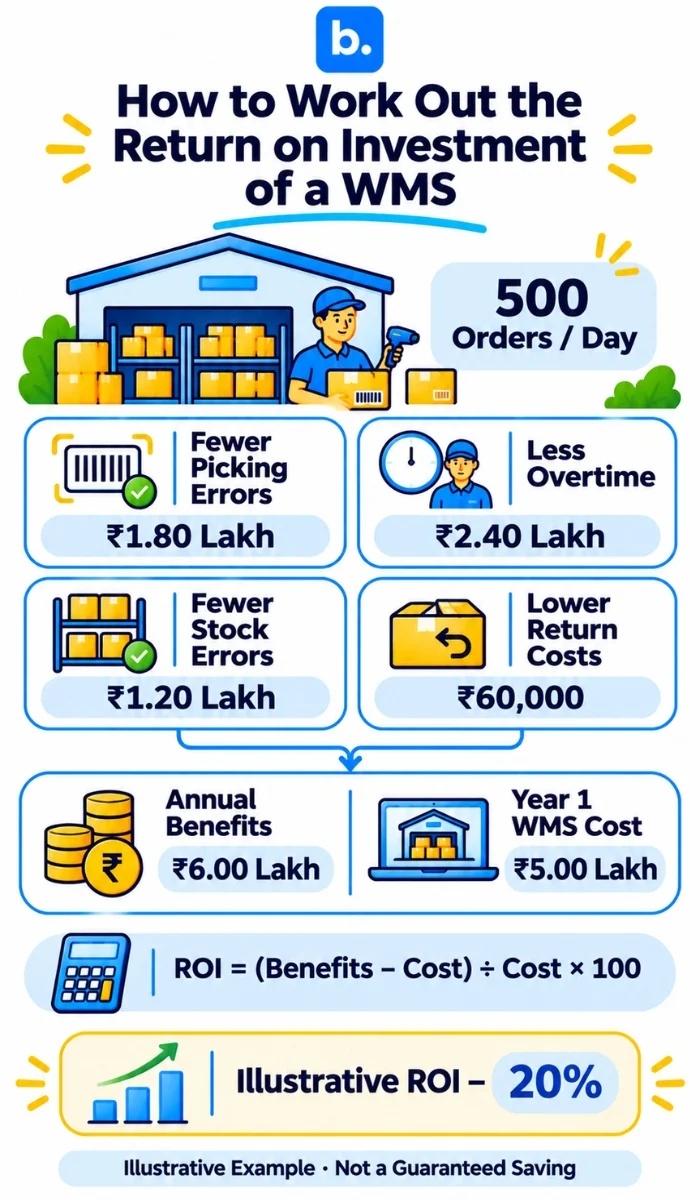
Return on investment (ROI) will tell you if the software is financially worth the investment.
A WMS can reduce picking errors, manual processes, stock errors and avoidable returns. However, you need to work out if you are saving money.
ROI% = ((Total Financial Benefits – Total WMS Cost) / Total WMS Cost) x 100.
Ensure you are comparing the same time frame.
For example if you are saving time due to less picking errors, work out how much you are saving on overtime, extra work or other costs.
Do not double count.
Illustrative WMS ROI – Is a ₹5 Lakh Investment Worth It?
Your warehouse processes 500 orders a day. You operate 26 days a month.
This is approximately 13,000 orders a month.
After implementing a WMS you notice the following savings:
| Benefit | Example Savings |
|---|---|
| Less Picking/Packing Errors | ₹1,80,000 |
| Less Overtime & Manual Processes | ₹2,40,000 |
| Less Stock Errors | ₹1,20,000 |
| Less Avoidable Return Costs | ₹60,000 |
| Total Financial Benefits | ₹6,00,000 |
| WMS Cost (1st Year) | ₹5,00,000 |
| Net Benefit (1st Year) | ₹1,00,000 |
Using the formula:
ROI = ((₹6,00,000 – ₹5,00,000)/ ₹5,00,000) x 100.
ROI (Example)
20%.
Your business is making a 20% ROI on the initial investment.
How Long Until You Break Even?
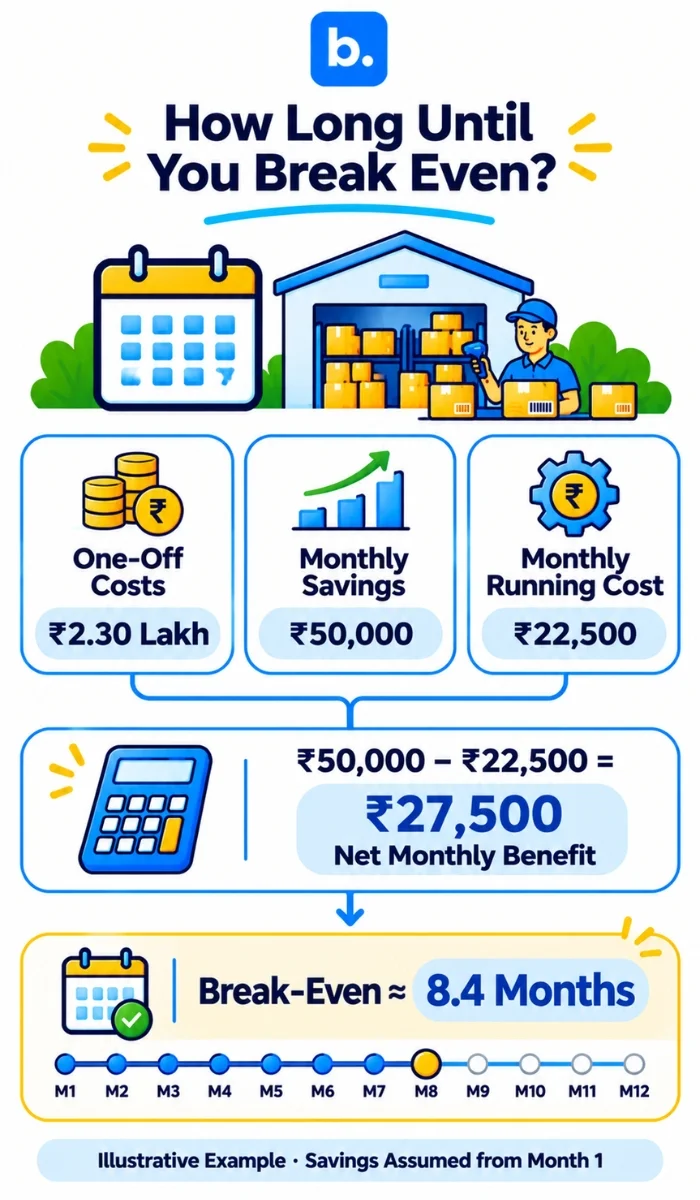
In this case you have ₹2,30,000 in one-off costs. You are saving ₹50,000 a month. Your WMS is costing ₹22,500 a month.
Net benefit = ₹50,000 – ₹22,500 = ₹27,500.
Break Even Point = ₹2,30,000 / ₹27,500 = ~8.4 months.
This assumes you start saving straight away and it remains the same. In reality it may take longer due to training, set up and improvements.
These are just examples and are not typical or guaranteed.
How to Compare Vendors Without Picking the Wrong Pricing Model
The cheapest warehouse management solution may not be the one saving you the most money.
Give each vendor the same requirements. This should include orders processed daily, number of SKUs, number of warehouses, existing software and how your business will grow.
Compare the following:
- Features – Receiving, putaway, barcode scanning, picking, packing, returns & cycle counting.
- Pricing – Monthly fee, number of users, number of warehouses & number of transactions.
- Set Up – Configuration, data migration, integrations, testing & training.
- Support – Hours of support, response time & extra charges.
- Scalability – Extra users, warehouses & orders.
- Contracts – Minimum commitment, renewal cost, cancellation & data export.
Use a comparison table to compare quotes.
| Criteria | Vendor A | Vendor B | Vendor C |
|---|---|---|---|
| Monthly Software Fee | TBC | TBC | TBC |
| One-off Set Up | TBC | TBC | TBC |
| Users Included | Check | Check | Check |
| Extra Warehouses | Check | Check | Check |
| OMS & ERP Integrations | Check | Check | Check |
| Barcode Processes | Check | Check | Check |
| Support Charges | Check | Check | Check |
| Total Cost of Ownership (3 Years) | Calculate | Calculate | Calculate |
Ask each vendor to demonstrate the same processes. For example, can they show you how they receive 100 units, allocate stock to bins, process an order and record a damaged return?
This will give you a better idea of the software.
When is a WMS Worth the Investment?
A WMS will be worth considering if you are experiencing issues with your existing processes.
If you are frequently having issues with:
- Picking & Packing errors.
- Incorrect stock.
- Difficulty finding products.
- Manual stock adjustments.
- Delays to dispatch.
- Multiple warehouses.
- Tracking batches, serials & expiry.
- Increasing orders.
Then you may need a more advanced software. However, do not pay for an expensive WMS just because your business is growing.
| Business Scenario | Recommendation |
|---|---|
| Low Orders & Simple Storage | Consider basic stock management. |
| Increasing Orders & Picking Errors | Consider entry level WMS. |
| Multiple Warehouses | Check if you need stock per warehouse. |
| Complex Batch/Serial Tracking | Consider specialised WMS. |
| High Volume Fulfilment/3PL | Consider advanced warehouse processes. |
| Have a good OMS | Check if you need a WMS. |
Work out how much you are losing due to your issues.
If you are losing ₹30,000 a month due to manual processes, you have a starting point.
How Base OMS Can Help Your Ecommerce
Before investing in extra warehouse software, check what your order management system can do. Base OMS helps ecommerce businesses manage their orders & stock information from supported sales channels.
Having a centralised order management system will help your team manage orders from connected marketplaces & online stores.
You will also have visibility of your stock and supported integrations to help you manage relevant stock information & fulfilment.
You may use a dedicated WMS for your physical warehouse and Base OMS to manage your ecommerce orders. Both systems will need accurate information to keep your orders & stock in line. Base OMS also offers WMS capabilities for managing physical warehouse operations, including stock locations, barcode scanning, picking and packing. The features available will depend on your subscription and configuration.
If you are looking at warehouse software costs, book a Base OMS demo to see what order & stock processes you can manage with your existing or planned integrations.
Common Mistakes Businesses Make When Budgeting
A WMS may seem like a reasonable investment but can end up being expensive.
Avoid the following 7 mistakes.
| Mistake | Risk | Solution |
|---|---|---|
| Only Comparing Subscription Fees | Not accounting for set up & support. | Calculate TCO. |
| Not Accounting for Set Up | Unexpected one-off costs. | Ask for detailed set up quotes. |
| Underestimating Integrations | Extra development costs. | Ask how much integrations will cost. |
| Paying for Unnecessary Features | More expensive subscription. | Only pay for what you need. |
| Not Accounting for Peak Times | More expensive usage. | Estimate peak times. |
| Assuming Savings from ROI | Unrealistic returns. | Use actual running costs. |
| Not Accounting for Growth | More expensive recurring costs. | Model growth scenarios. |
Compare the expected costs over 3 years.
Conclusion
The cost of a warehouse management system will be more than just the monthly fee. You will need to budget for set up, integrations, hardware, training & support.
Work out the total cost of ownership and compare to the savings you can make from your warehouse. The cheapest monthly fee may not be the most economical.
Compare vendors to your actual needs before investing. You can also check out Base OMS.