Flipkart Minutes, Amazon Now and Myntra M-Now are established quick-commerce services, but their public information differs when it comes to seller onboarding. Flipkart has reported close to 500 D2C brand partners and a network across more than 150 cities. Amazon Now has expanded its customer service to more than 120 cities, while Myntra M-Now offers faster delivery of fashion and beauty products in selected markets. Public information about dedicated seller applications, programme-specific fees and supply agreements remains limited. Brands should approach the relevant seller or partner teams to discuss eligibility, commercial terms and fulfilment requirements before committing stock.
Brands exploring how to sell on Flipkart Minutes, Amazon Now and Myntra M-Now should assess each programme separately, understand its product and fulfilment requirements, and commit stock only after receiving approval. This guide is designed for Indian D2C and ecommerce brand owners or category leads who are familiar with traditional marketplaces but are exploring quick commerce as an additional sales channel. It covers onboarding, documents, costs and fulfilment, including the practical questions to settle around supply, inventory ownership and returns. Programme information reflects publicly available announcements and may change as each service expands.
What is quick commerce?
Quick commerce is a retail model in which customers order products digitally and receive them within a short delivery window from nearby fulfilment locations. Local stock, micro-fulfilment centres and fast last-mile delivery bring products closer to demand. Delivery times and product availability vary by location and service.
Brands need a focused assortment, fast-moving SKUs, accurate stock records and regular replenishment. SKU means stock keeping unit, a seller’s identifier for a product or variant. Stock-outs at the local level can make a product unavailable even when central warehouse inventory is sufficient.
Quick commerce platforms and companies in India
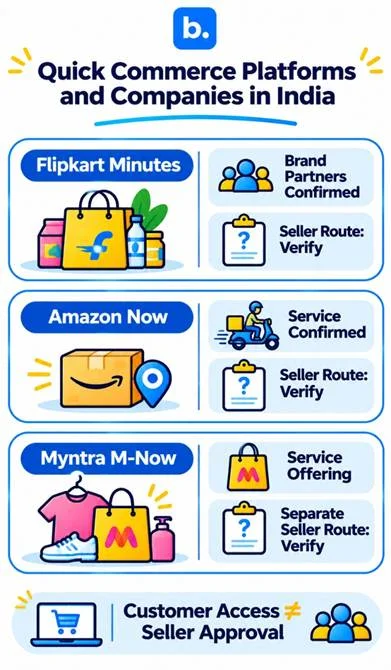
Flipkart Minutes, Amazon Now and Myntra M-Now serve customers through quick-commerce fulfilment networks. Their service coverage and product ranges are more visible publicly than the specific commercial arrangements available to individual sellers.
| Platform | Operated by / type | Public information and seller route |
|---|---|---|
| Flipkart Minutes | Flipkart Group’s quick-commerce service. | Flipkart reported close to 500 D2C brand partners and nearly 1,200 micro-fulfilment centres across 150+ cities in September 2026. It has highlighted gourmet grocery, men’s grooming and pet food among growing categories. Dedicated seller application details and commercial terms should be discussed with Flipkart. |
| Amazon Now | Amazon India’s quick-commerce service. | Amazon reported availability in more than 120 cities in October 2026, supported by nearly 800 micro-fulfilment and urban fulfilment centres. Its published range includes groceries, fresh and frozen food, personal care, fashion and beauty, small appliances, and home and kitchen products. Ask Amazon about programme participation and terms. |
| Myntra M-Now | Myntra’s quick-commerce service. | M-Now launched in Bengaluru and expanded to Delhi-NCR and Mumbai. Public reporting describes a selection of nearly 600 fashion and beauty brands. Brands can use Myntra’s Partner Portal to enquire about M-Now participation; programme-specific onboarding and commercial terms need to be discussed with Myntra. |
Customer availability does not guarantee seller access. Similarly, standard marketplace registration does not automatically confirm participation in a quick-commerce programme. Brands should discuss eligibility, approved categories, supply locations and commercial terms with the relevant team.
How to sell on Flipkart Minutes, Amazon Now and Myntra M-Now
The process for selling through Flipkart Minutes, Amazon Now and Myntra M-Now depends on each programme’s partner arrangements, product category and supply model. Public announcements confirm brand participation and service expansion, but they do not provide one common seller registration process for all three platforms. The comparison below separates what is publicly known from the details brands should discuss with each programme.
| Question | Flipkart Minutes | Amazon Now | Myntra M-Now |
|---|---|---|---|
| Is brand participation established? | Yes. Flipkart has reported close to 500 D2C brand partners. | Amazon has confirmed its service, product range and expansion. A universal seller application route is not published. | Yes. M-Now is an operating service with participating fashion and beauty brands. |
| How should a brand enquire? | Approach the existing Flipkart seller or account-management contact and ask about Minutes partnerships. | Contact the relevant Amazon category or account-management team to ask about Amazon Now participation. | Use the Myntra Partner Portal or existing category manager to enquire about M-Now participation. |
| What product categories are visible publicly? | Flipkart has highlighted gourmet grocery, men’s grooming and pet food among growing categories. | Groceries, fresh and frozen food, personal care, fashion and beauty, small appliances, and home and kitchen products. | Fashion and beauty, including apparel, footwear, accessories and beauty products. Confirm category acceptance with Myntra. |
| What is known about coverage? | Nearly 1,200 micro-fulfilment centres across 150+ cities, as reported in September 2026. | More than 120 cities and nearly 800 micro-fulfilment and urban fulfilment centres, as reported in October 2026. | Public reporting confirms expansion from Bengaluru to Delhi-NCR and Mumbai. |
| What must sellers discuss? | Eligibility, commercial terms, approved locations, stock ownership, replenishment and returns. | Participation, category approval, fulfilment location, inventory ownership, settlement and returns. | M-Now participation, product selection, inventory allocation, fulfilment arrangements, returns and commercial terms. |
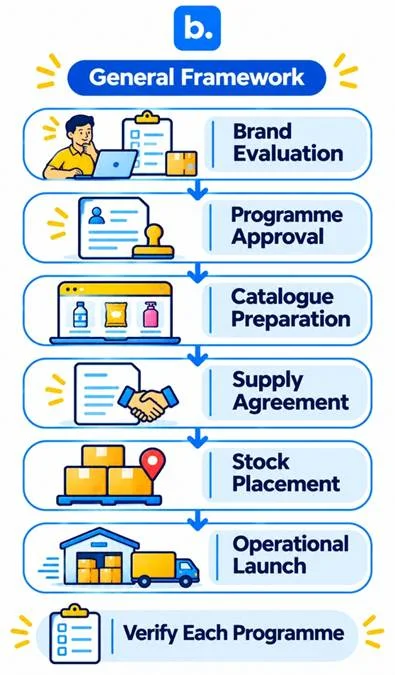
A typical high-level journey is:
- Seller or brand evaluation.
- Programme approval.
- Catalogue preparation.
- Supply agreement.
- Stock placement.
- Operational launch.
This is a general planning framework. The actual sequence, approvals and supply arrangements depend on the programme and the agreement reached with the brand.
Flipkart Minutes onboarding
Flipkart’s September 2026 announcement confirms that Minutes has built a partner ecosystem of close to 500 D2C brands. The service has expanded to nearly 1,200 micro-fulfilment centres across more than 150 cities. Flipkart has also highlighted growth in gourmet grocery, men’s grooming and pet food, showing that its quick-commerce assortment extends beyond everyday grocery products. These figures establish the scale of the programme and the presence of D2C brands, although they do not guarantee acceptance for every brand or category.
To explore participation, begin with your existing Flipkart seller or account-management contact and ask about the Minutes brand-partner process. Share your brand profile, product catalogue, category, pricing and intended supply locations. Ask whether your products are suitable for the programme and what commercial and operational conditions apply. Before committing inventory, obtain written details about margins, inbound stock, receiving locations, service levels, returns, settlement and inventory ownership.
Flipkart’s announcement of a network across more than 150 cities describes customer-facing service coverage, not a guarantee that every brand can supply every location. Confirm the approved cities, fulfilment centres and product categories with your contact. The programme’s commercial terms and onboarding timelines are agreed with participating brands.
Amazon Now onboarding
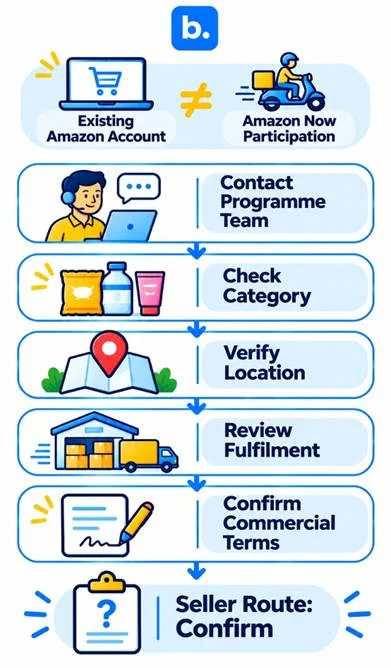
Amazon Now is Amazon India’s quick-commerce service for products delivered within minutes through a network of micro-fulfilment and urban fulfilment centres. Amazon reported availability in more than 120 cities in October 2026, supported by nearly 800 such centres. Its published product range includes groceries, fresh and frozen food, personal care, fashion and beauty, small appliances, and home and kitchen products. Selling on Amazon.in does not automatically establish participation in Amazon Now, and Amazon’s public service announcements do not provide a universal self-service application route for the programme.
Brands already selling on Amazon.in can approach their existing account manager or the relevant category contact to enquire about Amazon Now participation. Brands that are not yet selling on Amazon can use Amazon’s standard seller registration channel to understand general marketplace requirements, while separately asking Amazon about eligibility for its quick-commerce service. Before allocating inventory, confirm the approved catalogue, supply model, fulfilment locations, stock ownership, delivery responsibilities, returns handling and commercial terms.
Amazon announced plans in June 2026 to expand Amazon Now to more than 300 cities. Its October update reported that the service had reached more than 120 cities, supported by nearly 800 micro-fulfilment and urban fulfilment centres. The published product range includes groceries, fresh and frozen food, personal care, fashion and beauty, small appliances, and home and kitchen products. These figures describe customer availability and product selection, not guaranteed seller access. Confirm category eligibility and supply locations directly with Amazon. Programme-specific fees and application timelines are agreed through its seller and category teams.
Myntra M-Now onboarding
Myntra M-Now is Myntra’s quick-commerce service for fashion and beauty products. It was first introduced in Bengaluru and later expanded to Delhi-NCR and Mumbai. Public reporting has described a selection of nearly 600 brands across fashion and beauty. Myntra also operates an official Partner Portal for general brand and seller onboarding. However, the publicly available portal does not set out a separate M-Now application checklist or universal eligibility criteria. Standard Myntra seller registration should therefore be treated as the starting point for an enquiry, not automatic approval for M-Now.
Brands interested in M-Now can approach their existing Myntra category or account manager, or use the official Myntra Partner Portal for general partner enquiries. Ask whether the brand, product category and current catalogue can be considered for M-Now. Confirm the approved locations, product selection, stock allocation, fulfilment arrangements, returns and commercial terms before preparing inventory for quick-commerce supply.
Public reporting confirms that M-Now operates in selected markets and carries products from participating fashion and beauty brands. A separate M-Now seller checklist, rate card and universal supply agreement are not set out in the public partner information. Brands should discuss these details with Myntra rather than infer them from standard marketplace onboarding.
Documents you will need
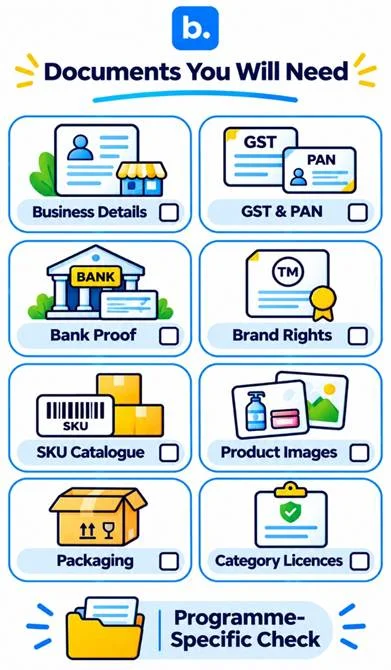
Prepare a working folder of business, tax, bank, brand and product records before approaching the platforms. The exact document list will depend on the programme, seller entity and product category, so confirm the current requirements before submitting an application.
| Document or information | Status | What to confirm |
|---|---|---|
| Business registration details | Programme-dependent | Requirements for legal entities and authorised representatives. |
| GST registration details | Transaction- and programme-dependent | Whether GST registration is required for the seller, product and transaction. |
| PAN | Programme-dependent | Which PAN and entity details are requested. |
| Proof of bank account or cancelled cheque | Programme-dependent | Required account type and name match. |
| Brand authorisation or trademark proof | Sometimes requested | Ownership, distribution rights or category checks. |
| Product catalogue and SKU details | Programme-specific confirmation needed | Identifiers, descriptions, variants, prices and required attributes. |
| Product images | Programme-dependent | Image format, dimensions and catalogue specifications. |
| Packaging and labelling information | Product- and category-dependent | Any applicable regulated-product requirements. |
| FSSAI licence | Category-dependent | Food business and product requirements that apply. |
| Details of supply and replenishment | Programme-dependent | Expected quantities, delivery locations and replenishment frequency. |
Costs to expect
The three platforms do not provide a comparable public rate card covering all quick-commerce seller arrangements. Costs may be agreed separately for each brand, category and supply model. Request the current commercial agreement or rate card and calculate the complete landed cost before accepting a margin.
| Cost line | What it may cover | Where to confirm |
|---|---|---|
| Commission or margin | Platform charge or agreed commercial margin on sales. | Existing programme agreement or rate card. |
| Fixed or closing fee | Per order, listing or fixed transaction charge (if applicable). | Current seller terms. |
| Logistics or handling | Movement, storage, fulfilment or handling. | Programme-specific fulfilment terms. |
| Stock inbound cost | Transferring stock to a specific fulfilment centre. | Supply agreement and inbound instructions. |
| Returns and damages | Return handling, unsellable stock and damage liability. | Returns and claims policy. |
| Promotions | Discounts, sponsored visibility or campaign participation. | Commercial agreement and promotion conditions. |
Explain in writing who is responsible for:
- Inbound stock movement.
- Storage and handling.
- Unsold inventory.
- Damages and losses.
- Returns and rejected stock.
- Discounts and participation in promotions.
How dark store operations work for sellers
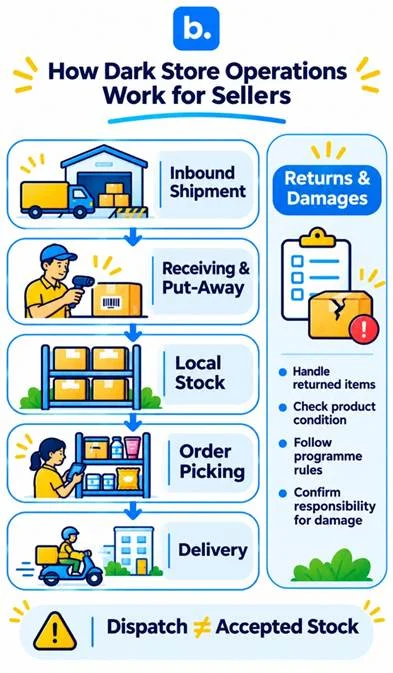
A dark store is a small fulfilment site, closed to the public, that holds stock for fast local delivery. Inbound means stock moving into a designated fulfilment location. Fill rate is the proportion of requested or ordered units that can be supplied from available stock, using the programme’s stated calculation. The exact receiving, storage and fulfilment arrangements differ by programme.
Agreed products are sent by the seller or distributor to an assigned location, where quantities and product identifiers are checked and accepted stock is put away for picking. SKU-level accuracy matters because availability depends on local stock, not only on what is held in a central warehouse. Schedule replenishment based on local demand and lead time.
Packaging, barcodes, shelf-life and expiry rules should be appropriate for the product category. The supply agreement should explain how short deliveries, rejected stock, damage, returns and unsold inventory are recorded, as well as who owns the inventory and who is responsible for any loss.
| Step | What happens | What to prepare |
|---|---|---|
| Inbound shipment | Stock is delivered to the specified fulfilment address. | Approved SKU list, quantities, labels and shipment documents. |
| Put-away | Products received are inspected and stored in designated areas. | Correct packaging, barcodes and product information. |
| Order picking | Available items are picked to fulfil customer orders. | Correct stock and product identification. |
| Delivery | Orders are sent from the fulfilment centre to customers. | Agreed service levels and stock availability. |
| Returns | Products returned or damaged are evaluated and handled. | Return rules, condition checks and responsibility terms. |
For channel and demand planning, see our quick commerce guide and Order Management Systems in India: 15-Day Pre-Sale Checklist. These guides offer broader planning advice for brands selling across ecommerce channels.
Quick-commerce integration software: what brands should check
For brands selling across multiple channels, a reliable view of orders and stock is essential. An integration label alone does not confirm support for a specific quick-commerce programme. Before choosing software, check:
- Platform connectivity: What are the marketplaces and quick-commerce programmes that the vendor officially supports today? Ask for the specific connector name and documentation.
- Stock synchronisation: How often is inventory updated, and what happens if an update fails?
- Order and return status: Do teams have visibility of the most recent status and exceptions for each connected channel?
- Error alerts: Do operations staff see failed imports, stock mismatches and integration errors?
- Reports by platform: Can the seller review orders, fulfilment performance and returns separately by channel?
If you are evaluating Flipkart Minutes integration software, ask for a live, documented demonstration of order flow, stock updates, errors and returns. A standard Flipkart marketplace connector alone does not confirm Minutes support. Check Amazon Now and M-Now independently.
How Base OMS helps when you sell on quick commerce
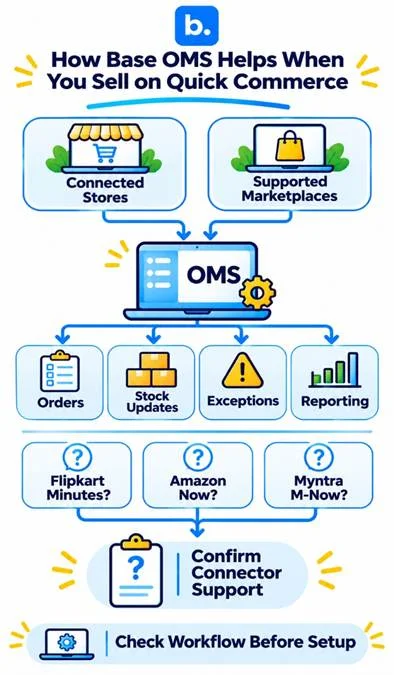
Orders: Base OMS documentation describes managing orders from connected marketplaces and online stores, with order processing and automatic actions. Public product information does not currently establish a connector for Flipkart Minutes, Amazon Now or Myntra M-Now. A general marketplace connection should not be treated as programme support.
Stock: Base product information describes stock synchronisation for supported integrations. Quick-commerce stock visibility, local dark-store inventory feeds and replenishment workflows for the three named programmes are not established by the available product information.
Reports: Check the order statuses, returns and channel-level data available for each supported connection before using them for operational reporting.
Ask the product team to confirm the channel, data fields and workflow before implementation. If you want to see a Base OMS workflow for your existing channels, book a demo. Quick-commerce integration with the three programmes discussed in this article should not be assumed.
Conclusion
Selling through Flipkart Minutes, Amazon Now and Myntra M-Now requires more than registering on a traditional ecommerce marketplace. Flipkart has publicly confirmed its D2C brand partnerships, Amazon Now has expanded its service and product range, and Myntra M-Now is an established quick-commerce option for fashion and beauty brands. However, dedicated onboarding processes, commercial terms and supply arrangements are not fully documented publicly for all three programmes. Approach the relevant seller or partner teams, confirm eligibility and approved locations, and agree on inventory ownership, replenishment, returns and settlement terms before committing stock.